Feeds:
Posts
Comments

Archive for July, 2012

There have been numerous excellent books produced on the Irish Republican and Socialist movements in the 1930s. The below is a brief post on two days of interesting Anti-Communist violence in April 1936, when the Left was attacked firstly on a broad republican march to Glasnevin Cemetery, and then the following day at a rally on College Green. It is intended as a brief insight into Anti-Communism in Dublin in the 1930s.

Willie Gallacher, a Scottish Communist MP present on the March to Glasnevin on April 12th 1936 and who was to speak at College Green the following day.

On 12th April 1936 Communists and left Republicans attending an Easter commemoration at Glasnevin Cemetery came under attack at various points along the route to Glasnevin from the city centre, during an event which was plagued by violence. It was not the last anti-Communist violence in April 1936, and just who was responsible for the violence was unclear, though the left-wing Republican Congress laid the blame at the feet of the far-right, the ‘Animal Gang’ and “other such defenders and faith and morals”.

The procession marched from the Carmelite Church on Whitefriars’ Street, following a mass for the requiem of the souls of fallen comrades, and made its way for Glasnevin. Within the sizeable procession was a contingent of a few dozen members of the Communist Party, who the Irish Press noted “wore red tabs attached to Easter Lillies.” Led by Sean Murray and Captain Jack White (a founding member of the Irish Citizen Army), this contingent included Willie Gallacher, the Scottish Communist M.P. In addition to the Communist Party, members of the Republican Congress marched in the procession. There were five bands in total in the march, and all shades of Republican opinion were represented.

The Communist contingent in the march, though small in the context of the demonstration, came under attack firstly on Westmoreland Street when about 20 people attempted to rush the crowd, and, newspapers reported by the time O’Connell Bridge had been reached a sizeable crowd were shouting “We want no Communists in Ireland!” at their targets. By the General Post Office, the attacking crowd was said to number 200 people, and police were forced to draw their batons. A hostile crowd tailed the Communists all the way to Glasnevin, and some leading left-wing activists of the day sustained injuries, with George Gilmore receiving nasty wounds as a result of the crowds stone throwing.

The Irish Independent reported that on reaching Glasnevin, the shout was raised that “this is a Catholic grave yard. Don’t let the Communists in!” The great irony of Glasnevin being non-denominational was lost on someone! Outside, sellers of the English Communist paper the Daily Worker found themselves attacked by the hostile crowd. In a letter to the Irish Press days after the violence, one member of the public noted that while such violence was unfortunate, it was the natural outcome of an attempt to stage an “anti-God display” at Glasnevin.

Patrick Byrne, a leading activist with the Republican Congress, recalled years later that:

The main target of the mob was Captain Jack White. He had been injured with a blow of an iron cross wrenched from a grave. It was necessary to get him away quickly. Fortunately, the Rosary had started and this caused a lull during which Tom O’Brien and myself got him away. Captain White wrote afterwards: “By the aid of two Republican Congress comrades, who knew the geography, we left by an inconspicuous back door. Slipping under a barbed wire fence, the Congress comrades and I dropped on to the railway and soon emerged into safety and a Glasnevin tram.”
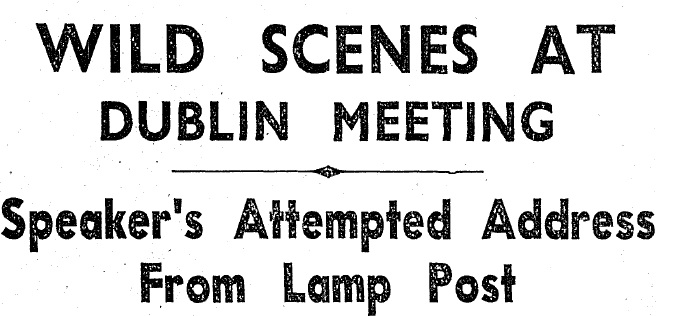
Newspaper report on the chaos described below at College Green.

The following day, on the 13th April, a left-wing meeting at College Green came under siege when thousands gathered for a rally featuring speakers from the left including Peadar O’Donnell and Willie Gallacher. Garda reports estimated that the crowd numbered between four and five thousand. They estimated that 98% of this crowd were hostile to the left-wing speakers at College Green. Prior to this meeting even beginning, newspaper reports noted that Gardaí lined College Green 100 strong. Peadar O’Donnell would be the only speaker on the night, addressing the crowd from a lamppost. In an obituary printed at the time of O’Donnell’s passing at the fine old age of 93, it was claimed that O’Donnell was met by “potatoes (with razor blades embedded in them), bottles and stones.”

Historian Fearghal McGarry has noted that following this event an anti-Communist mob laid siege to targets in the city centre, attacking the offices of the left wing Republican Congress and also attempting to attack other buildings associated with the left, although police prevented this. Interestingly, McGarry notes that targets included Trinity College Dublin and the Masonic Hall, and this indicates a spirit of militant Catholicism among the crowd.

Peadar O’Donnell would later comment that

After all it wasn’t the tycoons of Dublin who tried to lynch me in College Green during a Red Scare but poor folk who had been driven out of their minds by a month’s rabid Lenten Lectures.

(more…)

Read Full Post »

There is an enduring urban legend that suggests that Irish actor, and manager of the Smock Alley Theatre and afterwards the Theatre Royal in Dublin, Richard Daly (1758 – 1813) invented the word ‘Quiz’ to settle a bet in 1791.

The story goes that there was a gathering of the Dublin Volunteers to celebrate the birth of an heir to the Duke of Leinster in the Eagle Tavern in Eustache Street on August 21 1791. Present were ‘many of the wits and men of fashions of the day’ (1) as well as Daly who ‘had an extraordinary propensity for making wagers in reference to incidental maters, however unimportant’ (2).

Smock Alley Theatre today. (Templebar.ie)

During the evening a dispute arose about the exact meaning of a French phrase used by one of the volunteers named Delahoyde. In the following discussion, Daly made a bet that he could add a new word to the English language that ‘within forty-eight hours … (would) be on the mouths of the Dublin public, of all classes and sexes, young and old’. In order to win the wager, the word had to be ” altogether new and an unconnected by derivation from any wold in any other language’

As the legend goes, Daly sent all of his Theatre stage-hands and call-boys to chalk the letters ‘Q U I Z’ on the doors of shops, warehouses and people’s houses all over the city. People woke up on Sunday morning to be greeted with the word every where they looked. It soon became the talk of the town with neighbour asking neighbour what the word meant. After initial speculation that the word had something to do with politics or perhaps religion, the public of Dublin accepted that it had been successfully duped and the word became synonymous with the idea of a ‘hoax’ or something ‘strange’.

While it’s a splendid anecdote, the word ‘Quiz’ was certainly used pre 1791. It can found, for example, in Fanny Burney’s diary entry for 24 June 1782.

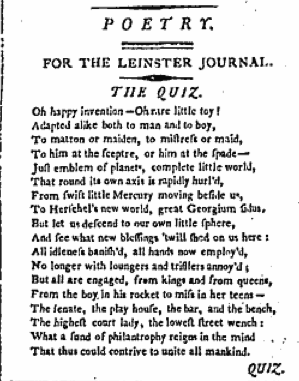
While this poem from Finns Leinster Journal predates the Daly story by two months:

Finns Leinster Journal. May 21, 1791.

While the word may not have been invented by Daly, it is true to say that it was not a commonly known word at the time, so it is possible (and quite nice to think) that Daly may have played some part in spreading the use of the word world-wide from little old Dublin.

The American website Museum of Hoaxes incidentally featured the story recently enough.

(1) Kazlitt Arvine, The cyclopaedia of anecdotes of literature and the fine arts (Boston, 1853), 694
(2) Frank Thorpe Porter, Gleanings and reminiscences (Dublin, 1875), 32

Read Full Post »

We’ve had a long running series on the site looking at the statues in Dublin city centre, but it got me thinking what Dubliners are remembered with statues abroad? I came up with a few, asked jaycarax who could think of one or two others, and this is the list to start:

Arthur Wellesley,The Duke of Wellington.

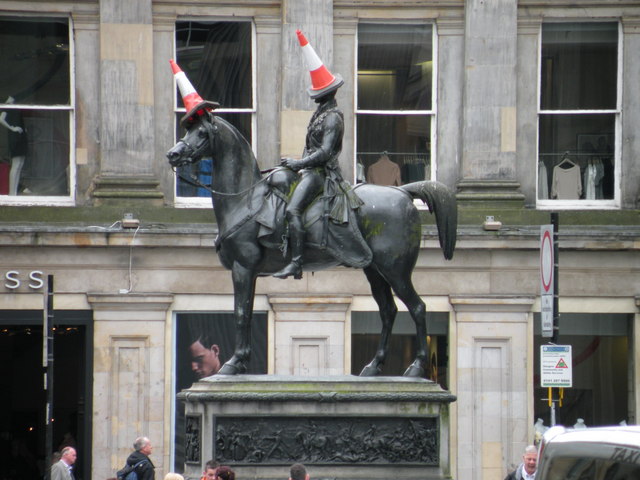
A two-time Tory Prime Minister, and the man who oversaw the passage of the Catholic Relief Act in 1829, Wellesley was born in Dublin on 1 May 1769. Wellington is perhaps best remembered for his decisive victory over Napoleon at the Battle of Waterloo in 1815.He is remembered by the Wellington testimonial in Dublin’s Phoenix Park today, and the Ha’penny Bridge was originally christened the Wellington Bridge in his honour. Wellington is remembered with numerous statues across the UK, for example in Leeds, Edinburgh, Glasgow, Manchester and London. The Glasgow statue is rarely found without a traffic cone on its head.

Duke of Wellington, Glasgow. Image via http://www.geograph.org.uk/photo/2456051

Robert Emmet

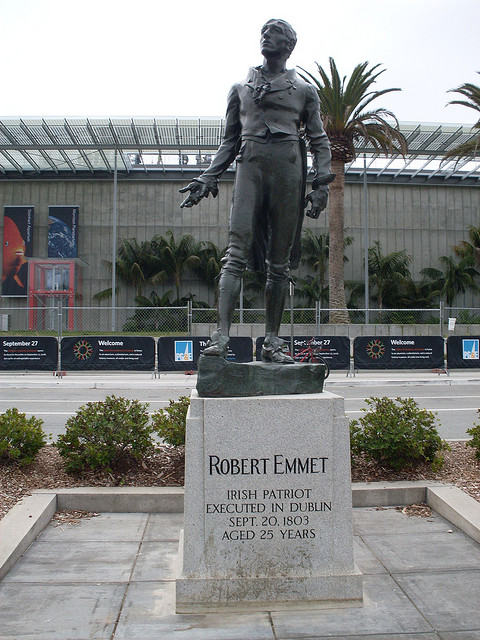
Robert Emmet, born at St. Stephen’s Green in March 1778, led the uprising of 1803 against British rule and was executed as a result. Remembered primarily for his excellent speech from the dock, Emmet has become one of the more romantic figures of Irish nationalism. There are four identical examples of Jerome Connor’s monument to Emmet to be found, located in Washington (on ‘Embassy Row’), San Francisco, Iowa and here in Dublin at Stephen’s Green.

Robert Emmet, San Francisco. Taken by Flickr user monikalel4

Bram Stoker

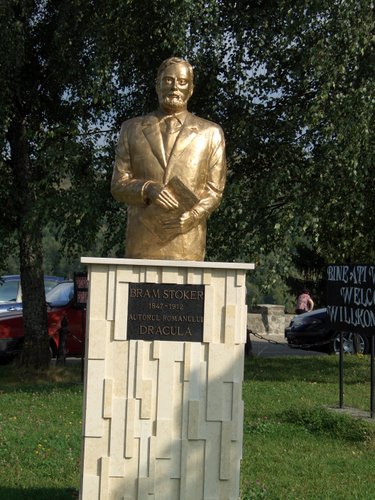
Born in Clontarf in November 1847, Stoker is of course best remembered for his work Dracula. Today, he is remembered with a statue in Bistrita-Nasaud county in northern Romania, a region closely associated with Stoker’s masterpiece. Recently, the Stoker family have come forward as saying they are willing to finance the costs which would need to be met to place a statue to Bram Stoker here in Dublin.

(more…)

Read Full Post »

Dublin’s first traffic lights, as shown in The Irish Press.

Recently I began attempting to establish when the first traffic lights in Dublin came into being. Many sources hinted at the Clontarf Road being able to claim the honour, with a set of lights placed there in 1893 by Fergus Mitchell, said to be the owner of the first car in Ireland. Why a single car would justify the presence of a traffic light is beyond me.

Newspaper reports show that the first traffic lights in Dublin city centre were erected over the second half of the 1930s, with the first set of traffic lights placed at the junction of Merrion Square and Clare Street in August 1937. There had been calls for traffic lights in Dublin in the years prior to this, as Belfast could already boast such a system, and the Irish Independent noted in 1936 that traffic signals in Dublin would “permit the public to cross with the hearts in the right place instead of their mouths”. It was reported in July 1937 that contracts had been signed with a London firm for the traffic lights and they would be on Dublin streets within a month.

The Irish Press reported on the unveiling of the first lights that:

Dubliners, ready at all times to stand and stare, had a regular field day yesterday when the new system of traffic lights, automatically controlled, came into operation at the junction of Merrion Street, Upper and Lower, Clare Street and Merrion Square.

The paper reported that Dubliners “thronged the pavements” to see the lights, but newspaper reports noted there was difficulties in the flow of traffic owing to tendency of Dubs to take no notice of the amber light, telling them to prepare to start.

A guide to the lights was printed in all daily newspapers at the time:

A guide to Dublin’s new traffic lights.

Following on from the success of the lights at Merrion Square, others followed around the city quickly, with the Clanbrassil Street junction and the junction of Northumberland Road and Haddington Road among others being identified as suitable locations. Interestingly, it was around this point that the Lord Mayor (Alife Byrne) first raised the idea of a specialist cyle lane in Dublin.

Read Full Post »

I’ve got a few emails over the years from people looking for information on where they can buy Bernard Neary’s biography of famous Dublin Garda James ‘Lugs’ Branigan. It’s been an invaluable resource for me in researching Dublin youth criminality in the 1930s and 40s, and while very sympathetic overall, it does offer great insight into things like the Animal Gangs, Teddy Boys and other youth groups which have come and gone in the city.

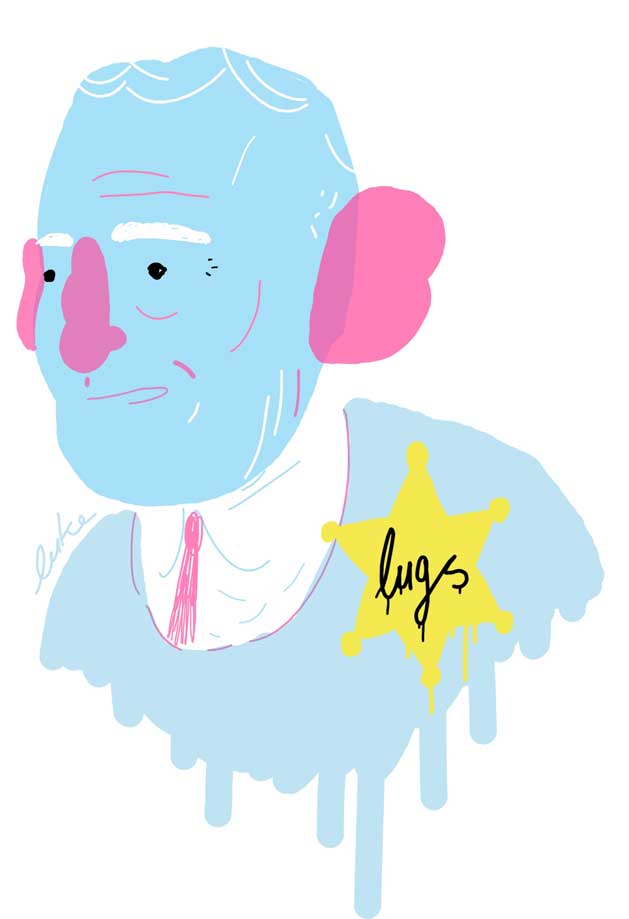
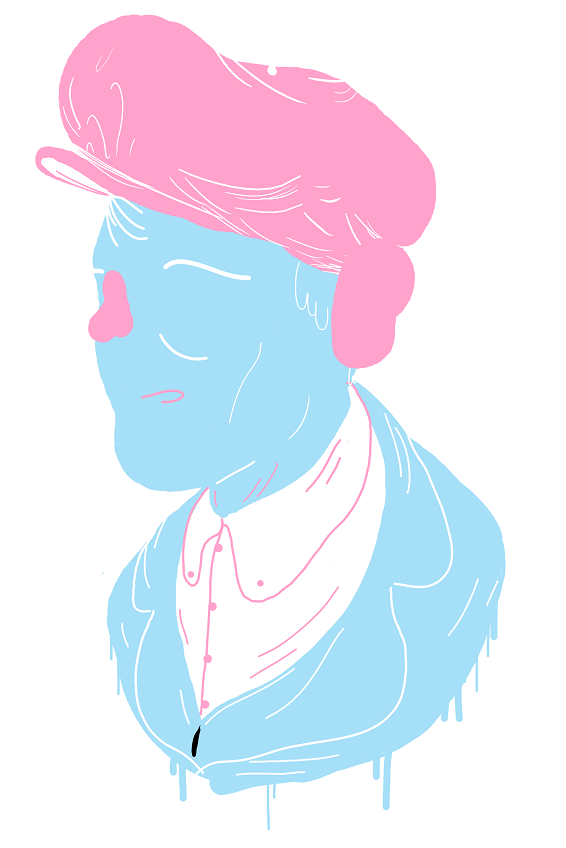
Lugs Branigan illustration by Luke Fallon for Rabble magazine.

It seems the Gardaí have uploaded the now years out of print book as a PDF, which can be read and downloaded from here. It lacks the fantastic pictures in the original, and the introduction from a certain Mr.Haughey, but the bones of the work is there.

Nobody in Ireland would have believed, in the last days of the nineteen forties, that the next decade would produce the King of Rock and Roll, the film (or movie) Rock Around the Clock and the Teddy Boy cult, and that the new and exciting young social scene would make Jim ‘Lugs’ Branigan a household name throughout the country and a legend in his own lifetime.

Read Full Post »

Bertie and Brendan.

Behan reflects. (Image: Paul Reynolds)

John Coll’s monument to Brendan Behan is one of the most popular in the city, showing a young Behan sitting at the Royal Canal, with an inviting space next to him for passers by to join him. You often see everyone from down and outs to children sitting next to Brendan, and I’ve always thought it the perfect monument for such a man. A number of triangles appear in the bench, a reference to The Auld Triangle, a song written by Brendan’s talented brother Dominic for his brothers play The Quare Fellow. John Coll said at the time that such a monument, a bench that could be used by the public, was perfect as Behan was always “a man of the people and didn’t want to be on a pedestal.”

In 1980, when the idea of a monument to Brendan was first discussed by Dublin Corporation, Tony Gregory had suggested that perhaps an inner-city housing development should be named in his honour, which would be fitting given his families background in Russell Street prior to their moving to Crumlin (or ‘Siberia’ as the Behan brothers knew it!). Pat Carroll from Labour made the point Behan would “laugh to scorn” at the idea of a plaque in his honour in a city that had treated him in a “scandalous fashion”.

Rather oddly, when the fine monument was unveiled in 2003, it was man of the people Bertie Ahern that unveiled it, which caused significant controversy on the day. Paudge Behan, son of Behan’s widow Beatrice and the republican Cathal Goulding, took exception to Bertie’s presence at the event and noted that there was “nobody further removed” from the spirit of Brendan, when asked to follow up Ahern’s speech with a few words.

He went on to tell journalists “what has Bertie Ahern in common with Brendan Behan, other than they are both Irish? When you see what is happening with the fat cats in this country, with Bertie Ahern and his Government, I can’t think of anyone further from the spirit of Brendan Behan. Shannon being used as an American air base for waging war on another country, was that in the spirit of Brendan Behan?”

The event was an embarrasing day out for Fianna Fáil, with Bertie (who was joined by Royston Brady, the then Lord Mayor of Dublin) on the wrong side of an Anti Bin Tax picket, and the following days newspaper reports may have disproven Behan’s classic remark that “there’s no bad publicity except an obituary.”

Lucian Freud and Brendan Behan, at the Mansion House in 1952

Read Full Post »

For anyone just stumbling across CHTM!, once a month or so the three writers behind this blog, joined by a small group of friends, visit five Dublin pubs and then write about our experiences. A different person each month picks the five pubs and makes sure not to give away any details beforehand. The reviews are often as varied as the pubs with the three different writing styles giving three very different narratives.

After twenty-one pub crawls many of us, including myself, believed that the days of crawls “between the canals” were perhaps over and that we’d permanently have to relocate to the suburbs. This crawl was designed to prove myself wrong.

A small but dedicated group of us met at Portobello Bridge on Sunday 1 July, the day of the UEFA Euro 2012 final.

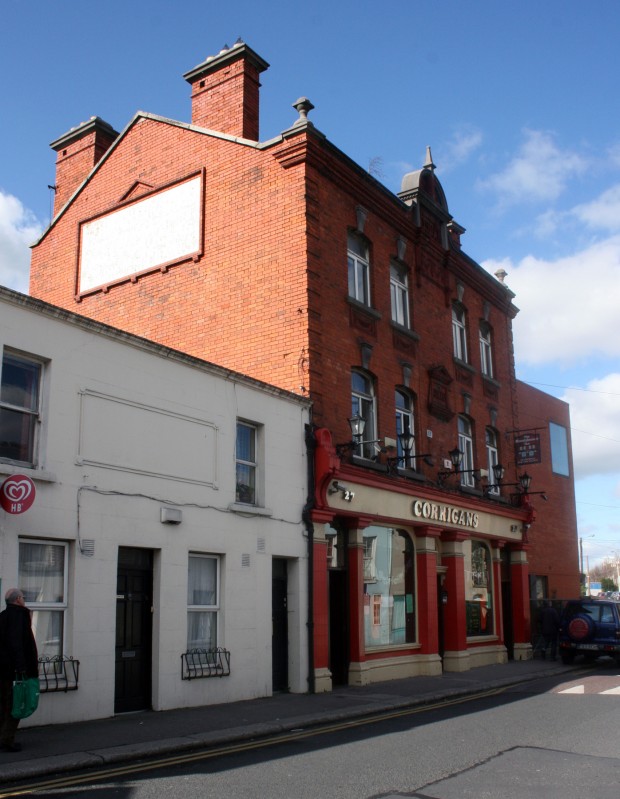
Ushering people back across the bridge away from Portobello, I led them up Mountpleasant Avenue Lower which acts like a dividing point between Ranelagh and Rathmines. The residential area is host to a lovely pub by the name of Corrigans (aka The Mountpleasant Inn) which rests beside a little shop and surrounded by nothing else but houses and flats. A proper ‘local’. You’d have to know exactly where you were going in order to find it.

Corrigans (Rate My Area)

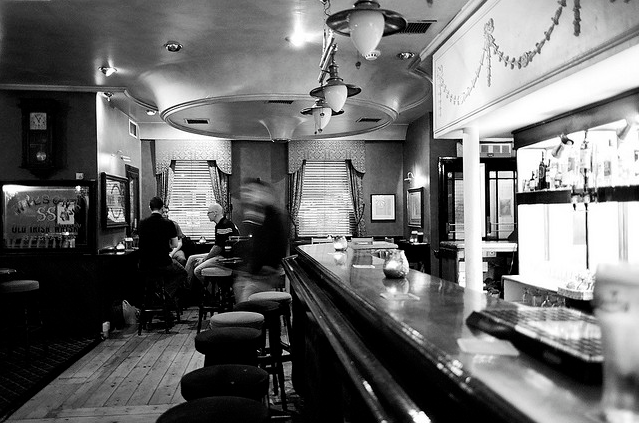
Coming in through the last door, we found ourselves in a spacious bar area. Certainly bigger from what it looks like from the outside. Its large windows ushered a lot of light into the room.  We had the place to ourselves and so nestled ourselves down at the back in the comfy seats. The friendly bartender who greeted us took our orders and dropped the pints down to us. We were all on Guinness and everyone agreed they were delicious. There was an overall ‘old-school’ feel about the place. “Green tiled walls and dark wooden floors” as Annie L. summed up on Yelp.ie

Established around 1914, the pub is still in the hands of Corrigan family after all these years. Obviously big sports fans there’s GAA and particularly Rugby memorabilia cover the walls.

Corrigans (Built Dublin)

Its main claim to fame is that it was used for the movie Young Cassidy (1964), a biographical drama based upon the life of the playwright Sean O’Casey directed by Jack Cardiff and John Ford and starring Rod Taylor, Julie Christie, and Maggie Smith. The pub, which was selected along with Mullligans of Poolbeg St and Fox’s in Glencullen, was chosen because it still had ‘its gaslights intact and its counter is divided up into cosy booths by the presence of ‘baffle-blinds’ mirrors’. A trailer for the film can be seen here.

All in all Corrigans is a stand up pub. Perfect location, nice interior, pleasant barstaff and decent pints at a reasonable price. Definitely up there with O’Connells on South Richmond St as the best pubs in the area.

Leading people back towards the canal, I took them down the scenic Charlemont Place and down to Leeson Street bridge. Our second pub of the day was The Leeson Lounge.

Leeson Lounge (Rate My Area)

I had been only once before. In September 2010 to see legendary guitarist Wilko Johnson (Dr. Feelgood) and bassist Norman Watt-Roy (Ian Dury & The Blockheads) play a very intimate gig.

A popular spot for Kilkenny GAA fans as former proprietor Paddy Morrisey was a proud Kilkenny man, the pub stands at the busy corner of Leeson St. Upper and Sussex Terrace. 46As and 145s whizz past it every couple of minutes.  Morrisey ran The Leeson Lounge from 1977 until his death in 2006. The walls are still lined with magnificent photographs from the past 100 years of GAA activity, mainly of the Kilkenny Cats.

The interior is quite bizarre. In a good way. A massive fish tank takes over a quite a lot of space while on the walls GAA photos and rockabilly gig posters fight for space. Open plan and spacious, an open door onto the road brought in cool air and light into the usually dark and slightly seedy room. A couple of regulars were propped up at the bar. There was no music  whats so sever and only a very quiet TV in the corner. A nice change to the blaring rubbish that some pubs force its customers to listen to.

Interior, Leeson Lounge. (Flickr User – Mark Waldron)

The pints, which were dropped down by the well-dressed, stylish barman, were ok. Nothing special but it is a cool little pub and I hope to check some more live gigs there soon. I’ve also heard the toasted sandwiches are excellent.

Next up was M.O’Briens which is situated immediately next door to The Leeson Lounge.

View of M.O’Briens from Sussex Rd. Leeson Lounge be can seen on the left. (M.O’Brien FB)

(more…)

Read Full Post »

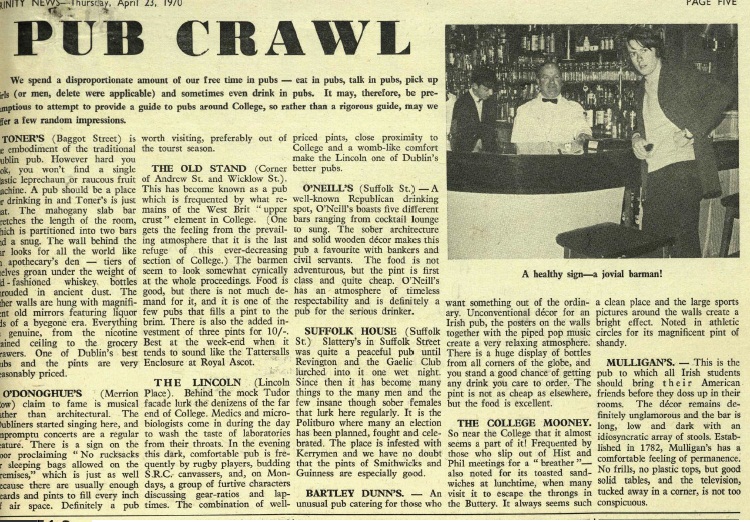
A 1970 Pub Crawl.

One of our reaccuring features on the site is the monthly pub crawls around the city we organise, visiting five establishments and writing about the day afterwards.

Below is the ‘Pub Crawl’ feature of Trinity News, a student newspaper at TCD. Most of these pubs are of course still doing plenty of business, for example O’Neill’s on Suffolk Street which we’re told is “a well-known Republican drinking spot, O’Neill’s boasts five different bars ranging from cocktail lounge to snug”. The image of a ‘jovial barman’ is fantastic. The College Mooney is today Doyles pub.

Trinity News, 23 April 1970. The left side is difficult enough to read though this is owing to the scan. Via the fantastic ‘Trinity News Archive’

Read Full Post »

A fantastic interview with Damien Dempsey here, recently aired on DCTV, on everything from the difficulties people have understanding the Dublin accent abroad to the state of the nation. “The scam of all scams” sums it up nicely.

Damien Dempsey in action at Cassidy’s on Westmoreland Street, captured by our own hxci last year.

Read Full Post »

Mena pictured outside her post office. (c) Irish Times May 24, 1985

Update : Mena died this week (6 August 2012). Here is a link to The Irish Times obituary.

Mena Cribben (aka Mena Bean Ui Chribin), aged 84 and mother of six, has been the postmistress of Santry Avenue Post Office for over fifty years. During this time, she has also been one of the most vocal spokespersons for the Ultra-Conservative Catholic strand of Irish politics having been active with the Irish Family League, Family Rights Group, Mna na hEireann, Irish Housewives Union and Ograchas Naoimh Papain.

Perhaps most infamously known for her role in the 2009 Roscommon family incest case, namely that she provided advice and (more than likely) funding for a legal action to stop the State from taking six neglected children into care, Cribben has been active in reactionary politics since the 1960s.

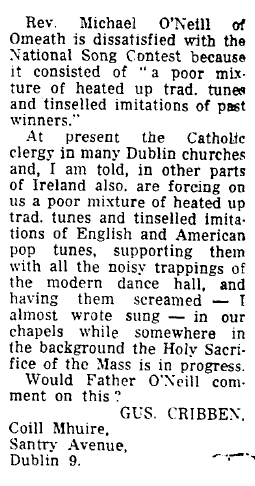
In the late 1960s, she began to write letters to The Irish Independent and The Irish Press and even managed to get published some of her own opinion pieces. Like this one on Marriage:

‘Marriage – an open letter’ by Mary Cribben. Irish Press. Aug 11, 1969.

American television network NBC produced and broadcast a special report, entitled ‘Land Of Saints And Scholars‘, on corporal punishment in Ireland’s schools in September 1969. It featured Mena Cribben and her husband Gus who ran a private after-school programme to help students with their homework. Mena and Cribben admitted giving an “odd smack of a cane” to their several female ‘students’ and spoke in favour of capital punishment. The programme, which was subsequently broadcast on RTE, sparked massive controversy.

Gus himself was a prolific letter writer, mainly on topics of Corporal Punishment and Catholicism, from 1965 right up the late 1970s. He was also the organisers of the annual mass held on a penal-day mass-rock in Wicklow.

Irish Press. Feb 28, 1972.

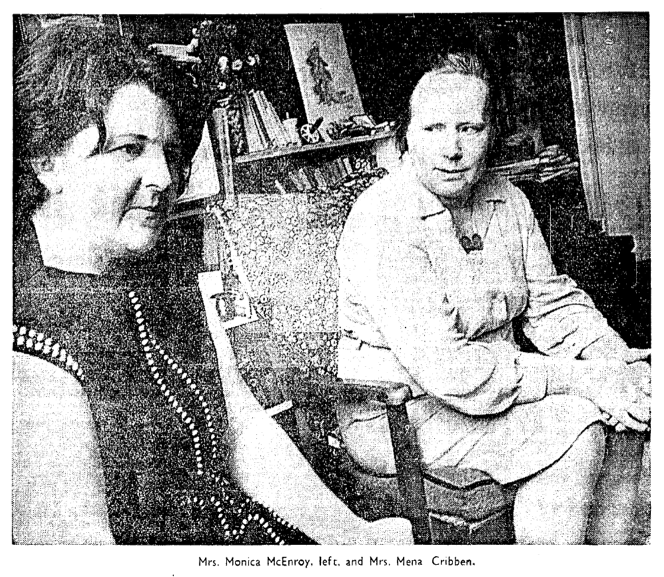
Mena was heavily involved in the campaign against contraception in the early 1970s. In November 1970, Irish Press journalist Mary Kenny brought together Mena Cribben and liberal campaigner and midwife Monica McEnroy for a debate on the subject.

Irish Press. Nov 03 1970

Cribben was quoted as saying:

One can’t plan a family. God alone decides when a child is made (and) the individual … has not the right to murder and that is what the definition of contraception really is

She also admitted that she would withhold any contraceptives that came through her post office.

(more…)

Read Full Post »

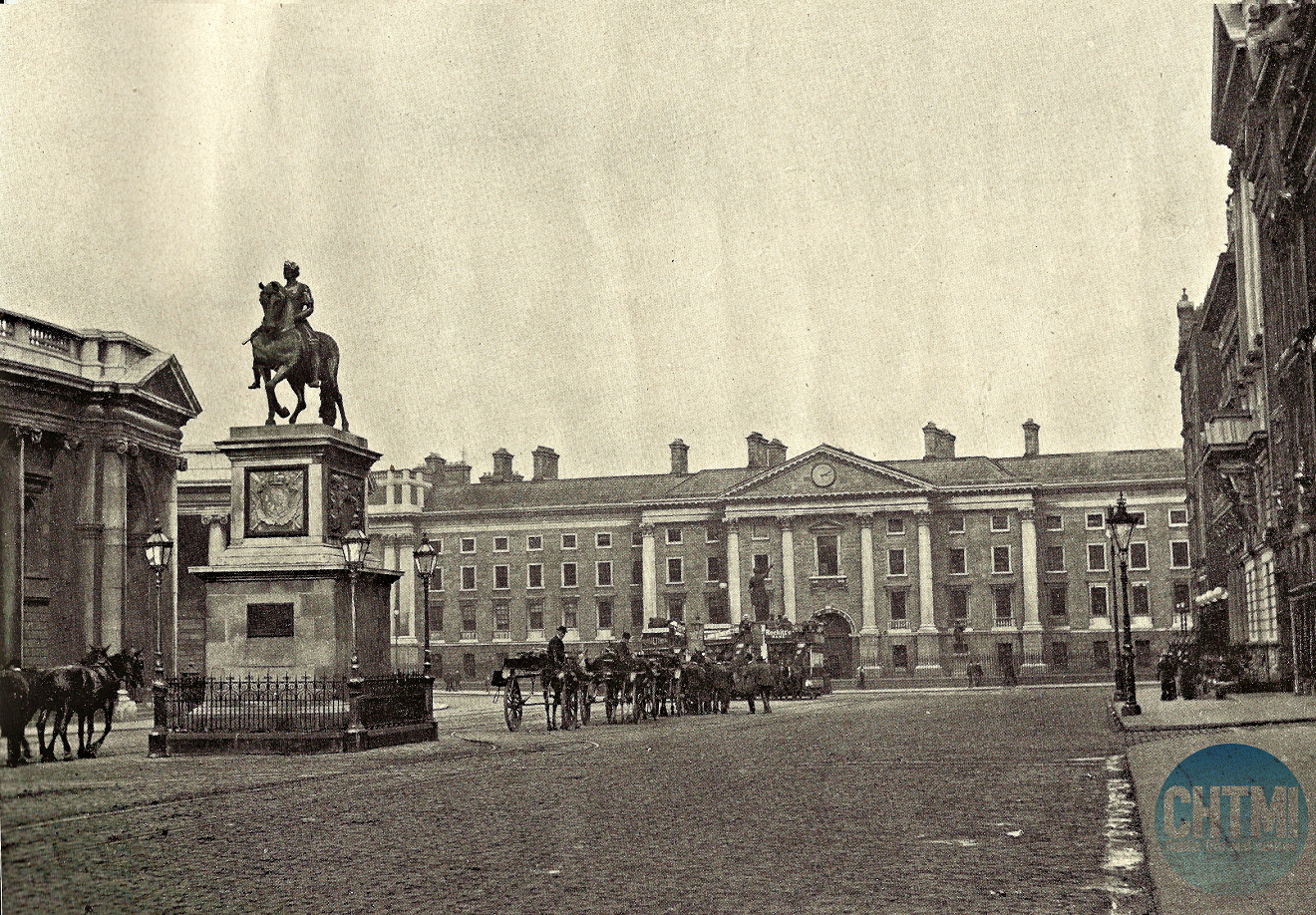
I recently picked up this great image of the King William of Orange statue on College Green, which is taken from ‘Ireland In Pictures’, released in 1898. We’ve had a series on the site here dealing with the statues of Dublin, which is still in its infancy, and I collect old original photographs, postcards and the like showing Dublin monuments and statues. It’s a cheap and cheerful hobby, and not quite as bad as stamps.

It’s a big image, so click to expand if you wish.

The King William of Orange statue on College Green was eventually removed in 1929, following an explosion in the early hours of Armistice Day that year. A bomb had also been placed at the base of the bronze statue of King George II in Stephens Green. It had sat on College Green since 1701, and was frequently the target of vandals (more on that below) but the explosion didn’t mark the end of its traumatic life as the King’s head was removed from the statue while it was placed in storage in Corporation Yard, Hanover Street!

The below is taken from the brief commentary on the statue that comes in ‘Ireland In Pictures’, dating from 1898. It’s a gem of a find.

This equestrian statue of William III stands in College Green, and has stood there, more or less, since A.D 1701. We say “more or less” because no statue in the world, perhaps, has been subject to so many vicissitudes. It has been insulted, mutilated and blown up so many times, that the original figure, never particularly graceful, is now a battered wreck, pieced and patched together, like an old, worn out garment.

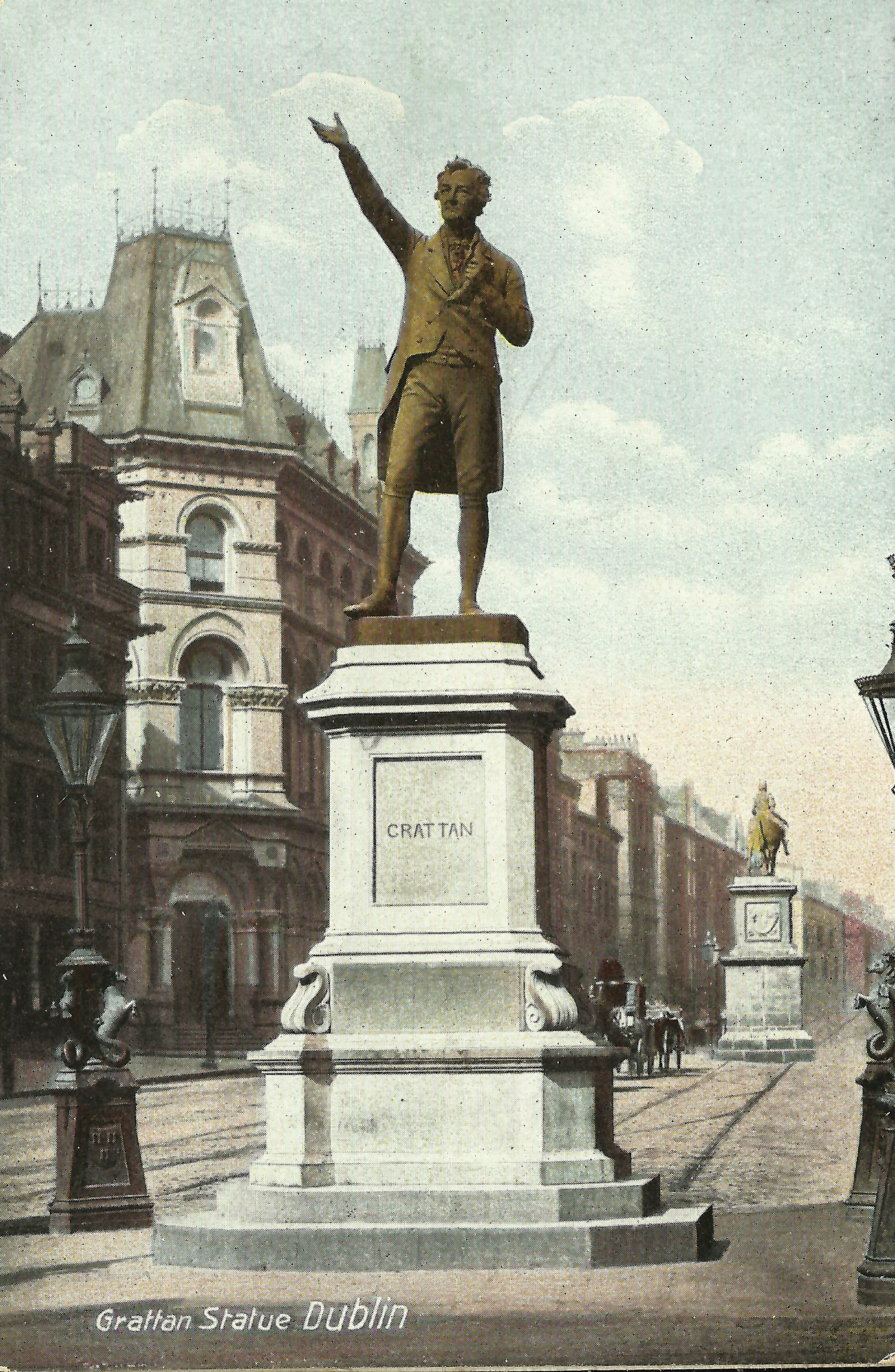
The back of the statue can be seen in this postcard image of the Grattan Statue (Fallon collection)

Read Full Post »

Mounted police were charging quick witted urchins who scattered and lured the attackers into narrow by-lanes. There the boys used stones and pieces of brick with accuracy and rapidity. My sympathies were with the newsboys.

-Ernie O’Malley remembers a newsboy strike in Dublin in his memoir On Another Man’s Wound.

—-

I like working with my brother, as he’s a more than capable illustrator and I find a good illustration brings a history piece to life. We have a piece together in an upcoming issue of Rabble around Dublin newsboys in the first half of the twentieth century. It’s a look at one of the most overlooked working class groups in the history of the city, and is at times both a tragic and humorous story. The final illustration is very, very different from this one below, but I still wanted to share it.

Illustration: Luke Fallon.

If it looks familiar, that’s entirely deliberate, as it’s in the same style as this illustration of the famous Dublin Garda Lugs Branigan he completed for a biography of that Dublin character in another issue of Rabble.

Read Full Post »

« Newer Posts - Older Posts »