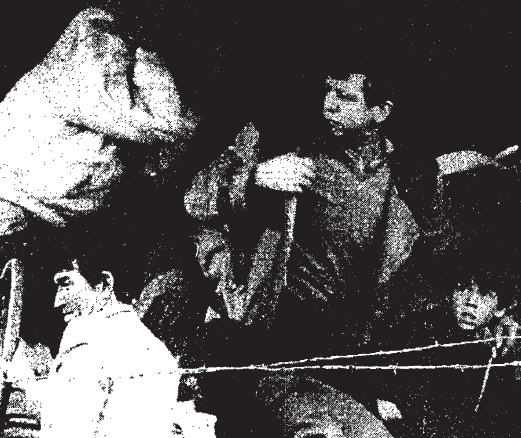
A youngster is shielded from missiles during a clash between Saint Patrick’s Athletic and Waterford United at Richmond Park, April 14 1986.
Writing in the Irish Press in 1972, one sports journalist asked with tongue firmly in cheek why was it that “Irish footballers are not able to emulate English footballers to some small degree, when their supporters have no trouble in successfully aping the cross-Channel hooligan element.” While football violence in Ireland never reached the level of that in the U.K, the media was awash with stories of the hooligan threat to the Irish game in the 1970s and 1980s. This brief article will look at one Dublin stadium, Richmond Park in Inchicore, and see when ‘hooliganism’ was reported on in the ground during the period.
Much of the Irish media coverage of soccer hooliganism in the 1970s centered around violence in British football. The Irish Times for example quoted Magistrate Grahame Hands in March 1974 when he demanded “labour camps for soccer hooligans.” Considerable space was given to reporting the antics of ‘firms’ at some of Britain’s leading clubs.
Clashes between Shamrock Rovers and Saint Patrick’s Athletic fans in March 1972 brought the issue of soccer hooliganism in Dublin out of the sports pages and into the national news section of the mainstream media, with a youngster stabbed during a terrace fracas. Disturbances at Richmond Park between both sets of fans, the second example in weeks, brought The Irish Times to note that “the FAI can do very little about these occurrences once they do not interfere with the actual match”. The Irish Press would write that “Shamrock Rovers, like their great Glasgow contemporaries Rangers and Celtic, should declare WAR on the hooligans who are dragging their club’s name down to gutter-level.”
The stabbing of a youth in Inchicore put real pressure on Shamrock Rovers, who pledged to stop those banned from Miltown Road attending away games as supporters of the club:

Violence in Irish football in the 1970’s and 1980’s was not confined to Shamrock Rovers, or indeed Dublin. Clubs like Sligo Rovers, Bohemian FC, Linfield, Dundalk and others had witnessed clashes and violence, with the August 1979 clashes between Linfield and Dundalk fans entering Irish football folklore for their viciousness. Journalist Peter Byrne wrote of those clashes, when he stated that
This was the night when the concept of All-Ireland club football was killed stone dead. Two hours of raw, naked tribalism on the terraces of Oriel Park convinced even the most reformist among us that the dark gospel of the paramilitaries has permeated Irish sport to the point where all attempts at reconciliation are futile.
Richmond Park found itself on the front of national newspapers in January 1977, following clashes on the football pitch which would see two footballers hospitalised. Pats goalkeeper Mick O’Brien and Home Farm left-winger Terry Eviston sustained injuries following assaults on them by fans, and the referee had to be taken off the pitch. Dozens of fans made their way onto the pitch, and St.Pat’s manager Barry Bridges pleaded with angry supporters over the P.A system not to attack match officials or players. The game finished in a 2-1 victory to the Saints.
Richmond Park witnessed little in the line of football violence in the 1980s, but some incidents of note did occur. In February 1980 it was reported that Shamrock Rovers supporters “chanted slogans of a political nature”, and chanted their support for Celtic, during a Dublin derby encounter. Reports of a brief fracas between both supporters featured in coverage of what sounded like a thrilling game on the pitch.
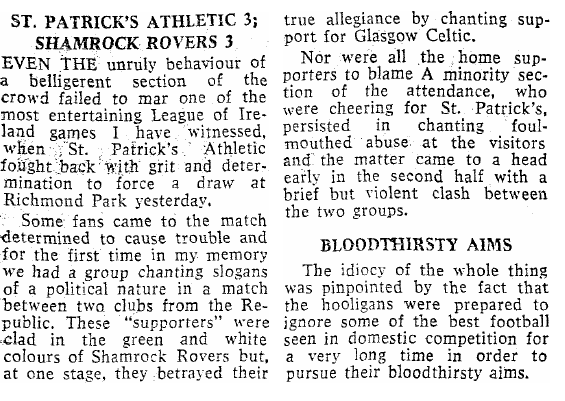
25 February 1980 (Irish Independent)
Perhaps the most serious violence the stadium has ever witnessed though was to come later in the decade, on a day that proved embarrassing for club officials and the Football Association of Ireland, and sparked a media frenzy. On 13 April 1986, Saint Patrick’s Athletic welcomed Waterford United to Inchicore. The clash was a FAI Cup tie, yet it would make the front page of the following days newspapers for all the wrong reasons. Violence on the Inchicore terraces marred the clash, which was to be the first defeat inflicted on the saints in 20 outings. The game was a crucial FAI Cup semi-final, and the two sides went into the game at 1-1. It ended with a 4-2 win to the visitors on aggregate.


















 Click on the book for more.
 Click on the book for more.
 Donal
Donal Ciarán
 Sam
Sam


 Come Here To Me!