Feeds:
Posts
Comments

Archive for May, 2012

From all reports, the Lighthouse Cinema’s showing of the outlandish Talking Heads concert film Stop Making Sense (1984) a couple of months back was a huge success. I’ve heard great stories about a dance floor organically emerging in front of the screen around half way through the show.

However, this was by no means the first time that this film has been shown in a Dublin cinema. In 1986, Stop Making Sense was shown every weekend night for nearly twenty weeks in The Ambassador Theatre.
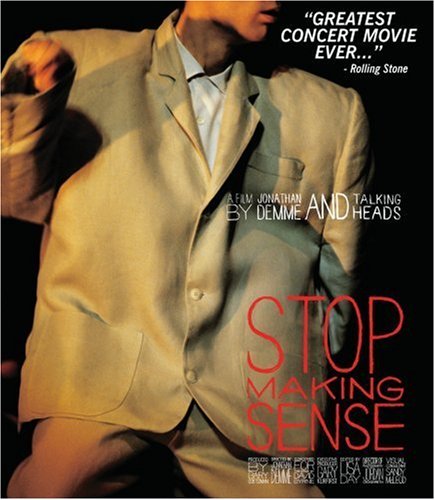
Stop Making Sense poster

Journalists, writers and music critics such as Dave Fanning, Graham Linehan, Jim Carroll, Donald Clarke and Gerard Byrne have all spoken on the significance of these last night showings.

Ciaran Carty in The Sunday Independent (10/03/85) first brought attention to the film’s showing and urged his readers not to “miss it” as it was “only booked for a week”. (As far as I can work out, the film was shown on March 8, 9, 11, 12, 13, 14 in 1985 and then reappeared on January  14 1986 where it played every Friday and Saturday night until May 1986. That sound right?)
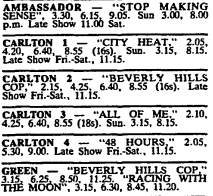
The Irish Times, 08 Mar 1985.

Dave Fanning in The Irish Times (30/07/86) wrote that the film had the effect of “transforming the Ambassador into a disco”.

Graham Linehan in his blog has admitted:


I went to see ‘Stop Making Sense’ every week for about fifteen weeks during its run at the Ambassador cinema in Dublin. They had to hire bouncers to stop people dancing, and when David Byrne ran round the stage, we ran round the Ambassador. Ah, me.

Jim Carroll (I.T. 11/12/03) also remembers the “couple of hundred party people” who used to “run laps around … the cinema” whenever David Byrne did something similar.

Simon Judge mentioned in a recent Le Cool piece that “bouncers were hired to curb the pogoing of the mental heads” while Gerard Byrne in Frieze Magazine  said that the “madness … usually ended with police intervention”.

Donald Clarke (I.T. 15/09/06) said the experience of these late night screenings was “akin to actually seeing the band in action”.
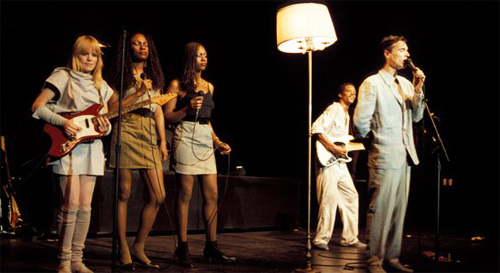
Still from the film

Dave Fanning summed up things quite well (I.T. 16/12/8) when he said that this sold out run of shows:

…provided one of the most memorable yet unsung highlights of the Irish rock decade and gave a whole new meaning to the phrase of ‘dancing in the aisles’

Things came full circle when David Byrne played The Ambassador, which had then been turned into a music venue, in July 2002.

Do you have any memories of going to see the film in The Ambassador?

Read Full Post »

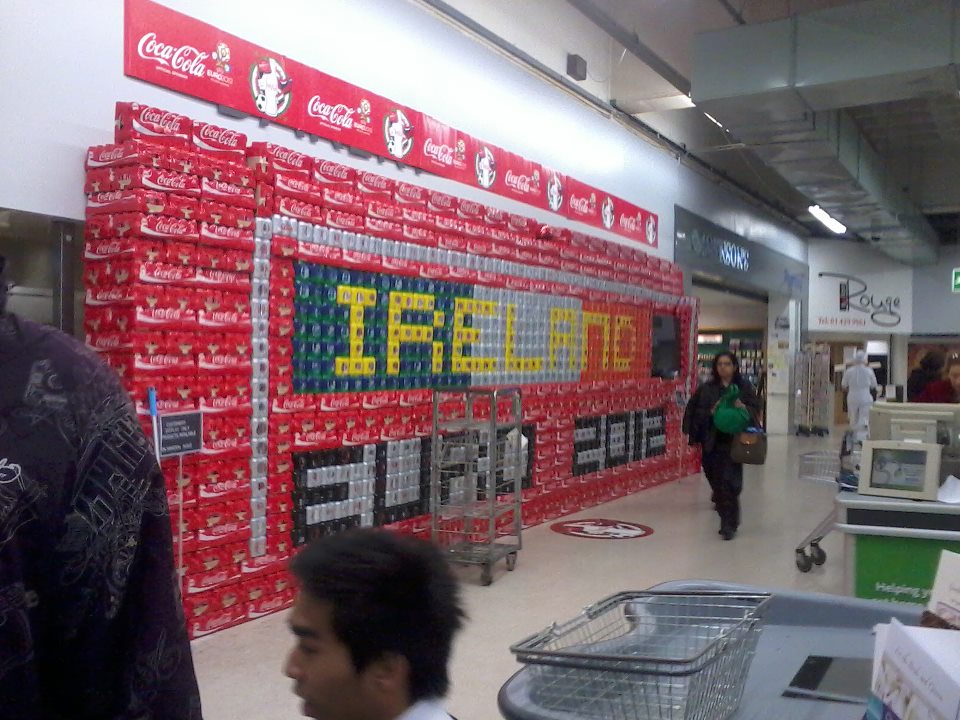
Bit much eh? Cans of fizzy drinks. Cheers to Adam K for the image.

Read Full Post »

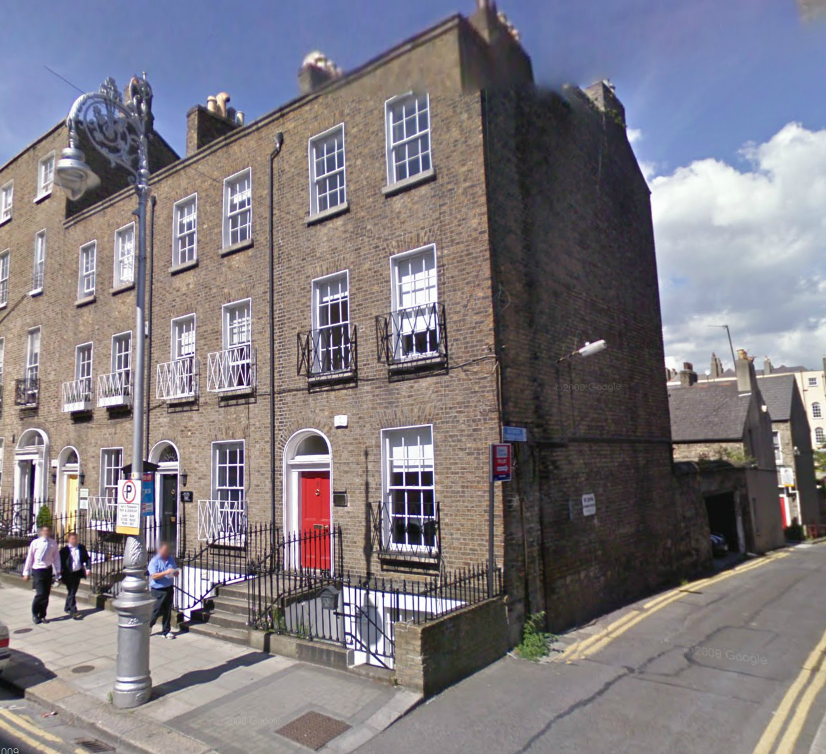
While heading to the Sugar Club yesterday from Baggot Street, I stumbled across this tiny little row of terraced houses off Lower Pembroke Street beside Fitzwilliam Square.

You can see the start of the terrace, the house with the red door, down the lane. (Picture – Google maps)

Totally overshadowed by the office buildings surrounding it, the hidden away terrace only has three houses on each side.

Anyone know anything more about them?

Mackies Place, Dublin. (Picture – JayCarax)

Read Full Post »

“The delights a stroll around Dublin can bring you. I’ve always carried my camera around with me, but have only recently started to take it out and not give a shite that I look like a tourist.

Sometimes I even post the resulting photographs up here. Below are the fruits of this weeks labours…

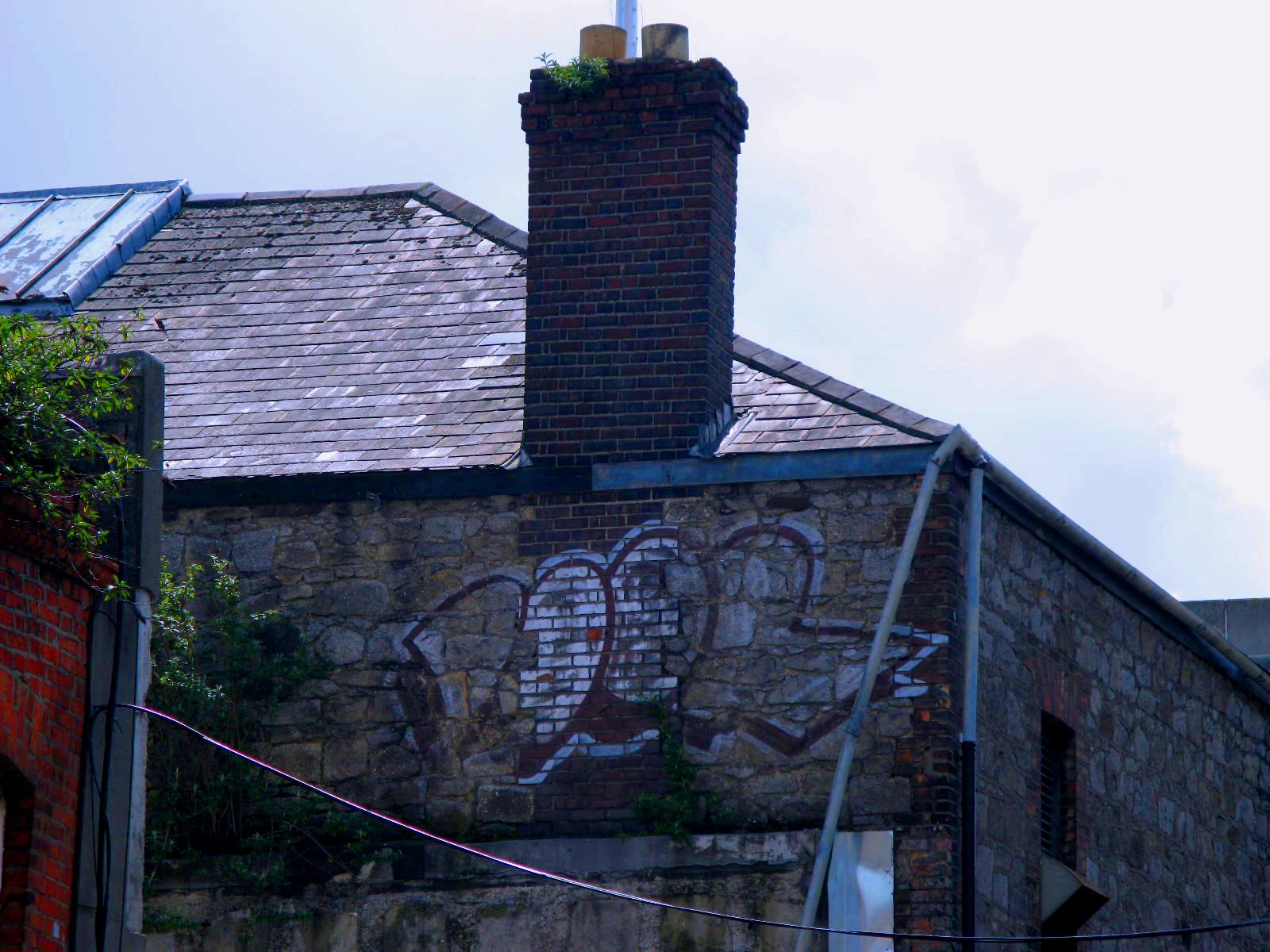
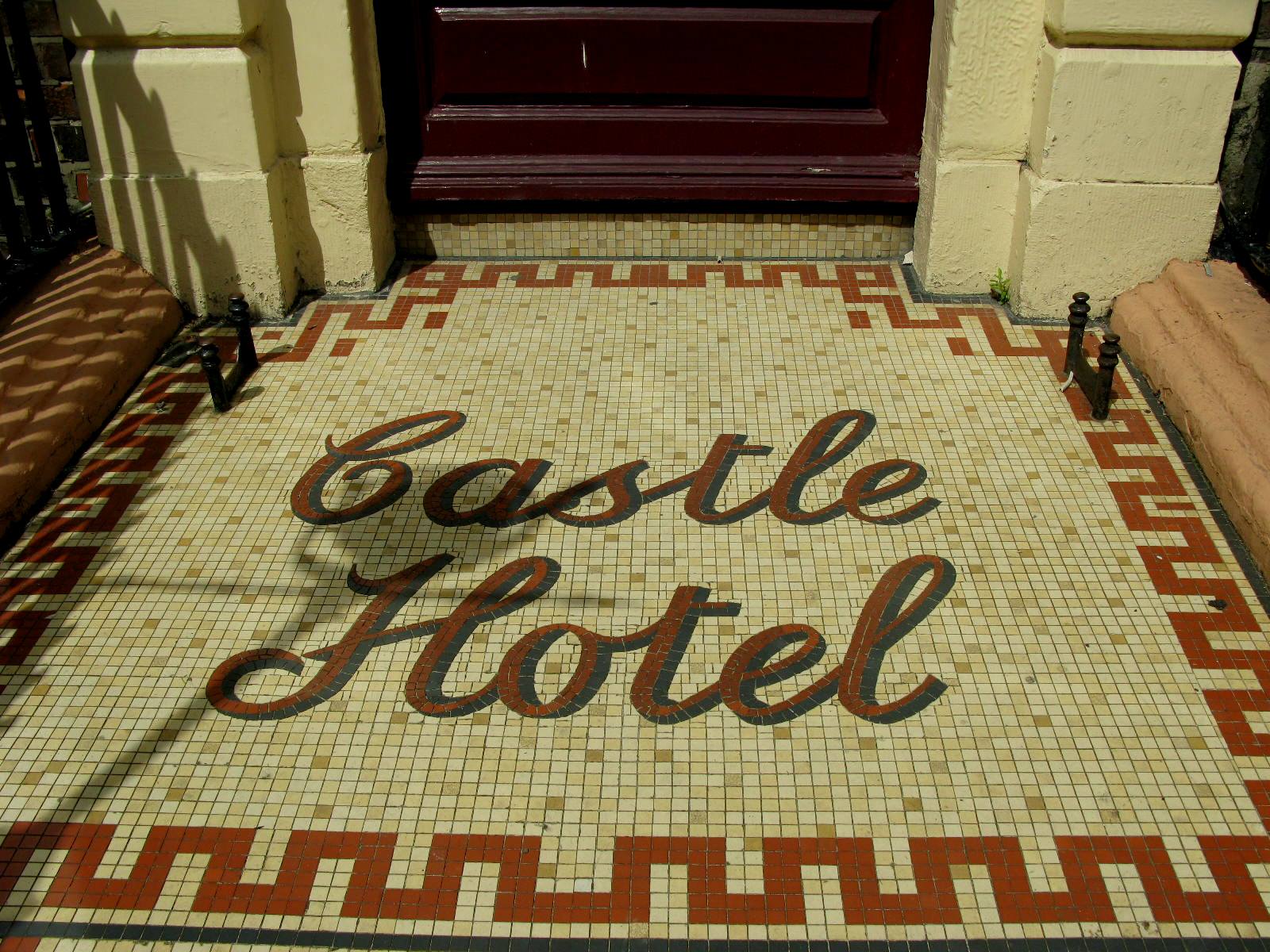
Anyone who can tell me where the above is, I’ll buy you a pint. Below, the Castle Hotel on Great Denmark Street.

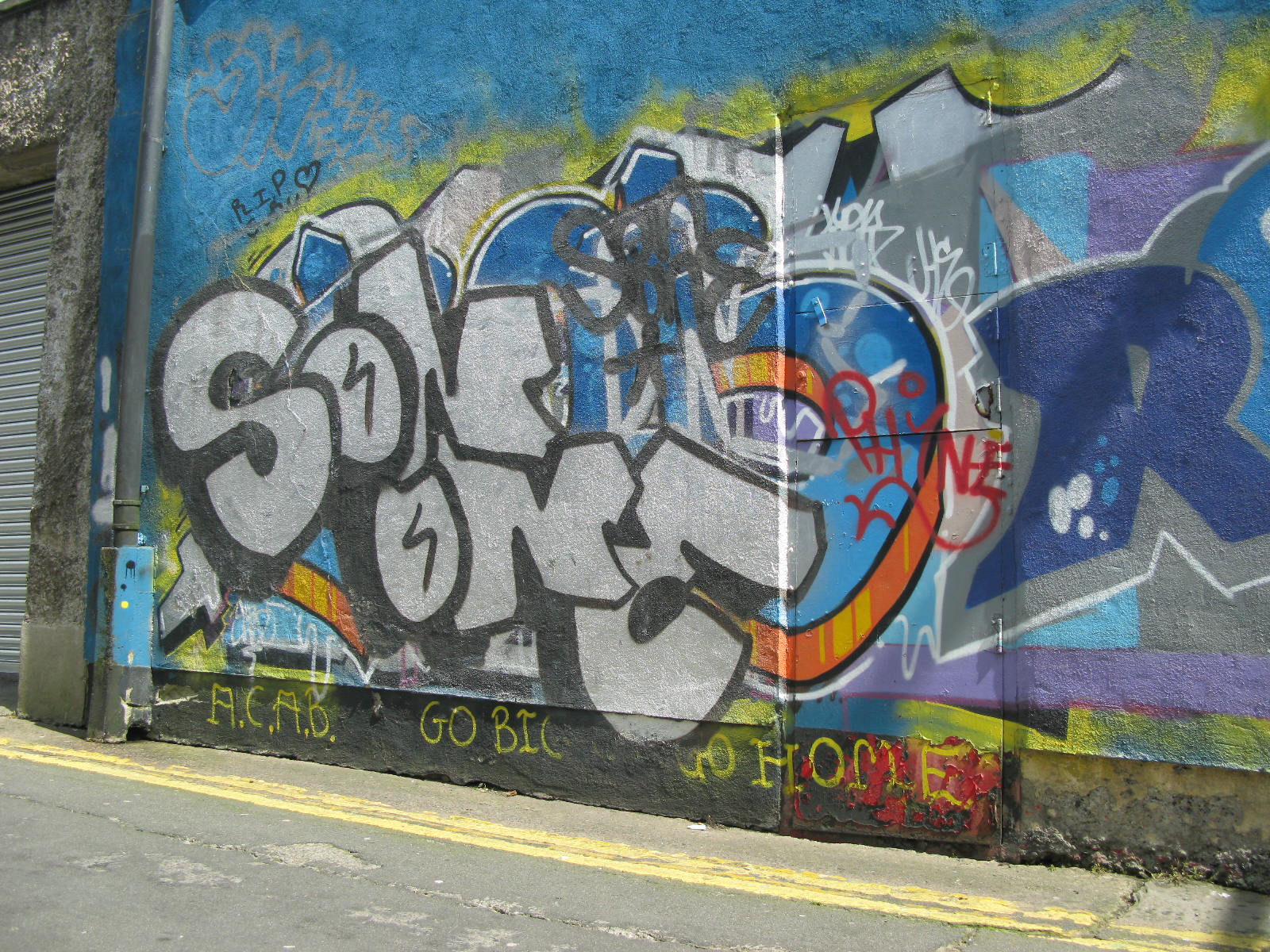
Below is a selection of graffiti from Rutland Place, a street in Dublin I’d never been down prior today… Bizaarely enough, you think you know the city inside out and then somewhere new suprises you. Pics read left to right, a good 30 foot of tags.

(more…)

Read Full Post »

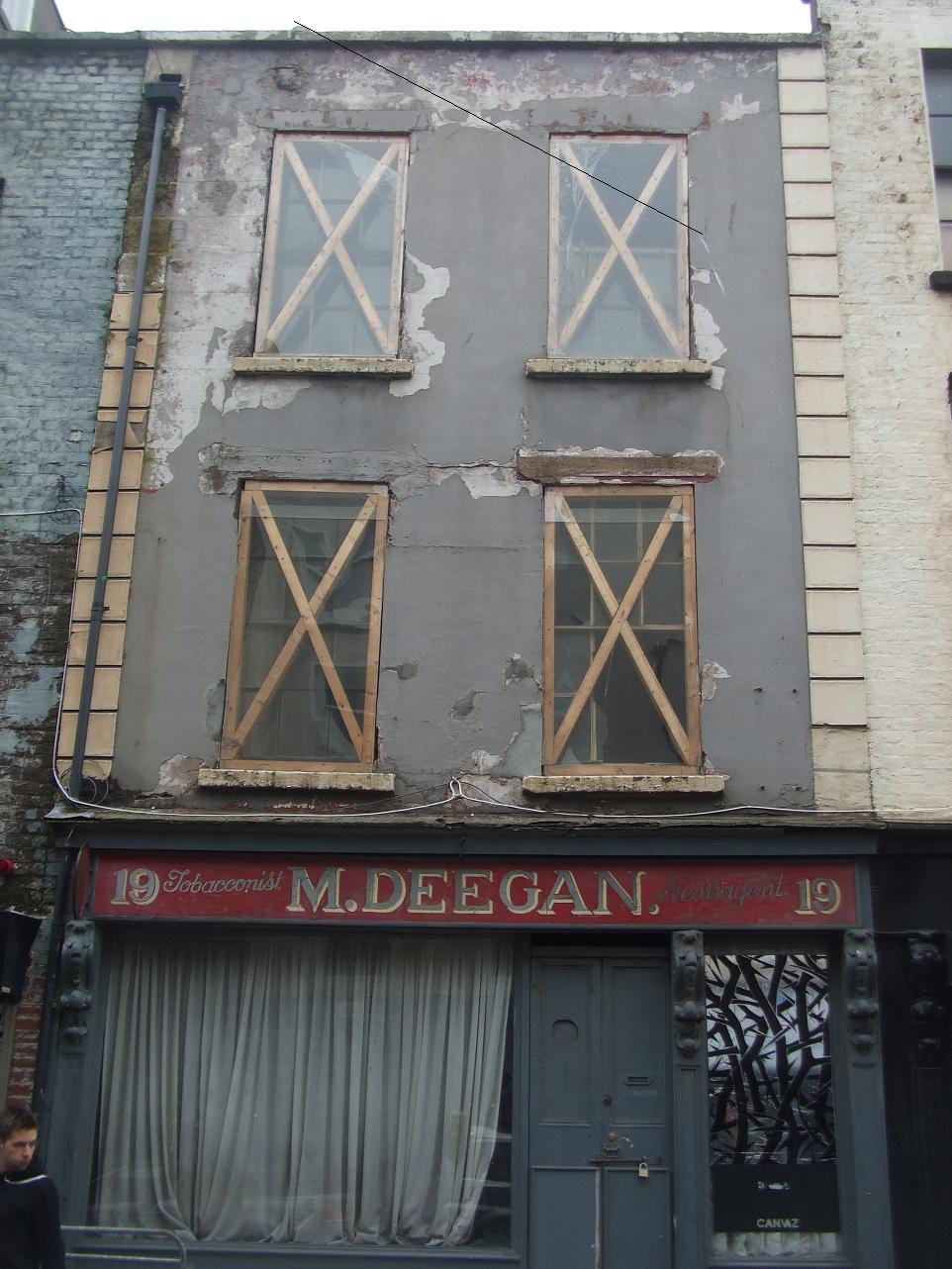
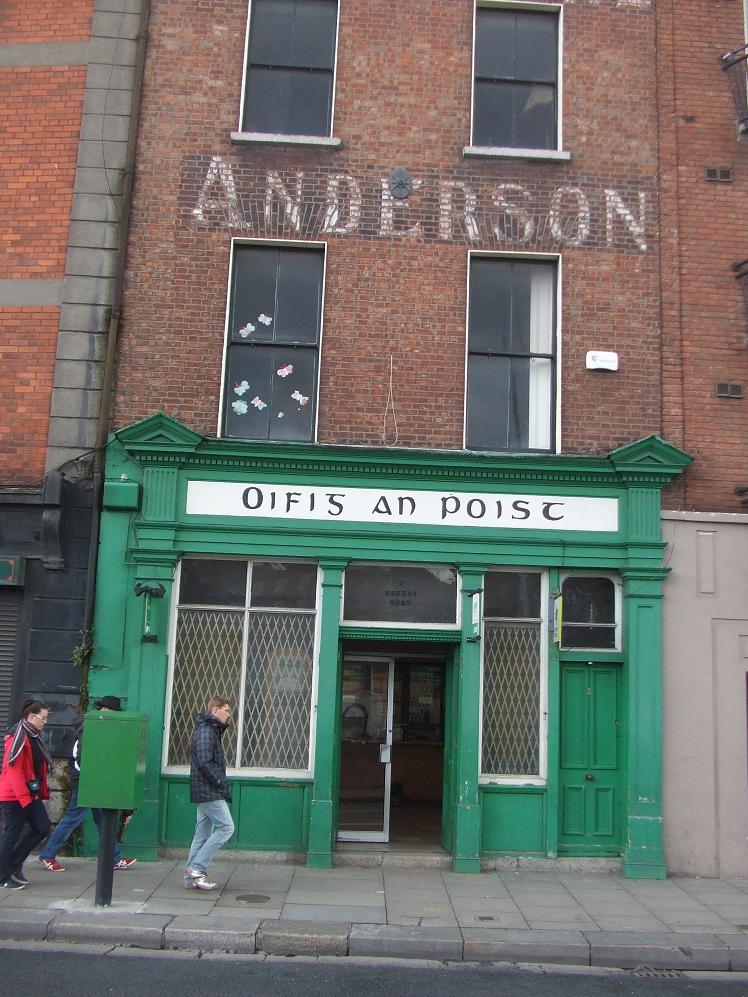
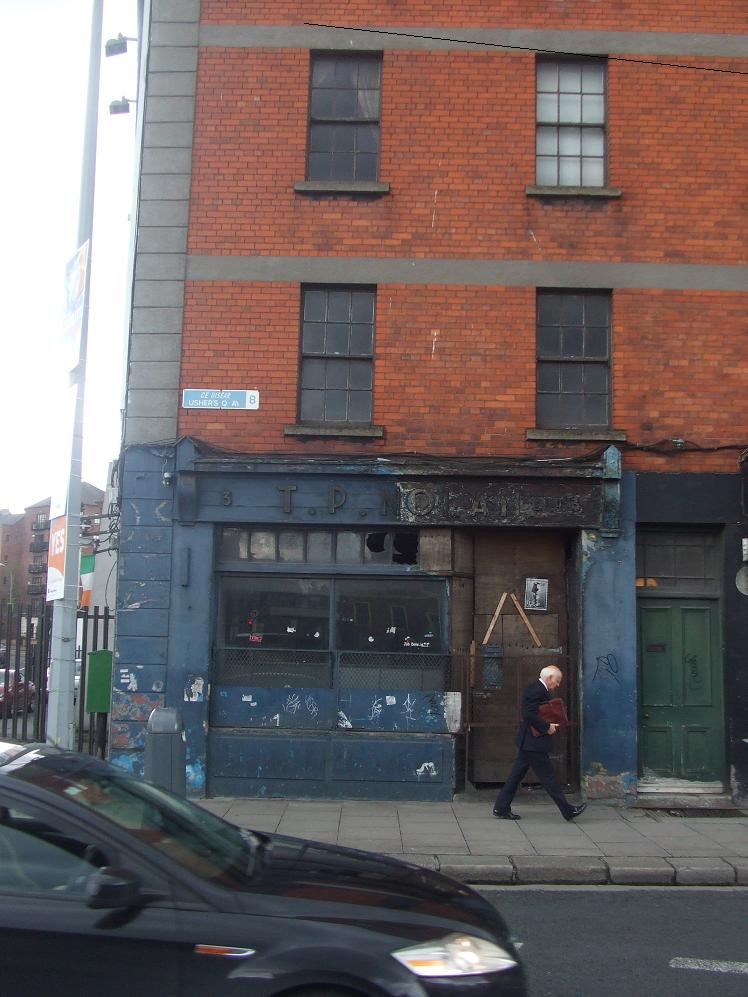
I’m fascinated by Dublin’s shopfronts, ranging from the beautiful and hand-painted to the gaudy and horrific ‘temporary signs’ that have found their way even to our busiest streets. I’m hoping to photograph a few that grab my eye and boot them up in small groups of five or so with some regularity. On a recent walk that took me from the city centre to Stoneybatter, I thought I’d start with these….

M.Deegan, South Anne Street.

Oifig An Poist, Ushers Quay.

T.P Nolan, Ushers Quay.

(more…)

Read Full Post »

I passed these earlier on today and was fortunate to be carrying a camera. The gate hinges of the National Concert Hall are truly fantastic, massive cast iron hands that grab your attention as you pass. A description of the Earlsfort Terrace gates comes from Alfred G. Jones, architect for the Dublin Exhibition of 1865, who noted that:

The principal entrance to the building is from Earlsfort-terrace, through six pairs of gates which form a portion of the enclosure wall and chain railing; this runs the entire length of Earlsfort-terrace, for a distance of 250 feet along Hatch-street. Each of the gate entrances has four piers of granite, circular on plan, 3 feet 3 inches at base, 8 feet 6 inches high, and surmounted with a cast-iron lamp-post 7 feet high. The iron gates are 15 feet wide, and 6 feet high, hung to massive cast iron hands, which are leaded into the stone piers.

The source of Jones’ comments is the old reliable Archiseek, who have a great article on the 1865 Dublin exhibition available to read here.

Read Full Post »

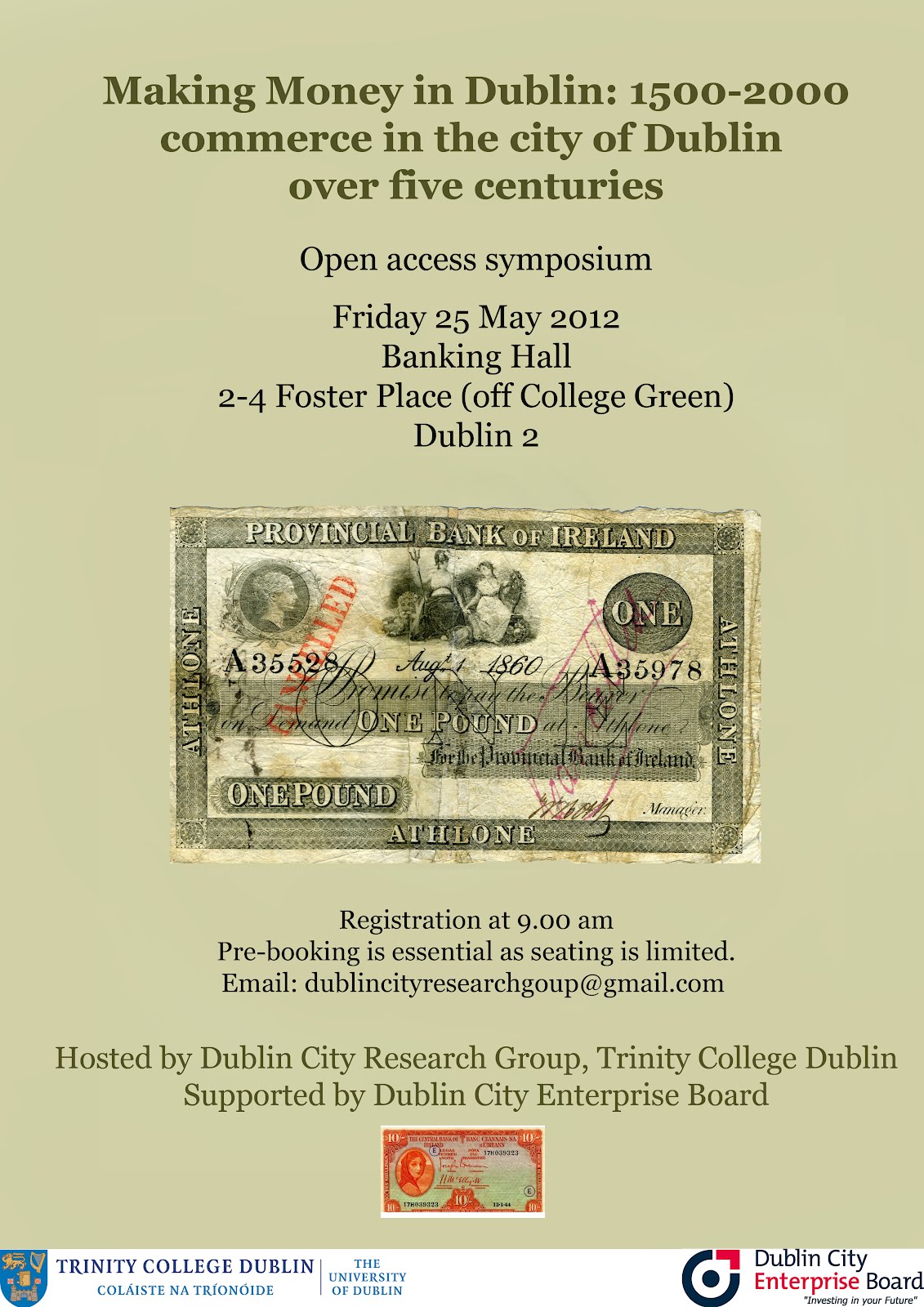
An interesting upcoming symposium, with free admission, looking at a wide variety of aspects of the economic and financial history of the capital.

For centuries Dublin has been the dominant location for making money in Ireland. Locals and new arrivals worked in an array of trades, businesses and professions – earning and spending, investing and losing money. As a capital city, Dublin was also home to lawyers, engineers and administrators attracted by the chance of a government job. Dubliners have lived and worked outside these approved (and taxed) workplaces too. Crime pays, and the pickpocket, fraudster and corrupt official are bound up with urban life. The world of work also involves social and political networks, fraternal organisations and strategic marriages.

Established academics and new researchers will examine the lives of people who made their living in Dublin from the Early Modern period to the late twentieth century. How did locals, rural migrants and immigrants succeed, scrape by or fail in the harsh world of commerce? What was their contribution to the evolution of the city? A wide range of papers will deal with topics including banking, architecture, women in business, printing, the professions and the technology boom of the 1980s.

To reserve a place please email: dublincityresearchgroup@gmail.com

Read Full Post »

‘Dub Rudie Giles’, under pressure from the powers of Babylon and his press agent, came out on the Ray D’Arcy show (Tues May 8) on Today FM refuting the story that he is a reggae fanatic.

You can listen back here here. Tuesday, Part 3, 48mins in.

The dream lives on. Design – K. Squires

His friends in the Reggae community understand why he has done this and support him 100%.  Though it is 2012, it is still not safe for an esteemed football player and pundit to come out about his love of Roots Reggae, Jerk Chicken and heavy bass.

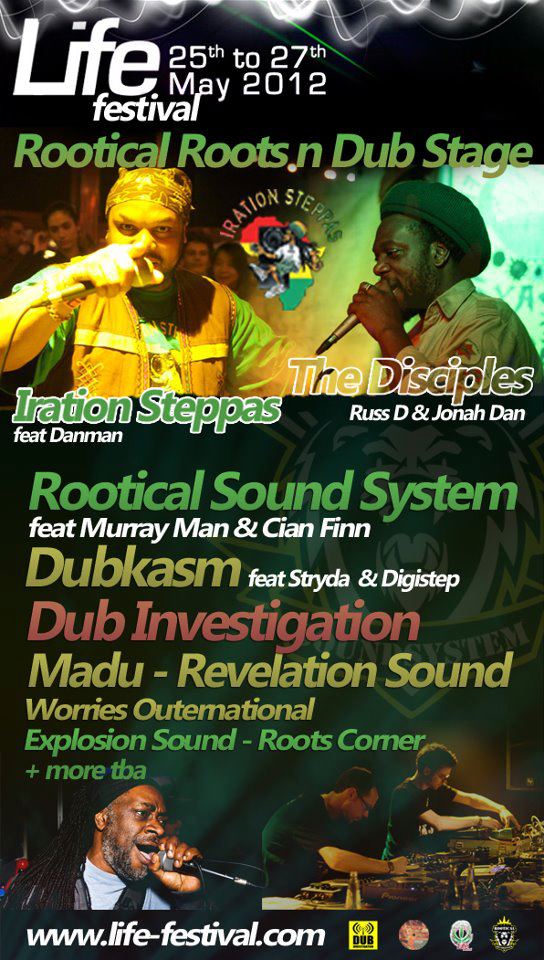
Rumours abound that he will be guest Selecta at the Rootical stage at Life Festival this year. Hold tight.

Life Festival, 2012.

Read Full Post »

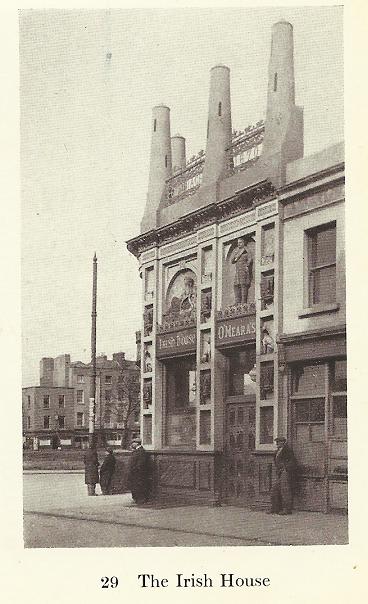
An image of The Irish House pub I scanned from John Harvey’s Dublin, 1949

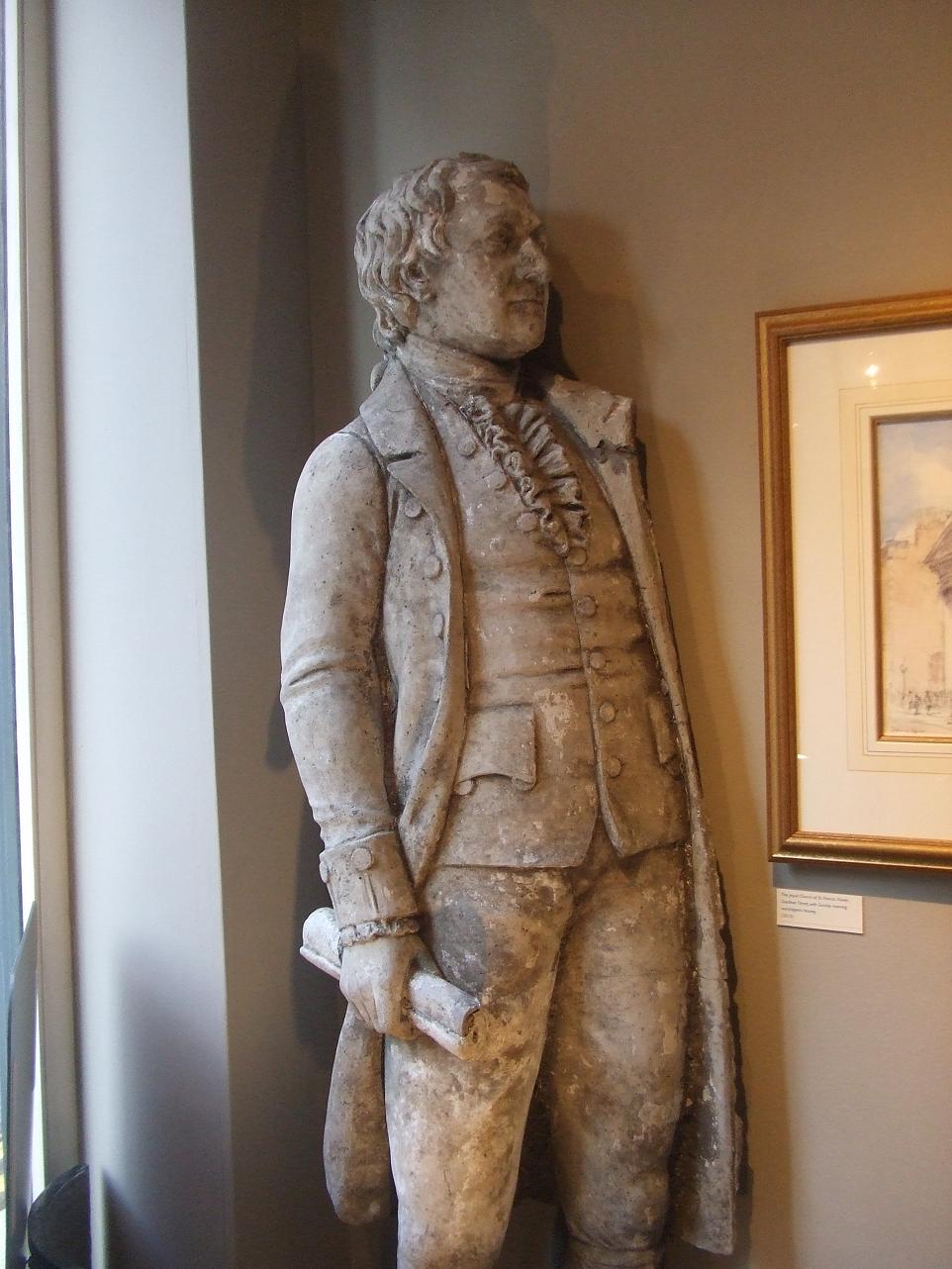
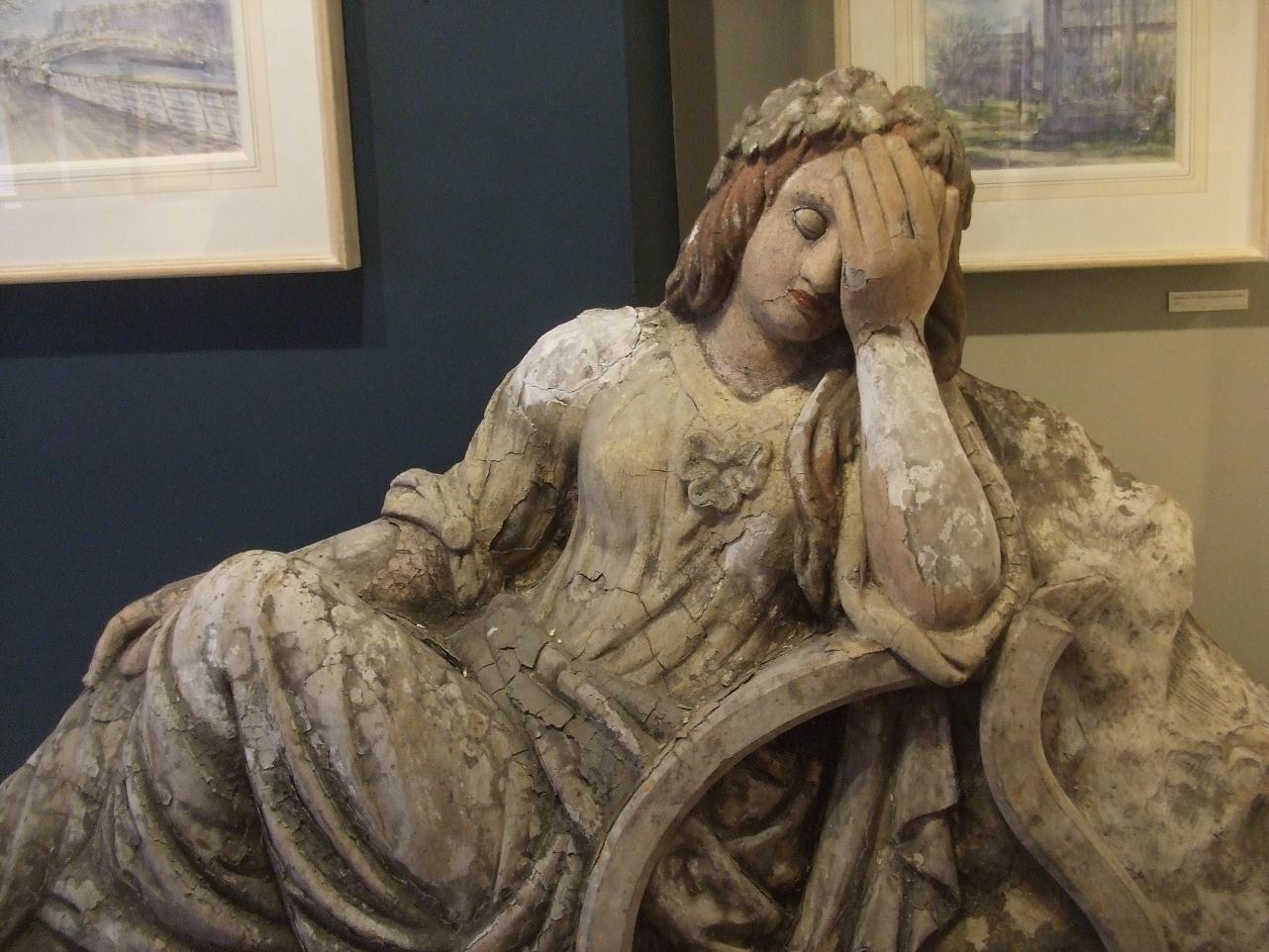
O’Meara’s public house, The Irish House, was a beautiful pub which sat on the corner of Winetavern Street and Wood Quay until demolished to make way for the Civic Offices. The fantastic public house which dated back to 1870 became a forgotten victim of ‘The Bunkers’ constructed at Wood Quay. The magnificent exterior stucco work upon the pub displayed historic scenes and nationalist leaders from Irish history, with Henry Grattan and Daniel O’Connell featuring. Sean Lynch has noted in his history of the building that Lord Moyne of the Guinness Brewery “financed a project to salvage the exterior of the Irish House. In July 1968 scaffolding went up and all embellishments were removed and transported to a warehouse at the Guinness Hopstore.”

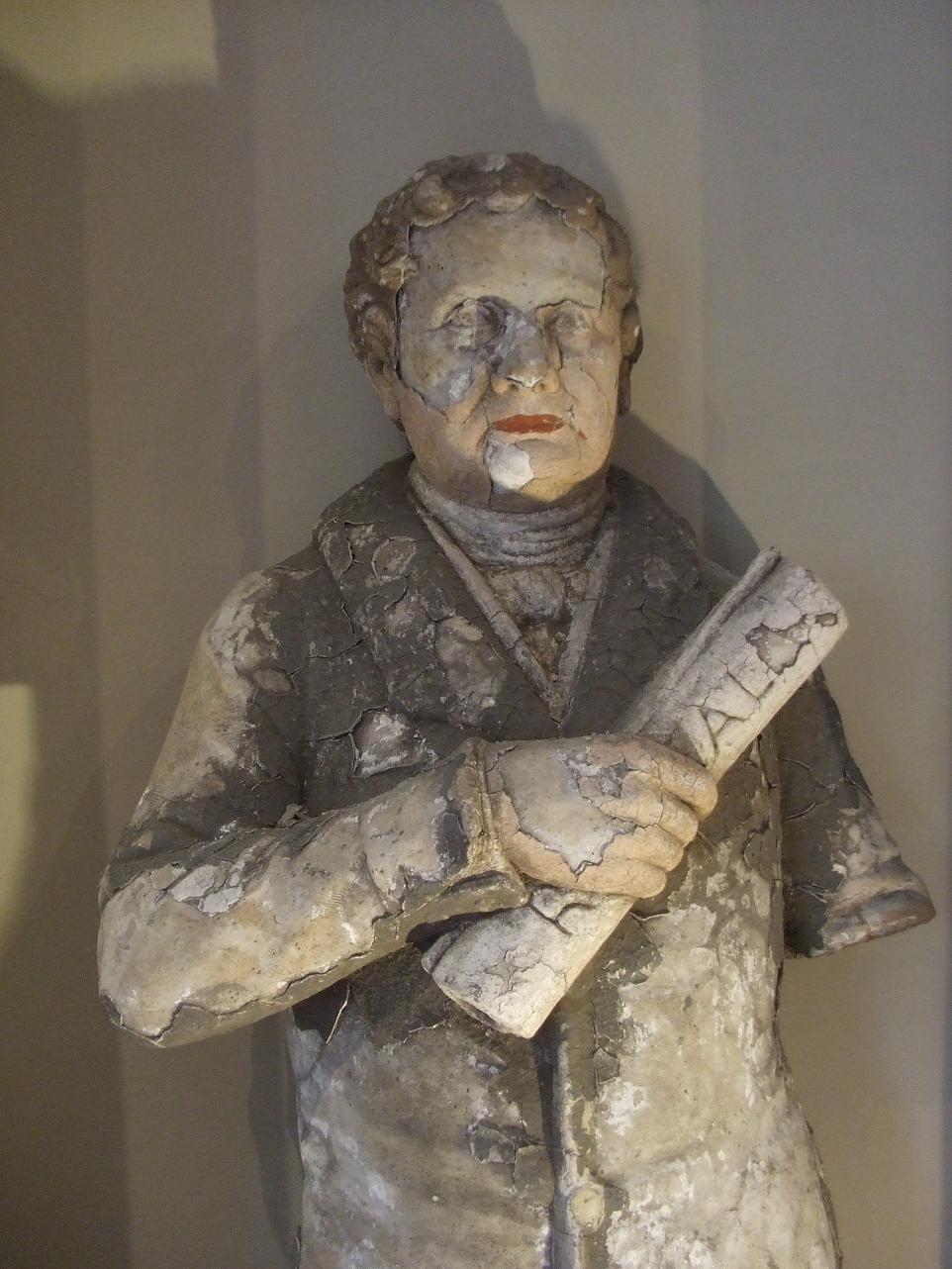
Today, some of the figures from the front of the building are on display in the Dublin Civic Trust on Castle Street. I photographed them on a recent visit, enjoy.

Daniel O’Connell, notice the word ‘Repeal’ on the document he clutches.

Henry Grattan

The figure of Erin

Read Full Post »

A very enjoyable Storymap on the Easter Rising, from John Gibney. John is the author of an upcoming biography on Sean Heuston as part of the 16 Lives series, and as a walking tour guide I suppose there’s a decent chance you’ve passed him on the street at work.

Sean McLoughlin is a fascinating and often overlooked character of the period. As well as discussing his role in the evacuation of the GPO, Gibney tell’s the story of the British officer who may well have saved young McLoughlin’s life. He also talks of how McLoughlin went on to become a communist activist. McLouglin’s politics feature in an interesting brief article here on the role of communists in the Irish Civil War.

Read Full Post »

The Ouzel Galley plaque is one I pass several times a week, but never investigated. It tells the story of a famous Dublin merchant ship that it was said set sail from Ringsend in 1695, on route to the port of Smyrna in the Ottoman Empire. She was to return the following year, having engaged on a trade mission on behalf of the Dublin company Ferris, Twigg & Cash. Eoghan Massey of Waterford captained the ship.

When three years had passed in 1698, and there had been no word of the ships faith, a panel of Dublin merchants settled the question of instance, by ruling that the ship had been lost with her crew of 40 on board, and that compensation should be paid out to the owners and insurers of the ship.

The story goes that in 1700, to the amazement of Dubliners, the ship returned up the River Liffey. Massey claimed that his men had spent five years in captivity at the hands of Algerian corsairs, who had used the ship to engage in acts of piracy. Rumours and allegations spread, and it was claimed Massey and his men themselves had engaged in such acts. The ship was loaded down with an impressive booty upon its return, which naturally raised questions in light of the fact insurance had been paid out two years prior.

John Moran wrote a fantastic account of the ships return in The Irish Times in 2005, noting that

…. five years after she sailed away, a battered and torn Ouzel listed up the River Liffey, and was greeted by first a sense of disbelief, then to scenes of wild dockside jubilation. Exhausted oarsmen rolled to the strains of an old sea shanty as they heaved her toward the howling crowd on the quay.

The ownership of the ship’s cargo became a huge matter of debate and controversy. The same panel of merchants which had settled the debate in 1698 on the ships fate met once more, and his time decided that all monies remaining following the proper compensation of the owners and insurers should go towards a fund for the alleviation of poverty among Dublin’s “decayed merchants”.

Out of this case, emerged ‘The Ouzel Galley Society’, a society founded for the purpose of determining commercial differences by arbitration. The 1818 History of the City of Dublin, its Present Extent, Public Buildings, Schools, Institutions, etc details the foundation of this society, and notes that “its members consist of a captain, lieutenants and crew who always have been, as they are now, the most respectable merchants in Dublin.” The society would meet two or three times annually it was noted, and the costs decreed against the parties “who submit to their arbitration are always appropriated to charitable purposes.” Arthur Guinness was among the individuals to serve time with the society.

Interestingly, historian Lisa Marie Griffith noted in a recent article for History Ireland on the subject, that:

While there is no doubt that an arbitration body called the Ouzel Galley Society was established in the early eighteenth century, the veracity of its origin-myth is a different story. I could find no eighteenth-century records referring to the incident of the pirates.

She goes on to note that the first reference to the involvement of pirates in the affair comes from a nineteenth-century novel, The Missing Ship, by William Kingston. This novel was first published in 1887 under the prior mentioned title, and then later in the same year as The Ouzel Galley. The novel, she notes, “certainly added layers to the story of the foundation of the Ouzel Galley Society.”

The Dublin Chamber of Commerce, founded in 1783, largely subsumed the Society, and the stone plaque on College Green today marks the spot where the Chamber of Commerce met historically, at Commercial Buildings. The Ouzel Galley Society was wound up in 1888, though in the year of Dublin’s millenium in 1988 it was reestablished, primarily as a charitable institution.

My favorite part of the popular story is that when the men of the Ouzel Galley, presumed dead, returned to Dublin they were met by remarried wives and brand new children. Children born illegitimately in Ringsend were supposedly jokingly refereed to as ‘Ouzellers’ in the aftermath of the incident!

Read Full Post »

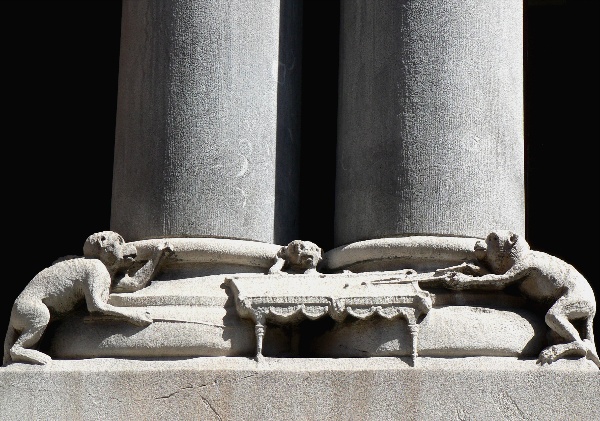
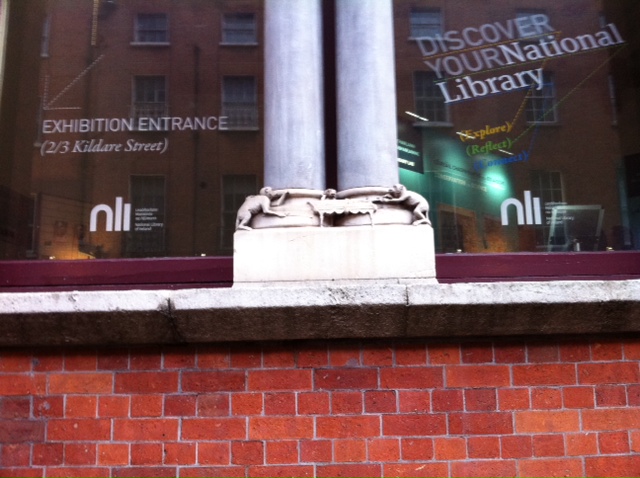
One of the most unusual and amusing architectural details in the city, in my opinion, is the stone carving of monkeys playing billiards on a window column at No. 1 Kildare Street.

Monkeys playing billards (c) Flickr user ramson

Now housing the the Alliance Française, the beautiful building was built for the Kildare Street Club in 1860-1 by architects Thomas Deane and Benjamin Woodward. Founded in 1782, the club was based at No. 6 Kildare Street from 1782 – 1860 and then at No. 1 Kildare Street from 1861 – 1977.

A fire ripped apart its original premises on 11 November 1860 killing three maid-servants and destroying their 15,000 volume library. A superstitious person might see something in the fact on May 4 1967, a fire swept through the top floor of No. 1 Kildare Street causing extensive damage.

The club merged with the Dublin University Club in 1976, thereafter sharing the premises of the latter at 17, St Stephen’s Green. However it still owns No.1 Kildare Street and currently leases the building out to a Heraldic Museum and the Alliance Française.

(c) A wider shot showing the monekys. From ‘http://deise-dispatches.blogspot.com/’

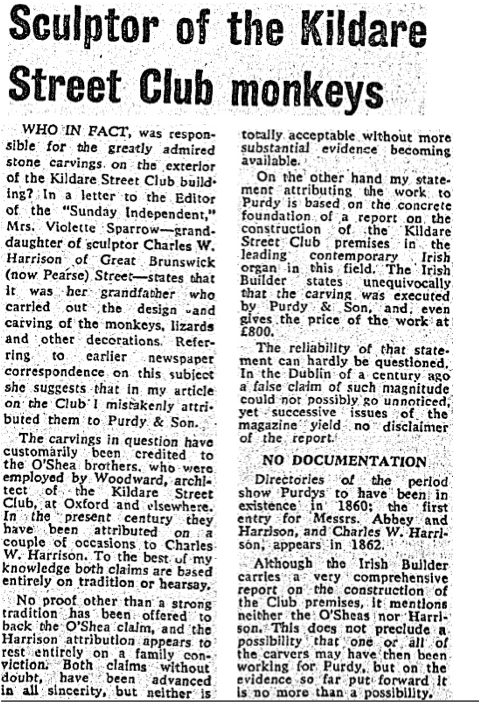
Debate on who the actual sculptor of the monkeys was as been going on for several decades. The three main candidates being Charles W. Harrison, the O’Shea brothers and Charles W. Purdy (Purdy & Son).

This author of this Sunday Independent article from 1969 is of the opinion that that they were the handywork of Purdey & Son.

Sunday Independent. Nov 02, 1969.

While an Irish Times article (Nov 25, 1961) alleges it was the O’Shea brothers and a piece from the Irish Press (Nov 7, 1975) states that it was Charles W. Harrison. For the record, it seems our friends over at Archiseek are on the pro O’Shea side.

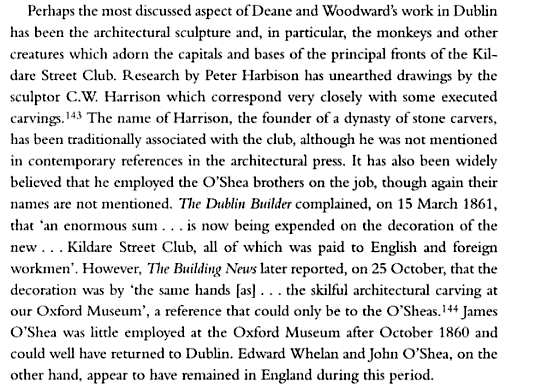
Frederick O’Dwyer in his 1997 book The Architecture of Deane and Woodward gave his own opinions on the matter:

Frederick O’Dwyer, The Architecture of Deane and Woodward (Cork, 1997), 336.

Either way, the monkeys are a wonderful piece of work. They themselves have been the source of many jokes, table quiz questions and riddles as this Irish Times piece from August 15 1928 suggests:

Quidung. An Irishman’s Diary. August 15, 1928.

Read Full Post »

« Newer Posts - Older Posts »