Feeds:
Posts
Comments

Archive for April, 2013

Back in October 2010, Donal touched briefly on an old Dublin legend about a solder who met a grim fate in the crypt of Christchurch. The story was recounted in Padraic O’ Farrell’s 1983 book The Ernie O’ Malley Story:

“Ernie received a note written by Rory O’ Connor in Mountjoy on 12 September. It told him of a tunnel leading to the Four Courts which could be used if they had left any important documents behind. One piece of folklore attached to that area of the city concerned a tunnel from there to Christchurch, built in the thirteenth century when a Dominican friary of St. Saviour occupied the Four Courts site.

Towards the end of the nineteenth century, an army officer was accidentally locked in the tunnel which was used for storing ceremonial paraphernalia. He was soon documented as ‘missing, presumed dead’ until the next occasion demanding the opening of the tunnel. Near its entrance was discovered the skeleton of the officer and in the bones of his right hand was his sword. Lying about were the broken bone fragments of up to 250 rats that had attacked and had been beaten off by the mans sword before he himself was overcome.”

From looking at a number of different sources, it seems likely that there is some truth to this macarbe story.

Christ Church crypt. Credit - http://kieranmccarthy.ie

Christ Church crypt. Credit – http://kieranmccarthy.ie

The earliest substantial reference I can find is from 1907. Samuel A. Ossory Fitzpatrick’s book Dublin: A Historical and Topographical Account of the City describes the

…tragic interest attached to the tablet to Sir Samuel Auchmuty, G.C.B., who died in 1822 while in command of forces in Ireland. It is said that at his funeral an officer lost his way in the crypt, was accidentally locked in, and was there devoured by rats, which probably swarmed from the great sewer which led from the cathedral to the Liffey. His skeleton is said to have been afterwards found still grasping his sword,  and surrounded by the bones of numbers of rats which he had slain before being overcome.

I believe this story was taken from page 33 of the 1901 book The Cathedral Church of the Holy Trinity, Dublin by William Butler but unfortunately the full book is not available to view online.

An article published in The Irish Times on 8 September 1926 repeats the story and names the poor soldier as ‘Lieutenant Mercier’.

The story was recounted, without a name for the dead soldier, in an 1940 article by P. J. McCall entitled ‘In the Shadow of Christ Church’ in the Dublin Historical Record journal.

Sir Samuel Auchmuty certainly died in 1822 and his funeral was held in Christchurch so the story’s backdrop does match up.
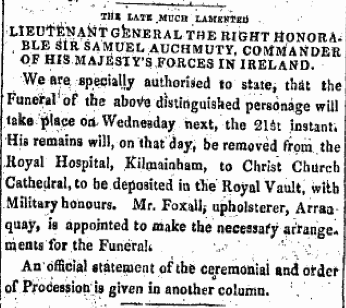
Samuel Auchmuty funeral arrangements. The Freemans Journal, 20 August 1822

Samuel Auchmuty funeral arrangements. The Freemans Journal, 20 August 1822

Elgy Gillispie writing in the The Irish Times on 19 June 1975 fleshed out the story considerably. The journalist was given a tour of the vaults of the Cathedral by guide Joe Coady who recounts the tale of the ‘Tragic Demise of Lieutenant Blacker”:

In August 1822, this young officer of the 78th Regiment of Foot came down with fellow mourners into the crypt to attend the funeral of his colonel, a Sir Samuel Auchmuty … In the gloom of the crypt Blacker lost his sense of direction and inadvertently wandered into the underground passage … He was attacked by a species of large river rats that populated the tunnels … His skeleton was found, picked clean to the bone, beside his broken sword by a search party two days later. After that the tunnel was filled.

Tour guide Joe Coady said that the sword was still in the possession of the Cathedral but not kept on display.

Like most old tales, there’s a couple of versions. Kevin Fitzsimons told an Irish Press journalist, in a 6 July 1967 article, that it was a “dragoon officer” who was got lost in the passageways with his dog. He was found months later eaten by rats while his dog had been accidently decapitated in the fight for survival.

More recently, a Dublin haunted ghost tour company are telling tourists this story but in their version, the soldier is killed after being locked into one of crypts by accident after a drinking session.

Next week, I will focus on the stories about the tunnel that allegedly ran from the crypt of Christchurch Cathederal, under the Liffey, to St Saviours Priory (site of the present Four Courts).

Read Full Post »

Mounted police in Dublin at the time of the 1913 Lockout (UCC Multitext)

Mounted police in Dublin at the time of the 1913 Lockout (UCC Multitext)

One of the more peculiar incidents in the course of the 1913 lockout in Dublin was a football clash in Ringsend, when Bohemians and Shelbourne went head to head in a match that occurred early on in the dispute. There was physical confrontation at this clash between trade unionists and football supporters, and the popular story has it that Jim Larkin accused the Bohemians side of having scabs in its ranks. This article aims to look at newspapers (including the organ of Larkin’s movement) from the period and other sources and try to piece together just what happened in Ringsend. It seems to me, that in reality, it was not alone Bohemians but also Shelbourne who Larkin took issue with, and that the story of Bohs alone being singled out by Larkin just doesn’t hold up.

Shelbourne and Bohemians were already two well established working class institutions in Dublin by the time of the 1913 Lockout. Writing in his classic book Dublin Made Me, C.S Andrews noted that at the time of his youth “there were only two senior soccer clubs in Dublin – Bohemians and Shelbourne- and the people on the southside followed Shelbourne.” He went on to write that “the supporters and players of the game were exclusively of the lower middle and working classes”.

The first reference to trouble at a clash between the two sides during the Lockout that I stumbled across was in the pages of Padraig Yeates’ classic account Lockout: Dublin 1913, where it is noted that the a game between the two sides on August 30th saw “about six thousand spectators” gather in Ringsend, where they were met by “a picket of about a hundred tramway men” who had gathered outside the ground and exchanged insults with the football crowd. Yeates quotes The Irish Times who noted that “the members of the Bohemian team, who pluckily drove to the scene of the scene of the match on outside cars through a hostile crowd of roughs, were assailed with coarse epithets.”

By this stage, the dispute between Larkin and William Martin Murphy had been underway for several days. Yet why was their hostility towards these football players? Why was there a picket of striking tramway men in Ringsend that day in the first place? The answer to that is found in the pages of the Irish Worker, where Larkin’s paper had denounced two players publicly as ‘scabs’. He had also allegedly attacked this match in a speech he had delivered the night previously to it, and called on workers not to attend the clash between the sides unless to picket it. Of the two players named in the paper, only one of these players was from Bohs however, Jack Millar. The other player, Jack Lowry, lined up for Shelbourne. This game was actually a charity game to inaugurate the new Shels ground, but with tensions high in Dublin following the outbreak of the tram dispute, it didn’t take much to spark trouble. Trams carrying supporters to the game were attacked, following a failed attempt by protestors to rush the gates into the ground.

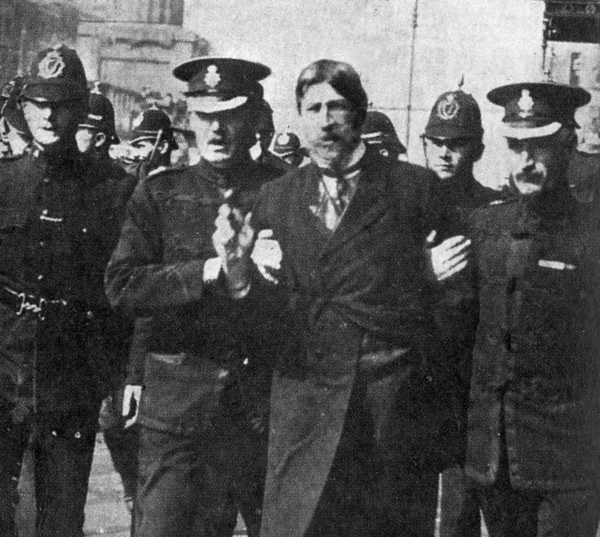
The events in Ringsend were just violent episode in a weekend which would see hundreds injured in Dublin, and death on the streets. This image shows the arrest of Larkin on the day after the Ringsend riot.

The events in Ringsend were just violent episode in a weekend which would see hundreds injured in Dublin, and death on the streets. This image shows the arrest of Larkin on the day after the Ringsend riot.

One of the most interesting primary sources from the time of the 1913 Lockout is Disturbed Dublin by Arnold Wright, which was written in 1914 and in many ways provided an account of the dispute which was very sympathetic to the employers and police. In that text, Weight notes that:

The opening scene, in what was to prove a prolonged and sanguinary drama, was enacted in the Ringsend district. In his speech on Friday night Mr. Larkin had referred to a football match which was to be played on Saturday on the Shelbourne Ground at Ringsend between two local clubs. ‘ There are ” scabs ” in one of the teams, and you will not be there except as pickets,’ he said, in language whose menacing character was understood by those who heard him. In obedience to the implied command, a large body of members of the Transport Workers’ Union gathered at the time announced for the match near the entrance to the grounds.

Wright’s claim that there were scabs in “one of the teams” is at odds with the claims made in Larkin’s own newspaper.

The Irish Times report on the incident claimed that some picketers had actually gained access to the ground, and “hurled vile language at the players.” It also claimed that the incident involving a crowd attacking trams was only brought to an end when “one of the passengers jumped from the tram, produced a revolver, and effectively dispersed the crowd.” It is noted in Lockout: Dublin 1913 that following this incident:

A section of the crowd, which now numbered between five and six hundred, decided to march on the nearby DUTC power station. At 4.30pm College Street DMP station received a call from an anxious sergeant at the plant appealing for help. Inspector Bannon commandeered a passing tram, put his ten men on board, and headed for Ringsend. By the time he arrived the crowd had quietened and he began shepherding them back towards the centre of Ringsend.

Further trouble escalated quickly however at Bridge Street, where one rioter even succeeded in liberating an inspector of the sword from his scabbard. This led to a police horse falling, bringing its rider down with it. It was not until the pubs in the area were forcibly closed by police before the crowds began to disperse from the area, with the inaugural opening match of Shelbourne’s new ground well and truly overshadowed. In total, sixteen arrests were made at Ringsend that day, with over fifty people treated in hospital for their injuries. The punishments were severe, with Thomas Deevey initially sentenced to “three months’ imprisonment with hard labour for striking a policeman on the leg with a bottle at Bridge Street, Ringsend.”

The newspapers blamed the influence of outside “hooligans” for the actions of the “usually peaceful and industrious inhabitants of Ringsend” on the day, but events on the following day would greatly overshadow what had happened at Ringsend. An outlawed labour meeting on Sackville Street would provide the location for ‘Bloody Sunday’, leaving hundreds injured and one man dead.

An iconic image of the police charges of Bloody Sunday.

An iconic image of the police charges of Bloody Sunday.

Read Full Post »

The Charge of the Light Brigade, the infamous battle that took place in the midst of the Crimean War (October 1853 – February 1856) remains one of the worst displays of military recklessness ever recorded. We’ve talked briefly about Dublin’s link to the fateful event before, in that not only was the bugle that sounded the charge made here, but the bugle call was given by a Dubliner, William ‘Billy’ Brittain of the 17th Lancers, Orderly Bugler to Lord Cardigan, the commander of the Light Brigade. Of the 673 horsemen involved in the charge, it is believed over 100 of those were Irish.

But the Charge of the Light Brigade was only one of many tactical and military errors committed in a conflict lasting more than three years. David Murphy, in History Ireland (Vol 11, Issue 1) estimated that at the time of the war, approximately 30-35% of the British army was made up of Irish troops, and that somewhere in the region of 30, 000 of those Irish troops served in the Crimea. They left Dublin with a fanfare bordering on the hysteric,  with the departure of the 50th Foot regiment on 24 February 1854 as recorded in the same article

The bands of three other regiments of the garrison led them along the line of route, one of the finest in Europe; and vast crowds accompanied them, vociferously cheering, while from the windows handkerchiefs and scarves were waved, and every token of a ‘God Speed’ displayed.

Irish involvement in the war wasn’t confined to belligerents though. Civilian medics tended to the wounded, and in a war where “frontline correspondants” arguably played a role for the first time, Irishman William Howard Russell’s first hand reports on troop welfare led Trinity College to award him an honorary degree on his return. As the war drew on, and casualties mounted (albeit mainly through disease, as cholera and malaria were rampant) the support that was granted to it as troops left the country diminished.

That is not to say that, returning victorous, the regiments were not treated to same the pomp and occasion they received as they left. The Lord Mayor of Dublin, at the suggestion of the Lord Lieutenant, the Earl of Carlisle, called together a committee to organise a National Banquet to pay tribute to Crimean veterans stationed in Ireland. A subscription list was established, and over £2, 000 was collected within the first nine days of it’s inception. An Irish Times report on the centenary of the event claimed that the merchants and the traders of Dublin showed great interest in the project, with offers of assistance coming from different patrons including

…a gentleman, styling himself the Wizard of the North who offered to give a performance for the benefit of the National Banquet Fund.

His offer was kindly declined. Over 3, 500 guests were invited to the banquet, (3, 628 sat down for dinner) along with over 1,000 paying spectators and such numbers caused large problems with regards finding a location.

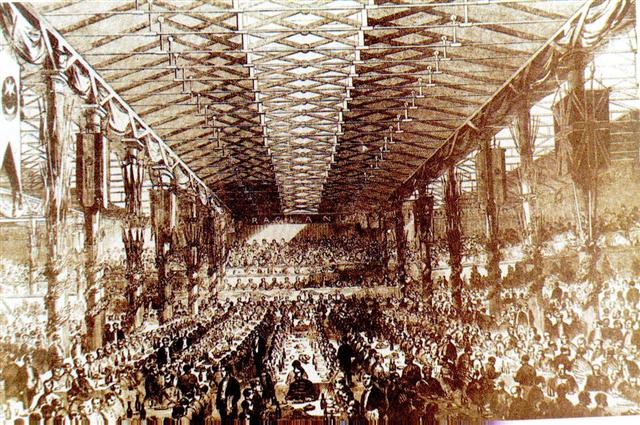
The Banquet. held in Stack A, Custom House Docks.

The Banquet. held in Stack A, Custom House Docks

The Rotunda, the Mansion House and several halls in Dublin Castle were examined but deemed too small to fit the purpose. There was a proposal to raise a purpose built marquee in the grounds of the Castle or Leinster House, but this plan too was dismissed. Finally, a Mr. Scovell offered the use of his bonding warehouse near the Customs House (the modern CHQ building in the IFSC.) Built as a “fireproof” tobacco warehouse in 1821, it remains to this day one of the oldest iron-frame buildings in Ireland. The date was set for October 22nd, and preparations for the Banquet were set underway.

The hall itself, which can still be seen almost in its original state, measures 260 feet long and 150 feet wide, with rows of pillars supporting a magnificent roof of iron framework painted in bright coloursfor the occasion. During the banquet, the walls of the building were covered in numerous national flags, some bearing the names of the major Battles of the War- Alma, Sevestopol, and Balaclava amongst others and decorative field guns on platforms guarded the entrance to the building.

The report continued

…the total length of the tables was 6, 172 feet. The viands supplied included 250 hams, 230 legs of mutton, 500 meet pies, 100 venison pasties, 100 rice puddings, 260 plum puddings, 200 turkeys, 200 geese, 250 pieces of beef weighing in all 3,000 lbs.; 3 tons of potatoes, 2, 000 half pound loafs, 100 capons and chickens and six ox tongues…. Each man was supplied a quart of porter and a pint of choice port wine.

There were guests from every regiment stationed in Ireland, along with “500 pensioners, constabulary and marines, and 60 gentlemen of the press.” Given that Ireland was in the grips of famine not a decade previously, it is surprising to read of the joy and excitement that the banquet generated. For while across the country people had starved, here you had the gentry feasting at what must be the largest number of people to have ever sat down to dinner together in this country; and yet there are several accounts of the vans containing the steaming food being cheered and applauded as they careened down Dublin’s North Quays!

The building of course was recently redeveloped at a cost of €50 million. It has gone on the market at a price a mere fraction of that… But that’s another story!

Read Full Post »

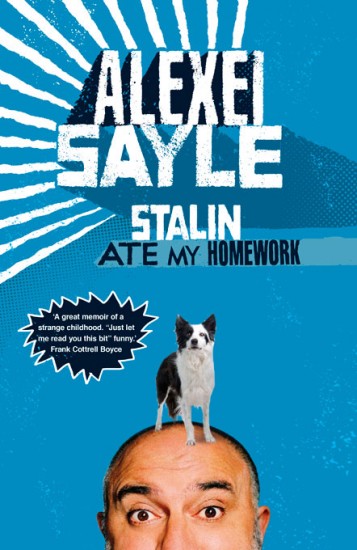
Stalin Ate My Homework - Alexi Sayle (2010)

Stalin Ate My Homework – Alexi Sayle (2010)

I’ve just finished ‘Stalin Ate My Homework’ by Liverpudlian alternative stand-up Alexei Sayle. It’s a very funny and well-written memoir of his childhood and teenage years. The only son of two Atheist members of the Communist Party, it offers a fascinating glimpse of 1950s-1960s Left politics in England. Alex’s father worked on the railways so the family were able to avail of free travel and visited the “workers paradises” of Bulgaria, Czech Republic and Hungary during the late 1960s.

From a social history perspective, it is interesting to hear of the radical groups and pubs of 1960s Liverpool:

Fortunately via the Marxist-Leninists I had finally got know the world of Liverpool’s radicals pubs. All the bohemians, the artists, the poets and the left-wingers drank in three or four boozers on the edge of the town centre … We drank in the Philharmonic Hotel, a monument of Victorian exuberance with dark wood-panelled walls, copper reliefs, Art Deco lights, a mosaic-covered floor and a bar with a huge golden eagle watching over the drinkers. Alternatively we met up in the Crack, which was the pub favoured by the arts students and consisted of lots of little rooms each with weird paintings on the walls.

During this period, Alexi was a member of the Communist Party of Britain (Marxist-Leninist) which upset his purist parents. Him and his mates pub of choice was Kavanagh’s while druggies favoured O’Connors:

O’Connors was the druggiest pub. A former chapel with doors at each end, it allowed dealers to run out one door when the police came through the other. And finally there was the one favoured by the Marxist-Leninists, named the Grapes but called Kavanagh’s by everyone. (We) drank in what was effectively a corridor, though there were two snugs, with old murals on the walls and unusual round tables supposedly taken from a sister ship of the Titanic and fire-places which blazed warmth in winter…

What caught my eye was this little anecdote of an Irish republican bank robber on the run:

All of these pubs, especially Kavanagh’s, were full of ‘characters’… There was one Irish guy who hung around with us. In Ireland this man had been a member of … Saor Eire and he was now on the run after being involved in several fund-raising bank raids. He was trying to keep his identity secret but everybody called him Irish John or alternatively ‘Irish John Who’s Been Involved In All Those Bank Raids In Ireland’. He tried to pay for his drinks with hundred pound Irish banknotes, then was quickly arrested and shipped back to Dublin. His real name was Simon.

Update:

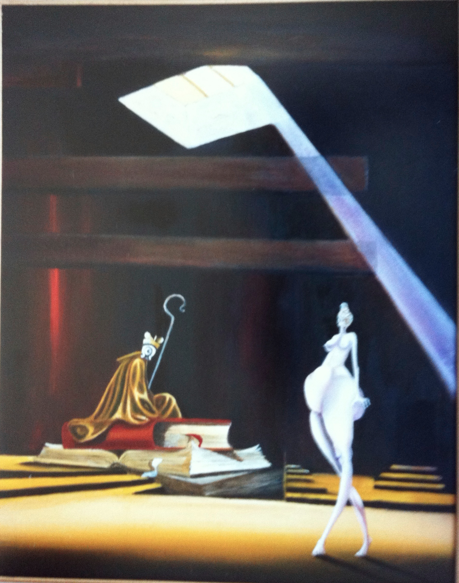
Thanks to Joe K. and Frank M. for getting in touch sending me on a copy of this painting ‘The Temptation of John Charles McQuaid’ by the aforementioned Simon.

The Temptation of John Charles McQuaid (2001) by Simon

The Temptation of John Charles McQuaid (2001) by Simon

Read Full Post »

« Newer Posts