Feeds:
Posts
Comments

Archive for May, 2013

Dublin Newsboy illutration: Luke Fallon.

Dublin Newsboy illutration: Luke Fallon.

Last night I read a piece on The History Show on RTE Radio One looking at childhood in Dublin in 1913. Interestingly, the piece focused on life in the city for children before the lockout. It was great fun to put it together, I particularly enjoyed the story of the young chancer who talked his way into an expenses paid trip abroad!

You can listen to the piece by clicking on the link above. It’s interesting to contrast the plight of working class and upper class children at the time. My thanks to the people at The History Show for the invitation to contribute something.

Read Full Post »

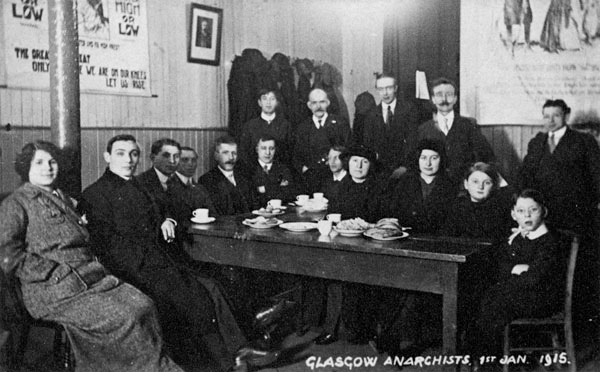
In Mairtin O’Cathain’s book ‘With a bent elbow and a clenched fist: A Brief History of the Glasgow Anarchists’, there is a short but fascinating mention of James Connolly.

Connolly’s paper, The Workers Republic, was suppressed by the authorities in December 1914 and O’Cathain writes that it was the “Glasgow Anarchist Group that took over the printing of the paper … and smuggled it into Ireland”. Apparently, the police in Britain raided several anarchist printing presses, including London’s Freedom Press, but never caught the Glasgow group.

Picture of the Glasgow Anarchist Group in 1915. Credit - ibcom.org

Picture of the Glasgow Anarchist Group in 1915. Credit – ibcom.org

In Donal Nevin’s fantastic biography of Connolly, ‘A Full Life’, there is a mention of Glasgow comrades taking over the printing of The Workers Republic. However, Nevin points to Connolly’s old colleagues in the Socialist Labour Party.  More specifically, Arthur MacManus who was the one who did the setting, composing, printing and then smuggled the copies to Dublin using the pseudonym ‘Glass’. (Belfast-born MacManus, son of an Irish fenian, later became the first chairman of the Communist Party of Great Britain and was buried in Red Square, Moscow after his death in 1927.)

As Nevin backs up his claim with a reference to C.Desond Greave’s book ‘The Life and Times of James Connolly’, the evidence stacks in his favour.

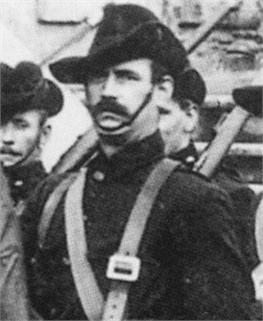
Speaking of Connolly, I’ve always liked the story of Antrim-born Anarchist and Irish Citizen Army founder Jack White traveling to the Rhondda and Aberdare valleys in South Wales to try bring the miners out on strike to save his life.

Jack White in ICA uniform, 1914.

Jack White in ICA uniform, 1914.

On 25 May, thirteen days after Connolly’s execution, White was charged with trying to ‘sow the seeds of sedition in an area which had nothing to do with the grievances of Ireland either real or imaginary’ and at a time when ‘a peaceful settlement was being arrived at’. He was sentenced to two sentences of three months.

Read Full Post »

 Perhaps the most famous example of an individual falling victim to a tarring and feathering. Boston Commissioner of Customs John Malcolm in 1774.

Perhaps the most famous example of an individual falling victim to a tarring and feathering. Boston Commissioner of Customs John Malcolm in 1774.

The process of tarring and feathering can be traced right back through history, as an often unofficial means of punishment or revenge, designed to shame the victim. Wikipedia notes that the first mention of the punishment appears in the orders of King Richard I in 1189. Looking in the archives, I decided to search for some examples of the use of the punishment form in Dublin over time.

While I expected to find many examples of people getting tarred and feathered in the revolutionary period of the early twentieth century, the late-eighteenth century also produced much, a time when there was massive political agitation in the city. Indeed, in a letter to the Prime Minister in 1785, the Duke of Rutland (then Viceroy of Ireland) complained that:

This City of Dublin is in a great measure under the dominion and tyranny of the mob. Persons are daily marked for the operation of tarring and feathering, the magistrates neglect their duty, and none of the rioters – till to-day, when one man was seized in the fact, have been taken…

Much of the tarring and feathering being done in Dublin at this time was, as Neal Garnham has noted, the work of “gangs of tradesmen and artisans” who targeted “importers of foreign goods, workers prepared to undercut the wages of their fellows, and those who informed on the actions of vigilantes.”

There was evidently a degree of popular support for the practice in Dublin. Padhraig Higgins has noted in his study of Irish politics in the late-eighteenth century that when Alexandar Clarke, a master tailor from Chancery Lane, fell victim to a tarring and feathering mob in June 1784 “a crowd of about three hundred from the Liberties” attacked his house, before dragging him almost naked to the Tenters’ Fields for the humiliating ritual.

The practice appears to have become much less common place throughout nineteenth century life in Dublin, or at least much less reported. Tarring and feathering in Dublin was not always restricted to just living people, as the hugely controversial monument of King William of Orange on College Green also fell victim. One publication wrote in 1898 of that statue, noting that “It has been insulted, mutilated and blown up so many times, that the original figure, never particularly graceful, is now a battered wreck, pieced and patched together, like an old, worn out garment.”

King William of Orange sits on College Green.

King William of Orange sits on College Green.


(more…)

Read Full Post »

Fatalities at political demonstrations in Dublin are extremely rare. Bloody Sunday during the 1913 lockout being an obvious exception where two striking workers James Nolan (33) and John Byrne (50) were beaten to death by police. There have also been some notable incidents of British soldiers shooting dead civilians such at Bachelors Walk, after the Howth Gun Running, in July 1914 or at Bloody Sunday in Croke Park in November 1920 after the IRA’s operation against the Cairo Gang.

One incident that bypassed me until recently was the death of 78-year-old Anna-Maria Fitzsimons in June 1897 at an anti-Jubilee event in Rutland (Parnell) Square.

On 19 June, James Connolly and his Irish Socialist Republican Party (ISRP) organised an anti-Jubilee meeting, under the slogan ‘Down with the Monarchy: long live the Republic’, in Foster Place which was addressed by Maud Gonne. She told the crowd that the queen’s reign “had brought more ruin, misery and death” than any other period. Students from Trinity attacked the meeting singing ‘God Save The Queen’ but were repelled by the crowd.

The following evening, the day of the Jubilee itself, Connolly and Gonne organised a funeral procession through the streets of the city as the United Labourers’ Union band played the Dead March. They carried a coffin marked ‘British Empire and a black flag inscriptions giving the numbers who had perished in the Famine and the numbers who had emigrated and been evicted during Victoria’s reign.

A convention of the ’98 Commemoration Committee was being held in City at the same time and the chairman, veteran Fenian John O’Leary, suspended the meeting so delegates could watch the procession. Some of them, including WB Yeates, joined in.

Maud Gonne and WB Yeates, nd (Credit - coreopsis.org)

George Hyde-Lees and WB Yeates, nd (Credit – coreopsis.org)

By this stage, several hundred people were following the procession and there was a small confrontation with police at College Green, where the statue of William III was wrapped with a green flag.

Mounted police reinforcements arrived from Dublin Castle and the DMP tried to disperse the crowd. Afraid that it would be taken by the police, Connolly ordered the coffin to be cast into the Liffey, shouting: “Here goes the coffin of the British Empire. To hell with the British Empire!”. At one stage, Trinity students tried to grab the crowd’s black flag but, as reported in the New York left-wing Daily People, ‘the proletariat drove the bourgeoisie home in disorder’. Connolly was arrested and taken to the Bridewell.

Afterwards, Gonne conducted an open air-slide show of scenes of evictions from a window in the National Club, Rutland Square onto a specially erected large screen opposite.

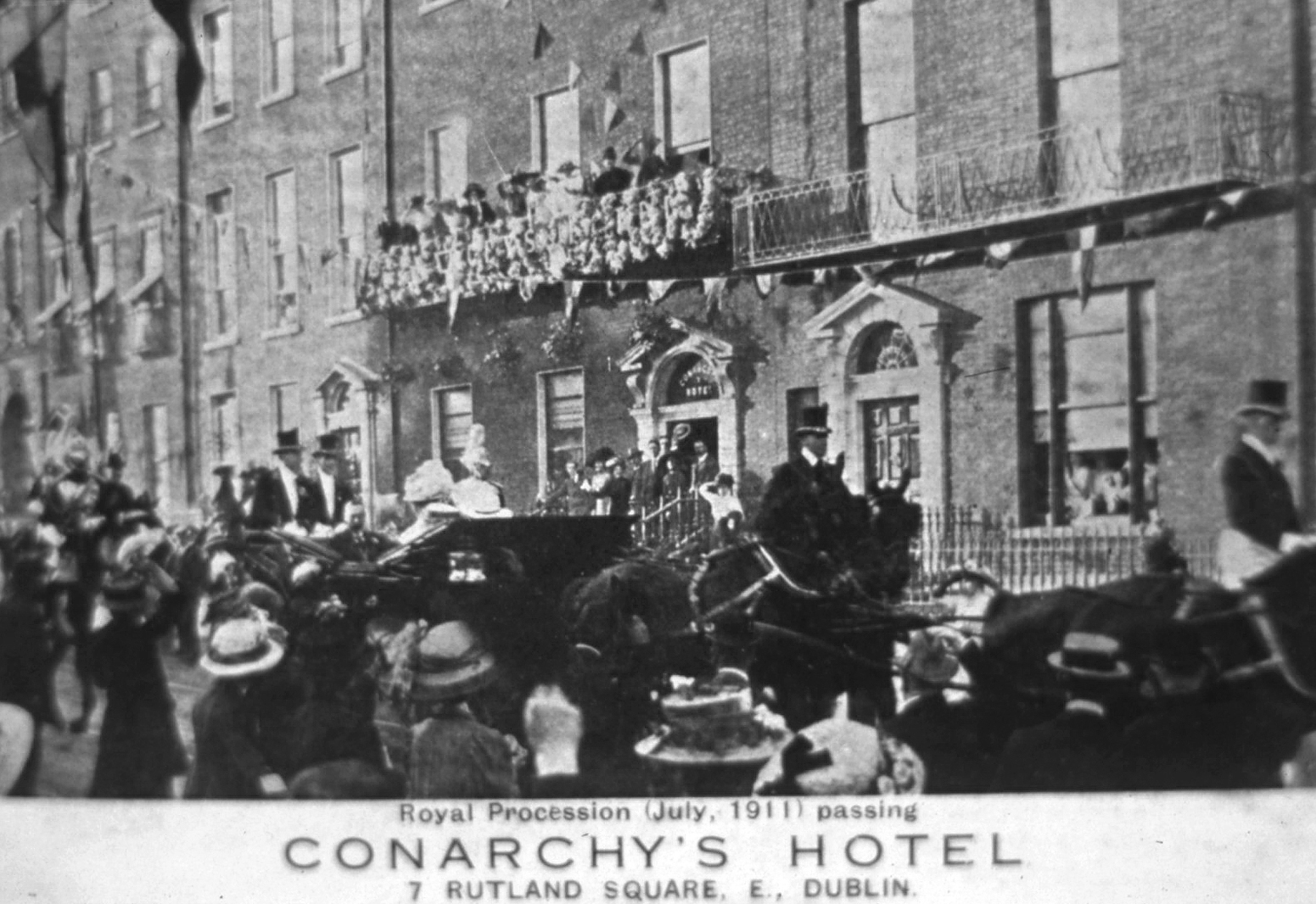
The Royal Procession passing through Rutland (Parnell Square), 14 years later.

The Royal Procession passing through Rutland (Parnell) Square, 14 years later. Credit – NAI

A large group of women and children watched the show. Maud Gonne wrote in her memoirs, A Servant of the Queen:

We were having tea [in the club] when suddenly we heard outside and cries of the ‘The police!’. I rushed to the window. Some twenty policemen with batons drawn a few people, mostly women and children, were running in all directions; a woman lay on the ground quite still; a girl was bending over her; someone called out ‘The police have killed her’.

The dead woman was Anna-Maria Fitzsimons from Cabra Road.

At the City Coroner in Jervis Street Hospital the following Saturday, her daughter told the inquest that herself and her mother came into town to see the ‘illuminations’ at Rutland Square. They walked up from Nelson’s Pillar, crossed at Cavendish Row and up to Rutland Square. They saw a number of people carrying flags and coming up from the direction of Sackville Street. The police baton charged the crowd and Anna-Maria was knocked down in the disorder that followed. She died later in hospital.

Does anyone know of any other deaths at political demonstrations in the 19th or 20th centuries in Dublin?

Refs:
The Irish Times (3 July 1897)
Donal Nevin, James Connolly A Full Life (Dublin, 2005)
James H Murphy, Abject loyalty: nationalism and monarchy in Ireland during the reign of Queen Victoria (Cork, 2001)

Read Full Post »
A recent post looking at some cartoons printed in the Sunday Independent during the Lockout proved popular, and in reality the cartoons we selected were only a small percentage of those that appeared in the publication. Cartoons were a form of propaganda used by both sides in the dispute, and these cartoons always ran on the front page of the newspaper. All the cartoons I have chosen for this post come from 1914, as the dispute dragged into that year before ending in failure for Larkin’s movement. The cartoons are the work of Frank Rigney, cartoonist with the Sunday Independent.

This cartoon from the month of February focused on the issue of pay for DMP men. The role of the DMP in the dispute, and in particular the events of Bloody Sunday in August 1913, ensured that their place in Dublin folk memory would not be as a revered force. The paper staunchly defended the actions of Dublin policemen during the months of strife.

1 February 1914

1 February 1914

In the same edition of the paper, this cartoon appeared, which called for a tough approach to be taken against the mob’s darling. This sinister cartoon draws parallels with the labour situation in South Africa, where military force had been used against the union movement there. A contemporary newspaper report on events in South Africa can be read here.

1 February 1914

1 February 1914

The paper routinely attacked Larkin and other ITGWU leadership figures as leading dupes into battle. A cartoon posted in the last series we ran here showed a worker awakening from the nightmare of socialism, while here the ‘Wellvpaid Socialist Leader’ is seen directing the vote of a blindfolded worker.

11 January 1914

11 January 1914

(more…)

Read Full Post »

« Newer Posts