The 1902 strike was one of the bitterest and strongly fought in the city’s history. Led by the Amalgamated Society of Engineers (ASE) and over the issue of wage increases, the strike lasted 25 weeks. The following extract, regarding the issue of British scabs, recently caught my attention. It is from Hugh Geraghty and Peter Rigney’s excellent article ‘The Engineers‘ Strike in Inchicore Railway Works, 1902‘ from Saothar Volume 9.
The blacklegs at Inchicore were housed in wooden huts built inside the works wall … They worked the normal fifty-four hour week for thirty shillings and all efforts were made to keep them content – “They left the work by train to Kingsbridge”. Bed, board, tobacco, ping-pong, piano playing, air gun practicing, skittles, cards and dominoes”
Nevertheless, they lead what was described as ‘prisoner of war’ existence, being unable to leave the works, even in groups and under police protection, without being attacked by the people of the area. On June 7 for example, four scabs were out walking, accompanied by policeman. They were attacked by a group of strikers and beaten, one being hospitalised. On another occasion, an attempt was made to set fire to the scabs’ living quarters.
As the summer progressed, an English or Scottish accent became a dangerous attribute in the Inchicore area. Three innocent Englishmen, employees of Guinness, were beaten while walking up Inchicore Road, being mistaken for scabs.
Billy Walker, a retired fitter whose father was on strike, recalled some incidents:
“They were about to hang a scab on the lamp-post opposite Cleary’s pub. Father Ryan saved him. The RIC came along then and my father would have been arrested expect Mrs. Tuite pulled him into her house. Mick Flynn threw a scab off the top of the tram, he got six months, but a job later in Broadstone”.
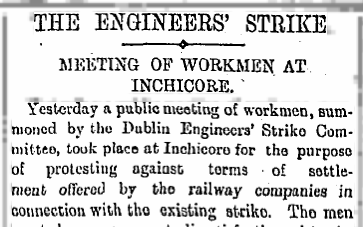
The Irish Times. Monday, July 28, 1902.

 Click on the book for more.
 Click on the book for more.
 Donal
Donal Ciarán
 Sam
Sam


 Come Here To Me!
Leave a comment