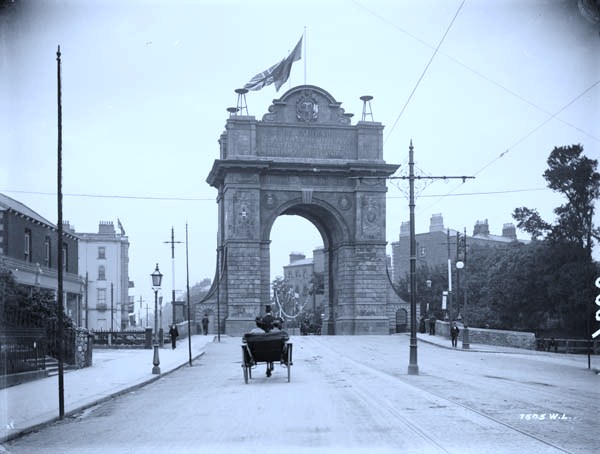
Dublin City Gates?
The large mock medieval castle gate and tower erected at the bridge echoed the more ancient gate to the walled city of Dublin. The 70 foot high tower made of wood, covered in canvas and painted to imitate the 16th century stonework of medieval Baggotrath Castle. A number of beefeaters in their tradition costumes flanked the gate and a stand was erected nearby to seat various dignitaries…
An image of the above gates can be seen below, as found here.

Leeson Gates, as from Chapters of Dublin
As you can see the two gates look very different- but the top one definitely looks like Leeson Street Bridge if you were heading towards town from the UCD direction. The visit of Queen Victoria to Dublin was a momentous one. An estimated 200, 000 lined the streets of Dublin and the occasion was marked by declaration of a public holiday. The Queen was presented with the keys of the city from the Lord Mayor and was given a rapturous welcome from the students of Trinity College as she passed by on her way to the Phoenix Park.
–
If anyone could shed any light on the first gate, an e-mail to ci_murray@hotmail.com would be much obliged. Alternatively, you can comment on here.

 Click on the book for more.
 Click on the book for more.
 Donal
Donal Ciarán
 Sam
Sam


 Come Here To Me!
maybe Dublin versions of Potemkin Villages………
Catherine II, who ruled Russia from 1762 to ’96, did indeed make a grand tour of the Ukraine and the Crimea in 1787, and her former lover Prince Grigory Aleksandrovich Potemkin did lean on the peons to spruce things up in time for her arrival. Contrary to legend, though, there’s no evidence that he (or anyone else) manufactured the phony villages that are now so firmly linked to his name.
An ambitious cavalry officer, Potemkin contrived to make Catherine’s acquaintance during the coup that brought her to power. (She deposed her incompetent husband, Peter III, just six months into his rule, and he was murdered less than two weeks later by the brother of her current boyfriend, Grigory Orlov.) During the Russo-Turkish War of 1768-’74, Potemkin distinguished himself by dint of his valor, and he became Catherine’s lover in 1774. The couple’s romantic relationship lasted less than three years, but they remained close the rest of their lives. Catherine appointed him to a series of important posts, eventually making him governor-general of “New Russia” (southern Ukraine and the Crimea).
In 1783 Russia had annexed the underdeveloped Crimea, and Potemkin resolved to make it the showplace of Catherine’s empire. He founded the Black Sea naval port of Sevastopol, effectively giving Russia a southern coast; established several more towns, an arsenal, and other public works; built a formidable war fleet (15 ships of the line and 25 smaller vessels, by one account); induced tens or possibly hundreds of thousands of settlers to colonize Russia’s new southern lands; launched agricultural and manufacturing enterprises; and generally performed one prodigious labor after another. Meanwhile he bedded countless women–possibly including, if one can believe biographer Simon Sebag Montefiore (Prince of Princes: The Life of Potemkin, 2000), his five nieces. (And Montefiore is an admirer.) One reads of his life and thinks: I’m going to quit complaining about how I don’t have time to get the garage cleaned out.
From the outset Potemkin planned to show off his accomplishments to Catherine and, equally importantly, to the European powers represented at her court. Given the gigantic scale of the work and the limited time to carry it out, one can’t be surprised that the odd village, road, palace, etc, wasn’t completed on schedule. Russia being Russia, it was also deemed necessary to greet Catherine with an ostentatious display at every stop on her tour of inspection–a regiment of 200 beautiful sharpshooting amazons here, 20,000 rockets and 55,000 burning pots spelling out the initials of the empress there. All this required a certain amount of stage management beforehand. (Much the way Anytown, USA, cleans house before George W. arrives.) Orders went out to hide beggars, paint facades, and perhaps erect the occasional false front to conceal the occasional hovel.
That said, there’s no reason to believe Potemkin ordered the construction of entire pasteboard villages on the banks of the Dnieper (much of the royal progress was conducted via riverboat); imported peasants, flocks, and herds from a thousand other villages to make a show of prosperity, thereby triggering famine in the depopulated hinterlands; or, once the procession had passed, dismantled the entire meretricious apparatus and reconstructed it several versts downstream (one verst is about two-thirds of a mile) in order to deceive the imperial court anew. These tall tales originated with the Saxon envoy to Catherine’s court, Georg von Helbig, who was not, safe to say, Potemkin’s bud. Von Helbig did not make the trip to the Crimea, but in his diplomatic dispatches (and in a Potemkin biography completed almost a decade after the man’s death in 1791) he evidently passed along gossip circulating in the Russian capital at Saint Petersburg. Shows you the power of the written word. Though Potemkin may have tarted up reality a bit, he did in fact build the fleet, arsenal, ports, and so on that dazzled Catherine’s court. But thanks to von Helbig’s coinage Potemkinsche Dörfer (“Potemkin villages”), the prince’s name is known to posterity as a synonym for sham.