Great stuff via Humourisms.com , of the often forgotten day in Dublin’s history when Alan Rickman briefly occupied the GPO. Die Hard is a far superior film to Michael Collins of course, but guess which one you get free when you join Young Fine Gael on Fairs Day in Trinners?
I had to laugh when I saw this doing the rounds on Facebook.
Irish Rail are currently asking commuters to vote for their favourite station, based on issues such as station presentation and services. A campaign of sorts has sprung up behind Broombridge station. Anyone who has been through Broombridge station will know it is beyond the words ‘awful kip’, a station neglected while those around her have been modernised, she continues to crumble, the very station sign telling you where you are difficult to read.
I would like to ask you to take a moment and vote for Broombridge as station of the year. Once more this humble Dublin station has excelled and deserves our recognition, it shuns many of the newfangled modern ideas in transport like ticketing and not being on fire and has once more outclassed the rest by just being two poorly guarded concrete platforms.
Brrombridge winning the ‘Best Station’ award would draw some attention to the sheer state of the place, and be the best coup for a public vote campaign since the BBC had to award the Wolfe Tones the best song of the last century. Go over here and give it a minute.
Downey’s pub, formerly of 108 Upper George’s Street, Dun Laoghaire, has the dubious title of being host to the world’s longest ever strike. It began in March 1939 and ended in November 1953, lasting a total of fourteen years and eight months.
The trouble started when the unionised bar staff objected to a senior male assistant being let go and a non unionised barmaid taking his place. The owner James Downey’s response was, as apprentice Con Cusask remembers, to “sack all of his staff and replace them all with non-union labour”.
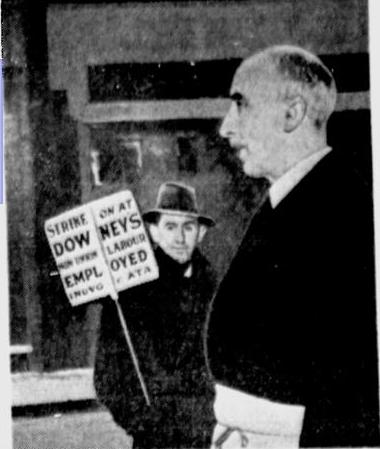
In reaction, the Irish National Union of Vinters, Grocers and Allied Trades Assistants put a picket outside. Here on, from 10am to closing, they tramped up and down outside carrying their battered placard: ” Strike On at Downey’s.”
James Downey stands at the door of his pub with striker in foreground. (c) The Age
After five years on the picket, Con Cusack left to find work elsewhere and two years after that Patrick Young (the barman dismissed) also found new employment. Undeterred, the union continued to send on picketers for the next seven years. In total, it is believed that they walked a total of 41,000 miles altogether.
The strike was featured in newspapers and periodicals around the world including Time Magazine. It was said that tourists used to go out of the way to visit the pub to see for themselves if the “everlasting strike” was still going strong. (This prompted some to suggest that Downey was paying the strikers in order to attract the tourists!)
On 20 March 1943, the German U-boat U-638, commanded by Kapitänleutnant Heinrich Oskar Bernbeck stopped the Irish Elm ship. Rough seas prevented the Elm‘s crew from pulling their rowboat alongside the submarine to present their papers, so the interview was conducted by shouting. During the course of the conversation, the Elm‘s Chief Officer Patrick Hennessy gave Dún Laoghaire as his home address which prompted Bernbeck to enquire whether “the strike was still on in Downey’s”. [1]
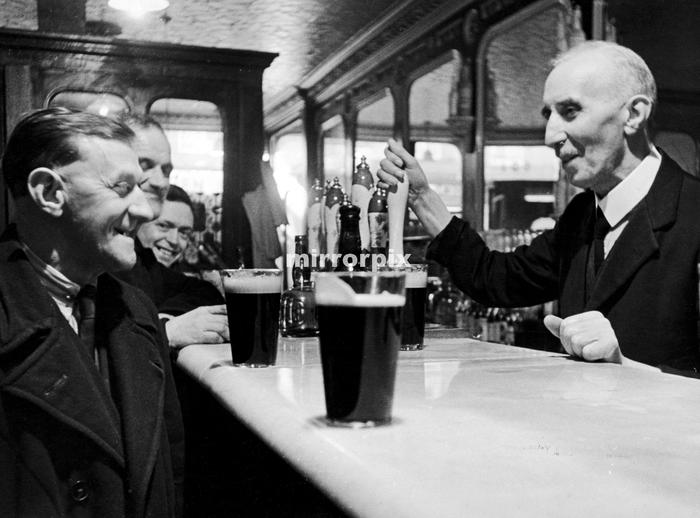
Landlord James Downey serving a pint to one of his regulars. 16th February 1948
On the anniversary of the start of the strike, March 3rd, Downey would host a party in the pub and allegedly would even ring up the union to tell them if the picketers weren’t there when he opening up.
Downey, a former boxer originally from Laois, died in May 1953 at the age of 79. The strike finally ended in November after an agreement was reached with the new owner. In July 1958 the premises was bought by Hugh Larkin, proprietor of the Royal Hotel in Arklow and Flynn’s pub in D’Olier Street. It was put on sale again in April 1963 and bought in February 1964 by the Dublin supermarket company of W.H. Williams Lt.d for a five-figure sum. It was demolished to make way for the Dun Laoghaire shopping centre in 1976.
—
[1] Frank Forde, The Long Watch (Dublin, 1981), 56
Great stuff this from ADW, in support of First Fortnight, Dublin’s arts-based mental health awareness project in its third year. You can check them out online here.
Recently, an ADW piece across the river Liffey on Middle Abbey Street in memory of Gil Scott-Heron featured on the site here and was warmly received, only to vanish almost as quickly as he painted it. Such is life, such is street-art.
One of my favourite websites to check in on almost daily is the Flickr account of the National Library of Ireland. It’s ‘Pic of the Day’ feature has thrown up a great many gems, not only from the capital but throughout the country, pictures which often are of special interest to those of us with a keen interest in social history.
Recently, they uploaded a picture of what they described as a “very ornate” urinal on Ormond Quay, dating from 1969 and in black and white.
It was soon followed by a great colour photo, believed to be from 1973, showing the same urinal this time with ‘The Eagles’ scrawled across it. I actually cringed upon seeing that, a bit like you would if one of your parents featured in the recent ‘Where Were You?‘ sporting skinny jeans.
Interestingly, a comment suggests that these style urinals were “imported prior to the 1932 Dublin Eucharistic Congress as part of a ‘clean up Dublin’ campaign.”
Sadly, the public toilets of Dublin are no more and those in need of a wee are advised to make for the nearest McDonalds, glance at the menu briefly for the security lad thinks you’re pondering a purchase, and then make a move when you have him off guard. We’ve come so far as a city.
The line-up was the Dubliners, Peggy Seeger/Ewan MacColl, and Joe Heaney – Half the audience was sleeping drunk. The other half was rowdy drunk. The concert was broken into two halves, and each of the three acts was to appear in each half. Joe, being the ‘less well known’ was to open. He was booed off by this despicable crowd after the first two lines of his first song. It is to our eternal disgrace that we other artists went on after he was forced off, almost in tears – I am sure the lack of appreciation in Ireland for Joe Heaney at that time was one of the reasons that he emigrated.
The above comes from Peggy Seeger, wife of Ewan MacColl, recalling a 1964 concert in Dublin at which sean-nós singer Joe Heaney of Connemara would be met by loud boos from a crowd who were wildly enthusiastic for the more moden traditional sounds of the likes of The Dubliners. It was an amazing moment in the history of traditional music in the capital, a culture-clash of sorts, and all the more remarkable today when one considers the fact Joe Heaney’s face is now beaming down from the walls of O’Donoghues, considered a legend of the traditional scene.
Born in the Carna, in the Galway Gaeltacht, Seosamh Ó hÉanaí arrived into the world in 1919. Over the course of his life he would spend much of his time living and working in Britain and even as a doorman in New York City, where he could be found at 135 Central Park West. There’s a wonderful story of one American walking into O’Donoghues establishment and being baffled to see his doorman Joe upon the walls. Towards the end of his life he even became artist in residence at the University of Washington in Seattle, before his death in 1984.
His contribution to Dublin life however, is huge. He was a core part of the O’Donoghues folk and trad renaissance. While the pub has undoubtedly changed and morphed in recent times for better or worse, his image is still there alongside the likes of Ted Furey, The Dubliners and the pubs legendary owners Maureen and Paddy O’ Donoghue on the walls of the pub today.
In Liam Mac Con Iomaire’s excellent study Seosamh Ó hÉanaí – Nár fhágha mé bás choíche, published by Cló Iar-Chonnachta,one image in particular is striking. A banner, draped across the O’Donoghues side entrance, reads ‘FÁILTE ROMHAT JOE’, upon a return home.
Yet while those who booed Heaney off stage in 1964 were probably wildly singing along to Seven Drunken Nights, it’s unlikely any would have been familiar with Heaney’s Peigin is Peadar which predates Seven Drunken Nights, yet contains the very roots of the song. It was unsurprising that when booed by the crowd in 1964, Ronnie Drew himself would reprimand the audience for their disrespect to a singer The Dubliners considered a core influence.
Pheigín na gcarad a Pheigín mo chroí
Cé hé an fear fada údan sínte leat síos?
O a hó, a hó mhaithín ó; A hó mhaithín ó, a stóirín mo chroí.
Muise, a Pheadair na gcarad is a Pheadair mo chroí
Sin é do leanbh nach bhfaca tú riamh.
O Peggy my dearest, O Peggy of my heart
Who is that long man stretched out next to you?
O, my goodness, little treasure of my heart.
That’s your own baby you never saw before.
Liam Mac Con Iomaire’s study of Ó hÉanaí (written in the Irish language, with quotations in English, and coming with a CD of Seosamh singing) warrants reading not just for those interested in his own musical history but also getting a better understanding of the scene in Dublin around that time.
Éamonn Ó Bróithe is quoted as saying
The mood of the pub was further invigorated by many from literary and theatrical Dublin who came to enjoy the music. The general mood of ’60s’ optimism prevailed, and one notable effect was the breaking down of social barries and differences between town and country engendered by a common appreciation of the music
It is worthy of note that Seosamh managed to find his way into Andy Irvine’s take on those days in O’Donoghues.
Joe Ryan and John Kelly in the front bar,
their fiddles are from the County Clare.
Joe Heaney sings in the cold night air
in the laneway after closing….
BELOW: Ewan MacColl in conversation with Seosamh regarding his advice to young singers, in which he asks would young Dubliners be welcome in Carna to learn.




 Click on the book for more.
 Click on the book for more.


 Come Here To Me!