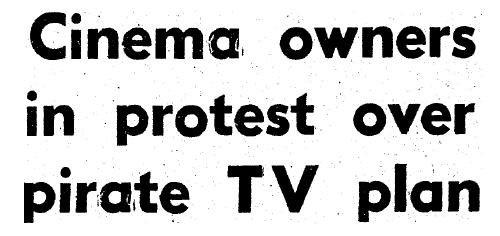
The Irish Press, April 15 1981.
In the past, we took a brief look at some unusual Dublin pirate radio stations here on the site, such as Radio Jacqueline, a 1967 schoolboy effort which made its way into the national media.
With RTE television turning 50 this year and much nostalgic feeling coming with that, perhaps some of you will remember Channel D, the first Irish pirate television station which popped up in April of 1981. Channel D, subtitled as ‘Independent Television Dublin’, lasted only a number of months due to pressure from state forces, and ultimately failed to establish any sort of loyal base like the pirate radio stations had succeeded in doing. Jim Reidy, one of the stations directors, and ‘Doctor’ Don Moore were among those involved with the station. Don Moore had played a leading role in the development of the pirate radio format in Ireland. Indeed, many involved in the earliest pirate television efforts in this city had come from that background.
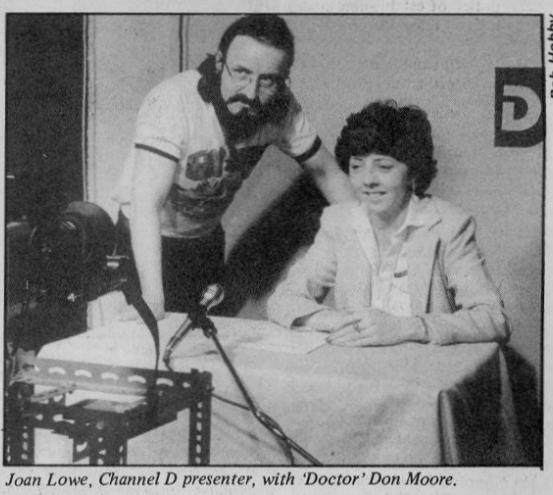
Channel D snap from In Dublin (scanned by daxarchive.com)
Even prior to Channel 3 (as the station was first known) taking to the small screen, the buzz around the station led to The Irish Press of April 21 1981 reporting that:
“All the means at its disposal” are to be used by the Department of Posts and Telegraphs to prevent the operation of the country’s first pirate television station which intends to start transmissions from north Dublin in the next few days. Action, in the form of the seizure of equipment, will be taken against this unlicensed station in others in Cork and Limerick which also mean to begin operations soon.”
Some of the fears around the stations had come about as a result of cinema owners taking to the media and complaining of their fears of uncensored films being shown on such stations. Jack Bourke, an owner of two cinemas, told The Irish Press that if films were to be shown on pirate television uncensored or prior to their cinema release, “cinemas will close or we will not bother about submitting films to the censor.” This led to a situation where a Limerick based consortium planning to soon commence pirate transmissions found themselves telling the national media they were prepared to submit their films to the film censor, Frank Hall.
It was April 25th when Channel 3, the nations first pirate telly station, took to the air. This was an incredible new experiment for those involved of course, which brought all sorts of difficulties with the task. An In Dublin feature on the station that summer noted that with these earliest transmissions:
The signal was weak, the reception in black and white and the frequently-repeated material irritating. One observer described the operation as ‘amateur-land’. But somebody, somewhere, had succeeded in putting a picture on my screen.
In its infancy, the station was broadcast out of the Camelot Hotel on the Malahide Road, and was only obtainable within a five mile radius of that location. Still, despite its incredibly small potential audience, it grabbed the national attention through the newspapers of the day. The station went to great lengths to stress the fact it didn’t want to be seen as a threat to the national broadcaster, with a spokesperson telling The Irish Press that the station only went on air after RTE had ceased transmission and that “we are not posing a threat to anyone.”
The Irish Times was completely correct when it stated that Channel D was “strangled at birth”, with a High Court settlement see ing the station banned from showing any films less than thee years old. The station had planned to show ‘Kramer versus Kramer’, but alas this wasn’t to be.
So, what did they show? Irish-TV.com notes that that it was said that Channel D’s stock of video cassettes was “burnt out in a ‘freak’ accident at a Dublin petrol station, so Channel D constantly repeated the same film, No.1 of the Secret Service in the evenings and a magazine programme filmed on a domestic camera in the day.” Also broadcast with great frequency was Don’t Swim on the East Coast by The Sussed. The song was about the Windscale Nuclear power station, Sellafield to me and you today.
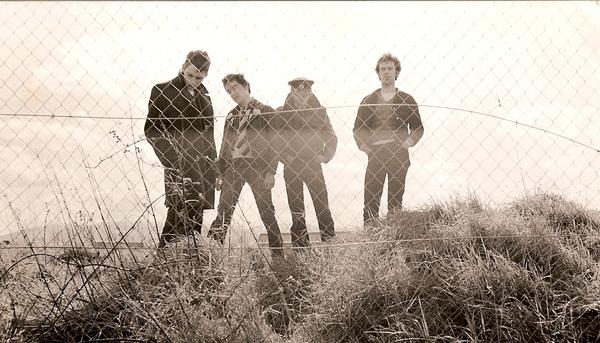
'The Sussed', taken from the bands MySpace account.
The In Dublin feature noted that “broadcasts begin very suddenly, without any ceremony. The equipment consists solely of a video-cassette recorder linked to a transmitter and thence to an aerial in the roof.” By the time the In Dublin feature was written in August of 1981, the station was broadcasting from the State Cinema in Phibsborough. The feature noted that “Channel D is financed by a large consortium of business interests whose main concern was to provide Dublin with local independent television at no extra cost to the viewers, since funds would be generated by advertising.”
Ultimately, Channel D was not the success it could have been, with state interference and poor equipment to blame. The station had ambitious plans which even included breakfast television, unheard of in Ireland at the time. Other pirate television stations would follow, with Radio Nova attempting to make the leap to the format too, but like Channel D these efforts would be shortlived.
At the time when Radio Nova attempted the move to the small screen, chairman of the RTE Authority, Mr. Frank O’Donovan, described pirate telly as nothing but “a two finger excercise to the government, to RTE and to the law of the land.” These stations represent a fascinating and forgotten piece of Dublin’s social history.
——————-
Sources consulted:
Newspaper archives
The DX Archive ( a brilliant site dedicated to pirate radio)
Irish Rock Discography

 Click on the book for more.
 Click on the book for more.


 Come Here To Me!
My memory of Nova TV was of it arriving with great fanfare with a front page story in the Herald including a pic of a “washing machine-sized” transmitter(?).
They were quite soon raided by the Gards and had all their equipment seized.
Aagghh fkg Sussed – spotty teenagers mimicing Geldof and still cudn’t make anything of themselves even tho related to puiblisher of Ireland only muisic magazine. All they did was graffitti their band’s name around their neighbours walls and wonder why they were disliked.
Somewhat related to Blue In Heaven and the scandalous photo which even back then was immature and pathetic.
There was also Boyneside TV in Drogheda which ran from November 1981 to April or May 1982. Not the most exciting programming, with the afternoon spent watching the DJ on Boyneside Radio, then news & sport at 6.15, and finally “locally produced programming” until closedown around 7.30pm. Still it upset RTE enough for them send up a transmitter van to jam the signal.
There was also Capitol TV from Milltown (connected with Capitol Radio) which broadcast a test card for about a week in 1982(?). Eamon Cooke, the sicko owner of Radio Dublin also claimed to have put out a TV test but I have never met anyone who saw it.
Outside Dublin there was the Irish language Telefís na Gaeltachta in November 1987 – this was broadcast to Connemara, and can be seen as an early TG4. In December 1988, transmitting from three different sites, they put out a few more programmes.
And Limerick had RLO TV around twelve years ago. The company who ran Radio Limerick One lost their franchise and went pirate. Around the same time they got a licence for a satellite TV channel, which “unknown people” then rebroadcast to Limerick. Much of it was relays of Britain’s Channel 5 TV.
Could be wrong but I have vague recollection of seeing this movie on pirate TV , think it was on pretty much every night for a while :
http://www.imdb.com/title/tt0069786/
I also remember something else with a pick-up truck with machine gun mounted on it and Mexican villains … does that narrow it down a bit ?
http://historical-debates.oireachtas.ie/D/0290/D.0290.197604280023.html Ballyfermot famously had a few runs at community television in the 1970s / 1980s – the link is to a response by the Minister for Communications, Conor Cruise O’Brien – to a Dáil question about the station.
I have heard a story that the first station in the area was in part enabled by an aeriel that was brought in from Germany and had been used to direct planes during the airlift of material into Berlin before being decommissioned and ending up in Ballyer. Here it was used as part of a deflector cable system which also saw a community channel available in the area on cable.
As somebody who works in radio I find the early 80s pirates fascinating – I wasn’t on the scene till some years later but I would still know some of the names.
Some of the names behind Channel D were colourful characters – think Delboy and Arthur Daley with Dublin accents 🙂
Combine that with the Irish tendancy to have splits in every movement and organisation ever and you’ll see how Channel D were always going to find it tough going.
There are some youtube clips of it – including a very funny ad starting ‘Doctor’ Don Moore trying to flog sofas!
(Don Moore is now a psychic with healing powers. Apparently!).
Careys attempt at Nova TV was more a sign of his out of control ego mania than any real effort to program Tv – and probably did him more harm than good as a paranoid RTE soon starting jamming both of his radio stations off the air – leading to financial losses, the row with the NUJ and the beginning of the end of his radio empire.
I remember watching Channel D as a kid. My brother built an aerial which covered the entire attic – he used to get German TV with it sometimes – and one night we watched a movie on Channel D about a man who became a tree. The actor in it I later recognised as Jason Robards, so i’m guessing that the movie I watched 31 years ago on pirate TV was this one:
http://www.imdb.com/title/tt0071867/
Mr. Sycamore (1975).
The movie shown over and over again was No1 of the Secret Service, a low budget James Bond and who can forget Brian Dick presenting Dublin Profile with special guest Mary Harney
[…] an easy to miss firemark in Kilmainham , some political art from Jim Fitzpatrick, the story of pirate television in the capital, Illustrated London News coverage of the War of Independence, when Hopalong Cassidy […]