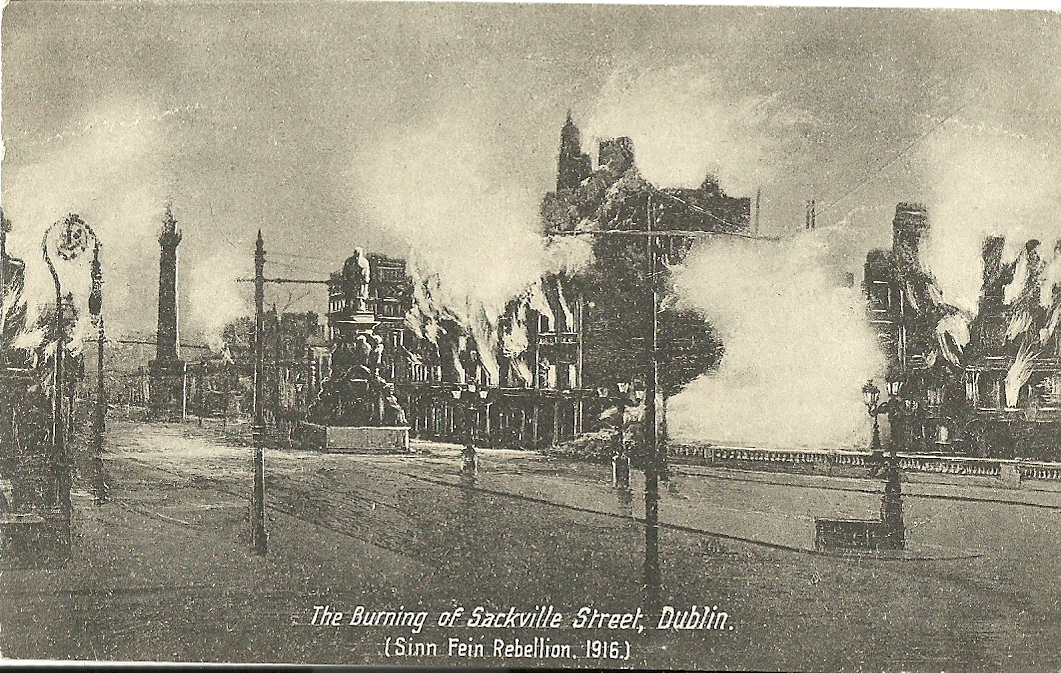
Sinn Féin Rebellion Postcard (Fallon collection)
In 1966, the then President of Maynooth College, the Right Rev. Monsignor Gerard Mitchell, invited the surviving members of an Irish Volunteers contingent who hard marched from Maynooth into Dublin to partake in the 1916 Rising to the College. There, a mass took place celebrated by an Fr. Tomhas O Fiaich, the Professor of Modern History at Maynooth.
It was a far cry from the last time some of those Volunteers had set foot in Maynooth College. In 1916, led by Domhnall Ua Buachalla (later the Governor General of the Free State) , a group of local Volunteers found themselves in a very different situation. ‘The movement’ as far as the Irish Volunteers were concerned, was quite well organised in North Kildare, and Lieutenant Eamonn O’ Kelly of the Volunteers arrived in Maynooth on Holy Thursday. He was aware of the plan for an insurrection on Easter Sunday, after being appointed to his position as a County Organiser by none other than P.H Pearse.
O’ Kelly had plans for the North Kildare Volunteers. He told Domhnall Ua Buachalla, the local leader of the force, to assemble his men on Easter Sunday in Maynooth town, and from there proceed to Bodenstown Churchyard, to meet with other Kildare Volunteers. Writing of his memories of this in 1926 for An tÓglách magazine (‘The Maynooth Volunteers In 1916’) Commandant Patrick Colgan noted that “Each man was asked if he was prepared to take part in the insurrection and each man agreed”
Counter-orders caused confusion, and Colgan noted that no sooner had the men committed themselves to a rising than word came through via a dispatch from Dublin that the mobilisation was called off. It would be Monday evening before they knew for sure an insurrection was underway. The men were armed, though they didn’t carry rifles- but rather single shotguns and roughly 40 rounds of ammunition.
“Many of us had never handled a gun prior to this and much practising in the loading and unloading of our weapons now took place” Colgan noted.
It was 7.15pm on Easter Monday before the men left Maynooth. By this stage, the Rising was well underway in Dublin and key positions had been seized by the rebels.
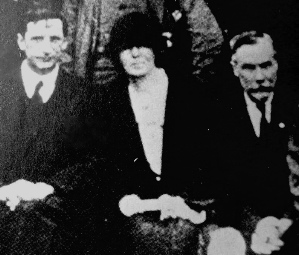
Domhnall Ua Buachalla, seated on right.
Before leaving Maynooth, the men proceeded through the main street to the College.C olgan noted that “..there were rumors to the effect that some of the students were anxious to join us” and the Volunteers also wanted to interview one of their own who had answered the original mobilisation call. “Our quest for this employee brought us to the building occupied by the late Very Rev. J. Hogan , D.D, President of the College” The President called on Domhnall O’ Buachalla to return home and to see to it his fellow Volunteers did the same. Undaunted, the men marched out the south-east gate of the College, and were now on route to Dublin.
The men proceeded to follow the Royal Canal to Leixlip, and from there take to the railway tracks. The men would march through Glasnevin Cemetery on route to the action, and Colgan noted that it was shortly after this point that they would encounter the first sign of the insurrection- two Volunteers armed with rifles on cross Guns Bridge.
Making their way to the General Post Office, it was the face of James Connolly that would first greet the Maynooth men. “We must have appeared as a motley crew of warriors to him, yet the welcoming smile which he gave us made us feel very full of ourselves”
They were to provide relief to the Citizen Army men who were surrounded at the Evening Mail office. Their journey there was nothing if not exciting, owing to the old man guarding the toll bridge. Demanding the toll, which the Volunteers did not have to hand, it was not until Lieutenant O’ Kelly drew a revolver that the man capitulated. Later, when coming back to the southside of the city, Colgan noted that “…following the example set me by Lietenant O’ Keely I presented my .32 revolver and recieved a free passage”
These men had fallen into trouble, owing to the difficulties of the ICA at City Hall, where Captain Sean Connolly had fallen, and British forces had seized the Hall early on. City Hall had been abandoned, with William Oman of the ICA noting that on seeing the mobs in Werburgh Street “..cheering the troops” the men with him had decided that “..each man should take his chance individually in getting away” He would ultimately end up in Jacobs, where a handful of other ICA men were to be found having retreated from Davy’s pub at Porotobello Bridge.
The Maynooth men that arrived on the scene then found themselves seizing the Exchange Hotel on Parliament Street. They themselves would come under fire from Dublin Castle. Patrick Colgan found himself returning to the rebel HQ at the GPO to inform Connolly that only Domhnall O’ Buachalla was armed with a rifle at the Hotel. Ultimately, it was only a matter of time until these men would end up back at the GPO, after a retreat up Temple Lane, which Colgan noted was the only time he had ever “….come near to breaking an athletic record”
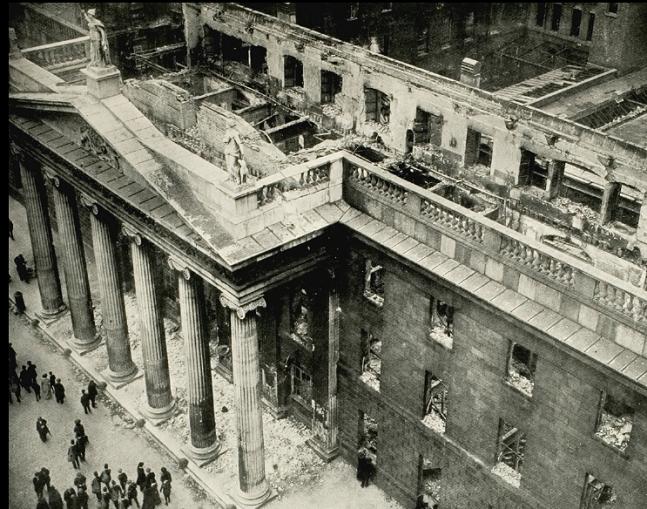
Ruins of the GPO, August 1916
The men would assist in the defence of the General Post Office, and Patrick Colgan would later end up in The Coliseum building on Sackville Street, but was to be captured on Liffey Street later. He described encountering an “extremely decent” man named Boland, of Carlow, who he stated was somewhat sympathetic to the “Finn Shaners”, yet confused they had not waited until Irish men had returned from the War.
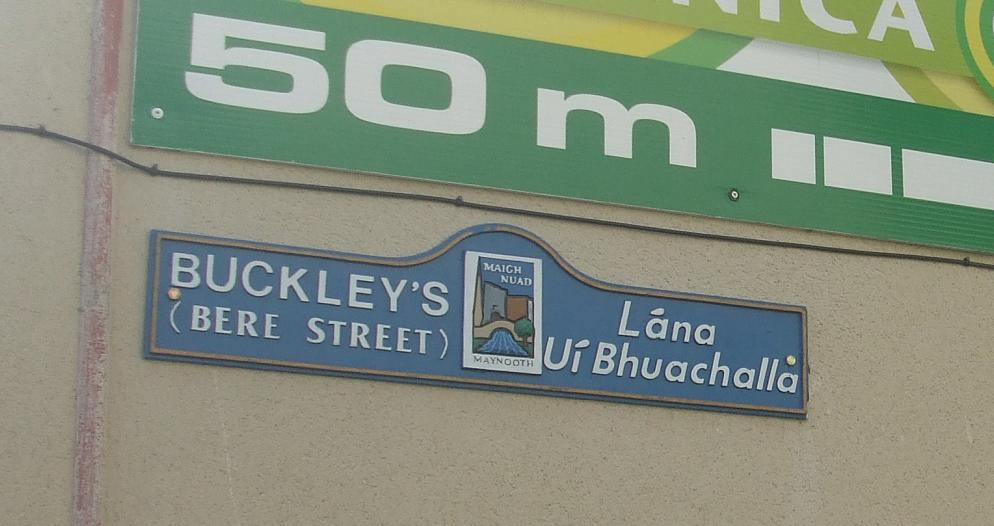
In 1966, Thomas Harris, Patrick Weafer, Timothy Tyrell, Joseph Ledwidge and Jack Maguire found themselves as guests in Maynooth College. Today, in the town square, a monument stands to them and the other men who assembled in Maynooth in 1916 to partake in the rebellion. Interestingly, the official report into the rebellion and its aftermath noted that there was now significant support for Irish seperatists in Maynooth, something not present before the rebellion and exections of the leading figures.Domhnall Ua Buachalla would be elected a Sinn Féin TD for Kildare in 1918. The family hardware store in Maynooth, founded in 1853, remained in operation until 2005. Buckley’s Lane is named after him today. Many of the other Maynooth men also remained active within the republican movement after being released for their roles in the Easter Rising.
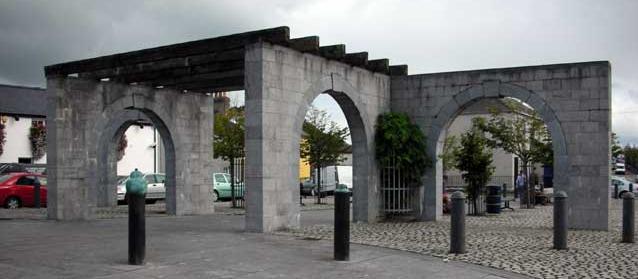
The square where the 1916 monument is located

 Click on the book for more.
 Click on the book for more.
 Donal
Donal Ciarán
 Sam
Sam


 Come Here To Me!
[…] and to Jervis St Hospital (picking up four of the Maynooth Fifteen along the way, but that’s another story). As the wounded left the GPO, the mobilisation of the rest was being planned. The new rebel […]