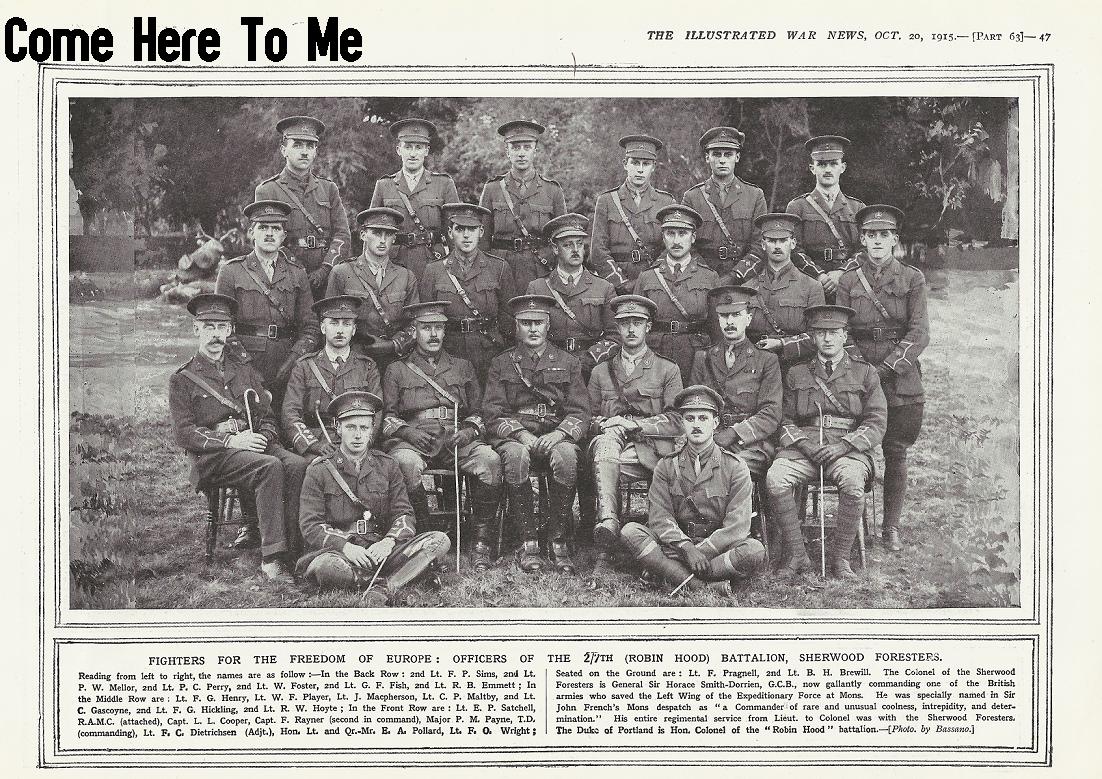
I acquired this great image recently, from the Illustrated War News Oct. 20 1915, it shows a group of “Officers of the 2/7th (Robin Hood) Battalion, Sherwood Foresters”.
Less than a year after this photo was taken, the Sherwood Foresters, described here as “fighters for the freedom of Europe”, would find themselves at the heart of the bloodiest battle of the Easter Rising in Dublin. 240 British soldiers were wounded or killed at Mount Street Bridge, where they came under sustained attack from a small band of Volunteers.
I always remember the first hand account of Captain A.A Dickson of the Sherwood Foresters, who wrote of the “baptism of fire” the men encountered at Mount Street Bridge. 25 Northumberland Road was the building from which Volunteer Michael Malone and Volunteer James Grace attacked, inflicting major casualties on the Sherwood Foresters. Dickson would recall:
It was a baptism of fire alright, with flintlocks, shot-guns, and elephant rifles, as well as more orthodox weapons. And 100 casualties in two days’ street fighting was a horrible loss to one battalion: the more so since my one friend from the ranks, commissioned same day, was shot through the head leading a rush on a fortified corner house, first day on active service, and it was my job to write and tell his mother, who thought him still safe in England.”
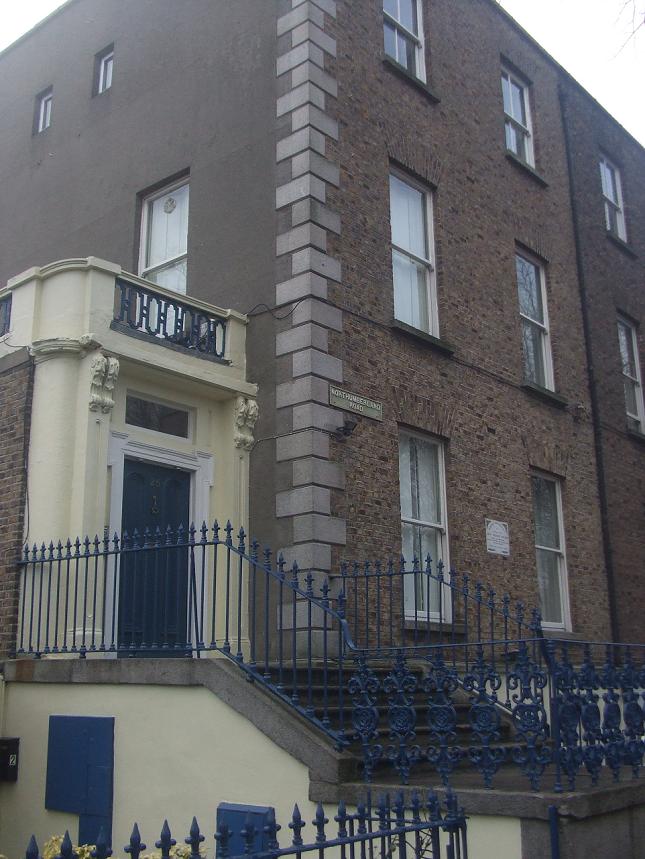
The house today (Donal Fallon)
If the Sherwood Foresters encountered such resistance, and suffered such heavy casualties in Dublin, surely some the men at the centre of the Battle for Mount Street Bridge feature in the image above?
I consulted Paul O’Brien’s excellent Blood On The Streets for more information. O’Brien has been writing detailed accounts of the battles of various 1916 garrisons, which look at the events in incredible detail which of course just isn’t possible in a broader study of the rebellion. Blood On The Streets (Mercier, 2008) tells the tale of Mount Street Bridge. I consulted it, and the classic Sinn Féin Rebellion Handbook, for an idea of how the men pictured above got on.
From the Sinn Féin rebellion handbook, I learned that two men shown were killed in action, while two were wounded.
L.T P.D Perry, third from the left in the back row, lost his life in the rebellion.
Likewise, Lt. Frederick Dietrichsen would perish.
Captain Hickling, second right in the middle row was wounded.
Also wounded was Lt. Pragnell, sitting on the ground on the left hand side.
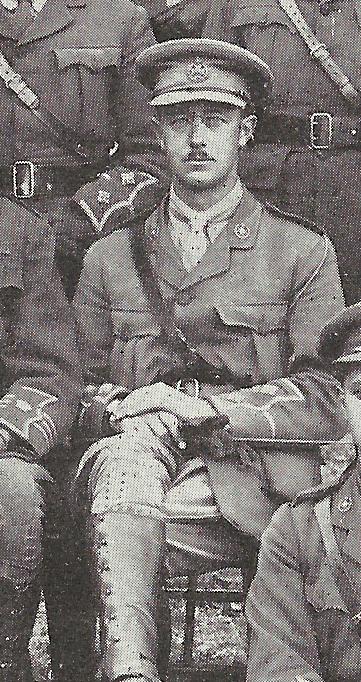
Captain Dietrichsen
The story of Captain Dietrichsen was particularly tragic. O’Brien gives some background information on Dietrichsen in his study, noting that he had previously been a barrister in Nottingham. He had sent his wife (who originally hailed from Blackrock) and two children to Dublin “to protect them from the ever-increasing German Zeppelin raids”, yet was taken aback to encounter his family as the Sherwood Foresters marched towards the city. O’Brien notes that: “Captain Dietrichsen dropped out of formation and hugged his family at the side of the road. He was to be one of the first killed in action during the battle of Mount Street.”
The other side of the newspaper page shows men of the Sherwood Foresters in very relaxed post,and notes that “….standing on a pile of fodder, is Nancy, the battalion mascot goat.”
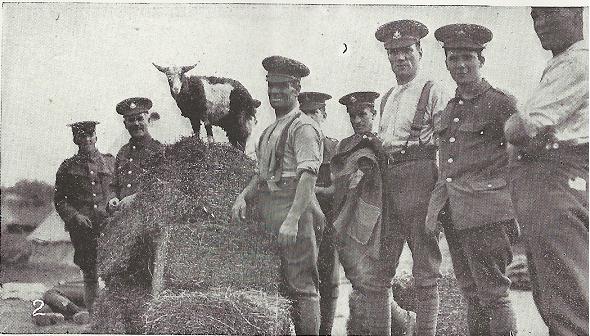
It’s certainly an unusual set of photographs, and I found it fascinating to see the faces of some of the men who were at the heart of the Battle for Mount Street Bridge for the first time. Today, the battle site resembles its ‘1916 form’ much more than many other sites of combat, and 25 Northumberland Road is marked with a small plaque to Volunteer Michael Malone.

 Click on the book for more.
 Click on the book for more.
 Donal
Donal Ciarán
 Sam
Sam


 Come Here To Me!
excellent stuff, we used to play the attack up Northumberland Road as kids.
Excellent piece of research DF. It’s adds some balance to put faces on the other side of the conflict.
Absolutely, all for it, the more detail the better.
There is far too much one sided emphasis in the way the history of the period is taught in schools. I blame the “christian” brothers and all their Faith And Fatherland bollocks…..look where all that’s led to.
From the regimental history of the 2/7th Sherwood Foresters it seems that John Macpherson, Charles Gascoyne, R W Hoyte and J A Cooper were later killed in France but others were promoted and/or received gallantry awards (Foster, Emmett, Henry, Rayner, Pragnell, Brewill). Lt Player was a member of the cigarette making family Player of Nottingham.
My interest in this comes through my grandmother’s brother, Private Kitchen, who was in the 2/8th Sherwoods, who supported the 2/7th at Mount Street Bridge and also suffered much. Private Kitchen was killed in France in 1918 so I never met him, but it’s a pity his only visit to Ireland was in an Imperialist cause.
And it’s a shame it turned out the other side were fighting for the Vatican and thieving cute hoors like Charlie, Ray Burke, and Bertie.
Hi Cliff, I’m doing some research on the Foresteres in 1916, and the battle of mount street. Could you email me – I’d like to talk to you? Kind Regard, Justin (email:justinmccarthy.mail@gmail.com)
According to the CWGC the only Kitchen KIA in France in 1918 from the Foresters was a Sgt/Major, not private. A private Kitchen lies in Balderton, Newark
cemetery having been killed in Dublin in 1916.
That ‘s quite correct. My great uncle was promoted Company Sergeant-Major just before the 2/8 Sherwood Foresters went to France early in 1917. Shortage of men led to the 2/8th (and other battalions) being disbanded in February 1918, and their men were distributed amongst other battalions. CSM Kitchen went to the 2/6th battalion and was killed in the massive German offensive 21 March 1918.
This is excellent. The story of the Mount St battle is truly epic and seems to have been missed by history. It deserves to be told.