Feeds:
Posts
Comments

Archive for 2012

(Starry Plough image taken from the cover of ‘The Lost Revolution’)

DCTV have uploaded this fantastic audio recording of last nights public meeting in the Ireland Institute on Pearse Street, with historians Brian Hanley and Matt Treacy discussing Republicanism in the 1960s. The meeting was chaired by Tommy Graham of History Ireland magazine, and certainly contained a lot of interesting discussion on the ideology and aspirations of those active in Republican circles in the period. The meeting was attended by a huge crowd, and there were familiar faces from the period in the audience. I’ll leave it to the listener to draw their own conclusions!

Click the link below to hear proceedings:

Read Full Post »

Lord Edward Carson confronted by the Irish Women’s Franchise League in Dublin. (NLI)

Edward Carson, the father of modern Irish loyalism, was born at number 4 Harcourt Street and the location is marked today by a small plaque. For many years, Carson’s birthplace sat in a decaying condition and looked likely to be demolished:

A 1994 Irish Independent image of 4 Harcourt Street.

While researching something entirely different, I stumbled across this ‘obituary’ to Carson in the pages of the left-wing Republican Congress newspaper in 1935. The Republican Congress emerged out of the left of the republican movement in the period, and many important figures like Frank Ryan, Nora Connolly O’Brien, Peadar O’Donnell and George Gilmore were active participants for varying lengths of time. This piece on Carson’s death ran on the papers front page on October 26 1935. It’s far from complimentary!

Lord Carson is dead- twenty five years too late. No tears will be shed for the maker of partition and the father of sectarian strife.

There was nothing inconsistent in the fact a Dublin lawyer should espouse a sectarian Belfast cause. It was the call of his class that Carson answered when he led the opposition to Home Rule.

In pursuit of personal gain Carson wrecked the unity of the nation. He got his reward- the power and pelf he sought. His dupes had to face disillusionment. Carson lived longer than most expected. But Castlereagh and the Sham Squire have boon company now!

Read Full Post »

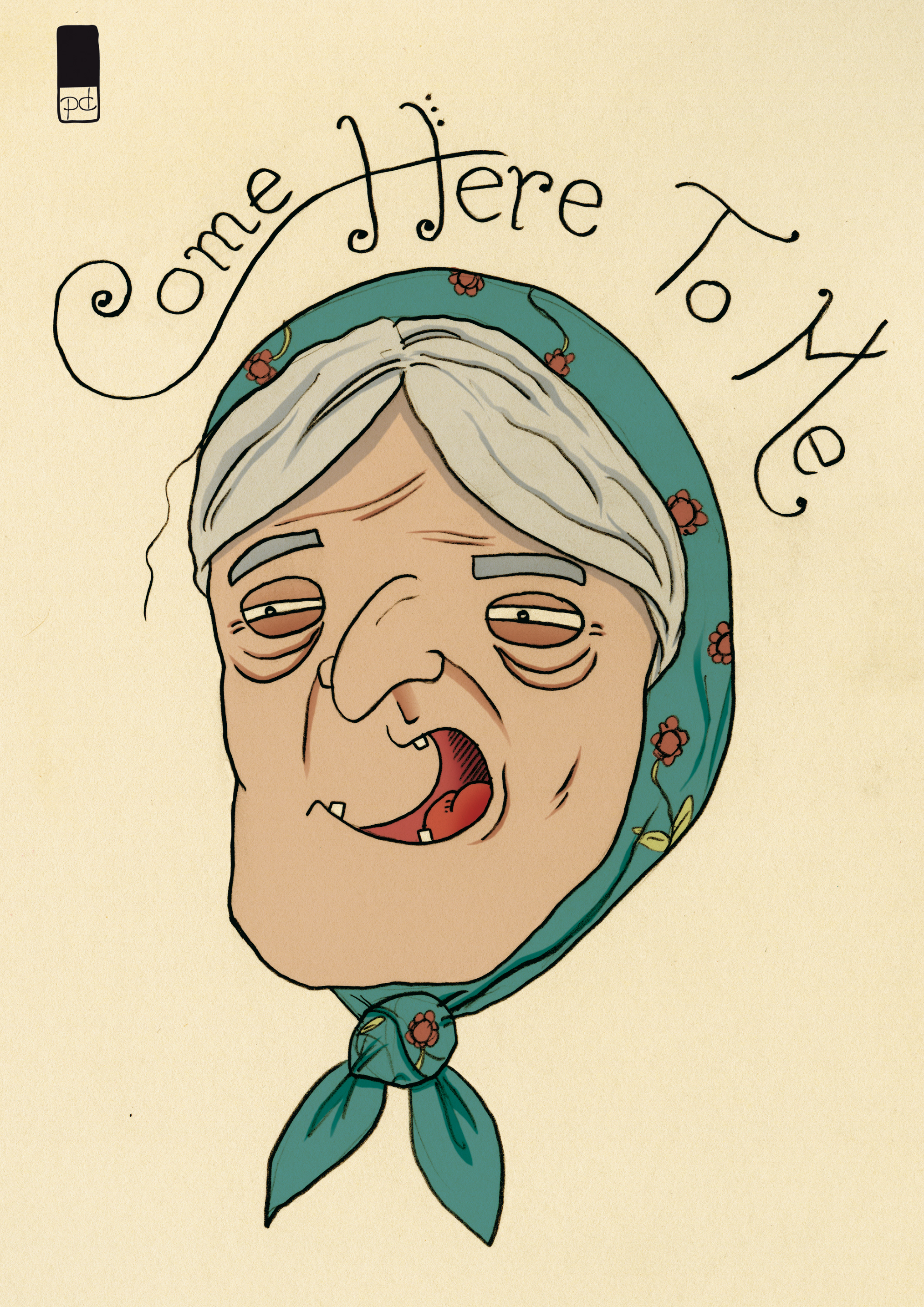
Hopefully the first of many this, from the very excellent Paul Duffy, one of the illustrators who is helping us out with the CHTM! book.  All this as well as being the drummer for Dublin hardcore band 20 Bulls Each. You can find more of his artwork at Duffy’s Dastardly Doodles. What a man.

Read Full Post »

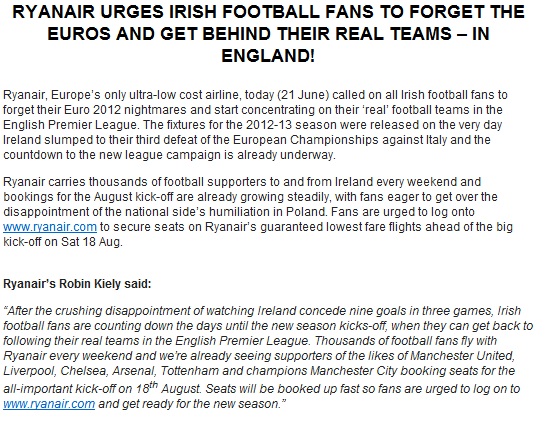
Spotted this on the Ryanair website and thought it had to be shared here. Ah, the state of Irish football. A constant source of material for Come Here To Me at least.

Read Full Post »

Recently, my brother was passing through town armed with a camera. By chance, he bumped into an artist at work on one of the many traffic light boxes that dot the city. As part of Dublin City Council Beta Project for the city, once boring grey boxes are coming to life.

Thanks to Luke for capturing these images of street artist ADW at work, including a look into his fantastic sketchbook. does that doodle look familiar? We’ve featured the finished project here before, a great tribute to the legendary Gil Scott Heron.

(more…)

Read Full Post »

Front Cover of ‘Paradise Alley’

Tuesday, June 26th sees the launch of a reprint of John D Sheridan’s classic account of working class life in Dublin’s docklands during the Lockout.

“Paradise Alley” was first published in 1945 by Talbot Press and has been largely unavailable for half a century. This new edition, from Seven Towers, a not for profit publishing house, features an introduction by Sarah Lundberg and Joe Mooney of the East Wall History Group.

It will be launched by Caitriona Crowe of the National Archives at St Joseph’s Co-Ed National School, East Wall Road, at 7.30pm on Tuesday.

The East Wall History Group has been doing sterling work to help collate the working class, radical and social history of their area. Tomorrow’s book launch is their latest event. It certainly won’t be their last.

More info can be found here.

Read Full Post »

The Irish Independent – Sep 15, 1939.

In September and October 1939 a 21-year-old “coloured alien” by the name of Karl Schumann, who also used the alias Ashely Shoeman, was found sleeping, on at least on two occasions, on the roof of the Polo Pavilion in the Phoenix Park.

It was heard in court that Schumann first arrived into Ireland, via Limerick, on a German steamer boat and decided that he “did not want to go further”.

Due to the fact that he reached Ireland in a German vessel, there was some confusion over his his nationality.

He was described first in court in by Senior District Justice Little as a “German from Cape Town”. However Mr. Donovan from the Chief Solictor’s Office raised the point that it “was mere chance that he was on a German ship” and because of his South African birth he should be described as a “British subject”.

The Victorian Polo Pavilion on the Nine Acres in The Phoenix Park from ‘The Illustrated Sporting & Dramatic News’, September 8 1900.

At the time, Schumann was living at an address in James Street but the house number was not given.

Schumann was again up in court in October 1939 for the same offence and here he was described as “British national … born in Cape Town”. The case was dismissed by the judge.

That’s when his trail ends.

I wonder what happened to Karl Schumann? Did he stay in Dublin? Return to his birthplace of Cape Town? Or perhaps make a new life in Britain?

He was born in 1917/1918 so he has, most likely, passed away at this stage.

If anyone has any information, please get in touch.
[References –  Irish Press; Sep 15 1939 & Oct 03 1939. Irish Independent; Sep 15 1939.]

Read Full Post »

Is there anything as sweet in football, or as painful, as a last minute goal? At half-time tonight in the Dublin derby between Saint Patrick’s Athletic and Bohemians i genuinely considered sticking in McDowell’s pub. 45 minutes later, and we’d gone from a goal down and playing horrific football to robbing it with what was basically the last kick of the game. We’ve been on the wrong side of the oul’ ‘last kick of the game’ a bit too often for my liking in recent years, so it felt very sweet indeed. A classic bit of Northern Soul from The Shirelles came to mind.

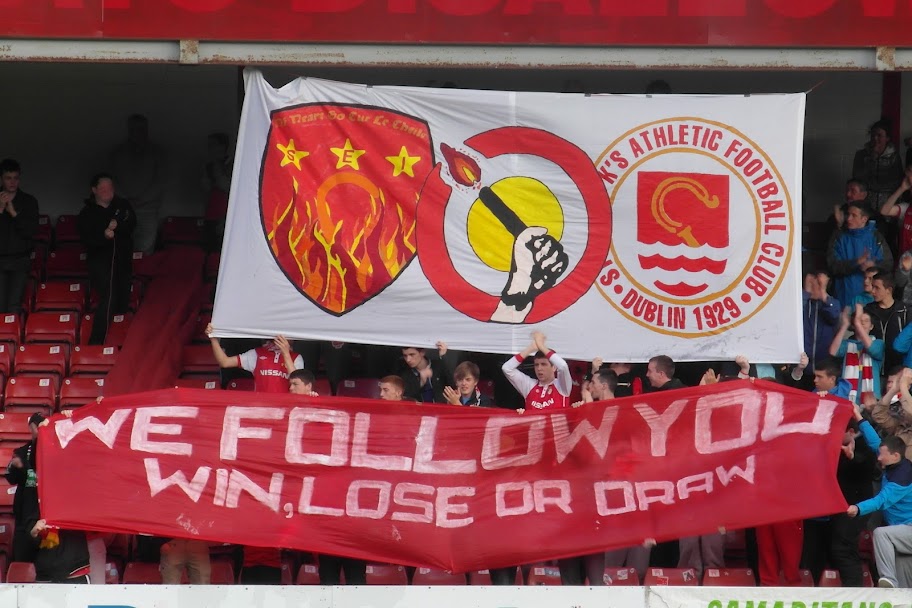
Pre match effort from Saint Patrick’s Athletic fans. It’s draws, mainly.

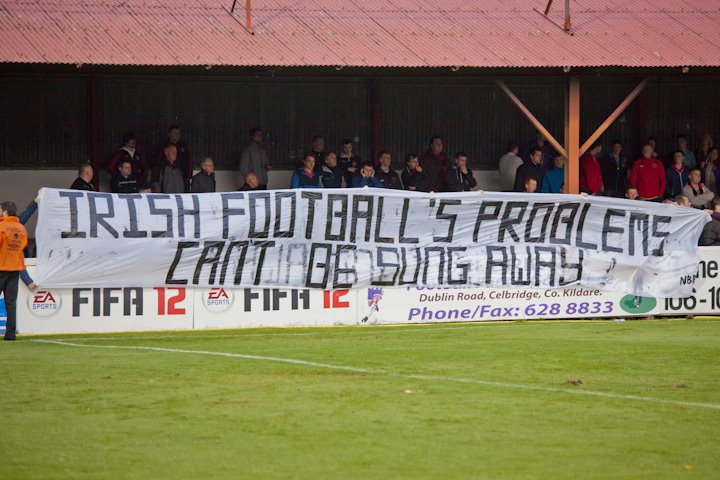
Perhaps the most interesting part of tonight however was the appearance of protest banners across the league in opposition to the total shambles that is the current set-up within the Football Association of Ireland. The FAI has the dubious honour of paying its president more than the combined prize-money available to all sides across the league. While the associations president, John Delaney, was recorded on the total piss in Poland engaging in sing-song sessions, Monaghan United were forced to drop out of the domestic league in less than dignified circumstances, only mid-season. They are not the first, and I dare say won’t be the last, top-tier side to fall in such circumstances.

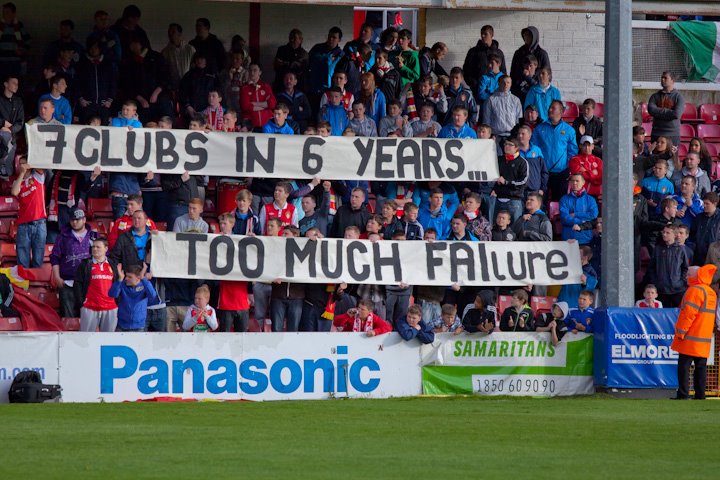
Saint Patrick’s Athletic (“Seven Clubs, Six Years: Too Much FAIlure”), Derry City (“JD Drinks, while the LOI sinks”), Bohs (“Ireland’s Football Problems Can’t Be Sung Away”) and Drogheda (“Gr€€dy, Corrupt, FAIlures”) fans all unveiled banners tonight making their feelings known on the running of ‘The Beautiful Game’ here. For me, the Bohs banner captured it all perfectly. It may be loney ’round the fields of Athenry, but it’s pretty grim in Gortakeegan too, without a local football side.

Saint Patrick’s Athletic protest banner. Photo (c) Paul Reynolds.

Bohs protest banner. Photo (C) Paul Reynolds.

(more…)

Read Full Post »

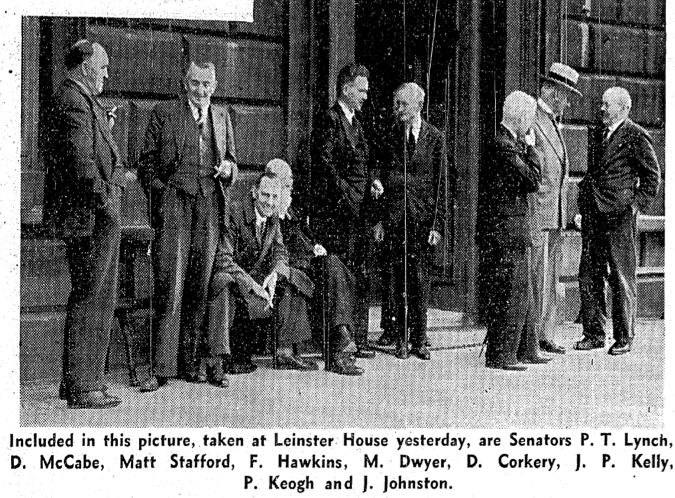
Matt Stafford. go Irish Press – Apr 01, 1938.

Dublin-born Matt Stafford took part in both The Fenian Rising of 1867 and The Easter Rising of 1916. I have not heard of any other individual who could boast of such an achievement.

He was described by Sean O’Casey as “a fine old skin, & a brave, honest man”. (The Letters of Sean O’Casey: 1942-54, p. 995)

My knowledge of Stafford from reading Harry Colley’s Witness Statement (no. 1687) to the Bureau of Military History in which he remembered:

… one Sunday morning when the whole Battalion was on parade we were doubling around Fr. Matthew Park and after two rounds an elderly man fell out of the ranks. I discovered that this man was Matt Stafford who must have been at at that time 64 years of age, and that he had been “out” with the Fenians at Tallaght as a boy. I always think what marvellous energy and enthusiasm he must have possessed to be able to double two rounds of Fr. Matthew Park at that age. Matt Stafford was later a Senator for a number of years and died at 95 years of age.

In actual fact, Stafford lived until he was 98!

A founding member of Sinn Fein, he played a prominent part in the Rising and then went onto become a founding member of Fianna Fail. Described by The Irish Times at the time of his death as “one of the last surviving members of the Fenian Brotherhood”, Stafford outlived his son Matt Stafford Jr. (d. 1947) who had taken part in the War of Independence and was interned in the Ballykinlar Camp in 1920-21.

A senator from 1937 – 1948, Stafford was also a member of Dublin Corporation, the Central Midwives’ Board and the Grangegorman Mental Hospital Committee.

Irish Press – Oct 05, 1939.

In 1945, De Valera described Stafford as the “longest link they had going back to the Fenian days”. (IT, 12/10/45)

Two years later, Stafford was formally honoured by the Fianna Fail party and was presented with his portrait in oils.

Irish Press – May 29, 1947.

De Valera said during this presentation:

The whole history of the past one hundred years can be exemplified in his person. He bridges all that immense period of time, which probably was one of the most eventful in Irish history and, indeed, taking a broader view, of the history of the world. To be able to look back on seventy-five years of active national work is given to a very few.

A 1942 election leaflet of his can be viewed on the wonderful Irish Election Literature blog here.

Read Full Post »
Image of The Patriots Inn from official website.

Interest in our recent post of the stonework of the Lafayette Building and others like it show that Dubliners are always interested in the former lives of the buildings of Dublin. Another building with an interesting historical feature is The Patriots Inn pub in Kilmainham. A more than decent pub, it sits in a fine historic location, with the Royal Hospital and Kilmainham Gaol among its neighbours. There has been an inn located on the site since the 1790s, historically enjoying both the custom of workers of Kilmainham Gaol and those of the Great Southern and Western Railway.

The pub is one of the last buildings in Dublin to boast an insurance firemark upon it:

Thanks to David Power for this image.

Before the establishment of a public fire service, insurance companies offered protection to premises marked by a ‘firemark’. These were essentially emblems (usually of lead) which displayed a company logo and insurance number. Before the establishment of a public fire service, no premises was covered until a firemark was in place.

In his history of the Cork fire service, For Whom The Bells Tolled, Pat Poland noted that:

The firemark served a number of purposes: it marked the property so it was obvious to all that the building was covered by insurance, it acted as an advertisement for the insurance company, and it let firemen responding to a call in no doubt as to which particular building was insured with their office.

There are very few such firemarks left to be seen in the city today. There is perhaps a joke to be made somewhere in the fact that from earlier this year, a €500+ call-out charge has come with a ring to the Dublin Fire Brigade!

Read Full Post »

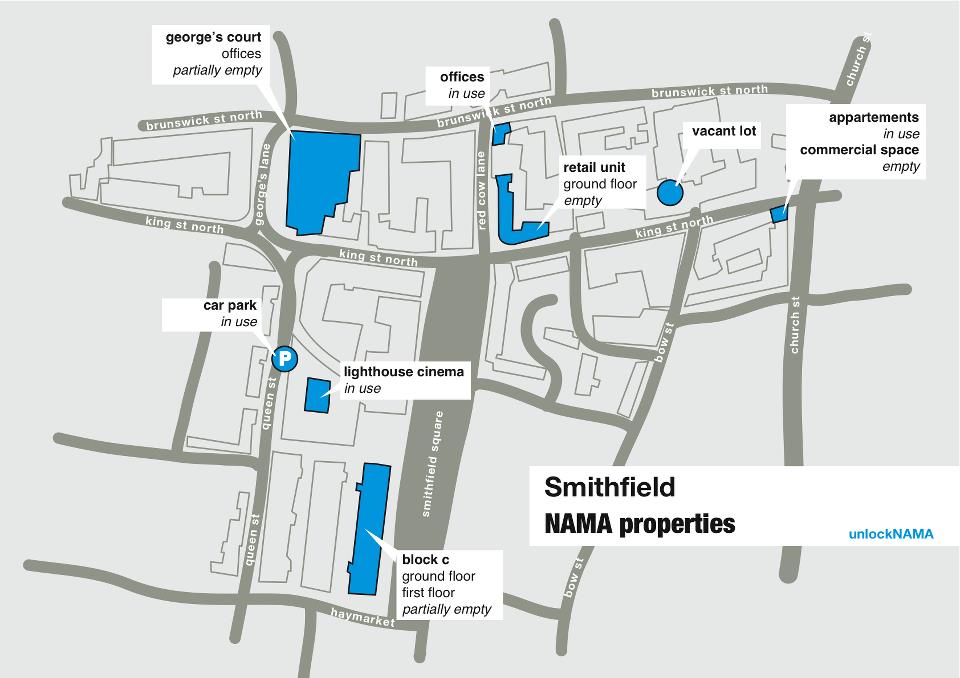
This is a very interesting map compiled by the folks at Unlock NAMA, and I must say the idea of mapping the city like this a good one. It really brings NAMA to life when you see what falls under its ownership list in an area the size of just Smithfield. Unlock NAMA are holding two discussions in the area in the days ahead. The first discussion will take place in the Macro Community Resource Centre on North King St., at 7pm on Wednesday the 20th of June, while the second discussion will happen in the Prussia Street Parish Centre, 7.30pm on Thursday the 21st of June.

Read Full Post »
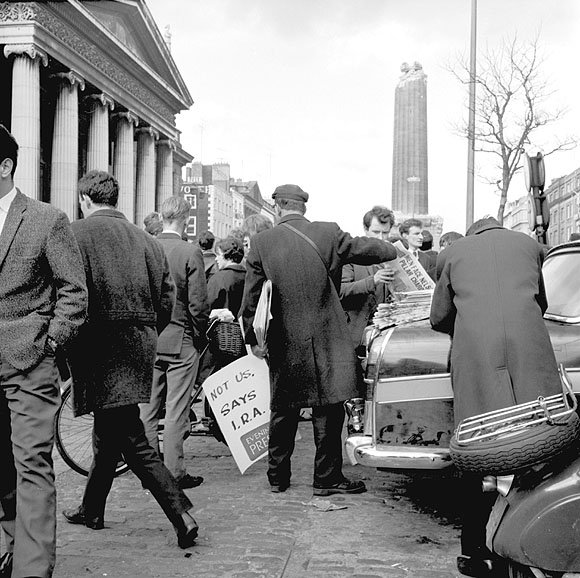
An upcoming public meeting next Tuesday (June 26, 7:30pm) was brought to my attention, entitled ‘New Perspectives on Republicanism in the 1960s’. It takes place in the Pearse Centre at 27 Pearse Street. The building is instantly recognisable by its fantastic restored front appearance, and the name ‘Pearse and Sons’ is found over what was once the business premises of the father of Patrick and William Pearse.

Brian Hanley (Historian, author of The IRA, 1926-1936, The IRA – a Documentary History, and co-author of The Lost Revolution) will be joined by Matt Treacy (Historian, author of The IRA 1956-69: Rethinking the Republic) for what should be an interesting night.

Read Full Post »

« Newer Posts - Older Posts »