Feeds:
Posts
Comments

Archive for 2012

My brother sent me on a link to these snaps this morning; based in London, someone had shared them with him given the week that’s in it. The full collection can be found here , I’ve only posted the Dublin (and Wicklow) related ones. Courtesy of the Library of Congress, Washington .

The Shelbourne Hotel

The Shelbourne Hotel

St. Patrick's Cathedral

Phoenix Park

Bray Head

Cheers to Richie for the shout out!


Read Full Post »

Today, a friend sent me on an article from Wednesday’s Morning Star about the decline of Europe’s left-wing press. It got me thinking about the newspapers and magazines that are published today in Ireland and what kind of future lies ahead for them.

While the latter question cannot be answered without some thought, I thought I’d first try to write up a detailed, updated list of what is currently being published.

Here’s what I came up with…

The anarchist group the Workers Solidarity Movement publish a paper Workers Solidarity (Free, bi-monthly) and a more theoretical magazine Irish Anarchist Review (Free, bi-annually, 24 pages).

An independent counter-culture crew bring out Rabble (Free, Quarterly, 24 pages).

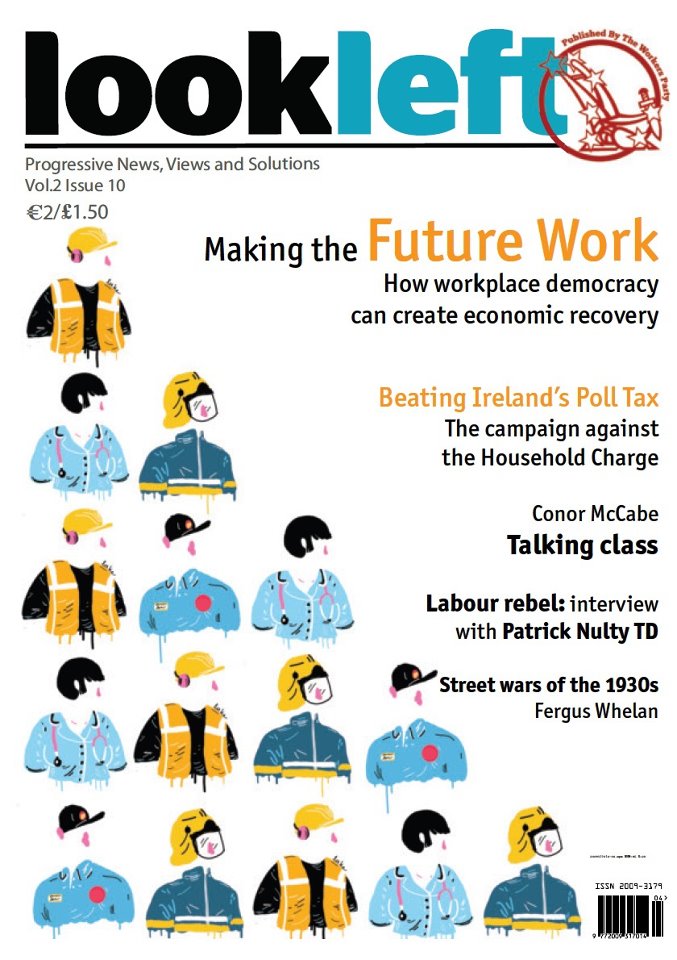
The Workers Party produces a broad left magazine called Look Left (€2, Quarterly, 40 pages).

Current Issue of Look Left

Trotskyist groups The Socialist Workers Party publish The Socialist Worker (Donation, Monthly, 8 pages) and Irish Marxist Review (€3, Irregular, 55 pages) while The Socialist Party publish The Socialist (Donation, Monthly, 12 pages) and a political journal Socialist View.

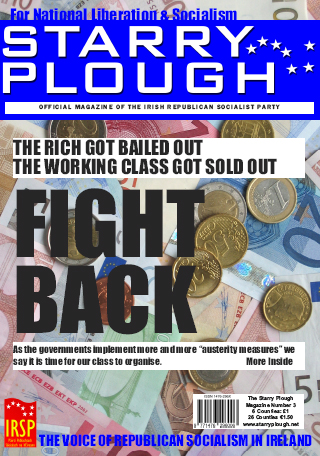
Within Irish Republicanism, Sinn Fein produce a newspaper An Phoblact (€2, Monthly, 32 pages) and a magazine Iris (€4, Quarterly, 64 pages), the 32 County Sovereignty Movement (32CSM) bring out The Sovereign Nation (€2/donation, Irregular, 8 pages), Republican Sinn Fein (RSF) publish Saoirse (€2, Monthly, 16 pages) and the Irish Republican Socialist Party (IRSP) has a new magazine Starry Plough (€1.50, Quarterly, 28 pages).

Current issue of The Starry Plough

The Communist Party of Ireland (CPI) publishes Socialist Voice (€1.50, Monthly, 12 pages)

As far as I’m aware, the Irish Socialist Network (ISN) still prints Resistance (Free, Quarterly, 4 pages)

A group of socialists independently produce Red Banner (€2, Quarterly, ?)

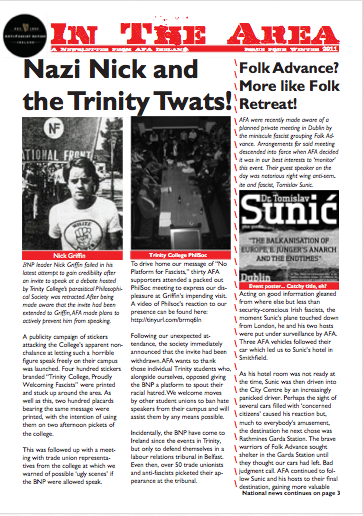
While Anti-Fascist Action (AFA) has a newsletter In The Area (Free, Quarterly, 4 pages) and a magazine No Quarter (€2, Irregular, 28 pages).

Current issue of In The Area

Read Full Post »

Unceremoniously swiped from the excellent balls.ie this. Someone obviously took inspiration from RTÉ’s recent screening of “Knuckle,” an insight into bare knuckle boxing the Irish travelling community and decided to throw up a dedication to Big Joe Joyce on Leeson Street Bridge.

Update: Apparently it’s been there for months. Ah well, just goes to show you the gems this city is hiding!

Read Full Post »

Leave Bertie A Loan.

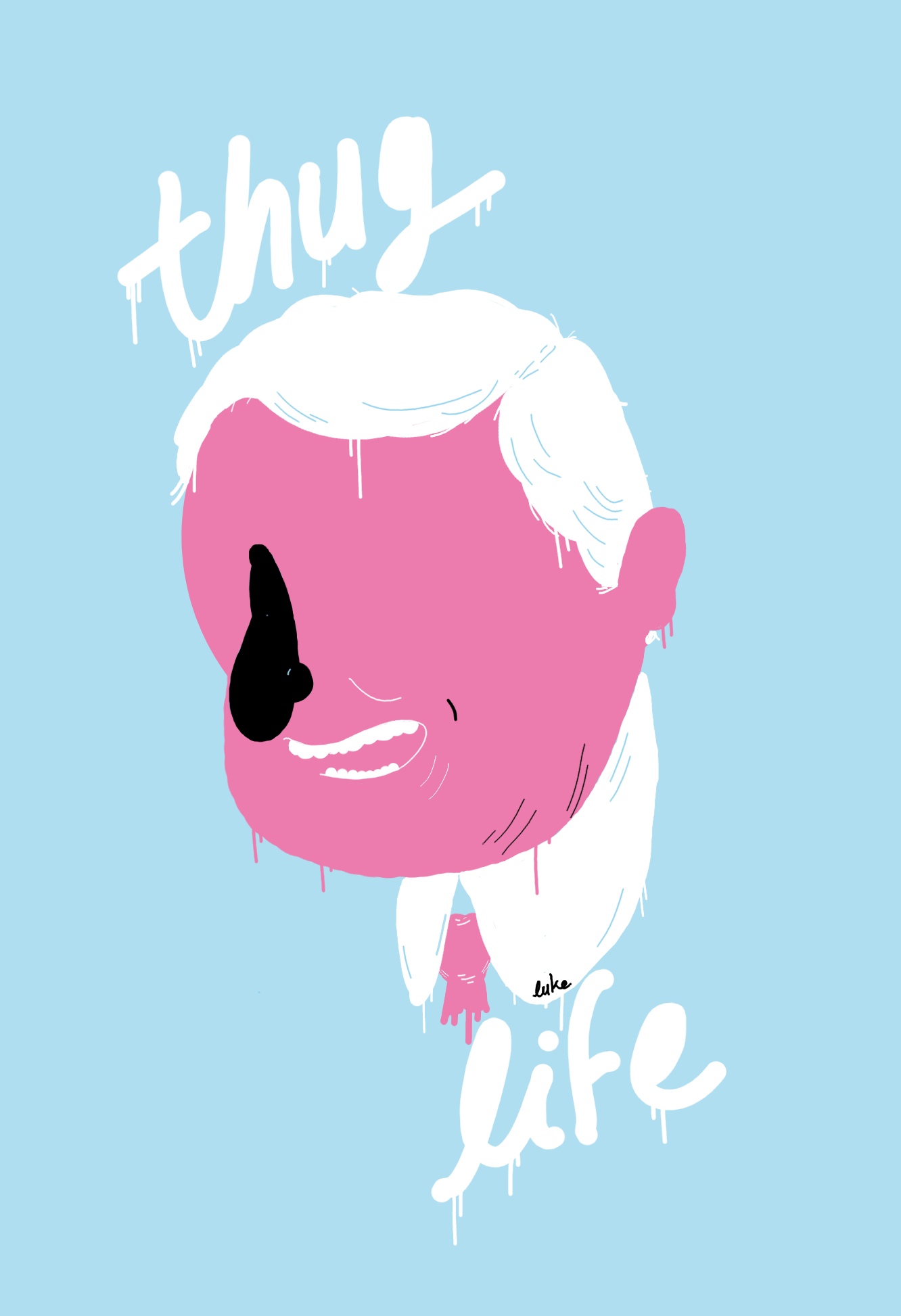
De Bruder did the above piece as a tribute to King Chancer, with the day that was in it yesterday. Thug Life is a play on the lavish lifestyles enjoyed (and boasted about) by a certain kind of hip hop artist of course. Bertie was never a hip hop artist, more a piss artist.

It reminded me to dig through the archive for this Come Here To Me classic…..

…..and that my friends is why they put cameras into mobile phones. Earlier today I spotted the same autobiography in a discount bookshop in town. How the mighty have fallen.

Read Full Post »

The brief piece below was written for publication in a student newspaper at University College Dublin. Frank Flood was a UCD student who was active within society life on campus, as well as being a member of the Irish Republican Army. He was one of the ‘Forgotten Ten’ buried in Mountjoy Prison, and the below piece is not so much a brief biographical sketch of his life as a look at his legacy to his college. It features in the current edition of ‘The College Tribune’.

Gerry Collins, President of the Students’ Representative Council of UCD, dipping the national flag outside the GPO during a march of UCD students to remember Kevin Barry and Frank Flood, November 1960

The republican history of UCD runs deep. Today, the campus boasts a building named in honour of feminist and republican Hanna Sheehy-Skeffington as well as a plaque in the Newman Building to the young poet Charlie Donnelly, who gave his life in defence of the Spanish Republic with the International Brigades. Our list of celebrated republican graduates crosses the Treaty divide, with men like Kevin O’ Higgins and Richard Mulcahy on the side of the Treaty, and men like the great character Ernie O’Malley on the other. Michael Hayes, a founding member of the Irish Volunteers who was at Jacobs Factory during the 1916 rebellion, even went on to become a Professor with the Irish Department of UCD. Perhaps our most celebrated revolutionary however is Kevin Barry, immortalised by The Ballad of Kevin Barry, which has been recorded and performed by singers as diverse as Paul Robeson and Leonard Cohen. The song is even referenced by Dexy’s Midnight Runners in their My Life In England, capturing its importance to the second-generation Irish in the United Kingdom:

I can remember St Theresa’s social where “Kevin Barry” rang out,
My mum whispered to me “Kevin, In England that song is not allowed”

Frank Flood is a name which may not be instantly recognisable to some in the way the name of Kevin Barry is, yet he is another young UCD student who gave his life during the War of Independence, executed at only nineteen years old. One of the ‘Forgotten Ten’, Flood not alone studied at UCD but was active within its society life. Todd Andrews, another UCD student active in the republican movement, perhaps put it best when he wrote in his memoirs that “as Kevin Barry passed into the nation’s mythology, Frank Flood’s name is scarcely remembered.”

Frank Flood (With thanks to members of the 'IrishVolunteers.org' society)

Francis Xavier Flood was the son of a policeman, born in 1901. The siblings in his family were firmly republican however, and of the eight Flood boys most were active within the Volunteers. Sean Flood, the eldest of the boys, had served five years in a Scottish jail for his republican activities, and died soon after his release. Young Frank Flood was educated at O’Connell Schools, run by the Christian Brothers and located on the North Circular Road. It was here he first met Kevin Barry, with whom he formed a friendship . Flood ended up winning a university scholarship in 1918 which saw him enter the Engineering School of UCD, while Barry was a medical student. While at the college Frank became active within the Literary and Historical Society. There was a strong republican presence in UCD at the time, though as Todd Andrews noted “there were a number of students who were known to be IRA men, but unless they were in the same Company or Battalion, they never spoke or associated with one another on the basis of their common allegiance.”

Flood had been captured while attacking the Dublin Metropolitan Police at Drumcondra on January 21 1921, and the event is popularly known as the ‘Drumcondra Ambush’ today. Flood, at only nineteen years of age, held the role of First Lieutenant ASU (Active Service Unit) of the Dublin Brigade.He had led an assault which saw three Volunteers lose their lives (two on the scene), and five others sentenced to death for their role in that attack, with Flood himself found with a grenade in his pocket. He was charged with High Treason, found guilty, and executed by hanging on March 14th 1921 at Mountjoy Prison. Kevin Barry had gone to his death in much the same way in 1920, and it is said Flood requested to be buried as close as possible to his former friend and comrade.

On the 40th anniversary of the death of Kevin Barry, six members of the Students’ Representative Council of UCD laid wreaths upon the graves of Frank Flood and Kevin Barry, inside the grounds of Mountjoy Prison. Hundreds of students marched from the college at Earlsfort Terrace to the General Post Office on November 1st 1960 to pay their respects to the two, before heading onwards to the final resting place of the two UCD students. This tradition continued in the years afterwards, for example in 1963 when 500 students joined the procession. There had been questions around whether the students would be allowed continue with their march in the years following the 40th anniversary, however the matter was settled following meetings between the Students Council and the Minister for Justice. The Minister was a certain Mr.Haughey, a graduate of UCD who had been among those Earlsfort Terrace students who burned a Union Jack outside that other Dublin university on Victory in Europe Day, 1945. On that day, Trinity College Dublin students had raised the flags of some of the victorious nations over the front of the college, with an Irish tricolour at the bottom of the mast.

Frank Flood (With thanks to members of the IrishVolunteers.org society)

The Kevin Barry window stands on campus today as a memorial in honour of that young republican, but was first unveiled at Earlsfort Terrace. At the time of its unveiling, Frank Ryan, another UCD student of old, wrote in the pages of the left-wing Republican Congress that:

At last, a Kevin Barry memorial has been unveiled at University College Dublin. The present committee were people who had no connection with the War of Independence nor with the organisaitons which participated in it. It is understandable therefore- though inexcusable- that few of Kevin Barry’s comrades were invited by the committee and that, instead, a Blueshirt presided and the anti-Republican President of UCD was given an opportunity to shed tears for the Boy-Martyr of 1920.

Ryan commented that he was glad at least Frank Flood was mentioned by one speaker. Ryan himself had graduated from UCD in 1925 with a second class honours BA in Celtic Studies. Interestingly, while a student at UCD, it is sometimes said that Ryan fell for Elgin Barry, the sister of Kevin.

On March 3rd 1967 ,UCD Professor Michael Hogan, Dean of the Faculty of Engineering, made it into the Irish Independent for refusing to chair a student debate around the motion that “God is dead” The motion had been chosen by the Mechanical and Engineering Socieities for discussion at the final of the Frank Flood Shield debating competition. Hogan objected primarily on the grounds that Flood held strong religious convictions and would have disapproved. Hogan had been a friend of Flood during his time in college.

Today, Flood is buried in Glasnevin Cemetery, as is Kevin Barry. Their bodies were removed from Mountjoy Prison in October 2001, with full State Funerals awarded to the ‘Forgotten Ten’ buried in the prison. One of the Volunteers was then buried in Limerick, the rest are side by side in Glasnevin Cemetery today.

Read Full Post »

Sinn Fein – March 22: 8,600. April 22: 9,386. May 22: 9,781.

Workers Solidarity Movement (Anarchists) –  M22:6,972. A22:7,347. M22:7,557.

Labour Party – M22:6,930. A22:7,009. M22:7,093.

Fine Gael – M22:6,385. A22:6,444. M22:6,498.

Socialist Workers Party – M22:4,012. A22:4,217. M22:4,517.

Fianna Fail – M22:3,765. A22:3,873. M22:3,963.

United Left Alliance – M22:1,789. A22:1,1803. M22:1,841

Republican Sinn Fein – M22: 1,487. A22: 1,531. M22:1,563

Communist Party of Ireland – M22:874. A22:919. M22:975.

Irish Republican Socialist Party –  M22:513. A22:552. M22:576.

Workers Party – M22:228. A22:246. M22:245.

There doesn’t seem to be a main FB page for the Socialist Party but Joe Higgins has 4,740 ‘likes’. The 32CSM nor the ISN seem to have FB pages either. Note: the RSF one is only the Wikipedia page but I thought it was worth including.

For the record, the Chicken Fillet Baguette has 7,999 likes!

“Opposition supporters talk near graffiti referring to social networking site “Facebook” in Tahrir Square in Cairo. Steve Crisp / REUTERS”

Read Full Post »

Stephens Green, nd.

Five stories, some you know and some you may not know, about our beautiful St. Stephens Green and the surrounding area.

1. Public executions

Up until the 1770s, most public hangings and executions took place in St. Stephens Green. Prisoners would be moved to the gallows, on a cart, from the old Newgate prison near Cornmarket.

On October 24 1773, a Mrs Herring was “burnt alive” in the Green after she was convicted of murdering her husband.

The method of execution of was as as follows:

She was placed on a stool something more than two feet high, and, a chain being placed under her arms, the rope round her neck was made fast to two spikes, which, being driven through a post against which she stood, when her devotions were ended, the stool was taken from under her, and she was soon strangled. When she had hung about fifteen minutes, the rope was burnt, and she sunk till the chain supported her, forcing her hands up to a level with her face, and the flame being furious, she was soon consumed. The crowd was so immensely great that it was a long time before the faggots could be placed for the execution [1] Sylvanus Urban, The gentleman’s magazine, and historical chronicle, Volume 43 (London, 1773), 461

Infamous brothel keeper and serial killer Darkey Kelly was said to have been publicly burnt in the green in 1761. (Others suggest her execution actually occurred on Baggot Street).

2. The Ghostly Cross

For years, every Holy Thursday, large crowds of Dubliners would gather at 80 Stephens Green, Iveagh House to see if a cross would appear on one pain of glass on an upstairs windows. Some thought it had to do with the legend that the house stood where the Archbishop of Cashel, Dr. Hurley was killed in 1583 while others thought it had to do with a dying servant girl whose  rosary beads were taken off her and thrown out the window (see below). A carpenter wrote to a Dublin newspaper suggesting it had something to do with reflections and the way the house was built!

The Irish Press. Oct 27, 1976.

3. Garden for the Blind

In the central area of the park, there’s a ‘Garden for the Blind’ which has scented plants labelled in Braille. Opened in 1972, the garden also contains a seat commemorating two Protestant feminist trade unionists, Louise Bennett (1870 – 1956) and Helen Chenevix (1890 – 1963).

4. Anti-Semitic murder

The steps of No. 95 Stephens Green was the scene of the murder of Manchester Jew and father of four, Bernard Golderg (42) on October 31, 1923. On November 14, Emmanuel Kahn (24), another Jew, was gunned down on Stamer Street in the heart of what was Little Jerusalem. In 2007, it was revealed that two Free State officers who were the main suspects fled to Mexico and the United States after the shootings.

The Irish Independent. Nov 01, 1923.

5. Hunting

Right up until the nineteenth century, it was able to shoot snipe (“a wading bird of marshes and wet meadows”) in the middle of the Green. Walter Harris noted in his History and Antiquities of the City of Dublin (published posthumously in 1766) that “an incredible number of snipe attracted by the swampiness of the Green in that season, and to avoid their enemies, the sportsmen – an agreeable and most uncommon circumstance, not to be met with in any city in the world”.

Read Full Post »

A great images here from Paul Reynolds. We’ve featured some of Paul’s photography on the site before, in particular his photos of Dublin League of Ireland clashes. This is directly across the canal from The Barge, at Canal Road. Does anyone know the explanation, or is there any, for the random dates?

Read Full Post »

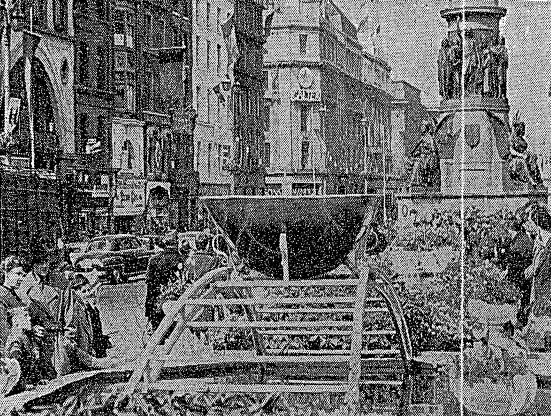
The statues and monuments of Dublin are a frequent feature here on the site. Many are familiar to Dubliners and still with us today, but some are no longer with us and were the subject of considerable controversy in their day. An example of a public ornament no longer with us is ‘The Bowl Of Light’, placed on O’Connell Bridge in 1953.
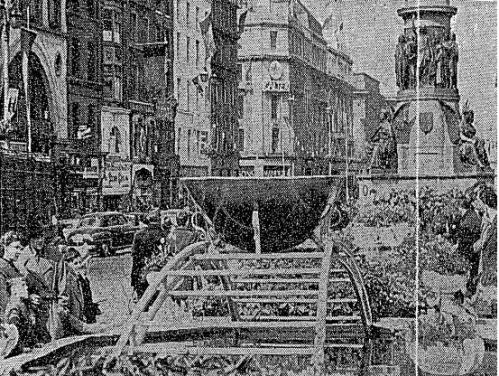
The Bowl Of Light, minus its flames.

The Bowl was the centrepiece of the An Tóstal scheme of decorations on the O’Connell Bridge in 1953. The An Tóstal event was an annual festival which ran 1953 to 1958, aimed at promoting Ireland as a tourist destination, and also luring Irish exiles home to reengage with the country. It was, quite simply, to be a celebration of Irish culture and traditions at home. In April 1952 a report in The Irish Times gave some idea of the ambition of the project, noting that:

The Board stressed that while An Tóstal whill be based in Dublin, it will be of national interest. “It will be intended that the whole country will, for the period of three weeks, be at home to Irish exiles and friends from everywhere.”

Major-Gen Hugo MacNeill was appointed organiser of An Tóstal. On the eve of the event, he wrote that:

In a few days the flag of An Tóstal will be hoisted ceremoniously all over Ireland, and the Easter fires blazing on the hills of Ireland will illuminate the skies with the message of IRELAND AT HOME!

The event would see the erection of ornaments and public art throughout the capital, but no piece captured the attention of the public quite like ‘The Bowl Of Light’, owing primarily to the fact it was to be a permanent feature.

The Bowl was described in The Irish Times, who noted that:

The copper bowl, with a diameter of about 4 feet, is fitted to a semi-circular bridge of tubular girders which spans an octagonal basin, measuring about 15 ft. by 18 ft. and containing about a foot depth of water. The many coloured plastic “flames”, which could revolve, were set in the bowl, and at night were illuminated from the inside.

The Bowl had been erected behind hoardings, meaning that the public were unable to see what it was that was to be placed on the bridge. In the region of 3,000 people gathered on Saturday April 3rd 1953 to see the unveiling of ‘The Bowl Of Light’, around which there was great curiosity among the public.

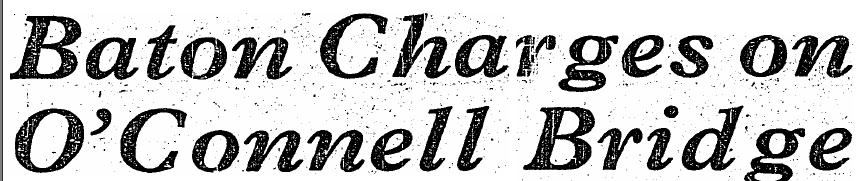
The Irish Independent reported that things turned ugly on the Saturday night, as Gardaí struggled to free traffic lanes and found themselves having to draw their batons against the large crowd. The paper noted that: ‘In scenes which followed floral decorations were thrown at Gardaí and windows were broken in a number of shops in O’Connell Street, including Clery’s. About 12 arrests were made.’

It was reported by the Sunday Independent that “at no time did the force of Gardaí on duty appear adequate to deal with the disturbance.”

The Sunday Independent reports.

While there was widespread bemusement at ‘The Bowl Of Light’, it would become one of Dublin’s most short lived public ornaments. On April 19th, only weeks after its unveiling, the ‘flames’ from the Bowl were chucked into the River Liffey, the actions of Anthony Wilson, a young student of Trinity College Dublin.

Wilson had been at a party, which was described in the courts of law as “a particularly good party.” Following it, he and friends went around the city enjoying themselves, and were spotted standing on the O’Connell Bridge complete with umbrellas, despite it being a fine day. The students made speeches there to the public, and it was evidently clear to those who heard them that a fair amount of alcohol had been consumed. “Wilson could not explain how he came to take the light and throw it into the river.”

Witnesses described witnessing a young man climb upon the parapet of the basin,pull the flames from the bowl and make his way towards the parapet of the bridge, hurling the plastic flames into the river. The young man made a run for it, but was caught on Aston’s Quay. Newspaper reports noted that some members of the crowd had shouted “Throw him in the river!” at Gardaí following his arrest. The student was ordered to pay £48 7/6 to cover the damages.

The ‘Bowl’ attracted its fair share of detractors in the letters pages of the national newspapers. However none were as loud in their criticisms as Myles na gCopaleen, who lambasted the Bowl and the Tóstal event itself. On April 9th 1953, Myles wrote tongue-in-cheek of those who had been responsible for the scenes at O’Connell Bridge on the Saturday prior.

Myles na gCopaleen, who attached The Bowl Of Light in his Cruiskeen Lawn column.

I did not have the pleasure to be in Dublin last Saturday night but absence did not deny me a glow of pride when I learnt what the citizens did when the pubs closed at ten. They decided to give the odd gawking visitor a real Irish welcome…..Here we had Cathleen Ni Hooligan in person.

He went on to attack the Bowl, writing that it was:

….an appalling piece of iron work bearing a basin out of which emerges a ‘plastic flame’. This metal thing has a spout on it, and the original intention was to have a “fountain” on the bridge. Nothing will ever in our time come out of that spout, but how much of the rate-payers cash has gone up it for this change of ‘plan’?

No need to guess. The figure is £1,768

With the flames long in the river, the Bowl continued to cause controversy through 1953 and into 1954. In November of 1953 Colm Gallagher T.D voiced his opinion, as the Sunday Independent reported, that:

O’Connell Bridge has been spoiled by the ‘slab of concrete’ and it was a disgrace to the city to see workmen using shovels during recent weeks to remove the water from the various openings.

While the Bowl itself was to be removed, the rest of the structure on O’Connell Bridge would remain until a decade on, in 1963. It is perhaps most commonly remembered among Dubliners today as ‘The Tomb Of The Unknown Gurrier’. The late Basil Payne would pen an excellent epitaph for the ‘Tomb Of The Unknown Gurrier, writing that:

The City Fathers’ grim myopia
confines me to this non-U-topia;
to reinforce their sentiment
They buried me in thick cement.

Today of course the traffic island between both sides of the O’Connell Bridge is popular with pedestrian traffic. Still, giving the state of the nation, perhaps a Begging Bowl Of Light wouldn’t go amiss!

Read Full Post »

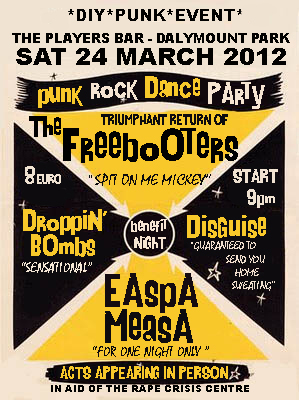
Gig poster.

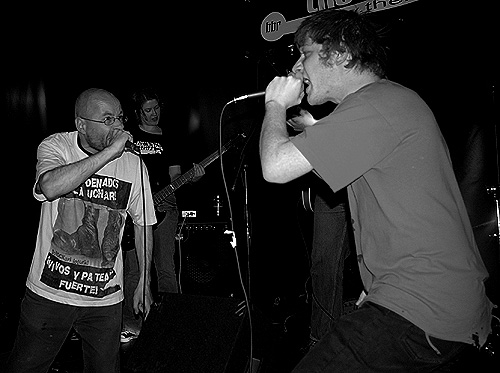
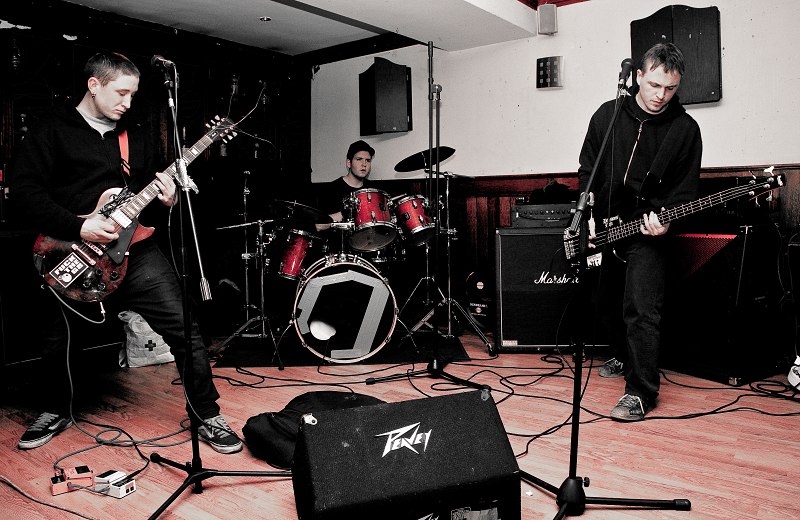
Four fantastic bands are coming together on Saturday, 24 March 2012 in The Players Bar, Dalymount Park in aid of the Dublin Rape Crisis Centre.

This will be the last ever show for political hardcore five-piece legends Easpa Measa who have been described at various times as “punishing crust”, “crusty melodic hardcore fury” and “dual vocaled crust with poignant lyrics”

Formed in 2001, the band have toured Europe widely and released a number of records; Renounce & Dethrone (2004), a 7″ split with Atomgevitter (2004), a 7″ split with Nemetona (2005), a 7″ split with Silence (2007) and split LP with Divisions Ruin (2010). Personally, not my cup of tea but they’re the best at what they do and a great bunch of lads!

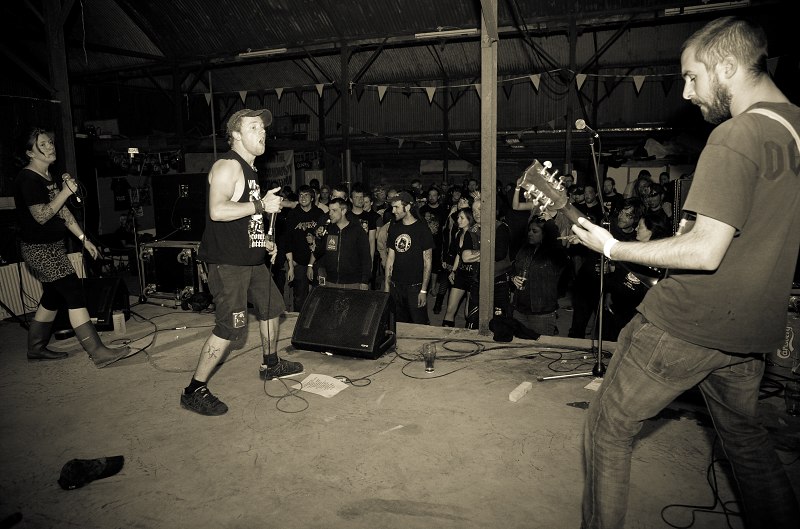
Easpa Measa @ GGI, 2010. Photo - Janer.

Next up on the line up are acclaimed streetpunk stars, The Freebooters, who will be playing their first Dublin gig since October 2010. On the go since 2005, the ban released their debut album Ordinary Level Oi! last year to glowing reviews. Definitely one of my favourite Irish bands!

The Freebooters, 2008. (Photo - Shay)

Local heroes Droppin’ Bombs who have been tearing the place up since 2004 are next on the bill. Moving on from their punky ska origins (a.k.a ‘thrashy ska-punk’ or ‘yipped out of it ska-core’) , the three-piece have been more recently labeled as ‘raging technical hardcore punk’. A part of me prefers the earlier more ska-themed stuff but I did really enjoy them at the Oi Polloi gig last weekend.

Droppin' Bombs, 2009. (Photo - Janer)

Finishing up this killer line-up are jap noise-core characters Disguise.

Doors 9pm. Admission €8. More information on the Facebook event.

Read Full Post »
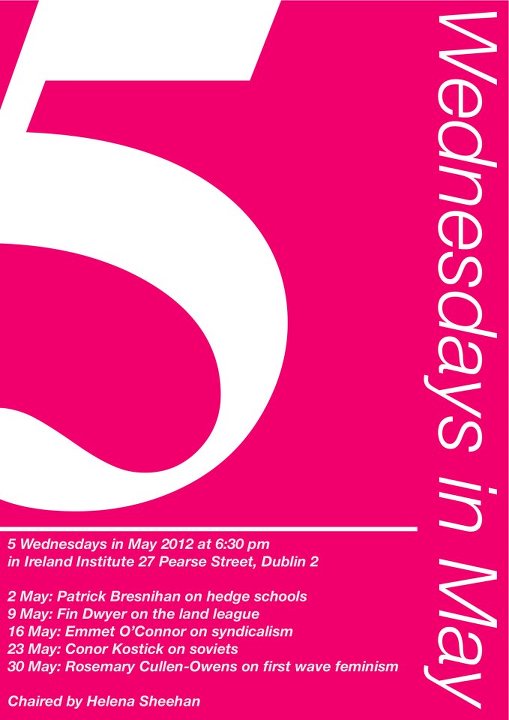
An interesting series of lectures are to be held in the Ireland Institute on Pearse Street in May, which will examine a number of movements and periods of importance in Irish history. Helena Sheehan will chair the talks, which will examine issues as diverse as the Soviets of the War of Independence period and the Hedge School tradition. While all five talks look appealing and stimulating,I’m especially looking forward to the talk on the Land League, by Fin Dwyer of the Irish History Podcast series, and Conor Kostick’s talk on the Soviets, as his Revolution in Ireland was such a groundbreaking contribution to the historiography of the period.

The talks have been organised by the ‘Occupy University’ group, and will be recorded for Dublin Community Television.

Wed 2 May: Patrick Bresnihan on hedge schools
Wed 9 May: Fin Dwyer on the land league
Wed 16 May: Emmet O’Connor on syndicalism
Wed 23 May: Conor Kostick on soviets
Wed 30 May: Rosemary Cullen-Owens on first wave feminism

Read Full Post »

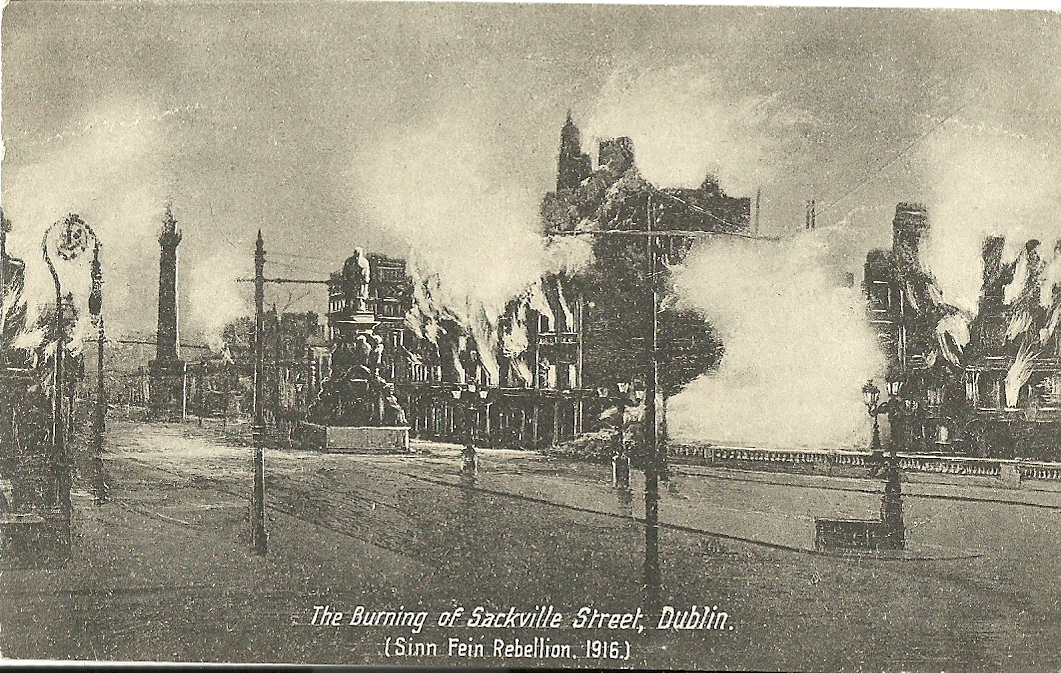
Sinn Féin Rebellion Postcard (Fallon collection)

In 1966, the then President of Maynooth College, the Right Rev. Monsignor Gerard Mitchell, invited the surviving members of an Irish Volunteers contingent who hard marched from Maynooth into Dublin to partake in the 1916 Rising to the College. There, a mass took place celebrated by an Fr. Tomhas O Fiaich, the Professor of Modern History at Maynooth.

It was a far cry from the last time some of those Volunteers had set foot in Maynooth College. In 1916, led by Domhnall Ua Buachalla (later the Governor General of the Free State) , a group of local Volunteers found themselves in a very different situation. ‘The movement’ as far as the Irish Volunteers were concerned, was quite well organised in North Kildare, and Lieutenant Eamonn O’ Kelly of the Volunteers arrived in Maynooth on Holy Thursday. He was aware of the plan for an insurrection on Easter Sunday, after being appointed to his position as a County Organiser by none other than P.H Pearse.

O’ Kelly had plans for the North Kildare Volunteers. He told Domhnall Ua Buachalla, the local leader of the force, to assemble his men on Easter Sunday in Maynooth town, and from there proceed to Bodenstown Churchyard, to meet with other Kildare Volunteers. Writing of his memories of this in 1926 for An tÓglách magazine (‘The Maynooth Volunteers In 1916’) Commandant Patrick Colgan noted that “Each man was asked if he was prepared to take part in the insurrection and each man agreed”

Counter-orders caused confusion, and Colgan noted that no sooner had the men committed themselves to a rising than word came through via a dispatch from Dublin that the mobilisation was called off. It would be Monday evening before they knew for sure an insurrection was underway. The men were armed, though they didn’t carry rifles- but rather single shotguns and roughly 40 rounds of ammunition.

“Many of us had never handled a gun prior to this and much practising in the loading and unloading of our weapons now took place” Colgan noted.

It was 7.15pm on Easter Monday before the men left Maynooth. By this stage, the Rising was well underway in Dublin and key positions had been seized by the rebels.

Domhnall Ua Buachalla, seated on right.

Before leaving Maynooth, the men proceeded through the main street to the College.C olgan noted that “..there were rumors to the effect that some of the students were anxious to join us” and the Volunteers also wanted to interview one of their own who had answered the original mobilisation call. “Our quest for this employee brought us to the building occupied by the late Very Rev. J. Hogan , D.D, President of the College” The President called on Domhnall O’ Buachalla to return home and to see to it his fellow Volunteers did the same. Undaunted, the men marched out the south-east gate of the College, and were now on route to Dublin.

(more…)

Read Full Post »

« Newer Posts - Older Posts »