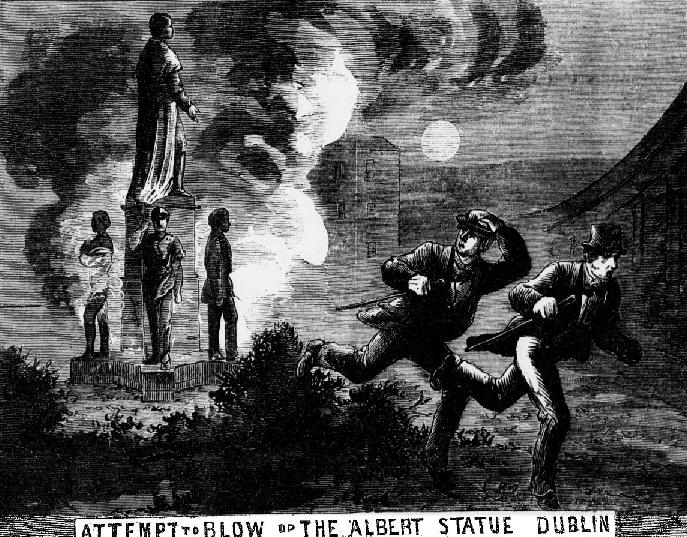
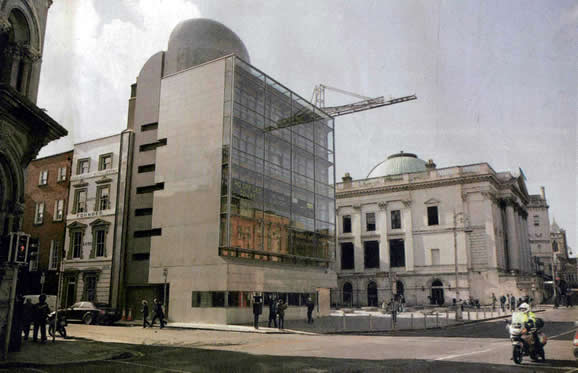
I thought this worth scanning, as it deals with a statue recent featured on the site. The Albert statue was originally to be located at College Green, but found itself ultimately in the grounds of the Royal Dublin Society. It may surprise some of you to hear the statue is still in Dublin, though now it is inside the grounds of Leinster House.
Henry Grattan of course occupies the space at College Green where Albert was originally to be located, and Irish nationalist newspaper ‘The Nation’ stated at the time: “The idea that Prince Albert’s statue would ever be raised in College Green was manifestly as hopeless and wild as a design to move the Hill of Howth”
(Article first published in Look Left, Vol.2 Issue 10)
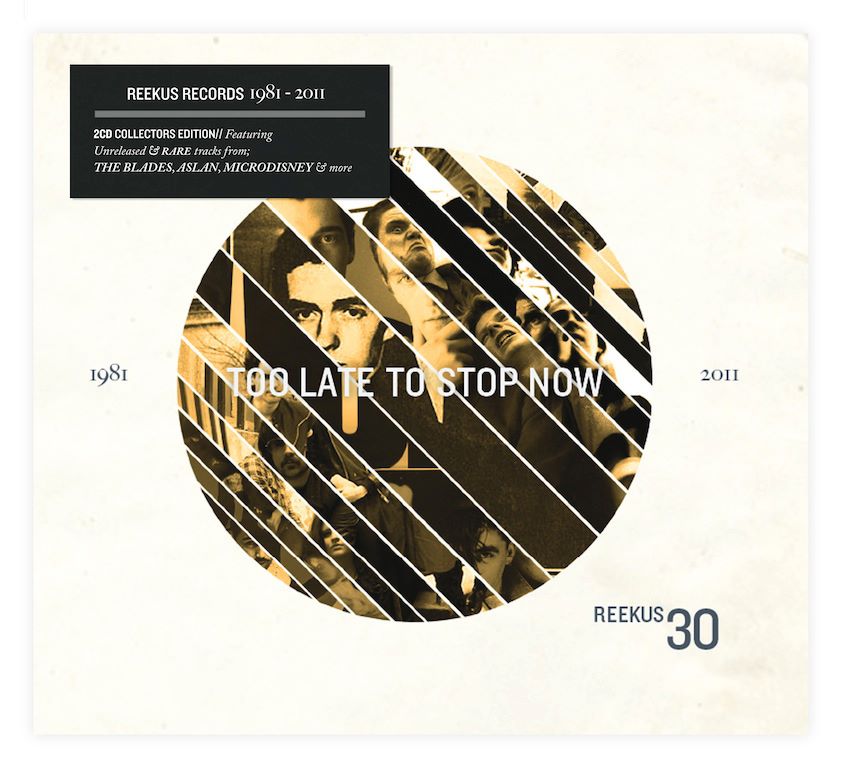
Featuring heavily on a recently issued Reekus Records anthology, ‘Too Late To Stop Now’, Sam McGrath explores the music and politics of The Blades.
reekus.com
Socially conscious, musically gifted and uncompromising in their attitude towards the manipulative music industry, The Blades remain one the most revered and important Irish bands of all time.
The genius of Paul Cleary, lead singer and songwriter of the band, lay in his ability to craft both memorable love songs and standout tracks about the critical issues of his generation – boredom, unemployment and a crippling recession. Class conscious and sympathetic to socialist politics, Cleary “tried to get that into (his) music without browbeating people”.
Lending support to various worthwhile causes, The Blades played numerous benefit gigs throughout the 1980s. These included gigs for Rock Against Sexism in UCD in February 1980, for the families of those who died in the Stardust fire in 1981, for the pro-choice Anti-Amendment campaign in September 1982 and for the Dunnes Stores anti-apartheid striking workers in January 1985. In 1986, they famously shunned the ‘back-slapping’ Self-Aid to play the left-wing Rock The System one-day music festival at Liberty Hall.
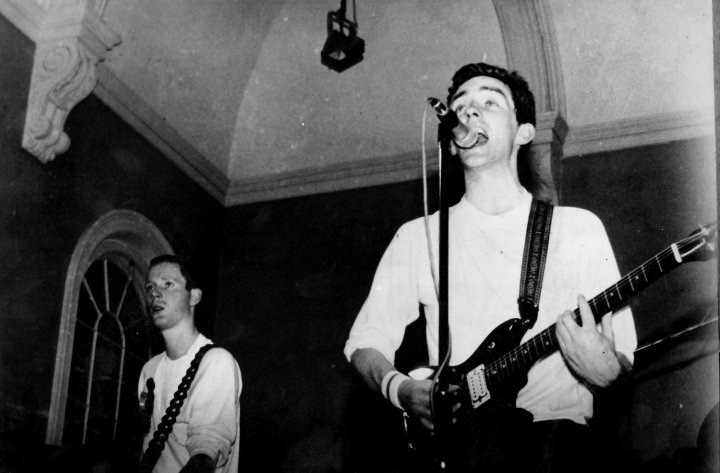
Brian Foley & Paul Cleary (Mill Butler)
The Blades roots lay in their working-class, southeast Dublin 4 neighborhood of Ringsend. Spurred into action by the Punk explosion, they made their live debut as a five piece at their local CatholicYoung Men’s Society (CYMS) Hall in the summer of 1977. Ironically, the plug was pulled on the gig early when the sound engineer took exception to the band playing God Save the Queen; not understanding it was The Sex Pistols version (!).
Subsequently with Cleary on bass, his brother Lar on guitar and childhood friend Pat Larkin on drums, the band were a formidable trio. The sharply dressed, melodic post-punk outfit played ‘short, punchy, guitar-driven songs’ that suited the live, intense atmosphere of their first home, The Magnet, a tough local bar on Pearse Street. These early gigs, only enjoyed by a room full of forty or so Mods and Soul Boys, would go down as some of the best in Dublin’s live music history.
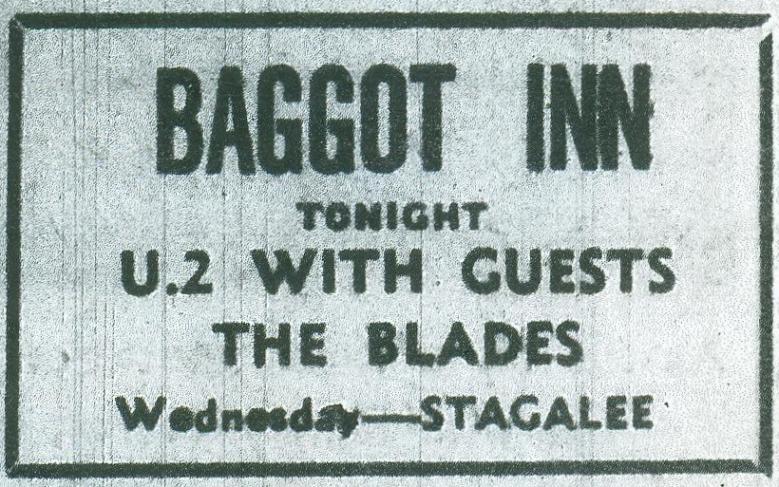
A year later, they were in The Baggot Inn playing a famous six-week residency with another fledging Dublin band – U2. Dave Fanning, who DJ’d at the gigs, recalls that parts of the crowd would leave straight after The Blades, ignoring U2. The two bands couldn’t have been more different. While Cleary and co. would unleash an assault of high-tempo, three-minute pop/soul numbers, Bono used to come on stage and tell the “crowd of a dream he had the night before’”
u2theearlydayz.com
This first line up of The Blades, which lasted from 1977 to 1982, released two fantastic singles; the catchy summer pop classic Hot For You in 1980 followed a year later with the more mature, Ghost of a Chance which dealt with love across the class divide. Disenchanted with the failure of Energy Records to proceed with the planned LP, Lar and Pat left the band.
Replaced by bassist Brian Foley (ex. The Vipers) and drummer Jake Reilly, Cleary took over guitar duties. Coupled with the horns section of the Blues Brass, a ‘couple of renegade musicians from The Artane Boys Band’, this more developed and ambitious model recorded a LP with Elektra but in a nasty turn of events, the record company, who had recently lost a substantial amount trying to break Howard Jones into the American market, decided not to release it.
Left with a finished product (recorded in London with The Smiths’ producer John Porter) but with little else, The Blades found themselves in a frustrating scenario. Luckily the record was eventually released, to critical acclaim, by the pioneering Irish label Reekus. Cleary, a life long fan of George Orwell, titled the LP The Last Man In Europe, the original choice of name for 1984.
Before their one and only studio album was released, The Blades brought out three first-rate singles. The guitar-driven The Bride Wore White in March 1982 which was voted single of the year in the Hot Press National Poll with Cleary also winning Best Irish Songwriter beating Bono, Van Morrison and Phil Lynott. It was followed later that year by Revelations Of Heartbreak, the multi-layered brass-tastic dancefloor stomper.
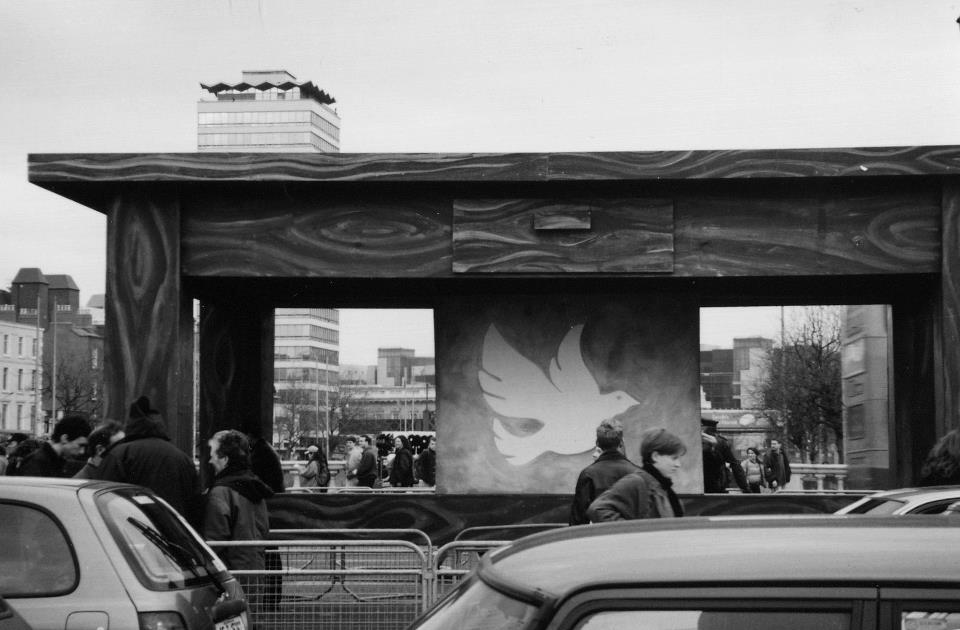
An interesting image and quote this. The Table Campaign was founded in 1996, around the time of the IRA’s shattering of the 17 month ceasefire, with the Canary Wharf bombing on 9th February that year.
The concept was to set up a load of tables on O’Connell bridge and invite people passing by to sit down and discuss what peace should look like at those tables. There was some Sinn Fein involvement and they argued for a giant table as a striking press image. On the day of the event however all that appeared was a giant table, maybe 3m high, far too high in the air for anyone to sit at, dominating the bridge. The lesser tables for the ordinary people to sit and discuss what a popular peace process might look like did not appear. Symbolic, if perhaps accidentally, of the process as a whole where the rest of the population were limited to the role of watching the drama around the big table at Stormont.”
Thanks to Andrew Flood for the image and accompanying quote.
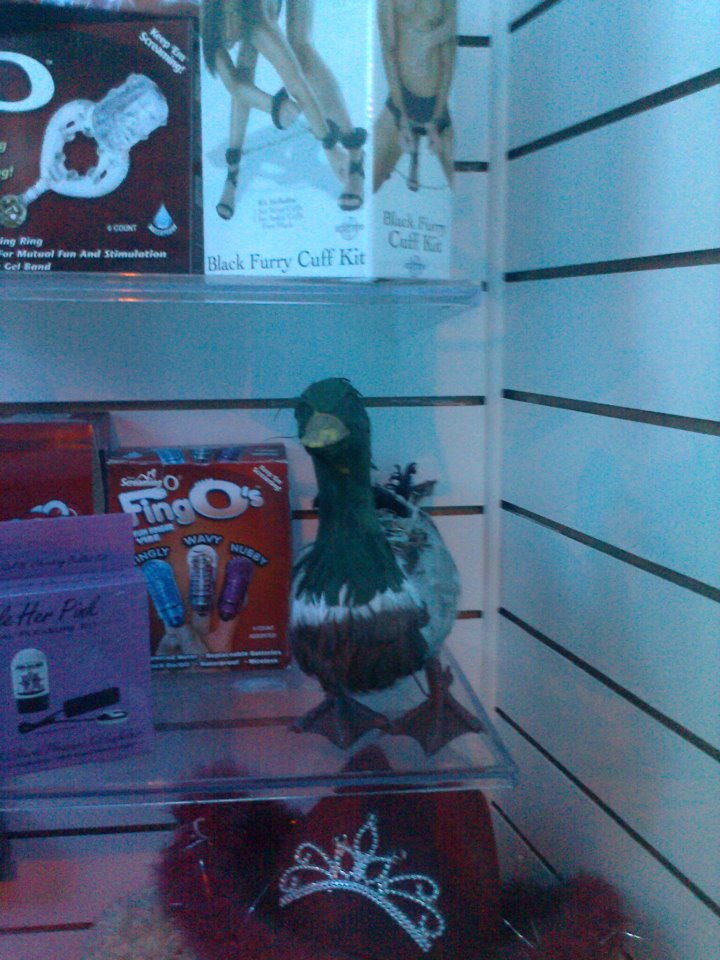
Thanks to Angela for this incredibly bizarre image from the window of a Capel Street adult shop.
A few weeks back we posted a history of Dublin’s sex shops, with many people surprised to hear it was 1993 before the first such shop in the capital was opened.
This Irish Times photo shows Shamrock Rovers fans outside Milltown Road following the 1-1 draw in Dublin that saw Rovers knocked out of European football in 1984.
The visit of Belfast’s Linfield to Milltown Road to face Shamrock Rovers in a European Champions Cup clash in 1984 was one of the largest football related security operations in the history of the state. The two-leg draw between the Belfast and Dublin sides made headlines on both sides of the border before a ball had been kicked, with The Irish Times report on the drawing of the two clubs together noting that it was the “spectre of the collision of the Orange and Green” that marked the draw out.
Much of the fear around the class had come out of events in Dundalk in August 1979, when Linfield and Dundalk faced each other at Oriel Park. Almost 500 Gardaí were involved in policing that encounter, and journalist Peter Byrne wrote after the clash that “this was the night when the concept of All-Ireland club football was killed stone dead. Two hours of raw, naked tribalism on the terraces of Oriel Park convinced even the most reformist among us that the dark gospel of the paramilitaries has permeated Irish sport to the point where all attempts at reconciliation are futile.”
Prior to the first round clash at Windsor Park in Belfast, there had been violence at Dalymount Park during a clash between Bohs and the visiting Glasgow Rangers in the same week. Among the Rangers support was a healthy contingent of supporters from Northern Ireland. The clash in Windsor Park on September 20th 1984 was played out before a near silent crowd of 6000, with The Irish Times reporting that “In stark contrast to the turbulent scenes in Dalymount Park 24 hours earlier, there was never the hint of crowd violence. Only a few Union Jacks were in evidence to taunt the visitors and, almost inevitably, there was not one spectator sporting the emblem of Shamrock Rovers to be seen anywhere in the ground.” It ended a nil all draw.
Jim McLaughlin, Shamrock Rovers manager at the time of the fixtures with Linfield, had held the same position at the time of the ‘Linfield Riots’ in Dundalk. Prior to the Rovers games, he stated in the media that: “Some people will attempt to attach a dimension to this fixture that will have nothing to do with football. Relations between the two clubs are good and I can only hope that the fans will have learned from the experiences of Dundalk.”
On September 25th Linfield Supporters Clubs were told by the club that Shamrock Rovers were unwilling to sell them tickets. Newspaper reports suggested that a sizeable group intended to travel tickets or no tickets. This greatly worried the club, as Linfield had found themselves having to play games in Holland following the violence at the time of their trip to Dundalk. Initally, Rovers had offered 1,500 tickets to Linfield supporters, smaller than the away allocation in normal circumstances. The club withdrew this offered allocation, and club chairman Louis Kilcoyle issued a statement which read:
Shamrock Rovers Football Club have advised Linfield FC that there will be no allocation of tickets to Linfield for the second leg of the European Cup tie at Miltown on October 3rd.
This decision has been taken to ensure that the second leg game takes place without incident and in a atmosphere as prevailed as Belfast last Wednesday.
Newspaper build-up to the clash focused on off the pitch matters, and when the clash actually did occur Rovers went out to Linfield, owing to a one-all draw in Dublin. Inside the ground, one newspaper reporter counted sixteen tricolours, and three Union Jacks.
The Irish Times reported on the trip to Dublin undertaken by one Linfield Supporters Club. There were 200 Linfield supporters in Dublin, and as the paper noted it wasn’t until Linfield’s goal their presence was felt. Following the encounter, the sound of ‘The Sash’ could be heard from the travelling contingent, while it was noted Dermot Keely received some abuse from the visitors. “Keeley, you Fenian Bastard!” was shouted, to which he responded with two fingers.
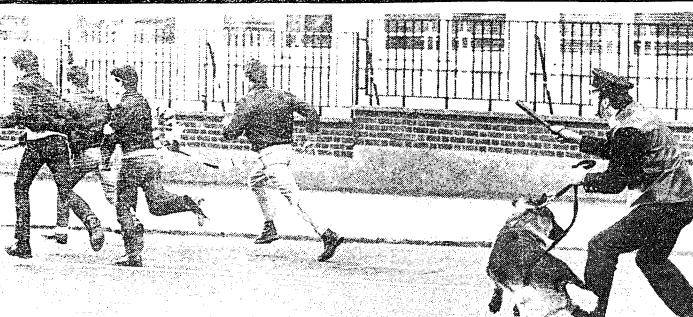
Outside, there was little in the line of the ‘hooligan’ element expected (or hoped for!) by those in the media. Gardaí in riot gear were met by around 100 Shamrock Rovers fans who threw stones at Gardaí as they awaited the exit of Linfield’s travelling support from the stadium. A Garda sergeant was reported as saying “it was our own who were the gurriers today” following the match. Yet the few dozen youths throwing stones didn’t live up to the newspaper reporting in the lead-up to the clash. Certainly, the violence was not on par with some seen in Irish soccer grounds in the 1980s, for example the disgraceful scenes at Richmond Park in April of 1986 at an FAI Cup Semi-Final between Saint Patrick’s Athletic and Waterford United. The fixation with the Linfield clash no doubt centered around the broader context of north-south relations, and memories of events in Dundalk.
In 1989, Shamrock Rovers fanzine the ‘Glenmalure Gazette’ ran a tongue-in-cheek feature from ‘R.Anglelodge’ on why Linfield supporters were the best in Ireland. It joked that:
Louis Kilcoyne recognised that Linfield fans were the best in Ireland. He didn’t think twice about banning Rovers scumbags from going to the European Cup game in Belfast. He was absolutely correct to let us blues fans go to Milltown. Two weeks before the match we had helped the Huns to try and wreck Dublin. We deserved the chance to have another go at it!
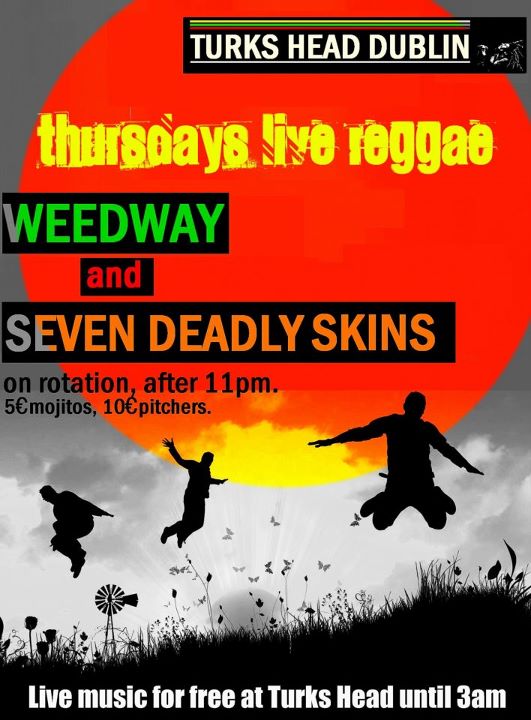
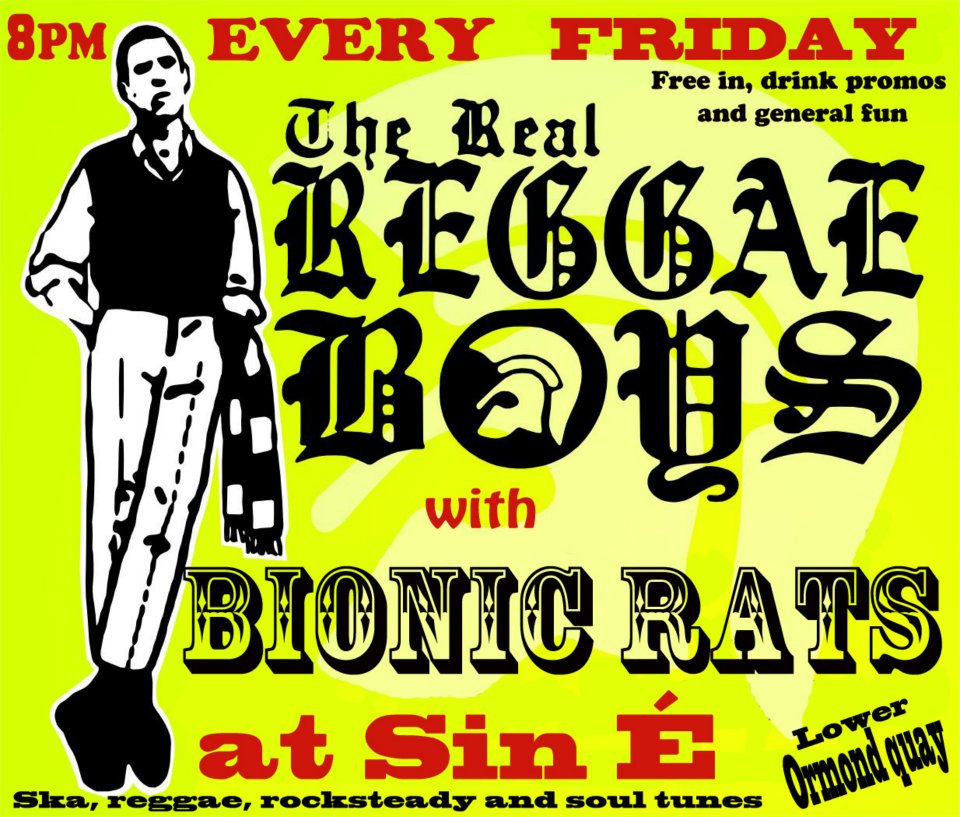
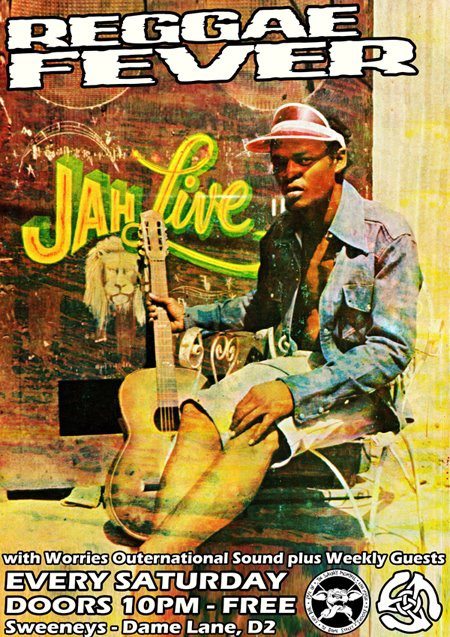
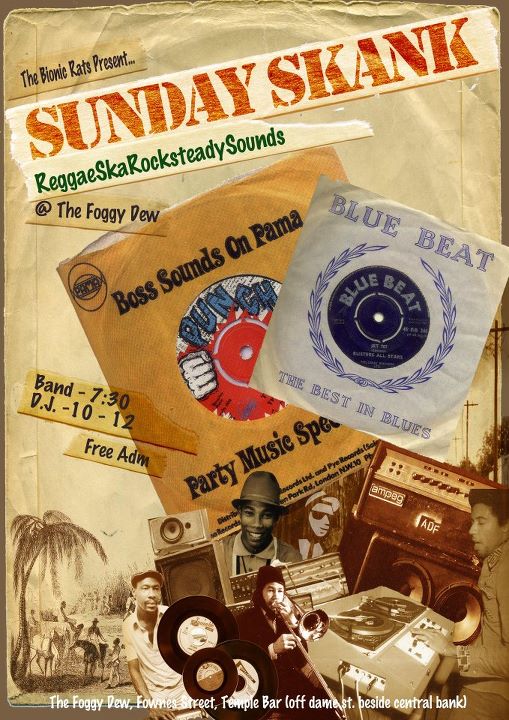
An up to date list of regular ska/reggae nights and promoters/DJs in the city. Missing anything? Leave a comment. All information correct as of March 2012.
Mondays:
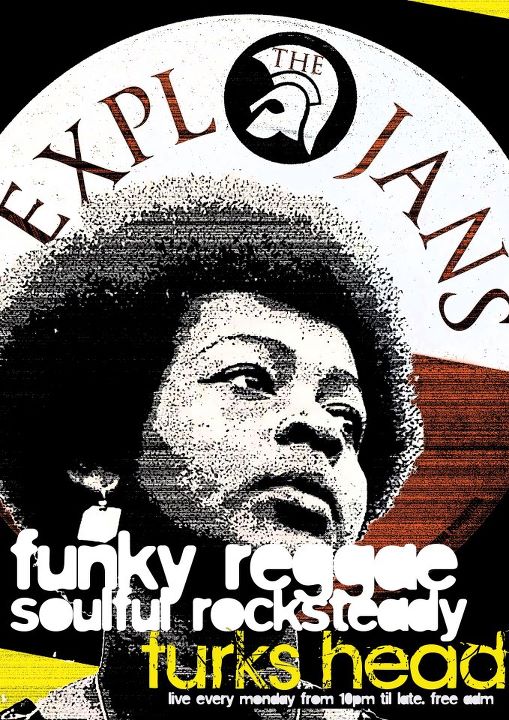
The Expojans @ The Turks Head, Monday nights.
Thursdays
Weedway or Seven Deadly Skins @ Turks Head, Thursdays.
Fridays
The Bionic Rats & The Real Reggae Boys DJs @ Sin E, Friday nights.
Saturdays
Worries Outernational DJs with guests @ Sweeney Mongrels, Saturday nights.
Sundays
The Bionic Rats plus DJs @ The Foggy Dew, Sunday nights.
For many many years, the shortest street in Dublin was Canon Street which was situated just off Bride Street near St. Patrick’s Cathedral. It was originally named Petty Canon Alley in the 1750s after the minor canons (members of the clergy who “assists in the daily services of a cathedral but is not a member of the chapter.”) of St. Patrick’s Cathedral.
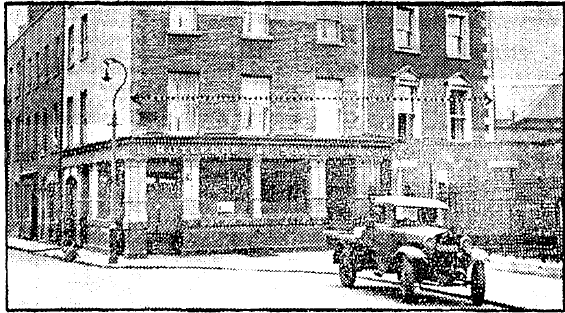
The street had just one address, the public house of Messrs. Rutledge and Sons, and was such described in 1949 as the ‘shortest street in the world’ (Irish Press) and in 1954 as the ‘shortest street in Europe’ (Irish Times).
Canon Street can be seen in this old photo. Rutledge and Sons is the corner building in the bottom left hand side of the picture.
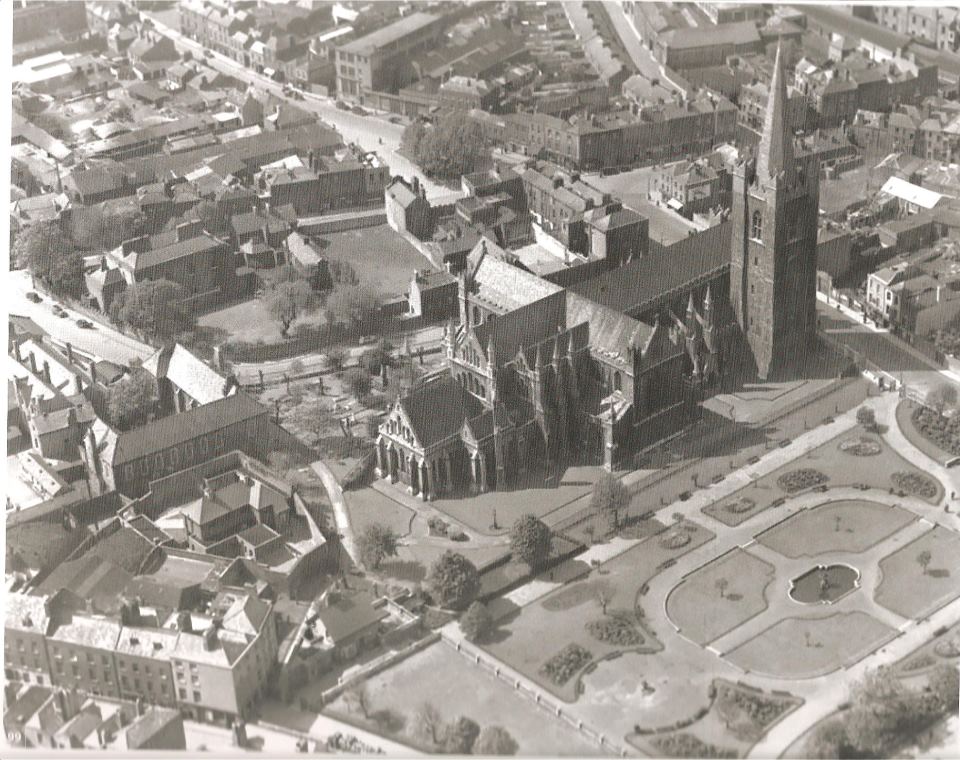
Aerial view of St. Patrick's Cathedral and surrounding area. nd.
It also hosted, to rear of the street, the famous Dublin Bird market for hundreds of years.
Canon Street Bird Market. nd. (Picture uploaded by Nioclás Mac Aodhagáin)
The pub was demolished and so the street disappeared in the late 1960s to make way for the widening of Bride Street.
Today, it is generally accepted that Palace Street, just off Dame Street and a attached to Dame Lane is Dublin’s shortest street with only two addresses. No.1 is the French restaurant Chez Max and No.2 was the building that hosted the The Sick and Indigent Roomkeepers Society from 1855 to 1992.
Does anyone know of a shorter street?
Nos 1 and 2 Palace Street on the left of the picture.
The statues on each side of the Trinity College Dublin Campanile are well known to many, not only to students of the college but also to the many Dubliners who use use the college as a shortcut from Dame Street to Nassau Street.
On the left hand side, you find George Salmon. Salmon, as well as being a highly regarded mathematician and theologian, was a one time Provost of the institution, a deeply conservative figure who firmly opposed the admittance of women to Trinity. “If a female had once passed the gate …it would be practically impossible to watch what buildings or what chambers she might enter, or how long she might remain there” wrote the Board of Trinity College in 1895, capturing the spirit of the institution in Salmon’s time. It was somewhat ironic the first female student at Trinity College Dublin was to arrive soon after his death in January 1904. On the far side of the Campanile sits a fine memorial to historian W.E.H Lecky.
George Salmon today.
The George Salmon monument was first placed on the Trinity campus in 1911, though it didn’t sit in its current location at Parliament Square, but rather in the hall of the museum of the college. The sculpture was John Hughes, and The Irish Times noted at the time that the statue was carved of Galway marble. It was done in Hughes’ studio in Paris, based on photographs of Salmon. The statue has moved around Trinity on several occasions, beginning its life in the hall of the museum before being moved to the small lawn at the end of the library, near to the playing fields.
Yet to many, the statue was considered quite ugly. Writing in the letters pages of The Irish Times in January 1964, Owen Sheehy Skeffington defended the statue of Salmon, noting that “it is not a work of outstanding artistic distinction, but it has a rugged honesty that of the ‘warts and all’ type which accords well with the fearlessness and integrity of Salmon the man.”
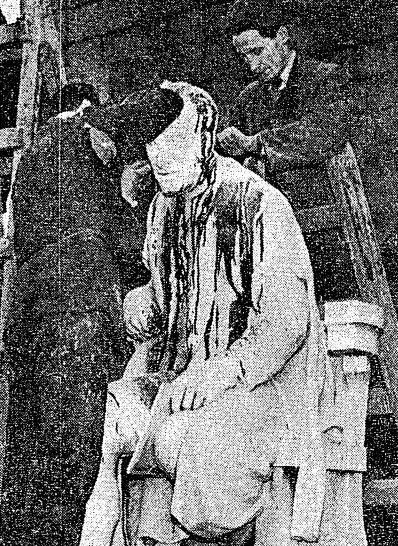
Some never saw the appeal of the monument however, and twice in the early 1960s Salmon’s monument made the national broadsheet papers following attacks upon it. In February of 1961, the monument was daubed with red paint and creosote. An official of the university remarked to The Irish Times that it was “probably some undergraduate prank”, but the paper quoted one student who passed them as saying “it was about time- and you can quote me on that.” In March 1963, Salmon was again singled out for attack, when black and red ink was flung upon it.
This Irish Times image shows the damage to Salmon following the 1961 incident.
Salmon was only moved to his contemporary location in January 1964. It became the first monument placed in the front square of the college in nearly 30 years, seated on the far side of the Campanile from Lecky. The Irish Times noted that “some people who have looked at the statue are doubtful about the wisdom of placing it in the square” and went on to state that it “is considered by many to be rather ugly.”
With Salmon having insisted women would not enter his beloved university, he must have turned in his grave in October 2004. The Philosophical Society of Trinity College chose Salmon’s marble statue as an ideal location for a photoshoot for Kayleigh Pearson, the Phil’s first invited chair of the year. If her name doesn’t ring a bell immediately, I’ll spare you the Google: she was a model from mens mag FHM, Britain’s favourite ‘Girl Next Door’ no less. Trinity had come a long way.
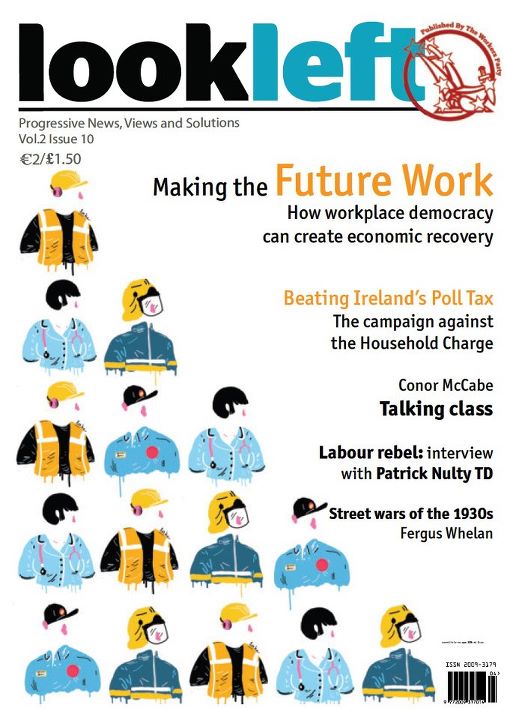
The latest LookLeft has made it to the streets, and should be shelved at Easons branches nationwide by Saturday. The cover is the work of Luke Fallon, and though I’m a bit biased I think it’s a nice break with regards normal left-wing aesthetic and design. Below is the blurb for the magazine, but it’s worth mentioning from ourselves you’ll find a piece focusing on long-time Come Here To Me favourites ‘The Blades’ (see here for some of the posts jaycarax has given us on the band) and a piece on the upcoming ‘Decade of Centenaries’ and what it means to different people.
The new edition of LookLeft is out now. It is now expanded to 40 pages, proving that growth is possible even in an age of austerity. Highlights include:
* Ireland’s poll tax – building a mass non-payment campaign against the household charge
* Class Dismissed – Conor McCabe on the need for class to become a central part of political and social debate in Ireland
* Whose Decade is it Anyway? – Donal Fallon on the forthcoming centenary commemorations
* Street Wars – Fergus Whelan on family history and ideological battles on the streets of 1930s Dublin
* Making the Future Work – Alan Myler on workplace democracy and economic recovery
* Football and Revolution – David Lynch on Egyptian Ultras and political struggle
* Feminism’s New Dawn? – Leah Culhane on Irish feminist debates on the Slutwalk phenomenon
* Rebel with a Cause? – Interview with Patrick Nulty TD
* Not Even Our Rivers Run Free – Padraig Mannion on the water privatisation agenda north and south
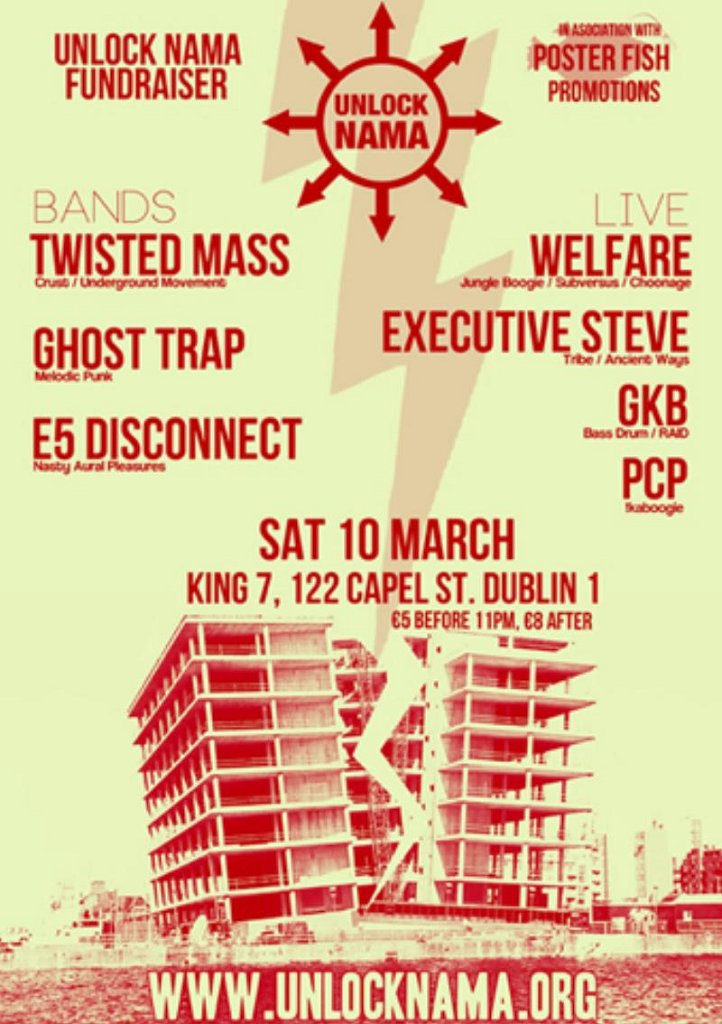
Unlock NAMA, a fantastic campaign dedicated to the promoting the ‘access NAMA properties for social and community use and to hold NAMA to account’, are hosting a kick ass fundraiser on Saturday night in King 7, Capel St.
Warming up the night’s proceeding will be aurally pleasurable Prog band E5 Disconnect, indie pop punks Ghost Trap and crust ‘dolecore’ Twisted Mass.
Taking us into the wee hours will be Kaboogie! legend PCP, RAID’s gKB, Drum n Bass connoisseur Executive Steve (Tribe / Ancient Ways) and Monaghan’s No1. DJ of all time Welfare (Jungle Boogie/Subversus / Choonage) who has been tearing up house parties, raves and club nights with a cheeky smile since 2004.
Tomorrow sees Bohs first home League game of the season, and to coin a phrase, all has changed, changed utterly. We’re lucky to have a team on the pitch, never mind a team who, despite their youth, fight like lions for possession and give it their all as seen over the last couple of weeks in the Setanta Cup and our first League game against Derry. I don’t think anyone can be disappointed with the effort put in so far.
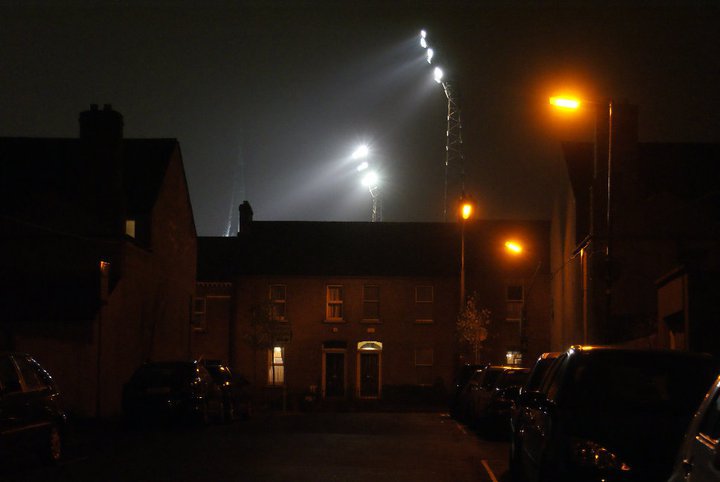
But, to the point. Tomorrow evening, at six o’clock or so, I’ll make the journey up North Circular Road. Coming to Mountjoy Prison or there-abouts, I’ll see the beacons in the distance that are the floodlights of Dalymount Park. And then I’ll start to get the jitters. They signify the start of something, generally a night of beer, shouting my head off, beer, football, camaraderie, beer, shouting my head off again and a sense of ‘home.’ They signify everything I love about this League, a feeling those who follow a foreign team might get if they were to make their yearly trip to Old Trafford or Anfield every week instead. But they don’t, and won’t ever feel it the same way. Its a feeling of pride/ despair/ love/ heartbreak/ joy/ pain. (Insert where appropriate.)
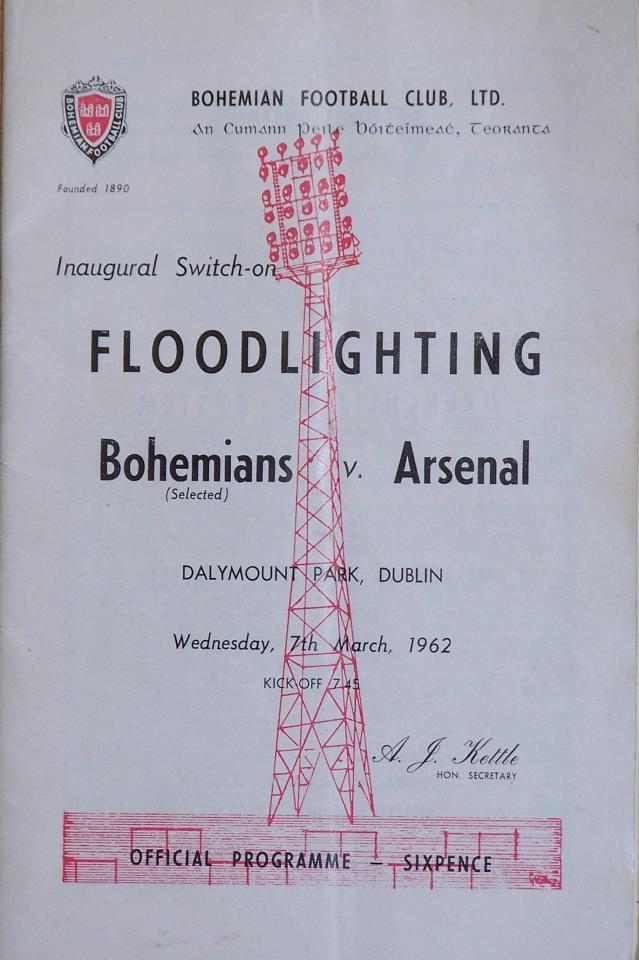
Anyways, the reason for this post. Yesterday, the seventh of March was the fiftieth anniversary of the installation of floodlights at Dalymount Park. One of the most striking features of the Phibsboro and indeed the North Dublin skyline has been around for a full half century. How old they are is anyone’s guess when you think the pylons themselves came from Arsenal second hand, and they were guest opposition on the event of their unveiling. Below is a scan of the programme cover from that night, shame I can’t find the match report.
So, for half a century, the phrase “just follow the floodlights” has been used when directing visitors to Dalymount. For half a century, people have been feeling that same feeling I do when I’m walking up the NCR on a Friday night. I can’t wait for it tomorrow, that feeling never grows old. This isn’t the end, and we told you so. Come on Bohs.
Cheers to Giofóg from thebohs.com messageboard’s Da for uploading the scan, and Dotsy for the picture above.
















 Click on the book for more.
 Click on the book for more.
 Donal
Donal Ciarán
 Sam
Sam


 Come Here To Me!