Feeds:
Posts
Comments

Archive for 2012

Well, this is unfortunate…

(we got word that those who postered the Eelus piece removed the posters, stating it to be a genuine error. As I said below, the real vandalism against this city is the empty NAMA buildings that dot it)


Only a few hours ago we posted a piece about the exciting new NAMA poster campaign around the city, bringing NAMA buildings to the attention of the public.

Sadly, it seems those behind the posters decided to hit up this beautiful EElus piece of street art on South William Street. If you’ve read A Visual Feast, last years excellent book covering Irish street art, you may have seen the interview with the street artist Eelus in it.

Eelus noted that he was approached by a young woman while painting this piece, who told him he’d robbed the idea from a similar piece of street art in the UK. He replied by informing her that was him! The constrast however is that this angel in Dublin, a lost angel, appears a bit vulnerable when compared with her London sister. I often admire her while walking down South William Street, she’s somewhat symbolic of where the city is.

Cheers to Freda, whose photos of street art have appeared on numerous occasions on this site, for drawing my attention to this.

The sentiment of the NAMA poster campaign is admirable. The real vandalism in this city in the state empty buildings fall into, while people lack homes.

Read Full Post »

How to spot a NAMA building…

This was brought to our attention earlier today, an interesting poster campaign in the city centre to draw attention to some of the NAMA owned buildings around us. Some, you pass on a daily basis and may be unaware that they are under the ownership of NAMA.

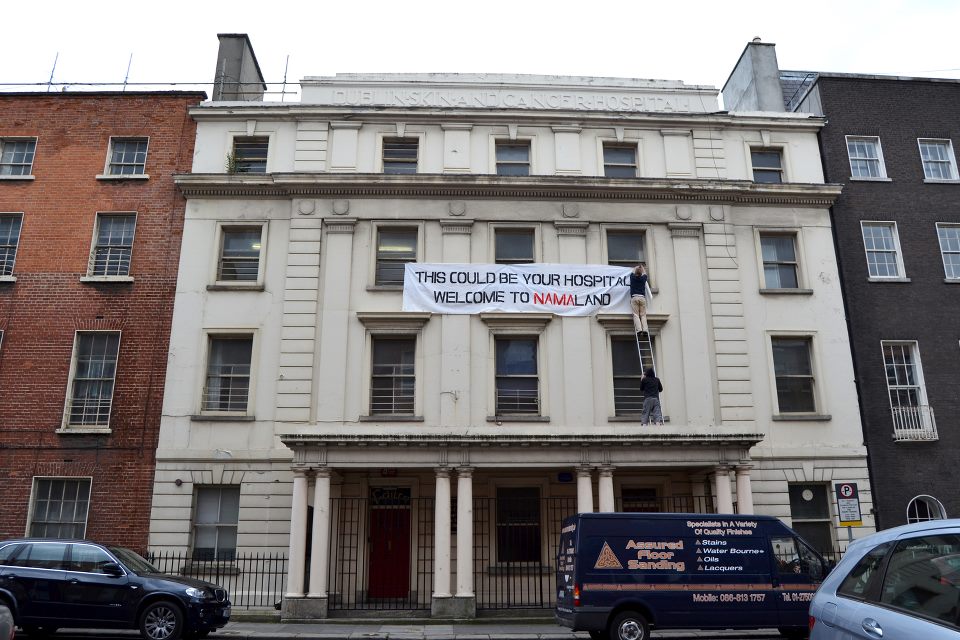
Of course, this isn’t the first protest engagement with NAMA buildings in Dublin. Back In November, we brought you this image:

Read Full Post »

The Irish Press, April 25 1966

The fiftieth anniversary of the 1916 rising was of course a monumental moment in the history of the Irish state. It was marked in a wide variety of ways, for example in Dublin with the opening of the Garden of Remembrance and the pageant Aiséirí at Croke Park on Easter Sunday, not to mention a full military parade on our main thoroughfare.

As Fintan O’Toole noted in a 2011 Irish Times article on commemorating the Rising:

The 50th anniversary in 1966 was perhaps the nearest thing to a broadly embraced national celebration, with everything from postage stamps to the renaming of train stations, and from Hugh Leonard’s TV re-enactment, Insurrection , to a pageant in Croke Park.

One of the more unusual manners in which the anniversary was marked was at Dalymount Park, where the FAI Cup Final would take place on the exact anniversary of the rising, April 24th.

The 1966 FAI Cup final was by all accounts not a beautiful game of football. Indeed, The Irish Times went as far as to say it was “among the most disappointing finals ever”. Shamrock Rovers and Limerick would play it out at Dalymount Park, with the game ending in a two-nil victory to the Dubliners, but prior to kickoff the crowd would witness something rather unusual.

Over 200 veterans of the 1916 rising accepted a special invitation to attend the final from the FAI, and among the survivors to attend the final was President Eamon deValera. The Irish Times of April 23rd noted the men were to parade in the centre of the pitch, salute the President and then there would be the playing of the Last Post before the veterans would then make their way to a special seating area in the stands. The Fintan Lalor Pipe Band led proceedings.

Oscar Traynor is a name today associated with football among the youth of the city for the cup named in his honour, but the one-time FAI President was also a veteran of the Easter Rising of 1916. Traynor had a great love of the beautiful game, and had toured Europe with Belfast Celtic in 1912. His Witness Statement to the Bureau of Military History on his role in the 1916 rising is quite a good read, and begins almost with this excellent line.

I was connected with football up to that and I broke with football when I saw that there was something serious pending.

Something serious indeed!

Veteran of the Easter Rising and later FAI President Oscar Traynor

Traynor passed away in 1963, but the Irish Independent report on the 1966 final would note that the pre-match ceremony “was a historic occasion with the freedom fighters of 1916 taking part beforehand in ceremonies which would have brought joy to the heart of the late president of the FAI, Oscar Traynor. The final itself, however, brought little joy to the hearts of the 26,898 spectators who gave it their disapproval in the slow hand-clap in the second half.”

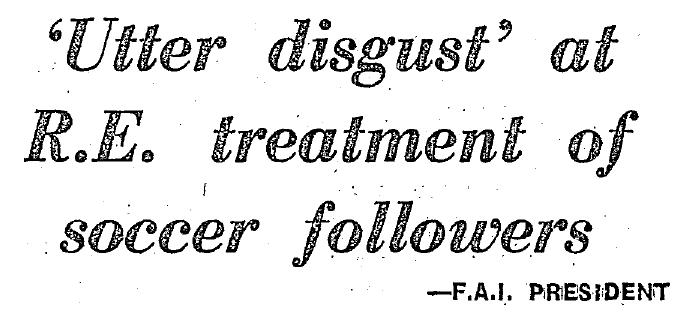
The FAI took aim at Radio Eireann the following day for not broadcasting the FAI Cup Final. The FAI President and Minister for Health Donagh O’Malley took aim at the station, stating “it would be remiss of me if I did not express my utter disgust at the manner in which the broascasting authority in this country has treated soccer followers.”

A historic day for Irish soccer, but not broadcast by Radio Eireann.

Sportsfile today have some excellent images from the 1966 clash, as mentioned above said to among the worst FAI Cup Finals ever played, but sadly no images of the 1916 commemoration prior to kick off.

Long on my list of books to read is Sean Ryan’s history of the FAI Cup. The cup has many interesting stories of course, and it’s role in marking the fiftieth anniversary of the Easter Rising shouldn’t be forgotten.

Read Full Post »

Let there be light

Lovely idea and a lovely video.

“On the shortest day of the year, December 21st, a little extra light shone out on Dublin’s Camden Street through a 19th century stainglass window which has been dark for more than a century”

Read Full Post »

Its not quite this stunning image from Broadsheet but someone has taken the time to print, frame and hang the below on the side of  a business in the Italian Quarter. Part of the Dublin skyline for over a century, plans are abound for demolishing the Pigeon House towers… a pity I say.

Read Full Post »

Champion Sports. If there’s one positive to this recession, it’s the bargains.

Read Full Post »

This is sheer brilliance from the lads at Storymap and Shane MacThomais, historian at Glasnevin Cemetery. It tells the story of a UVF man buried among some of our own ‘patriot dead’.

Read Full Post »

There were  a number of highly significant and influential one-day and two-day Punk and New Wave festivals from mid 1977 to late 1978 in Dublin.

The first was the Belfield Festival in UCD which took place on 25 June 1977. The line up was The Radiators from Space, The Undertones, The Vipers, Revolver and The Gamblers. Sadly the gig is perhaps best known for the tragic fatal stabbing which took place on the night.

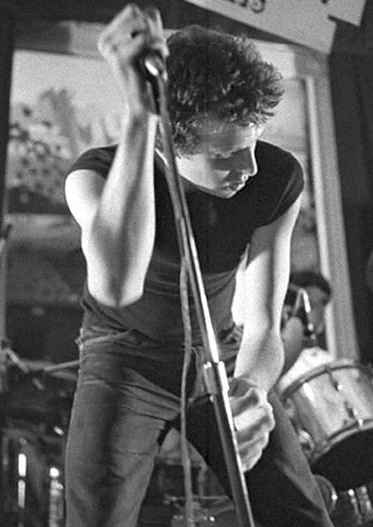
Philip Byrne of Revolver. (Picture: U2TheEarlyDaze)

Secondly, there was the first annual New Wave Festival which took place over two nights in The Project Arts Centre on 8 – 9 November 1977. The first night saw The Vipers and The Gamblers and the second night Revolver, Fabulous Fabrics and The Kamikaze Kids.

Paul Boyle (The Vipers), Steve Jones (The Sex Pistols), George Sweeney (The Vipers) & Larry Mullen (U2) at the Hot Press Xmas Party, '78. (Picture: U2TheEarlyDaze)

Thirdly, there was the one day Punk Festival on 28 November 1978 in St. Anthony’s Hall on the quays. The line up was The New Versions, Berlin, Virgin Prunes, Strange Movements, the Skank Mooks and The Citizens.

Strange Movements (Picture - Irishrock.org)

Anyone have any memories, pictures or gig posters of the above, please do get in touch.

Read Full Post »

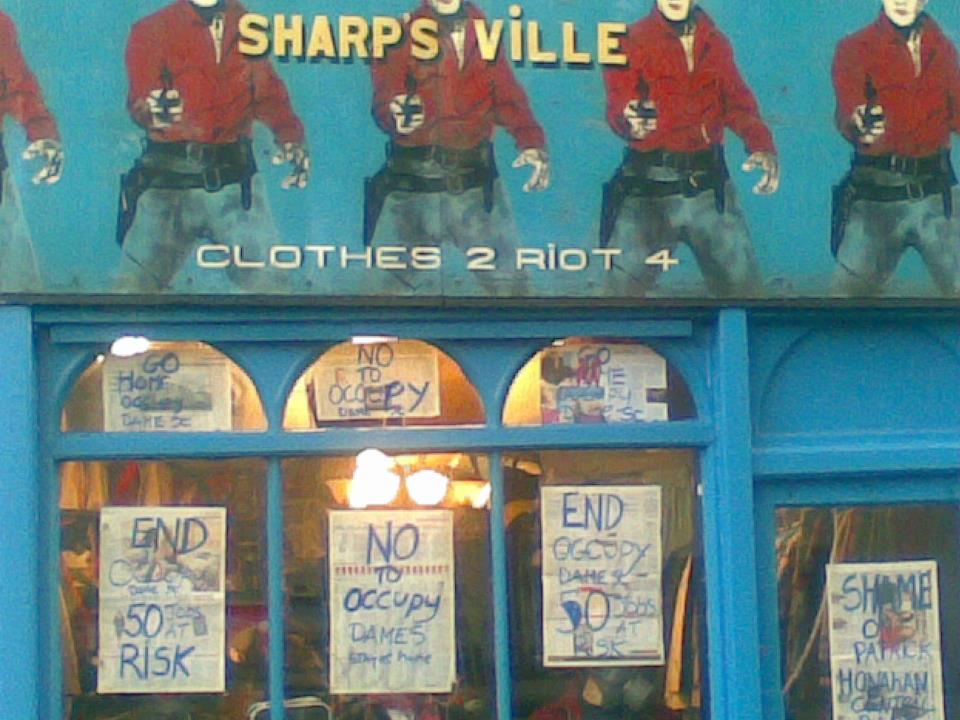
Interesting photo posted to Facebook, the inevitable fall out with local business for Occupy Dame Street?

Read Full Post »

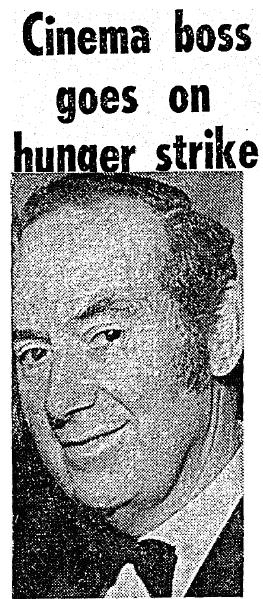
The story of the dispute between the owner of the Forum Cinema in Dun Laoghaire and the Irish Transport and General Workers Union in 1979 is a fascinating one.

On November 19 1979, Barney O’Reilly went on hungerstrike with the intention of drawing public attention to a dispute involving his cinema and the Irish Transport and General Workers Union.

The Irish Press reported that Mr.O’Reilly had told them he would “neither eat nor open the door until he had the choice to run his cinema as a non-union house. After the film was run in the cinema last night he locked the door to begin his protest.”

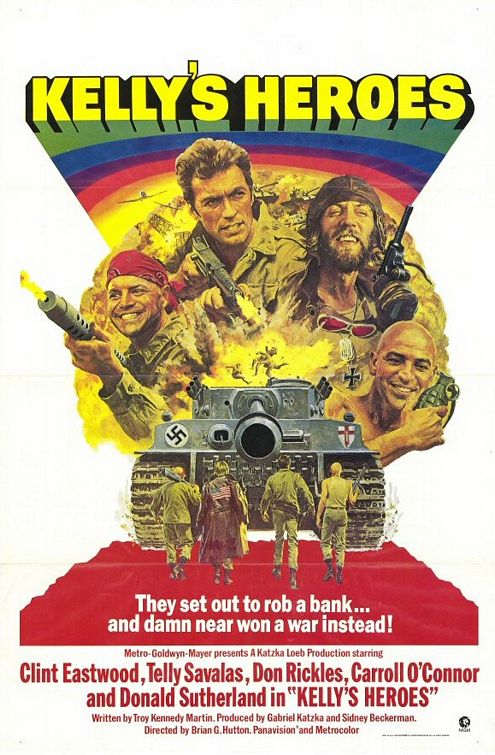
O’Reilly had been in dispute with the No.7 branch of the union, with members of the union refusing to co-operate with him. The first film due to be shown in his brand new cinema was Kelly’s Heroes which was distributed by M.G.M, but I.T.G.W.U members inside M.G.M’s dispatch department refused to handle a film intended to be shown in the Forum Cinema, owing to O’Reilly’s anti-union policies. The Irish Times noted O’Reilly had to replace the planned film with The Trials Of Oscar Wilde at short notice.

The Irish Times report at the start of O’Reilly’s hunger strike noted that he had spent £25,000 on renovating the cinema, formerly the Astoria, and that he intended to use a small-skeleton staff, unpaid and consisting mainly of family members for the first three months following opening.

Patrons who arrived at the cinema to see Kelly’s Heroes were met by a sign informing them that because of “victimisation and intimidation by the Irish Transport and General Workers Union” the film could not be shown. The union had blacklisted the cinema until O’Reilly agreed to employ union labour.

An I.T.G.W.U spokesperson told newspapers at the time that their letter to O’Reilly had gone unresponded to, a letter in which they informed him that they represented cinema workers in the Dublin and Bray areas. Members of the union who had been working in The Forum cinema installing automated equipment then withdrew their labour.

I.T.G.W.U members at other cinemas in Dublin had engaged in radical action in the 1970s, for example the sit-in protests which occurred at both the Ambassador and Academy Cinemas in 1977 with the announcement of the closure of those two cinemas. Earlier, in 1973, a strike of 300 I.T.G.W.U workers against Odeon Ltd. had closed nine cinemas in Dublin and Bray.

The hunger strike went on for a number of days. The Irish Press noted that on the fifth day of the strike O’Reilly was visited by a doctor who advised him to end his fast, and it was upon the advice of this doctor that O’Reilly thankfully ended his five day hunger strike. He told The Irish Press that his 120-hour fast had led to “other people and organisations getting involved” and brought public attention to his cause.

The Forum cinema is no longer with us, demolished in the summer of 2002, having closed in 1999. It was a small, two-screen cinema, and sadly many such cinemas would lose out in the days of the new multiplex outlets. As Justin Comiskey wrote in The Irish Times at the time of the Forum’s closure: ‘Small cinemas are dead, long live the multiplexes. That would appear to be the message following the closure of The Forum in Glasthule four weeks ago, leaving two small independent cinemas in Dublin.’

I’d be interested in hearing more from people about relations between the I.T.G.W.U and The Forum cinema following this dispute.

On a sidenote, some of you may remember a recent piece on this site from jaycarax which looked at a Dublin industrial dispute which lasted fourteen years. It occurred in Dun Laoghaire too, at Downey’s Pub.

Read Full Post »

Mark O’Brien in his 2001 book De Valera, Fianna Fáil and the Irish Press makes fleeting reference to an Irish Press reporter named Paddy Clare who ‘took sabbatical leave’ [1] in order to join the International Brigade during the Spanish Civil War.

Immediately, I became fond of this chap who decided to take a ‘leave of absence’ from work, not to go on holiday but to join the International Brigade and his risk his life in the defence of the Second Spanish Republic.

A bit of digging unearthed that Clare was firstly, a life long Irish Republican who fought in both the War of Independence and in the Civil War on the Anti-Treaty side and secondly, an individual who has largely been forgotten.

Born in Dublin into a republican family in 1908, his father Mick was an old Fenian. Joining Na Fianna Éireann in his early teens, he saw action in Dublin during the War of Independence. Following the treaty, he took the Republican side in the Civil War and was a member of the Four Courts garrison in 1922. Subsequently, he was imprisoned in both Kilmainham and Mountjoy where, in the latter, he once went on hunger strike. [2]

Always a keen writer, Clare contributed articles to An Phoblact and The Nation. His work caught the eye of De Valera who asked him to join the fledgling Irish Press in 1931. He would stay with the paper for the next forty-three years, first as diary clerk, then a reporter and finally as ‘night-town man’.

Still committed to Irish Republican Socialist politics, he made the decision to take a period of leave from the newspaper to join the International Brigade.

Unfortunately that is all I know about his involvement in the SCW. I’ve emailed Ciaran Crossey (from the Irish SCW website) to see if he has any more information

Returning to Dublin and to The Irish Press, he was appointed as the paper’s ‘night-town’ reporter, a post in which he’d keep until 1973. A tough job, Clare would man the office throughout the night and chase any leads or stories that occurred during the hours of darkness.

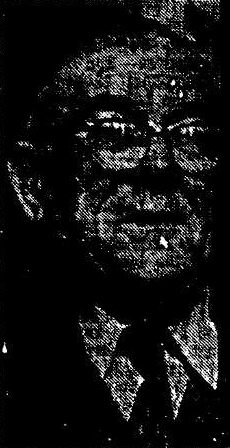
Grainy photo from The Irish Press (March 1, 1983)

Clare passed away in 1983 at the age of seventy-five. Tim-Pat Coogan wrote at the time:

Gravely voiced, indefatigably cheerful, with the yellow pallor of the night worker, which he was for scores of years, Paddy Clare to generations of young Irish Press journalists, epitomised the ideal of the hard-shelled, heart-of-gold professional reporter.

An IRA veteran of at least two wars (possibly three) and a respected journalist of over forty years, Clare lived a full life.

1 Mark O’Brien, De Valera, Fianna Fáil and the Irish Press (Dublin, 2001), 68
2 Unknown, Death of Paddy Clare, Irish Press, Mar 1, 1983

Read Full Post »

Reports from Broombridge……

The most popular posting in the history of Come Here To Me?

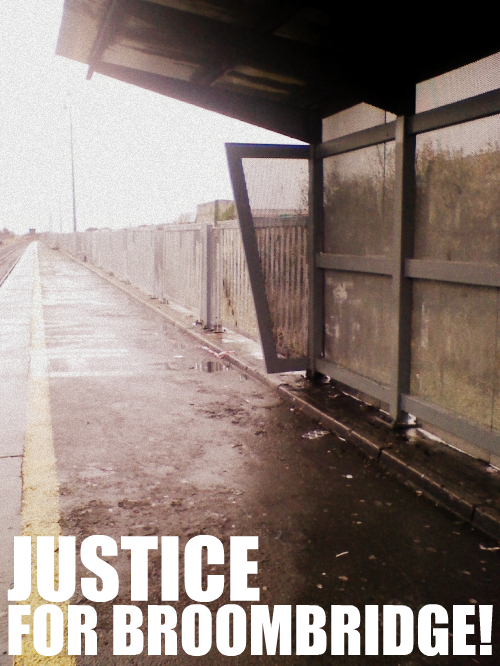
It was the story of Broombridge train station, the sheer state of the place, and the campaign for Broombridge to win the Irish Rail station of the year. There was just something incredibly Irish about Irish Rail even asking ‘hey, which of our stations do you think is the best?’ as opposed to ‘which stations really need a lick of paint?’

At the time we wrote:

Anyone who has been through Broombridge station will know it is beyond the words ‘awful kip’, a station neglected while those around her have been modernised, she continues to crumble, the very station sign telling you where you are difficult to read.

Brrombridge winning the ‘Best Station’ award would draw some attention to the sheer state of the place, and be the best coup for a public vote campaign since the BBC had to award the Wolfe Tones the best song of the last century

It emerged out of a Facebook campaign which caught our attention, and the story seemed to grow legs from there, with our original story posted by Broadsheet.ie and Colm O’Rourke, the man behind the Facebook campaign, interviewed by the Irish Daily Mail.

Thousands of you read the piece, but more importantly a very sizable chunk of you went on to visit the Irish Rail website and vote for Broombridge, something you can still do and should still do by clicking here.

Today I came home to an e-mail from Come Here To Me reader Ado with some great news regarding Iarnród Éireann:

Iarnrod Eireann today started cleaning up the Broombridge train station, new paintwork, signs, markings etc.., Nothing major but they are reacting to the email voting campaign. Well done to all involved.

He went on to note below:

The fact is we, the local Community Council, were informed by IE management in December that no upgrade was planned for Broombridge due to vandalism. A pathetic reason for abandoning our station. It’s IE’s duty to secure their property and maintain it to the same standards of every other station.

Nothing major indeed, but it is a start. Historically overlooked, even during times of renovation, it’s great that thousands of people have taken the time to register their protest with Irish Rail over the sheer state of Broombridge. For many Dubliners, Broombridge is the local train station remember. It’s just not up to scratch.

Read Full Post »

« Newer Posts - Older Posts »