Feeds:
Posts
Comments

Archive for 2012

I love the beautiful game, and I hate the ‘Red Tops’.

For years, I’ve been an avid reader of When Saturday Comes, and long-term readers of the blog will know that the once-thriving fanzine culture in the League of Ireland is something I sorely miss. In the past we’ve featured fanzines from Bohs, Pats and Rovers supporters, publications which really captured the spirit of the game and offered something much more than stats and sensationalism to the football faithful here.

Good football writing, and passionate football writing, is hard to find. In 2011, over in the UK, The Blizzard landed. I sat up immediately. It had all the passion of the fanzines, and was written in a style that meant it stood tall as a journalistic effort too. It gave space to things so often omitted from mainstream football publications, like the history of our beautiful game.

Describing the publication, editor Jonathan Wilson has noted

The Blizzard (is not) the organ of any one individual. Rather it aims to provide a platform for writers, British and foreign, to write about football-related subjects important to them, be that at the highest level or the lowest, at home or abroad. Eclecticism is the key. There will be no attempt to impose an editorial line; all opinions expressed are those of the individual author. Equally, within certain basic parameters, writers are encouraged to write in whatever style they see fit.

It’s format is perfectly between magazine and book, beautiful to handle and wonderfully designed. Prior to now Irish readers have had to purchase hard copies via the publications website, but now it is due to arrive in Dublin via Casa Rebelde in Temple Bar. All going well, I’m told it will arrive by the end of next week.

The Blizzard isn’t what one would expect from an ‘alternative’ football read. There’s more to this than a profile of Sankt Pauli or FCUM or something else you’d expect from The Guardian. A particularly strong past article that comes to mind looked at a first World War internment camp that shaped the development of the game in Europe. That’s the sort of thing you can expect.

Welcome to Dublin.

Read Full Post »

Great stuff this from Workin Class Records, more Dublin hip hop worth your time and ears.

Previously:
Street Literature-Products of the Environment

Costello- Young Apprentice.

Read Full Post »

Capuchin Annual’s really are the gifts that keep on giving. Not only do they frequently contain interesting essays, poems and the like but they throw up fascinating advertisements and photography from times past.

The Capuchin Annual 1948 has been sitting on the shelf opposite me for some time. Flicking through it, I stumbled on a series of photos from the launch of an art exhibiton in Dublin that year. An exhibition of Richard J. King’s work, two photos in particular stood out.

One featured M.Louis Jammet and Madame Jammet. Jammet’s Restaurant has featured on Come Here To Me in the past, when jaycarax sought out Dublin’s oldest restaurant. The other featured Jack B. Yeats and Ernie O’Malley. O’Malley of course has featured here on several occasions in the past, even popping up in a review of Trinity’s famous Pav. There are few pictures of Ernie online, so I thought this worth sharing too.

Louis Jammet and Madame Jammet

Jack B. Yeats and Ernie O'Malley

Read Full Post »

Women show their loyalties, Dublin 1922.

Michael Staines, of the Irish Volunteers, was Quartermaster General within the General Post Office during Easter Week 1916. He was the son of an RIC man, sent to Frongoch for his part in the rebellion where he became ‘Camp Leader’. In 1922, only six years on from the insurrection, he would be leading the Civic Guards through the gates of Dublin Castle, once more playing a leading role in Irish history.

For 700 years, prior to Staines and his men marching into that complex, Dublin Castle had meant one thing and one thing only, representing the fortified home of English (and later British) rule in Ireland. Standing in its courtyard today Justice gazes down on you, the work of John van Nost the Younger dating to 1753 and facing not towards the people of Dublin but away from them. She comes complete with drainage holes in her scales, to keep them from tipping unevenly. One couldn’t make it up. Does any statue say so much?

Notice the holes in the scales of Justice.

To mark the 90th anniversary of the handover of Dublin Castle, a series of public tours and talks have been organised. Details on how to attend are below. Some of these events will give visitors a different experience to the normal Dublin Castle tour. I’ll be attending several of the events, and am especially looking forward to Dr. Shane Kenna’s lecture ‘The Secret Service in Dublin Castle’.

Monday 16 January 2012; Anniversary of Handover 18.15
The Last Years of British Rule in Dublin Castle
Tour with Aisling Gaffney

Sunday 22 January 2012 12.00
What do national and foreign dignitaries miss on their visit to Dubiln Castle? Join Liz McCay for a quirky tour of her choice of art works from the historic collection, including behind the scenes access.

Tuesday 24 January 2012 18.15

Bedford Hall

‘The Secret Service in Dublin Castle’:
Lecture on a permanent secret service department established at the Castle after the Phownix Park assassinations in May 1882.

By historian Dr Shane Kenna.

Sunday 29 January 2012 11.00
‘A Piece of Make-do and Mend’:
An architectural tour with William Derham.

Limited places available by booking only.
Please email jenny.papassotiriou@opw.ie or dublincastle@opw.ie
or Tel: 01 645 8812

Read Full Post »

Cliche Guevara

Did a double take on Liffey Street earlier on at the windows of fashion chain Counter Propaganda. They stock a range of t-shirts and hoodies in a kind of tongue-in-cheek revolutionary style. I’ve never really gone for the likes of Mao’s Cafe, Pravda Bar, Counter Propaganda and the like, but thought this a bit too cheeky! The winter of discount tents? Occupy the January Sales.

Read Full Post »

The Free Peace Festival in The Phoenix Park in 1978 can either be seen as a bitter disappointment or as a fantastic achievement depending on your outlook.

It can be seen as a disappointment for it was supposed to take place over a full weekend, feature over ninety acts over three stages and attract over 50,000 revelers, but in the end, the festival opened with only one stage, a handful of bands and only 3,000 or so fans.

The achievement lies that in the fact that a free festival took place in The Phoenix Park which attracted 3,000 people, three times more than the one the year before.

Irish Press, Aug 08, 1978.

Bill ‘Ubi’ Dywer (1933 – 2001), the ecentric Irish-born self-described ‘non-violent anarchist’ and main organiser, made his name running the Windsor Free Festival in London from 1972 – 1974 which saw over 100,000 attend and was widely seen as being the forerunner for the Free Festival Movement and directly the Stonehenge Free Festival and the later Glastonbury Festival.

Ubi and Friend. © Al Lyons

The 1978 festival in The Phoenix Park was supposed to feature over ninety acts including U2, De Dannan, Clannad, Horslips, Paul Brady, The Bach St Kids, VHF, Biro’s, Revolver, Rocky De Valera & The Gravediggers and Brown Thomas. I’m not sure which of those actually played in the end. As well as music, there was theatre, mime and an adventure playground for children.

Gareth Byrne remembers that day:

Saturday 5th August the first morning was bright when organisers began to arrive at The Hollow. The first band played to a trickle of spectators. By midday I spotted half a dozen individuals in wheel chairs at one corner, supervised helpfully by Fergus Rowan and a friend, who had arranged special transport. Gradually the attendance swelled to a few hundred individuals and parents with children. More bands arrived and got their gear ready. By lunchtime the sky had clouded over and there was a heavy downpour. Ubi donned a yellow showerproof cape and put a cheerful face on things by dancing and twirling to the music around the bandstand. I noticed a sharp row he had with members of one band who got nervous about the possibility of electric shock and wanted to switch off the AC/DC system. He effed and blinded loudly at them and insisted that the show go on. The shower died down, the sun reappeared, and Ubi disappeared. More people turned up to listen and the music went on smoothly until about 7 p.m.

Around 4 p.m. Ubi reappeared at the bandstand and looked the worse for drink. His reeking breath and raving demeanour suggested several double shots of Irish whiskey in addition to the customary pints of Guinness. A uniformed member of the Gardai (police) and a plainclothes detective tried to reason with him. He was escorted from The Hollow, somehow got to the ferry harbour at Dun Laoghaire and took the boat and overnight train to London. British newspapers reported a week later that Thames Valley police arrested him as he arrived at Windsor Park intending to launch a banned free music festival there. He was sentenced to jail and didn’t return to Dublin until the autumn of 1979.

In many ways, the Free Peace Festival was overshadowed by the first Carnsore Anti-Nuclear Rally which took place just two weeks after and attracted over 10,000 people.

Ubi later ran as an independent in Dun Laoghaire for the Dail in 1981 and 1982, receiving 927 and 418 votes respectively, and later was involved in the campaigning for legalisation of Cannabisand H-Blocks prisoner rights. He was involved in a cycling accident in the late 1990s in the Dublin mountains, never fully recovered from his injuries at died at the age of 68 in 2001.

Read Full Post »

I’ve always loved the area around Ladys Lane in Kilmainham. It really is ‘old Dublin’ at its finest, a part of Dublin that truly hasn’t changed much in recent times. Sadly for residents, the area is infamous for flooding. Tom Macken’s excellent woodblock captures the lane perfectly, easy to miss as one drives past on route to the Liberties.

Tom Macken 'Lady Lane, Old Kilmainham' Woodblock

Passing in the car, this was spotted recently at the top of the laneway, the Lady of Ladys Lane. It appears like chalk, but she’s come through some awful weather unharmed. You’d miss her driving past, but she stares down Lady’s Lane towards the grounds of the Royal Hospital. A beautiful little touch, whether sanctioned or otherwise.

Read Full Post »

The Dublin skyline outside my window earlier this evening. Beautiful… (Apart from the Civic Offices on Wood Quay of course.)

Read Full Post »

They could’ve built flats in the centre of the town for us and kept reservations like this for them that come in from the country. Home from home it would have been. But us! And the only grass we ever saw we were asked to keep off it. – Dominic Behan

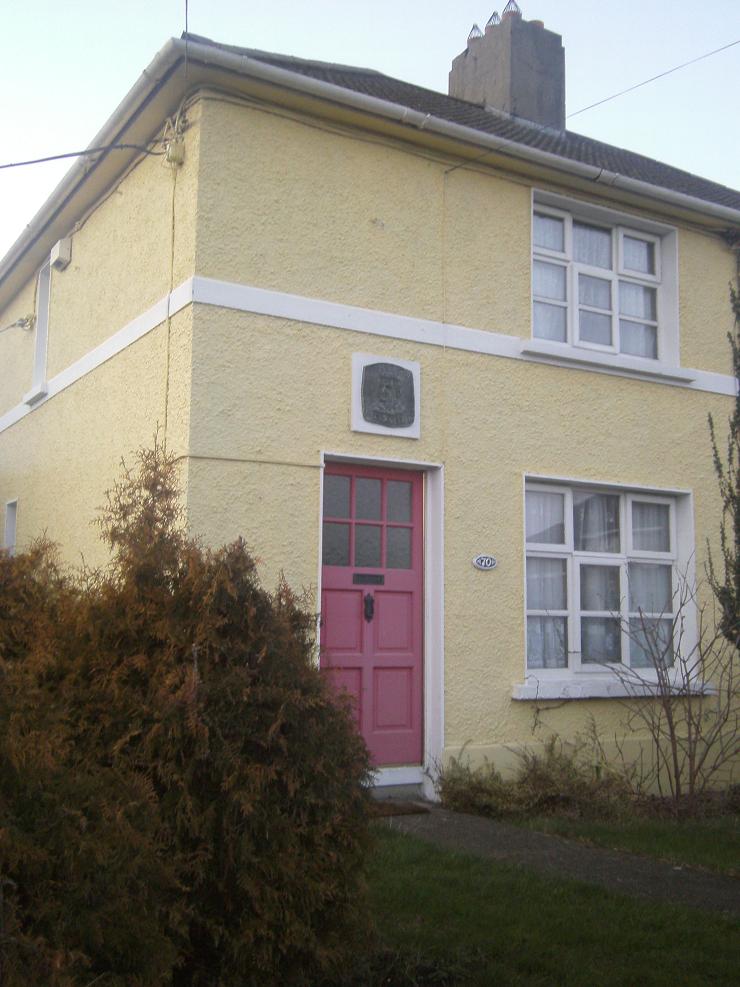
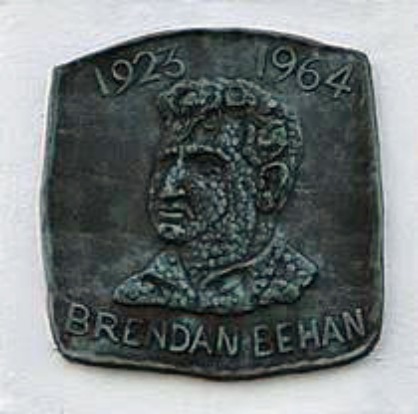
Passing Kildare Road in Crumlin, you couldn’t miss the plaque on no.70. It shows a very familiar face, that of the writer and poet Brendan Behan.

Behan and his family were moved to Crumlin from a tenement in Russell Street. As Ulick O’Connor noted in his biography of the great writer, his childhood in Russell Street would greatly shape Behan, as ‘besides the cultural advantages Brendan inherited from his parents, the indigenous tradition of Dublin played a major part in his development’. To many inner-city Dubliners, Crumlin and the like represented the countryside.

O’Connor notes that the general impression in Russell Street towards the new suburbs where the working class of the city were sent was that they were a place where they ‘ate their young’. Behan himself would refer to the area as the ‘Wild West’. In Behan’s play Moving Out, these new suburbs are referred to as Siberia!

Andrew Kincaid wrote of the emergence of Crumlin, Cabra and the like in his excellent Postcolonial Dublin: Imperial Legacies and the Built Environment. The corporation planned Crumlin at first for 3,000 houses, but by 1938 had zoned 2,400 more at Crumlin North.

The Behan’s arrived in the area in 1937, and Brendan himself would soon after be active in republican campaigns in Britain. Still, returns to the house were frequent for the writer. His brother Dominic, a celebrated writer in his own right, would join Na Fianna at the time the family moved to Crumlin.

It was 1977 before the home would be marked by a plaque.

We parked our car by the Clogher Road Allotments nearby, a credit to the local community in the grounds of Pearse College. Walking through them, you find this great tribute to the local lad Brendan. A local lad, but not by choice. What would he think of being honoured in Siberia today?

Read Full Post »

“Yipee Ki Yay…”

Great stuff via Humourisms.com , of the often forgotten day in Dublin’s history when Alan Rickman briefly occupied the GPO. Die Hard is a far superior film to Michael Collins of course, but guess which one you get free when you join Young Fine Gael on Fairs Day in Trinners?

Read Full Post »

Maser/BP Fallon.

Many of you will have no doubt seen Maser’s excellent tribute to BP Fallon on the walls of The Button Factory, part of Dublin Contemporary.

Eoin Murphy has uploaded this great video to Vimeo showing the painting of the mural. Well worth a watch.

Read Full Post »

I had to laugh when I saw this doing the rounds on Facebook.

Irish Rail are currently asking commuters to vote for their favourite station, based on issues such as station presentation and services. A campaign of sorts has sprung up behind Broombridge station. Anyone who has been through Broombridge station will know it is beyond the words ‘awful kip’, a station neglected while those around her have been modernised, she continues to crumble, the very station sign telling you where you are difficult to read.

I would like to ask you to take a moment and vote for Broombridge as station of the year. Once more this humble Dublin station has excelled and deserves our recognition, it shuns many of the newfangled modern ideas in transport like ticketing and not being on fire and has once more outclassed the rest by just being two poorly guarded concrete platforms.

Brrombridge winning the ‘Best Station’ award would draw some attention to the sheer state of the place, and be the best coup for a public vote campaign since the BBC had to award the Wolfe Tones the best song of the last century. Go over here and give it a minute.

Read Full Post »

« Newer Posts - Older Posts »