Feeds:
Posts
Comments

Archive for 2013

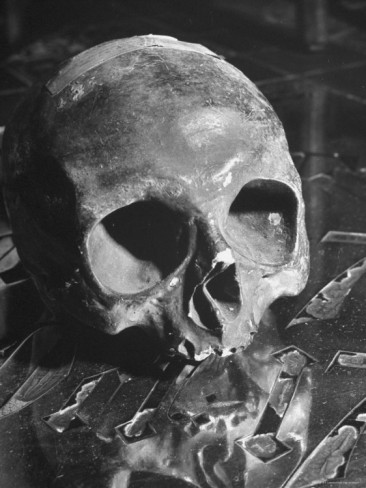
A cast of Jonathan Swift's skull, at Saint Patrick's Cathedral.

A cast of Jonathan Swift’s skull, at Saint Patrick’s Cathedral (Credit:LIFE)

A rather unusual story from the history of Saint Patrick’s Cathedral involves the remains of Jonathan Swift and his companion Esther Johnson, popularly known as Stella. Today, a visitor to the cathedral will see the epitaph Swift himself wrote. While it is in Latin, it has been translated into English as follows:

Here is laid the Body
of Jonathan Swift, Doctor of Sacred Theology,
Dean of this Cathedral Church,

where fierce Indignation
can no longer
injure the Heart.
Go forth, Voyager,
and copy, if you can,
this vigorous (to the best of his ability)
Champion of Liberty.

He died on the 19th Day of the Month of October,
A.D. 1745, in the 78th Year of his Age.

Among the exhibited items in the Cathedral today is a cast of the skull of Swift, but incredibly this cast dates to 1835, ninety years after the passing of the Dean. William Wilde, the father of none other than Oscar Wilde, would later detail the examinations upon the skull. Wilde was a prominent medical figure in Dublin, a leading eye and ear surgeon as well as author of several works on medicine. In his work The Closing Years of the Life of Dean Swift he described the exhuming of the body in 1835 in some detail.

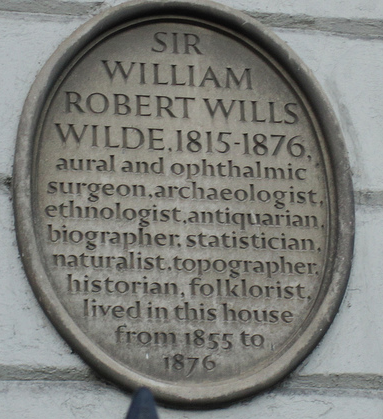
A plaque to Wilde upon the family home at Merrion Square today.

A plaque to Wilde upon the family home at Merrion Square today.

By 1835, the magnificent Cathedral found itself in dire need of restoration and renovation owing to water damage, and Wilde notes in his study that the frequency of flooding in the River Poddle led to much injury to the cherished cathedral. Repairs to the Vaults led to the exposure of the coffins of Swift and Stella, and Wilde stresses in his study that the repairs were “the sole cause of these sacred relics being again exposed.”

Incredibly, these coffins were not alone moved but actually opened, and among those present was the anatomist Dr. John Houston, who described the remains of Swift by writing of how “the bones were all clean, and in a singularly perfect state of preservation. When first removed, they were nearly black, but on being dried they assumed a brownish colour.”

Not alone were the coffins of the dead opened, but the skulls of both Stella and Swift were removed from the Cathedral, for examination by the British Association for the Advancement of Science. As Wilde notes:

The British Association were, at that very time,meeting in Dublin, and the skulls of Swift and Stella were then removed, for the purpose of being phrenologicaly examined by the corps of phrenologists that used to follow in the wake of that learned body…

For those unfamiliar with the term, Phrenology can be described as “a pseudoscience primarily focused on measurements of the human skull, based on the concept that the brain is the organ of the mind, and that certain brain areas have localized, specific functions or module.”

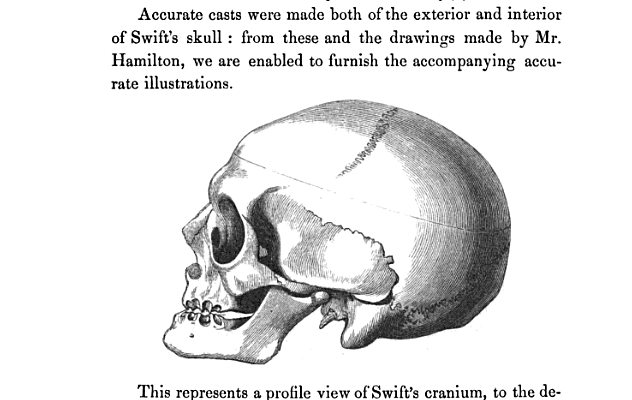
Casts and drawings of the skulls survive from 1835, and a number of these drawings were used as illustrations in the work of William Wilde:

From Wilde's study.

From Wilde’s study.

The observations made by one examiner of the skull seem quite humourous today, given the status of Swift as one of the greatest wits in Irish history:

On looking at Swift’s skull, the first thing that struck me was the extreme lowness of the forehead, those parts which the phrenologists have marked out as the organs of wit, casualty and comparison, being scarcely developed at all.

It has been noted that the skulls were ‘going the rounds’ at the time, becoming objects of great curiosity to Dubliners and visitors alike, and while the main examination of the skull was said to have occurred at the home of Sir Henry Marsh, Wilde notes in his study that “during the week or ten days which elapsed before they were returned….they were carried to most of the learned, as well as all the fashionable societies of Dublin.”

The manner in which the skulls were examined angered many at the time, and brought considerable criticism upon the then Dean of the Cathedral. Swift and Stella’s skulls were thankfully brought back to the cathedral. William Wilde’s study of the Dean is a very readable work available to read in full here, and particularly interesting is Wilde’s observation that a loose bone in Swift’s inner ear (Ménière’s disease) was responsible for much of his behaviour that was sometimes presented as insanity.

Wilde noted that:

… neither in his expression, nor the tone of his writing, nor from an examination of any of his acts, have we been able to discover a single symptom of insanity, nor aught but the effects of physical disease, and the natural wearing and decay of a mind such as Swift’s.

Today, a cast of Stella’s skull can be seen in Marsh’s Library, next to Saint Patrick’s Cathedral, while Swift’s can be viewed at the cathedral.

Read Full Post »

Many thanks to Mick Healy for sending these on.

'Postcard views of Dublin'

‘Postcard views of Dublin’

O'Connell St

O’Connell St

College Green

College Green

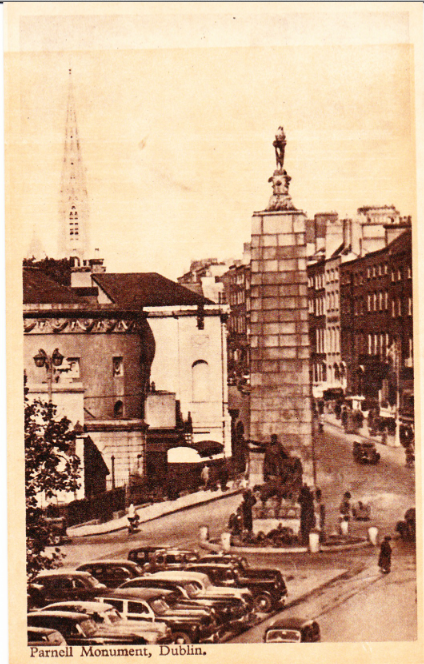
Parnell Monument

Parnell Monument

St. Stephen's Green

St. Stephen’s Green

Read Full Post »

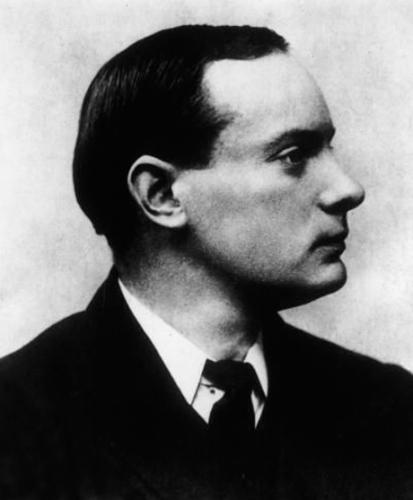
P.H Pearse, one of the signatories of the 1916 proclamation, executed for his role in the rebellion.

P.H Pearse, one of the signatories of the 1916 proclamation, executed for his role in the rebellion.

The afterlife of the Nelson Pillar on O’Connell Street is every bit as interesting as its lifespan, and from the late 1960s onwards various committees and campaign groups lobbied with the aim of placing a monument in the location where Nelson had stood. One reaccuring proposal was to replace Nelson with a monument to Patrick Pearse. Indeed, the idea of putting Pearse on top of the monument was even floating around before the destruction of the Pillar, with a motion calling for Nelson to be removed and replaced by the revolutionary leader brought before Dublin Corporation in August 1948.

In 1979, architect Yann Goulet brought forward a controversial model for a proposed Pearse monument to the City Council.

Architect Yann Goulet with his proposed monument to Patrick Pearse, photographed at City Hall in 1979.

Architect Yann Goulet with his proposed monument to Patrick Pearse, photographed at City Hall in 1979.

Higher than the GPO, and containing over £150,000 worth of bronze, the proposal was ridiculed when brought towards the City Council, with Councillor Frank Sherwin stating “it should be thrown in the Liffey”, while Councillor Hanna Barlow described it as “the yoke”. The proposed 100-foot-high abstract monument did not enjoy significant support from any quarters, but it is was just one proposed monument in honour of Pearse for the site. An earlier proposal in the same year came from the Pearse Commemoration Committee, who proposed a much more traditional style monument, to be carried out by sculptor Gary Trimble. The Irish Independent newspaper totally opposed any monument to Pearse in an editorial which noted:

If anything is to replace the Pillar, it should be something which will bring people together, and not something which will caused divisiveness and bitterness, as the proposed Pearse statue is clearly destined to do.

There were wild scenes at one meeting to discuss a proposed Pearse monument, when Lord Mayor Paddy Belton condemned the Pearse Commemoration Committee as “a bunch of Provos”, insisting that members of Sinn Féin were to the fore of the campaign to honour Pearse on O’Connell Street. This was a hugely controversial remark, as the Pearse committee had come from a very broad spectrum of Irish society, including Gael Linn and other Irish language groups. Bord Fáilte also objected to any planned memorial to Pearse, a surprise blow to the campaign, on the grounds that “it may interfere with the view of the GPO which is the vocal point of O’Connell Street.”

Trimble’s proposed monument was comparable in size to the monument to Parnell, and would show Pearse reading from a book, surrounded by children:

Trimble's proposed monument.

Trimble’s proposed monument.

Various points of view on any proposed monument to Pearse were reported in the media, ranging from over-the-top praise (“The messiah of the nation’s revival” in the words of Frank Sherwin) to calls for a monument that would be inclusive of the other 1916 leaders. Tomas Mac Giolla for example noted that James Connolly should not be forgotten in any monument at the site. The Pearse pressure group continued to campaign for the placing of a monument to Pearse on O’Connell Street, even if the Pillar site itself was off-limits. Councillor Pat Carroll reportedly pondered if it would be possible “to take down one of the monuments in O’Connell Street, such as that of John Gray, which did not seem to be too important.” However with Gray’s leading role in establishing a clean water supply for much of Dublin, I’d argue today he is far from unimportant!

Today, James Connolly remains the only one of the seven signatories of the proclamation with a statue in Dublin city centre.

Read Full Post »

There have been a small but not insignificant number of reactionary murders in Dublin and on the island of Ireland since the 1920s. I have tried to compile a list of these here. They are divided up into areas of anti-Semitism, homophobia and racism.

I have purposely not included murders in regard to nationality (Irish/English) or religion (Catholic/Protestant), as due to this island’s history, these are a completely different matter.

Obviously not all murders of ‘foreign nationals’ in Ireland can be considered ‘racist’. Those that have been included all had a racial element to them though.

Anti-Semitism:

31 October 1923: Bernard Goldberg, Dublin
Golderg (42), a Manchester jeweller and father of four, was shot on St Stephen’s Green after three men had stopped him and his brother Samuel and demanded their names.
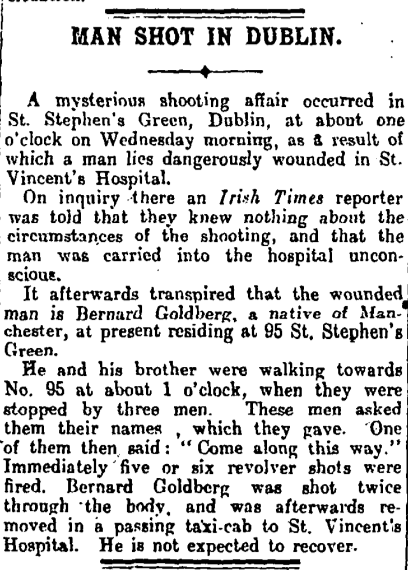
The Weekly Irish Times, 3 November 1923.

The Weekly Irish Times, 3 November 1923.

14 November 1923: Emmanuel Kahn, Dublin
Dublin-born Kahn (24) of Lennox Street, was gunned down in Stamer Street in Portobello as he returned home after an evening playing cards. David Millar, who was with him in the Jewish Club in Harrington Street, was also shot in the shoulder but managed to stagger home.

The principal instigator of these two murders was Commandant James Patrick Conroy, who claimed to have resigned from the army in December 1924 because he disagreed with the policy of the then government. He fled to Mexico and then to the United States, along with with two other suspects, after the incidents. No-one was ever convicted. A curious footnote to the whole affair was found in remarks in the Dail in February 1934, when Fianna Fail finance minister Sean McEntee claimed that one of the killers was walking free, and was a member of the fascist-style Blueshirts organisation.

Sexuality:

3 June 1979: Anthony McCleave, Belfast
McLeave was murdered in one of the city’s best known ‘cruising areas’. He was found with his head rammed onto a spike on a protective bollard outside the fire station on Chichester Street. The RUC closed the case within twenty-four hours but was it reopened after a campaign by the Northern Ireland Gay Rights Association (NIGRA) which was backed by the McCleave family. No-one was ever charged with his death.

8 September 1982: John Roche, Cork
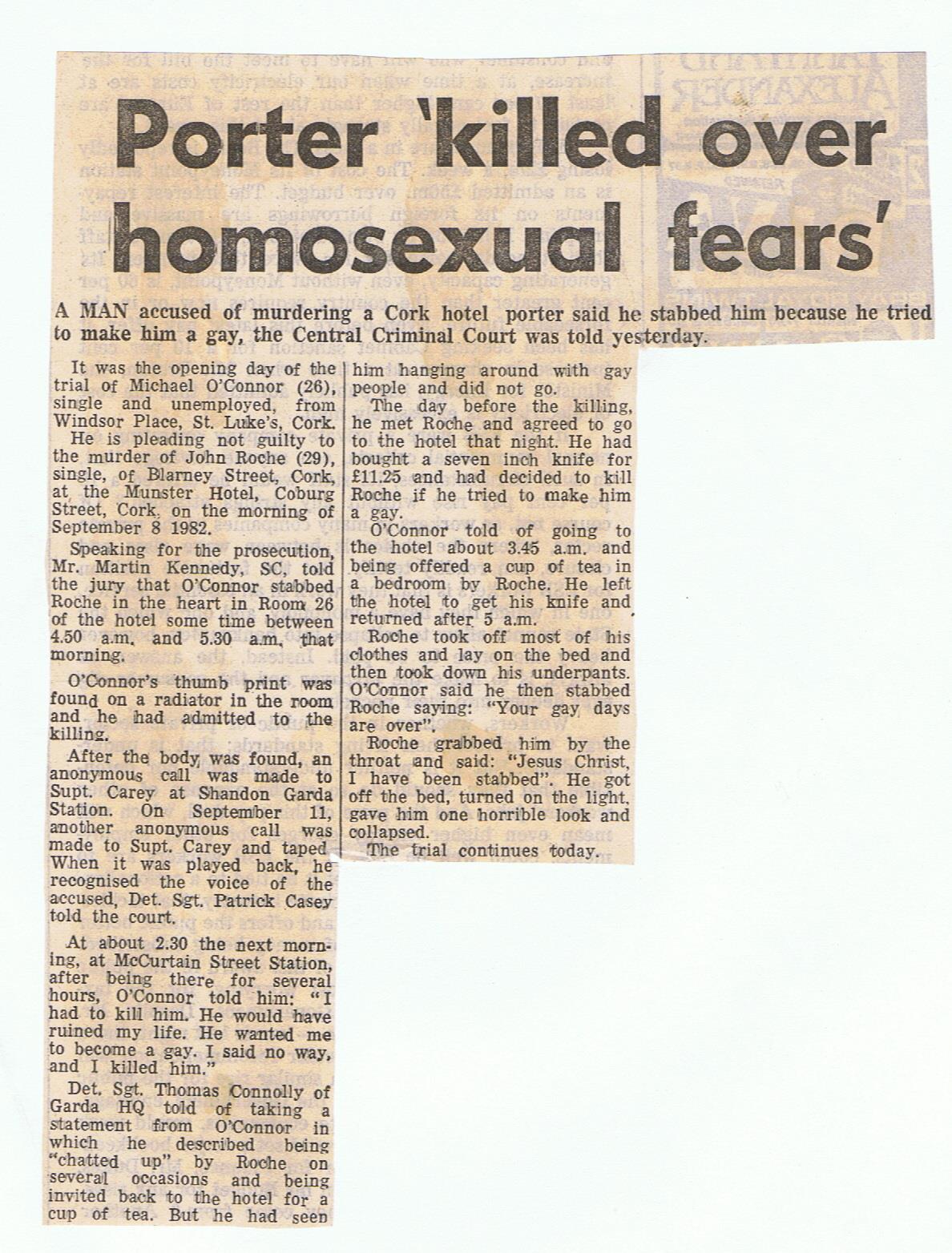
Roche (29), a gay man, was murdered by Michael O’Connor in the Munster Hotel in Cork City. The victim, who worked in the hotel as a night porter, was found tied to a chair in one of the bedrooms. He had been stabbed in the chest with a 15cm (6″ ) knife. Repulsed by the victim’s alleged advances O’Connor stabbed Roche, telling him “Your gay days are over”. Michael O’Connor was found by a jury to be not guilty of murder but guilty of manslaughter.
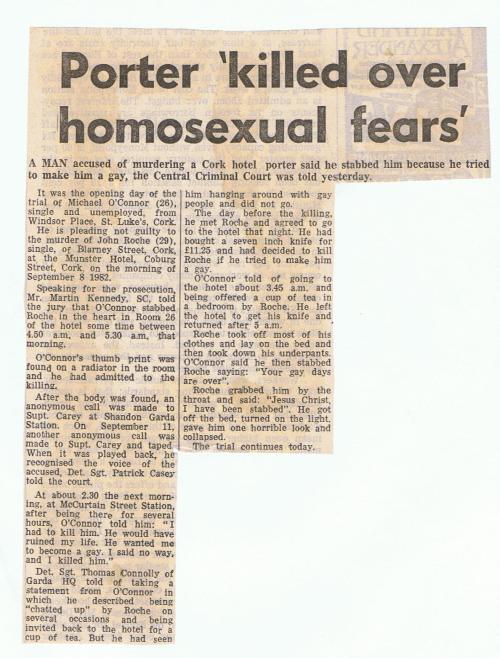
Evening Press, 11th May 1983. Credit - Irish Queer Archive

Evening Press, 11th May 1983. Credit – Irish Queer Archive

November 1982: Henry McLarnon, Ballymena, Co. Antrim
McLarnon (22), father of two, was murdered by Richard John Nicholl in Ballymena. In court, Nicholl said that McLarnon had lured him to the quarry where he had made a sexual advance. In response, he stabbed McLarnon with a work tool. There was controversy at the trial when Nicholl was convicted of the lesser charge of manslaughter and received a two-year suspended sentence. In 2002, Nicholl took his own life.

21 January 1982: Charles Self, Dublin
Self (33), a RTE set designer originally from Glasgow, was murdered in his flat on Brighton Avenue, Monkstown. He was found with knife wounds to his chest and neck. The investigation led to almost 1,500 gay men being questioned, photographed and fingerprinted at Pearse Street Garda Station. For many in the gay community, it felt like the police were more interested in compiling dossiers on gay men rather than solving the brutal murder. No-one was ever charged.

9 September 1983: Declan Flynn, Fairview Park, Dublin
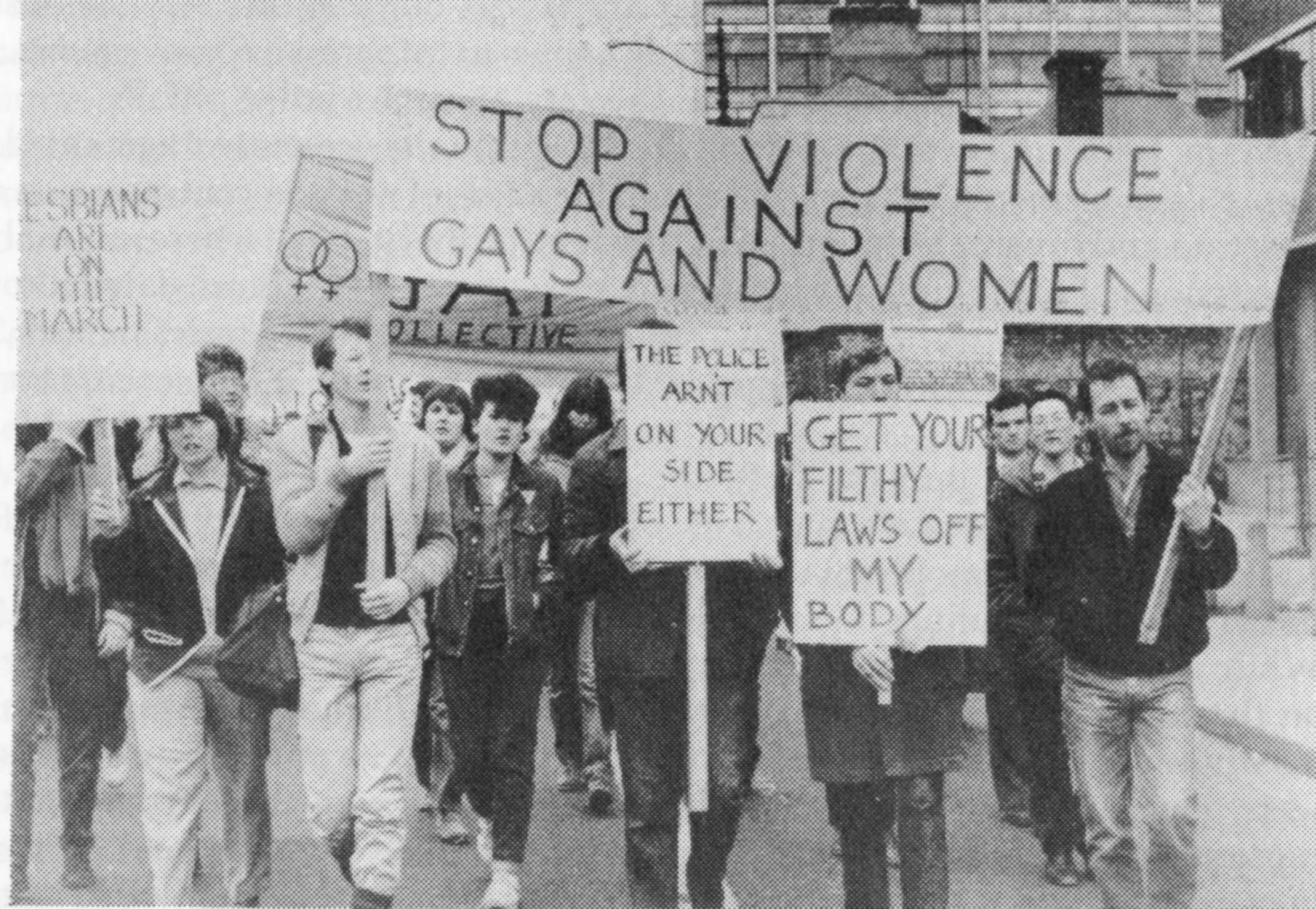
Flynn (31), an Aer Rianta worker, was beaten to death by a group of five teenagers in a ‘gay-bashing’ incident in Fairview Park. The gang had been responsible for a spate of attacks on gay men in previous weeks and it emerged that they used the park to target members of the gay community. As Flynn lay dying, £4 from his pocket and his watch was stolen. In court, one of the teenagers admitted that “we were all part of the team to get rid of the queers from Fairview Park”. The five male teenagers were all released on a suspended manslaughter charge with Judge Sean Gannon saying “This could never be regarded as murder”.
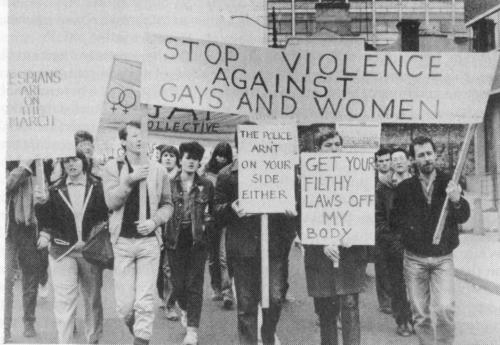
Fairview Park Protest March photographed on Amiens Street by Derek Speirs, courtesy "Out For Ourselves" (Womens Community Press, 1986). Credit - Irish Queer Archives

Fairview Park Protest March photographed on Amiens Street by Derek Speirs, courtesy “Out For Ourselves” (Womens Community Press, 1986). Credit – Irish Queer Archives

7 February 1997: David J. Templeton, Belfast
Templeton (43) was a minister of the Presbyterian Church in Ireland who was murdered after he was ‘outed’ as a gay man by the Sunday Life newspaper. Three men wearing balaclavas, believed to have been UVF members, entered his home in north Belfast and beat him with baseball bats with spikes driven through them. He died in hospital several weeks later.

(Note: Some websites list Darren Bradshaw, a gay men and RUC officer, murdered in 1997 by the INLA as a homophobic murder. However, it is probably fair to say that he was killed because of his occupation rather than his sexuality?)

7 September 2002: Ian Flanagan, Belfast
Flanagan (30), a civil servant, was battered with a wheel brace and stabbed with a kitchen knife in the grounds of Barnett’s Demesne park. His two killers ‘deliberately set out to target a member of the gay community’. Raymond Taylor was sentenced to 13 years and Trevor Peel was given 14 years.

3 December 2002: Aaron (Warren) McCauley, Belfast
McCauley (54), a nurse for over 30 years at Muckamore Abbey hospital, was lured and battered to death in a well-known ‘cruising’ spot. He was found in an alley just 30 yards from the Church Lane toilets and died two days later without regaining consciousness. The attack was believed to have been motivated by homophobia. His injuries consisted of a blow to the side of the head and another to the throat. Nobody was ever charged.

23 March 2008: Shaun Fitzpatrick, Dungannon, Co. Tyrone
Fitzpatrick (32), a supermarket manager, was kicked to death after leaving Donaghy’s Bar by two homophobic Lithuanian men. The court heard that when Mr Fitzpatrick’s body was found, he had been beaten so savagely that paramedics thought he had been shot. The pair were sentenced to to life imprisonment.

5 February 2012: Andrew Lorimer, Lurgan, Co. Armagh
Lorimer (43), a former canoeing instructor and security guard, was kicked and beaten to death with a hammer in his own flat in Portlec Place. Three men were charged with the ‘homophobic murder’.

Race:

24 December 1982: Abousef Abdussalem Salim, Limerick
Salim (21), a Libyan trainee airplane pilot, was stabbed in the head with a screwdriver by a Limerick man who screamed ‘nigger’ and ‘bastard’ before the attack at a taxi rank on Thomas Street. The attacker was sentenced to five years penal servitude for manslaughter.
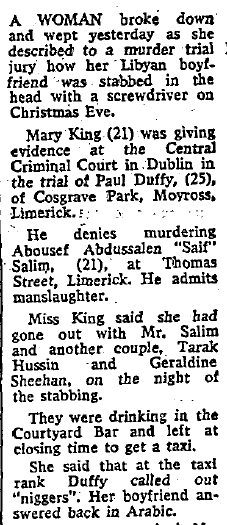
The Irish Independent, 3 February 1984.

The Irish Independent, 3 February 1984.

24 June 1996: Simon Tang, Carrickfergus, Co. Antrim
Tang (27), a Chinese businessman, was beaten and robbed as he left his takeaway business in Carrickfergus. Described by police as a ‘racist attack’, the father of two had his watch and the night’s takings stolen. He was taken to hospital but later died from his injuries. In 2002, two men were remanded in custody charged with the murder but they were later released. No-one has been convicted of the killing.

27 January January 2002: Zhao Liu Tao, Dublin
Tao (29), a Chinese student of English, was attacked by a five-member gang in Beaumont, on the northside of the city. The gang were reported as making racist taunts and a fracas followed. One of the youths struck Mr Zhao with a metal bar. He died three days later in Beaumont Hospital. An 18-year-old youth was sentenced to four years detention, the last two years were suspended because of the perpetrators age and the fact that he had no previous convictions.

29 August 2002: Leong Ly Min, Dublin
Min (50), who had been living in Dublin since 1979 after fleeing Vietnam, was assaulted in Temple Bar. He suffered head injuries and later died in hospital. Two men were charged in relation to this crime. At the time it was reported by the media that there might have been racist insults used during the attack.
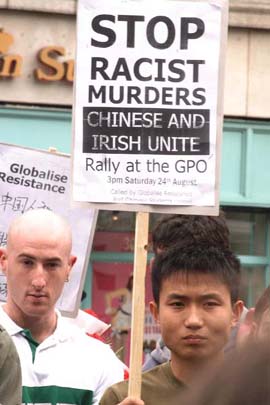
Anti-Racist protest after murder of Leong Ly Min. Credit - An Phoblact

Anti-Racist protest after murder of Leong Ly Min. Credit – An Phoblact

23 February 2010: Pawel Kalite and Marius Szwajkos, Dublin
Kalite (28) and Szwajkos (27), Polish nationals, were racially abused before being stabbed in the head with screwdrivers on Benbulben Road, Drimnagh. Two Dublin teenagers are currently serving mandatory life sentences.

2 April 2010: Toyosi Shittabey, Dublin
Shittabey (15), a talented footballer originally from Nigeria, died after being stabbed in Tyrrelstown, Dublin 15. A row with “racist undertones” began outside the house of Paul Barry at Mount Garrett Rise between Paul, his brother Michael and a group of black males and white females after one of the females asked Paul for a cigarette lighter and he had refused. Believing a phone was taken by the group, Mr Barry and his brother Paul went into his house to fetch a knife and then pursued them in a car. They encountered the group of teenagers at a roundabout in Tyrrelstown. Shittabey, known as “Toy”, urged his friends to walk away again but was stabbed in the heart by Paul Barry The two brothers were charged with murder. Paul Barry (40) committed suicide the day before the trial was due to begin. His brother Michael (26) was acquitted because it was his brother inflicted the stab wound. It transpired that Paul had been involved in another racist knife attack ten years previously.

Read Full Post »
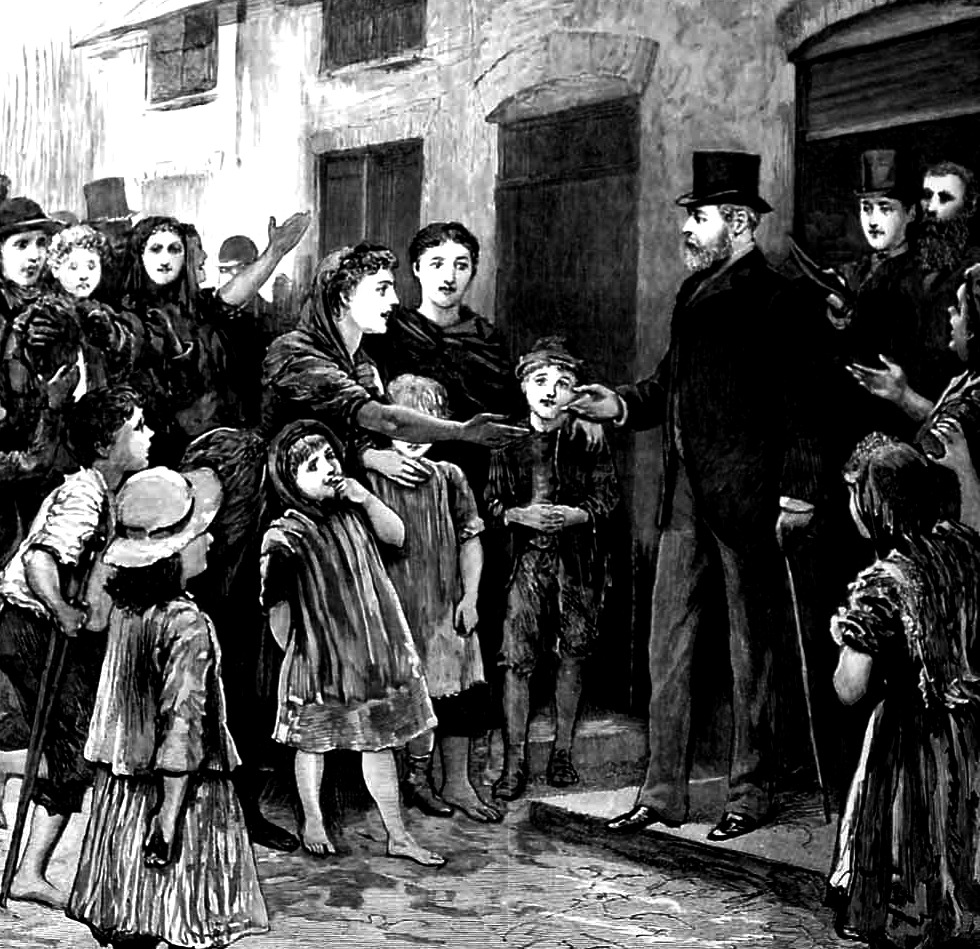
A contemporary illustration of a Royal visit to the slums of Dublin.

A contemporary illustration of a Royal visit to the slums of Dublin.

This above illustration from 1885 captures a rather surreal moment in the history of inner-city Dublin, when the slums of the city were visited by none other than the Prince of Wales, Prince Albert Edward. He would later visit the poor of Dublin again on a Royal visit in 1903, although on that occasion he had risen to the role of King. His 1885 visit to Golden Lane attracted huge media attention at the time.

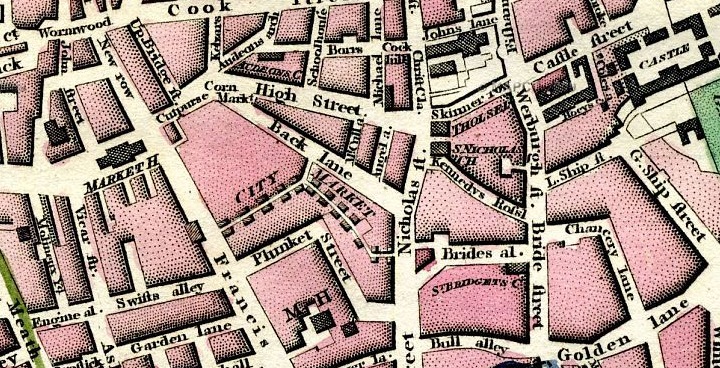
The visit of Prince Albert Edward in 1885 was not universally welcomed, and Dublin Corporation voted by 41 votes to 17 against participating in the official welcoming of the Prince to Dublin. Yet while Dublin Corporation were rather hostile to the visit on the whole, one individual who seized upon the presence of the Prince in Dublin was Sir Charles Cameron. Cameron held charge of the Public Health Department of Dublin Corporation for over a half century, and was a tireless campaigner for improved health standards in the city. Cameron accompanied the Prince on a visit to the slums at Golden Lane, ironically located very close to Dublin Castle.

This map from the late eighteenth century gives an idea of the proximity of Dublin Castle to Golden Lane. (Source: http://dublin1798.com/dublin15.htm)

This map from the late eighteenth century gives an idea of the proximity of Dublin Castle to Golden Lane. (Source: http://dublin1798.com/dublin15.htm)

In his memoirs, Charles Cameron discussed this visit to the slums, writing that:

I suggested to Earl Spencer, Lord Lieutenant at the time, that as the Prince of Wales had visited many model dwellings for the working classes, he ought to see some of the wretched dwellings in which the poor lived and which it was desirable should be replaced by healthy abodes. The proposal met with some opposition from the Prince’s entourage, but ultimately it was agreed that he would visit the slums, but strictly incognito. At 11 o’clock one morning, the Prince, the Duke of Clarence, and Sir Dighton Probyn left Dublin Castle in a plain carriage to visit, under my guidance, slums, and also the model dwellings erected at the expense of Sir Edward Cecil Guinness (now Viscount Iveagh). We went to Golden Lane, which was not far off.

Just as we stopped at a large tenement house a woman discharged into the channel course a quantity of water in which cabbage had been boiled and which contained fragments of leaves. In getting out of the carriage the Duke of Clarence unfortunately stepped into this fluid, slipped, and fell. He was much startled, and his coat and one glove were soiled. We wiped him with handkerchiefs, and Sir Dighton, a man of almost gigantic stature, took o:ff a light overcoat and invested the Duke with it. As the Duke was of moderate height, the coat reached nearly to his feet. On entering the large yard of the tenement house, a ragged boy familiarly took the Prince by the arm and enquired what he was looking for. The Prince took all this, including the Duke’s contretemps, with great good humour, and in visiting the rooms he left something behind him which delighted its recipients.

This visit is also referenced in King Edward VII, his life & reign; the record of a noble career, published first in 1910. There, it is noted that:

The heir to the British throne, accompanied by his heir, Prince Albert
Victor, was there among the dwellers in the slums of the Irish capital, unannounced, unguarded by soldiers or police, trusting himself, with a manly and well-merited confidence, to the people themselves. Readily recognized, he and his son were, at every step, attended by words of welcome and by ringing cheers from those who, apart from political agitation, are as warm-hearted and loyal as any people in the world.

In 1903, as King Edward VII, he once more visited the slums of the city, and it was noted that Lord Iveagh donated a sum of £50,000 to be distributed among the various Dublin hospitals, as a result of this visit and its impact. While these visits certainly attracted considerable media attention, the problem of slum housing in Dublin continued long into the days of Irish independence, and without famous visitors it went largely ignored.

Charles Cameron would become a Freeman of Dublin, an incredible honour to have bestowed among an employee of Dublin Corporation. Writing in his memoirs, published in the year of the Lockout, he noted that “I would like to bear testimony to the wonderful kindness which the poor show to those who are still poorer and more helpless than themselves.”

Read Full Post »

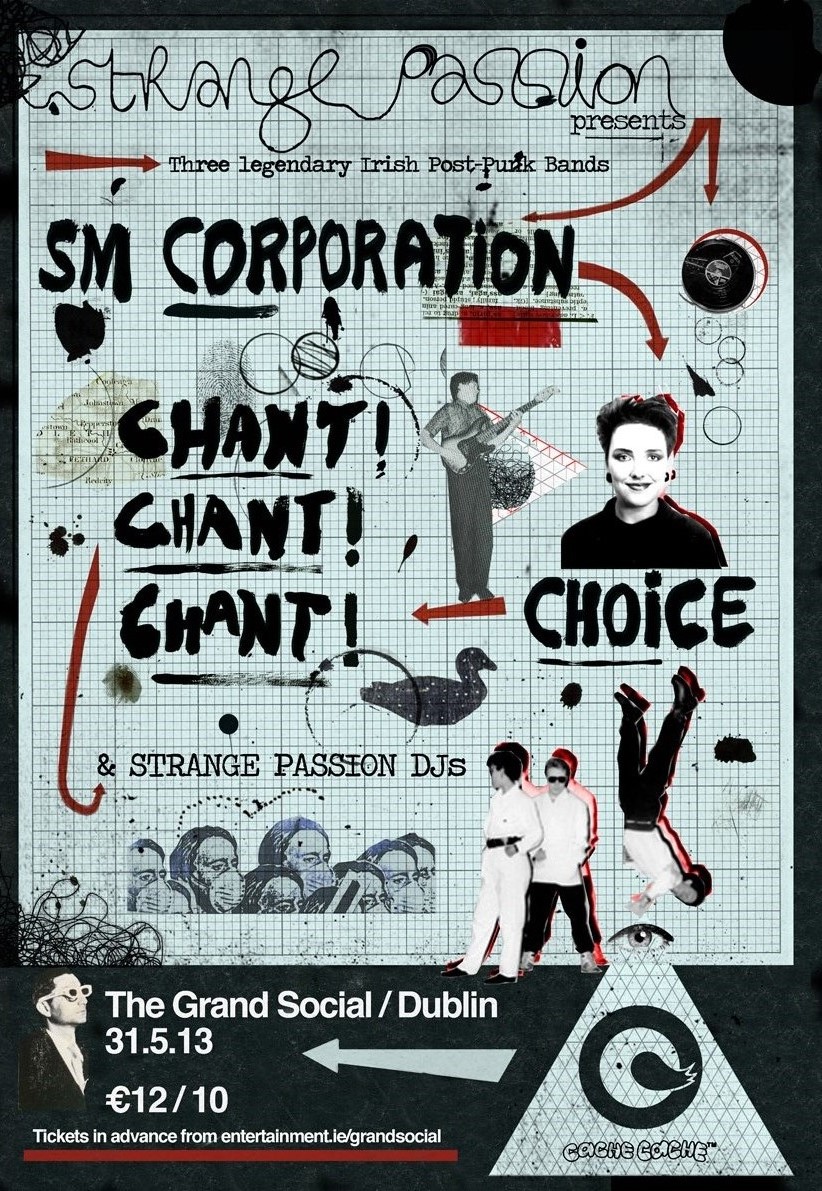
Strange Passion, 31 May 2013

Strange Passion, 31 May 2013

Three Irish Post Punk bands return to the stage this Friday after a 30 year hiatus following the release of critically acclaimed compilation Strange Passion in 2012.

The Grand Social, Dublin. Friday 31st May. Doors open 8pm. First band on at 8.30pm sharp. €12 entry.

Line up:

The SM Corporation(Irish rock entry)

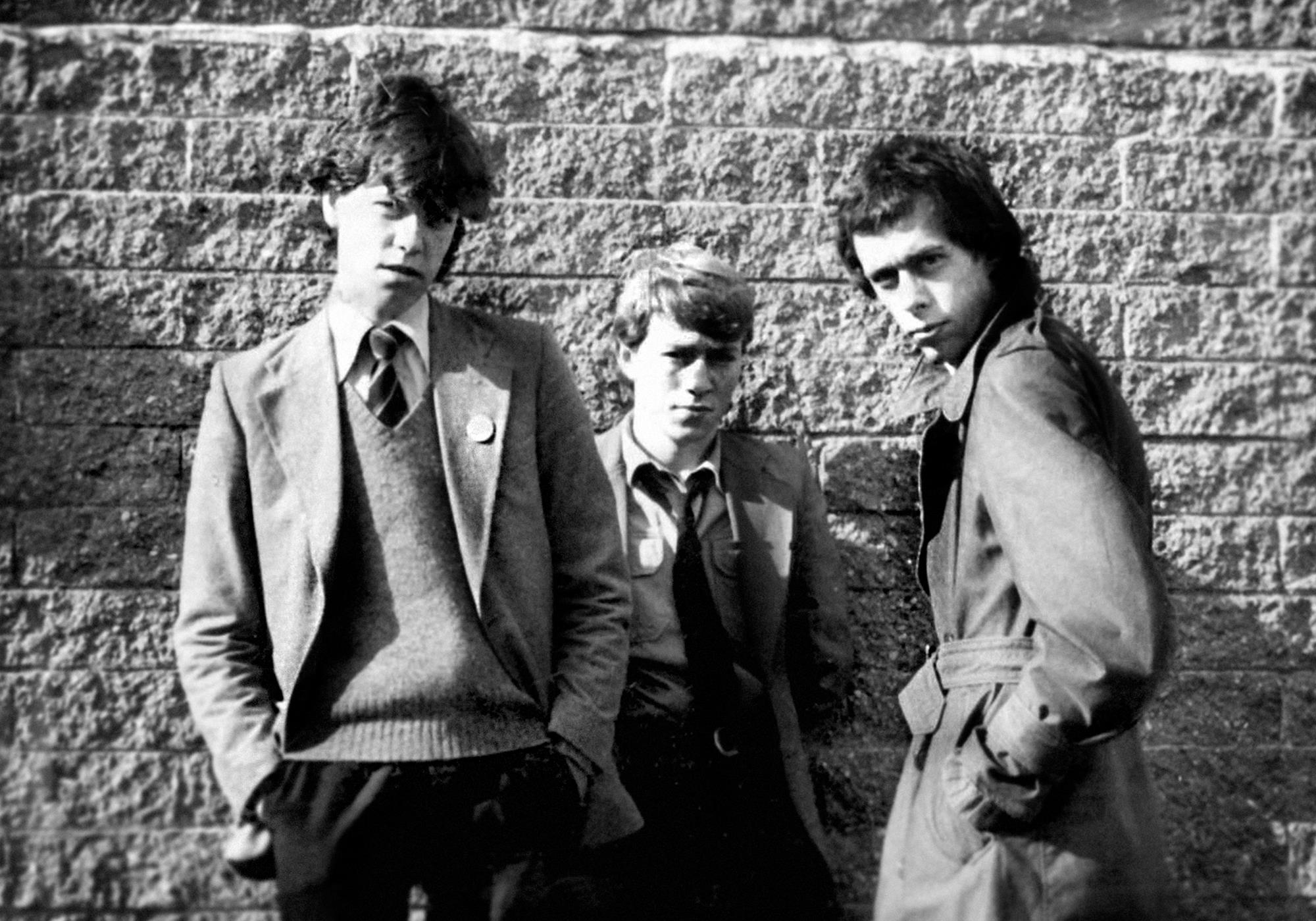
Dublin electronic experimenters come electro-pop pioneers 1978-1987 made up of Tina O’Brien (vocals), Paul Wynne (Keyboards, Rhythms) and Steve Rapid (Keyboards, Noises)

SM Corporation, 1979.

SM Corporation, 1979.

Chant! Chant! Chant! (Irish Rock entry)

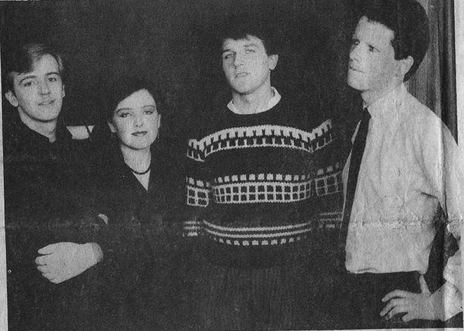
Dublin post punk legends (reminiscent of The Birthday Party and Gang Of Four) made up of Eoin Freeney (vocals), Robby Wogan (guitar), Larry Murphy (bass) and Paul Monahan (drums). Supported the The Fall in Cork & the infamous 4 BE 2’s charade in the Trinity JCR.

Chant! Chant! Chant!,  1980

Chant! Chant! Chant!, 1980

Choice

Dundalk electronic pop band formed in 1980 with Brian McMahon (aka Dougie Devlin) on bass, Ciaran Vernon (aka CV) on synths, Noel McCabe on drums and Jaki McCarrick on vocals. With the departure of drummer, the band became a three-piece – with a drum machine.

Choice, early 1980s

Choice, early 1980s

For those interested, check out our previous post – Dublin Punk & New Wave singles timeline (1977 – 1983)

Read Full Post »
Recently, we’ve featured a series of blog posts looking at the year 1913, which primarily have involved the Lockout and its effect on the city of Dublin. While browsing the archives, I stumbled across a very interesting article from November 1913 which was printed in The Irish Times, dealing with the ‘Dublin Volunteer Corps’, or ‘Dublin Volunteer Force’. This was an armed movement established by Dublin loyalists, following in the footsteps of the Ulster Volunteer Force, and about whom little has been written. The article claimed in its subheading that “over 2,000 men” were enrolled within this band of men, and noted that:

While Ulster is preparing to resist Home Rule by force if necessary, and is busy building up a great citizen army, the spirit of militarism that has gripped that province and fired the enthusiasm of its young manhood is also at work in Dublin.

Dubliner Edward Carson inspects the Ulster Volunteer Force (UVF) in 1914.

Dubliner Edward Carson inspects the Ulster Volunteer Force (UVF) in 1914.

The paper noted that “should a Home Rule Parliament be established in Dublin, this volunteer force is intended to be used in the preservation of the civil and religious liberties of Protestants in Dublin and the south.” It was noted that “company after company was formed, and drill instructors were appointed”, and that while membership was at first confined to members of the Orange Institution, due to an excess of applications it was decided to broaden the ranks, with “over 2,000 men already enrolled.”

It was claimed that the force would serve as a reserve of the Ulster Volunteers, and that:

should civil war break out in Ulster as a consequence of Home Rule, the leaders of the Dublin Volunteers have undertaken to hold in readiness a force of at least 2,000 men for service wherever required by the Commander-In-Chief of the Ulster Army.

Union flags can be seen on Grafton Street, in this photograph taken around the time of the last Royal Visit to a British Dublin, 1911.

Union flags can be seen on Grafton Street, in this photograph taken around the time of the last Royal Visit to a British Dublin, 1911.

The training of these men was reported to take place “at various centres in the city three nights of every week”, and that firing exercises and musket training featured. It was also claimed that similar training was happening in various locations outside of the city, in South County Dublin.

From that 1913 report, I wondered what else I could find online. A recent report in the Belfast Newsletter shined further light on this force, noting that:

IN June 1935, a Dublin Board of Works employee was among a group working at part of the Dublin GPO (General Post Office), the men having been assigned to remove presses from the cellar of the GPO Customs Parcels Section, located at 10 Parnell Square.

When several presses were removed however, some mortar appeared insecure, and when touched, collapsed. Upon further investigation the employee realised he had uncovered a large cavity several feet long. Within it, in perfectly dry conditions, lay a massive arms cache. He had discovered over 90 rifles and over 2000 rounds of ammunition.

This weapons were not in fact for Irish nationalists, but rather the new Dublin loyalist organisation. The Belfast Newsletter piece is a fascinating insight into the group, focusing on the role of Fowler Hall for Dublin Loyalists. Located at 10 Parnell Square, this was one of several Orange Halls in the city and a centre of activity for the organisation.

Interestingly, a 1964 article in The Irish Times claimed that these weapons were actually found during renovations in 1927, and claimed that at least one rifle was stamped “For God and Ulster.”

The arms from Fowlers Hall discussed in The Irish Times in 1964.

The arms from Fowlers Hall discussed in The Irish Times in 1964.

The Orange Order were forced from the Fowler Hall by the IRA at the time of the split of the organisation into Pro and Anti-Treaty wings, and in his Witness Statement to the Bureau of Military History republican Patrick J. Kelly noted that “During the period when Belfast refugees were pouring into Dublin the Dublin Brigade H/Q quartered the homeless in the Fowler Hall, Parnell Square, and supplied them with food.”

It’s certainly interesting to think about this band of Dublin loyalists, willing to take up arms against their fellow Irishmen. What else is known about this organisation?

Read Full Post »
As part of background research for my dissertation, I am trying to collate a list of Irish archives/museums and community/individual history projects that have an active Facebook page and post historical material. Here’s what I’ve come up with so far.

Do you know of anymore?

Cultural/Social:

Dublin Dockers – Amazing selection of scanned images. Post regularly.

Irish Queer Archive – Excellent quality of scans and descriptions of items. Posts every few days.

Irish Photo Archive – Amazing selection of images. Updated at least once a day.

Irish Traditional Music Archive – Mainly contemporary posts. Some historical images.

Where Were You? – Series of photos posted in batches every other week. Lots of personal comments and memories.

Gay Health Action (GHA) 60's Night Benefit Disco. Flyer, designer unattributed. 1985 [Ephemera Collection, IQA/NLI]

Gay Health Action (GHA) Benefit Disco at Sides DC. Flyer, designer unattributed. 1985 [Ephemera Collection, IQA/NLI]

Established:

Irish Architectural Archive – Post regularly but not much historical stuff.

County Archives

Clare – Updated quite a bit. Interesting conservation photos.

Cork – Very irregular posts. Some historical material.

Donegal -Updated quite regularly. Mainly historical items.

Waterford – Updated quite regularly. Some historical material.

Glasnevin Museum – Great mixture of posts about contemporary issues (tour guides etc.) and historical bits and pieces.

National Library of Ireland – Excellently run page. Updated regularly.

Political:

Irish Anarchist History Archive – Irregular posts of scanned up documents or photos.

Irish Student Movement Research Project – Nice mixture of scans and short text posts.

Official Republican/WP Archive – Diverse selection of photos and newspaper clippings. Some scans not of high quality.

Students outside Dail Eireann highlighting the Stardust (Artane, 1981) and the Central Hotel (Bundoran, 1980) fire disasters. Credit - Irish Student Movement Research Project.

Students outside Dail Eireann highlighting the Stardust (Artane, 1981) and the Central Hotel (Bundoran, 1980) fire disasters. Credit – Irish Student Movement Research Project.

Religious:

Capuchin Archive – Post fantastic historical documents every other day.

Sport:

Dublin Maccabi (Jewish sporting club)  – All historical photos and documents. Lots of personal comments and memories.

Jackie Jameson Irish Football Legend (Bohs) – Mainly historical photos being posted.

Dalymount Park in 1952. Credit - Jackie Jameson Irish Football Legend

Dalymount Park in 1952. Credit – Jackie Jameson Irish Football Legend

Read Full Post »

'Duck, You Sucker!' - The cover for a recent DVD special edition of the 1971 film.

‘Duck, You Sucker!’ – The cover for a recent DVD special edition of the 1971 film.

Duck, You Sucker!, also known as A Fistful of Dynamite and Once Upon a Time… the Revolution, is a 1971 Italian film directed by Sergio Leone and starring Rod Steiger,James Coburn and Romolo Valli. A much praised film, the film caused considerable controversy at the time of its release with certain scenes deemed excessively violent. The film is set in Mexico in 1913 around the time of the Mexican revolution.

The plot is a bit of a head scratcher, centering around the story of Sean Mallory, an explosions expert from the IRA hiding out in America. Mallory comes into contact with Juan Miranda, a Mexican outlaw who attempts to convince him to join a raid on the Mesa Verde national bank. Details on the film can be found on its Wiki page, but what makes of interest to Come Here To Me is this scene below, which tells viewers why Mallory felt the need to leave Dublin.

Toners pub shown in the film.

The bar in Toners shown in the film.

Here, we see a familiar pub, Toners on Baggot Street! This flashback scene shows us just why Mallory is on the run from the British authorities, following a shooting in the pub:

Another flashback scene in the film was filmed at the grounds of Howth Castle in Dublin:

The film is hugely entertaining and Ennio Morricone’s excellent score works incredibly well with the flashback scenes. Users of the popular internet film review site Rotten Tomatoes have given the film a glowing 90% approval rating.

My thanks to Peter Box Andersson who put this idea into my head, and reminded me what a rich history Dublin has as a filming location historically!

Read Full Post »
(In terms of food history, we’ve previously looked at the city’s oldest restaurants, the first Chinese restaurants, the first Italian restaurants, the first pizzerias and the first Indian restaurants)

This is part two of our series looking at the history of Vegetarianism in Dublin, primarily focusing on restaurants and cafes. Part One began in the 1860s and finished up in the early 1920s.

We pick up the story in the 1930s…

Frank Wyatt, editor of Vegetarian News and Secretary of the London Vegetarian Society, gave a talk in January 1933 on Vegetarianism in the Mansion House. The Irish Times (17 Jan) noted that the meeting was mostly made up of women. Wyatt, a vegetarian of twenty years standing, told the room that he was ‘satisfied that he was a healthier man than any flesh eater’.

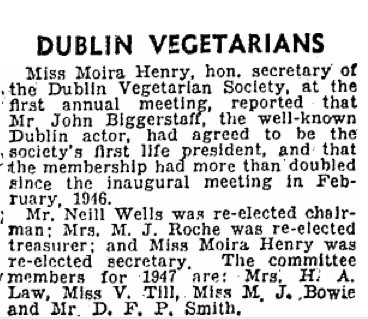
Here is a report in the Irish Press on the first annual meeting of the resurrected Dublin Vegetarian Society in 1947:
The Irish Press, 5 March 1947

The Irish Press, 5 March 1947

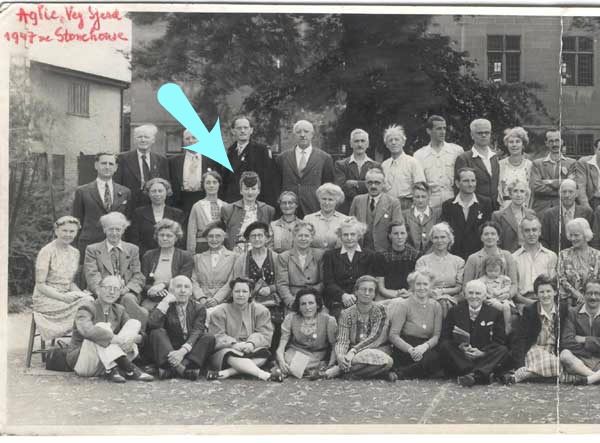
Moira Henry is pictured at the 1947 11th International Vegetarian Union Congress whcih took place at Wycliffe College in Stonehouse, England:
Moira Henry as one of the delegates at the 11th IVU World Vegetarian Congress 1947. Stonehouse, England. Credit - http://www.ivu.org

Moira Henry as one of the delegates at the 11th IVU World Vegetarian Congress 1947. Stonehouse, England. Credit – http://www.ivu.org

Remarkably on 26 February 1949, the Irish Press interviewed ‘the only vegan in Ireland’ – Moira Henry (mentioned in piece above). She told the reporter that she had been a vegetarian since 1930 and a vegan for the last four years .The journalist defined a vegan as a ‘vegetarian who not only eschews fish, flesh and fowl but also such by-products as eggs, milk, cheese and margarine’. Moira, Honorary Secretary of the Dublin Vegetarian Society, revealed that the membership of the organisation was currently 32.
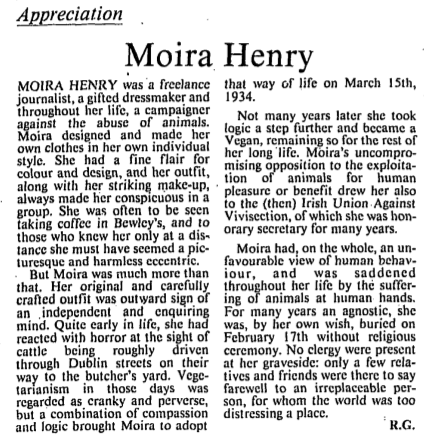
Moira Henry passed away in 1997. The Irish Times, 10 March 1997.

Moira Henry passed away in 1997. The Irish Times, 10 March 1997.

Patrick Campbell (aka Quidnunc) interviewed Florence H. Gourlay, honorary treasurer of the Dublin Vegetarian Society for An Irishman’s Diary on 5 March 1951. Gourlay admitted that the organisation only had 33 members (an increase of 1 since 1949!) but she knew of 104 vegetarians altogether in the Republic. It was noted that while Belfast had a vegetarian restaurant, Dublin did not.

In March 1955 Geoffrey Rudd, secretary to the Vegetarian Society (Britain), addressed a public meeting on the principles and uses of the vegetarian ideals at the Central Hotel, Dublin. An article in The Irish Times (1 March) noted that the Dublin Vegetarian Society was founded in 1946 and presently had around 50 members. The original Dublin Vegetarian Society had been founded in the 1890s but ‘went out of existence during the first world war‘. A member of the society told the newspaper that:
while Dublin had no purely vegetarian restaurant, hotels and restaurants generally were becoming more sympathetic towards their needs and could usually provide vegetarian meals if notice was given beforehand. Most of the members agree that a specialist restaurant would be a step forward but this would take time as well as a ‘lot of hard work and some capital’.
Theodora Fitzgibbon in The Irish Times (7 Nov 1969) wrote that she felt sorry for vegetarians as there was no such thing as a ‘purely vegetarian restaurant’ in Dublin. Two years later (18 Oct 1971). Sean Doherty wrote to the Irish Press also complaining that the country’s capital city did not have a vegetarian restaurant and the ‘once thriving’ Vegetarian Society was no longer active.

All changed the following year with the arrival of Good Karma at 4 Great Strand Street. As far as I can work out, this was the first purely vegetarian restaurant in the city since the College Vegetarian Restaurant closed its doors in 1922. It was opened by Jas Adams, Peter Lawson and Robert and Aaron Bartlett.

Site of Good Karma. 4 Great Strand Street as it looks today. Credit – infomatique

Elgy Gillespie in The Irish Times  (11 September 1972) described the restaurant as having a:
long room with wooden pillers and a cosily dim glow from candles and firelight. The table (made by the owners) are high if you like sitting up to your food: low if you prefer to loll across the tie-dyed cushions also made by the owners … Taj Mahal, Doctor Pepper and Crosby, Stills and Nash provided lush sounds in the background  … it makes a wholesome change from the stagnancy of Dublin eating.
I believe Good Karma only lasted a year as Gabrielle Williams in The Irish Times (7 December 1973) described it has having being ‘recently’ closed down by the Eastern Health Board. A reminiscing Sonia Kelly in the same paper on 11 February 1976 described their kitchen as ‘immaculate’ but was ‘closed for tripping over an obscure regulation’.

John S Doyle writing in the Irish Independent in 2005 remembered Good Karma as a:

A ‘head’ restaurant not everyone knew about, with bare brick walls and no seats, only bean bags, and mellow ‘sounds’. Nice food, none of your macrobiotic stuff. The ‘staff’ were laidback types who said “all right man”, and you were to take it as a privilege to be served by them. This was 1974 (sic) or so. There were numerous Garda raids, and the restaurant didn’t last long.
Restaurant reviewer Paolo Tullio on a recent trip down memory lane called Good Karma:

…Dublin’s first macrobiotic restaurant back in the early seventies and it was filled with, run by and staffed with hippies …What made it a nice place, perhaps more than the food, was the amateur attitude of everyone involved. You never felt that it was a commercial enterprise. Sure, money changed hands, but somehow you felt you were part of a social and gastronomic experiment.

It’s pretty amazing that there are so many positive memories of a place that was open for little more than twelve months.

While the restaurant closed, the health food shop, Green Acres, in the basement remained open. Patrick Comerford in The Irish Times (39 July 1975) interviewed the owner, Philip Guiney. He told Comeford that ‘not all the staff, and only a quarter of (his) customers’ were vegetarian. Open for three years, an increasing number of older people were visiting the ship realising that it was ‘not just a place for young freaks’. These older people came to ‘supplement their diets with natural foods, and probably a small number had become vegetarian out of economic necessary‘.

The journalist also mentioned the Ormond Health Centre (run by a Mr. Evans) on Parliament Street which sold dandelion coffee, Honeyrose cigarettes and herbal tea and the Irish Health and Herbal Centre on Trinity Street (run by Ann Flood and Michael McDonald) which was ‘not vegetarian orientated by any means’ but sold a lot of products popular with the vegetarian community.

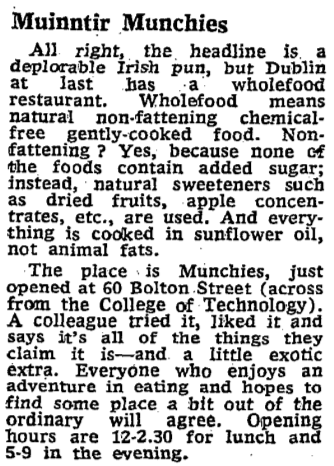
In the late 1970s, there were a number of whole-food restaurants in Dublin including Munchies at 60 Bolton Street, The Golden Dawn on Crow Street and the Supernatural Tearooms at 53 Harcourt Street.

Here is a short piece on Munchies from 1977:

The Irish Times, 6 December 1977

The Irish Times, 6 December 1977

The Golden Dawn, established in 1976, was described by Christy Stapleton of the Vegetarian Society of Ireland in the late 1990s as ‘the closest thing to a vegetarian restaurant in Dublin’ at the time. Ran by showband singer Joe Fitzmaurice and his wife, it used to be a favourite of actors Gabriel Byrne, Vinny McCabe and Garrett Keogh while DJ Paul Webb worked there as an assistant cook and Golden Horde frontman Simon Carmody as dishwasher. Here is a link to a great 1978 RTE piece on the restaurant.

(more…)

Read Full Post »

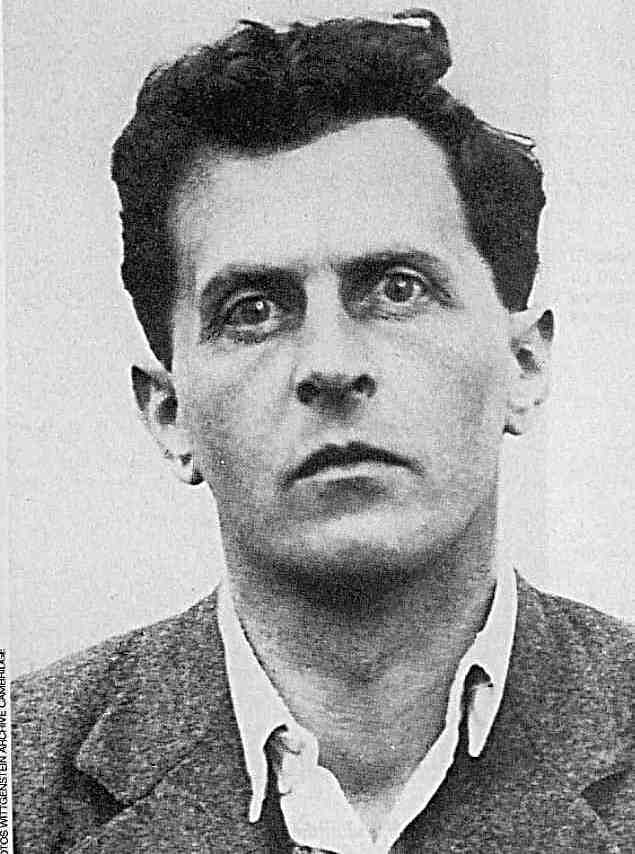
Not too long ago, we had a brief post on the website here looking at the brilliant statue of Socrates (the philosopher, not the footballer) which stands proudly in the grounds of the Botanic Gardens. This raised the issue of another philosopher who is remembered in the Botanic Gardens, albeit for very different reasons. While Socrates never walked through Dublin city, Ludwig Wittgenstein did. Indeed, the Vienna-born philosopher, considered one of the greatest minds of his time, actually lived and worked in the city.

witt
In a 1997 article for the Sunday Independent, Ulick O’Connor noted that this was a time when Wittgenstein had just resigned a Professorship in Cambridge, and that:

Wittgenstein had chosen Dublin because of his friendship with a consultant psychiatric at St. Patrick’s Hospital in James’ Street, Maurice O’Connor Drury. Before taking up medicine, Drury had been a philosophy student of Wittgenstein’s at Cambridge. But, in 1947, at the height of his fame, Wittgenstein had decided to resign his Cambridge Professorship and settle in Ireland.

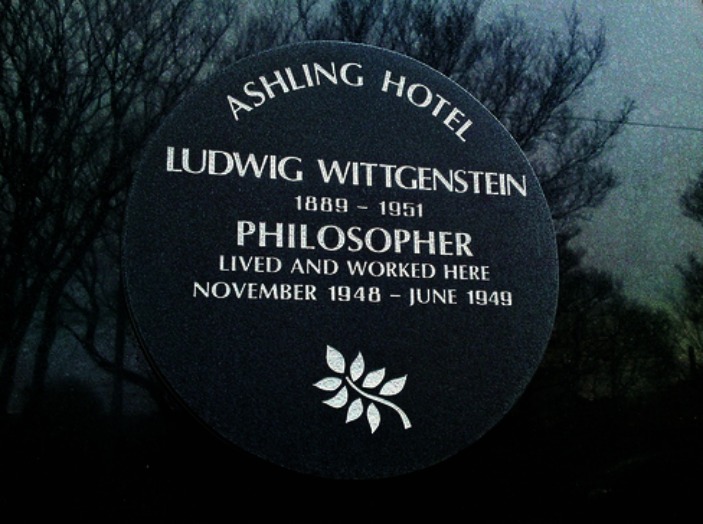
Wittgenstein spent two years of his life writing in Dublin, and indeed these were among the most productive years of his life, as it was during this time he wrote much of his most influential work, Philosophical Investigations. From November 1948 into the summer of 1949, he lived in a small modest room at Ross’s Hotel, today known to Dubliners as the Ashling Hotel. A small plaque on the front of this hotel marks the fact that Wittgenstein boarded here. This plaque was unveiled in 1988, by John Wilson, who was then Minister for Transport and Tourism.

_MG_7481b

Interestingly, he had visited Ireland and Dublin prior to this for short periods, with the first visit occurring in 1934. It was during his extended stay at the Ross’s Hotel in the late 1940s however that he truly familiarised himself with the city, and as Brian Fallon has noted he was frequently to be found “walking in the Phoenix Park, lunching in Bewley’s or in the Members Dining Rooms at the Zoo, and sometimes, during the winter, sitting on the parapet in the Palm House of the Botanic Gardens, writing.”

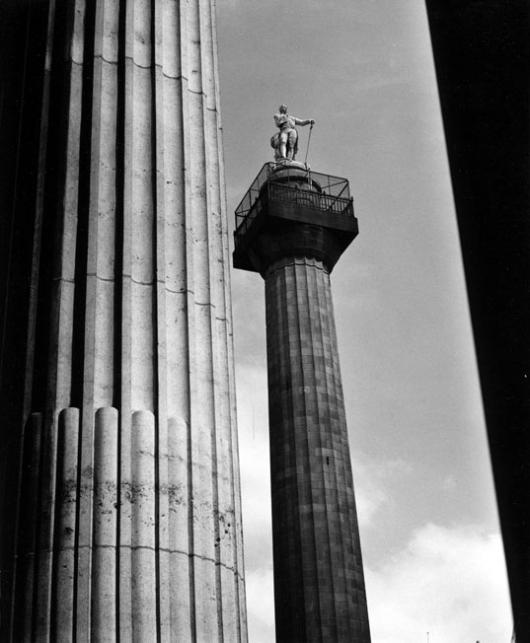
Richard Wall’s study Wittgenstein in Ireland provides good detail of his time here. His love for Bewley’s is evidently clear from his own correspondence. He would always enjoy the same lunch of an omelette and coffee, and was said to be delighted by the fact the staff there would always remember his order without even needing to place it. Wall notes that while we know for certain he frequently visited Bewley’s, the question of whether the great intellect ever stepped inside a Dublin pub remains unanswered. We know on one occasion that Wittgenstein and his friend Drury bought cheap cameras in Woolworth’s and then photographed the city from the top of Admiral Horatio Nelson’s Pillar!

Nelson's Pillar on O'Connell Street.

Nelson’s Pillar on O’Connell Street.


(more…)

Read Full Post »

(In terms of food history, we’ve previously looked at the city’s oldest restaurants, the first Chinese restaurants, the first Italian restaurants, the first pizzerias and the first Indian restaurants)

Note: Part two of this article can be read here.

Vegetarian Restaurants in Dublin date back to the late 19th century while groups of Vegetarians have been organising events in the city since at least the 1860s.

In September 1866, a public meeting on Vegetarianism in the Exhibition Rooms, Rotunda Hospital was heckled by several members of the public. The meeting was held ‘for the purpose of affording an opportunity to several prominent vegetarians (to) explain … the principles and practices of the Vegetarian Society’.

The Freemans Journal of 28 September 1866 noted that:

There was a large attendance of respectably dressed persons, but there were many amongst the audience who evidently attended the meeting more for the purpose of disturbing the proceedings and amusing themselves in a very disorderly manner.

Amongst those speaking were Carlow-born social reformer and temperance activist James Haughton (who had become Vegetarian in 1846); Rev. James Clarke of Salford (who had helped establish the American Vegetarian Society in 1850); ‘acknowledged statistician of the British temperance movement’ William Hoyle from Bury and writer and campaigner James A Mowatt from Dublin.

The newspaper concluded:

The last question put was directed to the Rev. Mr. Clarke, who was asked, amid much laughter what he should do at the North Pole, where there were no vegetables. The reverend gentleman said he should not go there at all. The proceedings then terminated.

The first Vegetarian restaurant in Dublin, the ‘Sunshine Vegetarian Dining Rooms‘, was located at 48 Grafton Street (now Vodafone) and was opened in March 1891 by the Dublin Vegetarian Society.

The Irish Times, 28 August 1891

The Irish Times, 28 August 1891

Consisting of a ‘pair of the most elegantly-decorated and tastefully-fitted apartments’, the restaurant served ‘toothsome food, free from the slightest suspicion of animal matter … at a surprisingly moderate rate’.

The same article from The Irish Times noted that the ‘question of vegetarianism has not to any great extent excited public discussion in Dublin’ but the journalist wondered if this might change as the ‘restaurant has been extremely patrionised’ since opening. It is unclear how long the restaurant was in business. I would guess for for a few months or maybe a year at most.

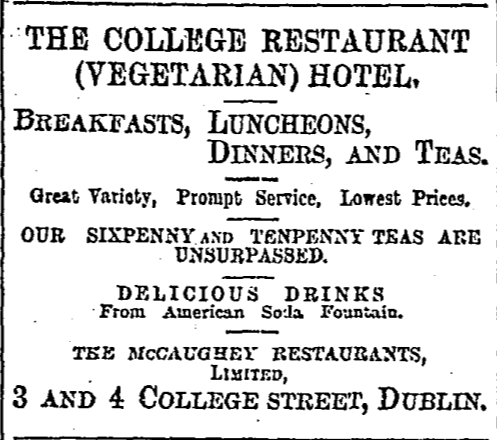
In July 1899, the ‘The College Vegetarian Restaurant‘ was established at 3-4 College Street by Antrim man Leonard McCaughey. This hotel and restaurant is the present location of The Westin (as far as I can work out).

The Irish Times, 11 September 1900

The Irish Times, 11 September 1900

DIT food historian Mairtin Mac Con Iomaire, in his excellent ‘Searching for Chefs, Waiters and Restaurateurs in Edwardian Dublin’, has written that McCaughey:

…had built a chain of successful vegetarian restaurants in Glasgow, Leeds, Belfast and in Dublin … (and that he) owned the Ivanhoe Hotel in Harcourt Street, Dublin, and the Princess Restaurant on Grafton Street.

The 1911 census lists Leonard Mccaughey as a 70-year-old hotel proprietor from Antrim living in 72.1 Harcourt Street with a wife, three children, a cook and two servants.

An advertisement in The Irish Times on 2 February 1900 proclaimed that ‘Vegetarian food is the coming diet’ and suggested that ‘every man and woman that has suffered from influenza should dine at the College Restaurant as the use of a pure diet is the simplest and surest cure for this woeful disease’ and another on 27 April of the same year noted that ‘The College Vegetarian Restaurant is the seat of learning in the science of food. In it all can learn how to get the best food in the easiest digestible form, at the lowest cost’.

In 1907, the Vegetarian Society hosted a once-off restaurant at the Irish International Exhibition at Herbert Park.

The Irish Times (11 May 1912) reported that a foreign chef at the restaurant on College Street, Leon Cromblin, was discovered in the cellar of the premises with his throat badly cut and a razor by his side. He was taken to Jervis Street hospital where he was said to have been in a critical condition. It is not known if he survived.

(more…)

Read Full Post »

« Newer Posts - Older Posts »