Feeds:
Posts
Comments

Archive for 2013

Back in 1965, Smithfield square and other parts of the northside were transformed into Berlin, when Richard Burton visited Dublin (along with Liz Taylor) for the classic espionage film ‘The Spy Who Came In From The Cold’. Today, a visitor to Smithfield would learn this from the local history plaque which takes pride of place within the old drinking fountain, while sharper eyes might notice the sign above the Cobblestone pub, who sell a beer named ‘Checkpoint Charlie’ in honour of the areas Hollywood connection. The cost of bringing Berlin to Smithfield was reported to be £8,000, with “firemen on call in case the rain demanded by the script didn’t arrive.” This being Ireland, they naturally weren’t needed.

You can see Smithfield transformed in the trailer for the film here:

What became of the Berlin Wall and Checkpoint Charlie after filming? Digging in the newspaper archives, I found this image. It shows the set in all its glory.

The Irish Times, 30 March 1965.

This photo shows 45-year-old Dublin businessman Bart Cummins, who bought the set and who the paper reported “is moving Checkpoint Charlie to the gate of his new galvanising works at Inchicore, Dublin.” Bart purchased the set for Cummins Brothers’ brass foundry. Bart was also heavily involved in local football club Saint Patrick’s Athletic, at a time when the club were in financial dire straits and at risk of collapse. The Cummins family had long been involved in the club from its formation, and continued to play a role in the club long afterwards.

A December 1965 Irish Press report on Saint Patrick’s Athletic

Sean Lynch has written about Bart acquiring the famous set, noting that:

He re-erected a watchtower in front of his yard in Inchicore and appeared on national television as the man with the best known replica of the Wall. He gradually sold it off in sections. Some of the material was recycled to rebuild Saint Christopher’s School, the first Travellers’ school in Ireland. Situated in Cherry Orchard at the western edge of Dublin, the school was organised and run independently of the Department of Education by civil rights activist Grattan Puxon.

Does anyone from Inchicore have any images of this watchtower, or do they remember seeing it?

Read Full Post »

There was once a stage where I’d go out at least once a week with my camera, but the long dark winter nights never did anything for my productivity or enthusiasm and as such, I’ve failed miserably over the last couple of months. Now that the evenings are getting brighter, its time to get back on the horse (read ‘bike’) and get the camera out again…The snaps below were taken over two nights, one recent, the other not so recent.

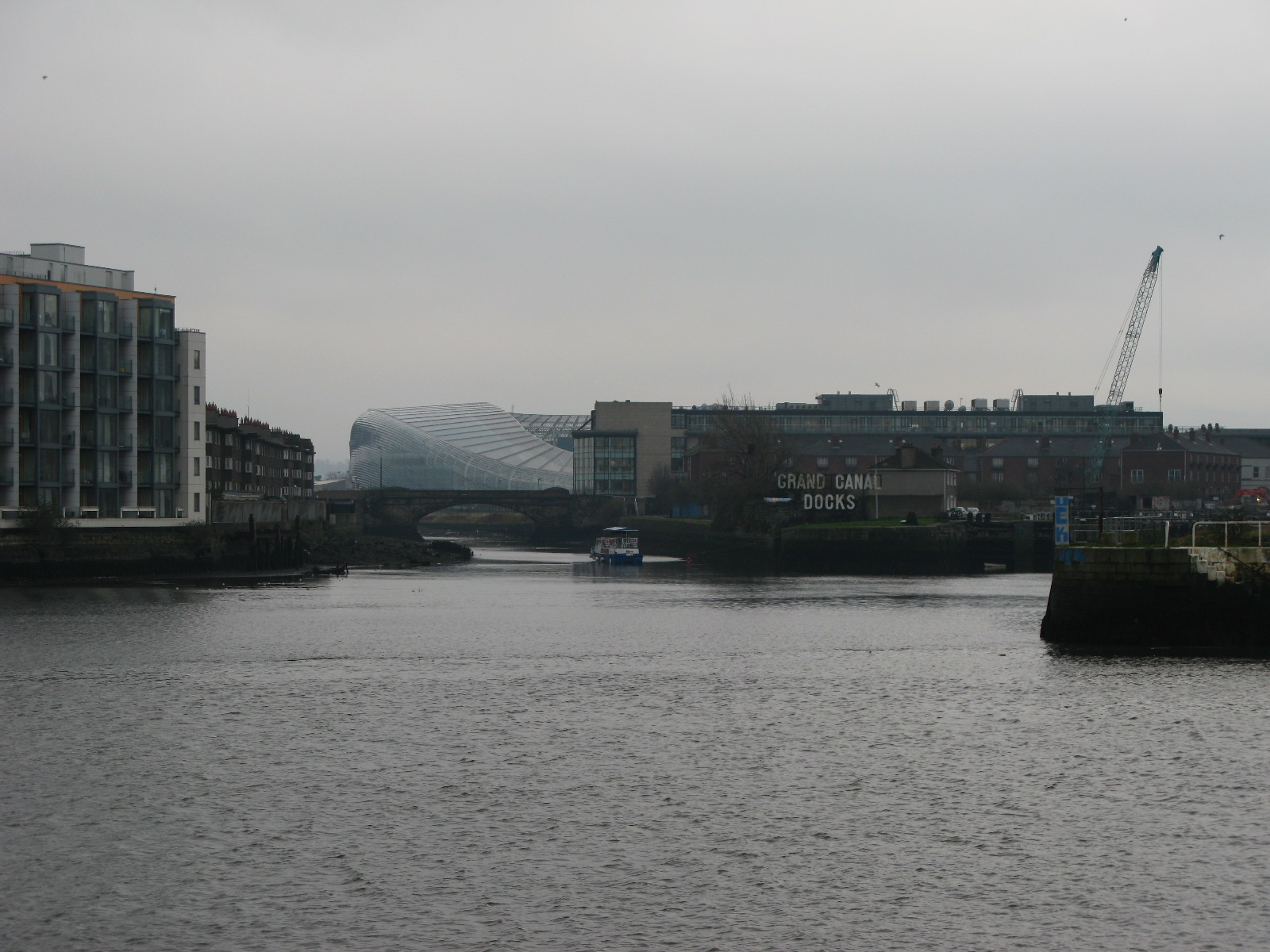
The Docklands is a great place for a wander with a camera. Its less than five minutes cycle from O’Connell Bridge, but its a world away. I’ll hopefully have another piece up next week from the area around the port itself. Below, I never noticed that you could see Lansdowne Road from the Liffey before. I took this at the time, and then on a bus the other day with Donal from this here parish and he saw it and said “that’s a great snap…” Well, here you are. A bit grey but…

005

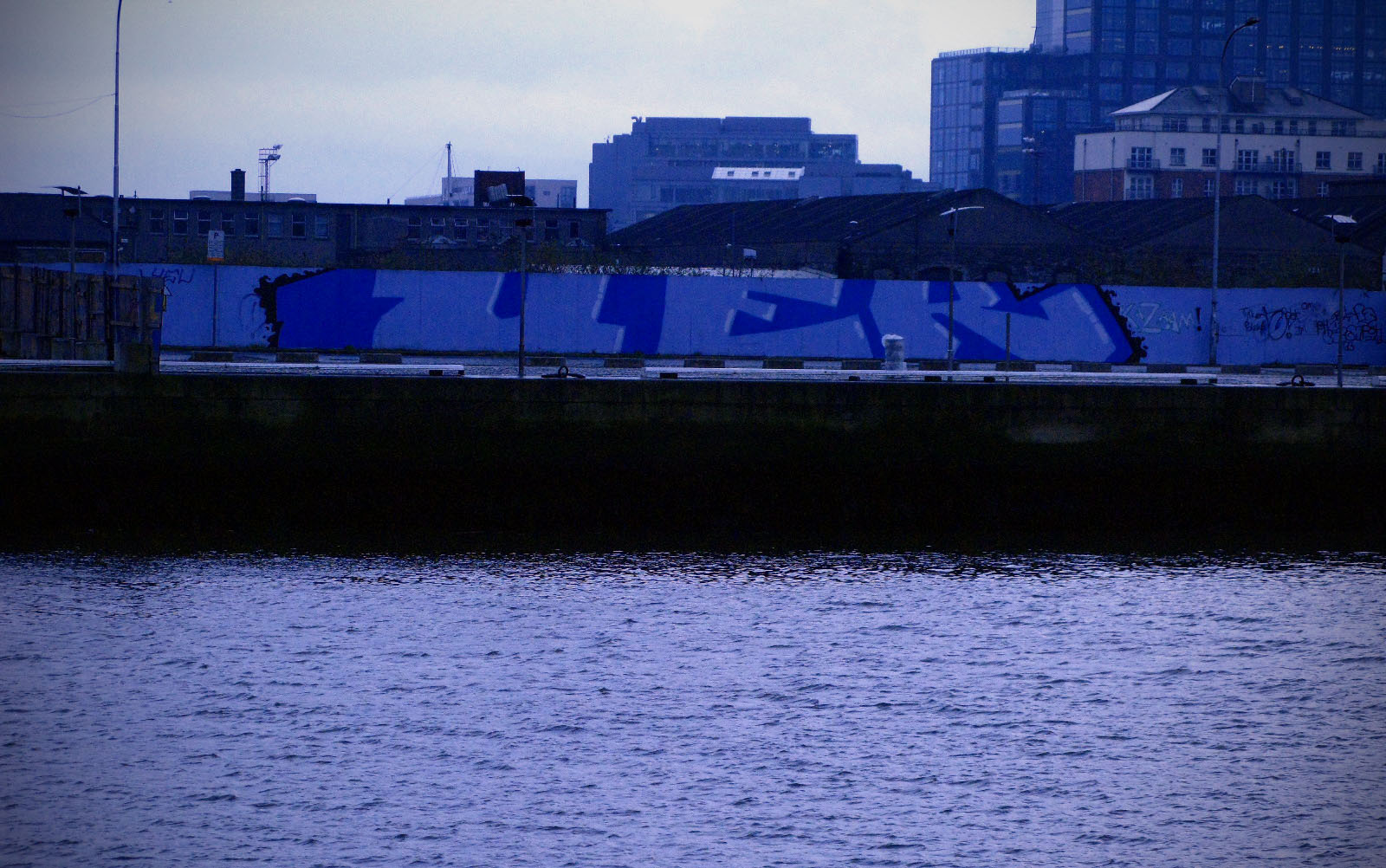
Apologies for the quality of the below snap, it was taken from the other side of the Liffey and daylight was starting to fade. For the sheer size of the piece its worth a look, must be at least thirty foot long. Sam has previously published a series of articles on Dublin graffiti artists, and the entry for UEK can be found here.

003 copy

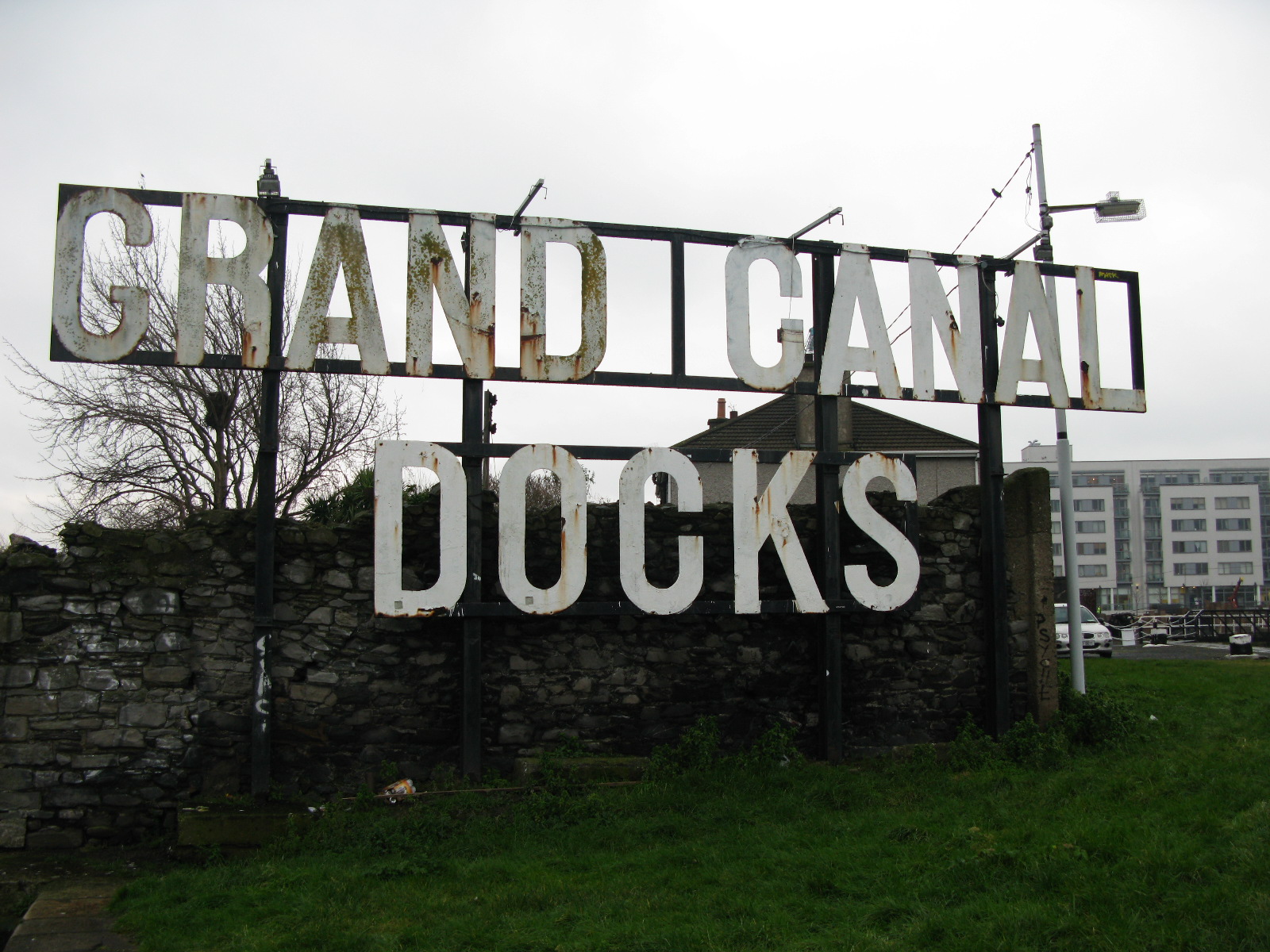
Below is a close-up of the sign you can see in the distance in the first image. A strange little area this, with locks and little bridges over docks off the Liffey. Looks like a great place for undisturbed midsummers drinking all the same…

020

(more…)

Read Full Post »

Meath Street - 1984 - Photo Anthony Dempsey from the Growing Up In The Liberties page (via Where Were You?)

Meath Street – 1984 – Photo Anthony Dempsey from the Growing Up In The Liberties page (via Where Were You?)

I encourage everyone to listen this four-part Phantom FM series on Irish youth subcultures.

Episode 1 looks at the birth of the youth cult in Ireland and focuses on teddy boys, rockers, mods and hippies.

Episode 2 focuses on the 1970s chronicling the rise of skinheads, punks and the rockabilly revival.

Episode 3 takes up the baton in the 1980s with the mod revival, psychobillies, goths, metallers, new romantics and b-boys.

Episode 4 brings the story up to present with ravers, grungers, emo kids and hipsters.

Contributors to the series include Eamon Carr (who can join the dots from Horslips to Hotwire), Garry O’Neill (author of the awesome Where Were You?), Alison O’Donnell (Mellow Candle), Dara Higgins (The Jimmy Cake), Stompin’ George, Mim Scala (author of Diary Of A Teddy Boy), Laura Lee-Conboy, Daragh O’Halloran (author of Green Beat), Irish Jack Lyons (the legendary mod) and many more.

—> You can listen to all four episodes here.

Mods on O'Connell Street - Mid 80s - Photo from Dublin Opinion. (via Where Were You?)

Mods on O’Connell Street – Mid 80s – Photo from Dublin Opinion. (via Where Were You?)

Read Full Post »

EDITTRANSFORM

An interesting exhibiton this week from Sketchy Inc.

I’m a big fan of the Sketchy Inc. takes on Dublin’s streets, backalleys and laneways. Back in December we featured one of their prints in our Dublin christmas wishlist, and they’ve gone on to produce more and more Dublin landmarks and less familiar streets in their own unique form. Below are a few of my personal favourite pieces:

Bolands Mill, graffiti and all:

Bolands Mill

Bolands Mill

The convention centre in all its glory:

ConventionCentre

One-time Anglo HQ:

Anglo HQ

Anglo HQ

You can check out more from Sketchy Inc. here.

Read Full Post »

A book I’ve mentioned several times on this site recently is James Curry’s Artist of the Revolution, which examines the political cartoons of Ernest Kavanagh. Murdered on the steps of Liberty Hall during the 1916 Rising, Kavanagh was a prolific cartoonist who contributed work to a variety of suffragette, nationalist and labour publications. His work during the 1913 lockout is well documented in the book, and many of the cartoons he drew resonated strongly at the time with ordinary Dubliners.

Yet the employers also used cartoons during the dispute, most notably on the front page of the Sunday Independent, a publication owned by William Martin Murphy. Some of these cartoons have become familiar, but others have not been reproduced. Digging through the archives, here are a few I think are worth sharing. Some I had seen before, but others were new to me.

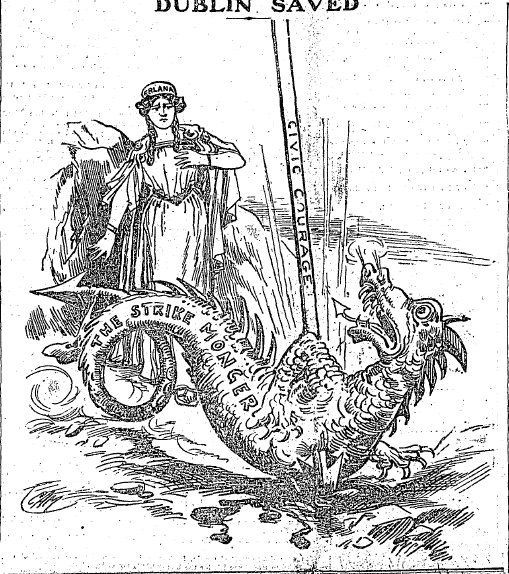
This cartoon below was printed on August 31st, the day after the horrific scenes of Bloody Sunday, when a baton charge by the DMP on Sackville Street filled the city hospitals. The Independent noted that “Larkin’s mobs attack police”, going on to state that “although his poor dupes were being batoned right and left Larkin kept carefully out of harms way.” Larkin was arrested on Sackville Street for attempting to address a banned demonstration.

The front page cartoon of August 31st shows ‘civic courage’ defeating ‘the strike monger’, as Eblana looks on.

One of the most interesting cartoons during the dispute was printed on November 9th, and took aim at those who sided with Larkin. High profile targets W.B Yeats, George Russell, George Bernard Shaw and Francis Sheehy Skeffington were attacked. ‘Skeffy’, a known feminist, is shown clutching a banner calling for voting rights for women, while Yeats mourns ‘the dead past’. Shaw is presented as a ‘Buffon’, while Russell is listed as a ‘pal of the fairies.’ Russell’s condemnation of the Dublin employers was particular strong, with him writing:

Your insolence and ignorance of the rights conceded to workers universally in the modern world were incredible, and as great as your inhumanity. If you had between you collectively a portion of human soul as large as a threepenny bit, you would have sat night and day with the representatives of labour, trying this or that solution of the trouble, mindful of the women and children, who at least were innocent of wrong against you.

The paper frequently took aim at syndicalism (“A radical political movement that advocates bringing industry and government under the control of federations of labor unions by the use of direct action…”), and the cartoons of the newspaper frequently featured the word. This cartoon from September 21st shows a worker ‘blinded’ by syndicalism, surrounded by his family who wish for him to return to work. Suffering families often appeared in the newspapers cartoons during the dispute.


(more…)

Read Full Post »

Manchester via Crumlin

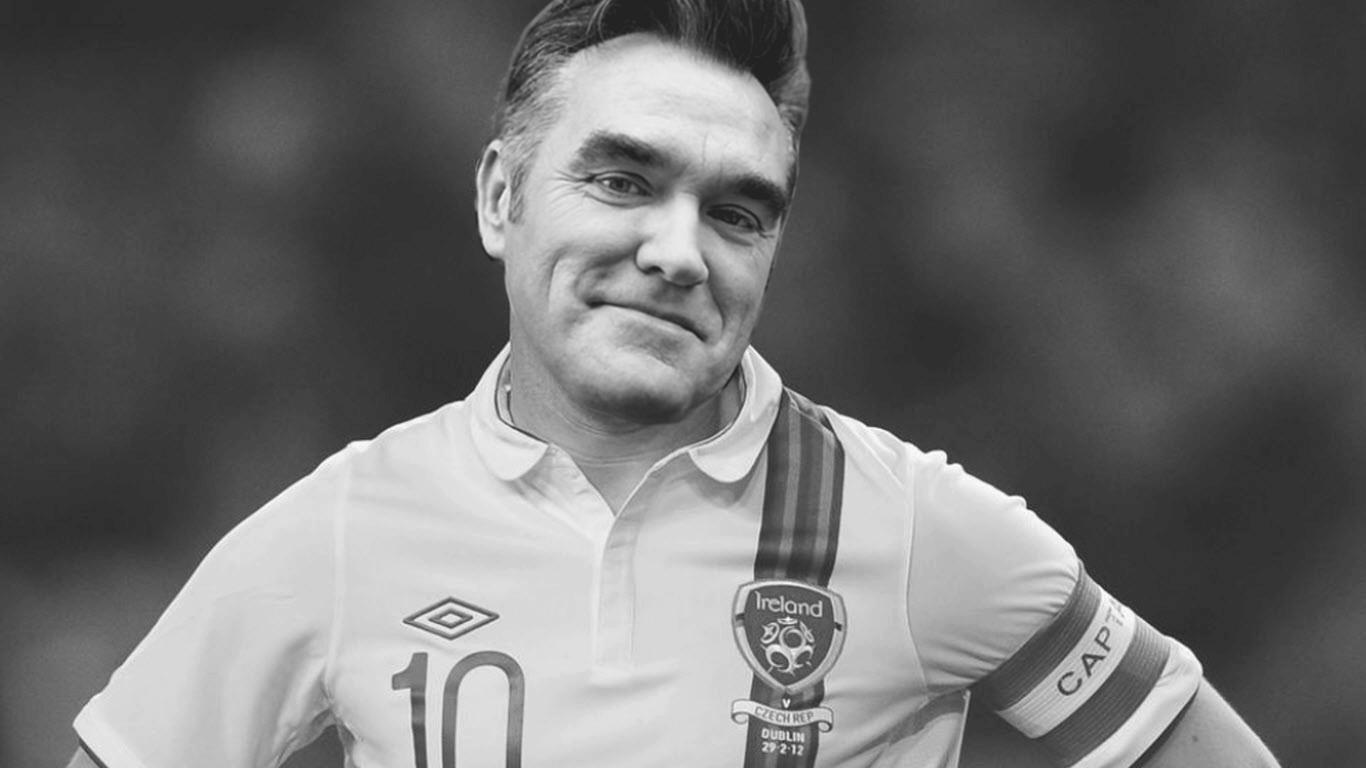
The recent revelation that Morrissey and Robbie Keane are related was news to many, and the story was first brought to our attention by the brilliantly named sports website balls.ie. An image of the two arm in arm, along with a brief post from Morrissey himself, has been flying around the internet.

Morrissey wrote that:

It was a joyous head-storm to attend LA Galaxy -v- Club Tijuana last night and to see captain Robbie Keane score in the fourth minute. Why, exactly?
Well, family tree aficionados will be aware that Robbie and I share the same Irish blood; his late grandfather (Thomas Nolan) being my own father’s cousin. In filial terms the Irish blood, English heart genetic between Robbie and I is evident – his chin is my chin, my chin is his. Robbie was raised on Captains Road (as was my mother) in Crumlin (Dublin), before he was shipped out to Tallaght. He is a gentleman of the highest caliber (or, if you must, calibre), and to watch him on the pitch – pacing like a lion, as weightless as an astronaut, is pure therapy. Robbie, the pleasure, the privilege is mine.

Luke Fallon (who gave us our recent book cover, and countless illustrations and bits and pieces for this site) wasted little time getting to work. Some of you may have seen these two efforts on RTE last night, brilliantly set to the music of The Smiths. Morrissey fanatics (and eh…Robbie Keane fanatics) will get a smile from these images no doubt.

(Credit: Luke Fallon)

(Credit: Luke Fallon)

This image is fantastic, though perhaps only Smiths fans will get the reference, the colour and style is reminiscent of so many classic album and single covers from the bands career:

(Credit: Luke Fallon)

(Credit: Luke Fallon)

Read Full Post »

Image: George Kelly

Image: George Kelly

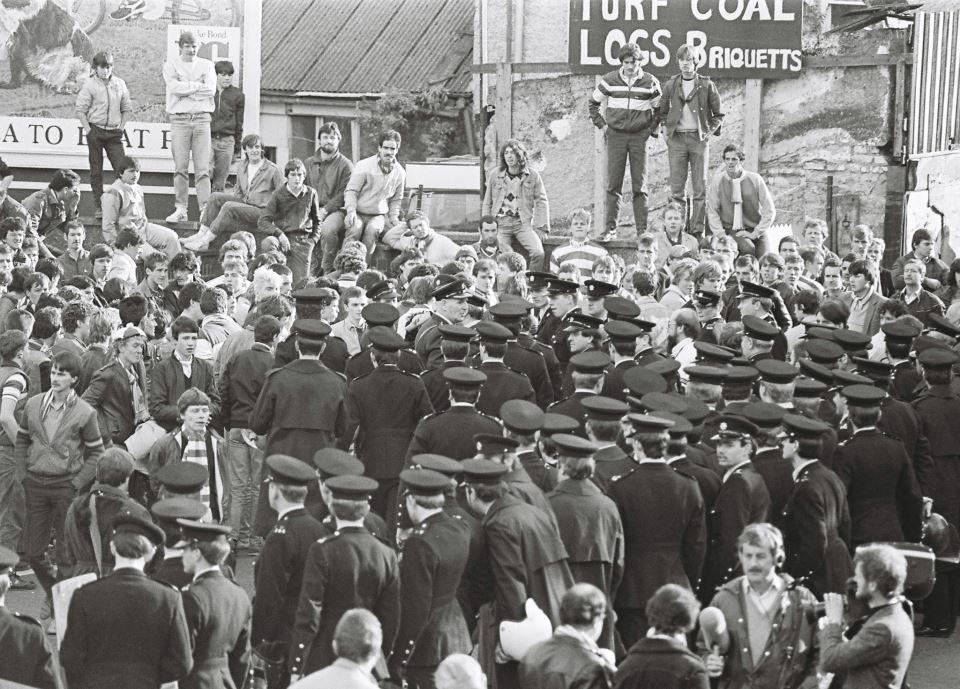
George Kelly took the great photo above, and allowed us to post it here. It’s a fantastic shot from the 1984 clash between Linfield and Shamrock Rovers, fitting to post now with the two clubs set to meet soon in the cross-border Setanta Cup.

We’ve had plenty of articles on the site recently looking at football violence in Dublin over the years, ranging from hooliganism in Richmond Park to trouble at high-profile European fixtures. One fixture we looked at in detail was Linfield and Shamrock Rovers in 1984. The game was marked out by an almost unprecedented police presence, but passed off relatively peacefully, with nothing near the anticipated crowd trouble.

Much of the fear around the class had come out of events in Dundalk in August 1979, when Linfield and Dundalk faced each other at Oriel Park. Almost 500 Gardaí were involved in policing that encounter, and journalist Peter Byrne wrote after the clash that “this was the night when the concept of All-Ireland club football was killed stone dead. Two hours of raw, naked tribalism on the terraces of Oriel Park convinced even the most reformist among us that the dark gospel of the paramilitaries has permeated Irish sport to the point where all attempts at reconciliation are futile.”

The article on the 1984 fixture is available to read here. How different will the scene look in a few weeks time from that above? If the policing at the recent Saint Pat’s/Glentoran game in Inchicore is anything to go by, not very.

Read Full Post »

It’s hoped that over the coming weeks and months we can post several stories relating to the 1913 Lockout, looking at some of the key events and characters in brief posts which should serve as an introduction to the event and the protagonists. This brief post looks at an unusual aspect of the story of William Martin Murphy, leader of the employers in that great dispute.

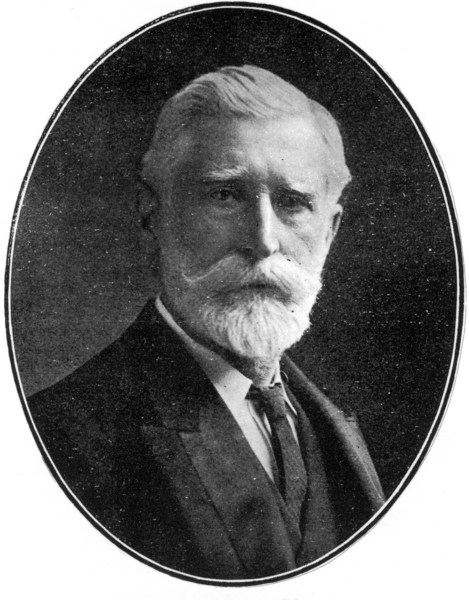
William Martin Murphy

William Martin Murphy (Image Credit: Multitext UCC)

More out of laziness than anything else I’ve always believed, the 1913 Lockout has often been spoken of as some sort of ‘dress rehearsal’ for the 1916 Rising. The Lockout was not a dress rehearsal for anything however, but rather it is a hugely important moment in Irish history in its own right, representing the greatest ideological battle between labour and capital in Irish history.

While ‘Big Jim’ continues to hold a central place in the popular memory and folklore of Dublin, William Martin Murphy is a figure many Dubliners are unfamiliar with in any detail. Murphy was an incredibly complex character, and his own politics were actually of an Irish nationalist type.

The eldest son of a Co.Cork building contractor named Dennis William Murphy, he was born in 1845. Educated at Belvedere College in Dublin, he worked in the offices of the Irish Builder and The Nation publications as a young man. Patrick Maume writes in his biographical entry on Murphy for the Dictionary of Irish Biography that:

In 1863 Murphy inherited the family business on the death of his father. In 1867 he moved to Cork, where in 1870 he married Mary Julia Lombard, daughter of a prominent Cork businessman, James Fitzgerald Lombard (qv). They had five sons and three daughters, whose marriages (notably with the Chance family) strengthened Murphy’s political and business alliances. His success was based on building light railways in the south and west of Ireland; he also became involved in running these railways, sat on several boards, and facilitated the merger that created the Great Southern and Western Railway.

Padraig Yeates notes in his history of the Lockout that Murphy displayed “an entrepreneurial talent rare for Ireland in that era and developed an expertise in constructing light rail and tramway systems.”

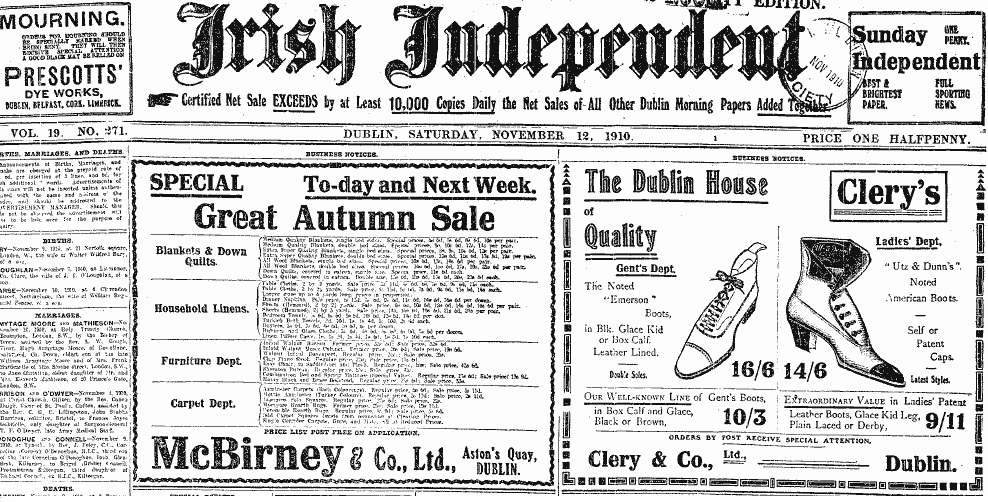
Murphy was elected as an MP for the Irish Parliamentary Party for St Patrick’s, Dublin at the 1885 general election. Following the split in the party, Murphy sided with the Anti-Parnellites, which cost him in Dublin, a city which remained loyal to the fallen leader. In 1900, he purchased a fledgling Parnellite newspaper the Irish Daily Independent from the Parnellites, merging it with the Daily Nation. This move gave birth to the Irish Independent, a paper still with us today. By the time of his death in 1919, Yeates estimates that “he had accumulated a fortune of over £250,000, had built railways and tramway systems in Britain, South America and West Africa, and owned or was a director of many Irish enterprises, including Clery’s department store, the Imperial Hotel and the Metropole Hotel”.

Two aspects of the one empire. An advertisement for Clery's on the front of the Irish Independent (1910)

Two aspects of the one empire. An advertisement for Clery’s on the front of the Irish Independent (1910)

(more…)

Read Full Post »

Sir Patrick Abercrombie, the British architect and town planner who redesigned London after the Blitz, was long connected to Dublin city.

He was the winner of the 1916 Civics Institute of Ireland competition on town planning for Dublin which gained him £500 and recognition. Later, he was responsible for the sketch development plan of Dublin produced in 1922 produced on the basis of his competitive designs and a revised report produced in 1941. You can read more about him on Archiseek here.

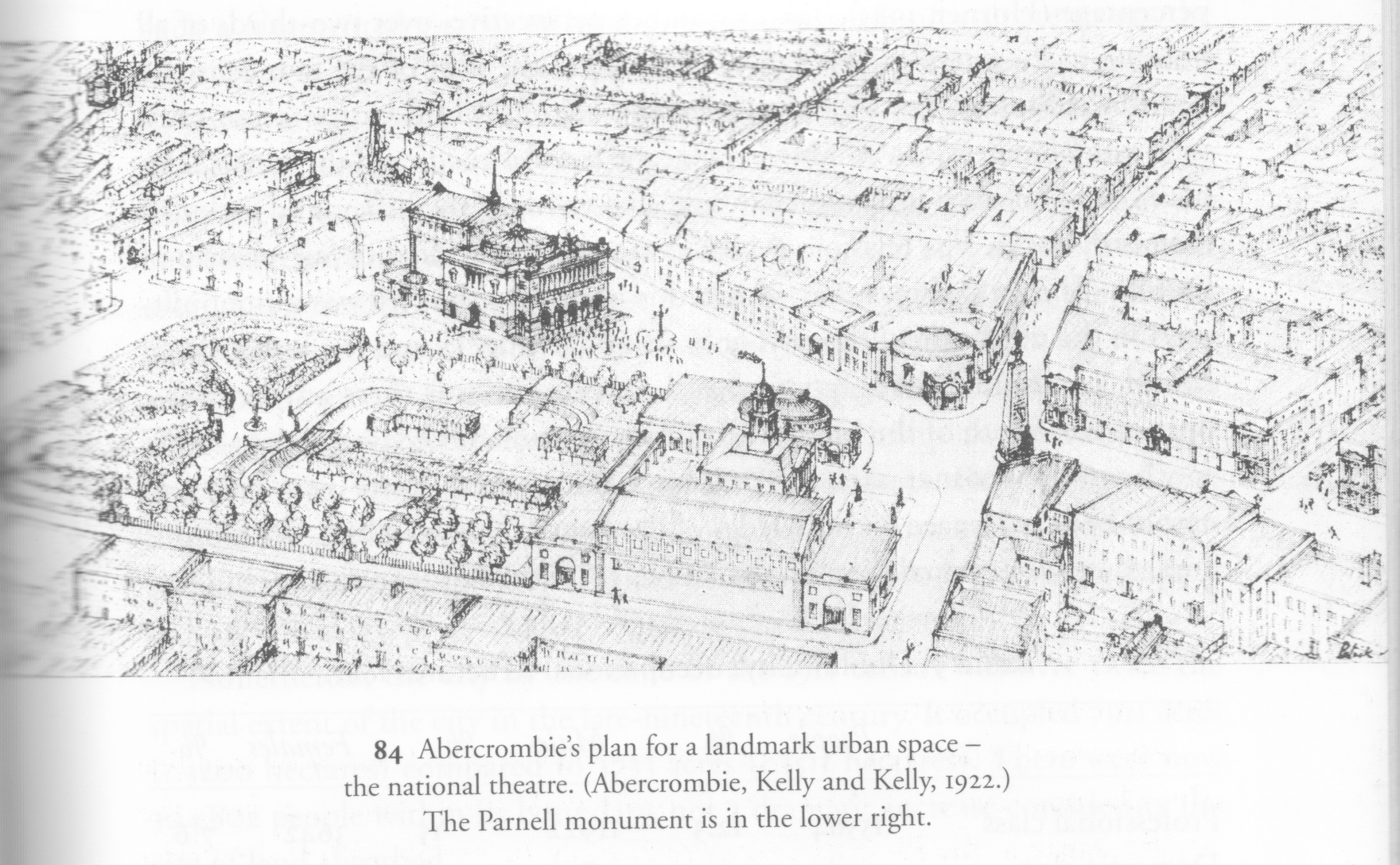
Here are some sketches from his 1922 report ‘Dublin of the Future’ showing Abercrombie’s sketch of upper O’Connell Street area:

Credit - Dublin: through space and time (2001).

Credit – Dublin: through space and time (2001).

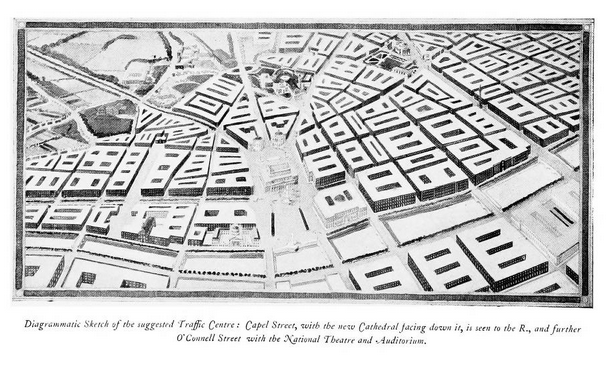
His view on what Capel Street and the new Cathedral could have looked like:

Credit - unz.org

Credit – unz.org

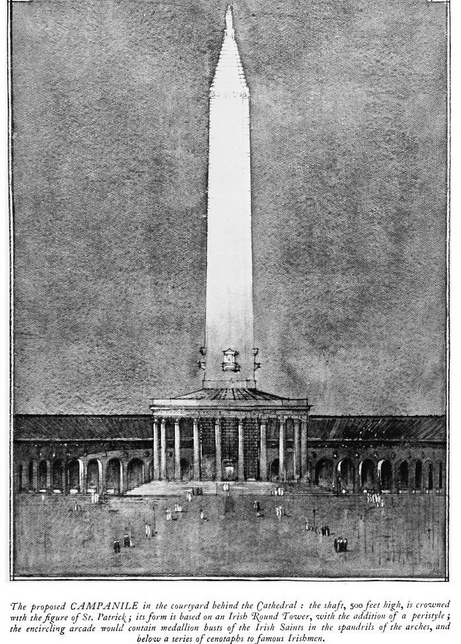
A sketch of the towering 500 ft. campanile that would have been placed behind the new Cathedral on Capel Street.

For more, you can view the full pamphlet here.

Read Full Post »

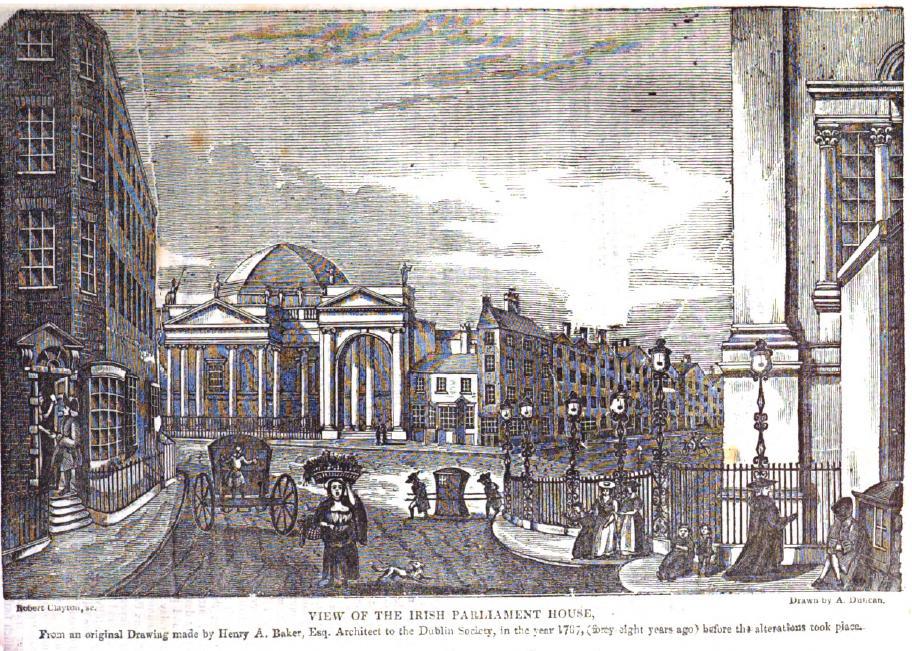
This Dublin Penny Journal scene shows a Sedan chair at College Green.

This Dublin Penny Journal scene shows a Sedan chair at College Green.

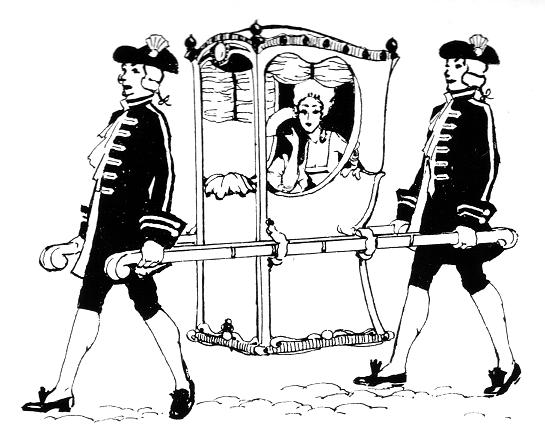
Thankfully, sedan chairs have long vanished from the streets. I saw one recently at a museum in Edinburgh, and it really is difficult to picture a time when they were a common sight on the streets of British cities. Essentially a sedan chair was a chair or windowed cabin, which would be carried by at least two porters through the streets. You could say that these were human taxis in their day.

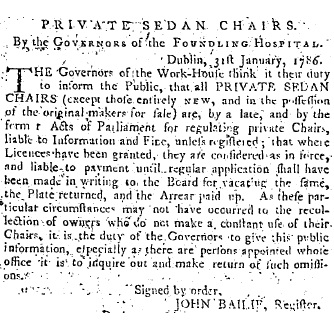
In his study of Irish tourism between 1750-1850, W.H.A Williams noted that in 1771 sedan chairs “outnumbered licensed carriages in Dublin, to the benefit of the Dublin Lying-In Hospital, which had been granted a duty on the chairs. The use of sedan chairs persisted in the largest Irish cities into the 1830s.” The process of licensing the chairs is made clear in this brief piece from the front page of the Freeman’s Journal in 1786:

Front page of Freeman's Journal, April 25th 1786

Front page of Freeman’s Journal, April 25th 1786

Thanks to the licensing process, we are able to see just where the owners of sedan chairs lived, and Peter A.Clarke researched this in the study Two Capitals: London and Dublin, 1500-1840. Based on the 1785 returns, it is evident that “over two-thirds of the holders of sedan chair licenses were members of the titled nobility”, going on to write that “the licensees lived for the most part in Henrietta Street, Rutland Square, Sackville Street, St.Stephen’s Green and Merrion Square”. These were among the wealthiest streets and squares of eighteenth century Dublin, popular with parliamentarians and other elites.

Colonel Henry Luttrell was assassinated while traveling in a sedan chair in Dublin on 22 October 1717, by a “band of ruffians” according to the Biographical Peerage of Ireland, which was printed in 1817. Frank Hopkins writes about this in his book Rare Old Dublin: Heroes, Hawkers and Hoors. Luttrell was a figure who had deserted from the army of the Catholic James II to fight alongside Williamite forces following the Siege of Limerick in 1690. None too popular then amongst Catholics, he was murdered when travelling between a Cofffee House on Cork Hill and his lofty residence on Stafford Street.

Illustration of a sedan chair in the eighteenth century (wiki)

Illustration of a sedan chair in the eighteenth century (wiki)

(more…)

Read Full Post »

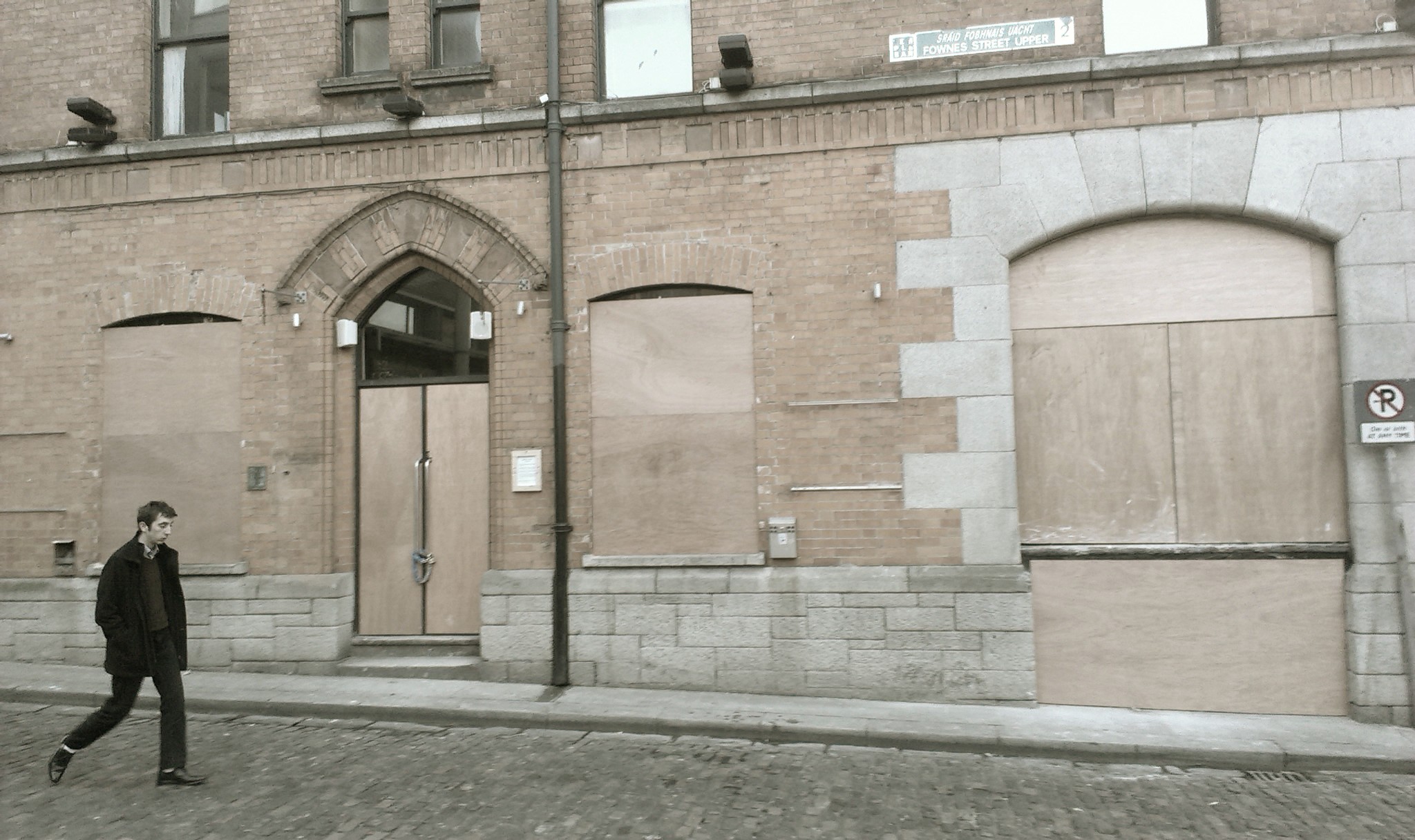
The location of our next McDonald's, Temple Bar.

The location of Dublin’s next McDonald’s, Temple Bar.

McDonald’s are set to move into the Temple Bar area soon, with the premises previously occupied by Frankie’s Steak House serving as the location for their newest Dublin branch. While many would argue the damage was done a long time ago with regards Temple Bar (The Hard Rock Cafe, TGI Fridays, tacky tourist traps), it is still a pretty significant piece of news for what was once referred to in the media as “Dublin’s Left Bank”. Dublin City Council had rejected a planning application from McDonald’s on the grounds that the premises would have a “detrimental impact on the mix of users within the Temple Bar area, which already has an ample supply of restaurants”, but the green light of An Bord Pleanála last year brought the proposal to a reality.

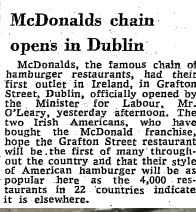
McDonald’s is a powerhouse of international business and the fast food trade, operating in 119 countries and serving tens of millions of customers on a daily basis. News of the multinational arriving in Dublin in 1976 was first reported in the Irish media in September of that year, when it was noted by The Irish Times that the company had purchased the old premises of the Hospital Sweepstakes on Grafton Street. The company was understand to be paying something in the region of £50,000 a year in rent for the premises.

The first branch of the restaurant in Ireland opened to minimal fanfare, and this is how the May 1977 opening was reported in The Irish Times:

McDonalds

A feature on the restaurant soon after its opening noted that it opened for about thirteen hours a day, seven days a week, far removed from the 24/7 branches in the city centre today. A 1978 report noted that the place was almost always busy, with a plain hamburger costing only 28p, a small chips 23p and a cup of coffee costing 17p. A journalist reviewing the restaurant for The Irish Times wrote that “the decor is far from appealing and my friend was convinced the seats are specifically designed so that if you relax you fall out of them.”

The expansion of the brand saw a second restaurant open in October 1978, this time on O’Connell Street. Like the first branch, this one remains open today.

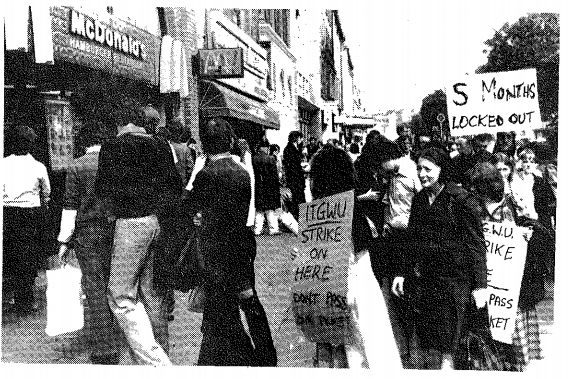
McDonald’s were involved in a massive labour dispute in 1979, which lasted for almost six-months and saw the company entangled in a media storm, dragging workers through the courts in an attempt to stop them picketing the premises. This dispute began when workers within the company began to join the ITGWU union. At the time, it was reported that pay in McDonald’s was 85p an hour. The Anarchist Worker newspaper reported that “management refused to recognise the union or even to talk over the phone to union officials.” Coming out on March 16th, the workers involved picketed the two restaurants demanding the right to union recognition.

A picket on the O'Connell Street branch (Anarchist Worker newspaper)

A picket on the O’Connell Street branch (Anarchist Worker newspaper)

(more…)

Read Full Post »

In the last few weeks, a number of stories from Come Here To Me! have been aired on The History Show on RTE Radio One. These stories have tied-in with content on the programme, or have been aired to coincide with historic anniversaries.

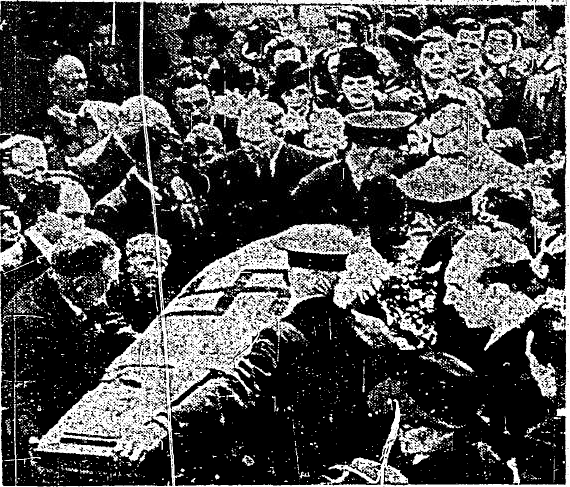
The first story aired was on 13 January, and involved an infamous incident at Deansgrange Cemetery when swastikas were on show at the funeral of ‘Nazi master spy’ Hermann Goertz. This story was read during a segment of the programme which focused on Ireland after WWII, and the podcast recording can be played here.

A scene from the funeral. Published first in The Irish Independent, Oct 22 1961.

A scene from the funeral. Published first in The Irish Independent, Oct 22 1961.

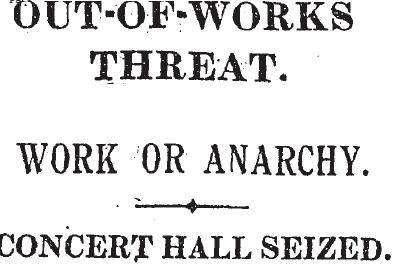
On 20 January, our account of the workers occupation of the Rotunda Concert Hall in 1922 was read on the programme. This event occurred five years after the Russian revolution, and saw a red flag flying over the city of Dublin. The occupation was led by the talented writer Liam O’Flaherty, and the story was read on RTE Radio by the actor David Herlihy. The podcast recording can be played here.

'Work Or Anarchy' - Media coverage of the 1922 occupation.

‘Work Or Anarchy’ – Media coverage of the 1922 occupation.

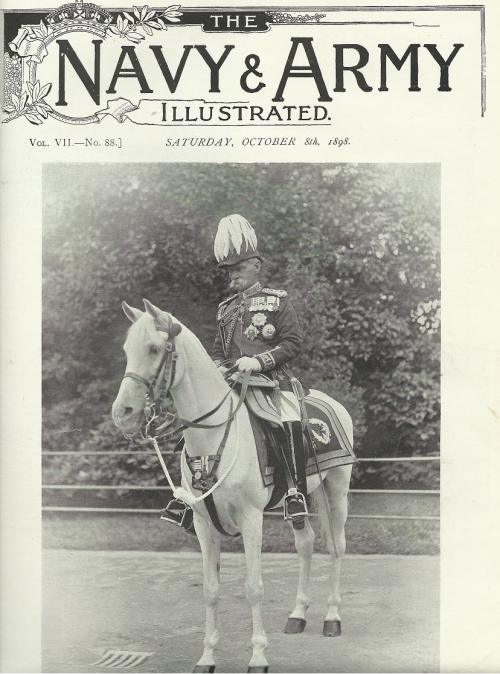
On the 17 February edition of the show, our story about Vonolel was read on air. Following on from a discussion around the Irish and horse meat, Dublin’s War Horse got an airing. The loyal companion of Field Marshall Earl Roberts, this remarkable and decorated horse is buried in the grounds of the Royal Hospital Kilmainham. His grave must be one of the most unusual in Dublin. Again, the story was read by David Herlihy. The podcast recording can be played here.

The famous and decorated Vonolel.

The famous and decorated Vonolel.

Our thanks to everyone at The History Show for bringing these stories to a wider audience, and we hope that readers of the blog have enjoyed hearing the stories brought to life as much as we have.

Read Full Post »

« Newer Posts - Older Posts »