Feeds:
Posts
Comments

Archive for 2013

The word ‘joyrider’ is of North American origin and became popular as a term in Britain and Ireland in the early 1910s. It was defined as a ‘ride at high speed’ and initially applied to all those who took their cars out for recreational drives. It was later used negatively to describe car owners who took non-essential rides at the time of petrol shortages during World War One.

Car Wreck in Washington D.C, 1921 (via Reddit)

Car Wreck in Washington D.C, 1921 (via Reddit)

During the interwar period (1918-1939), the term took on its modern connotation of a ‘fast and dangerous ride in a stolen vehicle’ . Dublin, along with London, Manchester and other large cities, started to develop a problem with joyriding in the mid 1920s. At the time, it was considered as mainly frowned-upon high-jinks and pranks as opposed to dangerous anti-social behaviour. Historian Claire Millis described it, in an Irish context, as a ‘mild enough outlet for underemployed and envious youth’. She also points to the fact that many newspapers, especially provincial ones, used ‘joyriding’ as a barely disguised euphemism for sex.

The Irish Times reported on 24 September 1923:

A Bedford two-seater motor car, belonging to Mr. Erley, Rockview, Coliemore Road, Dalkey … which had been stolen … late on Saturday night was found abandoned at Harbour Road, Dalkey yesterday morning. It was badly damaged and evidently ran against the harbour wall.

A ‘well dressed American visitor’ Christopher Harrison and a friend James Bradley, a carpenter of South Circular Road, were fined £6 in total in August 1929 for taking a car from Waterloo Road for a joyride.
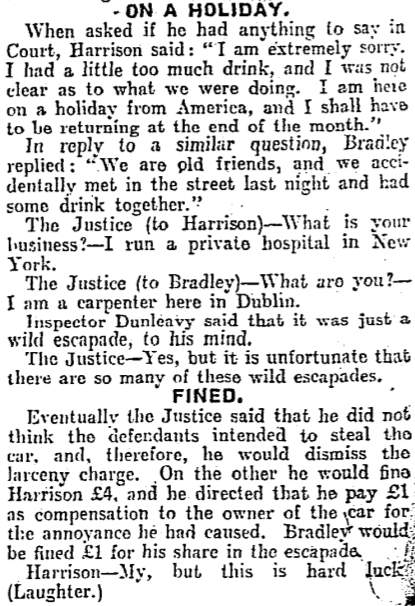
21 August 1929. The Irish Times.

21 August 1929. The Irish Times.

In September 1929, Reginald McCoy from Elinton in Dundrum was charged with stealing a motor cycle from Molesworth Street. In court, he said that he had ‘only taken it for a joyride’. He drove it to Mayor Street where he hit a pothole and damaged the machine to the extent of £10. McCoy said he willing to pay for the damage caused. (Indo, 19 Sep ’29)

Three teenagers in January 1930 robbed a Morris Cowley car worth £60 from outside an office on Middle Abbey Street and were caught in Drumcondra after going at a speed of over 45 miles per hour. Eugene Caldwell (17), Patrick Hughes (17), both of Lower Dominic Street, and Patrick Scully (16) of O’Daly Road in Drumcondra were first spotted by a Garda driving on the wrong side of the road by Sir John Rogerson’s quay. Two Garda on motor cycles gave chase and followed the stolen car around Drumcondra, Marino and Drumcondra before they managed to get in front it causing a collision. (IT, 8 Jan ’30)

Two young men – John Walshe of Reginald Street and Peter Borgan of Parnell Street – were remanded on bail in May 1930 for driving a car through Capel Street and Parliament Street in a reckless manner, injuring three children in the process. Their lawyer said the charge was the outcome of a ‘joyride’ gone wrong. (IT, 20 May ’30)
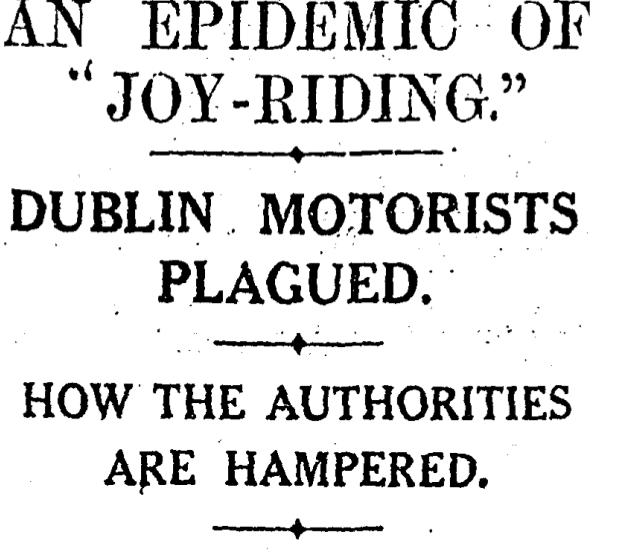
26 November 1930. The Irish Times.

26 November 1930. The Irish Times.

By the end of 1930, the police announced that an average of three cars a day were being stolen by joy riders in Dublin city. The vast majority of which were found abandoned and undamaged twenty four hours later. Often they were found within a few miles of the city, having been driven until the petrol supply is exhausted. Interestingly The Irish Times of 26 November 1930 said that a ‘large proportion’ of the joyriders ‘are young people in good positions’ with the minority belonging to the ‘poorer classes’.

(more…)

Read Full Post »

While the destruction of British symbolism was a common occurrence here in the decades following independence, it was largely confined to statues and monuments of individuals that republicans objected to, like Horatio Nelson or King William of Orange. In the 1950s however there were two attempts made on the War Memorial Gardens at Islandbridge. Neither succeeded in doing any lasting long-term damage to the gardens, although the Cenotaph was damaged by the blasts. A blast on Christmas Day in 1956 was sufficiently loud to wake up people in Finglas and Castleknock, according to The Irish Times.

Poppy wreaths at the War Memorial Gardens, Islandbridge.

Poppy wreaths at the War Memorial Gardens, Islandbridge.

The War Memorial Gardens at Islandbridge are the work of Edwin Lutyens, a celebrated London architect. While largely completed by 1939, there is a certain irony in the fact a memorial garden constructed to remember those who perished in the First World War had its opening delayed by the outbreak of the Second World War and the political instability it caused. Incredibly, it was not until 1988 that the Gardens were formally dedicated and formally opened to the public, though it had long been a place of commemoration and remembrance by then.

On 25 December 1956, a blast at 1am at the War Memorial Gardens occurred when a charge of high explosive was placed on the granite base of the large memorial cross. The blast may have awoken people in suburbs well beyond the memorial, but it failed to do any real lasting damage to the memorial itself. The British Legion condemned the attack as “a most disgraceful affair, particularly at Christmas.” The cross, made of granite from Wicklow, withstood the power of the explosion, with Gardaí believing the people responsible for the explosion “were not used to handling charges.” Despite not succeeding in doing any real damage, the bomb attempt did succeed in attracting considerable media attention, with the New York Times and other international outlets reporting on the Christmas Day attack. This wasn’t the first time republicans had attacked such symbols on Christmas Day, as on Christmas morning 1944 the statue of Lord Gough in the Phoenix Park was beheaded, though the head would later be found in the Liffey!

A young boy playing in the grounds of the War Memorial Gardens, early 1960s (NLI, Wiltshire Photographic Collection)

A young boy playing in the grounds of the War Memorial Gardens, early 1960s (NLI, Wiltshire Photographic Collection)

While the explosion in Dublin had been a failure, the following year a British Legion memorial at Pery Square in Limerick would be shattered by the force of an explosion. On 8 August 1957 it was reported that “the 20ft high memorial, which was erected in 1932, was shattered, and houses in the vicinity suffered damage when windows were blown in.” Condemning the attack, The Irish Times asked “what kind of mentality can justify to itself these childish conspiracies to remove from our midst symbols of what is, after all, our own history?” The attack was unclaimed by any republican group at the time.

Despite the attack on Christmas Day 1956, the gardens remained a focal point for Remembrance Sunday events in Dublin, and in November 1957 huge numbers of British Army veterans paraded in the memorial gardens, while it was noted former soldiers also paraded “via Parnell St. and O’Connell St. to Bachelor’s Walk.” There were no reports of clashes, something which had been rather common during such parades in the 1920s and 1930s. The laying of wreaths at Islandbridge became an annual event.

Independent photo showing  parading veterans in the Memorial Gardens, November 1957.

Independent photo showing parading veterans in the Memorial Gardens, November 1957.

A follow-up attempt on the Dublin gardens took place in October 1958, and it was reported that “the flash of the explosion was seen in Rialto, almost two miles away.” Once more, the huge cross withstood a republican bomb with only minor damage to show. The Irish Republican Publicity Bureau denied any involvement in the attack. Five men were later arrested and questioned about the explosion, though it remained an unsolved incident.

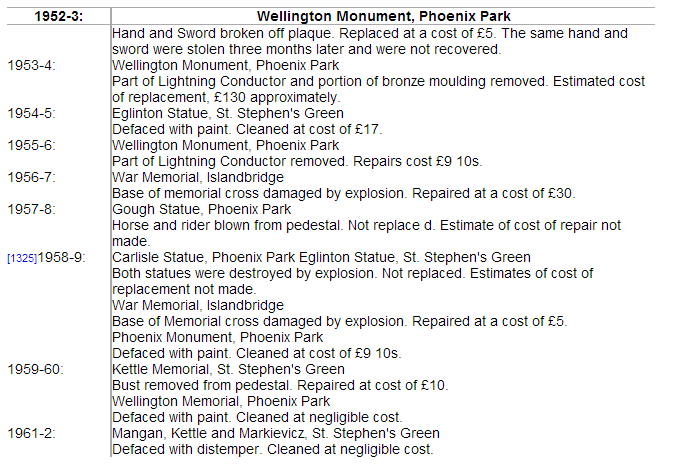
In 1961, the issue of attacks on the War Memorial Gardens and other memorials and monuments was raised in the Dáil. Asked to give an idea of the extent of damage to monuments in recent years, Minister Joseph Brennan gave the following details. It looks like the Duke of Wellington got a particularly hard time!

The Islandbridge memorial is not the only WWI memorial in Dublin, and readers may be interested in a previous CHTM article looking at the Trinity College Dublin war memorial.

Read Full Post »

The Cobblestone has become the favourite haunt of those with an interest in social and political history, with the Stoneybatter & Smithfield People’s History Project and others hosting meetings there. Another group of individuals have organised a great talk there for this Thursday, looking at radical politics in the late 1960s and into the 1970s.

RadicalPolitics

The organisers of this meeting have been doing brilliant work in recent times recording the memories of some who were active in radical politics at the time, for example interviewing veteran republican Liam Sutcliffe, who participated in the explosion which destroyed the O’Connell Street monument of Admiral Nelson. They have also interviewed Jim Lane, who has a long history of activism in socialist-republican politics in Cork. These interviews are an invaluable resource to those interested in this aspect of Irish history.

Read Full Post »

The Red Bank Restaurant (19-20 D’Olier Street) was one of the city’s most famous and long-running restaurants, open from 1845 – 1969.

Culinary historian Mairtin Mac Con Iomaire wrote that it was:

…established by Burton Bindon on the site of a famous city hostelry (and) known originally as ‘Burton Bindon’s’. (It) took its current name from the famous ‘Red Bank’ oysters which grew on beds owned by Bindon in Co. Clare and were available in season in his Dublin establishment [1]

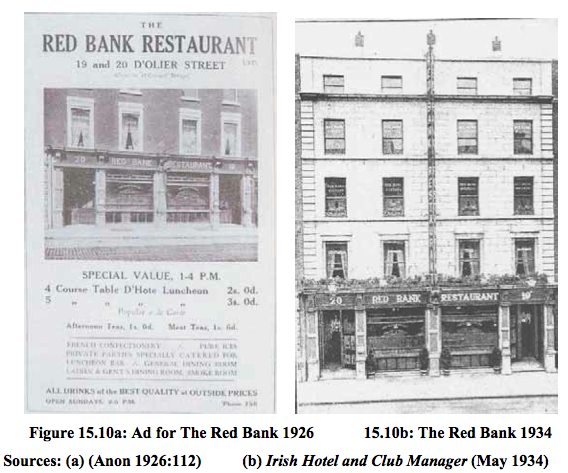
Taken over by the Montgomery family at the turn of the century, by 1934 it boasted a ground floor with a grill room and luncheon bar, two further floors of dining rooms and some of the best food in the city.

Sadly, it perhaps best known for being a popular meeting place for pro-Axis supporters. American historian R. M. Douglas described it as a ‘well known haunt of ultra-nationalist and extremist bodies owned by a German-born member of the Dublin Nazi Party’. [2]

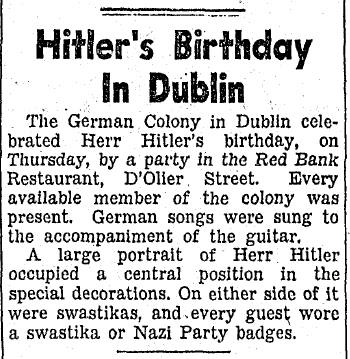
It was a regular meeting place before the war of Adolph Mahr’s ‘German Association’. Mahr had been a leading Nazi official in Dublin, and also the Director of the Irish National Museum. The ‘German Association’ would often invite sympathetic Irish men to these dinners where the table was draped with a Swastika flag.

Red Bank. The Irish Press (Apr 22, 1939)

The Irish Press (Apr 22, 1939)

In February 1940, 1916 Rising veteran and long-serving fascist organiser WJ Brennan-Whitmore invited a select group of ‘Celtic Confederation of Occupational Guilds’ (CCOG) veterans, most of whom he had known from his Blueshirt days, to the Red Bank restaurant to sound them out for a new group called ‘Clann na Saoirse’ (‘Tribe of Freedom’). [3]

In May 1940, the ‘Irish Friends of Germany’ (aka the National Club) held a meeting in the restaurant that was attended by 50 people. George Griffin, veteran anti-Semite and ex Blueshirt, spoke on the subject of the ‘The Jewish Stranglehold on Ireland’. Griffin mentioned many Jews by name and went onto advocate that ‘… we should never pass a Jew on the street without openly insulting him’. [4]

In 1942, the restaurant was host to a number of meeting from the ‘Aontacht na gCeilteach’ (Pan Celtic Union), a front group for ‘Ailtri na hAiseirghe’ (‘Architects of the Resurrection’). [5]

Images from Mairtin Mac Con Iomaire's ‘The Emergence, Development and Influence of French Haute Cuisine on Public Dining in Dublin Restaurants 1900-2000: An Oral History'

Images from Mairtin Mac Con Iomaire’s ‘The Emergence, Development and Influence of French Haute Cuisine on Public Dining in Dublin Restaurants 1900-2000: An Oral History’

As aforementioned, RM Douglas is of the opinion that the restaurant was owned by a German Nazi party member. Historian Gerry Mullins (author of Dublin’s Nazi No. 1) supports this theory and names the Schubert family as owning the restaurant.

However, respected culinary historian Mairtin Mac Con Iomaire has said that he has ‘found no evidence of the Red Bank leaving the Montgomery family ownership from the beginning of the twentieth century until its sale in the late 1960s’ and that the Mr Schubert referenced was actually the manager of the Solus factory in Bray. Mac Con Iomaire also seriously questions the claim by David O’Donoghue (author of ‘Hitler’s Irish Voices’) that newspaper advertisements for a new lounge in The Red Bank Restaurant were coded messages for Nazi meetings.

The standard of food at The Red Bank declined over the war years, when it became a late night drinking establishment. It closed in 1948 but was reopened under new management. A fire in 1961 gutted the place and the restaurant finally closed its doors in 1969.

Notes:
[1] Mairtin Mac Con Iomaire, ‘The Emergence, Development and Influence of French Haute Cuisine on Public Dining in Dublin Restaurants 1900-2000: An Oral History’ (DIT, 2009), 100
[2] RM Douglas, ‘Architects of the Resurrection: Ailtirí na hAiséirghe and the Fascist ‘New Order’ in Ireland’ (Manchester, 2009), 66
[3] ibid
[4] Martin White, The Greenshirts:Fascism in the Irish Free State 1935-45, (Queen Mary University of London, 2004), 245
[5] Douglas, 271

Read Full Post »

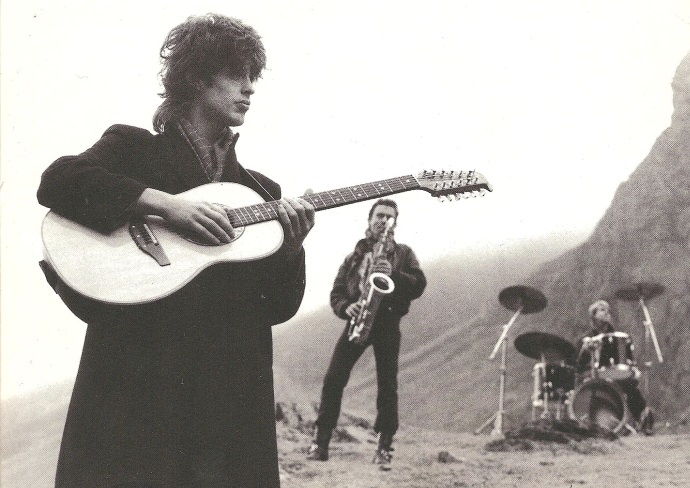
A Song For Arthur’s Day

The Waterboys

The Waterboys

This morning on Twitter I noticed Jim Carroll of The Irish Times and a few others sharing a little ditty to Arthur’s Day, composed by Mike Scott of The Waterboys. “We’ll leave the streets in tatters on Arthur’s day, drink is all that matters on Arthur’s Day…”

It brought to mind Christy Moore at the Grand Canal Theatre in January, who performed his own tribute to the day:

Read Full Post »

1929

All are invited to attend the launch of ‘Locked Out: A Century of Irish Working-Class Life’ on 19 September in Liberty Hall. Diarmaid Ferriter (UCD) will be on-hand to launch the book, which contains essays looking at the history of the Irish working-class in the hundred years since the 1913 Lockout. I have contributed a chapter to the book on the ‘Animal Gang’ and gang violence in 1930s Dublin. The launch will be followed by music and (most importantly of all!) there’ll be a bar on the night 😉

Read Full Post »

Recently my brother pointed me towards a priceless archive of Dublin images online, hosted by NUI Galway.

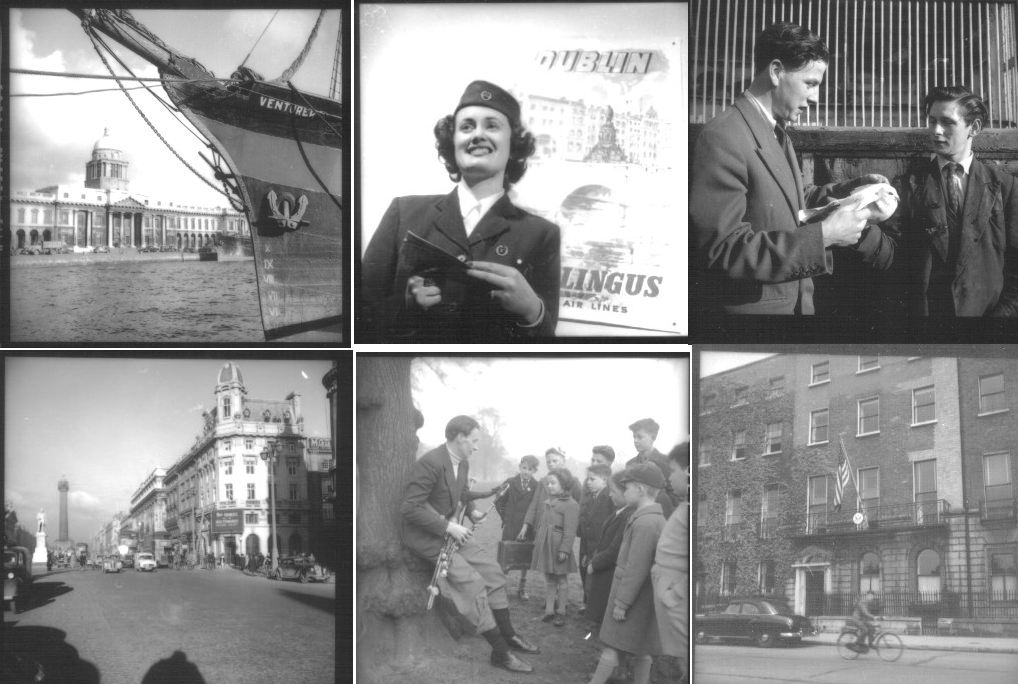
Known as the ‘Pickow Collection’, the archive contains hundreds of priceless images of Ireland, with great emphasis on the capital. Some familiar faces and locations feature, with piper Seamus Ennis for example shown playing to an audience of young children in the Phoenix Park. Elephants giving people lifts around the zoo and masses of cyclists crossing O’Connell Bridge are among other once common Dublin scenes in the collection.

Some background information on the collection is provided by NUIG:

Jean Ritchie, singer, folklorist and dulcimer player was born on 8 December 1922 in Viper, Kentucky. She was the youngest of a family of 14 children, known as .The Singing Ritchies.. Jean graduated from the University of Kentucky in 1946 and taught for a time. In 1952 she was awarded a Fulbright Scholarship to enable her to research the origins of her family.s songs in Great Britain and Ireland. Her husband George Pickow, a photographer, accompanied her and they spent approximately eighteen months recording folk songs and traditional musicians and taking photographs

A selection of images from http://archives.library.nuigalway.ie

A selection of images from http://archives.library.nuigalway.ie

You can view and browse the Dublin photos in the collection here.

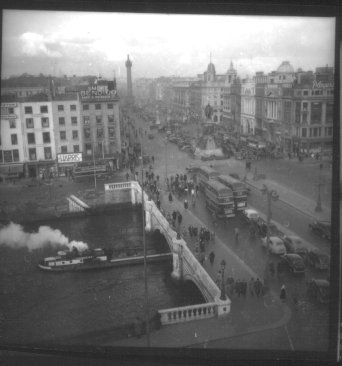
I think my favourite image in the collection is this one below, showing two once familiar Dublin sights. While Horatio Nelson looks down towards the O’Connell Bridge, a Guinness barge passes under it!

George Pickow Image Collection (NUIG)

George Pickow Image Collection (NUIG)

Read Full Post »

Acclaimed novelist Joseph O’Connor, from Glenageary in Dublin, who won international  recognition with ‘Star of the Sea’ (2002) and ‘Redemption Falls’ (2006) wrote a special poem for Philip Chevron’s testimonial on 24 August.

I doubt that many people know that Joseph O’Connor’s first non-fiction book (and second book published) was a biography of the Tyrone Republican Socialist and poet Charles Donnelly who was killed in the defence of the Spanish Republic with the International Brigades. It was based on his MA thesis, for which he was awarded a First Class Honours, in Anglo-Irish Literature at UCD. He completed this Masters after returning from a five month trip to Nicaragua where he had reported on the aftermath of the Sandinista revolution for various Dublin publications. ‘Even the Olives are Bleeding – the life and times of Charles Donnelly’ was published by New Island Books in 1992.

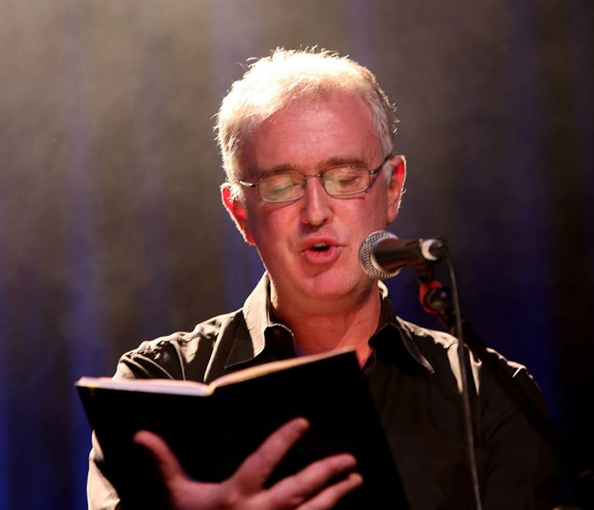
Novelist Joseph O'Connor at Philip Chevron's testimonial. Credit - theradiators.tv

Novelist Joseph O’Connor at Philip Chevron’s testimonial. Credit – theradiators.tv

Here is the text of the beautiful poem that Joesph wrote for Philip.
Note: It can’t be reproduced further without his permission.

A BRIDGE FOR PHILIP CHEVRON

On his sixteenth Christmas Eve, a boy in wintry Dublin
Bought an album he’d heard on a pirate-station show.
‘TV Tube Heart’. Maybe you know it.
As he took the bus homeward the streets filled with snow
And late that night, alone in his room
He played those songs over and the world burst alive
In the voice of a city on the cold Irish Sea.
Passionate. Eloquent. Longing to be free.

THUNDER in the drumming and the punk rock guitars
Like Molly Malone meets the Spiders from Mars.
Lyrics with a BLAZE and a beauty hard and fine
From a poet. And a Dubliner. Name of Philip Ryan.
CHEVRON they called him. Cool as a knife.
Smoothest Irish writer ever seen in your life.
SPARKIN images together till they scorched off the paper.
NO ONE told a story like that Chevron shaper.

Martyrs on the banknotes. Liars on the box
Killers on the altar rails, shadows on the docks.
Pearse on his pedestal, still dreamin’ a dream.
He’d like to stick a Telecaster
Through the television screen.

Then Brother Brophy caught me outside a the class
Listenin to Philip when I shoulda been at Mass.
Big stew-eatin’ bollocks from Upper Drumcondra
And he’s not a huge admirer of the….punk rock…genre
Says Wheredjathinkyou’rgoinWiththatlookuponyerface
Whothehelldjethinkyeare?
I said:
A Radiator.
From Space.

Well his eyes are kinda flashin and his lips are turnin blue
Says Get in there to Confession or I’ll radiator YOU.
Father O’Reilly says Bless you, my child,
And how long has it been since you last…reconciled?
I said, Bless me, Father, been nearly a year.
See….I got the ticket and the bus stops here.

You see, I saw you there, Philip,
In hushed Dublin streets,
Walking at dawn past a shuttered store
Or pausing a moment to look at the statues
Of Wilde. Larkin. Joyce. Thomas Moore.
Grey gulls above Christchurch
The old city sleeping
McGonagles closed and a rumour of snow
And there’s little to hear but the dawn alleluia
Of a garda-car siren down Portland Row.

Your mind raining melodies, nighttowns of humour,
Cabaret, greasepaint, heart-aching wrong,
Your heroes, inconvenient people in corners,
People that rarely get put in a song.
Early-house ghosts in the hunger of morning
Five-o-clock shadowmen shook by the fates,
Huers and bogeymen waiting for openings.
People unnoticed by cold eyed Yeats.

I saw you there, Philip, walking lost Dublin theatres.
Brunswick Street, Francis Street, down towards the Coombe,
City of actors, in all of her vagaries,
Wandering back to her lonely room,
Loving her streelings and early-hour homecomings
The LASH of her wit and her dirtyfaced talk
You and the spirit of Micheal MacLiammoir
Talkin of Bowie
On Bachelor’s Walk.

I saw you there, Philip, drifting past Trinity,
Cobbles of history moistened by mist
Head full of powerchords, thunderstorm images
Lovers you kissed.
Your shy smile by Bewleys.
Your handshake to Duke Street
Some evening when August had glittered the town.
The windows all shining in glorious cadence
With your stubblecheek grin and your beautiful frown.

You pause on the bridges
Named for our poets.
I saw you there, Philip.
You always knew –
A song is a bridge on
Uncrossable rivers.
I saw you there, Philip.
This bridge is for you –

And the thousands gone sailing
While Kitty Ricketts weeps.
‘Cross the street from Clery’s clock
The G.P.O. sleeps.
Johnny Jukebox in the Ghosttown
Still paintin up his lips.
‘Stranger than fiction,’
Sighed the girls in the kips.
Thank you, Philip Chevron.
I’ll sing no more.
Million dollar hero
In a five and ten cent store.

© Joseph O’Connor, August 2013

The one and only Philip Chevron at his testimonial in the Olympia last month

The one and only Philip Chevron at his testimonial in the Olympia last month Credit – Daragh Owens from theradiators.tv

Read Full Post »

Earlier tonight I was on Monday Night Soccer (RTE) discussing the Ringsend Riot in 1913 with Tony O’Donoghue. ANU productions also featured with their Dublin Tenement Experience scene dealing with the clash included. Larkin’s paper the Irish Worker denounced two footballers as scabs (Jack Millar and Jack Lowry, both appearing to be pseudonyms) and there was trouble in Ringsend when locked-out workers attempted to prevent a football match from taking place. This story featured recently on Newstalk, and thankfully with the centenary here at last this forgotten part of the story has been given plenty of attention. Our article is available to read here.

Read Full Post »

In February 1918, thousands of Dubliners celebrated the Russian Revolution at a packed meeting in the Mansion House. Indeed, the attendance was so great that it spilled out of the Mansion House, with many more filling parts of Dawson Street, with an attendance of up to 10,000 people.

Some of the most interesting characters of the time, such as Maud Gonne, Countess Markievicz and others spoke, and ‘The Red Flag’ was sung with gusto. The song, which has become something of a socialist anthem, was written by Irishman Jim Connell in 1889. Jim Connell was awarded the Red Star Medal by Vladimir Lenin in 1922, which gives an indication of the importance of the song to the socialist movement. While much has been written of anti-communism and anti-socialism in early twentieth century Ireland, this incredibly well-attended meeting is largely forgotten. The meeting was chaired by William X. O’Brien, who had been instrumental in the trade union movement during the Lockout of 1913.

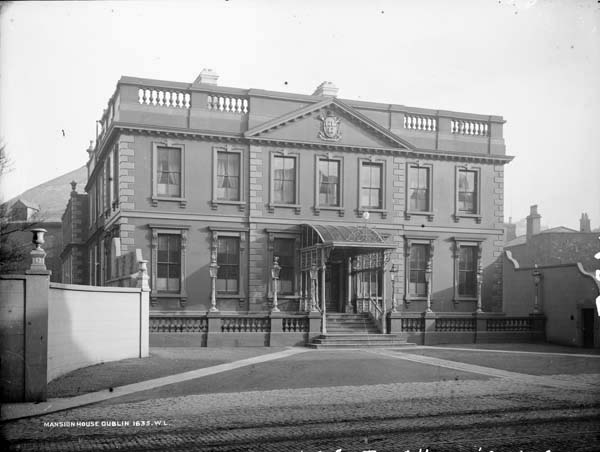
A historic image of the Mansion House (French Collection, National Library of Ireland)

A historic image of the Mansion House (French Collection, National Library of Ireland)

The meeting took place on 4 February 1918, and the Irish Independent proclaimed the following day that:

The scene in the Round Room was an extraordinary one. The passage up the centre of the spacious and crowded floor was occupied by a dense body of men standing. Near the front of this body was borne aloft a red flag, and during an interval in proceedings, while a collection was being taken up, the song ‘The Red Flag’ was sung.

A resolution was passed at this meeting that was put forward by Cathal O’Shannon, with newspaper reports noting that it expressed that the “people of Dublin were at one with the Bolsheviks”, and “maintaining that the Russian interpretation of the democratic principle was the only one that would be acceptable to the people of Ireland.” O’Shannon, from Antrim, was a trade unionist and republican who had spent time in Richmond Barracks, Frongoch and Reading jail in the aftermath of the Easter Rising, despite not seeing action during the rebellion. There were several other republicans who had either fought in the Rising or been interned in its aftermath at this meeting, including Dr. Kathleen Lynn of the Irish Citizen Army, who stated that some people were shy to acclaim the Russian revolution for fear of being labelled anti-clerical. Lynn was a tireless campaigner for the poor of Dublin and the medical well-being of children, and established the Saint Ultan’s Hospital for Infants in 1919.

The media noted that some Russian Bolsheviks were on the platform at this meeting, alongside leading lights of the trade union movement. Thomas Johnston of the Labour Party proclaimed that “the cry for bread was at the bottom of all successful revolutions”, to loud applause.

Dr. Kathleen Lynn, shown her with Madeline ffrench Mullen.

Dr. Kathleen Lynn, shown here with Madeline ffrench Mullen.


Patrick Coates also spoke at this meeting, describing himself as a revolutionary socialist, he drew a huge cheer by noting that he wasn’t sure if this was the first time ‘The Red Flag’ had been sung in the Mansion House, but that “it would not be the last.” He later stated that when Ireland received her liberty the people would transform the Viceregal Lodge into the headquarters of the Transport Workers’ Union!

Countess Markievicz rose to offer congratulations to the Bolsheviks “on behalf of the Irish Citizen Army”, and in the aftermath of this meeting thousands would march through the city of Dublin, though interestingly there were no reports of any confrontation between this demonstration of solidarity with the Russian revolution and anti-socialist elements.

Only weeks after the meeting, The Irish Times warned that Bolshevism was creeping into Ireland, noting that:

They have invaded Ireland, and if the democracies do not keep their heads, they may extend to other countries in Europe. The infection of Ireland by the anarchy of Bolshevism is one of those phenomena which, though almost incredible to reason and experience, are made intelligible by the accidents of fortune and human folly.

Read Full Post »

This is the third post on the website looking at cartoons printed in the Sunday Independent during the course of the 1913 Lockout. Part 1 can be read here, while the follow-up post is here.

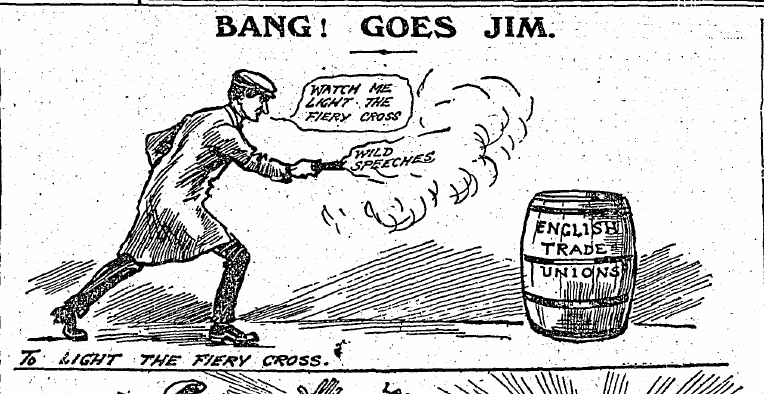
The cartoonist often poked fun at Jim Larkin’s expense, especially as the dispute dragged on, and this cartoon shows him and William O’Brien, another leading trade unionist of the day. Larkin would go to England during the dispute to drum up support among the English workers and trade union leadership, referring to this as the Firey Cross campaign. The mission was to instigate solidarity strikes in Britain which could be of assistance to the cause of the Dublin workers, but Larkin failed in this task. Here we see a match, representing the English union movement, with Larkin bemoaning the fact “it will only strike on its own box”.

23 November 1913. Sunday Independent.

23 November 1913. Sunday Independent.

Larkin’s attempt to ‘light’ the Firey Cross was ridiculed the following week once more. Larkin was shown firing at a barrel, which in another cartoon below was shown to explode with ‘trade union snubs’ and ‘hostile public opinion’ and the like. Mocking Jim, the paper noted on its frontpage that Larkin was a “Liberty Hall autocrat” who was “looking for trouble” in England.

30 November 1913 (Sunday Independent)

30 November 1913. Sunday Independent.

One cartoon which did not feature in either post to date and really should have is this powerful image, showing a Catholic priest rescuing a child from ‘socialism’.

26 October 1913. Sunday Independent.

26 October 1913. Sunday Independent.

The cartoon is a reference to the Save the Kiddies campaign, essentially an attempt to send the children of locked out workers to England during the labour conflict. The intervention of the church in this dispute was reprehensible, physically preventing working class children from leaving the city. The attitude of the church hierarchy was captured best in a letter from Archbishop Walsh to the media in which he targeted the mothers of the children and claimed

.

I can only put it to them that they can be no longer held worthy of the name of Catholic mothers if they so far forget that duty as to send away their children to be cared for in a strange land, without security of any kind that those to whom the poor children are to be handed over are Catholics, or, indeed, are persons of any faith at all.

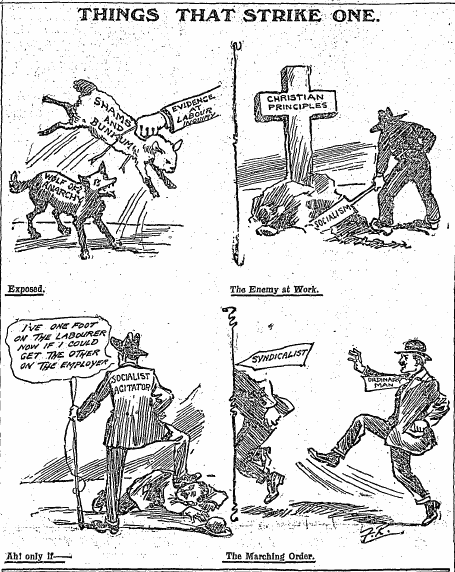
This series of cartoons featured on the front page of the Sindo on 5 October 1913. ‘Socialism’ is shown burying ‘Christian Principles’, while the ‘Ordinary Man’ is showing telling the ‘Syndicalist’ where to go. Both of these were common themes in the Indo cartoons, the idea that socialism was somehow anti-Catholic or anti-Irish, and the idea that the ‘ordinary people’ of Dublin would be the ones to ultimately tell Larkin and his followers they were not wanted.

5 October 1913. Sunday Independent.

5 October 1913. Sunday Independent.

On 19 October, this series of cartoons appeared. One shows the ‘Sympathetic Strike’ represented in the form of a hot air balloon. This tactic was central to Larkin’s political ideas, and involved bringing out workers not directly involved in a dispute in solidarity with those who were. It is clear Murphy’s paper believed that the lockout was breaking this tactic and Larkinism in general. The bottom right cartoon gives some commentary on the housing crisis, insisting that “a helping hand” was needed to provide better housing for the working class. The horrific Church Street collapse in September 1913 ensured housing was a topic on the lips and minds of many in the last four months of 1913.

19 October 1913. Sunday Independent.

19 October 1913. Sunday Independent.

Read Full Post »

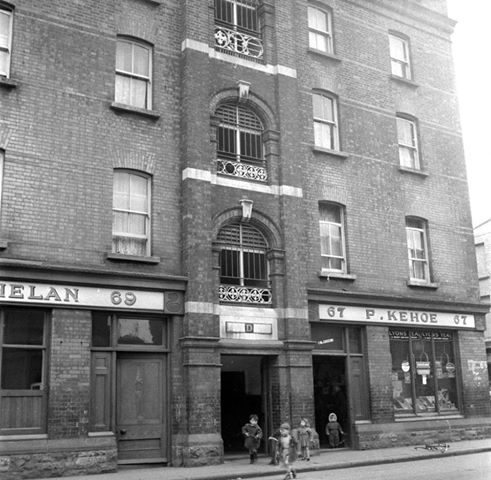
A historic image of Benburb Street (Via 'Dublin Tenement LIFE')

A historic image of Benburb Street (Via ‘Dublin Tenement LIFE’)

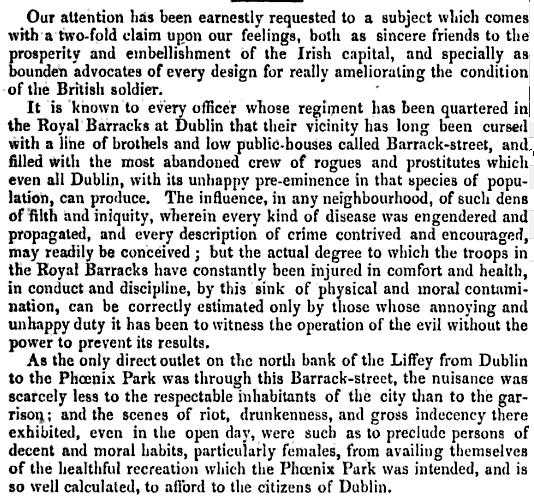
Recently while researching tenement Dublin and the history of prostitution in Dublin, I stumbled across an 1837 publication The United Service Journal. Speaking about the area around the Royal Barracks in Dublin, the publication noted that “scenes of riot, drunkenness and gross indecency” were common place, and that the area was home to many prostitutes but lacking in “persons of decent and moral habits” . Royal Barracks is Collins Barracks today of course, and Barrack Street has since been renamed Benburb Street.

Benburb Street was the location for the first Dublin Corporation housing scheme in the late nineteenth century. Shortly afterwards, the Corporation also constructed public housing on Montgomery Street, in the heart of what was known as ‘The Monto’. By attempting to keep public housing cheap, the Corporation ended up constructing homes in areas with long standing social problems. I’ve long had a personal interest in Benburb Street as my great-grandmother lived in a tenement on that street, and in-time we will look in detail at the first Corporation housing schemes in Dublin on the website.

Here is the extract:

Excerpt from 1837 publication.

Excerpt from 1837 publication.

The publication is available to read here.

Read Full Post »

« Newer Posts - Older Posts »