Feeds:
Posts
Comments

Archive for September, 2016

I was delighted to be asked to give a brief talk last night in Drumcondra Library on the life of Seán Connolly, the first rebel fatality of the 1916 Rising in Dublin. This talk was part of the Dublin Festival of History, which is a Dublin City Council initiative that grows with each year. While there are large events in the Printworks venue at Dublin Castle, there is also a full calendar of talks in DCC libraries.

Seán Connolly (1882-1916) was a trade unionist and cultural nationalist who was heavily involved in the language, theatre and sporting movements of the early twentieth century. Gary Holohan, a leading member of the republican scout movement Na Fianna, recalled that “the Connolly’s were the first Irish-Ireland family I ever knew.” Seán O’Casey, who also entered radical politics through the cultural movements around it, remembered the first time he met Connolly, as “in the lapel of the coat he wore a button badge, having on it a Celtic cross with the words The Gaelic League over it.”

From a family of committed Larkinites, some of Sean’s siblings were later central to the reorganising of the Citizen Army after Easter Week, with his brother Joseph holding the rank of Captain in the ICA until 1923.

I want to express my thanks to those who traveled to the talk last night with this unique banner, loaned by Catriona and John Malone. From 1918, the banner was produced for a local Cumann of the Sinn Féin party in Naas. It was made by Elizabeth Garry (nee Cahill) of Poplar Square in Naas, and looks remarkably well after 98 years:

seanconnollybanner

1918 banner for Naas Cumann of Sinn Féin, dedicated to the memory of Sean Connolly. (Drumcondra Library,29 September 2016)

While the Connolly family home was on Gloucester Street (now Seán MacDermott Street) in Dublin’s north inner-city, the roots of the family were in Kildare, which may well explain the decision to name a Sinn Féin Cumann there in his honour. The family had a tradition in radical politics that stretched back to the days of the Land League, when the family were evicted from their land at Straffan. Seán’s grandmother, Eileen Connolly, was evicted for subscribing to the Land League funds, something that the landlord took exception to.

Produced just two short years after the Rising, the banner shows that some of those who died in the fighting in Dublin were already taking on enormous symbolic importance. Seeing such a piece of history up close also makes you wonder how many gems like it are hiding in attics!


Read Full Post »

Introduction

Konrad Peterson/Konrāds Pētersons (1888-1981) was a Latvian-born revolutionary, socialist and civil engineer who lived for most of his life in his adopted home of Ireland.

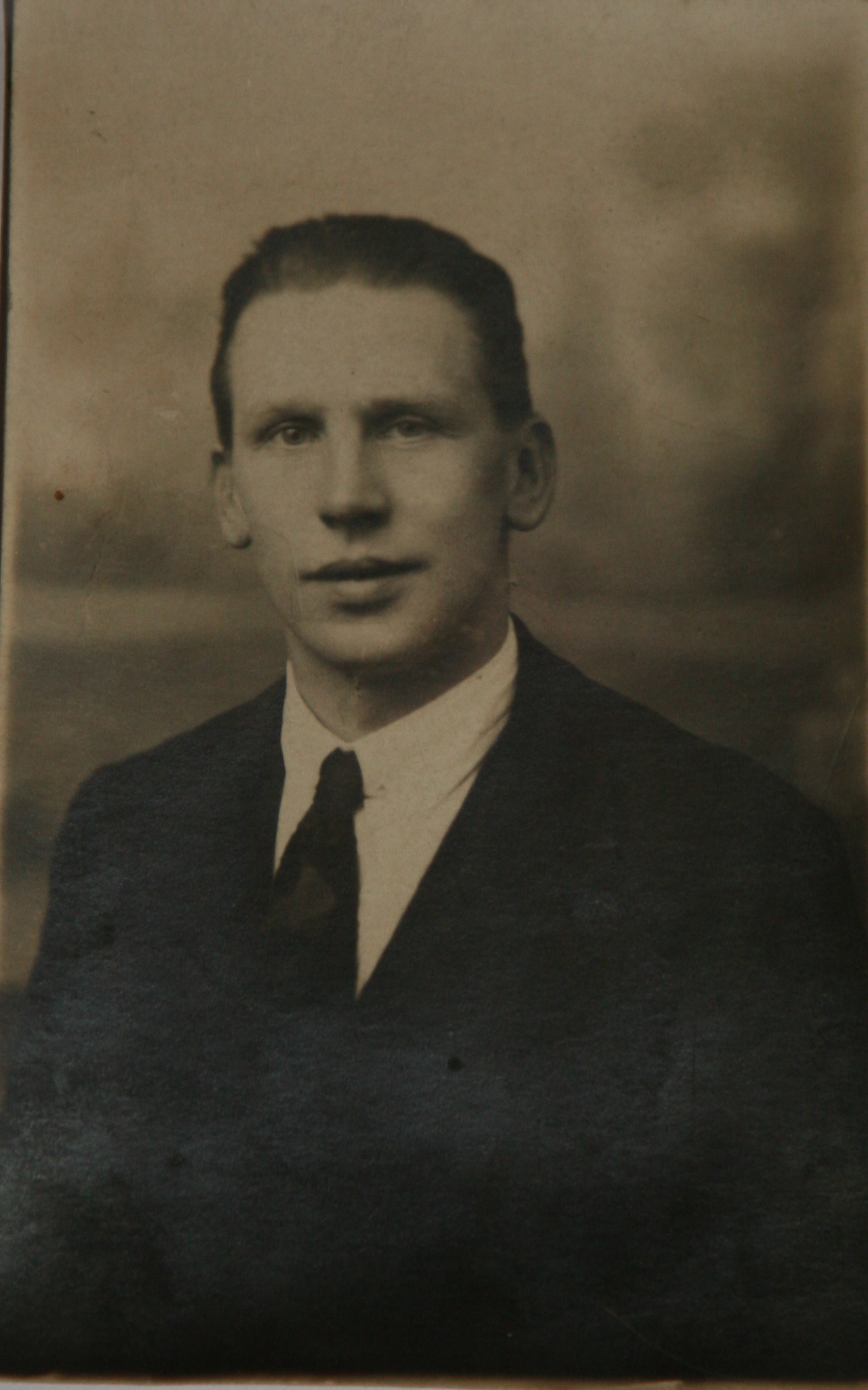
Conrad in Dublin, ca. late 1910s. Konrad in Riga, Latvia pictured soon after his return from Dublin, c. 1919. Credit : Brady Family via Sandra Bondarevska.

Konrad in Dublin, ca. late 1910s. Credit : Brady Collection via Sandra Bondarevska.

At the age of only 17, he participated in the Russian Revolution of 1905. Forced to flee to Dublin in its aftermath, he was active in socialist and Irish Republican politics in Dublin during his time living in the city from 1906 to 1919. Returning home to a newly declared independent Latvia, he was witness to the Nazi and Russian invasions of his home city during the Second World War. He returned to Ireland in the mid-1940s to work with Bord na Móna and lived in Athy, County Kildare where he died in his 90s.

Peterson’s story is a fascinating one that has largely been forgotten. Especially in labour history and republican circles in Dublin. Sandra Bondarevska within the Latvian community and local Athy historian Frank Taaffe has done much to help ensure his memory hasn’t been totally neglected.

Note: his first name is sometimes spelt ‘Conrad’ and his surname ‘Petersen’. For the purpose of continuity, I will spell it as Konrad Peterson which is the most commonly used form and the spelling which is on his grave.

Early life (1888-1905):

Peterson was born in Riga in the Russian Empire (now Latvia) on 15th October 1888. He studied at Tilo (Tilava) primary school and then at the Mangali Maritime school from which he was expelled for refusing to speak only Russian.

According to nekropole.info, his father ran a tavern in the suburb of Zasulauks outside Riga city.

Sandra Bondarevska in an unpublished history article states that Konrad had been been a member of Revolutionary movement in Latvia from a young age and had “had close ties with the famous social democrat and renowned poet Rainis, who had emigrated to Switzerland with his wife Aspazija after the events of 1905.”

During the 1905 Russian Revolution, it is believed that Konrad participated in two major events in Riga. The first was the 10,000 strong workers demonstration on 13th January in protest at the Bloody Sunday massacre. Three days earlier in St Petersburg, Russia, over 1,000 unarmed demonstrators were shot dead by soldiers of the Imperial Guard as they marched towards the Winter Palace to present a petition to Tsar Nicholas II of Russia.

In September 1905, Peterson was involved in the daring raid of Riga Central prison which involved the rescue of two imprisoned comrades. His involvement is in the revolutionary movement is covered in Fēlikss Cielēns memoir ‘Laikmetu main̦ā’.

John Langins (History of Science professor, University of Toronto) met Peterson in later life and retold in his memoirs how:

Conrad took part in the bloody demonstration in January. Jumping over the wall, one Kazaks tried to spear him (in the) the bottom but (the) spear (went through his) thick coat out the back.. (Konrad was) later was an active combatant in Riga and in the countryside. These revolutionary instincts remained with Conrad (his whole) lifetime.

In wake of the brutal repression following the revolution, Peterson was smuggled out of Riga in December in a cargo ship and traveled to Ireland via Scotland where he had family.

Langins memoirs elaborates how:

Konrad fled from the terror of the Tsar. (He) hid (in a) ship that traveled to Scotland with a few comrades. Some were concealed (amongst) potatoes and some Linos. Those (in) potatoes (were) found, and right there on the ship (were) shot, but those who had Linos, was moved to one (friendly) small cabin, where they spent several days and nights in meetings, motionless on one bed … When (they) jumped down from the board in Scotland, they almost could not walk and was accepted as heroes of the English trade unions.

Dublin (1906-1919):

Arriving in Dublin about 1906, he moved in with his uncle Charles Peterson, of the well-known pipe firm Kapp & Peterson, who lived on Leinster Road, Rathmines.

He was enrolled at Padraig Pearse’s famous school St. Enda’s in Rathfarnham. In the year 1908-1909, he is listed as being a pupil in Fourth Class, Division II.

Peterson would have been about 20 years of age in 1908 (!) but as he had only been in Ireland for two years, with presumably little or no English, it makes sense that he would be in a class for much younger children.

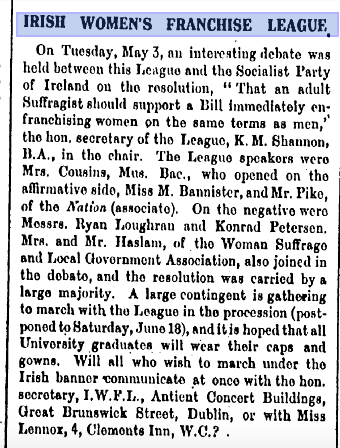
His english much have improved greatly as on 3rd May 1910, he is listed as taking part in a debate between the Irish Women’s Franchise League and the Socialist Party of Ireland.  The resolution was “That an adult Suffragist should support a Bill immediately enfranchising women on the same terms of men”. Speaking in favour were Mrs. Cousins, Mrs. Bac, Miss B. Bannister and Mr. Pike of The Nation newspaper. Speaking against were Mr. Ryan Loughran and ‘Konrad Petersen’. Presumably both were representing the Socialist Party of Ireland.

Whether Peterson actually believed in that viewpoint or was speaking against for argument’s sake is unknown.

Newspaper 'Votes For Women', 6 May 1910.

Newspaper ‘Votes For Women’, 6 May 1910.

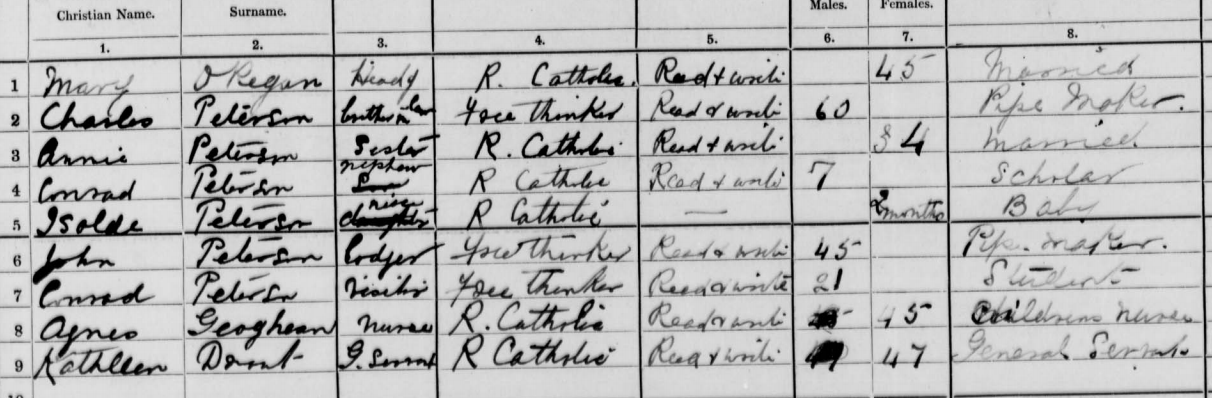
In the 1911 census, the Peterson family were living at 114 Leinster Road, Rathmines, Dublin 6. Konrad, aged 21, was listed as a scholar. He listed his religion as a “Free Thinker” as did his uncles Charles (60) and John (45), both pipe-makers. Charle’s wife was a Dublin-born Catholic called Annie Peterson (nee Forde).
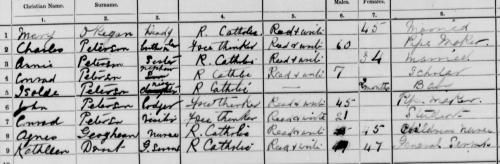
Peterson family. 1911 census return, 144 Leinster Road. Via census.nationalarchives.ie

Peterson family. 1911 census return, 144 Leinster Road. Via census.nationalarchives.ie

The Peterson family home was just a few minutes walk from ‘Surrey House’ at 49b Leinster Road, Rathmines. This was the home of Constance Markievicz and a hotbed of revolutionary activity. Markievicz became friendly with Konrad and his uncle Charles.

Around this time, he enrolled as a Engineering student at the Royal College of Science for Ireland (RCScI). This college later absorbed into University College Dublin (UCD) as the faculty of Science and Engineering.

Peterson continued his activity with the Socialist Party of Ireland and the milleu surround it. In 1911 he offered his advice and help to Irish Republicans organising protests against the visit of King George V and Queen Mary to Dublin. In her Witness Statement (No. 909) to the Bureau of Military History, Sidney Czira (aka ‘John Brennan’) recalled:

It was suggested to us by Conrad Peterson who was a student in the College of Science and who had some experience of shock tactics in Czarist Russia – he was from Riga – that we should adopt the methods used by demonstrators in Russia i.e. fold all the leaflets in two and catching them by the corner, fling them into air if we saw the police approaching. They would fan about the crowd and be picked up.

Sidney Czira (nee Gifford) was an officer of Cumann na mBan in Dublin and sister of Grace Gifford, the widow of Joseph M. Plunkett who was executed after the Rising.

He was certainly active in labour politics in Dublin in 1913 but it is not known to what extent he participated in the turbulent events of the Lockout.

In this wonderful picture from around 1913 published in Fearghal McGarry’s book ‘The Abbey Rebels of 1916: A Lost Revolution‘ you can see Konrad Peterson, Constance Markievicz, Helena Molony, Michael Gorman and George Doran dressed in costume for a performance or fancy dress party.
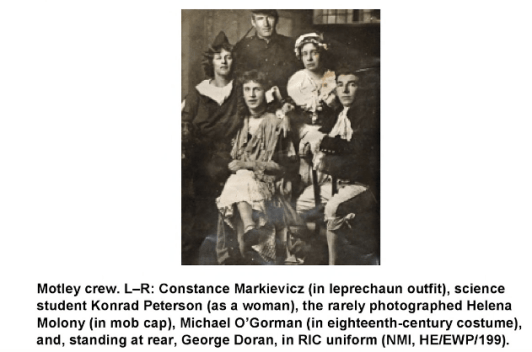
Peterson pictured in c. 1913. Fearghal McGarry, The Abbey Rebels of 1916: A Lost Revolution (Gill & Macmillan, 2015)

Peterson pictured in c. 1913. Fearghal McGarry, The Abbey Rebels of 1916: A Lost Revolution (Gill & Macmillan, 2015)

C.S. Andrews wrote that during this time Peterson:

formed close links with many of the literary and theatrical figures of Dublin … including, in particular, the famous Daisy Bannard and the man who she afterwards married, the Republican journalist Fred Cogley (‘Man of No Property, p. 188).

Peterson graduated in 1913 with an Engineering degree from the College of Scienc . Afterwards, as retold in CS Andrew’s book ‘Man of No Property’ (p. 188), he worked on a number of engineering projects. These included a survey, carried out by a group of private entrepreneurs before the First World War, into the possibility of harnessing the Shannon for Electricity Production. The project came to nothing and the idea remained dormant until revived by Dr. TA. McLaughlin in the 1920s.

On May 4th 1915, he was granted naturalisation by the British government. He was listed as ‘Konrad Peterson, from Russia. Resident in Rathmines, Co. Dublin’.

Around this time he married Helen Yeates from Dublin. From the process of elimination, I believe this is our Helen Yeates, born 9th February 1893 to Joseph and Bridget Yeates living at 10 Beresford Place. By 1911, eighteen-year old Helen was living at 107.1 Amiens Street.

Peterson was living and working in Dublin during the 1916 Easter Rising and was friends with many of its leading personalities including Connolly and Marchievicz. According to The Irish Press (24 May 1951), Peterson “helped in the organisation of communications for the Rising”. But there is no more reliable sources or references to back up claims he took an active part during Easter Week.

Many will know the story of the Finn and Swede who fought in the GPO making references to Russian and British imperialism. Interestingly, there is also some evidence to suggest that a handful of Russian revolutionaries may have visited Dublin in the immediate aftermath of the Rising.

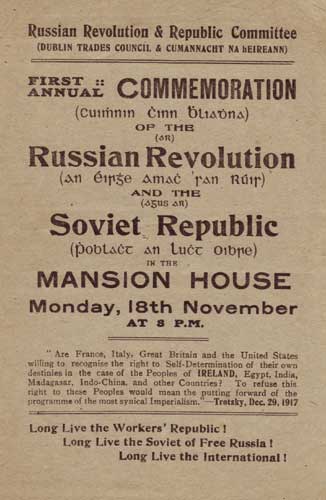
In February 1918, Peterson was present at large meeting that took place at the Mansion House to celebrate the Russian Revolution. The Irish Times (9th February 1918), reported that those present wished “to congratulate the Russian people on the triumph they have won for democratic principles“. During the proceedings, “The Red Flag” was sung and red and republican flags were waved.

Flyer for 1918 event in the Mansion House. Credit - http://www.whytes.ie/.

Flyer for another 1918 event in the Mansion House. Credit – http://www.whytes.ie/.

The Irish Independent (5th February 1918) wrote:

Mr. Conrad Peterson who announced himself as a Russian Social Democrat spoke strongly in support of “the great struggle for peace, liberty and bread”.

Those present also included Cathal O’Shannon, Dr. Kathleen Lynn, Countess Marchievicz and Mrs. (Maud) Gonne-McBride.

In June 1919, Peterson was listed as a committee member of the ‘James Connolly Birthday Celebration’ in the Mansion House. Tickets were one shilling and all proceeds were to be devoted to the establishment of a ‘Connolly Memorial Worker’s College’.
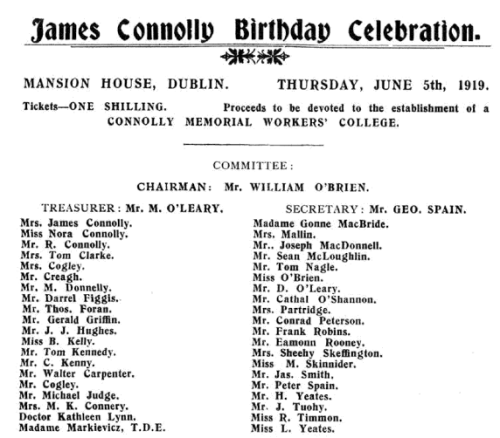
Republished in 'Songs of Freedom: The James Connolly Songbook' (PM Press, 2013), page 33.

Peterson listed second row in the middle. Republished in ‘Songs of Freedom: The James Connolly Songbook’ (PM Press, 2013), page 33.

(more…)

Read Full Post »

A 1985 edition of Inner City Magazine containing two advertisements, one photograph and two reviews of Dublin pubs.

imag0372

Front cover of Inner City Magazine (Vol. 3 / No. 19, 1985)

The first advertisement is for The Sunset House at 1 Summerhill Parade in Ballybough. It shows two older woman named Ellen and Carmel enjoying a glass of Guinness. The pub was the scene of a fatal shooting in April 2016 and closed down. It was recently taken over by Paul Gannon, the brother of Social Democrats councillor Gary, and re-opened as The Brendan Behan.

imag0371

Advertisement for The Sunset House

The second advertisement is for the Hill 16 bar at 28 Gardiner Street.  Offering “best drinks – pub grub”, it shows a barman pulling pints behind the counter.

imag0370

Advertisement for the Hill 16 Bar

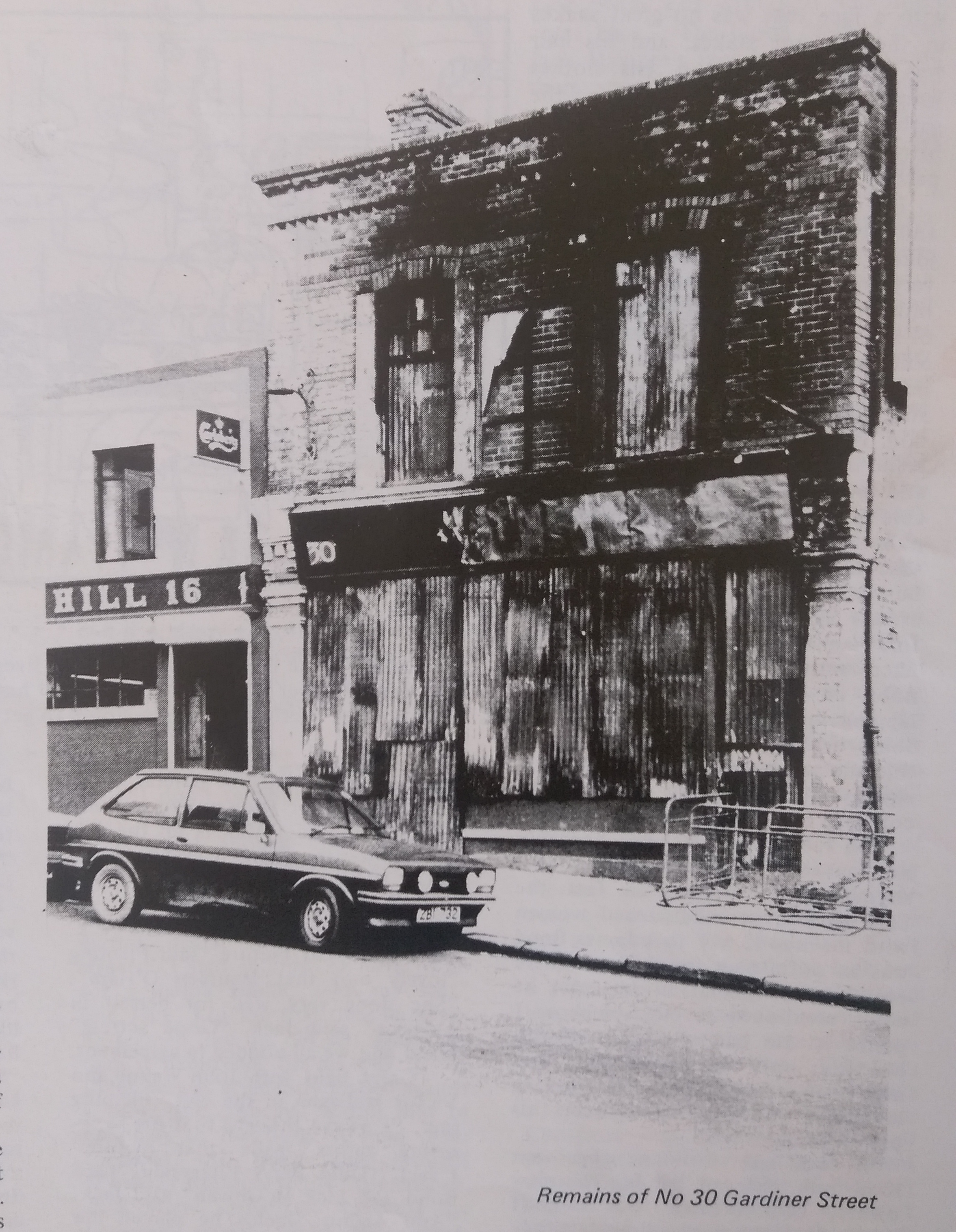
A photograph in the magazine shows a burnt out property immediately next door to the Hill 16.

imag0369

Photograph of Hill 16 beside burn out property.

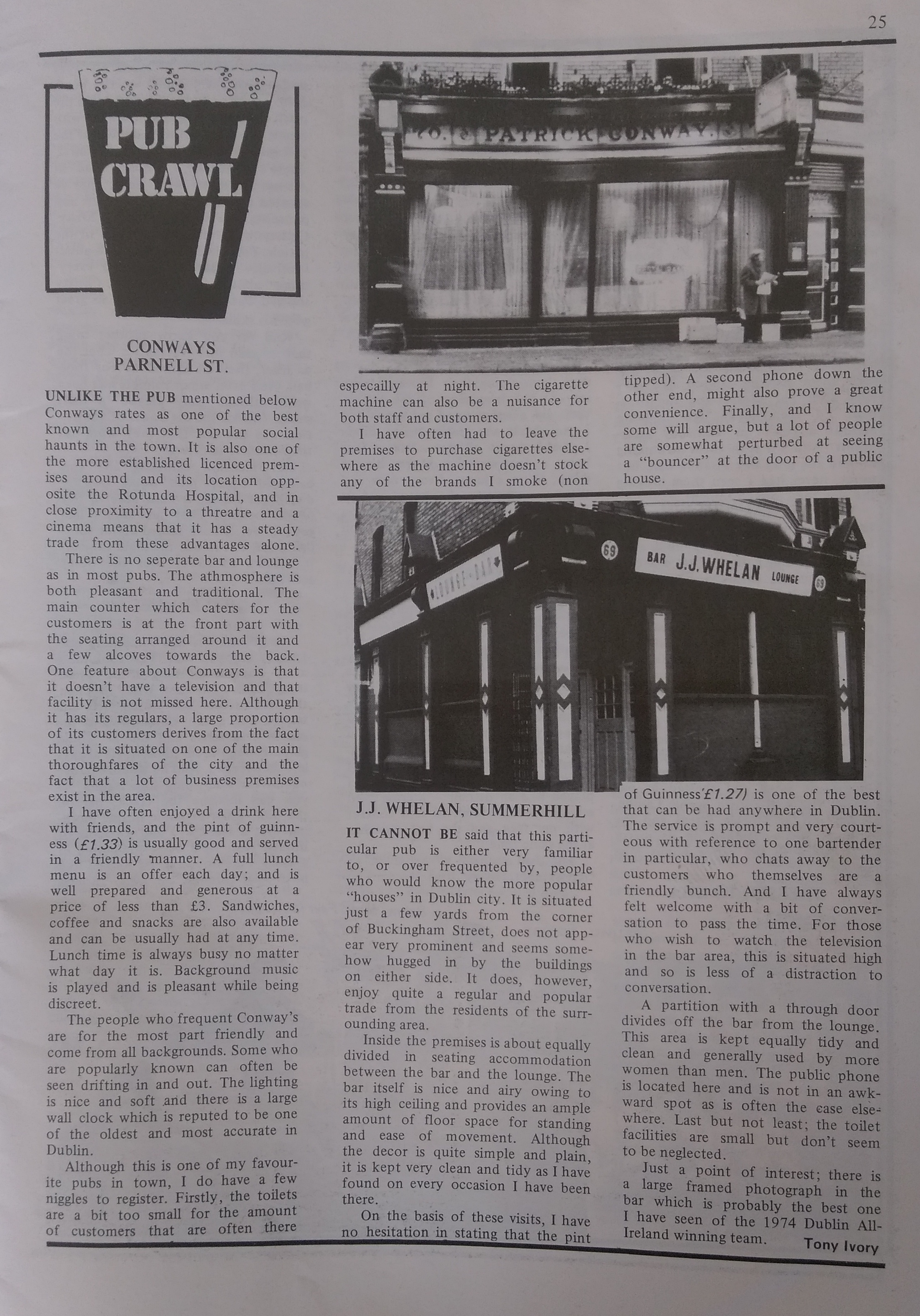
The issue also includes reviews by Tony Ivory of Patrick Conway’s at 70 Parnell Street, closed since February 2008, and J. J. Whelan’s at 69 Summerhill, which is currently known as ‘Cuchulainn’s at Croke Park‘.

Ivory described Conway’s as one of the “best known and most popular haunts” in the city centre. There is no television and the Guinness (£1.33 pint) is “usually good”. However, the writer did complain that the toilets were not sufficient for the amount of punters and the cigarette machine didn’t stock his favoured brands.

The review of J. J. Whelan’s focused on the high standard of the Guinness (£1.27 pint) which Ivory called “one of the best that can be had anywhere in Dublin”.

imag0368

Reviews of Conways, Parnell Street and J. J. Whelan’s in Summerhill

Read Full Post »
Ban the Bomb! (1961)

My thanks to @bigmonsterlove on Twitter for sending something my way recently, in the form of some brilliant archival footage just posted online by the Irish Film Institute.

A hugely important and much-loved institution in Temple Bar, the IFI are now bringing some of their archival holdings to the general public online with their new IFI Player. To start with, we have 1,200 minutes of material from the vaults (thankfully only about a minute of this involves Bob Geldof), including some footage from Gael Linn’s Amharc Éireann series.

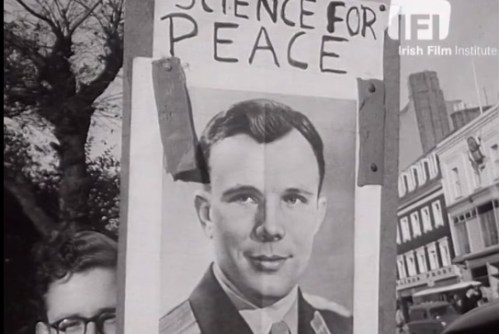
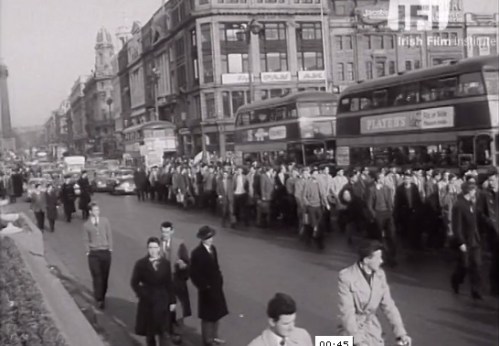
Amharc Éireann: Eagrán 126, Dublin Students Protest, available to view here, captures a 1961 anti-nuclear protest in Dublin city centre, led by students from Trinity College Dublin. The demonstration is small, but the footage is telling of its time, in terms of politics and fashion! Some students carry the now-iconic peace symbol of the Campaign for Nuclear Disarmament (CND), which had been born in 1958 in England, while others carry placards which reference the tragedy of Hiroshima. One student carries the image of Yuri Gugarin, a hero of the Soviet Union and the first man in space.

The march was a bit of a disaster, with The Irish Times reporting the next day that:

A peace march by some 200 placard-carrying members of the Irish students’ Campaign for Nuclear Disarmament in Dublin yesterday turned out to be anything but peaceful. The “ban the bomb” marchers were heckled by a rival group of students shouting “we want the bomb!”. Scuffles broke out between rival students and  were broken up by civic guards, and over-ripe tomatoes and bags of flour were showered on students and guards alike.

tumblr_mre9azrqnz1seji43o1_500

Still from footage: Science For Peace, placard shows Yuri Gagarin.

tumblr_mre9azRQNZ1seji43o1_500.jpg

Still from footage: Students march at Stephen’s Green, carrying the CND symbol.

tumblr_mre9azrqnz1seji43o1_500

Still from footage: Passing over the O’Connell Bridge, the Nelson Pillar in background.

The CND logo, so prominent in the footage, was designed  in 1958 by Gerald Holtom, a professional designer and artist. In explaining what the symbol means, Holtom recalled:

I was in despair. Deep despair. I drew myself: the representative of an individual in despair, with hands palm outstretched outwards and downwards in the manner of Goya’s peasant before the firing squad. I formalised the drawing into a line and put a circle round it.

As the CND themselves note, “the symbol continues to be used as shorthand for peace”.

Read Full Post »

The 1930s anti-jazz movement has been well-documented in recent years, with Cathal Brennan’s 2011 Irish Story article a particularly good read. The movement against jazz was by no means merely a Dublin phenomenon, indeed it was often strongest in rural Ireland. Brennan’s article notes:

On New Year’s Day 1934 over three thousand people from South Leitrim and surrounding areas marched through Mohill to begin the Anti – Jazz campaign. The procession was accompanied by five bands and the demonstrators carried banners inscribed with slogans such as ‘Down with Jazz’ and ‘Out with Paganism.’

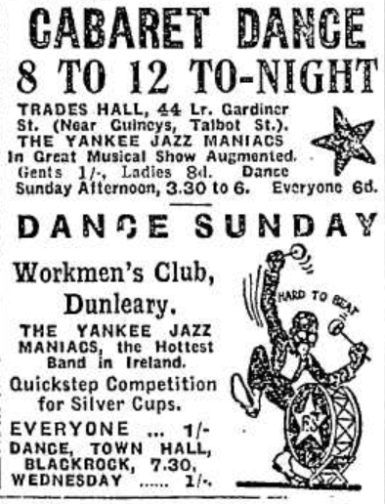
Only in the last few weeks, the Evening Herald has joined the long list of newspapers digitsed by the excellent and very important Irish Newspaper Archives. Being a tabloid publication, it is of a very difficult style to many of the previously digitised broadsheet newspapers, and throws up some real gems on cultural issues and moral panics. While there is much condemnation of jazz music and the danger of the dance halls, there are also some wonderful advertisements for jazz bands, including ‘The Yankee Jazz Maniacs’, described on more than one occasion as the “hottest band in Ireland.”From time to time, these advertisements could appear on or opposite pages denouncing jazz music!

YankeeJazz.png

Much of the discourse in the Ireland of the time around music, dance halls and jazz was shaped by the Public Dance Halls Act of 1935, introduced under the first Fianna Fáil government. That Act can only be viewed in the context of the moral panic against dance halls of the time, which was encouraged by the Catholic Hierarchy, cultural nationalists and some in the press. The Act sought to make provision for the licensing, control, and supervision of places used for public dancing. It was bad news for dance halls in the cities, but also for communal traditions like crossroads dances in rural Ireland. It could only have been introduced in a country where it was acceptable to peddle the kind of nonsense that “one of the immediate and chief causes of the immorality of recent times, involving particularly the unmarried mother, is the commercialised dance halls.”

The fear of jazz ‘infiltrating’ the dance halls of Dublin was present even at meetings of Dublin Corporation, with Lord Mayor Alfie Byrne on record in February 1934 as stating:

The Citizens of Dublin are not following the dances of negroes. I challenge you to go into any hotel or ballroom in the city and point out anything that could be described as following the negroes or indecent.It is a slander on the people of Dublin to say they are following the negroes, and nobody has any right to make that charge.

It was clear those condemning jazz and jazz dancing knew nothing about it, with the claim that the music was “borrowed from Central Africa by a gang of wealthy international Bolshevists in America, their aim being to strike at Christian civilisation throughout the world” even making its way into the papers.

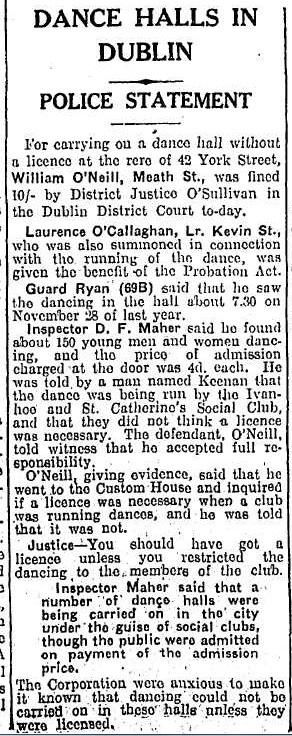
The raiding of dance halls under the terms of the ludicrous 1935 Act took up plenty of column inches; the Herald reported of a raid in January 1936 which resulted in the closing down of a dance involving 150 young men and women. Unsurprisingly, young people were more than willing to violate the terms of the Act and to seek something other than rigidly controlled social spaces:

yankeejazzmaniacs

Evening Herald, 27 January 1936.

A rare moment of sense in the debate around dance halls came from a letter writer to the paper in October 1940:

As a parent, may I be permitted to give my views on the dance problem? Dancing is one of the oldest of human pleasures…and telling young people that dancing is wrong is just inviting trouble. If you go further and prevent them from attending dances, you have only yourself to blame if they kick over the traces. I have never opposed my children going to dances. I trust to their good sense and it works out alright.

Read Full Post »

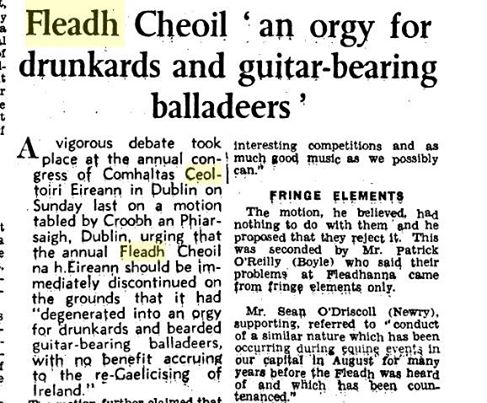
If you’re attending this years Electric Picnic festival, which runs from tomorrow to Sunday, consider dropping into the Mindfield area on Saturday at 1pm (if you can get yourself out of the tent) where I’m taking part in a History Ireland Hedge School discussion on the history of the Irish festival. We’ll be looking at O’Connell’s Monster Rallies (‘REPEAL’ was the slogan then too), the chaos of the Donnybrook Fair and the youthful enthusiasm of Carnsore Point among other talking points.

Fleadh.jpg

1964 press on the Fleadh Cheoil.

The discussion is, as ever, chaired by History Ireland editor Tommy Graham. The other panelists are Tonie Walsh (of the Irish Queer Archive), Naoise Nunn (the man behind the always interesting Mindfield area of EP), Carole Holohan (author of a forthcoming study of youth in 1960s Ireland) and musician and broadcaster Philip King.

It also seems fitting to highlight the fact several friends of the blog are performing at this years festival. Lynched, Skipper’s Alley, Costello and Stephen James Smith,  all of whom have performed at CHTM nights in The Sugar Club and elsewhere, will be performing across the weekend. Be sure to see some local talent along with the global superstars!

Read Full Post »