Feeds:
Posts
Comments

Archive for November, 2016

simms3

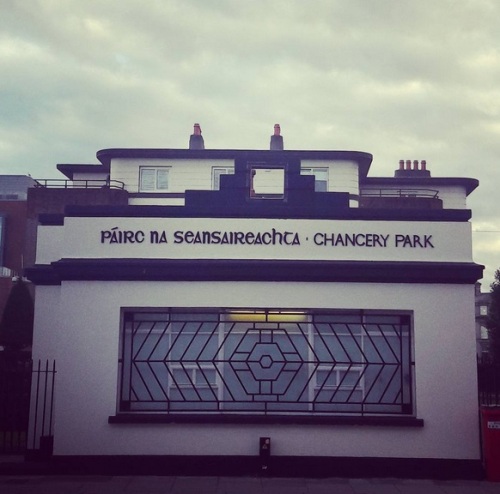
Chancery Park housing scheme, the work of Housing Architect Herbert Simms.

23 years after the birth of the Free State, a writer in the journal Studies complained that slumdom remained, and that the city was still home to “conditions which are often quite unsuitable for cattle,much less human beings.”

To Professor T.W.T Dillon, things were still dire and not getting better:

…the pattern of dirt, decay and discomfort is everywhere the same. The filthy yard with the unspeakable closet often choked, always foul-smelling,serving the needs of all the families in the house; the single tap,often situated in the basement or even in the foul-smelling yard; the cracked and crumbling walls and ceiling covered with scabrous peeling paper or blistered paint; the leaking roofs and rat-infested floors. There are differences in detail, but in general a drab and disgusting uniformity is unrelieved by any sign of human dignity.

Yet while there was much work still to do in 1945, the previous decade had witnessed some  significant changes and improvements, which we can still see in the urban landscape today.

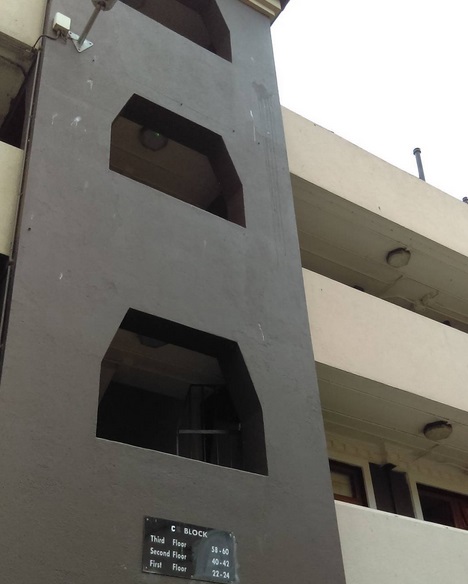
This year marks the 80th anniversary of the opening of the Oliver Bond House scheme at Usher Street and Cook Street. Just like the beautiful Chancery Park complex across the Liffey, it serves as a reminder of the remarkable architect Herbert Simms, who was to be “responsible for the design and erection of some 17,000 new homes” in his time as Housing Architect from 1932 to 1948. In recent years there has been a great resurgence of interest in Simms and his work, and public housing in Dublin more broadly speaking.
simms1

Detail of North Cumberland Street scheme, the work of Housing Architect Herbert Simms.

“Bread for the People” – The coming to power of Fianna Fáil and the issue of slumdom.

The 1932 General Election is primarily remembered for the cynical ‘red scare’ tactics of the out-going Cumann na nGaedheal government. Front page newspaper advertisements from the party warned that “The gunmen are voting for Fianna Fáil. The Communists are voting for Fianna Fáil.” One government publication warned that if de Valera’s party took control, “the extremist minority, as in Spain, as in Mexico, as in Russia, will get the upper hand.”

Fianna Fáil attempted to make the slums an election issue, promising increased public spending on housing. This was one contributing factor in Labour supporting the first Fianna Fáil government, with party leader Willie Norton declaring that “so far as the slum-dwellers are concerned, they need have no regret at the change of government, and the old-age pensioners have reason to be glad that the rich man’s government of the past ten years was not in office at the present time to further reduce them.”

Cumann na nGaedheal had, in truth, delivered some advances in public housing in Dublin. The Free State’s first attempt at public housing was in Marino, well-detailed here by Rhona McCord. The new state looked internationally for influence on occasion; as architectural historian Ellen Rowley has noted, “a collective of Dublin officials took a study tour to Amsterdam and Rotterdam in 1925 so as to examine the Dutch Expressionist housing by Michel de Klerk and Piet Kramer.”

On political platforms and stages, the slums became an issue. One Fianna Fáil candidate, Eamonn Cooney, declared at a 1932 election rally that “in the slum dwellings there would arise a new hope” if the party were elected to power. In Smithfield, a Cumann na nGaedheal candidate was heckled by Fianna Fáil supporters about the condition in local slums, attempting to deflect criticism by asking if people were prepared to see “the red flag flying” in Dublin.

Fianna Fáil’s policies undoubtedly owed more to populism than socialism, but as Brian Hanley has noted, the party did evoke the promise of the revolutionary period:

It talked about putting into practice the “ideas embodied in the Democratic Programme of the First Dáil” while de Valera claimed James Connolly as his major inspiration and promised to make “the resources and wealth of Ireland … subservient to the needs and welfare of the people”.

Furthermore, there would be more than simply political independence; Ireland would be “self-supporting economically”. Much mocked now, Fianna Fáil’s commitment to protectionism and native industrial development was fresh and radical in a state whose government seemed content to maintain itself as a giant beef ranch for the British market.

When Seán MacEntee read the first Fianna Fáil budget before the Dáil, he emphasised that this was a new approach to ruling. Now, there would be “bread for the people”. The poor were promised dignity, and that meant pulling down the slums.

simms2

Greek Street scheme, completed in 1936.

Throughout the decade, the slums of Dublin were spoken of  as hotbeds of vice and crime. To The Irish Times, the slums were “Dublin’s deepest shame and gravest peril”, and it was “almost a miracle that hitherto Communism has not flourished aggressively in that hideous soil.” In 1936, an Archdeacon Kelleher was reported as saying:

Slums could be called the breeding grounds of potential Communists. The fact that they are not producing the natural destructive effects of typical Communism is to be attributed, in my mind, to the fundamental Christian virtues of faith, charity and humility.

Horace O’Neill, the City Architect, went as far as to tell a 1935 meeting of the Old Dublin Society that “slums are barbarous. If I were born and lived in a slum and unemployed, I would be a revolutionist.”

Herbert George Simms:

The Londoner Herbert Simms entered the service of Dublin Corporation at the age of only 27, a veteran of the First World War who had served with the Royal Field Artillery. A scholarship received in the aftermath of the war allowed him to study architecture at Liverpool University,  and he was appointed temporary architect to Dublin Corporation in February 1925. Seven years later, and after a brief spell working as a planner in India, he was appointed to the position of Housing Architect for the Corporation. There was much work to do; Simms told one 1936 tribunal that “they were now trying to do in one generation what should have been done by the last four or five generations.”

(more…)

Read Full Post »

Introduction:

Thomas Farrelly (20), of 30 Mary’s Lane, was shot and killed by the British Army in Dublin’s North Inner City in August 1920. A neighbour Thomas Clarke (19), of 16 Green Street, was seriously wounded in the attack.

It occurred during a turbulent month within a turbulent year. On 7th August, an IRA Flying Column’s ambushed a six-man RIC foot patrol near Kildorrery, County Cork. Two days later, the Restoration of Order in Ireland Act received royal assent giving Dublin Castle the authority to replace the criminal courts with courts-martial and to replace coroners’ inquests with military courts of inquiry. On 12th August, Terence McSwiney, Lord Mayor of Cork was arrested and began his hunger strike.

Planned visit of Archbishop Mannix:

During the summer of 1920, the outspoken Cork-born Dr. Daniel Mannix (1864-1963), Archbishop of Melbourne was undergoing a tour of the United States. He shared a platform with Eamon de Valera at Madison Square Gardens in New York telling the audience of 15,000 people that Ireland should be given the “same status in postwar planning as the other small nations of Europe”.

He openly supported the actions and aims of those behind the Easter Rising proclaiming :

I am going to Ireland soon and I am going to kneel on the graves of those men who in Easter Week gave their lives for Ireland.

On 31st July 1920, he boarded the transatlantic liner Baltic at New York for his long journey to Queenstown (Cobh) in his home county of Cork. The ship had made it so close to the Irish coast by 8th August that Mannix could see the lights of Cobh and the flames of huge bonfires of welcome on the hilltops.

But the British government had other ideas and the ship was intercepted by the Royal Navy. Mannix was denied entry to Ireland, arrested and brought to Penzance, Cornwall. Padraig Yeates, in his brilliant book ‘A City in Turmoil‘, wrote that Mannix was prohibited from addressing any public meetings in any part of England with large Irish immigrant populations. He remarked with characteristic irony: “Not since the Battle of Jutland had the British Navy scored a victory comparable with the capture of the Archbishop of Melbourne without the loss of a single British sailor.”

A summer’s night in Dublin

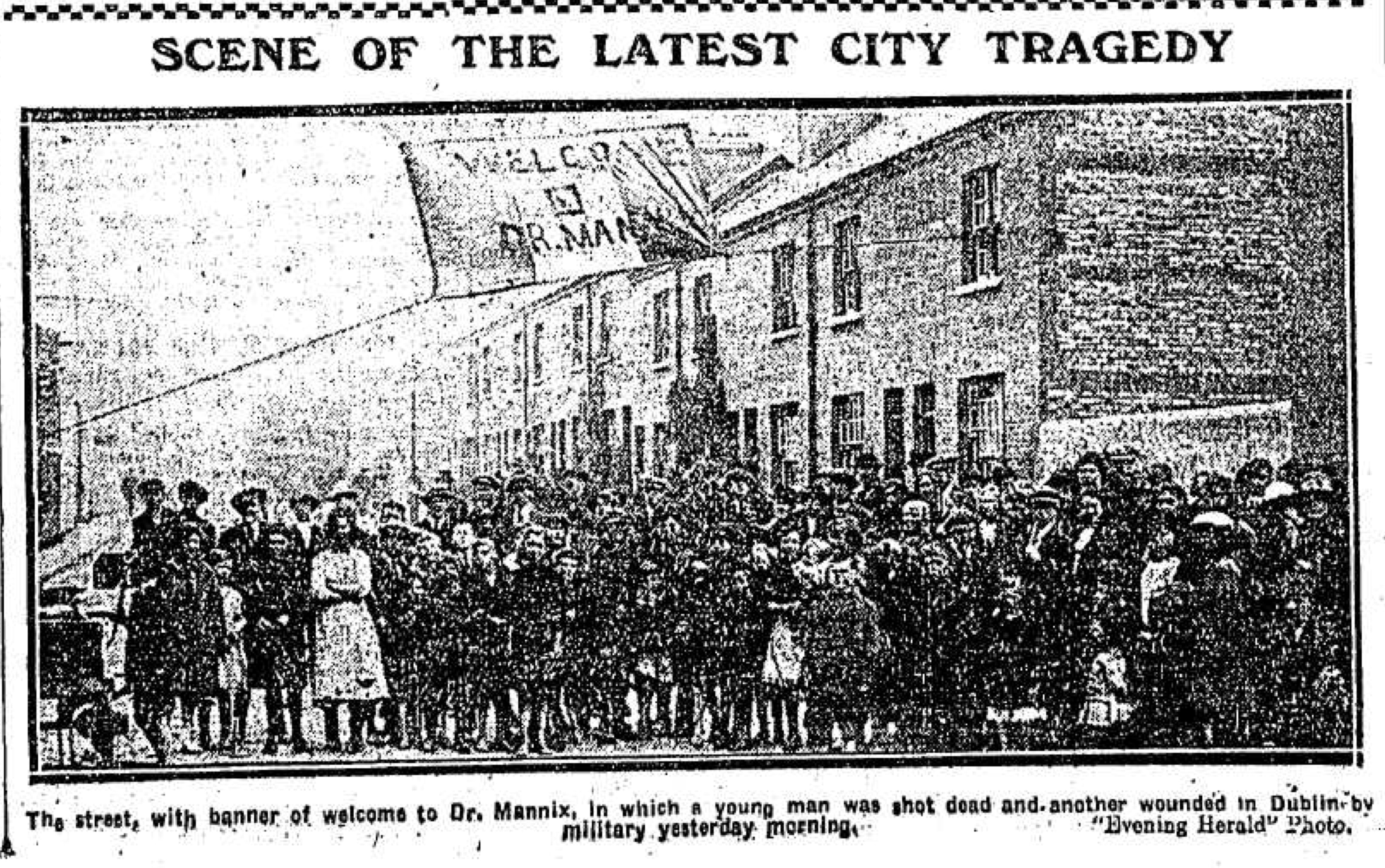
Bonfires to welcome Archbishop Mannix to Ireland had also been lit across Dublin city including one on Greek Street in the Markets area of the North Inner City.

A large Irish tricolour with the wording ‘Welcome Dr. Mannix’ was draped across the street by supportive locals.

The Evening Herald, 11th August 1920.

Crowds and tricolour to celebrate the visit of Mannix. The Evening Herald, 11th August 1920.

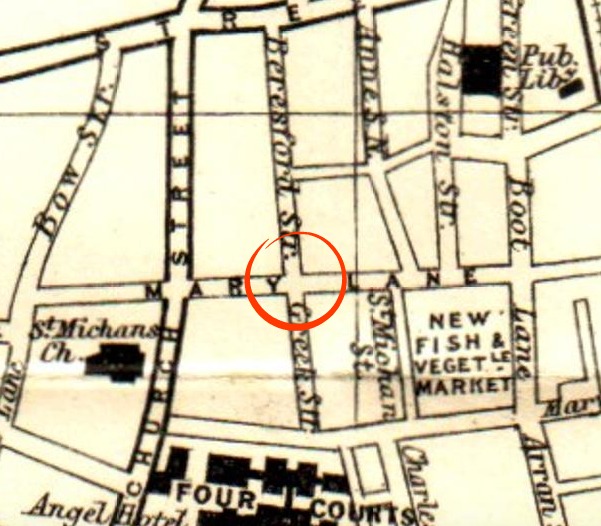
On that summer’s night late on 10th August, a small group of about ten young men were sitting around the dying embers of the bonfire at the corner of Greek Street, Mary’s Lane and Beresford Street. Newspaper articles reported that they were singing Irish nationalist songs. During the singing of ‘The West’s Awake’, a truck full of British Army soldiers from the Lancashire Fusiliers pulled up.

Location of the bonfire and shooting from 1913 Dublin Map.

Location of the bonfire and shooting from 1913 Dublin Map.

At the time, Dublin was under a strict military curfew and people without the necessary permits could not be outdoors from midnight until five in the morning.

At the following inquest, local witnesses like Joseph Eccles of Church Street said: “No challenge was given and nothing was said by the military” before they opened fire.

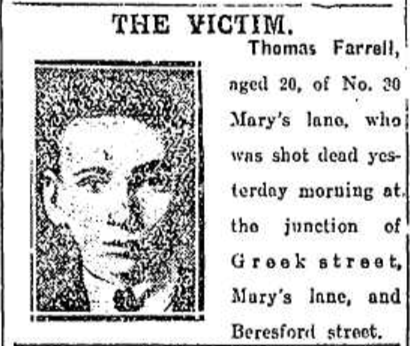
Thomas Farrelly ran in the direction of his home and was about 20 yards from the front door when he was hit by a volley of bullets. He was carried into his mother’s house and laid on the kitchen floor. According to the Sunday Independent (15th Aug 1920), Farrelly exclaimed “oh mother! oh mother!” and soon died in her arms.

Evening Herald, 11th August 1920.

Thomas Farrell (sic). Evening Herald, 11th August 1920.

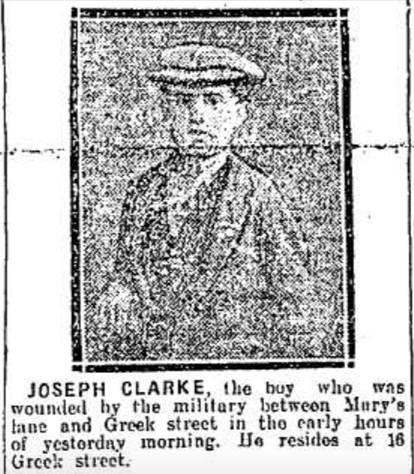
Another young local man Thomas Clarke was shot and wounded in the knee. He limped into the same house where he collapsed on the floor but luckily recovered from his injuries.

Farrelly was rushed to the Jervis Street Hospital in an ambulance but was pronounced dead on arrival.

Evening Herald, 11th August 1920.

Joseph Clarke. Evening Herald, 11th August 1920.

Funeral

Dr. Mannix sent a telegraph to the Lord Mayor of Dublin:

Just now I can only use this means of thanking you and all my friends in Ireland for their welcome to Irish waters. Kindly convey my heartfelt sympathy to the relatives of the murdered man Farrell. God rest his soul and comfort those who mourn him” (Irish Times, 13 August 1920)

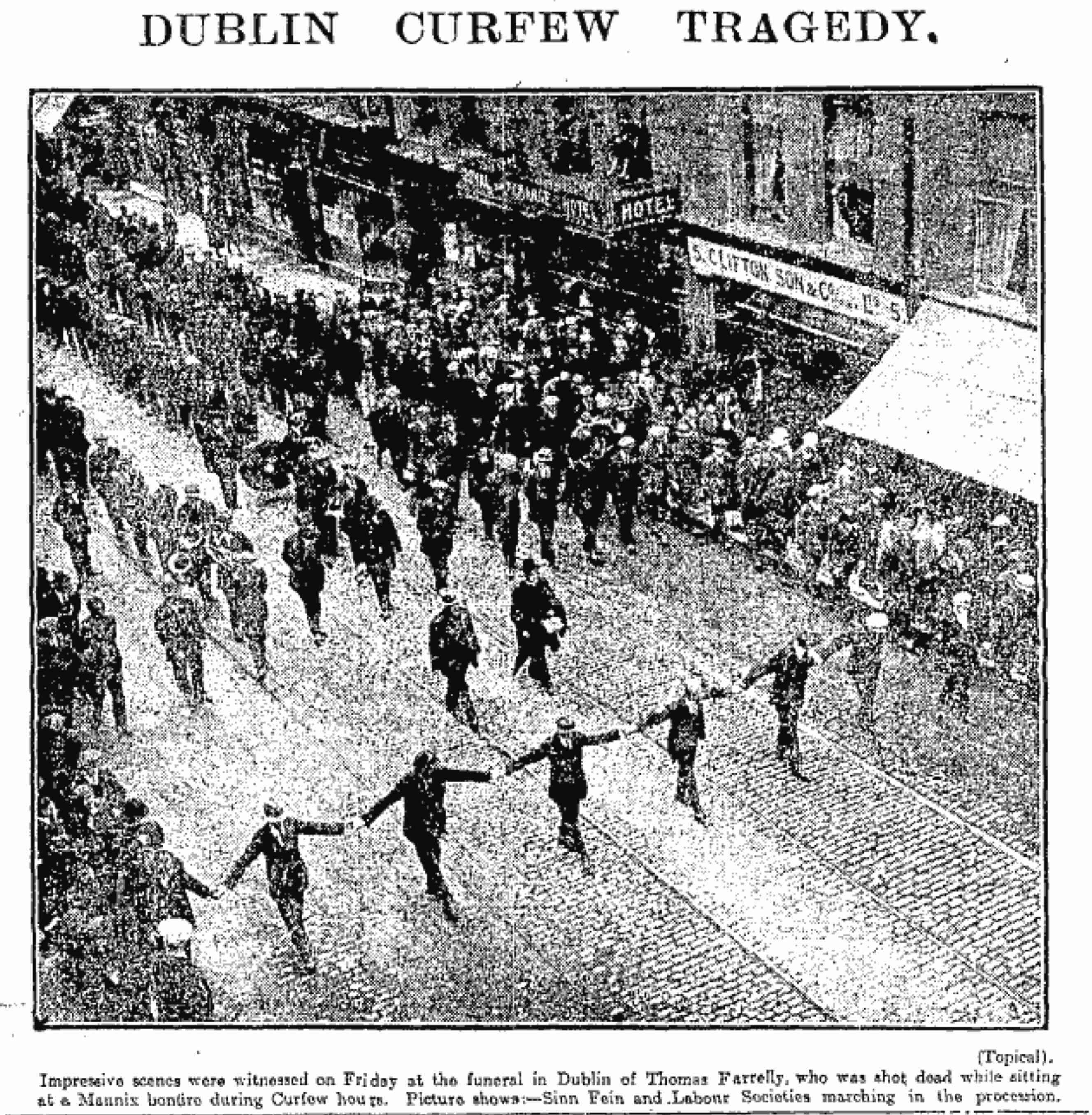
Thousands attended his public funeral which took place on Friday 13th August 1920. The Evening Herald reported that “all shops for a large area around were closed and blinds in private houses reverently drawn”.

The Irish tricolour flag with the message “Welcome Dr. Mannix” was draped over his coffin. Thomas Farrelly apparently had helped to make this flag which was hung near where the shooting took place.

Irish Examiner, 17th August 1920.

Funeral of Thomas Farrelly. Irish Examiner, 17th August 1920.

The hearse was drawn by four black horses from Halston Street Church to Glasnevin Cemetery. Thousands lined the route from North King Street, Church Street, Mary’s Lane, Little Mary Street, Capel Street, Parliament Street, Dame Street, College Green, Westmoreland Street and Parnell Square.

The Herald stated that the scene from Dame Street to the Cemetery was “particularly impressive as the long line of Volunteers, members of the Citizen Army and numerous Trade Unions marched four deep behind the hearse “. A slow, death march was played by the bands of the United Labourers’ Union and the Irish National Foresters.

(more…)

Read Full Post »

To date, we’ve been lucky enough to host four nights in conjunction with our friend Johnny Moy at The Sugar Club.  The Dublin Songs and Stories nights have all been for charity, with the Dublin Rape Crisis, Inner City Helping Homeless and other great causes benefiting. There have been some real moments of magic at the nights to date; poet Stephen James Smith played a blinder in December 2015, while veteran political activist Ailbhe Smith and artist Jim Fitzpatrick are two others that come to mind instantly as special moments. We’ve had rappers, traditional musicians, street artists and historians, and always a very engaged and lively audience!  The common thread between all the various performers has been the city of Dublin, and its importance in their lives and work.

The last night happened in March of this year, and included Will St Leger, Rory O’Neill (aka Panti Bliss) and others. It’s taken us a while to get the wheels in motion again, but I will lay the blame for that on the centenary. There was plenty for historians to be doing this year! Still, we’re going back into it now and seeing the year out with the fifth night.

This night is to benefit a great cause, and a friend of the website who needs life-saving surgery in the United States (click for Gofundme page). Mags lives with multiple conditions which drastically affect her quality of life, and is in a very brave battle with Ehlers Danlos Syndrome (EDS). The manner in which friends have mobilised around her and her family in recent times in inspiring to see, and this is a small contribution towards a great cause.

Once again, the mix is as eclectic as you’d expect from this blog. Tickets are available in advance from here, at €10 plus booking fee.We recommend getting them in advance. All help in promoting the night is much appreciated.

Doors are SEVEN, first act on at half seven sharp!

BrianKerr.jpg

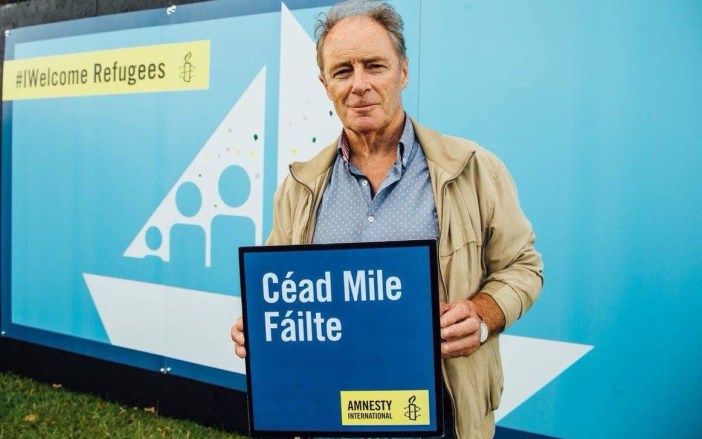
Brian Kerr  (Image Credit: Amnesty International)

If things had gone differently, Brian Kerr from Drimnagh could have followed his father into boxing. Thankfully for the entire Irish football community, he took a different path. There are few people who have contributed as much to The Beautiful Game in this city and country, from his close involvement with Saint Patrick’s Athletic to his work with the national squad at youth and senior level. He has done wonderful work with Sports Against Racism Ireland (SARI) and other progressive campaigns, and is a much-loved broadcaster, not afraid to call out the ruling powers that be in Irish football.

DannyDiamond.jpg

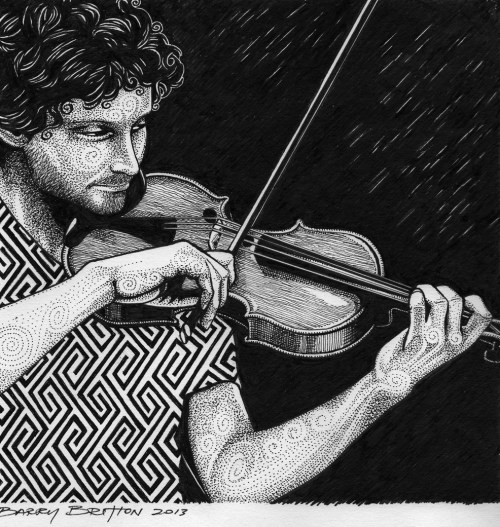
Danny Diamond by Barry Britton (Image Source)

The traditional music dimension of these nights has always proven popular. At the first night, Barry Gleason took the roof off the place when he burst into song, and Landless, Rue and John Flynn of Skippers Alley have all represented traditional and folk music and singing at the nights since. This time, Danny Diamond brings his fiddle along. Majestic stuff always, his 2004 album Fiddle Music is well played around these parts, with echos of the great Tommy Potts. Danny is part of the great Slow Moving Clouds among other musical pursuits, and this promises to be a great set.

IMG_0359-2.jpg

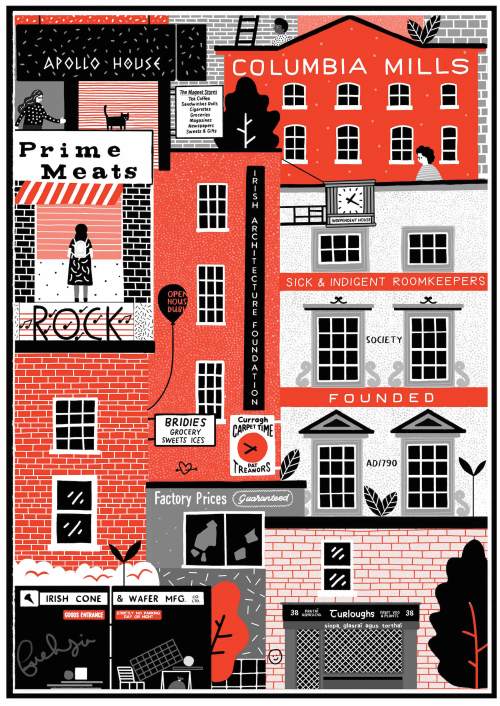
Fuchsia MacAree print for the Irish Architectural Foundation, posted to the excellent Dublin Ghost Signs.

We’re delighted to have got Fuchsia MacAree on board for the night, being long time admirers of her work as an illustrator. Her work is often very playful and frequently draws on Dublin itself – her characters, buildings and eccentricities. Formerly NCAD’s Designer in Residence, you have seen her work in a wide variety of Irish publications. Anyone that can make a play on Busáras and dinosaurs is sound in our book. See her website MacAree.ie  for examples of her work.

(more…)

Read Full Post »

ColleyCole2.jpg

Colley and Cole memorial, Yellow Road (Image Credit: Eirigi DNE)

On Yellow Road in Whitehall, a small memorial amidst terraced houses honours the victims of an atrocity. This memorial marks the spot where the bodies of Alfred Colley and Seán Cole were found on 26 August 1922. Cole was a 19 year old electrician, while Colley was a 21 year old tinsmith. They were both members of Na Fianna Éireann, the republican boy-scout organisation, and were killed because of their political affiliations. It happened mere days after the death of Michael Collins at Béal na Bláth, yet unlike that event it has been largely forgotten.

 While history has recorded that seventy-seven political opponents were executed by the Free State during the Civil War (the figure now appears higher),the number of unofficial killings was significantly higher still. Bob O’Dwyer’s study Death Before Dishonour, a labour of love drawing on primary source materials, points towards a figure of more than 120 such killings, with some bodies discovered in ditches and back alleys. There is no denying that the bitterness of this Civil War cast a long shadow over the new state. Dr. Noel Browne remembered the bitterness that still existed in the 1940s, on his entering the Dáil:

I recall my shock at the white-hot hate with which that terrible episode had marked their [older TD’s] lives. The trigger words were ‘seventy-seven’, ‘Ballyseedy’,  ‘Dick and Joe’ and, above all, ‘the Treaty’ and ‘damn good bargain!’. The raised tiers of the Dáil chamber would become filled with shouting, gesticulating, clamoring, suddenly angry men.

The stories that (almost) got away:

 In recent years, family researchers and historians alike have devoured the Witness Statements of the Bureau of Military History. These first-hand accounts of the Irish revolution have proven to be invaluable (though flawed) sources, providing first hand testimonies of key events like the 1913 Lockout, the Easter Rising and the subsequent War of Independence. We have drawn on them quite extensively, for example in this piece on looting during the 1916 Rising. The Bureau was established with the explicit brief to “assemble and co-ordinate material to form the basis for the compilation of the history of the movement for Independence from the formation of the Irish Volunteers on 25th November 1913, to the 11th July 1921.”

Some republicans refused to engage with the BMH in any form, believing it to be a project tainted by association with the Free State. Crucially, the BMH stopped short of seeking reminisces of the Civil War, no doubt fearful of opening old wounds. In spite of this however, there are still some references to the Civil War from participants who insisted on discussing those events, which have thankfully been included in the digitisation of the memoirs. One such republican to discuss the Civil War was Alfred White of Na Fianna Éireann. He talked of the deaths of Colley and Cole in the aftermath of events in Cork, describing what happened as murder:

 The unfortunate death of Michael Collins from a stray bullet removed the one man who would have had the strength to control them, and sharpened by their desire for vengeance. Their first victims were two unarmed Fianna boys, Seán Cole and Alf Colley, whom they captured at Newcomen Bridge (the military uniforms were clearly seen by witnesses under the disguise of trench coats), brought away in a car and murdered.

He was not alone in linking the deaths of the young activists to events in Cork. Frank Sherwin, another prominent member of Na Fianna who later served as an Independent TD, detailed in his memoir how he felt histories of the Civil War overlooked these connections:

Several books have been written about the Civil War. They deal largely with events leading up to the attack on the Four Courts and the fighting up to a period when Collins was killed, but they gloss over the remainder of this tragic event. When Collins was killed the ‘Terror’ began.

Sherwin, like White, did not mince his words. To him,”murder gangs” were to blame, while “men were found riddled with bullets all around the outskirts of the city. All over the country, similar murders took place and went on not only for the duration of the war but for months after it ended.”

The Oriel House Gang:

While the republican press presented Colley and Cole as ‘boys’, they were senior figures in Na Fianna. Colley held the rank of Vice-Brigadier of the Dublin Brigade, while Seán Cole was a Commandant. Most sources suggest they had joined the organisation in 1917 and 1918 respectively, in the period between the Rising and the outbreak of the War of Independence. Their senior positioning within the body would have made them political targets, but to whom? The task of monitoring and neutralizing political opponents fell largely on the shoulders of the CID (Criminal Investigation Department), based at Oriel House, a building which stands on the intersection of Westland Row and Fenian Street.

OrielHouse.jpg

Oriel House today (Image Credit: Wiki Commons)

As Eunan O’Halpin has noted in his study Defending Ireland: The Irish State and its Enemies since 1922, the behaviour of the CID during the Civil War was “highly controversial”:

Allegations soon surfaced not only of widespread ill-treatment of suspects, but of killings – a British army intelligence resume of 9 September [1922] spoke of the “murder of a number of prominent republicans…Certain of these…are laid to the door of Oriel House”

Even among senior Treatyite politicians, there was an awareness that the behaviour of Oriel House was sometimes inexcusable. Ernest Blythe, later a prominent Blueshirt in the 1930s, would use his statement of the Bureau of Military History to acknowledge that while “investigators were somewhat tough with prisoners”, this was justified:
Oriel House was a somewhat doubtful institution, and a good many suggestions were made that its methods were too like the worst we hear of the American police. However, the American police operate under peace conditions, whereas Oriel House at the time was carrying on under war conditions, and if investigators were sometimes somewhat tough with prisoners, I should say that the circumstances were such that tough methods were not only excusable but inevitable.

Padraig Yeates, author of the masterful A City in Civil War: Dublin 1921 – 24, has detailed the manner in which the CID became “probably…the most effective counter-insurgency unit working for the Free State.”  Under the stewardship of Joe McGrath, the body operated on multiple fronts, with a “Protective Officers’ Corps that was dedicated to guarding Ministers, important government supporters, public buildings and some commercial premises.” There was also a “Citizens’ Defence Force…which included about a hundred British ex-servicemen as well as former IRA Volunteers and some women.”  The CID utilised informers and agents in the ranks of the IRA, and unsurprisingly the building was physically attacked on multiple occasions. In the autumn of 1922, four mines were planted in the basement of the CID building, though only one exploded. Simultaneously to this, republicans opened fire on the building, firing “fifty or sixty rounds”, but leaving when the CID returned fire.

(more…)

Read Full Post »

AntoninArtauds.jpg

Antonin Artaud (1896-1948)

One of the most puzzling little stories of 1930s Ireland has to be Antonin Artaud’s arrival here in 1937. The French poet, dramatist and theatre director is remembered as one of the major figures of the avant-garde art movement of his time, but to the people of the Aran Islands, and to the confused Gardaí of Miltown in South Dublin, he was a total mystery.

Arriving in the country in August 1937, a troubled Artaud was convinced he carried with him the staff of Saint Patrick, which he felt he had to return to its rightful home. To him, this was a spiritual mission of sorts, and the staff possessed magical qualities. Along with the staff, he carried a letter of introduction from the Irish Legation in Paris, who were unaware of the nature of his pilgrimage. He would end up in Mountjoy Prison for his troubles, before being deported as a “destitute and undesirable alien.”

Who was Antonin Artaud?

While the name Antonin Artaud means little to the Irish public, things are certainly different in France. Born in Marseilles in September 1896, Antonin endured both physical and psychological illness in his youth. At the age of only four he was diagnosed with spinal meningitis, and as one biographical entry notes:

His health did not improve as he matured and for most of his life he was beset with ill health, pain and nervous depression. He was continually admitted and discharged from hospitals and sanatoria and developed addictions to hallucinatory and pain-reducing drugs like opium. His addiction and abuse of these substances began to have permanent effects and his mental health gradually deteriorated.

He was inducted into the French armed forces in 1916 when war was raging in the country, but quickly dismissed on health grounds. It was in 1920, following the end of the horror show that was the First World War, that a young Artaud arrived in Paris, at a time when the city was redefining culture in its own unique ways.

Ian Buchanan maintains in his Dictionary of Critical Theory that Artaud “never had a proper career. He lurched from one thing to another seemingly at random, but apparently with the constant aim of challenging the perception of reality.” In Paris, he studied under Charles Dullin, theatre manager and bold director, and appeared in a number of French cinematic productions, including La Passion de Jeanne d’Arc, a beautifully shot 1928 silent film in which he played the role of Jean Massieu, the Dean of Rouen.

artaud

Artaud in La Passion de Jeanne d’Arc.

(more…)

Read Full Post »

Born To Create

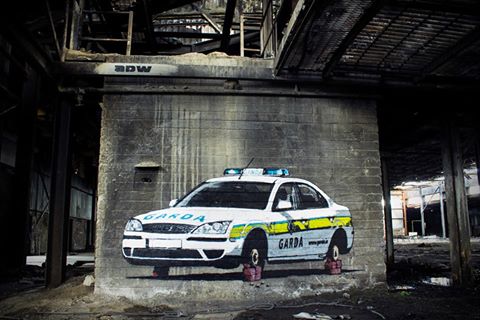
adwatart

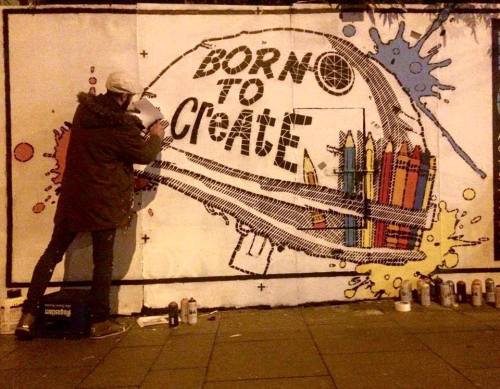
ADW At Work. (Image Credit)

This Thursday, our friend ADW is opening his new exhibition, Born To Create, in The Kemp Gallery on South Frederick Street.

If you made it to our ‘Dublin Songs and Stories’ event in September 2015, you would have heard ADW talking about his work. As we said before that event, “He has used the city as a canvas over the years, and his work is thought-provoking and humorous, just how we like it.”

His work has gone from strength to strength since 2008, and this is a chance to see some of his latest offerings. A limited edition screenprint, based on the reworked city coat of arms, will be available on the night and would look good on the wall of any CHTM reader 😉

Happyisthecity.jpg

“Happy is the city where citizens obey” – a reworked city coat of arms (Image Credit: ADW)

ADW1916.jpg

“I see his blood upon the rose” – A tribute to Joseph Mary Plunkett (Image Credit: ADW)

caronbrickds.jpg

Car on bricks (Image Credit: ADW)


Read Full Post »

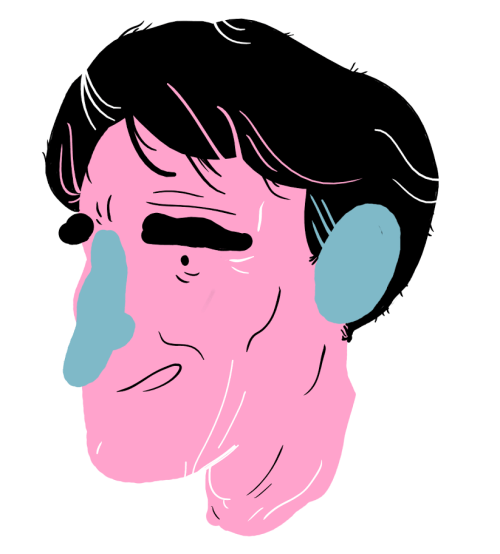
DominicBehan1.png

Dominic Behan (Illustration by Luke Fallon for CHTM)

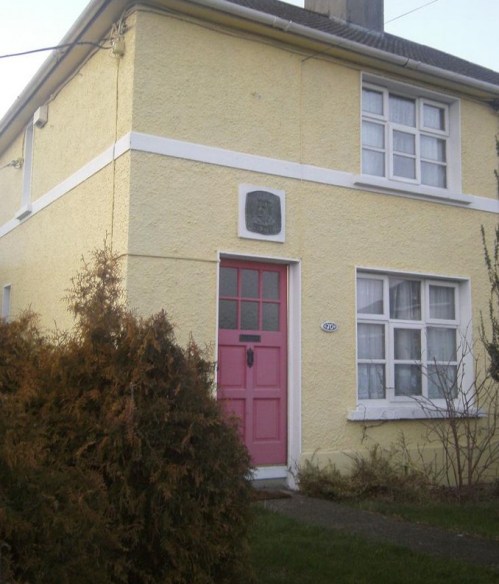
On Kildare Road in Crumlin, a small plaque above the door of number 70 tells passers-by that it is a home of historical importance. The plaque shows the face of Brendan Behan, alongside the years of his birth and passing. Brendan was a giant of Irish literature of course, but this house was a home in which the sound of music and the typewritten word emerged from all rooms.

The children of Stephen and Kathleen Behan would, in their own unique ways, come to reflect the rich literary interests and political passions of their parents, and the contribution of Dominic Behan to the worlds of stage, song, politics and literature deserves greater recognition. A committed republican of a socialist variety, Dominic would publish his first poems and prose in the pages of the journal of Na Fianna Éireann, and in time would become a writer celebrated by voices as diverse as James Plunkett and John Lennon, not to mention clashing in dramatic style with Bob Dylan.

Russell Street Beginnings:

The Behan boys were products of the inner-city, to whom Russell Street was home.

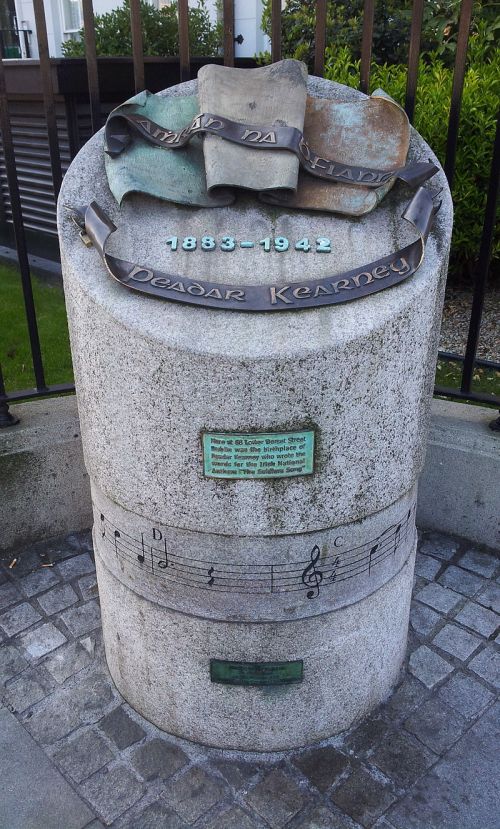
Stephen Behan, Dominic’s father, was a veteran of the War of Independence, and took the Republican side in the Civil War which followed. Stephen was educated by the Christian Brothers on North Richmond Street, a school which produced more than 1916 participants than any other, proudly boasting of 134 participants between students and graduates. By trade,Stephen worked as a signwriter, a trade his son Brendan would briefly follow him into. Stephen married Kathleen in July 1922, as the country was in the midst of Civil War. Kathleen had previously been married to John Furlong, a  1916 veteran who died two years after the insurrection. Her brother was Peadar Kearney, author of The Soldier’s Song, who took the Pro-Treaty side in the Civil War divide. Not long after his wedding, Stephen was himself imprisoned. Family lore had it that Brendan Behan would first see his father through the railings of prison.

peadar_kearney_monument

Memorial to Peadar Kearney on Dorset Street, not far from the Russell Street beginnings of Dominic. (Image Credit: Wiki Commons)

Certainly, the Behan family lived in working class surroundings, but Brendan Behan in particular could be prone to exaggerate the working class pedigree of the family. Kathleen came from  strong middle class stock, even if it had since been greatly reduced,  and the family lived in a home owned by Christine English, grandmother to the boys who owned several homes in the vicinity.

Dominic Behan was born in October 1928, into a family for whom republicanism was still a pillar of life and identity. Kathleen in particular shaped the world view of the Behan boys; as Ulick O’Connor detailed in his biography of Brendan, she would bring them on walks through the city, showing them not only places associated with the battle of Irish independence, but the houses of Shaw, Swift and Wilde too. Dominic found his heroes in the Irish revolutionary tradition; he would particularly come to admire the Protestant and Dissenter radicals of the United Irishmen, and Big Jim Larkin of the Lockout, of whom he would write later:

Larkin gave a new meaning to Christianity when he decided to fight his cleric critics with their own cannons – a Bible and a plea for a true brotherhood of man. When they accused him of being a red menace, he threw back the suggestion that they were un-Christian, but it was in Larkin’s mouth more than a suggestion, it was an indictment of the Christian soldiers who were prepared to stand by and see the children of Christ starve.

Dominic remembered Russell Street fondly, recalling that “the native industries of Russell Street were drink and cleanliness, represented respectively by the Mountjoy Brewery and the Phoenix Laundry.” With a greengrocers, bookmakers and public,Dominic joked in his memoirs Teems of Times and Happy Returns that there thus existed no reason for anyone to leave the confines of the street, unless off to work. It was far from the worst of tenement Dublin, with Dominic recalling how “Russell Street was the extreme tip of a jungle of north city tenements: Georgian, red-bricked, strait-laced, and, at this time, complete with closed hall-doors and mahogany railed staircases. Even a few of the windows were still intact.”

No Suburbia, Only Siberia:

amf3

70 Kildare Road,photographed by me in 2013.

(more…)

Read Full Post »

This recording of The Smiths in November 1984 at the SFX comes and goes online, but it seemed time to upload the 12″ vinyl for convenience sake, and perhaps for a nice nostalgic buzz for a few of you. While the sound recording isn’t the best, the crowd noises and singalongs are great too at times. This was a band on the ascent, and the crowd are loving every minute of it.

The most popular LP bootleg of these gigs is known as ‘Blue’, and the cover of the bootleg shows Elvis Presley.  I don’t like it, so here’s a new one that feels a little more fitting. Brendan Behan was referenced by name on Morrissey’s last LP, World Peace is None Of Your Business, and an image of the Dublin writer appeared on screen during his 2014 show at the Point Theatre. Brendan is shown here in discussion with Lucian Freud at the Mansion House.

BrendanBehan1.jpg

The bootleg includes the following tracks:

Side A:01 Reel Around The Fountain
02 Heaven Knows I’m Miserable Now
03 Rusholme Ruffians
04 This Charming Man
05 How Soon Is Now?

https://soundcloud.com/aughrimhedgeschool/smiths-sfx-dublin-side-a

(more…)

Read Full Post »

HammondLane.png

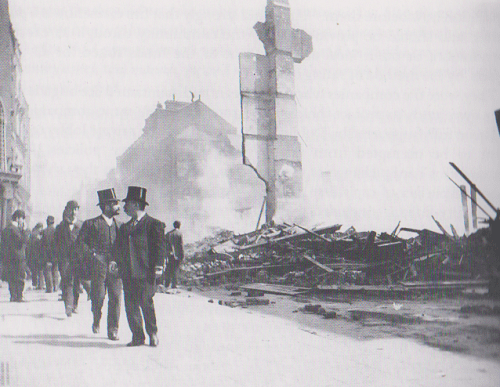
Destruction in Hammond Lane. Image from Trevor Whitehead and Tom Geraghty’s ‘The Dublin Fire Brigade’ (Dublin City Council,  2004)

Saturday, 27 April 1878, was a devastating day for Dublin, when death and destruction made their presence felt in one of the poorest districts of the city.

One newspaper called the day “a catastrophe, perhaps exceeding in its calamitous nature and deplorable consequences, any event which happened in Ireland within recent years.” The death of fourteen Dubliners in Hammond Lane, the result of an industrial accident, shocked the city and altered the street forever, with tenements, public houses and industrial buildings reduced to rubble or dragged down in the days that followed. Today, there is no memorial at the site of one of the worst industrial accidents in the history of the city.

hammondlane

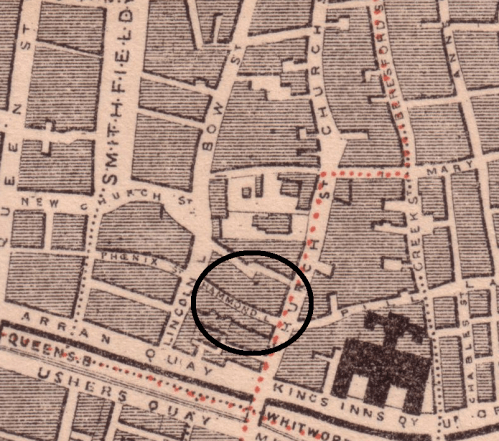
Hammond Lane,located just off Church Street. This nineteenth century map comes from Swilson.info.

In the late 1870s, Hammond Lane and the streets around it were heavily populated. Situated beside Church Street, and in the vicinity of Smithfield, the narrow street was home to several tenement houses, but also some industrial buildings, with the foundry and ironworks of Messrs. Strong a significant local employer. One contemporary source described the street, and not in a flattering manner:

On one side of it was a public house kept by a name named Patrick Duffy, while on the other side was a private dwelling house inhabited by several families. Tenement houses occupied by people of the labouring classes interspersed with a few shops of extremely humble pretensions formed the rest of the narrow, long, dirty street.

At one o’clock on the day of the tragedy, the bells of the foundry rang, the sign to discontinue work. Men had gone to their dinners, and the lane was described as “deserted, save by a few passers-by and some children playing in front of the ill-fated walls.” Some men made their way into the neighbouring Duffy’s pub to enjoy a pint on their break, but little time passed before tragedy struck:

Scarcely however, had half an hour elapsed, than, while about twenty persons were taking some refreshment in Duffy’s public-house, a dreadful explosion was heard, and the houses in the immediate neighbourhood were shaken as by the shock of an earthquake, while simultaneously, the boiler burst with terrific force, one of the front walls of the foundry was rent into pieces, and literally blown into the street.

One newspaper described how “the public-house and the factory, instantaneously giving away, fell with a loud crash, amid blinding clouds of dust, down into a mass of ruins and debris.”

When the large twenty-foot boiler of Strong’s exploded, a portion of it was thrown across the street, “violently hurled into a gateway opposite. Had it struck one of the houses filled with alarmed men, women and children, a terrible addition might have been made to the dreadful calamity.”

In their history of the Dublin Fire Brigade, Tom Geraghty and Trevor Whitehead described the madness of the scene:

Many people were buried in the debris of their collapsed homes, while others stumbled out with varying degrees of injury, trauma or bewilderment. The scene,  which a few seconds before was one of life, activity and neighbourliness, was turned into a virtual  battleground, with everywhere the pleading cries of people seeking immediate help for themselves or those they knew who were now buried or lying amidst the carnage.

(more…)

Read Full Post »