As we move from the centenary of the Easter Rising into the broader revolutionary period, there will be key moments in the War of Independence chronology that will undoubtedly be significantly marked. The firing of the first shots of the conflict at Soloheadbeg in Tipperary, the destruction of Dublin’s Custom House and, of course, Bloody Sunday in November 1920.
One date which could have taken on such significance, had things gone a little differently, is 24 June 1921. On that day, the IRA planned a major attack in Grafton Street and its surrounding districts, designed to take out every Auxiliary in the vicinity of one of Dublin’s busiest streets. Encircling the area, they hoped to then move against uniformed and plain clothes Auxiliaries, with IRA intelligence officer Joseph Dolan remembering that “the idea was to nail the whole lot in one blow.” In many ways, this operation would have been a ‘second Bloody Sunday’, and conducted in a much more open environment.
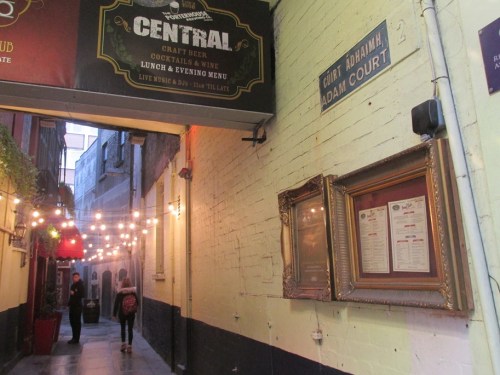
Adam Court, just off Grafton Street. Today home to the Porterhouse and Lillie’s Bordello, in 1920 the lane led to Kidd’s Buffet, which was to be targeted on 24 June 1921.
John Anthony Caffrey, a member of the IRA’s Active Service Unit, remembered in his statement to the Bureau of Military History that:
On an evening in June 1921, the entire Active Service Unit in conjunction with selected members of the Dublin Brigade were detailed to shoot every Auxiliary in Grafton Street, and at the same time one squad was to bomb Kidd’s Buffet, which was one of the places chiefly frequented by members of the Auxiliary Division. The section to which I was attached was to operate on the top of Grafton Street, south King Street to Chatham Street. Our instructions were that the operation would commence at 6 or 6:15pm sharp.
Armed IRA men would be joined by an Intelligence Officer, capable of pointing out Auxiliaries who were dressed in civilian clothes. Joseph Dolan remembered that:
At the time great numbers of Auxiliaries paraded up and down Grafton Street in civilian clothes, and frequented Kidd’s restaurant which was at the corner of Grafton Street. Michael Collins decided that there should be an attack on the Auxiliaries in this restaurant and in Grafton Street. The job was timed for the afternoon. This was the time the greatest numbers of enemy troops would be strolling in Grafton Street. The idea was to nail the whole lot in one blow.
Kidd’s Buffet was a well-known rendezvous point for Auxiliaries and agents. Rather bravely, a number of IRA men close to Michael Collins, had begun frequenting the restaurant from October of the previous year. David Neligan, a leak within the British intelligence operation who was providing intelligence to Collins and the IRA, introduced these men as informers. Frank Thornton, one of the IRA men who infiltrated this circle, was surprised by how little the Auxiliaries seemed to know about the IRA leadership, recalling that “they actually had no photograph of any of us, and had a very poor description of either Collins or the three of us.”
Kidd’s was popular with more than just Auxiliaries and the Dublin Castle set however, and contemporary menus promised “the best Culleenamore Oysters in season…Salmon, lobster, home-made pressed beef” and more besides.

1920 advertisement for Kidd’s Buffet.
Participating IRA man Padraig O’Connor remembered the manner in which the area was subdivided:
The area was divided up from Suffolk Street to Wicklow Street; from Wicklow Street to Johnson’s Court; from Johnson’s Court to Harry Street and from Harry Street to South King Street. Parties were also taking in Stephen’s Green, Dawson Street, Nassau Street and Suffolk Street and a special party were going to Kidd’s Cafe.
Unfortunately, a number of factors worked against the IRA plans for the night in question. Dolan recalled that the plans were dealt a serious blow owing to what seemed to be an increased checkpoint presence on the streets of the capital, making it difficult for IRA members to take their positions. The men had even planned for “a Ford Van to take away and wounded, and that couldn’t turn up either. It was also cut off. Because all these things happened it was decided to call the whole thing off.”
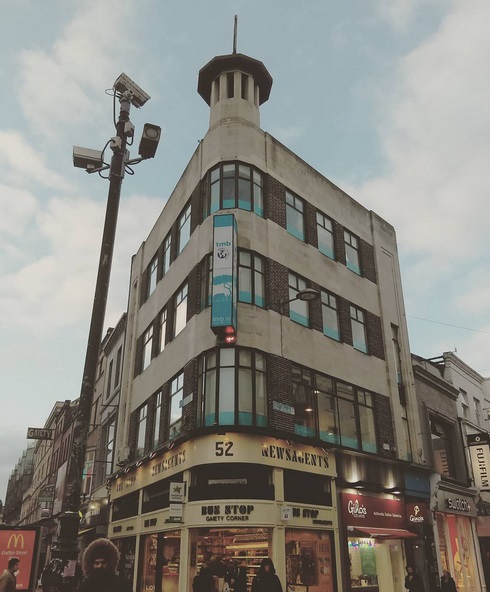
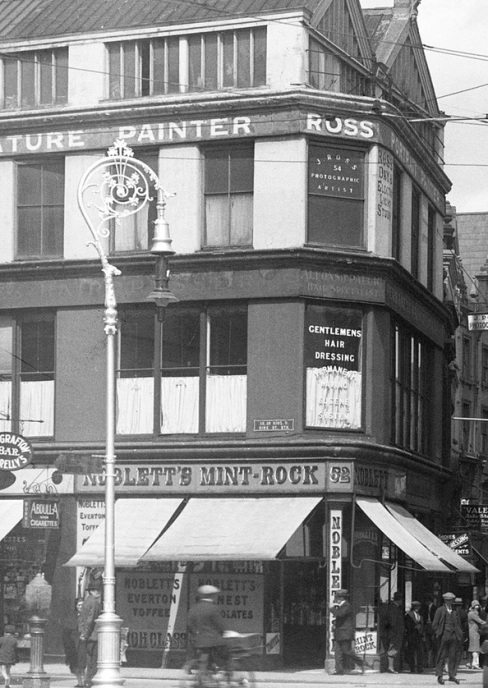
Still, some shots did ring out that night. Joseph McGuinness, one of the men who had gathered to attack Kidd’s specifically, remembered that “the four of us loitered for some time and no shot was fired.” Yet further up Grafton Street, at the intersection of Chatham Street and Grafton Street, an opportunity presented itself, as two Auxiliaries wandered into the path of a waiting IRA unit. One participant recalled that “one man fell on top of the other on the footpath. We fired against them and got away.”

Where Chatham Street meets Grafton Street today.













 Click on the book for more.
 Click on the book for more.
 Donal
Donal Ciarán
 Sam
Sam


 Come Here To Me!