Feeds:
Posts
Comments

Archive for October, 2017

Magazine

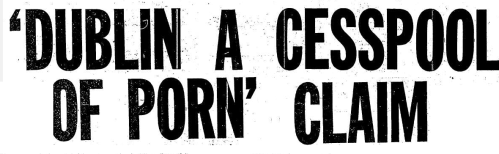
Evening Herald, October 1975.

My apologies for a relatively quiet CHTM!

I’ve spent the last few weeks traversing across Ireland with the National Treasures project. We set out to “crowd-source everyday objects that explore the history of the island of Ireland over the past 100 years”, and I feel confident in saying we did that. There will be an exhibition and a telly series in 2018, so it is all ahead of us.

Anyway, a few items that came forward around Ireland really took me by surprise. In Belfast, we had a stall from the Brand New Retro team, and Brian McMahon and Sinead Kenny brought some wonderful periodicals from the Ireland of yesteryear. One which was most unusual was Man Alive (see issue 1 here), a short-lived magazine from the 1970s aimed at Irish men which included culture, sports, politics, art and…..a bit of nudity. The magazine attracted the predictable ire of the League of Decency, whose President described the banning of the mag as “a victory for morality.” The outlawing (temporary) of the magazine was front page news to the Irish Independent:

Magazine.png

Irish Independent, 25 October 1974.

Published for the first time in April 1974, Man Alive was too complex a publication to just dismiss it as an ‘Irish Playboy‘, or even the Playboy Of The Irish World. In its first editorial, it noted that “despite some of advance speculation it is definitely not, nor will it be, a pornographic magazine.” Man Alive insisted that it was “in fact the first general interest man’s magazine in the modern international mold. Our package is aimed at today’s increasingly sophisticated Irishman in his 20s and 30s.”

Contributors to issue one included Jim Fitzpatrick, the artist then best known for his series of posters celebrating Irish literary figures, not to mention the iconic Che Guevara poster of 1968. J.P Donleavy wrote about the response to The Ginger Man, which had infuriated Ireland’s moralists, while Alan Coran was an interesting international voice, a regular contributor to Playboy and The Times.

The magazine was produced by the Creation Group, responsible for titles as diverse as New Spotlight, Woman’s World and the Sunday World. The publication was decidedly liberal (not least beside the Sunday World!), with Issue One including a profile of Senator Mary Robinson. A British newspaper, baffled by the controversies around Man Alive, insisted that “it offers no more titillation than that endured almost daily by readers of the British popular newspapers, all of which except The Sun circulate freely and uncensored in the Republic.” To The Sunday Times, “what appears to have shocked the Irish most is the fact that local models were prepared to sell their modesty for £100 a session and appear on the pages of the magazine.”

High profile interviews included Charlton Athletic footballer Eamon Dunphy, who proclaimed that “football is run by an ignorant, amoral petite-bourgeoisie and it shows.” Philosophical as ever, Dunphy’s views on the state of the game wouldn’t have been welcome in a tabloid, but here he proclaimed:

There’s a crisis in football: the signs are everywhere – violence at the game, violence coming from the game, dull football. And of course, the thing which really worries the management, falling gates. People are beginning to realise that football is in part a con: that’s why there’s falling gates.

Profiles, sometimes critical, of leading figures in Irish life included Conor Cruise O’Brien, a man who had his own obsessions with censorship (though in his case, limited to political opponents with Section 31). There were difficult issues addressed in the magazine too; an article by Carol Shaw noted that while there organisations like The Union for Sexual Freedoms in Ireland, “it’s difficult for a movement like Gay Liberation to get off the ground in Ireland – mainly because of attitudes to sex.” An article on men’s sexual health issues  included an interview with a representative from the Irish Family Planning Association, which discussed the issues of men who attended their weekly psycho-sexual help clinics.

Clearly, there was a demand for the magazine.  Whether most people read the articles or not remains a subject of debate, but the sheer volume of sales told its own story. Issue 3 of the magazine boasted of the growth of the magazine, as “we printed 15,000 more than the first issue and it was a sell-out”. A circulation of 40,000 was claimed at the height of Man Alive‘s popularity.

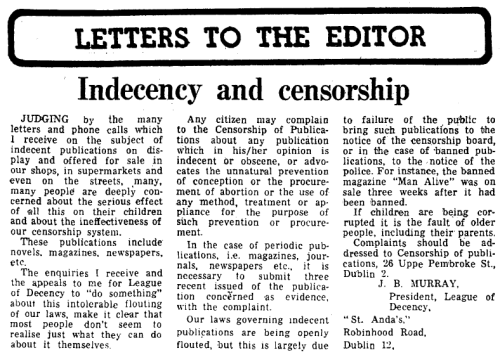
Against the backdrop of the controversy, the League of Decency’s Joseph Murray was interviewed in the Irish Independent, outlining a belief that “what this country needs to stem the tide of depravity and corruption was not less censorship but more”, before singling out Christy Brown’s Down All The Days as a “very disgusting book and certainly not a book that should come from the pen of an Irish writer.”  Murray claimed that the League was heading towards boasting “eight significant branches in Dublin…ten in Cork and branches in at least 30 counties.” For someone who hated Man Alive, he could boast of owning a few copies, and showed one to the interviewing journalist:

I find that revolting and disgusting, a gross display of indecency.Those pictures are without doubt an incitement to sexual immorality. These days you cannot pick up a book or magazine or even so-called newspapers without seeing a naked or almost naked woman. This is bound to affect young and impressionable minds.
Magazine.png

Letter from the League of Decency to the Irish Press, December 1974.

The Censorship of Publications board ruled against the magazine on the basis it was “indecent or obscene”,  meaning that after four issues it temporarily disappeared from the shelves. Returning later in the year, they were warned a second ban would mean the “permanent banning of the magazine.” Man Alive limped on, with the Summer 1975 edition noting that it included “a new short story by John McGahern” and “Gorgeous girls galore.”

By October 1975, the magazine was no more, but foreign imports remained. It was all enough to lead the Catholic Young Men’s Society to declare Dublin a “cesspool of porn… the filthy literature that litters the streets of Dublin is on par with any cesspool in Europe.”

For a look inside the magazine and more from the weird and wonderful world of Irish publications, visit Brand New Retro.


Read Full Post »

Youth culture in Dublin is a reoccurring theme on the blog, from the Beat Clubs to the Teddy Boys.

This year marks the fiftieth anniversary of the birth of The Grove Social Club, an important local disco with a difference on Dublin’s northside which ran for an incredible three decades. A proudly alternative disco, this Raheny night achieved something of a legendary status, with the Northside People noting that it was “a safe haven for Northside teens; a melting pot where rockers could hang with Mods, Goths, geeks, hippies and Cureheads.” The club has inspired a dedicated website which tells its story, not to mention television documentaries and radio features. The club was such a part of the northside that one journalist was moved to write in the early 90s that “anyone between the ages of 15 and 40 living north of the Liffey has its name emblazoned on their souls.”

thebestdays

Evening Herald, December 1993.

The Grove club owed its very existence to Cecil Nolan, who the writer Tara Delaney would honour as “the man whose disco-spinning nursed generations through spots, break-ups and exam stress”. Emerging out of members of the Belgrove Football Club, Cecil was a natural DJ fit for the new local endeavor, already known locally as ‘The Music Man’ for his eclectic collection of records. He later recalled that “I played whatever I wanted because I knew there was a market out there for it and if it failed,well I didn’t care, at least I was enjoying myself.”

Beginning life at the Belgrove Football Club on Mount Prospect Avenue in 1967, it immediately acquired a reputation as a night with a difference. Attendees of the club remember the unique music it offered, from Led Zeppelin to Deep Purple, and from Elmore James’ Dust My Broom to Procol Harum’s A Whiter Shade of Pale. Much like DJ Paul Webb would recall Dublin’s Hirschfeld Centre as a break from “the same twenty clubs up on Leeson or Harcourt St all playing the same twenty songs” in the 1980s, The Grove introduced young suburban Dubliners in the 1960s to entirely new music, far removed from that in the charts. Following a fire at Belgrove, it moved to St Paul’s school in Raheny in the mid 1970s, though it retained its original name through subsequent decades. A recent video marking the fiftieth anniversary of the club shows its St Paul’s hall, with Cecil recalling his memories of the place:

Moral panic around youth discos in the 1960s was very real; readers of one newspaper were warned in 1967 that “a young boy or girl put on the way to becoming regular drinkers can only finish up as moral wrecks.” Plenty of column inches were lost on purple hearts and marijuana. Yet while plenty of newspaper ink went on that, there were also advertisements from young men and women looking to rent spaces across the city for discos.  In an affectionate remembrance piece on the youth discos of 1970s Dublin, the journalist Niall Bourke recalled how “your arse wouldn’t touch the ground until you hit the tarmac of the car park outside if you were found in possession of any dodgy substances.” It would be foolish to suggest drink wasn’t a factor in it all – Jason Duffy recalled “finishing off a few drinks in St. Anne’s Park before making our way into St. Paul’s” – but anyone who thought it the main attraction of a night out missed the point.

Whenever a journalist did darken the door of a youth disco, they found them to be places of community and enjoyment, and well-needed escapism from school and the stresses of life. The Grove in particular had a transformative effect for many, with broadcaster Marty Whelan (who met his wife at the club) recalling:

Every time I hear certain songs I’m right back there remembering the Grove. There was just a vibe. I think a place like that is special because someone like Cecil,who was from another generation, came up and related to every teenager who went over a thirty year period.

Hard rock took over for a period, but as Bourke noted, Cecil “knew how to work a crowd…during his career he presented the different genres of metal, punk, gothic and grunge to the ever-enthusiastic punters who lapped it all up with absolute relish.” A discussion on a forum dedicated to the club gives a sense of its 1980s playlist. The Damned and Motorhead competed for time against The Smiths, XTC and 10cc. Leonard Cohen’s Suzanne is recalled too, presumably a ‘slow dance and snog’ type of number. The last song played at The Grove in 1997 was Nirvana’s Smells Like Teen Spirit, a classic teenage angst anthem which includes the line “Here we are now, entertain us.” For thirty years, The Grove entertained without disappointment.

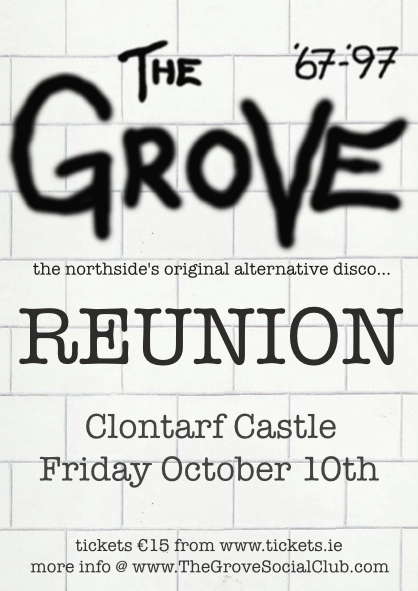
In 2006, RTÉ produced a True Lives feature special entitled The Grove: More Than A Feeling. Including contributions from RTÉ’s own Eileen Dunne, Marty Whelan and the comedian Brendan Bourke, it was a nostalgic but important piece of social history. It captured the sense of community which existed – and continues to exist – around the club. Reunion nights, instigated by former Grover Andy Colbert and featuring the original club DJ Cecil Nolan, have ensured that the community remains today.

TheGroveReunion

A Grove Reunion Poster.

As well as inspiring documentary features and reunion nights, The Grove has even made its way into fiction. In the trailer for the award winning 2007 feature film 32A, the story of teenage years in the suburban Dublin of the late 70s and early 80s, the all-important question “are you going to The Grove tonight?” is asked:

We salute all involved on fifty years of a club culture in Dublin, and may their reunions continue long into the future!


For a membership card from The Grove, see this recent addition to The National Treasures project. My thanks to Dr. Linda King, with whom I am working on National Treasures, for putting the idea for this article into my head!

Read Full Post »

The Winter Garden Palace was situated on the corner of 106 St. Stephen’s Green West and 24 Cuffe Street for over 200 years.

From the newspaper archives, it seems that the business was in operation from at least 1866. Described as the ‘Winter Garden’s Gin Palace’, its first proprietor was James Brady.

The Winter Garden Palace, The Irish Times (31 March 1866).

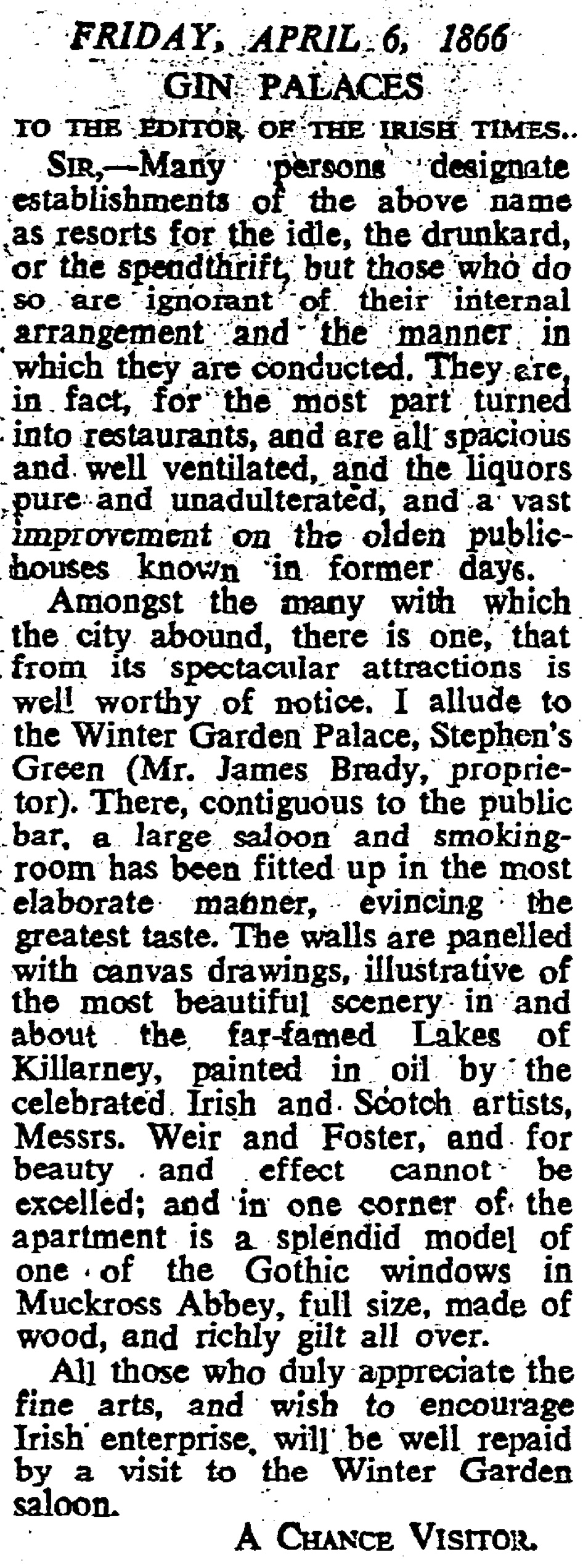
It received a glorious review in The Irish Times in April 1866. The unnamed writer wanted to put on record that a  Gin Palace was just for the “idle, the drunkard or the spendthrift”. The Winter Garden Gin Palace  on St. Stephen’s Green could boast of a “public bar, a large saloon and smoking room”. Its walls were decorated with beautiful scenic canvas drawings and in one corner there was a model of “one of the Gothic windows of Muckross Abbey”.

The Winter Garden Palace, The Irish Times (6 April 1866).

Philip Little, who first began his publican career in Dublin in 1863, appears to have re-opened the Winter Garden Palace under his own patronage in August 1877.

The Winter Garden Palace, The Irish Times (20 Aug 1877).

In the 1880s, the pub was referred to as a favourite meeting spot for the Invincibles (Fenian-splinter group)

The 1901 census shows that Phillip Little (65), a “Grocer and Spirt Merchant” from County Cavan, lived in the property with his wife Bridget Little (62) from County Kildare and their four children. On the night of the census, a visitor Mary Molloy and her son were in the house. Little employed a domestic servant (housekeeper) and six young male grocers assistants. Five of whom were from his home county of Cavan.

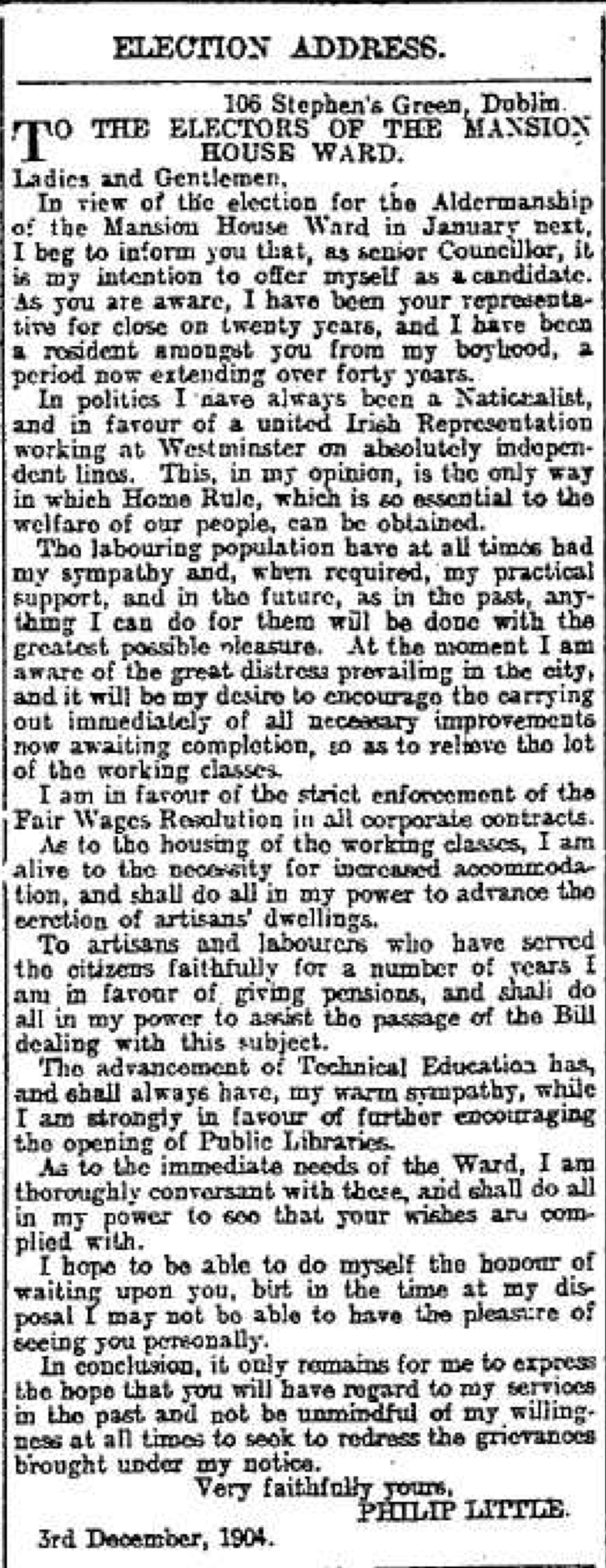
Proprietor Philip Little was a Dublin Corporation councillor from 1884 and seeked re-election in the 1905 election. He described himself as a Home Rule Irish Nationalist, a friend of the Labouring Classes, a supporter of social housing and in favour of more public libraries and expanding Technical Education.

Philip Little, election address. Evening Herald, 3 Dec 1904

The 1911 census shows that Phillip Little (75) lived in the house with his wife Bridget Little (70), a son, a daughter and two grandsons. The employed a coach-man, cook and maid. While five male groces assistants worked in the Little’s Winter Garden Palace.

During the 1916, Easter Rising, a number of building’s overlooking St. Stephen’s Green were commandeered by rebel forces. These included Little’s public house (Winter Garden Palace) at the corner of Cuffe Street and the Royal College of Surgeons at the corner of York Street. The pub was occupied by an eight-man team, a mix of Irish Volunteers and Irish Citizen Army, under the command of James Kelly. Most of them had retreated from Davy’s pub at Portobello and from Leeson Street bridge.

Philip Little put in a claim into the Property Losses (Ireland) Committee, 1916 for £189 5s 8d. This was a result of damage to his business from rifle fire, the looting of goods and the use of his property for barricades. A payment of £158 was recommended by Committee. Among the list of goods that Little claimed for included one feather mattress, 42 pieces of “best china”, six silver spoons and one gents suit.

(more…)

Read Full Post »

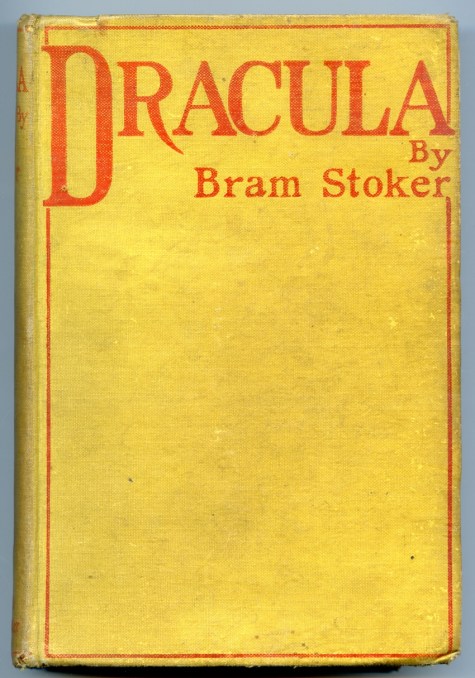
DraculaFirstEdition

A first edition copy of Dracula, 1897.

Nothing is too small. I counsel you, put down in record even your doubts and surmises. Hereafter it may be of interest to you to see how true you guess. We learn from failure, not from success!

I was delighted to be asked to curate an event for the forthcoming Bram Stoker Festival, which returns to Dublin from October 27 to 30. It is a fitting time of year to remember the Dubliner who brought the world what is undoubtedly the most celebrated Gothic horror novel.

Stoker was born in Clontarf in 1847, and educated at Trinity College Dublin, before going onto a career as a civil servant in Dublin Castle. Like his contemporary Oscar Wilde (who Stoker proposed for membership of the TCD Philosophical Society), he is  thought of not as an Irish writer, but someone who left Ireland at a young age and was shaped by other places and things. I don’t think this is fair, and this event will aim to put him in the context of the Victorian Dublin he worked in, lived in and knew as home.

What I’ve done is gathered together a team of writers, for the purpose of going on a bit of a ramble through Stoker’s Dublin, but we won’t be leaving our seats. It is a sort of ‘Psycho-Geography’ in the Little Museum of Dublin, using old photos and other sources to open up a discussion. Le Blurb:

Without even leaving your seat, take an imaginary trip through the streets and alleyways of the Dublin of Bram Stoker and his literary contemporaries, Lafcadio Hearn and Sheridan le Fanu.

Vivid conversations with striking visual images describe the lit erary, social and political scenes of Victorian Dublin.

lisamarie

Stones of Dublin (Collins Press)

Lisa Marie Griffith was a natural fit for any such panel, owing to her excellent study Stones of Dublin: A History of Dublin in Ten Buildings. Beautifully illustrated, the book examines places like Trinity College, Dublin Castle and the Old Irish Parliament and looked at their importance in shaping the city. She knows the bricks and mortar of the city so well, but also the important contexts (political, cultural, social) of the times in which these buildings were constructed. It’s a great read,and just part of her excellent output on Dublin in recent years.

Frankie+Gaffney

Frankie Gaffney (Liberties Press)

Frankie Gaffney’s debut novel, Dublin Seven, was described as being akin to “Love/Hate meets Ulysses.” Set very much in the here and now, there’s a reason I asked Frankie onto this panel. His knowledge of the written word through time, and his obsession with the evolution of the novel (see this Tedx talk), is part of his great love for literature and the journey it has come on. He is completing a PhD in Stoker’s Alma mater, not to mention teaching there. He is an important voice on Dublin today, but I look forward to hearing his views on Stoker’s place in the literary canon.

lisamarie

A Fantastic Journey (University of Michigan)

Finally, Paul Murray was not only a natural addition to this panel, he was an essential part of it. An expert on not only Bram Stoker, he has also examined the more forgotten Lafcadio Hearn, another important horror writer of the nineteenth century. That study won the 1995 Koizumi Yakumo Literary Prize in Japan, and was awarded the Lord Mayor of Dublin’s Prize too. Stoker is just one of the horror writers Ireland has produced, so let us briefly examine the others.

This is a chance to learn more about Dracula, yes, but also Dublin. How did Dublin shape Stoker? Come along and find out!

Time 3pm
Date October 28th
Location The Little Museum of Dublin, 15 St. Stephen’s Green, Dublin 2

TICKETS FROM BRAM STOKER FESTIVAL.


Read Full Post »

guevarastamp

New commemorative stamp from An Post.

Today marks the fiftieth anniversary of the passing of Ernesto ‘Che’ Guevara, shot in Bolivia having been captured leading a small revolutionary force against the Bolivian army.

In Ireland, there has been considerable controversy around the decision of An Post to issue a commemorative stamp to mark this anniversary. That the stamp is very much a celebration of one of the most important pieces of twentieth century Irish art, Jim Fitzpatrick’s Viva Che!, seems to have passed many commentators by.

In an Irish context, Guevara is very much associated with Fitzpatrick’s iconic artwork and the words of his father, who proclaimed following his sons death that “the first thing to note is that in my son’s veins flowed the blood of the Irish rebels.” They were powerful words, even finding their way to the painted gable wall of a Derry house in time.

In 1949, General Tom Barry published Guerrilla Days in Ireland, considered by many to be the classic War of Independence memoir. While Ernie O’Malley would poetically capture the spirit of the people in On Another Man’s Wound, Barry’s memoir focused primarily on the IRA’s Flying Columns, the bands of men who terrorised patrolling Auxies and Black and Tans in the Irish countryside.

The IRA of 1919 did not invent guerrilla warfare, in an Irish (Michael Dwyer of the United Irishmen may claim that honour) or international context. In South Africa, the Boers adopted guerrilla army tactics so effectively during the 1899-1902 war, that the widespread internment of Boer women and children in concentration camps was used to break their morale. Zapata had his ‘dynamite boys’, the Italians their ‘Brigands’. What the Irish War of Independence did produce however was a remarkable volume of literature on guerrilla warfare.

In her biography of Barry, historian Meda Ryan discusses the international influence of Barry’s memoir, noting that its influence was significant enough to move many international fighters to contact Barry. One such figure was the Zionist radical (for radicalism is not exclusive to the Left) Menachem Begin, founder of the militant group Irgun and later sixth Prime Minister of Israel. Begin’s appeals to Barry are all but forgotten, but the same cannot be said of Che Guevara.

Guevara’s outreach to Barry was, Ryan notes, unsuccessful. Barry believed that the fight of Irishmen was at home, and though opposed to the Blueshirt threat in 1930s Ireland, had strongly discouraged Irish participation in the Spanish Civil War. It remains an interesting footnote in Irish history.

maureenhavana

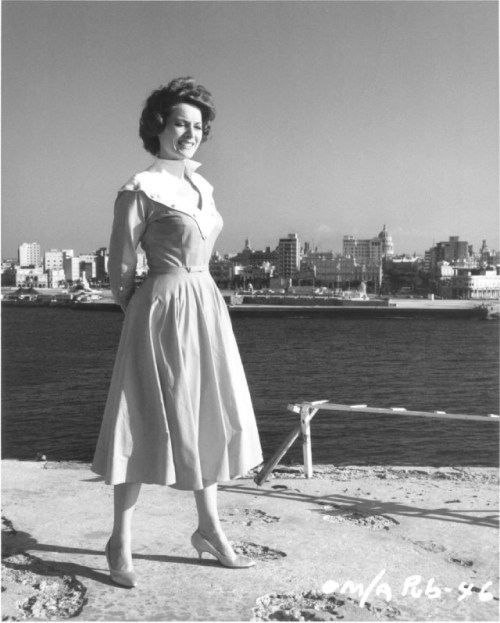
Maureen O’Hara in Havana, 1959.

While Guevara may not have encountered Tom Barry in the flesh, he did cross paths with many Irish people, including the celebrated Dublin-born actress Maureen O’Hara. Filming Our Man in Havana there in 1959, she was clearly smitten by the Guevara she met, remembering later in her memoir:

When we arrived in Havana on April 15, 1959, Cuba was a country experiencing revolutionary change. Only four months before, Fidel Castro and his supporters had toppled Fulgencio Batista… Che Guevara was often at the Capri Hotel. Che would talk about Ireland and all the guerrilla warfare that had taken place there. He knew every battle in Ireland and all of its history. And I finally asked, “Che, you know so much about Ireland and talk constantly about it. How do you know so much?” He said, “Well, my grandmother’s name was Lynch and I learned everything I know about Ireland at her knee.” He was Che Guevara Lynch! That famous cap he wore was an Irish rebel’s cap. I spent a great deal of time with Che Guevara while I was in Havana. Today he is a symbol for freedom fighters wherever they are in the world and I think he is a good one.

O’Hara found it hard to believe “how young and idealistic Che was…he had already helped to topple a dictator and liberate a nation.”


Read Full Post »