Feeds:
Posts
Comments

Archive for April, 2018

Nannetti

Joseph Nannetti, Lord Mayor of Dublin 1906/7.

Little Jerusalem has a special place in the folk memory of Dublin, with the area around Portobello and the South Circular Road boasting a number of plaques and a museum which tells the story of Jewish Ireland. The story of Jewish Dublin includes names like Harry Kernoff, Leopold Bloom, Leslie Daiken and Chaim Herzog, and has been documented in memoirs like Dublin’s Little Jerusalem by Nick Harris.

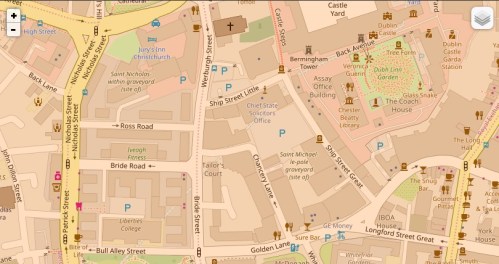
One of the more curious migrant quarters that has all but disappeared from memory is Little Italy, located in the vicinity of Little Ship Street, Chancery Lane and Werburgh Street. Its story is intertwined with that of the Cervi family, who established a lodging house in the area which became popular with Italian workers in the city. In the words of Toni Cervi, son of Guisseupi Cervi (who opened Dublin’s first fish and chip shop in 1882):

The area around us – off St. Werburgh Street….was known as ‘Little Italy’. If someone came to Dublin and wanted to locate a particular Italian, he would more often than not be directed to Little Italy. The place was filled with barrel-organ men, ice-cream men who traveled the city with their barrows, and with marble men.
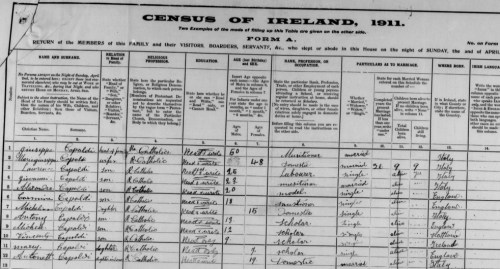
1911CenusItalians

The 1911 Census returns of the Capoldi family, living in Chancery Lane. Notice the diversity of birthplaces, revealing the journey the family had undertaken before setting in Dublin (National Archives of Ireland.)

Little Italy never amounted to a community the size of Little Jerusalem. As Cormac Ó Grada has noted, Dublin by 1912 contained fewer than 400 migrants of Italian stock. What is telling was the diversity of Italian migrants living in Ireland in terms of skilled labour; workers from Italy’s Lucca region tended to be “made up of artisans, plaster workers, and woodworkers, with surnames like Bassi, Corrieri, Deghini, Giuliani and Nanetti.” Others, originating in the Val di Comino, tended to be “either street-sellers of ice cream or cafe owners.” The later included familiar names like Forte and Fuscos.

References to Dublin’s ‘Italian Colony’, as such quarters were known, are plentiful in the press of the 1880s and 1890s. The Freeman’s Journal wrote in 1886 of the contribution of Italians living in Dublin to New Years Eve traditional festivities:

 There is within the boundaries of Dublin no more extraordinary spectacle to be witnessed on New Years Eve than the annual serenade of the Italian organ-grinders and musicians in Chancery Lane. This comparatively unknown portion of the city has been for many years the headquarters of all the Italian and other itinerant foreign street musicians who migrate to Dublin.

Italian ice cream men sometimes got a hard time of it in the Irish press, with the Evening Herald lamenting how “thoughtless city children eagerly partake of the ice-creams vended by them. These delicacies are manufactured and stored in the tenements of Chancery Lane…It should interest the authorities to discover whether these dairies are registered according to law.” Still, Dubs trusted the Italians when it came to ice cream. John Simpson has noted that “the 1901 Ireland census records the Dubliners’ indebtedness to their compatriot Italians for ice-cream. Of 23 people listed as involved with the ice-cream trade as vendors or makers, all but seven were born in Italy.”

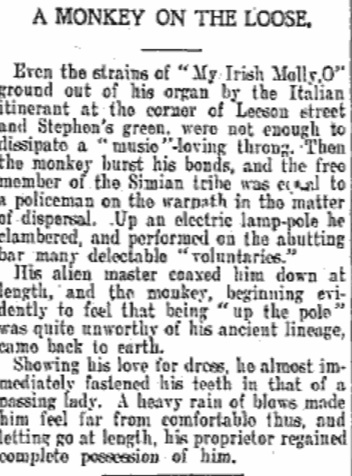
Italian organ grinders, complete with performing monkeys, became familiar sights on the streets of the capital too. The occasional escaping money made it into the press, and sometimes their owners made it into the courts.
ItalianColony

Irish Independent, March 1906.

The most well-known figure to emerge from the Italian community in Irish public life was Joseph Nannetti, the son of an Italian sculptor and modeller who involved himself in both municipal and national politics. A Home Rule nationalist and a committed trade unionist (though of a school of trade unionism that was very different from the radicalism preached by men like Connolly and Larkin), Nannetti served as Lord Mayor of Dublin in 1906/7, and is mentioned by James Joyce within the pages of Ulysses.

The level involvement of Italians in radical Irish politics is difficult to gauge, though there are some passing references to the Irish Italian community within the Bureau of Military History. Stephen Keys,a section commander in the IRA’s Dublin Brigade during the War of Independence, remembered that “No one in Camden Street ever attempted to obstruct us.. In fact, they had great respect for us. Some of the shopkeepers; in that area, including an Italian named Macetti who had an ice-cream shop, used to subscribe to our arms fund.” There are mentions of some members of the Italian community in Belfast suffering during the Anti-Catholic pogroms there in the dark days of the Civil War too.

One family of Italian blood who were deeply involved with republicanism during the revolutionary period were the Corri’s, with Hayden Corri’s Military Service Pension file detailing his contribution to the Republican Police during the War of Independence and the Republican side of the Civil War. Hayden and his brother, WIlliam Corri, were the grandchildren of the talented landscape painter Valentine Corri, whose family hailed from Rome.
1911CenusItalians

Contemporary Ordinance Survey map showing some of the streets where Dublin’s Italian community settled, including Ship Street Little and Chancery Lane (Image Credit: OSI)

With the emergence of Fascism in Italy, the ideology gained influence among some sections of the Italian community in Ireland. The presence of Italian ‘Fascisti’ in Dublin was closely monitored by state intelligence. The fourth anniversary of Mussolini’s March on Rome was marked at the Italian Consul’s Office on Lower Abbey Street, while an ‘Irish Free State Fascisti Headquarters’ was opened at Fownes Street in September 1927. At the funeral of Kevin O’Higgins, the government minister assassinated by Irish republicans in retaliation for the execution policy of the Free State in the Civil War, the Leinster Leader newspaper reported that “a picturesque note was struck by the Dublin Fascisti in blackshirts.”

1911CenusItalians.jpg

Evening Herald, October 1926.

There is no trace of Italian migration in the areas around Chancery Lane, Werburgh Street and Little Ship Street today. Familiar Italian names over fish and chip shops, and beautiful stucco work inside some of Dublin’s finest homes, remain however.

Read Full Post »

casinofinglas

On both sides of the Liffey, former cinema buildings dot suburban Dublin. They have taken on new lives, often as bingo or snooker halls. The old Astoria Cinema (later the Oscar) by Ballsbridge has become a Sikh temple, while Ballyfermot’s  Gala Cinema became home to a carpet shop, Chinese takeaway and more besides.

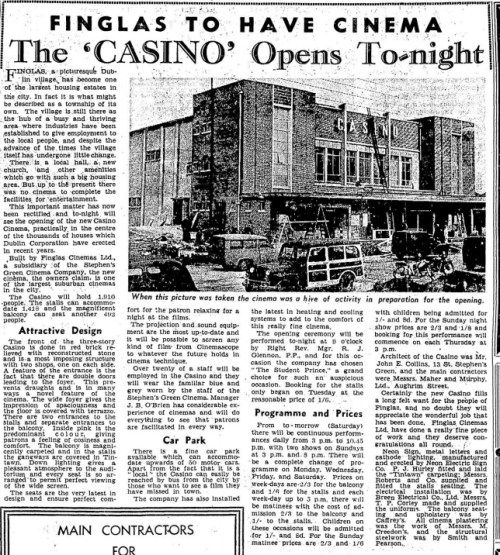
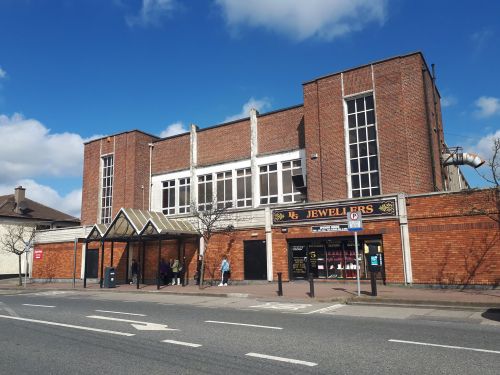
One I’d walked by several times before noticing is The Casino in Finglas village. Sitting between Supervalu and the Shamrock Lodge, The Casino was perhaps a victim of its own ambition, boasting a remarkable 1,910 seats. To put that in context, a nearby church could hold 1,500 parishioners. The misfortune of The Casino was the timing of its arrival on the scene,  opening in 1955 as the spectacle of television was beginning to loom large over suburban Dublin. Looking at it from across the street, it retains the very distinct appearance of a suburban cinema, despite its entrance being swallowed up by new development.

Constructed by Maher and Murphy, a building company based on Dublin’s Aughrim Street, the new cinema became an integral of a suburb that was very new, much like Artane and Ballyfermot on the other side of the Liffey.  Almost overnight, it seemed to the Evening Herald that Finglas, “a picturesque Dublin village, has become one of the largest housing estates in the city.” New suburbs required churches, schools, shops and cinemas.

The Evening Herald praised the building, noting that “the front of the three-story Casino is done in red brick relieved with reconstructed stone and is a most imposing structure with two shops, one on each side. A feature of the entrance is the fact there are doors leading to the foyer.”

casinofinglas.jpg

Evening Herald report on opening of cinema.

The new suburbs saw an influx of families from the inner-city, where tenements remained a subject of worry to many, and which continued to pose a grave threat to the welfare of Dubliners, with four lives lost to tenement collapses in 1963. In the below RTÉ feature from 1964, it is clear that some were quite content to move to Finglas. One youngster interviews mentions there being “plenty of fields to play in”,while another talks of her joy of having hot water in her household. Still, local amenities were often slow to pop up in new suburbia, creating alienation and boredom. The actor Brendan O’Caroll remembered the positive impact of The Casino in the area in the absence of other amenities, recalling that “I loved the fact you could go to the pictures and imagine you were the boy up there on the screen. I never thought that one day I’d ever be in a movie, that would be crazy, but the films allowed you the chance to dream, to use your imagination.”

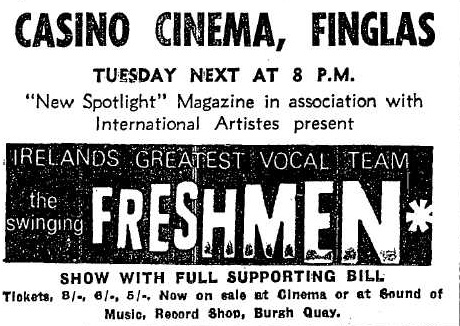
What nobody could predict when the doors of The Casino opened was the impact of television in the following decade. In a city and county that boasted no fewer than 56 cinemas in 1956, the arrival of television into the living rooms of suburbia heralded their death kneel. Cinemas sometimes took on a new lease of life as concert venues, with The Ramones  famously playing in Cabra and Phibsboro cinemas, while The Casino hosted concerts of its own.

casinofinglas

Evening Herald, 1968.

What suburbia felt it needed now was not cinema, but shopping centres. By 1970, The Casino was a memory,  replaced by Superquinn. Still, the facade remains today, reminding many locals of simpler times.

Read Full Post »

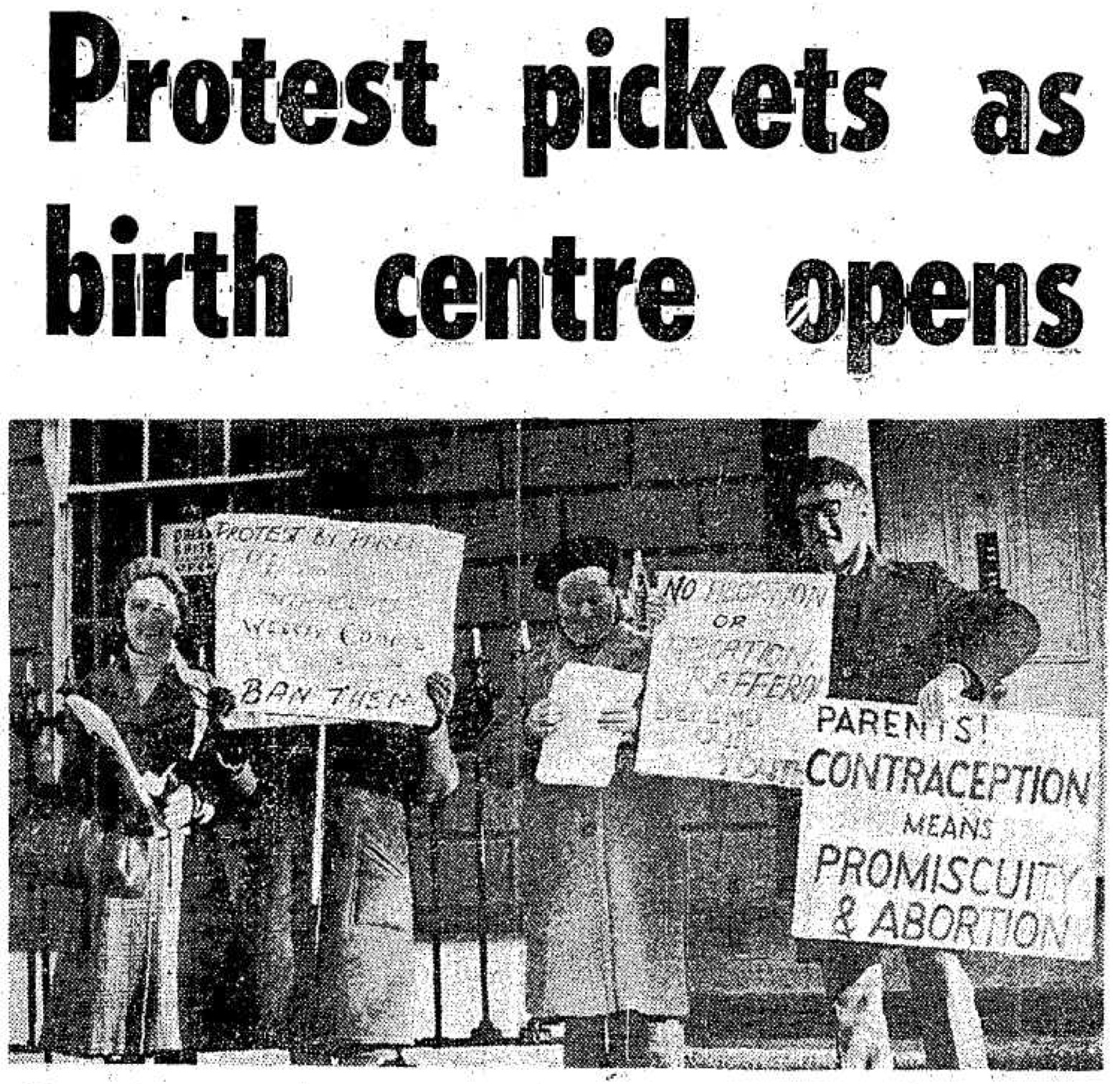
In January 1978, the Dublin Well Woman Centre opened its fifth clinic in the city at 63 Lower Leeson Street under the directorship of Anne Connolly. The aim of the organisation was to help “Irish women access family planning information and services”.

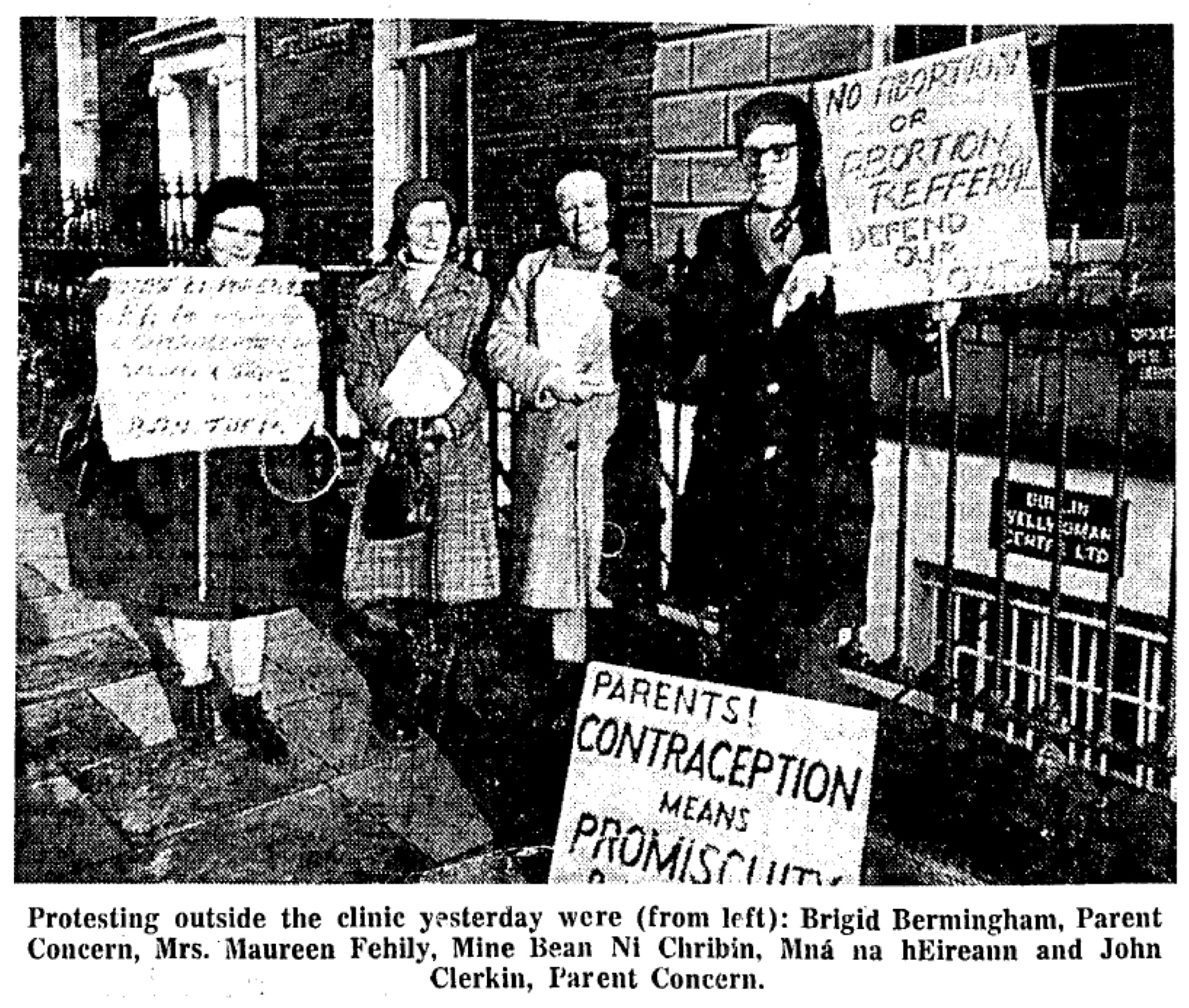
Four right-wing Catholics picketed the opening of the centre with placards reading: “Parents! Contraception means Promiscuity & Abortion” and “No Abortion or Abortion Referral! Defend Our Youth”.

Well Woman Centre picket. Evening Herald, 17 Jan 1978.

The four individuals were Brigid Bermingham, Maureen Fehily, Mine Bean Uí Chroibín/Chribín (Mena Cribben) and John Clerkin.

Well Woman Centre picket. Irish Press, 18 Jan 1978

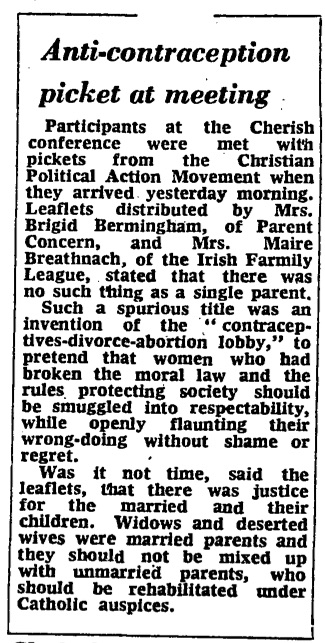
Bridget Bermingham (or Brigid Bermingham) of 25 Lombard Street West, Dublin 8 was Secretary of Parent Concern in the 1970s/1980s and was also connected to the Concerned Christians’ Group in the early 1980s. She wrote dozens of letters to the newspapers from 1975 until 1986. In November 1977 she handed out leaflets, with Máire Breathnach (Irish Family League) outside a Cherish conference, that stated that there was “no such thing as a single parent” and that the term was invented by the “contraceptives-divorce-abortion-lobby”.

Brigid Bermingham. The Irish Times, 19 Nov 1977.

In June 1980, Bermingham wrote a letter to the Taoiseach Charles Haughey expressing concern about family planning centres and suggesting that they “are no more than prostitution centers (sic) for orgies with … the commercial advocacy of contraceptives and abortion”.

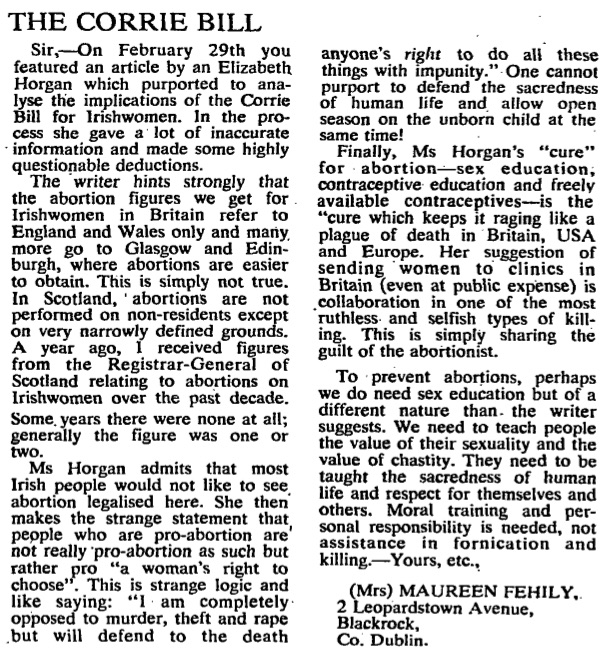
Maureen Fehily, of 2 Leopardstown Avenue, Dublin 18, seems to have been an independent operator. A 1980 letter of hers advocated that Irish children needed a sex education based around the concepts of chastity and moral training and “not assistance in fornication and killing“. She passed away in 1982.

Letter from Mrs. Maureen Fehily to The Irish Times, 06 Mar 1980

Mena Cribben of Santry Avenue, Dublin 9 was a vocal spokesperson for an array of ultra-conservative Catholic groups from the late 1960s until the late 2000s. We covered her political history in a 2012 post on the site. She passed away that same year.

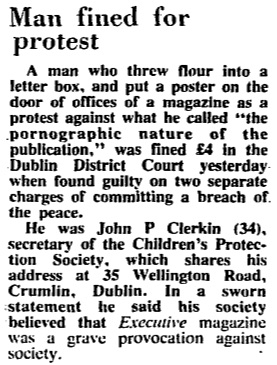
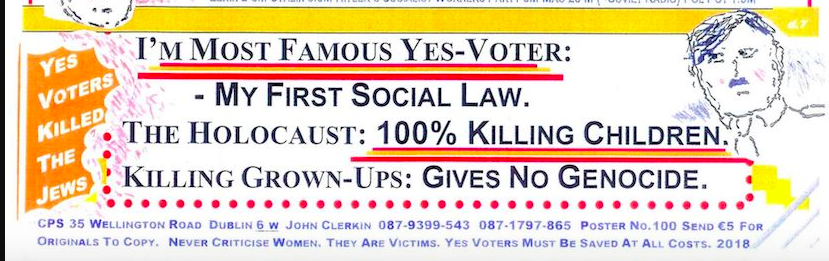
John P. Clerkin of 35 Wellington Road, Crumlin, established the Children’s Protection Society in late 1978. Throughout the 1980s, he rallied against contraception, homosexuality and liberal values.

John P. Clerkin fined. The Irish Times, 27 June 1980.

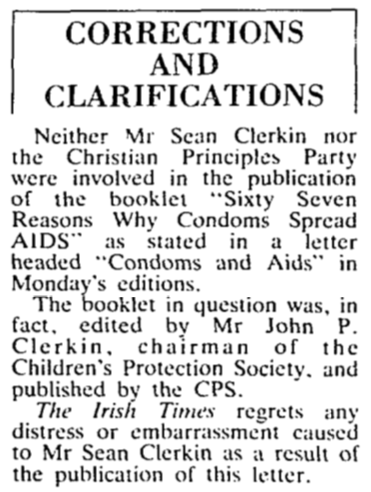
In 1991, he published a pamphlet entitled ’67 reasons why condoms spread acquired immune deficiency syndrome’.

While they have similar names and have been confused in the past, it would seem that John P. Clerkin is a different individual to Sean Clerkin who ran for the Christian Principles Party in the Cabra ward in the 1991 Dublin City Council Local Election polling 1136 votes (10.4%).

Clerkin mix-up. The Irish Times, 25 July 1991.

Bizarre leaflets from the Children’s Protection Society using the same address and signed by John Clerkin appeared in 2015 and 2017. Further unhinged literature calling on the Irish public to Vote No to retain the 8th amendment also appeared in April 2018 pasted to lampposts and bus-stops. The original John Clerkin, aged 34 in 1980, would be around 72 today so it is quite possible that he or a close relation are behind the most recent circulars.

2018 anti-Repeal material from the Children’s Protection Society. Credit – Irish Election Literature blog

Read Full Post »

Sunstroke

The Irish Times image of Sunstroke, 1994.

Times change, and with it so does public taste. It is certainly fair to say that Irish music festivals in recent years have been dominated by electronic acts and hip hop, which of course is not in and of itself a bad thing. Kendrick Lamar headlines Electric Picnic, Forbidden Fruit sees acts like Four Tet. Those complaining that these festivals are moving away from their so-called roots should note that this has always been the case, with festival line-ups reflecting contemporary charts and tastes. For as long as there have been festivals, there have been people moaning about their line-ups.

In Ireland, the festival came late. The first ever outdoor rock festival in Dublin, and one of the first in Ireland, happened on the hollowed-turf of Richmond Park in 1970, headlined by Mungo Jerry supported by upcomers Thin Lizzy. The thing was a spectacular flop, largely because of scaremongering in the run up to it, especially around drug use.  “I’ve been to better wakes” was a quote from one discontented young punter in The Irish Times, which ran with the headline ‘Open Air Festival Hardly Pops’.  In some ways, and as historian Diarmaid Ferriter has noted, the 1970s were Ireland’s 1960s, and as the decade went on we got better and better at festivals, producing some of the finest in the world for diversity. One could hear a New Wave band like The Atrix and folk giants like Moving Hearts at the same festival in Ireland, proper diversity if ever it existed.

Today, we’re looking at Sunstroke – an incredibly optimistic name for an outdoor festival in Ireland, where pneumonia is generally a greater threat that sunstroke to any paying punter. Running in the early 1990s, it rode the wave of grunge, a real youth culture phenomenon in its day. The festival took place on another League of Ireland pitch, this time Dalymount Park, and had a capacity of 15,000 people. It brought music back to a venue with a prestigious musical history, Dalymount had previously hosted acts like Bob Marley, Thin Lizzy and The Specials.

Sunstroke geared itself towards fans of a heavier sound, young people who were drawn in particular to the distinctive Seattle sound that had become both popular and marketable. It was hard to define just what ‘grunge’ was, The Boston Globe had a go in 1992:

The Seattle-based ‘grunge’ movement is a loosely defined amalgam of guitar-heavy rock music, retro-hippie fashion, laid-back attitude and cafe culture. While nobody can define what grunge is exactly other than a youthful rebellion against pop culture’s slicker aspects, musical, sartorial and otherwise, devotees know it when they see it. And from espresso bars to wool caps, from Alice in Chains on the radio to students in plaid on the streets…the trappings of grunge culture are popping up everywhere.

Every subculture of the twentieth century worried someone of course – before Grunge it was Punk, before Punk it was the Beats, before them the Teddy Boys. Bands from this scene found international success – Nirvana’s Nevermind was a game changer, less commercially successful but equally socially important were Soundgarden’s Superunknown and bands like Mudhoney. A ticket to Sunstroke was £23.75, a very significant sum of dosh in 1993.

To launch a music festival in Ireland in 1993 required a certain confidence. The opposition seemed unshakeable.  Feile in Thurles marketed itself proudly as “Europe’s biggest musical festival”, which some may dispute, but its line-up was absolutely stellar. In 1993 it boasted, to quote one regional paper, “top Australian rockers INXS, former bad boy Iggy Pop, supercool Chris Issak and crusty faves The Levellers.  Also being confirmed are The Shamen, Manic Street Preachers, Nick Cave and the Bad Seeds, Henry rolls, Teenage Fanclub, Squeeze and Paul Brady.”

Sunstroke.jpg

‘Pogo on a Nazi’ – The fashion of Sunstroke, City Tribune.

Sunstroke’s line up was reflective of the latest trends – Sonic Youth, the Red Hot Chili Peppers…. When RHCP drop out late in the day, they are replaced by Faith No More. There are brilliant images of the stage constructed on the League of Ireland pitch, and the feedback was overwhelmingly positive. The Irish Press reported that “master of ceremonies Dave Fanning kept everything moving swiftly and this open air gig didn’t suffer from the long delays between acts so many others do.”Tony Connolly in the Independent wrote after that it was a sign of something:

It is clear that something phenomenal has been happening in Ireland over the past five years. By the standards of any economic argument a turnover of millions over just ten days in a summer and in predominantly sparsely populated areas is prodigious….It is clear that bands want to come and record here. Ireland is the new Mecca for rock and roll.

Sunstroke returned to Dalyer in 1994, happening on a Thursday which was peculiar in itself, but with a line up that included RHCP and Soundgarden. Just to give a sense how mainstream this kind of music is at that moment in time, some of the best reportage in the run up to the gig came from the regional press all over the country, who reported on how many youths in every corner of the island were expected to converge on Phibsboro. Like in 1993, there was a high profile drop out, this time Soundgarden; Ice Cube stepped into the breach –  leading the Evening Herald to write “there are as many people appalled at his bitter ranting as there are people who claim to be down with Ice.”

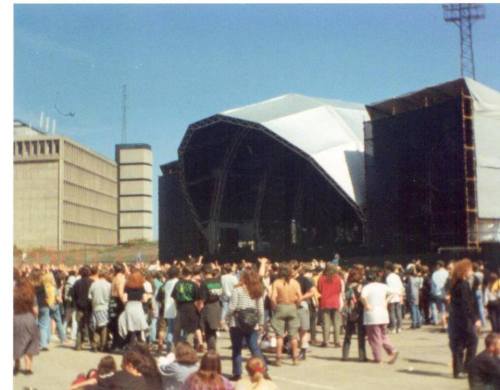
It seemed Sunstroke 1994 rocked a little bit too much – The Dalymount Roar – normally reserved for Block G on a Friday night, infuriated local residents. Mountjoy Garda station were quoted in the press the following day as saying “we were getting between 10 and 15 calls a minute protesting  at the noise levels. Some of the calls came from as far away as Coolock, Raheny and Clontarf.” Sunstroke 94 was a massive success, leading the inimitable Jim Carroll to say that “Sunstroke is now a well-established date in the Irish rock calendar. A one-day event without mud, mislaid tent pegs or the danger of an outraged crozier-bearing bishop, it’s got international kudos, bringing some of the best touring acts to Dublin.” There is something magic about images of crowdsurfing long haired young fellas, with the brutalist Phibsboro shopping centre and the battered terrace of Dalymount behind them.

Dalymountstage

Dalymount Park stage and Phibsboro shopping centre. From the excellent Classic Dublin Gigs Facebook.

Ironically, Sunstroke was probably too good at what it did. They promised rock music, they brought it, and they were in turn driven out of Phibsboro quicker than a man clad in a green and white football scarf. Councillors, even the normally hip and down-with-it Tony Gregory, kicked up a major fuss about the noise, and Sunstroke made its way to the RDS, where it died peacefully in 1995. Soundgarden headlined then, continuing a fine tradition of bands showing up a year after they were meant to.

Sunstroke.jpg

Evening Herald coverage of Sunstroke 1994.

The Irish music festival is an institution, it will no doubt continue into subsequent decades. New festivals, like All Together Now, should be welcomed, but particular praise should go to the small independent festivals, who embody the spirit of the pioneers of the 1960s and 70s.  The magic of any festival is diversity – in 1980, Seamus Ennis walked out onto the Lisdoonvarna stage and mesmerised long haired youths with the Uileann Pipes, in 1992 Primal Scream stole Chris de Burgh’s star at Feile. Magic moments.

Read Full Post »

The Man with the Hat

SeanGarland

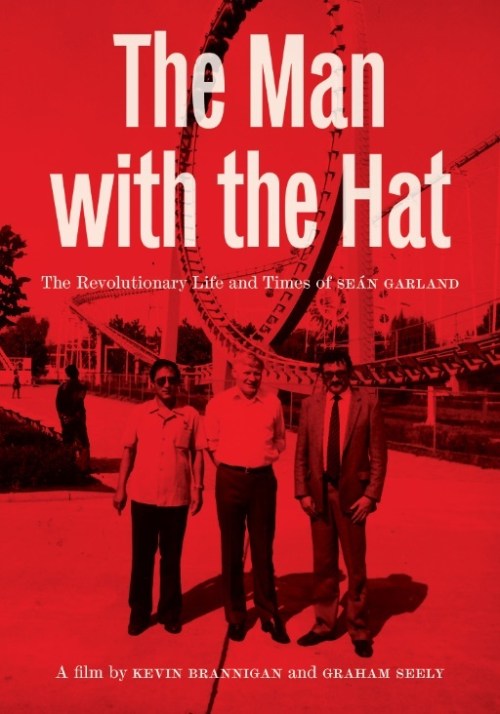
‘The Man with the Hat’ is not a name Seán Garland chose for himself. A code name bestowed upon him during a CIA investigation, it is an intriguing title for a documentary telling the story of one of the most important and controversial figures of Irish republicanism in the second half of the twentieth century. The Man with the Hat premieres May 15th in Dublin’s Sugar Club, with tickets on sale now from Eventbrite.

A veteran of the Operation Harvest campaign, which saw IRA units attacking British military interests on the north of the Irish border in a campaign directed from Dublin, Seán moved away from traditional republicanism and towards a Marxist perspective in subsequent decades. Republicanism is a broad church of course, and one of those who he had fought alongside in the so-called Border Campaign had been Seán South, an ultra-Catholic nationalist who secured his place in the nationalist pantheon thanks to’ Seán South from Garryowen’.

Sunstroke.jpg

The funeral of Seán South.

Garland was prominently involved with both the Workers’ Party and the Official IRA,  which declared a ceasefire in May 1972, though the organisation became entangled in increasingly bitter feuds with rival republican organisations in subsequent years, resulting in the deaths of primarily young men on the streets of Belfast and Dublin on all sides, including Charlie Hughes, Seamus Costello and Liam McMillen. The various feuds tore the republican movement apart at moments when unity was badly required.

Garland’s story plays out in Dublin, Belfast, Moscow, Pyongyang and in other surprising places. It is both the story of a secretive parliamentary organisation (which remained active in various ways long after its supposed ceasefire) and a political party which sought Soviet guidance and political power in Ireland. By 1987, an explicitly Marxist party had eight parliamentarians sitting in Dáil Éireann. In 1992, as communism collapsed across Europe, seven of its parliamentarians had abandoned the party and established the social democratic party Democratic Left.

In 2005, a new chapter in Garland’s life began as the United States sought his extradition on the basis of alleged involvement in the distribution of counterfeited US dollars – widely known as “superdollars” – in 1998. American authorities alleged that the source of the banknotes was the government of North Korea.

This upcoming documentary promises to examine all of these issues and more. How a young man from Dublin’s north inner-city can later become entangled in a tale that involves Pyongyang and the U.S legal system is one of the most intriguing stories of twentieth century Ireland, and it is long overdue an airing.


Read Full Post »