At night we lie in filthy beds
Scratching our aching lousy heads.
Broken by the thought of rent
For a room in a stinking tenement.-excerpt from ‘The Workless’ in Republican Congress, 30 June 1934.
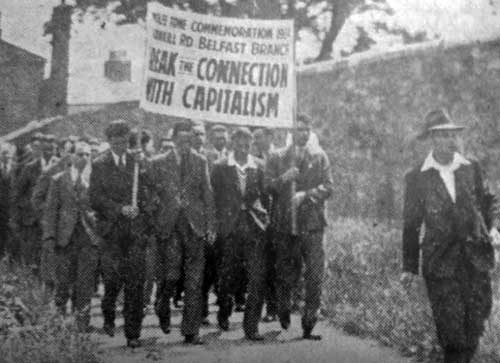
Iconic image of Republican Congress delegation partaking in commemoration. “Shankill Road Belfast Branch: Break The Connection With Capitalism.”
The Republican Congress occupies an important, though disputed, place in Irish left-wing memory. In existence from 1934 until 1936, the organisation emerged from a split within the ranks of the IRA, proclaiming boldly at its inception that “we believe that a Republic of a united Ireland will never be achieved except through a struggle which uproots capitalism on its way.”
Torn apart by internal ideological disagreement from the beginning, there is a certain romanticism attached to the Congress owing to its ability to organise some Belfast Protestant workers into its ranks and the fact some of its leading lights were killed on the battlefields of Spain (the Spanish Civil War remaining one of the few occasions in human history where history has very much been written by the defeated protagonists). Yet while much has been written on the anti-fascist activities of the Congress and its contribution to the ranks of the International Brigades, other aspects of its political activities are often overlooked. If Congress enjoyed success on any frontier, it was certainly in its abilities to organise in both Dublin slumdom and emerging suburbia with the emergence of Tenants Leagues, winning a number of victories over landlords and an embarrassed Dublin Corporation. Many of its tactics, from rent boycotts to the occupation of houses, would be adopted by later generations of housing activists.
A changing tenement landscape
The tenement landscape of 1930s Dublin is something we have previously examined on the website. In an irony of history, many of the tenements occupied what was once the splendor of a Georgian city. As Jim Larkin Jr. would recount, Dublin stood upon the Liffey as “a city of fine Georgian houses which had been slowly rotting away for a hundred years and which had become an ever growing cancer of horrible, inhuman, dirty, vermin infest tenements, unequaled by any modern city in Europe.”
The period witnessed some significant advances in public housing in the capital, thanks in no small part to the approach taken by Housing Architect Herbert George Simms, responsible for the construction of some 17,000 new dwellings in his time in office. New flat dwellings were constructed in the city, while suburban development pushed ahead. Taking Cabra as an example of growth, the population there increased from 5,326 in 1926 to 19,119 in 1936. Cabra on the northside and Crumlin/Drimnagh on the southside represented the most ambitious suburban developments of the still relatively new Free State. Fianna Fáil had made housing an election issue in 1932, referring to the out-going first government of the state as a “rich mans government” who had failed to provide for the working classes of Ireland’s urban centres.
Still, images like this one recently posted on the blog show how there was still much work to do. Right alongside the new developments of Simms and Dublin Corporation, tenements like those shown there in Mary’s Lane remained a reality for many. Conditions were poor in early Dublin Corporation inner-city housing schemes like Corporation Buildings, but they were worse still for those at the mercy of private landlords.
‘We, The People Of York Street’
From the very beginning of the Congress, its newspaper, Republican Congress, focused its attention on conditions in tenement Dublin. An edition of the paper in June 1934 reported on the refusal of residents of York Street to pay rents until conditions improved:
The slum dwellers of York Street have been the first section of the working-class to petition the people of Ireland to right the insufferable, shocking,inhuman conditions under which they live. Here is an appeal to the conscience of the Irish working-class that should strike a deep, momentous note of response. Terrible indignation should burn up in the breast of every worker at a system that condemns our brothers and sister to crawl to an unholy death in such cesspools of misery and abomination. Dublin landlords stand forth in this area as the most soulless, greedy, despicable exploiters of their class.
The paper called for the refusal of rents to be extended into other areas where housing was inadequate, insisting that “York Street is the first; where is the next? Extend the area! Broaden the struggle! Compel the Corporation to house the workers, whether they are able to pay or not. Houses first; talk of rent afterwards….Already it is done in English cities controlled by Labour Corporations.”
The paper encouraged tenement dwellers to “appear in your hundreds at the next Corporation meeting! Demand immediate action to clear these areas and transfer the tenants to Corporation houses and flats.” At the time, Alfie Byrne was Dublin’s Lord Mayor. Byrne had long enjoyed a strained relationship with the labour movement, stretching back to the days of Larkinism. The tenants marched onto the Mansion House, making their demands for “the stopping of eviction proceedings now pending, and immediate steps by the Corporation to house the workers of the areas in suitable surroundings.” Byrne was in unfamiliar territory, the ever-popular politician now in a hostile crowd. While he met with a delegation from the York Street tenements, he emerged to an unfamiliar audience:
When the deputation appeared with Byrne on the Mansion House steps, the crowd refused to hear Alfie Byrne and shouted for Congress speakers. In response, Charlie Donnelly said that when the Congress led the tenants of Magee’s Court, York Street and Gloucester Place to the Mansion House did not give them the undertaking that the Lord Mayor would have any solution to their problem. The Congress had told them that the Corporation was a landlord Corporation, that it served the interests, not of the tenants, but of the landlords (cheers)
The landlords’ Corporation could not solve the workers’ housing problem because under the present system, houses were not built for workers’ use but for landlords’ profit (cheers).

Charles Donnelly, a young Congress activist centrally involved in the Tenants Leagues.




 Click on the book for more.
 Click on the book for more.
 Donal
Donal Ciarán
 Sam
Sam


 Come Here To Me!