Feeds:
Posts
Comments

Archive for the ‘Dublin History’ Category

On 17 April 1949, the Cabra Grand Cinema on Quarry Road was formally opened. The Lord Mayor of Dublin, John Breen, opened the 1,600 seat cinema by cutting a tricolour ribbon with a pair of gold scissors. The cinema was designed by Samuel Lyons, and in a move that captured the spirit of the time, the building was blessed by a priest from the nearby Christ the King Church in Cabra. After the formalities, the comedy Sitting Pretty was shown. The first two films listed at the cinema in newspaper advertisements (the below advertisement appeared the day after the opening) both featured Maureen O’Hara, and the cinema boasted that it was “equipped with the latest RCA sound system”, to give cinema goers a top class experience.
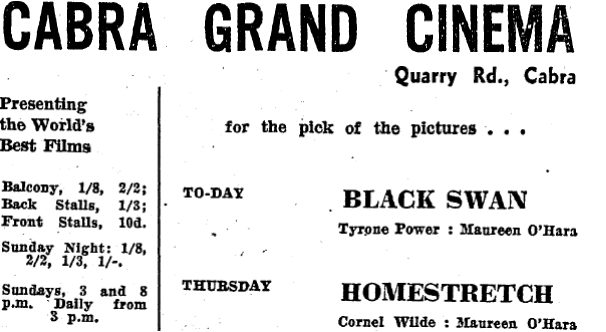
Advertisement for the new cinema.

Advertisement for the new cinema.

The first manager of the cinemas was Louis Marie, an interesting individual who had seen action during the revolutionary period. Marie had been a member of the Fianna Éireann republican boy scout organisation, and took part in the Easter Rising in 1916. His name appears in a few of the statements given by participants in the Rising to the Bureau of Military History. Gearoid Ua h-Uallachain, who took part in the attack on the Phoenix Park magazine fort at the beginning of the rebellion, noted that “Louis Marie, manager of a picture-house”, was among those involved. One newspaper article from the time of the cinemas opening claimed that Louis had served in both the French Army and the Irish Army.

Just over a year after its opening, there were very ugly scenes at the cinema, which saw shots fired by Gardaí over the heads of a reactionary mob. Two women had to seek refuge in the cinema, after they had attracted the scorn of hundreds of local people. They had been going door to door with a “peace petition” calling for the banning of the atomic bomb, and residents believed them to be members of a communist organisation. The Irish Press reported on 25 July 1950:

GARDAI from many parts of the city were hurriedly picked up by patrol cars and rushed to Quarry Road, Cabra, last night, to disperse a hostile crowd of nearly a thousand people who had surrounded the Cabra Grand Cinema and threatened two women who had taken refuge there. Weapons brandished and thrown included sticks, stones, bricks and bottles. One Garda, as he was pushing through the shouting and jostling mass, was struck by a brick in the back, but was not seriously injured. To force the crowd away from the cinema doors, which had been closed, Gardai had to draw batons and a number of shots were fired over the crowd’s heads…. The incident had its beginning shortly after nine o’clock when the two women concerned were apparently canvassing in the Quarry Road’area for signatures in connection with a “peace petition” to ban the atomic bomb.It appears that as they were going from house to house the impression that they were members of a Communist organisation got around and they were soon surrounded by a hostile crowd.

There was more drama at the cinema in 1953 when it was held up by two men armed with what appeared to be a pistol. At the time of the robbery the cinema was showing The Apparition, a religious film which was being screened as a fundraiser for the African Missions of the Holy Ghost Fathers. £6 10s was taken on that occasion.

By the late 1950s, television was the big fear for the owners of Dublin’s suburban cinemas. The biggest problem for cinema in Ireland, one official warned in 1959, “would be the advent of television on a national basis.” Many of Dublin’s suburban cinemas closed their doors throughout the 1960s and 70s, but others took on a new lease of life as centres of their communities. Jim Keenan notes in his study of Dublin cinemas historically that “by the late 1960s, the Grand has become economically unviable and it closed on 31 January 1970. The last film shown there was The Big Gundown.” The Cabra cinema was purchased by Gael Linn in 1975, and like other suburban Dublin cinemas it became both a bingo hall and a concert venue.
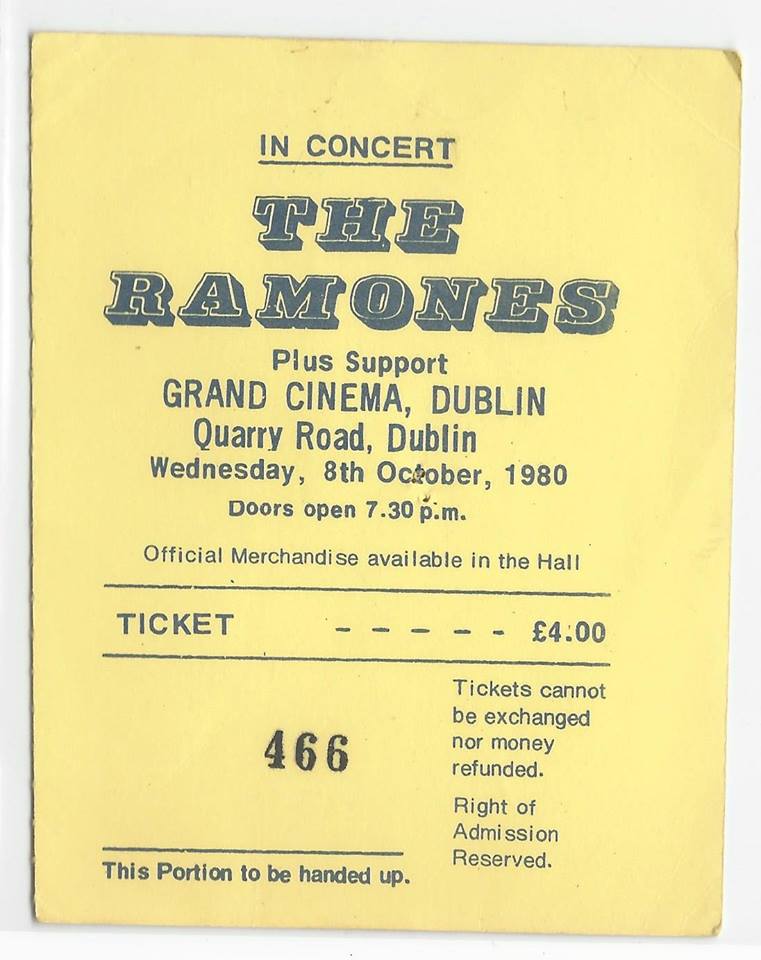
Ticket to the Ramones gig. Uploaded to the brilliant Facebook page 'Classic Dublin Gigs' by James Aquafredda Sr.

Ticket to the Ramones gig at the Grand. Uploaded to the brilliant Facebook page ‘Classic Dublin Gigs’ by James Aquafredda Sr.

The old Cabra cinema witnessed a number of celebrated, and in some cases infamous, rock concerts. Indeed, the behaviour of some youngsters after one gig led to a Dublin District Court decision that no more rock concerts could be held in the cinema in 1980. In November 1980 it was reported in the Irish Press that “Gardaí told the court that gangs of youths lay in wait to attack patrons of rock concerts at the cinema.” One source blamed the violence on a “Mod and Skinhead element in Cabra who are always fighting among themselves.” Four stabbings were reported after the legendary U.S punk band The Ramones played the venue. Joe Breen, a journalist with The Irish Times, rushed to the defence of the cinema by noting that the trouble had not only taken place after the gig, but had happened far from the venue. “There is enough trouble at gigs without it being invented”, he noted. Going into the gig, the organisers claimed that the 1,000 or so in attendance were frisked and even had their belts taken from them. Of the gig itself, Breen was far from blown away, writing that “the concert in the end was something of an anti-climax. The excitement had more to do with expectation than with experience.” The Ramones were no strangers to Dublin cinemas, haven performed two years earlier in the State Cinema, Phibsboro.
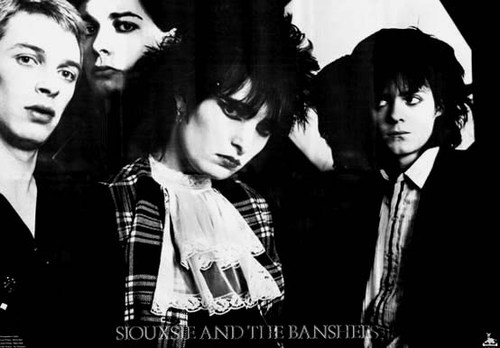
Siouxsie and the Banshees, who performed in Cabra in 1980.

Siouxsie and the Banshees, who performed in Cabra in 1980.

Siouxsie and the Banshees played the same venue soon afterwards in 1980. A comment on this very blog from a reader by the name ‘PJM’ recalled this gig, noting that the band abandoned the stage with no encore owing to the “crowd trying to get on stage and bouncers not stopping them.” 1980 was a good year for gigs at the venue, with Duran Duran also playing the cinema. Fifteen years later, Boyzone took to the stage of the old cinema before a crowd of well over 1,000 young fans, with one reviewer noting that “the bingo machine could be partially seen lying behind the curtain.”

Today, the old cinema remains very much a part of the community around it, with regular bingo nights drawing huge crowds. It, and other once thriving cinemas, are an unusual feature of suburban architecture in Dublin, and hopefully the buildings will be preserved long into the future. Many local people have great memories of films, concerts and more at this venue and we’d love to hear from you in the comments section below if you’ve a story to tell about it.

Read Full Post »

We are very pleased and excited to announce we will be hosting an evening of music, talk, film and more on 30 December at P.Mac’s pub on Lower Stephen’s Street. It is all part of Visit Dublin’s ‘Dublin Genius’ day of events, and it is totally free to attend.

For anyone wondering just where P.Mac’s is, it is the former Bia Bar, opposite the Hairy Lemon. Our event runs there from 5 to 7pm. A Facebook event for the evening can be viewed here.

We’re still finalising the line-up, but so far we feel we have put together a mix of music, history and more that captures the spirit of CHTM and should make for an interesting two hours.

Firstly, the music line-up:

Pete Holidai (Image Credit:  peteholidai.com)

Pete Holidai (Image Credit: peteholidai.com)

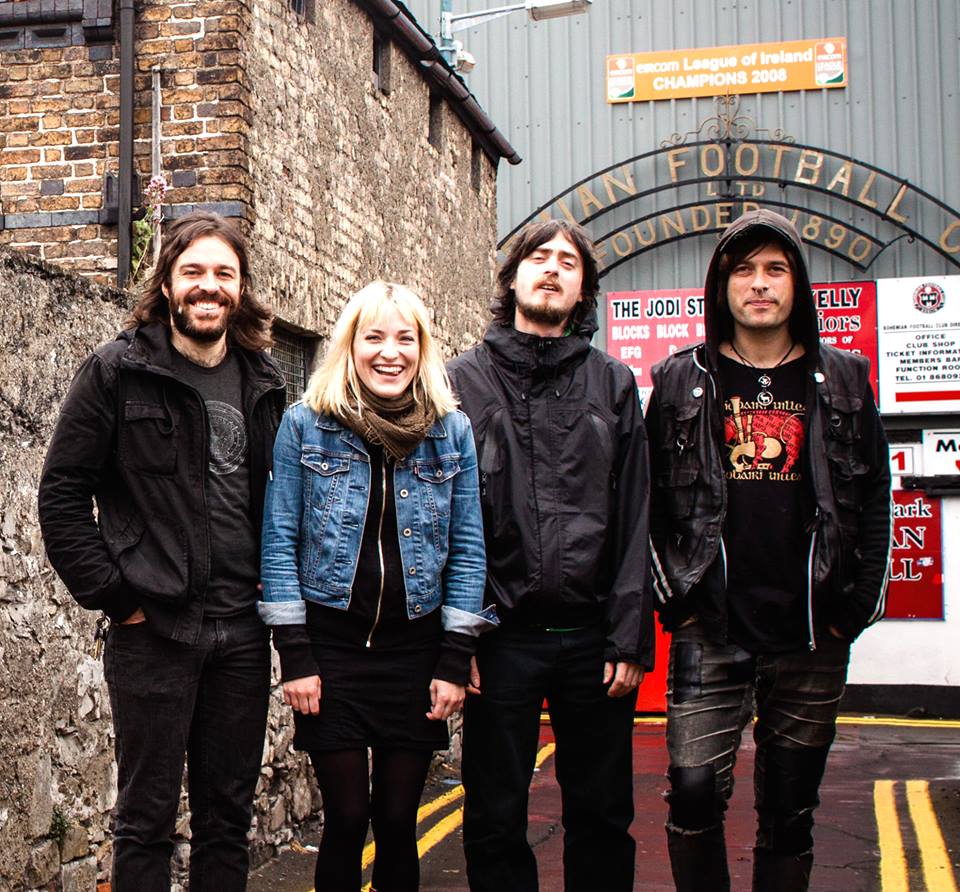
Pete Holidai plays with the Trouble Pilgrims and was a member of the classic Irish punk band The Radiators From Space. We have a lot of love for The Radiators on this website, see for example Sam’s ‘Dublin Punk & New Wave Singles Timeline 1977-1983’.

Lynched. (Image Credit: Irene Siragusa, via Lynched FB)

Lynched. (Image Credit: Irene Siragusa, via Lynched FB)

Lynched describe themselves as ‘local folk miscreants’. Having begun by performing their own folk-punk numbers, in recent years they’ve taken on many Dublin traditional songs and given them a new lease of life. Most recently I saw them perform on the same bill as Barry Gleason, and we’re big fans of what they are doing with Irish folk music.

We have a few interesting speakers lined-up, to give short talks on the subject of Dublin through the ages.

Dead Interesting by Shane MacThomais.

Dead Interesting by Shane MacThomais.

Shane MacThomais is the resident historian of Glasnevin Cemetery, and author of several works on Dublin’s history, most recently Dead Interesting: Stories from the Graveyards of Dublin. He is the son of legendary Dublin historian Éamonn MacThomais, and he’ll be chatting about how Dublin has changed over the years, mostly for the better.

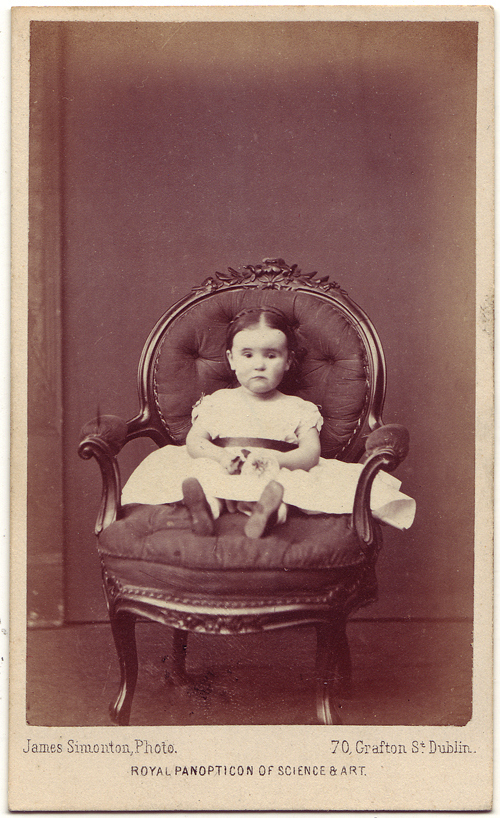
'Little Ada Cowper visits the Royal Panopticon of Science & Art, Dublin, 1867' - A post from Jacolette, February 2013.

‘Little Ada Cowper visits the Royal Panopticon of Science & Art, Dublin, 1867’ – A post from Jacolette, February 2013.

One of the most rewarding things about Come Here To Me! has been coming into contact with others online who are also doing interesting things with history. Orla Fitzpatrick is a photo historian who runs the Jacolette blog. ‘A gallery of Irish snapshot and vernacular photography’, it features many weird and wonderful pictures of Dublin, and Dubliners, through the ages.

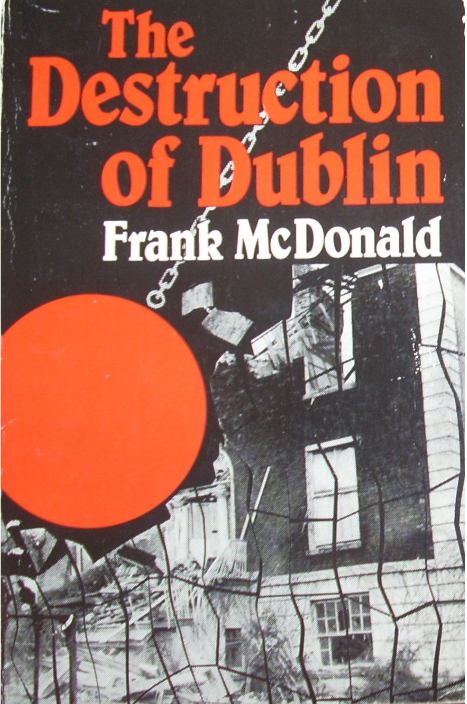
The Destruction of Dublin - Frank McDonald

The Destruction of Dublin – Frank McDonald

Few people have championed the cause of Dublin like Frank McDonald, journalist with The Irish Times and author of several works on the city, its architecture and planning. We’ll be chatting to the author of The Destruction of Dublin about how things are since the release of that classic book, and the state of the city today.

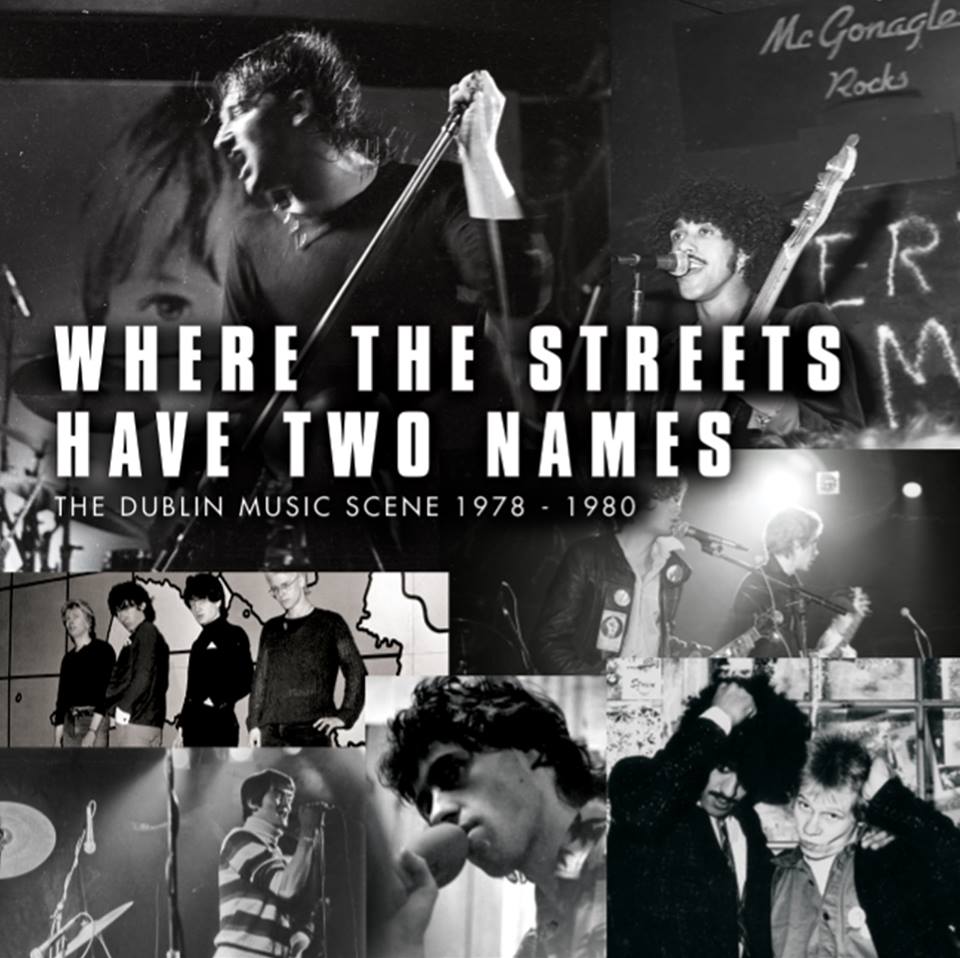
Where The Streets Have Two Names

Where The Streets Have Two Names

We’re delighted to announce that Patrick Brocklebank (photographer) and Sinead Molony (editor) who were behind this year’s excellent book ‘Where the Streets Have 2 Names: U2 and the Dublin Music Scene, 1978-1980’ have been added to the line up for our event on the 30th. There will be slideshow of some of the most interesting photos from the book (as well as some that didn’t make it into it) followed by a Q&A session.

Quadrophenia advertisement at Ambassador. Handpainted by Kevin Freeney (Image Credit: http://www.flickr.com/photos/gentlemanofletters/)

Quadrophenia advertisement at Ambassador. Handpainted by Kevin Freeney (Image Credit: http://www.flickr.com/photos/gentlemanofletters/)

We are also very pleased to announce we’ll be showing the short-film Gentlemen of Letters. This new short film from Colin Brady looks at a longstanding Dublin tradition of signpainting, from the days of Dublin legend Kevin Freeney right up to Maser and modern artists in the city.

Read Full Post »

Enjoying the view from the top of the Pillar.

Enjoying the view from the top of the Pillar.

All help in spreading this post is appreciated.

For the last number of years, I’ve been researching the Pillar and its impact on Dubliners and Dublin life. I’m as interested in the memory of the monument, and the various rows over its replacement, as the Pillar itself. I’m hopeful of doing something with my work in the very near future, but now that it is at the final hurdle, I want to issue an appeal to people for personal images and stories.

In recent years, one of my favourite works on Dublin history has been the Hi Tone produced Where Were You, a history of Dublin street style. I liked it because it put people themselves at the heart of the work. Just like the way old photographs have survived of Dubliners in jackets they now maybe wish they never bought (or in some cases, still haven’t taken off!), I know there are hundreds of photographs across the city of people and the Pillar.

I’d be very grateful to anyone who makes contact with
a) Personal images of themselves/relatives at the monument.
b) Other items of interest, such as chunks of the monument in family ownership, or miscenalious bits and pieces like artwork.
c) Proposed alternatives for the site they themselves put forward at competititon level.

You can contact me via donalfallondublin(at)gmail(dot)com. As ever with Come Here To Me and its related projects, thank you to everyone for your support to date.

Read Full Post »

By this point of 2013, many people are perhaps suffering from Lockout fatigue.

The so-called ‘Decade of Centenaries’ however is only in its infancy, with the anniversaries of historic moments like World War I, the Easter Rising, the War of Independence and the Civil War all still ahead of us. Throw in the fact that next year will mark a thousand years since the Battle of Clontarf, and you can only come to the conclusion that ‘commemoration’ is a word we will all be hearing plenty of for the foreseeable future. For all the controversies in the press around how 2016 should be marked, it must be remembered it is a relatively easy affair for the state to commemorate events that are so distant from us in there here and now.

All of which got me thinking, how was the Easter Rising marked in Dublin in the years immediately after the event? In particular, how was it marked in 1917? A year on from the rebellion, and before the outbreak of the War of Independence, was the event marked at all, or did authorities prevent any marking of the painfully recent past? With much of Sackville Street still in ruins, and some prisoners still in English jails, did the republican movement seize the anniversary as a propaganda opportunity? Looking at newspaper reports, as well as the testimony of some participants in events, they certainly did.

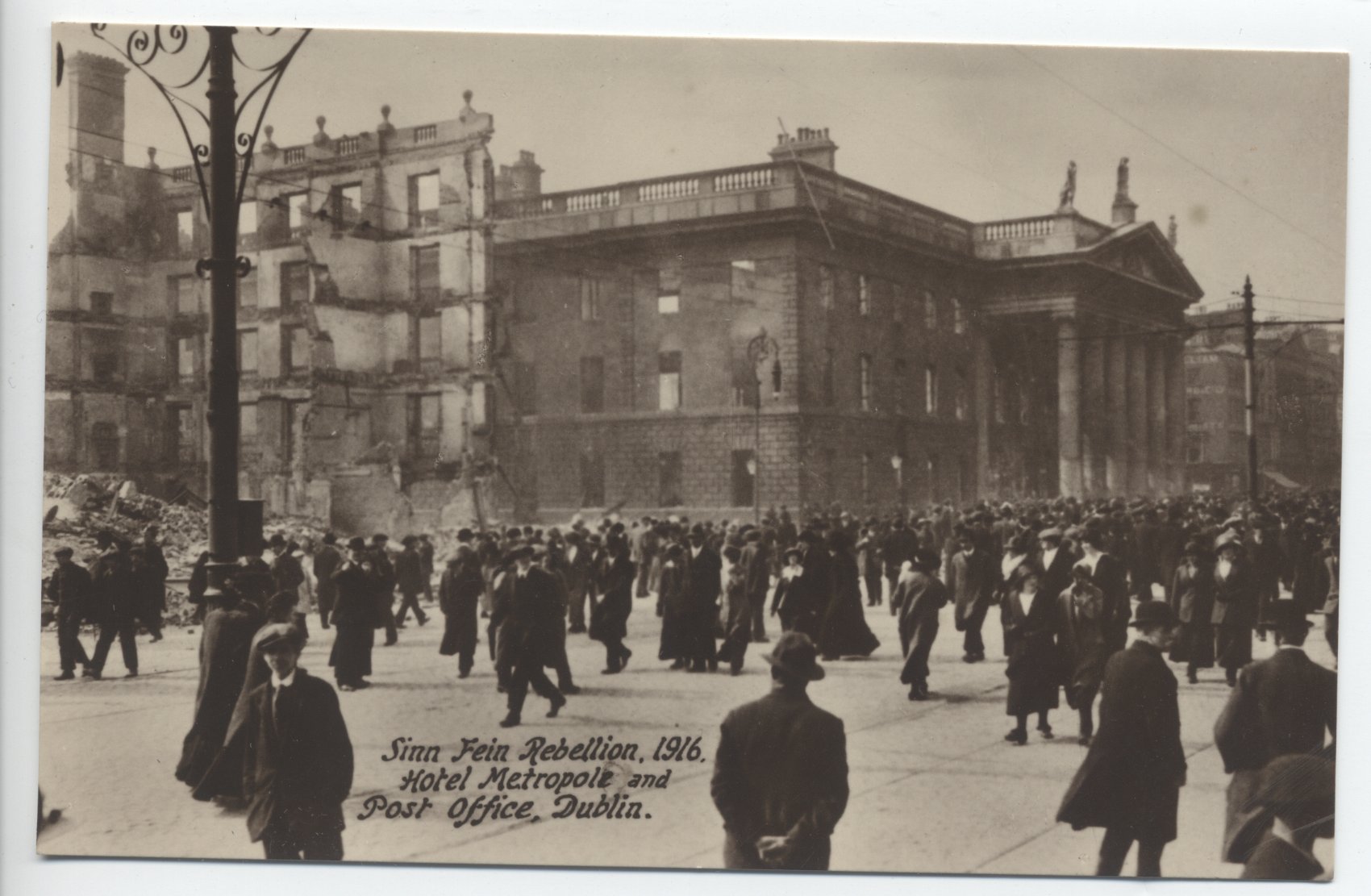
Postcard showing the intense damage to Sackville Street, issued in 1916.

Postcard showing the intense damage to Sackville Street, issued in 1916.

On 6 April 1917, a proclamation was issued by General Sir Brian Mahon, Commander-in-Chief of British forces in Ireland, and posted at the different police barracks in Dublin. It was a clear attempt at preventing any commemorative gatherings in the city during the week marking the anniversary of the uprising. It noted that “between Sunday, the 8th day of April, 1917, and Sunday, the 15th day of April, 1917” any assembly of persons for the purpose of the holding of meetings would amount to to a breach of the peace and would likely serve to “promote disaffection”. Under the Defence of the Realm Regulations, Mahon’s proclamation made it clear there would be no tolerance for unapproved gatherings, ending with the words ‘God Save the King’.

Easter Sunday 1917 was reportedly very quiet in Dublin, with The Irish Times proclaiming that, if anything, there were fewer people on the streets of the capital than on a regular Sunday. This was not attributed to appalling weather conditions. An exception to the rule was Glasnevin Cemetery, where it was noted an “exceptionally large number of persons” had been attending the graves of some who had died a year previously. The paper noted that remembrance wreaths and flowers had been placed on some of the graves, though it is unclear if these graves were predominantly of republican participants or civilians who had died.

On Easter Monday itself, all eyes were firmly on Sackville Street. It was reported in the following days newspapers that small crowds had gathered on the street from early in the morning anticipating something, and The Irish Times reported that:

Towards 9 o’clock in the morning excitement and speculation were aroused by the discovery that the Sinn Féin flag had been hoisted surreptitiously on the staff which stood on the south-east corner of the General Post Office before the rebellion, and survived the effects of bombardment on that occasion. The flag floated at half mast.

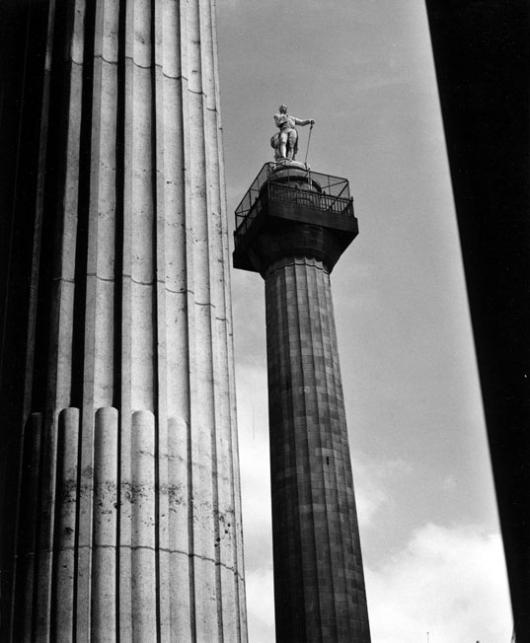
The flag fell down the pole at one stage, but by twelve noon a larger crowd had gathered on the streets and there was an incident that attracted the attention of all gathered, as a man walked across the parapet of the General Post Office and raised the flag once more. The paper reported that this was a signal “for an outburst of cheering, and various other demonstrations of approval on a wide scale.” The raising of the flag over the General Post Office once more was followed by another highly symbolic act, as republicans raised what was also reported to be a “Sinn Féin flag” from the top of the Nelson Pillar. The monument, erected to one of the heroes of the British public, had long been detested by republicans, and Nelson himself took a bullet or two during the Easter Rising. A police constable removed the flag from the Pillar, but the focus of the crowd shifted to other sites in the city as the day went on, and it was reported that some made their way down Middle Abbey Street towards Liberty Hall, which was still badly damaged as a result of firing from the Helga warship a year earlier.

The viewing platform of the Nelson Pillar, seen from the General Post Office. A republican flag from flown from here in 1917.

The viewing platform of the Nelson Pillar, seen from the General Post Office. A repubican flag from flown from here in 1917.

Defiantly, some Dubliners wore symbols of commemoration upon their own clothing. Black bands were reportedly worn by some in the crowd at Sackville Street, while others wore “ribbons of the Sinn Féin colours.”

It was noted that the rubble of the rebellion was used by some youths to attack the police, with stone-throwing on Sackville Street from about 4 o’clock, and an Inspector and Superintendent were reportedly struck. A number of young men, “wearing republican badges”, appealed to youths to desist in throwing stones, but they continued for some time, even smashing the windows of a military guard passing through Abbey Street. This kind of behaviour was condemned by The Irish Times as “the lower element seeking to let itself loose in honour of Easter Week.” As a result of clashes between youths and police, it was reported that eight civilians and four police men were treated for injuries at Jervis Street hospital. The newspaper also reported that “young roughs” had attacked the Methodist Church in Lower Abbey Street in the melee, breaking a number of windows and doing considerable damage.
(more…)

Read Full Post »

96fans

Advertisements like the one above for The Indian Store were quite commonplace in 1930s newspapers, appearing not only in An Phoblacht and the republican media, but also in mainstream publications like the Irish Press. The Indian Store sold a variety of produce inspired by India, or in some cases imported from the country. This advertisement is interesting because it attempts to ride the wave of the ‘Boycott British’ movement at the time, something we’ve looked at on the site before, in a feature on the ‘Boycott Bass’ campaign.

Republican newspapers gave very significant coverage to Indian affairs at the time, with An Phoblacht proclaiming in June 1933 that “the terror of the Tans, hidden from the eyes of the world, is sweeping over India. Indian revolutionaries, jailed for their activities, against British rule, protesting against their treatment by hunger strike, have been killed by forcible feeding.” Sympathy for Indian nationalism had existed in Irish nationalist circles long prior to the 1930s. Helena Molony, in a detailed statement to the Bureau of Military History about her involvement in revolutionary politics, remembered that the women’s group Inghinidhe na hÉireann had flypostered Dublin with posters in honour of Indian nationalist Madan Lal Dhingra, who was executed for assassinating a British official in 1909. From the gallows, Madan Lal Dhingra stated that “I believe that a nation held down by foreign bayonets is in a perpetual state of war.” He was executed at Pentonville Prison, the same prison where Roger Casement was hanged in 1916.

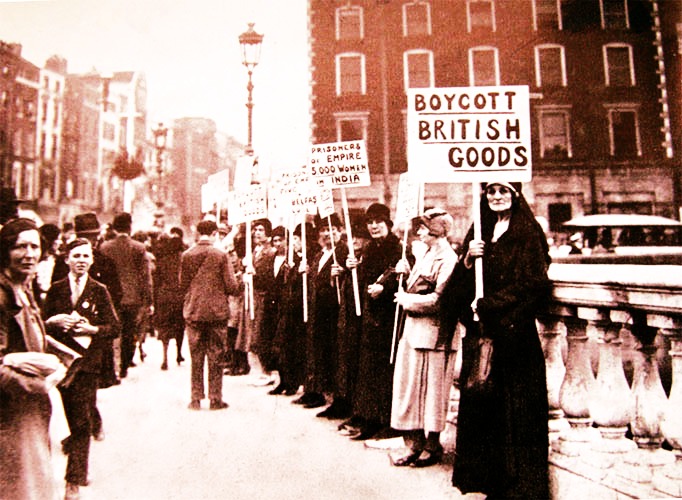
Back to the advertisement. This image of Maud Gonne MacBride was taken around the same time this ad appeared in the media, in the early 1930s. It should be noted that while her placard simply calls on passersby to “Boycott British Goods”, another placard is visible behind her expressing solidarity with India.

Maud Gonne protesting on O'Connell Bridge in the early 1930s.

Maud Gonne MacBride protesting on O’Connell Bridge in the early 1930s.

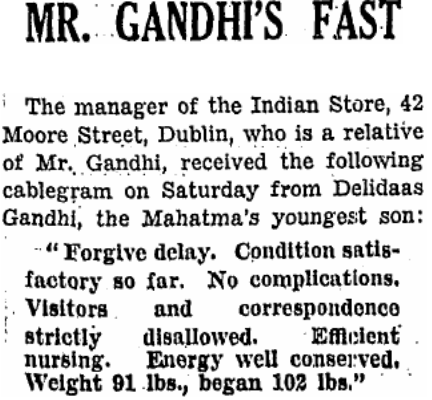
The shop appears to have been based on Moore Street for a period in the 1930s, a street that today includes multiple Indian restaurants and international shops. The most interesting reference to the shop I can find in the archives comes from the Irish Press in May 1933, who reported that the owner of the shop was a relative of Gandhi:

IndianStore

Read Full Post »

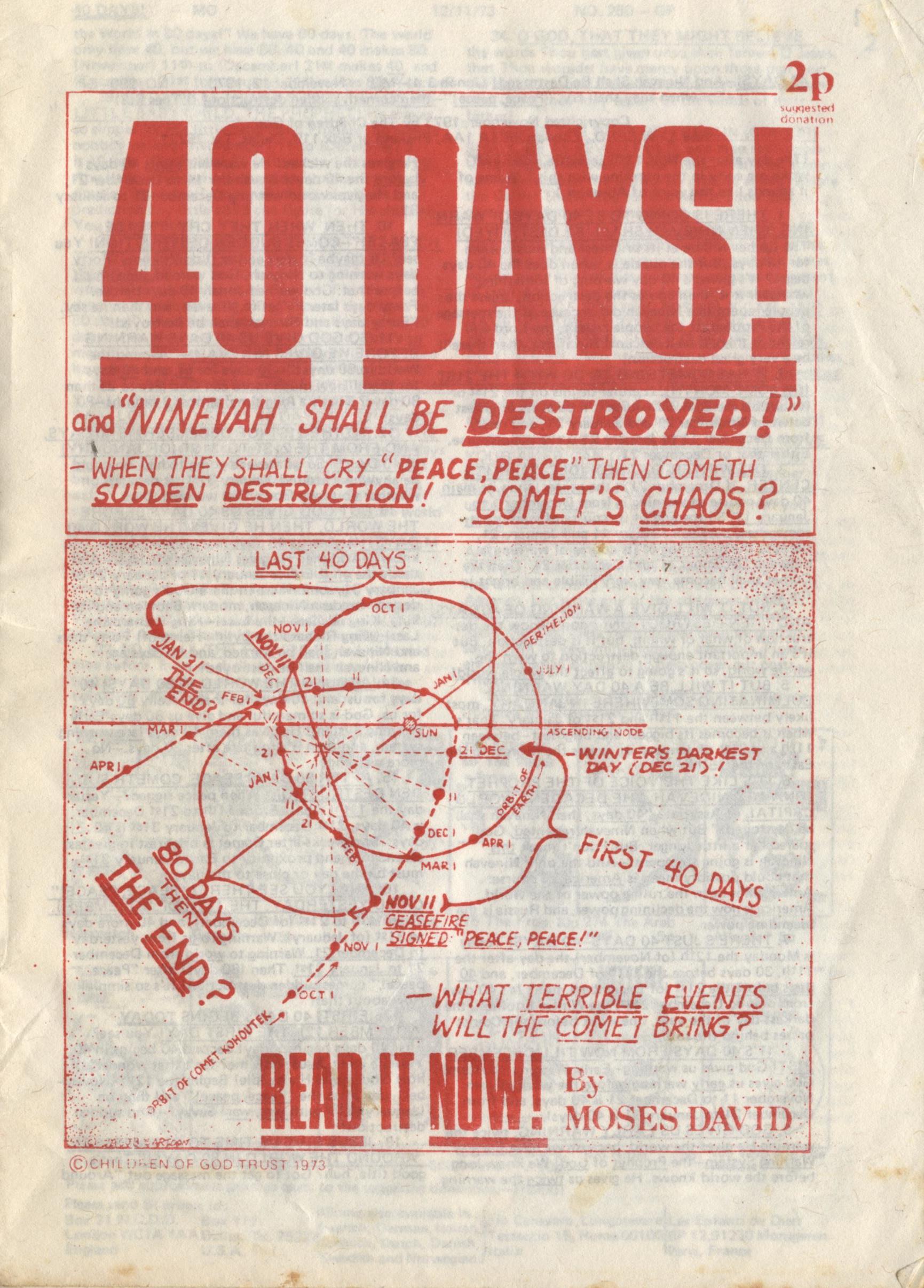
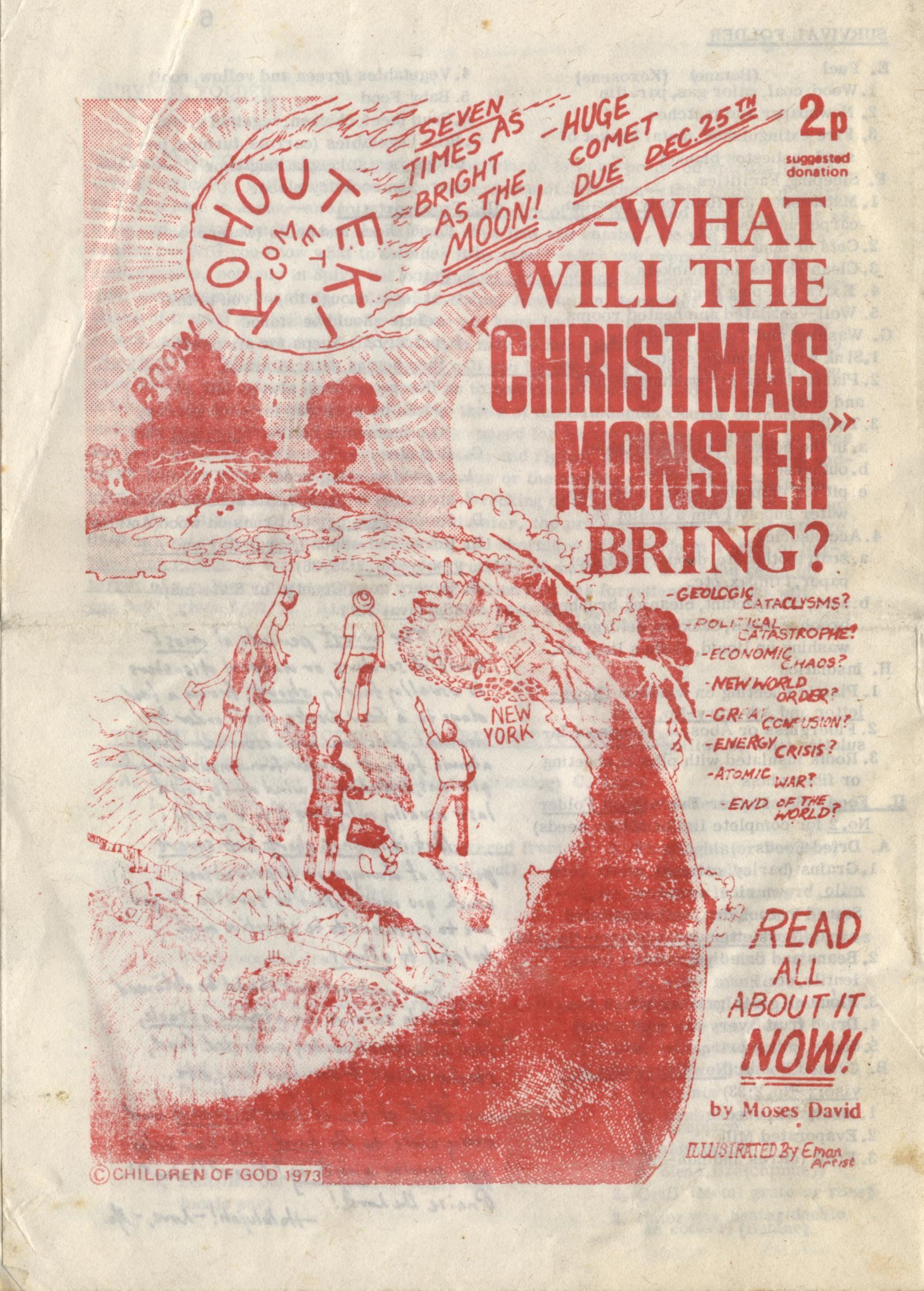
“What will the Christmas Monster bring? Geological cataclysms? Political Catastrophe? Economic Chaos? New World Order? Great Confusion? Energy Crisis? Atomic War? End of the World?” So reads the rear of an eight page pamphlet distributed outside the GPO in the run up to the Christmas of 1973 by a group calling themselves the “Children of God.”  The leaflet heralded the arrival of the Comet Kohoutek and the group’s belief in the impending apocalypse.

Comet Kohoutek was discovered on March 7th 1973. Astronomers predicted that it would be the brightest “naked eye comet” since Halleys’ passed in 1910. Dubbed the “Comet of the Century” by the media, much like the recent Comet Ison, predictions fell well short of the mark, and rather than the spectacular show the world was promised, Kohoutek proved to be a bit of a let down, with the Wall Street Journal calling it at the time “a disappointment to sky-watchers, if not a fizzle.”

Front Page 001

Front page of pamphlet handed out by the Children of God at the GPO, 1974. Scanned and uploaded by CHTM!

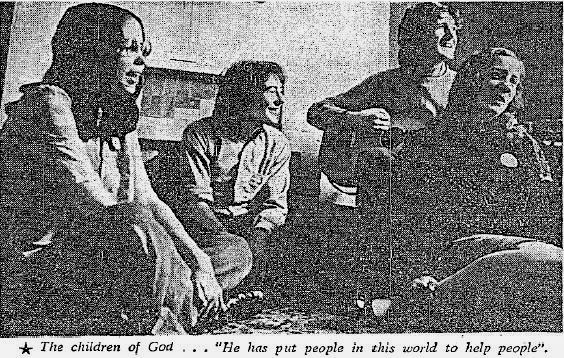
The Children of God were a fundamentalist Christian sect founded in 1968 in California by David Brandt Berg. “Moses David” as he was known within the group, declared himself to be “God’s Prophet for this time.” The organisation had an estimated 165 “colonies” in late 1973, with a presence from London to Paris, Florence to Liverpool and from their headquarters in Dallas, Texas to Dublin, Cork and Belfast. In order to show devotion to the organisation, followers were expected to live a communal existence in their “colony,” obey communiques from their leader (known as “Mo Letters”) , adopt Biblical names and refuse to accept secular employment. Marriage was promoted amongst members, but couples were far from monogamous, and rumours of child abuse in the organisation were rife.

According to a Des Hickey article in the Sunday Independent, September 16th 1973,  a Children of God colony was active in Dublin and based themselves out of a two storey house in Rialto. There were ten members of the organisation living in the house, including a 22 year old named Zibeon, his American wife Aphia,  20 year old Parable, and his English wife Magdala. Both Zibeon and Parable were Irish, Zibeon having attended Blackrock College, before going to the North for University, though both men spoke with “indeterminate American accents.”

back page 001

Back page of same pamphlet. Scanned and uploaded by CHTM!

The month after the article was written, a bus belonging to the group (which had at one stage been used as the London Headquarters of the organisation), caught fire whilst parked on Nutley Lane in Donnybrook. “Gardaí at the time could not tell if the fire was malicious or not.” (Irish Independent, 17th October, 1973.) Given that the group were looked upon suspiciously by established churches in the country, it’s doubtful arson could be ruled out. Several religious organisations spoke out against the groups “eccentricities and questionable characteristics” (Presbyterian Church notes in the Irish Times, December 6, 1972.). A 1984 meeting in Malahide proclaimed young people were at grave risk from cults operating in Ireland, and included the Children of God (alongside the Mormons and Opus Dei) on their watch list.

Throughout the early half of the Seventies, the organisation grew to approximately one hundred members in Ireland. At one point there were 27 members, both male and female, living in a house in Clontarf. Their main work consisted of distributing/ selling literature and “rehabilitating” drug addicts and alcoholics; “converting” them and asking them to give up their worldly possessions to the organisation. Judging from the fact that the address given on the Kohoutek pamphlet published here was a P.O. Box in Fairview, it’s possible that they were living here by the end of 1973, although the organisation had also based itself in different locations around the city, including Rathmines, Portmarnock and Miltown according to the Sunday Independent, 3rd December 1978. Moses David never paid the Dublin colony a visit but did, according to the same report, issue them with upwards of 500 letters, “with instructions ranging from how to brush their teeth to what music they should listen to.”

Des Hickey, Sunday Independent, September 16th 1973

Des Hickey, Sunday Independent, September 16th 1973

The pamphlet handed out at the GPO largely contained gibberish, proclamations and counter proclamations of impending doom or salvation, warnings that the apocalypse will happen either in forty or eighty days, or as seen below, some time in 1986. Some of the more ‘interesting’ quotes:

“According to our own calculations, 1986 should be about the time of the final takeover of One World Government by a world dictator known as the “Anti-Christ” and the beginning of his reign of terror!”

“For the heat of the comet shall be sevenfold, and men shall gnaw their tongues for pain for the travail that shall come upon them when the Lord shall arise to shake terribly the Earth! Thank You for the words Thou hast given their father! In Jesus’ name, Amen.”

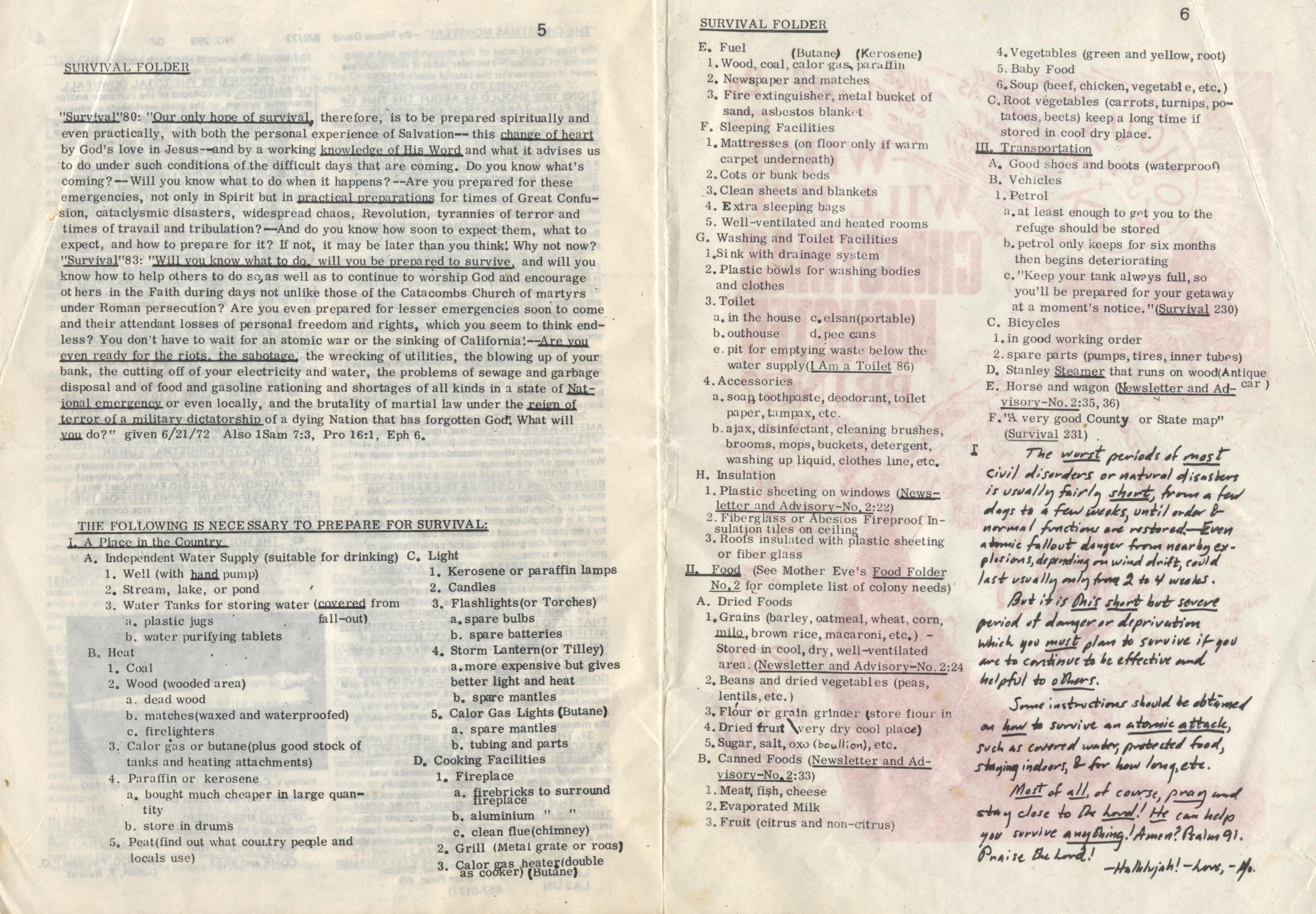
The pamphlet also includes these two pages of useful survival tactics, along with instructions to “pray and stay close to the Lord!” The opening paragraph of these pages ends with the following line:

Are you even ready for the riots, the sabotage, the wrecking of utilities, the blowing up of your bank, the cutting off of your electricity and water, the problems of sewage and garbage disposal and food and gasoline rationing and shortages of all kinds is a state of emergency, and the brutality of martial law under the reign of terror of a military dictatorship of a dying nation that has forgotten God? What will YOU do?

Children of God Survival Tactics

Children of God Survival Tactics, click to zoom. Scanned and uploaded by CHTM!

The main focus for the group seems to have surrounded Comet Kohoutek, and reports about the organisation die out after this event, with the trail for the Children of God going cold around 1978. At the beginning of the eighties, there was apparently a small community in Mountjoy Square, but these fled the country to Argentina in 1981 under fear of another impending apocalypse proclaimed by Moses David.  A couple of newspaper reports appear in 1993, of a Dublin man taking his wife to court for custody of their daughter, whom she had taken without his knowledge to live with the Buenes Aires branch, now known as “The Family.”

This Post wouldn’t have been possible were it not for Harry Warren loaning us the pamphlet. Cheers H!

Read Full Post »

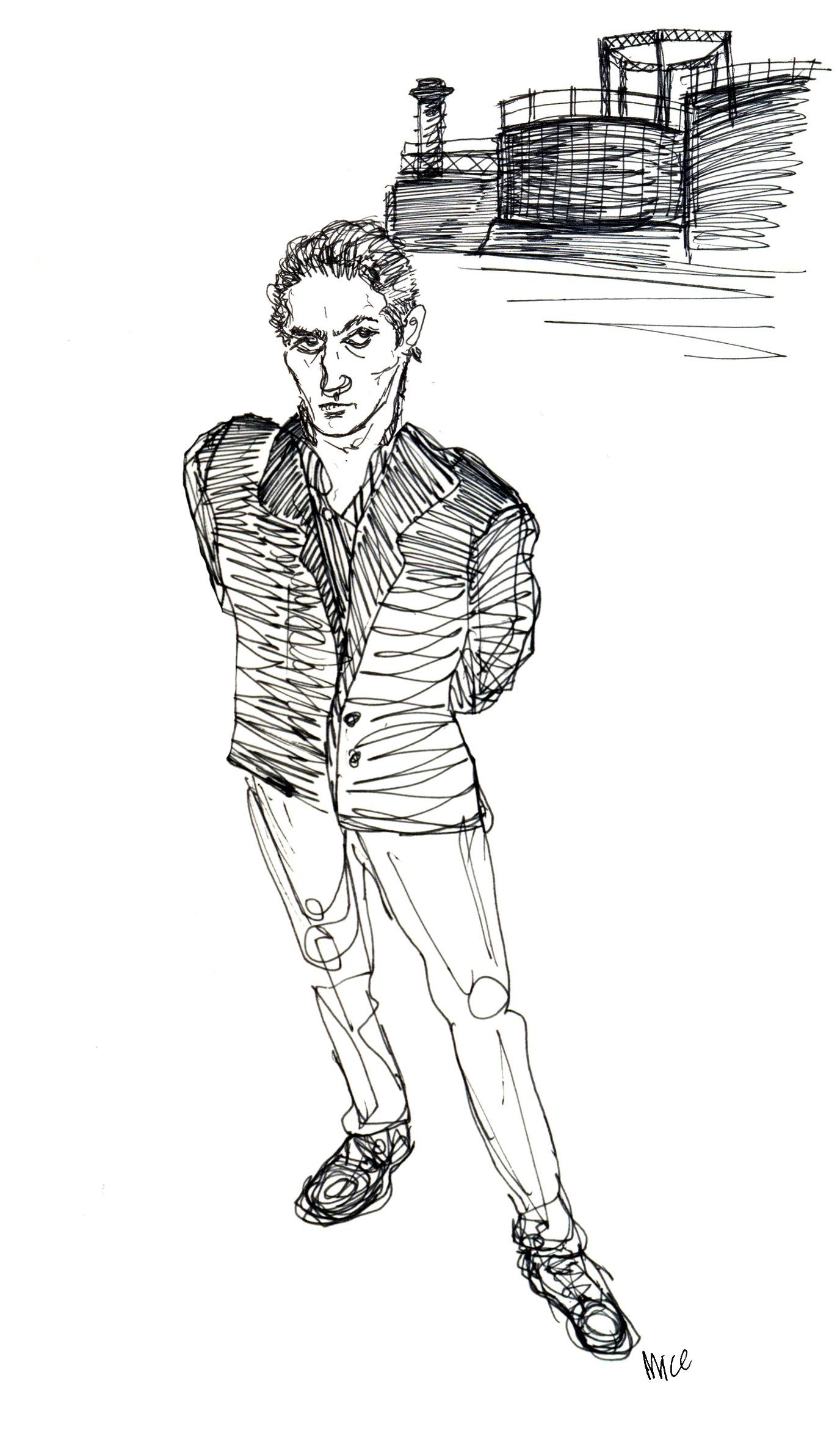
Paul Cleary by Mice Hell (http://triggerthumbs.wordpress.com)

Paul Cleary by Mice Hell (http://triggerthumbs.wordpress.com)

When I spoke to a healthy Philip Chevron in the lobby of Brooks Hotel in April 2012, I asked him about Paul Cleary and The Blades. He said with much enthusiasm:

I very much admired Paul Cleary. He appears to have retired from Irish music, which is a huge loss, but I don’t blame him. I know how difficult it is. I have utmost admiration for him and the band.

I don’t think anyone could have imagined that just over 18 months later, we would have tragically lost Philip to cancer at the age of 56 and that Paul would be coming out of perceived retirement to play with The Blades on stage for the first time in 27 years.

Both events are somewhat linked.

Paul explained to Pat James on Radio Nova last Sunday night (8th December) that Philip had invited him to play at his testimonial in the Olympia in August 2013. Paul sang two songs, a cover of ‘Enemies‘ by The Radiators From Space and his own ‘Downmarket‘. I’m not 100% sure but I believe this would have been the first time he had played a Blades song in public since March 2002 and before that January 1986.

Eamon Carr summed it up so well during the week when he said:

…the audience agreed on two things. One: the spirit of Philip Chevron would live forever. Two: Paul Cleary had stepped out of some ghost estate of the heart to save Ireland in a time of crisis.

In the same radio interview on Nova, Paul explained that the dignity of Philip and his close family and friends on that special night in the Olympia made a huge impact on him. While he admitted that the two weren’t particularly close friends, he had met Philip at various events down through the years and always liked him. He knew that Phil would have loved to have been able to play himself on the night if he had had the strength. Philip’s emotional testimonial concert, at which the crowd gave Paul such an amazing reaction, was one of the reasons that spurred on Paul to get the The Blades back together.

Besides sharing the same initials (ignoring Philip’s real surname of course), I believe Paul Cleary and Philip Chevron shared quite a bit in common.

Both were proud Dubliners and gifted songwriters who were able to write fantastic love songs as well as tackle serious political issues in their work. Born a couple of years apart, the explosion of punk changed both their lives. Philip formed The Radiators from Space at the dawn of punk in 1976 while the younger Paul had to wait until 1977 to get The Blades together. Both bands received widespread critical acclaim but found little financial success and their first bands suffered from record company woes.

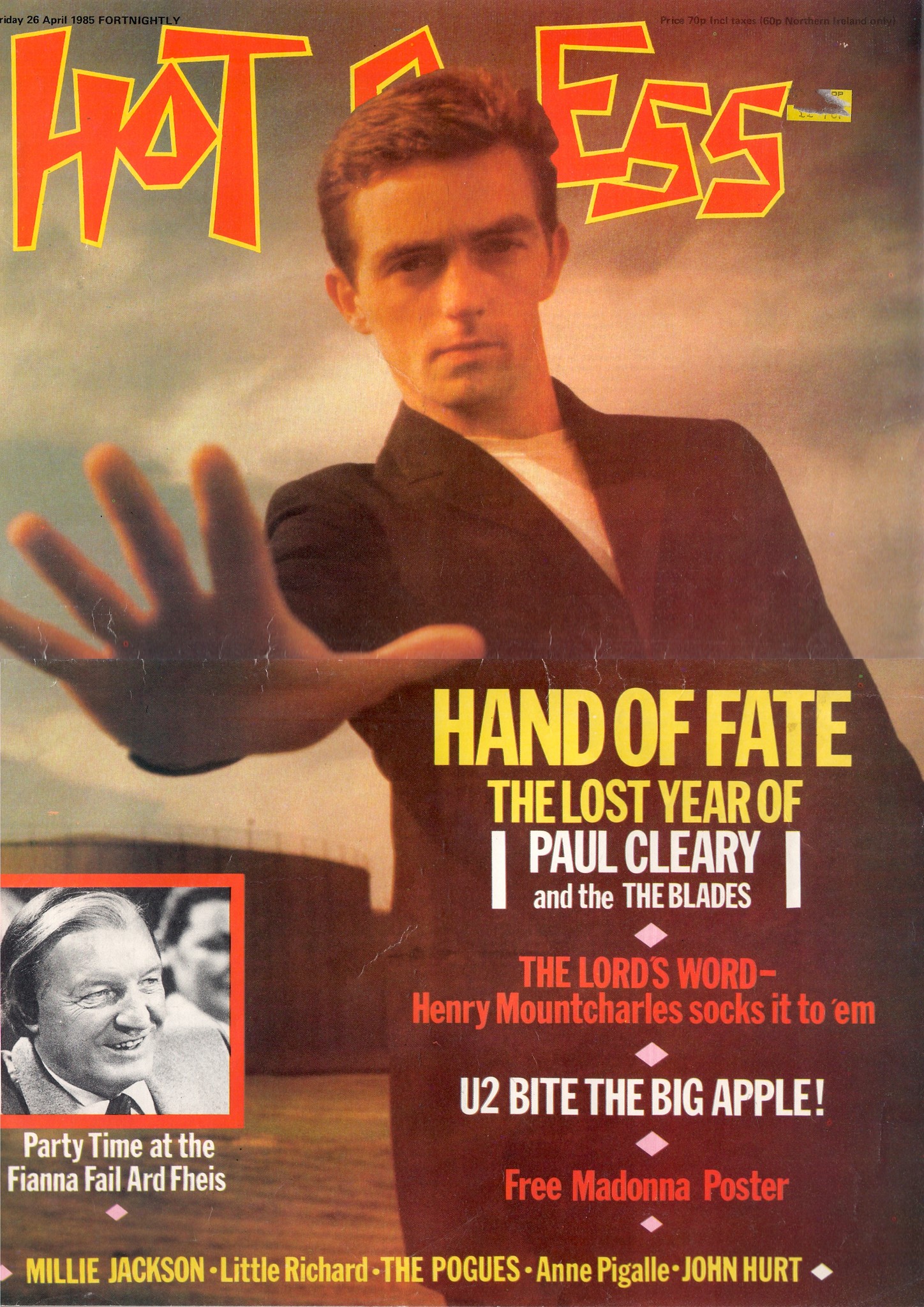
Paul Cleary, Hot Press, 1985.

Paul Cleary, Hot Press, 1985.

On the other hand, their song writing was very different. While Philip was strongly influenced by the theatre, the literature of James Joyce and cabaret stars like Agnes Bernelle, Paul’s Dublin had a lot more to do with James Plunkett and Sean O’Casey. It was kitchen sink realism with a Dublin twist.

So while only Philip Chevron could write:

We’ll even climb the pillar like you always meant to,
Watch the sun rise over the strand.
Close your eyes and we’ll pretend,
It could somehow be the same again.
I’ll bury you upright so the sun doesn’t blind you.
You won’t have to gaze at the rain and the stars.
Sleep and dream of chapels and bars,
And whiskey in the jar. (Song of the Faithful Departed)

Equally no-one could come close to matching Paul Cleary’s bitter description of a city torn apart by unemployment and monotony:

On a rainy afternoon
On a gambling machine
Same old jukebox, same old tune
It’s hard to break this old routine

Everything’s black and white and grey
Living from day to day to day
It’s a fatal resignation, when there’s nothing left to hope for
In a hopeless situation
I’m not waiting at an airport
I’m not waiting at a station
I’m standing at a bus stop (Downmarket)

In the bar of the Herbert Park hotel on 20th November, I spent a very enjoyable hour talking to Paul Cleary. While he sipped soda water, we spoke about football, his early musical influences, some aspects of The Blade’s career, his political motivations, his song lyrics and his plans for the future.

As is often the case with these kind of things, I believe our conversation was only really beginning to flow properly just as we had to wrap things up. But Paul is a very busy man these days and he had at least another interview if not two lined up immediately after mine. I was just chuffed that he had managed to take time to speak to me. Come Here To Me! is not a national newspaper or a music magazine. We’re just a small Dublin-focused social history blog with a loyal community of readers. I’ll always thank him for that chat and to his long-time fixer and close friend Elvera Butler of Reekus Records for sorting everything out.

In as much as possible, I wanted our chat to be a informal conversation than a rigid interview. Here it is…

I thought I could break the ice by talking about football. I heard you were quite a decent player in your younger days?

“Yeah, I played seriously until I was about 14 or 15. I was good enough to play for Dublin schoolboys. A scout from Man United came down to my parents and they were going to send me over for a trial but a few weeks before I was supposed to go over, I pulled a ligament in my ankle.”

And you were a Shamrock Rovers fan from day one?

“Yep, my Dad used to bring me to Milltown as a kid. Frank O’Neill up front. Mick Leech on the wing. We’d walk up from Ringsend most times. That was quite the walk! Though sometimes we’d get the ‘football’ double decker bus from town. We’d go home after the match and listen to Brendan O’Reilly reading out the sports results. That was the only way we’d find out about the other games that night. Then from around the age of 14 or so, I started going with a gang of mates to the matches.”

Was there much bootboy trouble on the terraces at this point?

“Oh there was. An awful lot. Rovers fans did have a bit of a reputation then. We’re talking late 1960s, early 1970s. My first floodlight game was Rovers-Bayern Munich in Dalymount. 1-1 I think. 1966 if I can remember correctly. I would have been about 7 or 8.”

Did music become your next passion after football or was there a bit of an overlap?

“There was an overlap. My Dad was really into music. He had a very eclectic taste. He was into classical, jazz and pop. One day he went out to get a [Felix] Mendelssohn album but came back with Bad Company’s ‘Running With The Back’ [1976]. He also had all the Beatles albums plus Buddy Holly, Bill Haley and other Rock ‘n’ Roll stuff too.”

(more…)

Read Full Post »

1939 headline from The Irish Times.

1939 headline from The Irish Times.

With the rise of late night spots like the Vintage Cocktail Club and the Liquor Rooms in Dublin, there seems to be quite a market for cocktails at the moment. Interestingly, in the 1930s, cocktails in particular were targeted by the temperance movement here, who saw them as a threat because of their appeal to the middle class and female drinkers. Cocktails were routinely denounced by some within the religious community, often lumped in with jazz dancing, gambling and other such risks to faith and morals.

The temperance movement in Ireland has a long and interesting history, with Father Theobald Matthew central to its story. In April 1838, Father Matthew established the ‘Cork Total Abstinence Society’, which quickly became a nationwide movement. Individuals took ‘The Pledge’, which saw them pledge that “I promise with the divine assistance, as long as I continue a member of the teetotal temperance society, to abstain from all intoxicating drinks, except for medicinal or sacramental purposes, and to prevent as much as possible, by advice and example, drunkenness in others.” Thomas O’Connor, in his entry on Father Matthew for the Dictionary of Irish Biography notes that:

His crusade rapidly developed into a mass movement whose organisation, given its scale, was necessarily loose. For this reason, it never became a structured, national organisation. This may be how Father Mathew preferred things, partly, perhaps, out of a fear of losing control, partly out of the conviction that the movement was divinely directed.

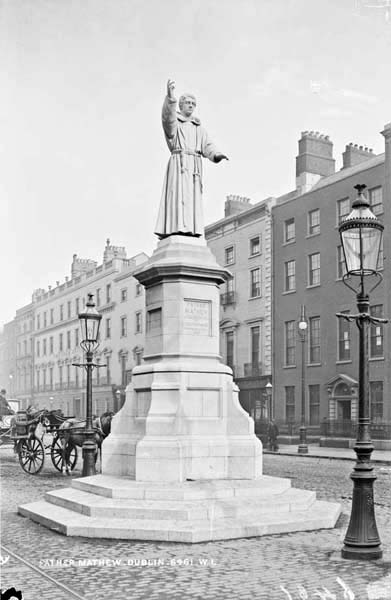
Father Matthew is today honoured with a monument on O’Connell Street, which was unveiled by the Lord Mayor of Dublin in 1893, when huge crowds thronged the streets. After Father Matthew’s movement, the most significant to emerge was the Pioneer Total Abstinence Society in 1898, though it should also be noted that the movement for abstinence was not limited to Catholic organisations, with sizeable Protestant equivalents active both in Ireland and Britain.

A historic image of the Father Matthew monument, O'Connell Street. (Image Credit: National Library of Ireland)

A historic image of the Father Matthew monument, O’Connell Street. (Image Credit: National Library of Ireland)

At the 1938 centenary celebrations of Father Matthew, where Éamon de Valera presided in front of a packed room in the Mansion House, the Bishop of Kilmore warned that:

I am told of a danger, not from the good old glass of whiskey, but rather from a new thing I have heard of called the cocktail, and I am told is not workmen you will see going after cocktails, but people who have some claim to education and better positions in life than the workmen, and that these people are falling more or less into the cocktail fashion. I have not seen it with my own eyes, but I have heard stories, which, if they are true, make me very sorry. If what I have been told is true, we should get busy about it, and open the eyes of fathers and mothers to it.

The appeal of cocktails to young female drinkers was often identified by those in the temperance movement. At the annual meeting of the Irish Association for the Prevention of Intemperance in 1936, it was noted that “appalling revelations have been made in the press lately about cocktail and sherry parties even among business girls in their own apartments.” This well attended meeting, which was held at Bewley’s on Grafton Street, called for “the discontinuance of cocktails and the elimination of drinking clubs”, as well as seeking “the elimination of drinking at public dances.”

Of course, the very idea of a young woman drinking was shocking to many. At a packed meeting in the Theatre Royal in 1932, hosted by the Pioneer Temperance Association, “the advent of the modern girl” was discussed, with one speaker noting that “she loudly proclaimed herself a post-war creation. She was certainly a post-war sensation. The Irish Independent reported that “They knew the type he meant – a feather headed, immature creature who talked a lot of being independent, emancipated and ‘flap doodle’ of that sort.”

The Irish Times denounced the cocktail in 1932, warning readers that the cocktail “fulfils no useful function. It is supposed by the many to induce an appetite and to stimulate intelligent conversation; in fact, it absorbs the pancreatic juices and encourages cheap wit.” Never one to over-sensationalise things in the 1930s, the paper reported the belief of a doctor from Clare Mental Hospital in 1937 that “now that women have taken with avidity to tobacco and cocktails, one can visualise the most appalling results for the human race at a not far distant date.”

In 1930, one writer in the pages of the same newspaper wished a quick demise to the cocktail trend in Ireland, hoping that it would not alone be put to rest but would remain there. “May earth lie heavy on the cocktail, for its influence has been heavy on the earth”, he hoped. Today, it seems the cocktail has never been more popular.

Read Full Post »

Below is the excellent 1976 RTÉ documentary on Irish involvement in the Spanish Civil War (Spanish Anti-Fascist War, 1936-1939) uploaded by our good friend and grandson of brigadista Michael O’Riordain, Luke in the last couple of days. Presented and produced by Cathal O’Shannon, the documentary features contributions both from Irishmen who fought for the International Brigades on the Republican side and those who travelled with Blueshirt Eoin O’Duffy’s Irish Brigade to support Franco and Fascism.

The documentary title was inspired by poet Charlie Donnelly, who remarked that ‘even the olives are bleeding’ shortly before he died fighting for the Republic at the Battle of Jarama in February 1937.

The documentary features some amazing footage, including an Eoin O’Duffy address from the balcony of the Ormond Hotel on Dublin’s Ormond Quay. Other notable contributions, apart from those with Michael O’Riordan and his great comrade Bob Doyle, came from Terry Flanagan, ex-baker and Saor Eire member and Alec Digges, a brigadista who returned to Ireland from Spain, before going on to fight in the Second World War, where he lost a leg.

Mural of Brigadista, Bob Doyle, installed on the Cobblestone Bar, Smithfield, (since removed.) From An Phoblacht.

On the fascist side, there is contributions, amongst others, from George Timlin, an NCO in the Irish Army who gave his reasons for going to Spain as “the spirit of adventure” and to quote “to oblige a friend… Eoin O’Duffy who wouldn’t have asked me if he didn’t want me to go” and Padraig Quinn, veteran of the War of Independence and the Civil War who, encouraged by the anti-communist sermon of his local bishop, joined Eoin O’Duffy’s legion.

Its sometimes easy to forget that there were Irishmen on both sides in an at times brutal war, and this documentary gives a good account of both.

Read Full Post »

"Nice photo of Brian, Paul, Conor and Jake from the archives." - The Blades official FB page

l-r Brian Foley, Paul Cleary, Conor Brady and Jake Reilly. From The Blades official FB page. Photographer – Conor Horgan (www.conorhorgan.com)

As I continue to transcribe the interview that I did with Paul Cleary of The Blades the other week, I thought it would be worth collating the band’s lyrics in the run up to next weekend’s two gigs in the Olympia Theatre.

Friday is completely sold out but there’s a few tickets left for the Saturday night via Ticketmaster. Copies of both albums are available on CD via Reekus or via Itunes.

The lyrics to the 15 songs from Raytown Revisited weren’t included in the sleeve notes to the LP so I spent a couple of enjoyable hours listening to the album and trying to make out the words. Thankfully I got a lot of help from other members of The Blades fan group on Facebook.

The lyrics to the 11 songs from ‘The Last Man In Europe’ were included with the sleeve notes so it was just a case of writing them up.

If you see any mistakes, please leave a comment.

Lyrics from Raytown Revisited 1980-85 – LP – Reekus Records, 1985

1. Ghost of a Chance

Long weekend
When boredom takes a grip
I’m in Dublin
She’s on a working trip
Cause she send me postcards
Every now and then
Yes, she send me postcards

To put the blame on education
Call it separation

Ghost of a Chance
We never had
Ghost of a Chance
We never had

United Nations
They sit with headphones on
Hearing speeches
Protect the Lebanon

To hear her talking  (talking)
Sweet sincere
To her her talking  (talking)

This situation
Doesn’t need interpretation

Ghost of a Chance
We never had
Ghost of a Chance
We never had x 2

2. Animation

I dreamed I had a dream
And in that dream
I turned to stone
I woke up in the park
Under a statue in the dark
Then the statue walked away

Full buses, busy streets
No-one lost and no-one found
Can’t tell if my heart beats
I never hear a sound

Though it’s funny how I go into
Animation, when I see that girl walking by
Animation, with the single blink of an eye
Animation,  though I’m usually so shy

Long nights and longer days
And all that trouble that they bring
Stare through a coloured haze
I never seen a thing

Though it’s funny how I go into
Animation, when I see that girl walking by
Animation, with the single blink of an eye
Animation,  though I’m usually so shy

Animation, when I see that girl walking by
Animation, with the single blink of an eye
Animation,  though I’m usually so shy

3. Muscle Men

What a compliment, they say he’s got chiseled features
A face like granite would be fair
Wrestled with the thought, he may be one of God’s creatures
I’d rather wrestle with a bear

Muscle Men

Go and do your duty
And if anyone complains

Muscle Men

Make them understand
That muscle men have got no brains

I had to pinch myself just to see if I was dreaming
Woke up in hospital today
What a poor excuse when they asked him for the reason
“He wasn’t dancing the right way”

Keep the place in order
Shirt and suit and black bow tie

Muscle Men

Say it’s provocation
Muscle Men don’t ever lie

Muscle Men x3

Keep the place in order
shirt and suit and black bow tie

Muscle Men don’t ever lie

MUSCLE MEN!

4. Stranger Things Have Happened

Don’t…… try to hide
Your feelings
The way that I do
Please…. open your mind
And let…. me in it with you
Waking up together
Imagine it it this way
We could both swap memories
And stay in bed all day

Stranger things have happened x2

If… you go away
I won’t cry
And I won’t grieve
Faith… is a word
It means nothing
If you refuse to believe

We could say I made you and stop these silly games
In a foreign country, where no-one knew our names

Stranger things have happened x2

This is self-inflicted
Why must our hearts be blue?
Sometimes when out drinking I fool myself that…
I’ll forget you

Stranger things have happened x5

(more…)

Read Full Post »

Citizen Tone

Citizen

I’ve always enjoyed the classic British comedy Citizen Smith, the work of John Sullivan, who later gave the world Only Fools and Horses. I think anyone who has spent any time in left-wing politics in particular can only laugh at poor Walter Henry Smith, or ‘Wolfie’, as he attempts to bring revolutionary inspiration to the people of South London.

A great Dublin dimension to it all is the fact that Walter Henry Smith’s nickname in the programme, Wolfie, is taken from Theobald Wolfe Tone. While in Paris, Theobald Wolfe Tone operated under the alias of Citizen Smith, with ‘James Smith’ appearing on his fake American passport. Tone had travelled to the United States in 1795, and while there attempted to drum up the support of the French Minister for the cause of Ireland.

Ralph E. Weber, in his study of United States diplomatic codes and ciphers, details a very interesting letter received by James Monroe in 1796, as a sort of introduction to the revolutionary Dubliner. Monroe, who would become the fifth President of the United States, was at that point serving as the Minister to France. As Weber has noted:

The text of the letter introduced the bearer to Monroe as a friend, Mr. James Smith, “who has been about two years in our Western Country in pursuit of lands, and now visits Europe in search of a good market.” The enclosed portion of the letter, however, revealed the bearer’s name to be Theobald Wolfe Tone, and that “the bearer hereof is an agent from Ireland in whom you may confide. His object is to obtain of France aid in favor of his distressed country what that aid should be and the manner of giving it he will mention.”

The real Citizen Smith.

The real Citizen Smith.

Sadly, I’ve been unable to find any reference to Sullivan explaining just why he took Theobald Wolfe Tone as the inspiration for naming the character. Neither Citizen Smith the secretive Irishman, or Wolfe the London revolutionary, ever brought about the change they envisioned for their respective people sadly. For anyone who has never watched the classic comedy, it is available to view on YouTube today. Below is the pilot episode, which even opens with The Red Flag.

Read Full Post »

I stumbled upon this hilarious personal account, of four tongue-tied students and a bewitching girl from the early 1910s, in the Witness Statement of Robert Brennan. The story is centered around a house in Lennox Street in Portobello and is worth reading in full:

“I had traveled to Dublin for an examination and I was met at the railway station by three Wexford friends of mine, John Moloney, his brother Peter, and Fred Cogley, all students. They were all staying at the same digs in Portobello and they had arranged for me to stay there also. We were hardly well inside the house when the three of them rushed to the front room crying, “Here she is”. I joined them and saw a very good looking girl. She came up the steps of the house and entered and the attentions of all three of them were transferred to the doorway through which she could be seen tripping lightly up the stairs. They said to me

“Isn’t she grand?”

I agreed and asked what she was like.

Well, haven’t you seen her for yourself?”

“But what is she like to talk to?”

They didn’t know. They had never spoken to her, because they had not been introduced. She was a lodger like themselves. Her name was Kiernan and she was a native of Carlow. I thought it strange that in the course of several weeks they were unable to strike up an acquaintance. They wanted to know how.

“Well” I suggested, “you could, for instance, run up the stairs when she’s coming down … bump into her and ‘beg your pardon’ and there you are”.

“But” said Peter, “what could we talk to her about?”

“I don’t know” I said, “maybe if you get talking to her you could think of something”. I suddenly remembered she was from Carlow. “Why not talk about Carlow?”

They knew nothing about Carlow, did I?

“The only thing I know bout it,” I said “is that they have electric light there.”

At the time Carlow was the only provincial town in Ireland so blessed.

The next day I left the library and walked up into Grafton Streer. What was my amazement when I saw Peter Maloney on the opposite side of the street standing talking to Miss Kiernan, or rather he was standing looking at her, his round, fair, innocent face like the rising sun. When he saw me he sent out signals of distress and I joined him and was introduced.

“This is Mr. Brennan, Miss Kiernan”.

I looked at her and saw the bluest eyes I had ever beheld. They were paralysing. I managed to say:

“How do you do?”

“I’m well, thanks” she said, and she was blushing too. I made a violent effor to concentrate.

“It’s a fine day” I said

“Yes” she replied

Then I tried in vain to think of any further word in the English, Irish or any other language. The silence was sold. At last I blurted out:

“Which way are you going?”

She indicated the direction of Stephen’s Green.

“That way” she said.

So am I”

The three of us walked towards Stephen’s Green. I tried to think of something to say and Peter’s obvious embarrassment did not help me. At last I had an idea. Of course, I could not know that Peter had said it already.

“I understand” I said “that you are from Carlow, Miss Kiernan”.

“Yes”

I saw now that Peter had already said it, but it was too late to draw back.

“I believe”, I said, and there was desperation in my voice, “that you have electric light there.”

“Yes.”

We entered Harcourt Street without another word. The perspiration was rolling off me. It was clear that what Peter was saying to himself should have blasted me from the earth.

We were halfway up Harcourt Street when we saw Cogley coming down. I thanked God.

He stopped and was introduced.

“How do you do”, he said and I was horror stricken to see that her eyes had the same effect on him.

“I’m well thanks”

He managed to say “It’s  a fine day.”

“Yes”

After a very long pause, he said: “I think I’ll go back with you”.

And the four of us walked on. The silence was now fourfold.

Of course, Fred got the same idea. I saw it dawning in his mind and I kicked him. This only spurred him on.

“I believe, Miss Kiernan” he said, “that you come from Carlow”.

“Yes.”

He knew now. It was evident from the quiver in his voice.

“I understand” he said “you have electric light there.”

“Yes.”

It was terrible. There was not a word spoken till we turned into Lennox Street. John Maloney was sitting on the steps of house. I hastened on in front.

“John” I said in a tragic whisper, “don’t say anything about electric light in Carlow”.

And aloud he said: “What about electric light in Carlow?”

She heard him and she passed indoors, her head held high. She never looked at any of us again.”

It was fantastically written so I was not surprised that the author, Robert Brennan, wrote several novels, plays and a well-received memoir.

Brennan was a founder member of the Wexford branch of the Gaelic League, Wexford IRB organiser in 1916, commanding officer of the Sinn Fein Press Bureau from 1918- 21, director of publicity for the anti-Treaty IRA during the Civil War, a founding member of the Irish Press and Fianna Fail, Irish Minister to the United States from 1937 to 47 and later director of broadcasting at Radio Éireann.

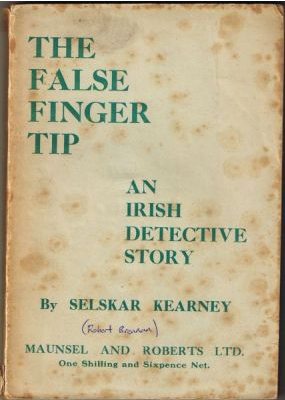
He published his first novel, The False Fingertip, in 1921 under the pen name ‘R. Selskar Kearney’ followed by a crime novel The Toledo Dagger, in 1926 under his own name.

The False Fingertip (1921). Credit - yvonnejerrold.com

The False Fingertip (1921). Credit – yvonnejerrold.com

In the 1930s his play about the life of convicts in an English prison, The Bystander, was performed in the Abbey, and later in the decade his comedy on the disappearance of the Irish crown jewels, Goodnight Mr O’Donnell, was performed at the Olympia Theatre.

The Bystander (1930). Credit - yvonnejerrold.com

The Bystander (1930). Credit – yvonnejerrold.com

After his retirement, he wrote and published his memoir Allegiance in 1950. The following year he wrote another novel, The Man Who Walked Like A Dancer, that was set in Washington. Through 1956 and 1957 Brennan published a weekly column of reminiscences in the Irish Press entitled Mainly Meandering. He passed away in 1964 and is buried at Mount Jerome cemetery.

His daughter Maeve Brennan was a celebrated New Yorker columnist (1954-81), called the Long-Winded Lady, who was almost unknown in Ireland until her work was revived to critical acclaim in the late 1990s. Described by one journalist last year as “The greatest Irish writer you’ve never heard of”, Maeve grew up at 48 Cherryfield Avenue, Ranelagh (the setting for almost half her forty plus short stories) but moved to New York in her late teens after her father became secretary of the Irish legation in Washington DC.

Her entry in the Dictionary of Irish biography by Angela Bourke discusses her early work and the build up of her image:

From 1943 to 1949 she wrote fashion copy for [Harper’s Bazaar] and its offshoot Junior Bazaar, often accompanying photographers on assignment, and also completed her novella ‘The visitor’. Her strikingly glamorous image, with dark lipstick, high heels, and hair piled on top of her head, dates from this period, while her trained observations of fabric, cut and colour would lend characteristic detail to all her fiction, and to her ‘Long-Winded Lady’ essays in the New Yorker’s ‘Talk of the town’.

Recruited to the New Yorker in 1949 by William Shawn, Brennan first wrote fashion notes and book reviews, but fiction editor William Maxwell soon began to publish her stories about Dublin. Maxwell later said of her: “To be around her was to see style being invented”. Some believe she was the inspiration for the character of Holly Golightly in Truman Capote’s Breakfast At Tiffany’s. The two had worked together at both Harper’s Bazaar and The New Yorker.

Maeve Brennan at home. Photo by Karl Blissinger. Credit - http://thelicentiate.com

Maeve Brennan at home. Photo by Karl Blissinger. Credit – http://thelicentiate.com

Journalist Colin Murphy picks up the story:

She married a colleague, St Clair McKelway, but he was even more unsettled: he had been married three times, and was a drinker, womaniser and depressive. Their five years together were chaotic; they had no children and, after they split, Brennan remained single.

Her sardonic observations of New York life  in her The Long-Winded Lady column in The New Yorker and her fiction criticism, fashion notes, and short stories were widely praised throughout the 1950s and 1960s. However, by the 1970s she became increasingly isolated and unable to take care of herself. She was mired in debt, thanks to her generosity, extravagance and a habit of abandoning apartments to stay in hotels. Brennan became homeless, and took to sleeping in a cubicle at the New Yorker, where she nursed a sick pigeon she had rescued. Her last New Yorker piece, ‘A blessing’, appeared on 5 January 1981. She died, in 1993, aged 76, in a nursing home.

It was only after he death that she became to be appreciated in her home country. Thanks mainly to a series of posthumous collections and biography of her written by Angela Bourke. Two plays about aspects of her life have been performed by Emma O’Donogue (‘Talk of the Town’, 2012) and Eamon Morrissey (‘Maeve’s House’, 2013) in recent years. The latter of whom met her in 1966 in New York as a 23 year old after he found out he was living in that house she grew up in. Eamon explained to the Irish Examiner back in September:

She is a neglected author in the Irish canon. And she is very definitely an Irish writer, even though she lived most of her life in New York. She’s in that difficult situation where the Americans regard her as an Irish writer and the Irish regard her as an American writer. Both nations should be proud to claim her.

Read Full Post »

« Newer Posts - Older Posts »