An advertisement for U.2 and The Blades at The Baggot Inn (u2theearlydayz.com)
On August 8th, CHTM will be taking part in ‘Banter on the Liffey’, a night of chat and discussion organised by Jim Carroll of The Irish Times. It’s all happening as part of the Liffey Legover Festival, and Sam will be joining Jim to talk about some of Dublin’s famous (and infamous) musical venues historically. From Punk to Rave, Rock to New Wave, it’s a fascinating subject that has featured on the site here plenty. It’s one of three discussions Jim has organised. The other two see legendary DJ Tony Fenton discuss his career and life, and visual artist Fergal McCarthy discusses the River Liffey and how it has influenced his work. Some of you may remember the giant Monopoly homes floating in the Liffey!
The three talks: The Tony Fenton Retrospective In 35 Minutes – the Today FM legend on his life on and off the airwaves Dives, sweatboxes and ballrooms – Come Here To Me’s Sam McGrath on the life and times of some of the city’s most celebrated music venues The Liffey and me – visual artist Fergal McCarthy on how the river has influenced his works like Liffeytown and No Man’s Land
According to Jim:
We’ll start the night at 7pm-ish in the Workman’s Club, move across the river to the Grand Social for 8.30pm and bring it all to a close at the Twisted Pepper, the place where Banter started, for 10pm-ish. Admission to all events will be free
The Workman’s Club on Wellington Quay, in a former life.
American newspaper image showing Gardaí keeping protesters away from Edward Kennedy at Trinity College Dublin, 1970.
The fiftieth anniversary of the visit of John F. Kennedy to Ireland has seen much commemoration, with events in Dublin and across the country marking the Presidential visit. While protest was absent during the visit of J.F.K, international coverage of the visit of Edward Kennedy to Trinity College Dublin a few years later in 1970 had plenty to say about protesters and a less-welcoming crowd. Protests against Kennedy were largely orchestrated by Maoist students, and while they ultimately failed to disrupt Kennedy’s visit in any real way, they received huge media coverage in Ireland and the United states. The Milwaukee Journal went as far as to claim “it was the first time in Irish history that more than a few isolated Irishmen even spoke against the Kennedy family.”
In March 1970 Kennedy was invited to Trinity College as part of the bicentenary celebrations of the College Historical Society. He was to give a lecture in honour of Edmund Burke, one of the most celebrated graduates of the university and indeed the society. In opposition to this visit, Kennedy was met by protests not alone at the college itself but even at Dublin Airport. This opposition was organised largely by Maoist students at the university, a small but dedicated band of left-wing activists who had a rather high-profile having launched major protests against the visit of King Baudoin of Belgium to the college in the summer of 1968.
A rather unusual headline from The Meridian Journal (Connecticut)
Conor McCabe has written on the history of the Maoist tendency among the student left in Trinity College Dublin, pinpointing November 1965 as the moment ‘The Internationalists’ were founded. In his article he identifies Hardial Bains, a lecturer in bacteriology who was originally from India, as crucially important to the growth of Maoism in the college. Bains was also referenced in American media reports at the time of Kennedy’s visit, with The Meridian Journal claiming he had come from Canada to Trinity and since returned there, “leaving a hardcore of about 40 Trinity Maoists” An article on the Maoists published in 1970 by Nusight, and available to read in full here, was a little less generous, estimating that their membership was something around fifteen in the college, but noting:
There are quite a few Maoists in Ireland now. In Trinity College there are about 15, in U.C.D. about 8. In U.c.c. there are only 4 or so, while in Galway university there are about 5. In Limerick there are around 6 while in Dublin outside the university there are possibly another 10 to 15. This numbers in all about 50 Maoists.
In addition to this there are numerous camp followers in the universities. Various dilletante socialists follow the Maoists because they feel they are the “authentic” socialists. Other students follow them but do not join either because they are not allowed to or because they are unwilling to commit themselves wholly to the group. This might bring the total of Maoists in the country up to about 70-80. They remain nevertheless a static group
The Internationalists called on Trinity students to protest against the visit of Edward Kennedy in propaganda leaflets, even drawing on the memory of the 1963 visit of JFK by noting that such visits by the family to Ireland were designed to present themselves as “friendly visiting celebrities” and to confuse people “about the true nature of U.S imperialism”. The students condemned Kennedy as “representative of the most barbarous class of parasites the world has seen”, and called on students to join a mass demonstration against him at 7.30 on Tuesday 3 March, designed to coincide with his speech.
An Associated Press image showing Ted Kennedy in Dublin, being welcomed by Dublin County Chairman P.J Burke
Kennedy’s visit was not limited to Dublin, he also visited New Ross, where a crowd of several hundred welcomed him warmly. The Sarasota Herald-Tribune in the U.S claimed that “students from Dublin – the ‘long haired brigade’ as the locals call them- invaded the town during the night and plastered up posters saying ‘Oppose Ted Kennedy: American Imperialist!’ but most were taken down before Kennedy arrived from Dublin.” Kennedy had first visited New Ross in 1962, but in 1970 the purpose of his visit was to visit the John F. Kennedy Memorial Park, which had been opened to commemorated his murdered brother. A rather different environment than what awaited him in Dublin, newspaper reports noted that he was “surrounded by a crowd of around 200 jostling to shake his hand.”
When Kennedy spoke on the topic of Edmund Burke at Trinity College Dublin on the Tuesday night, it was reported that “demonstrators outside displayed portraits of Communist Chinese leader Mao Tse-tung alongside a ‘Down With Kennedy!’ banner”. Kennedy’s speech was interrupted by a student in the gallery waving the little red book of Mao’s theory, shouting “Down with U.S imperialism- Kennedy get out!”. Kennedy joked “there goes one of the great debaters” as he was removed from the hall.
A cartoon in The Irish Times following Kennedy’s speech.
As Kennedy left the university, his car was blockaded by a few dozen students, with a Garda force of only forty reportedly on hand. The pounding of the car lasted for several minutes, with Gardaí arresting one student demonstrator. This was not to prove the only confrontation between Kennedy and the Internationalists however, as protesters also made their presence felt outside his hotel by attempting to prevent his driver bringing him to meet with the Taoiseach, Jack Lynch. Even prior to his departure from the city at Dublin Airport, Kennedy was again greeted by protesters. Though a crowd of 200 or so gathered to cheer him, there were also opposition voices.
The Internationalists remain a fascinating chapter in the history of the student left and the broader radical left in Ireland. At the time, they were viewed by some in the media as a very real threat. In 1970, The Irish Times wrote that Maoism was gaining some influence in Irish secondary schools, with the suspension of four young Dublin students receiving significant coverage in the paper.
Yet others viewed things differently. The Nusight article quoted above ended on the following note, only months after the Kennedy visit:
Anyone who understands the Irish working class knows that the Maoists are not a threat to the status quo in Ireland. They are however a threat to the radical left in that they discredit socialism in the eyes of the ordinary people and are a constant source of ammunition for professional scare-mongers in Ireland
Anthony Cronin, John Ryan and Patrick Kavanagh at the Martello Tower, Sandycove , marking the first Bloomsday (National Library of Ireland)
The first Bloomsday in 1954 is the stuff of Dublin legend. Flann O’Brien and Patrick Kavanagh paid drunken homage to the masterpiece of Joyce, joined by an array of characters including the publican and artist John Ryan, Anthony Cronin and Tom Joyce. Tom was a dentist, but crucially he was also a relative of the more famous Joyce. The plan was to travel the city in horsecabs, following the journey of Leopold Bloom.
Despite the good intentions of the group, the entire thing was abandoned for a session at The Bailey, a public house that was conveniently owned by Ryan. Interestingly, The Bailey was once been the home of the front door of No.7 Eccles Street, the address of Leopold Bloom in the work. Ryan had the good sense to save this door at the time major construction was taking place on Eccles Street for further development of the Mater Hospital, and he placed the door inside of his pub. Today, it is on view in the James Joyce Centre.
This brilliant video footage was posted to YouTube recently by artfarrago· It shows Flann O’Brien in particular looking well on his way, but it is perhaps the sight of literary talent pissing against the wall at Sandymount Strand that will interest readers!
Storymap have just released over a dozen new videos of Dublin storytellers, as part of the Dubline project. The Dubline is intended as a historical and cultural route that runs from Trinity College Dublin to Kilmainham. These stories are a great adddition to the stories along the route which were already recorded as part of their broader project of mapping the city. You can see their map of the Dubline stories here.
A screengrab of the new Storymap ‘Dubline’.
Beginning down at College Green, Lorcan Collins has contributed this great video on the history of King Billy on College Green. We’ve looked at this statue in the past, quoting from Ireland in Pictures (1898) who wrote that “no statue in the world, perhaps, has been subject to so many vicissitudes.” Lorcan’s story ends with praise for the brilliant Thomas Davis statue, and the meaning of that man to the nation:
Ross Keane from the IFI talks about the history of that institution, including controversies around films which suffered to Ireland’s infamous film censorship such as Natural Born Killers.
My own father has contributed to the series, telling the story of the horrific Whiskey Fire that hit the Liberties in 1875. Horses and pigs running through the streets, dead bodies carried out of wakes and burning tenements all feature. You’ll be amazed to hear how all those who died met their end:
My own earlier contribution to the Storymap series features along the route, in the form of the story of Vonolel, a famous and honoured horse. We’ve posted that here on the site before.
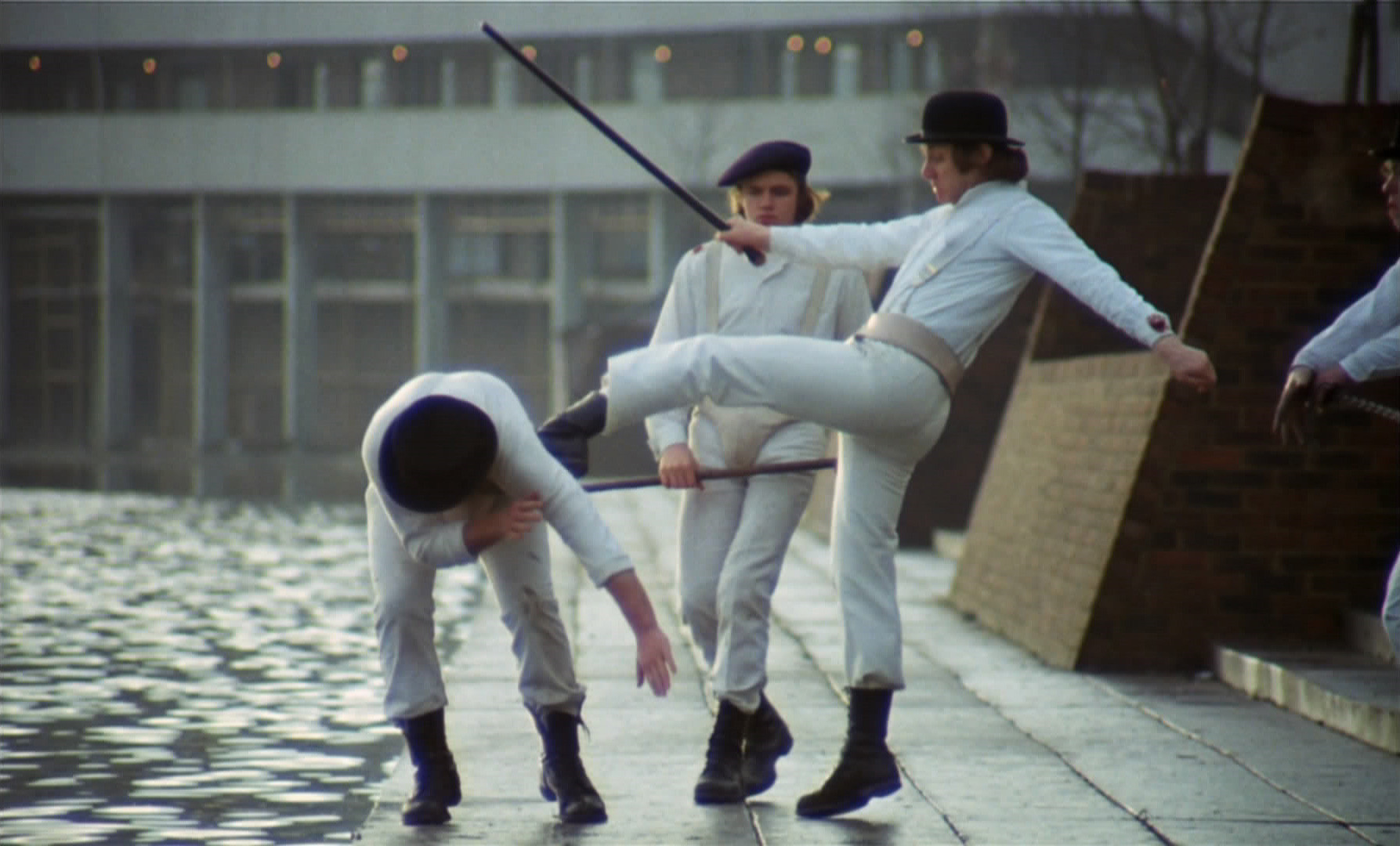
A few nights ago, a friend had the brilliant idea of screening the classic film Life of Brian in his back garden, an excuse to have a few beers and make the most of the incredible Dublin summer. The film of course was difficult to view in Dublin at the time of its release, falling victim to the heavy censorship of the time. There is an article on the controversies around the film at the time of its release in the current issue of Village magazine. It all made me think of some other films which fell victim to the hand of censorship, including my own personal favourite film, in the form of Stanley Kubrick’s celebrated A Clockwork Orange. The film was only removed from the banned list here in December 1999, with a letter writer to The Irish Times noting his opinion then that:
As one who was stopped from seeing this film during my earlier years and who did not appreciate the censor’s power
at the time or his role in protecting the common good of society, it now seems to me that the original banning was
both wise and courageous, in contrast to the more recent sad decision.
A scene from A Clockwork Orange.
The film A Clockwork Orange was based on the brilliant novel of the same title by Anthony Burgess, published in 1962. The novel, much like the film, felt the wrath of Irish censorship, although seemingly long after publication. A 1976 Irish Times report on the banning of the publication Gay News noted that among other titles banned was A Clockwork Orange.
The film opened in London in 1971, though was not submitted to the Irish censor until two years later. At the time of its unbanning in 1999, Micheal Dwyer noted that “The censor viewed the film on April 10th 1973, and rejected it. Giving the furore surrounding it by then, Warner Bros. did not see any point in submitting it to the Film Appeals Board.” While films could be resubmitted to the censor after seven years, Kubrick had made the decision to remove the film from the UK market himself by then, owing to threats against him from those who believed the film was leading to copycat violence. With Britain and Ireland in the same film distribution zone, this ban on the work extended to Ireland.
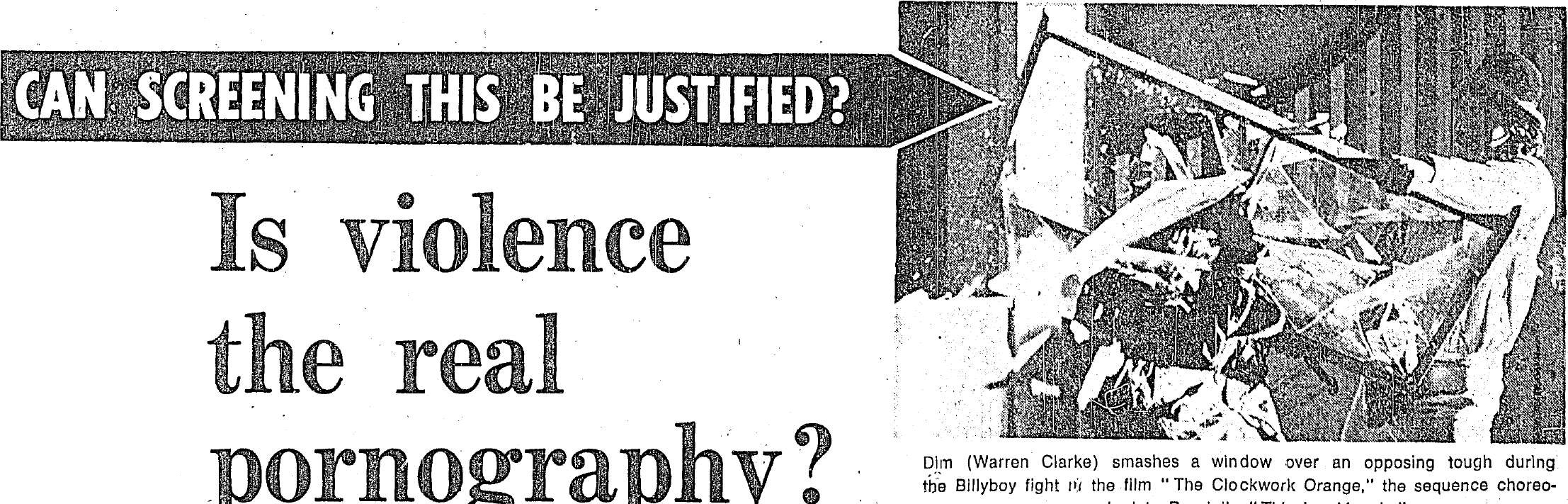
In February 1972, The Irish Independent ran a picture of a scene from the film, asking “can screening this be justified?” and asking readers “is violence the real pornography?”
The Irish Independent asks if screening the film can be justified.
The banning of the film irked many journalists, with Ciaran Carty complaining in the Sunday Independent that picking the top films of the year for “a cinematic backwash like Ireland is like seeding a Wimbledon tournament from which most of the leading professionals have withdrawn.” In another article for the paper, Carty noted that “not only do we not make any movies of our own, but we are not able to see the work of many of the world’s most original and stimulating directors.”
Stephen Murney, from Coleraine, was serving as the Secretary of the British Board of Film Censors at the time of the films release, noting in an interview that films like A Clockwork Orange and Straw Dogs both got through the censorship process in Britain, and that “I recognise that violence is part of our life today…and so it is valid, when the film is not merely exploiting it for its own titillation sake.”
Dave Fanning writes about going to see the film in his autobiography, noting it was just before starting his student days in UCD. Fanning described spending five days in England just before embarking on student life, noting that “I took advantage of the trip by going to see a few films such as Straw Dogs and A Clockwork Orange that were banned in Ireland back then. It’s easy to forget what a strange priest-riddled society we were – and in some ways still are.”
Opposition to the film was to be found in England too, and the Irish Sunday Independent interviewed Mary Whitehouse, founder of the Clean-Up TV campaign in Britain, who campaigned against the film in the UK. She also claimed that Dr.Who was inducing nightmares in children, and the article noted that she and her husband “begin each day early with joint Bible readings in bed and a cup of tea.”
‘Crusader or Crank?’ asks the Sindo.
In November 1973, an attempt to get-around the censorship of films in Irish society came in the form of the Dublin Film Institute. Hugh Leonard, Robert Bolt and others were involved in establishing the Institute, which it was reported would confine itself to private membership and which the journalist Ciaran Carty, such a vocal critic of film censorship in Ireland, hoped would “enable people to see films they could not see in the past. Many were not shown because cinema managers were too conservative. Invariably, there will be films that have been banned.”
Stanley Kubrick found himself in Ireland not long after the controversy around what is perhaps his most celebrated film. Shooting much of Barry Lyndon here in 1973, he filmed some scenes for the work in the Irish capital. Arthur Flynn recounts the story of Kubrick’s time in Ireland brilliantly in his book The Story of Irish Film, noting that:
On the day when Dublin was hit by a spate of bomb hoaxes the unit was lining up a shot in the Phoenix Park. Kubrick heard the news and immediately left the set and returned to his house in Leixlip and refused to leave. It was late afternoon before his associates could persuade him to return to a new location in Dublin Castle but not until he got a Garda escort and an assurance that civil war had not broken out. He had constant fears of the IRA and wanted armed guards on the set.
It is worth noting that the film A Clockwork Orange itself actually contains a little bit of a Dublin reference, with an early scene showing an Irish tramp attacked by the gang central to the film, as he sings Molly Malone. This scene was filmed in Wandsworth in London:
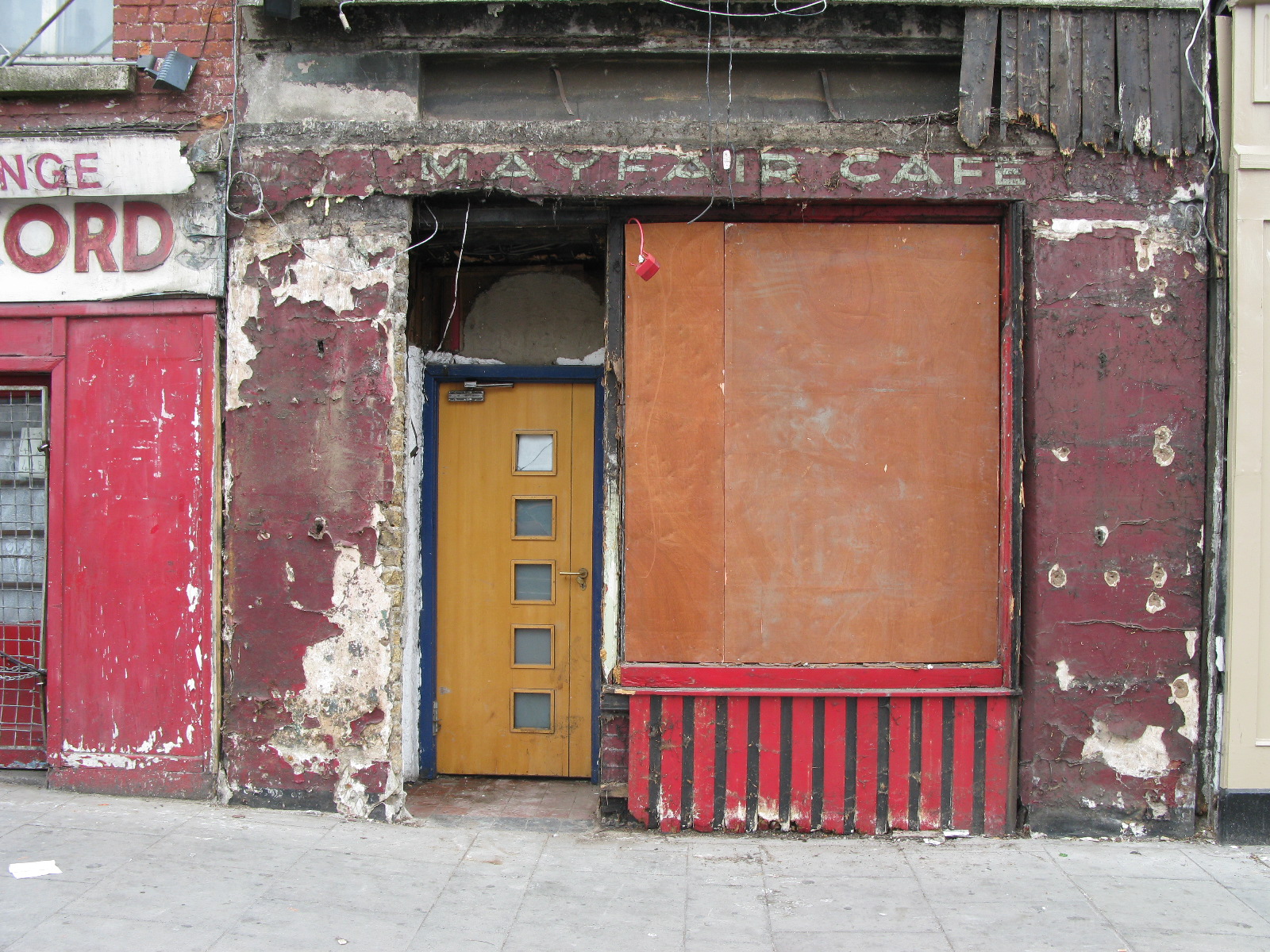
Sometimes we are lucky on CHTM! to get mails from people who share the same love we do for history. So after posting about the Mayfair Café shop frontage on Richmond Street South the other day, to get this mail in our inbox this morning was an absolute pleasure. I was going to edit it, but its worth posting in full; a huge thanks to Graham Stone for getting in touch, the words below are his!
Can’t help out a lot with Molly Tansey (the electoral register for 1962-63 lists her as Mary and I have spoken to one old-timer – grocery wholesaler George Cooke, born in 1924 down the road at No 46 and died a year or so back, his father ran The Delta Café at No 40 South Richmond Street 1939-44 – who claimed to recall the Mayfair as “proper sort of place, neat and clean and well-turned out, like eating at home, good plain food and no pretensions”) but as for the location …
Before Portobello House opened in 1807 as the Portobello Hotel there were no buildings on the west side of Richmond Street, the land north of Portobello House used for storage by the Grand Canal Company. In 1840 (by which time there were three buildings at what today would be Nos. 38, 42b & 44), the stretch of land between the rear of Portobello House and Lennox Street was leased to builder James Henderson who used some to store his own building materials and sub-let portions to other merchants. Around 1850 this area is described as “Portobello Market” which suggests itinerant trading.
After Henderson (who continued to reduce his own holding bit by bit until, in 1869, he disposed of the last piece of land, at the corner of Lennox Street, today home to the Aprile Café and the Bretzel bakery), members of the Sweny family – furniture dealers, hauliers, undertakers and fuel merchants, see attachments 1 and 2 from the Irish Times – occupied the site until at least 1880 after which the building housed a plumber, a greengrocer/fruiterer, a grocer, a hairdresser and a wholesaler before Mary Tansey set up her Mayfair Café in 1956.
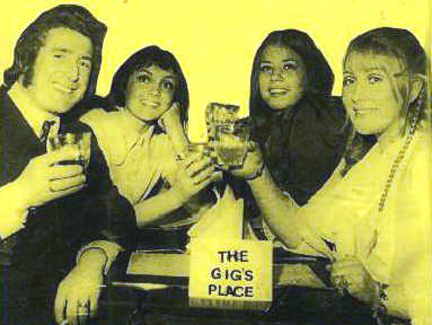
In 1970, musician Brian Carr (guitarist with the Royal Blues Show Band) saw an opening for a late-night dive where musicians could convivially gather after gigs and turned the Mayfair into one of Dublin’s earliest celebrity hotspots which he called The Gig’s Place. It attracted the likes of Sonny Knowles, chanteuses Maxi, Dick and Twink and bad boy of pop Dickie “Spit on Me” Rock, and later Bono, Vinnie Jones and Ken Doherty. Over the next four decades, as late-night bars and eateries proliferated, business gradually declined (it had become the haunt of sleepless taxi drivers rather than the rendezvous of glamorous celebrities) and Carr sold up in 2005. It struggled on under new ownership for a further seven years before closing.
Number 43:
1840-49 – an undeveloped site, part of James Henderson’s builders’ yard
1850s – first building on site, date uncertain
1858-1860 – William S Sweny, “job carriage, furniture van, coal factor and funeral establishment”
1860-1880 – John P Sweny (William’s son?) “job carriage, furniture van, coal factor and funeral establishment”
1881-1903 – Patrick Byrne, plumber and gasfitter
1904-25 – Miss Walsh, greengrocer
1926-29 – Ed Brean, fruiterer
1930-36 – P O’Flanagan, fruiterer (also ran a dairy next door at No 44)
1937 – James Moore, grocer
1938-42 – Paul Kane, hairdresser
1943-45 – vacant
1946-55 – Patrick O’Connor & Co , wholesale provision merchants
1956-69 – Mary “Molly” Tansey’s Mayfair Café
1970-2012 – The Gig’s Place (1970-2005 proprietor Brian Carr)
2012-13 – closed and derelict
—-
All images apart from the photograph of the Mayfair storefront came from Graham. Again, a huge thanks.
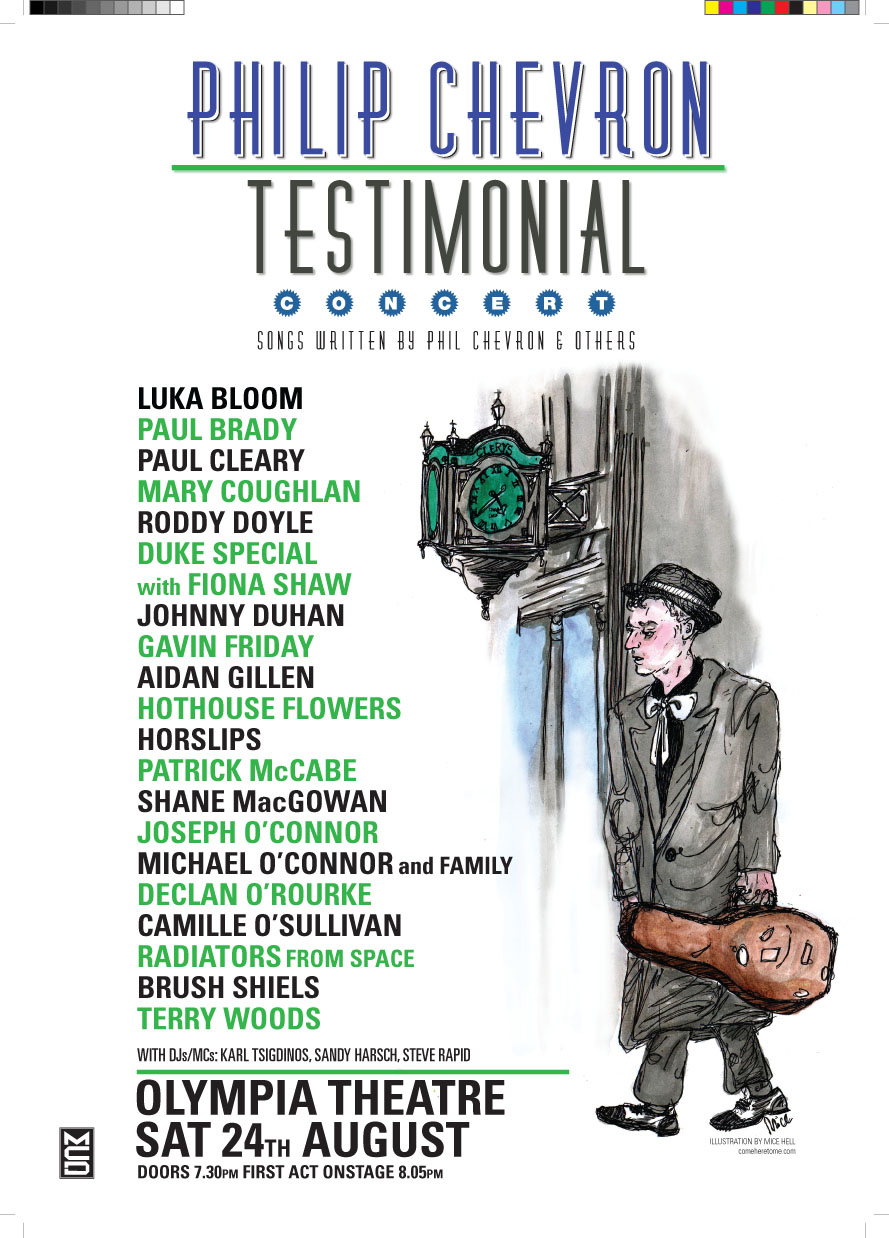
Tickets (€30) are now on sale for Philip Chevron’s (The Radiators from Space & The Pogues) Testimonial Concert.
Philip revealed last month that the cancer he has battled since 2007 has become incurable and terminal. A life-long football fan, he has decided to hold his own ‘Testimonial’.
Artists confirmed so far for include Horslips, Luka Bloom, Declan O’Rourke, Brush Shiels, Shane MacGowan, Patrick McCabe, Gavin Friday, Duke Special with Fiona Shaw, Paul Brady, Joseph O’Connor, Mary Coughlan, Paul Cleary, Aidan Gillen, Fiachna Ó Braonáin & Liam Ó Maonlaí, Roddy Doyle, The Radiators from Space, Michael O’Connor and family, Terry Woods and Camille O’Sullivan.
A feature of the show will be that performers will offer their own work along with selections from Chevron’s own songbook, including some items never heard before in public.
All at CHTM! were chuffed to see that Steve Averill (aka Steve Rapid) from The Radiators from Space and designer of U2’s album covers decided to use Mice Hell’s illustration of Philip Chevron which was first published in the CHTM! book last Christmas.
P. Chevron concert. Design – Steve Rapid
In April 2012, I sat down with Philip in Brooks Hotel and spoke for over three hours about his life, music and opinions on everything from Dr. Feelgood to the punk’s reaction to the Troubles. You can read that interview here.
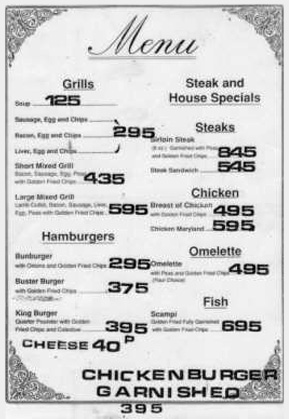
Ah… the hidden layers of a city. The Gigs Place, the late night eatery on Richmond Street South closed down to some dismay recently. A contender for one of Dublin’s longest running restaurants it was 42 years young when it closed, having opened in 1970. But before the Gigs Place sat Molly Tansey’s “Mayfair Café” which occupied the spot from 1956 -1969. The building work being done on the building has led to the facade to be recently stripped back, revealing a shopfront from a different era.
I’ve searched and searched online but can find very little about the place, only that it was run by a lady called Molly Tansey from 1956- 1969. Newspaper archives are throwing up nothing and I’ve Googled it to death. Any of our readers remember the place?
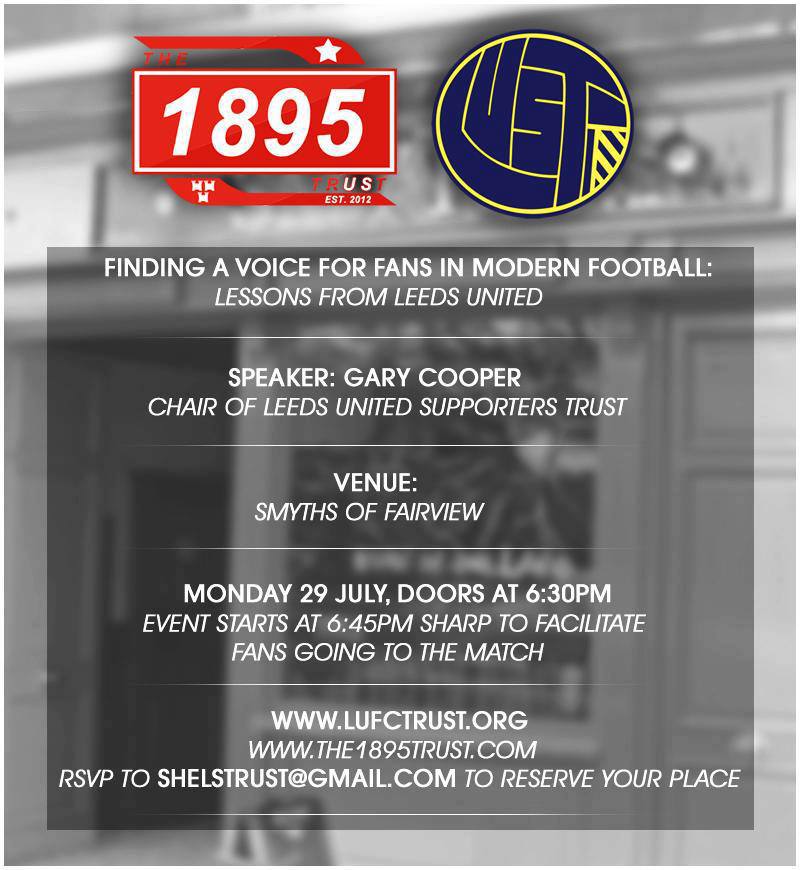
This upcoming event from the 1895 Trust is deserving of a plug. The trust is a relatively new fans iniativie at Shelbourne F.C, which serves in its own words as a “democratic, not-for profit organisation working to strengthen the influence of Shelbourne FC fans.” The event is a product of the brilliant and unique links the Supporters Direct organisation are facilitating between different Supporters Trusts in Ireland, the UK and Europe. The event page is here.
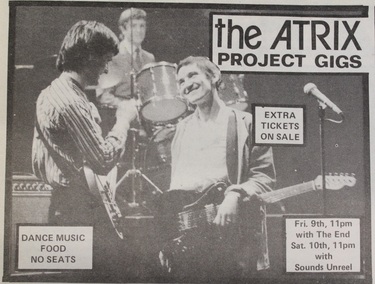
Hot Press advert for a series of Atrix gigs in the Project Arts Centre in 1980. Credit – u2theearlydayz.com
Irish Times journalist John Fleming has recently uploaded a 30mins broadcast from Dublin New Wave legends The Atrix. Recorded on 14 February 1983 at the Top Hat in Dun Laoghaire, the footage was first broadcast on RTE’s ‘Campus Rock’ on 29 February 1983.
The Atrix was John Borrowman (guitar/vocals), Dick Conroy (bass), Chris Green (keyboards) and Hugh Friel (drums).
Set List:
1. The Life I Lead
2. It’s Taboo
3. Sweet Memory
4. The 11th Hour
5. Treasure On The Wasteland
6. I Wonder Why
7. The Moon Is Puce
8. Procession
Most of the songs (bar The 11th Hour, Treasure On The Wasteland & The Moon Is Puce) come from the band’s album ‘Procession’ which was released on Scoff Records in November 1981.
On 17 February 2013, poet Pat Boran looked at The Atrix on RTE Radio show ‘Sunday Miscellany‘. You can listen to the episode on the excellent ‘Fanning Sessions’ blog here.
In response, an individual called Tony left a comment on the blog:
I was a very close friend of Johns. In fact i was by his side when he died, 15 years ago, here in Copenhagen.
I have copies of his two short movies and his solo album- “Stoned Circle”- which should be in the public domain.
Reply please- I need assistance putting these things out. Permission has been granted by family.
On 12 March, the ‘Fanning Sessions’ blog uploaded John’s solo album ‘Stoned Circle’ which was recorded in Copenhagen in the late 1980s. John passed away in the city in January 1998. You can listen to the album here.
I set up a Facebook page for the band a while back, link here.
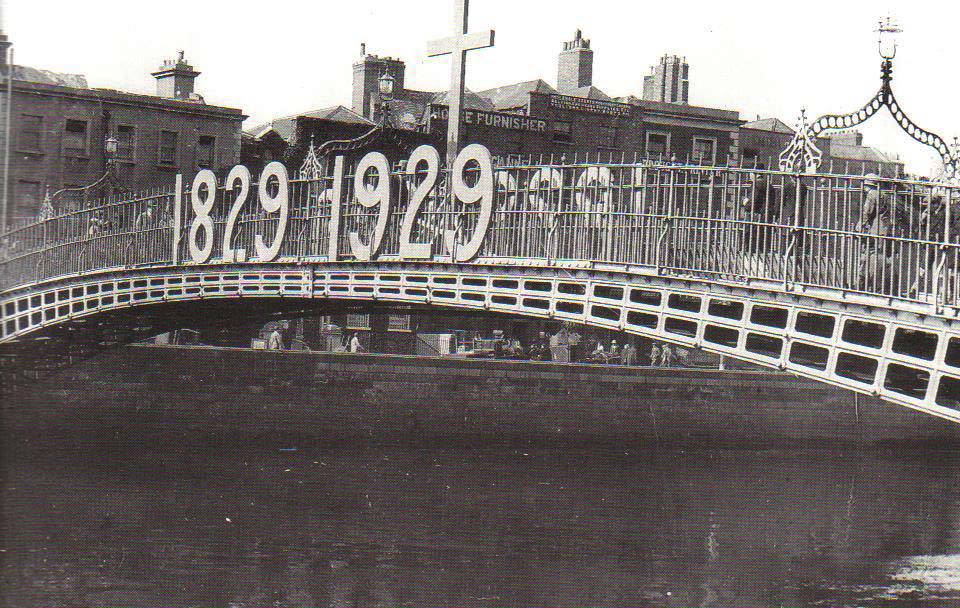
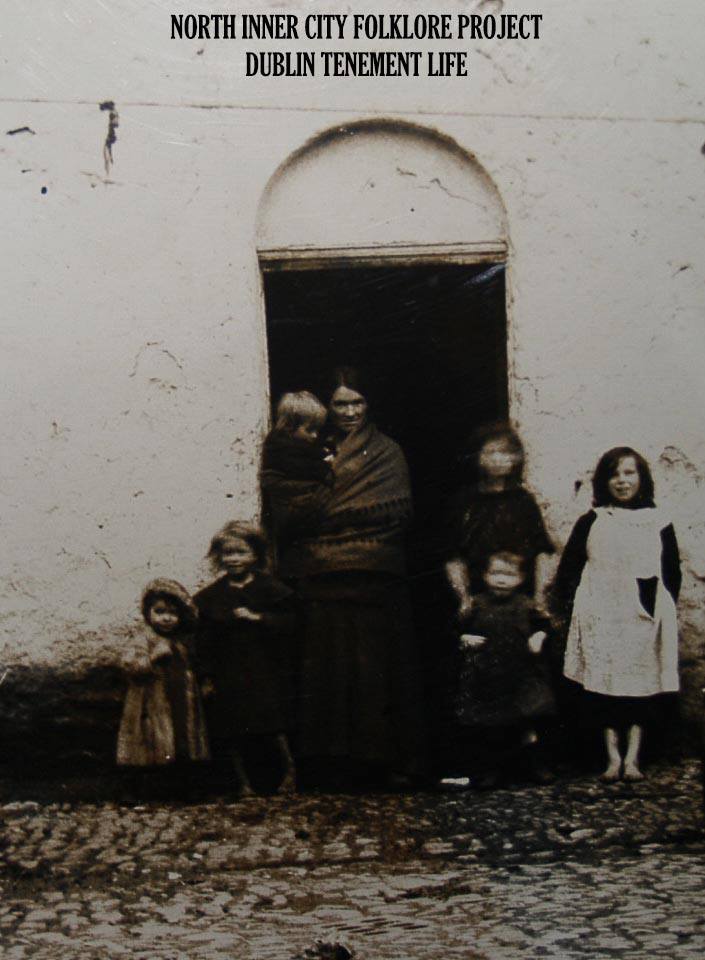
A brilliant new Facebook page has emerged recently, entitled ‘Dublin Tenement LIFE’. It has posted a remarkable collection of photographs, primarily showing working class life in inner-city Dublin in the late nineteenth and early twentieth centuries. Many of the photos have been collected by the North Inner City Folklore Project, and capture important moments in the history of the city.
The Ha’penny Bridge on the centenary of Catholic Emancipation (Posted by Dublin Tenement LIFE)
Inner-city women and children (Image posted by Dublin Tenement LIFE)
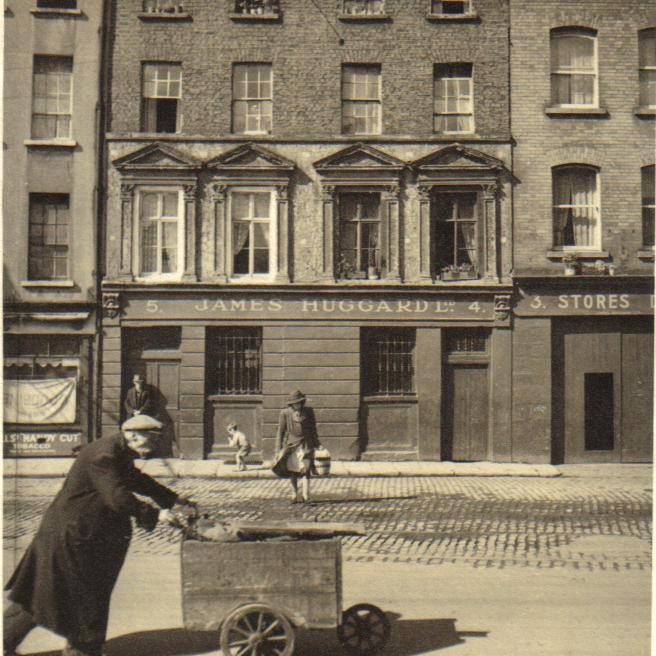
One particular photograph from the 1940s is very interesting for me though, and a bit touching. A relative realised while browsing the pictures that one of them shows the home of my grandmother at Cornmarket, near to the Liberties. I never met my grandmother, but her home can be seen in this image. We know that they had the two front rooms on the left on the first floor. The ones with the painted windows and curtains. Of course, this is all demolished now, but it’s a great image to have.
Cornmarket. (Image posted by ‘Dublin Tenement LIFE’
You can find the page here, I recommend liking it for more great photos and stories.
This month marks the 75th anniversary of a very peculiar moment in the history of Baldonnel Aerodrome here in Dublin.
On 18 July 1938, an American aviator by the name of Douglas Corrigan landed in the aerodrome, after a 28 hour flight. This was all particularly unusual as Corrigan had flown off from Brooklyn in New York, supposedly destined for Long Beach, California! Corrigan returned to the United States to massive fanfare in New York City and California, and was honoured with a brilliant New York Post front page, reproduced below.He was only the eleventh person to fly across the Atlantic, and the parade that welcomed him home even surpassed that of Charles Lindbergh.
New York Post coverage of parade in NYC.
Douglas Corrigan was born at Galveston in Texas in 1907, the son of a Construction Engineer. In his younger years, he himself worked as a mechanic of the famed Spirit of St.Louis, the plane that his hero Charles Lindbergh would use to make the first non-stop flight between New York and Paris in May 1927. At the time, Corrigan was working at the Ryan Airlines aircraft manufacturing plant in San Diego. Lindbergh’s success and fame had a huge impact on the young Corrigan.
The plane Corrigan used for his incredible flight across the Atlantic in July 1938 was a nine-year-old Curtiss Robin, well below the standard required to fly across the Atlantic. Corrigan had repeatedly sought permission to fly across the Atlantic, but been refused on the grounds that his plane was considered incapable of such a flight. Indeed, Corrigan’s plane was in such a condition that authorities were even reluctant to allow him to fly back to California in it. As Mary Maher noted in an article on the fiftieth anniversary of the flight, it was said at the time that “the pilot had no radio, no parachute, and had overloaded his nine-year-old plane by half a ton. He’d wired himself into the cockpit with a few boxes of chocolate and fig bars, and when he discovered the knob had fallen off the cabin door, he closed it with some more wire hooked around a nail.”
The fact he had requested permission to fly across the Atlantic of course made his story of ‘accidentally’ ending up in Dublin a little suspect. Corrigan claimed that he misread his compass by watching the wrong end of the needle, and therefore headed east instead of west.
Newspaper coverage of Corrigan’s arrival noted that the nine-year-old plane Corrigan arrived in was “tied up with wire” and that “Mr. Corrigan stepped smiling from his machine at Baldonnel and was surrounded by a group of Army air officials, who were entirely mystified by his appearance. He explained what had happened and was taken to the officers’ mess, where he had a meal.”
Wrong Way Corrigan and the plane that brought him to Dublin from New York.
It was reported that after being questioned by Customs and Army officials at Baldonnel, Corrigan was taken to meet John Cudahy, then the U.S Minister to Ireland. Thanks to Cudahy, Corrigan was also introduced to Eamonn De Valera, then Taoiseach, as well as his two aviation experts John Leyden and John Walsh. Corrigan became something of a celebrity in Dublin, mobbed by autograph hunters in Dublin city centre, and even received by President Hyde at the Áras. This presidential reception attracted huge international media attention, with one American newspaper noting that:
Ireland’s new president honoured America’s new aviation hero by receiving him in Dublin’s imposing presidential palace.
Spick and span in new clothes, Douglas C. Corrigan drove from the United States Legation to the palace. There, the 78-year-old President Douglas Hyde and the young Californian animatedly discussed the latter’s amazing flight from New York to Dublin.
Irish Times image of the plane.
Following his flight to Ireland, the United States Bureau of Commerce suspended the experimental airport certificate of Corrigan’s plane, with the intention of keeping him out of the air. It was noted in newspaper reports that Corrigan had joked his next plan was to fly around the Eiffel Tower in Paris, but in the end Corrigan and his plane returned to the U.S by ship. He certainly capitalised on his fame, with an autobiography published within months, as well as endorsing a rather useless watch that ran backwards! Sadly, he became something of a recluse from 1972 onwards when one of his sons perished in a plane clash, but he did publicly mark the fiftieth anniversary of the flight on both sides of the Atlantic.
Returning to Dublin in 1988, he met with some of the army officials who he had encountered at Baldonnel, spoke at Trinity College Dublin and even returned to Clery’s department shop, where he had gone fifty years earlier. Once again, he captivated Dubliners with his story, though many felt not even he believed it!
In 1988, Corrigan talked about his incredible journey on an American news channel:











 Click on the book for more.
 Click on the book for more.
 Donal
Donal Ciarán
 Sam
Sam


 Come Here To Me!