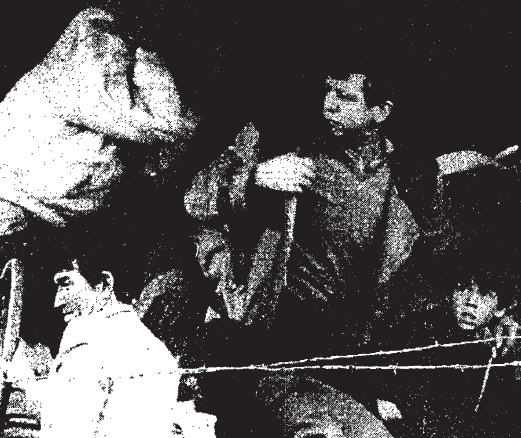
There was a lot of interest in a post earlier this week looking at football hooliganism at Richmond Park in the 1970s and 1980s. Outside the scope and timeframe of that article was the UEFA Cup Clash between Saint Patrick’s Athletic and Heart of Midlothian F.C in Tolka Park in 1988. Clashes at this game were photographed by the media, and this fantastic image was printed in the Irish Press on the day following the fixture:
Irish Press capture violence at Tolka Park, 1988.
The Saints were defeated 2-0 in Tolka Park by their Scottish opponents, but as one match report noted:
The loss of the match will be difficult enough to bear, but the behaviour of some of the estimated 8,000 people who came to watch may cost them dearly. Spectators carrying Glasgow Celtic flags and Irish tricolours inscribed with the letters IRA gathered under the popular stand and in the second half threw missiles onto the pitch causing the referee Harry King from Wales to draw the attention of the officials and the Gardaí to this behaviour.
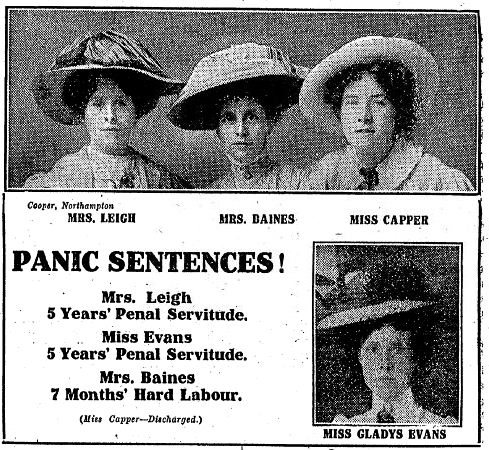
On August 7th 1912 four women- Gladys Evans, Mary Leigh, Jennie Baines (under the nom de guerre Lizzie Baker) and Mabel Capper were sentenced at the Green Street Special Criminal Court in Dublin accused of “having committed serious outrages at the time of the visit of the British Prime Minister Herbert Asquith.” The trial lasted several days during which police came under fire for initially refusing to allow admittance to women. Given the nature of the case, this act was met with steady and mounting pressure until the ban was repealed.
The “acts of serious outrage” have been mentioned in passing here before in an article on the Theatre Royal. The visit of Asquith to Dublin in July 1912 was met with defiance from militant suffragettes, some of whom (including the four above) had followed him over from England. On July 19th, a hatchet (around which a text reading “This symbol of the extinction of the Liberal Party for evermore” was wrapped) was thrown at his moving carriage as it passed over O’Connell Bridge. The hatchet missed Asquith but struck John Redmond, who was travelling in the same carriage, on the arm. There was also a failed attempt at setting fire to the Theatre Royal as he was due to talk on Home Rule in the same venue the following day. A burning chair was thrown from a balcony into the orchestra pit and flammable liquid was spread around the cinematograph (projector) box, and an attempt made to set it alight. It caught fire, and exploded once, but was quickly extinguished. The Irish Times, as below, reported the attempt which, in any case was foiled by Sergeant Durban Cooper of the Connaught Rangers who was in attendance:
At this moment Sergeant Cooper saw a young woman standing near. She was lighting matches. Opening the door of the cinematograph box, she threw in a lighted match, and then tried to escape. But she was caught by Sergeant Cooper and held by him. She is stated to have then said: “There will be a few more explosions in the second house. This is only the start of it.” (Irish Times, July 19th 1912)
Taken from “Votes for Women,” August 9th, 1912
The four women mentioned above were accused and charged over both actions. The then Attorney General for Ireland, C.A O’Connor conducted the prosecution, and the case was presided over by Judge Madden. It seems that the authorities were at great pains to quell the burgeoning suffragette movement, and so set out to brand the women as highly dangerous provocateurs. O’Connor spoke of the horrors the fire in the Theatre could have caused, and Judge Madden, upon passing sentence on the women, rendered it his “imperative duty to pronounce a sentence that is calculated to have a deterrent effect.” Large crowds had gathered inside and outside the court for their sentencing upon which, as seen in the Evening Post clipping below, applause rang out around a largely hostile room.
The Chelsea Hotel in New York has provided a bed to some of the finest minds and talents in human history, serving as an inspiration for Leonard Cohen, Dylan Thomas and others. From Simone De Beauvoir to Jack Kerouac, some of the most celebrated works of some of the most celebrated writers of the past were composed within its walls, and its beautiful facade and iconic ‘Hotel Chelsea’ sign have become a must see for many tourists to New York.
The Chelsea Hotel, New York. (2010,Wiki)
The front of the hotel has several plaques upon it, in honour of some of the figures closely associated with the premises. One of these plaques marks the connection between the Chelsea Hotel and Leonard Cohen, who has sung of the Hotel in his song named in its honour. Thomas Wolfe and Dylan Thomas are among other writers remembered in bronze. Among these great names is that of a Dubliner, Brendan Behan:
Brendan Behan plaque upon the Chelsea Hotel. Thanks to wheresmybackpack.com
Behan spent some time in New York, though the period was towards the end of his life. Clifford Irving wrote of Behan in America that “he was a vicious tank of a man rolling relentlessly through the minefield of America, crushing everything in sight until he blew up.” The New York media and art scene were both fascinated by the Dubliner, falling for his charm. Novelist Norman Mailer once asked Brendan if he usually had a police escort at home in Ireland, to which Brendan joked “I do, but I’m usually handcuffed to the bastards!” It was said that when in New York Brendan stuffed $80 in the pockets of Allen Ginsberg, hero of the Beat Generation types.
Brendan’s niece Rosemary visited New York in 2001, and followed in the footsteps of her uncle. Reflecting on that visit she noted:
I wasn’t overly impressed with the Chelsea, either. The hotel, a seedy red-brick Victorian building of more than 100 rooms, trades on its past, on a guest list of literati that included Dylan Thomas, Arthur Miller and William Burroughs. It wouldn’t be my choice as a base in New York. It has too little of the promise that Brendan loved about the United States and which he summed up in a sentence preserved in a plaque at the front door: “To America, my new-found land: the man that hates you hates the human race.”
But there is no doubt that he felt at home at the Chelsea. In a disorganised office, filled with piles of books and papers spread across several desks, Stanley told me: “Brendan would come in just as you did now and stand right there where you are standing. I would be on the phone to my wife and he would grab the phone off me and start singing to her.”
By his own standards, though, he was reasonably well-behaved. “We are interested in helping the artist and he respected that,” said Stanley. “He never abused the hotel or anyone in the hotel.”
Brendan Behan’s New York was published in 1964,though it was a ‘talk book’, far removed from the classic novels and plays the Russell Street native had produced before it. Behan’s best days as a writer had passed him as he succumbed to the drink, his untimely death robbing Dublin of one of its most celebrated voices, and as his brother Brian would recall “greater writers have graced the literary canvas than Brendan in Ireland’s history, but not greater characters– before or since.”
A youngster is shielded from missiles during a clash between Saint Patrick’s Athletic and Waterford United at Richmond Park, April 14 1986.
Writing in the Irish Press in 1972, one sports journalist asked with tongue firmly in cheek why was it that “Irish footballers are not able to emulate English footballers to some small degree, when their supporters have no trouble in successfully aping the cross-Channel hooligan element.” While football violence in Ireland never reached the level of that in the U.K, the media was awash with stories of the hooligan threat to the Irish game in the 1970s and 1980s. This brief article will look at one Dublin stadium, Richmond Park in Inchicore, and see when ‘hooliganism’ was reported on in the ground during the period.
Much of the Irish media coverage of soccer hooliganism in the 1970s centered around violence in British football. The Irish Times for example quoted Magistrate Grahame Hands in March 1974 when he demanded “labour camps for soccer hooligans.” Considerable space was given to reporting the antics of ‘firms’ at some of Britain’s leading clubs.
Clashes between Shamrock Rovers and Saint Patrick’s Athletic fans in March 1972 brought the issue of soccer hooliganism in Dublin out of the sports pages and into the national news section of the mainstream media, with a youngster stabbed during a terrace fracas. Disturbances at Richmond Park between both sets of fans, the second example in weeks, brought The Irish Times to note that “the FAI can do very little about these occurrences once they do not interfere with the actual match”. The Irish Press would write that “Shamrock Rovers, like their great Glasgow contemporaries Rangers and Celtic, should declare WAR on the hooligans who are dragging their club’s name down to gutter-level.”
The stabbing of a youth in Inchicore put real pressure on Shamrock Rovers, who pledged to stop those banned from Miltown Road attending away games as supporters of the club:
Violence in Irish football in the 1970’s and 1980’s was not confined to Shamrock Rovers, or indeed Dublin. Clubs like Sligo Rovers, Bohemian FC, Linfield, Dundalk and others had witnessed clashes and violence, with the August 1979 clashes between Linfield and Dundalk fans entering Irish football folklore for their viciousness. Journalist Peter Byrne wrote of those clashes, when he stated that
This was the night when the concept of All-Ireland club football was killed stone dead. Two hours of raw, naked tribalism on the terraces of Oriel Park convinced even the most reformist among us that the dark gospel of the paramilitaries has permeated Irish sport to the point where all attempts at reconciliation are futile.
Richmond Park found itself on the front of national newspapers in January 1977, following clashes on the football pitch which would see two footballers hospitalised. Pats goalkeeper Mick O’Brien and Home Farm left-winger Terry Eviston sustained injuries following assaults on them by fans, and the referee had to be taken off the pitch. Dozens of fans made their way onto the pitch, and St.Pat’s manager Barry Bridges pleaded with angry supporters over the P.A system not to attack match officials or players. The game finished in a 2-1 victory to the Saints.
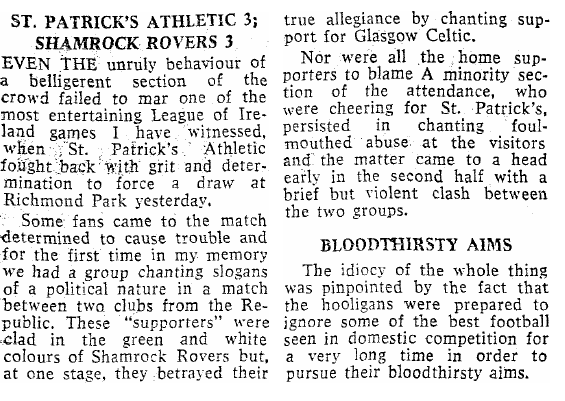
Richmond Park witnessed little in the line of football violence in the 1980s, but some incidents of note did occur. In February 1980 it was reported that Shamrock Rovers supporters “chanted slogans of a political nature”, and chanted their support for Celtic, during a Dublin derby encounter. Reports of a brief fracas between both supporters featured in coverage of what sounded like a thrilling game on the pitch.
25 February 1980 (Irish Independent)
Perhaps the most serious violence the stadium has ever witnessed though was to come later in the decade, on a day that proved embarrassing for club officials and the Football Association of Ireland, and sparked a media frenzy. On 13 April 1986, Saint Patrick’s Athletic welcomed Waterford United to Inchicore. The clash was a FAI Cup tie, yet it would make the front page of the following days newspapers for all the wrong reasons. Violence on the Inchicore terraces marred the clash, which was to be the first defeat inflicted on the saints in 20 outings. The game was a crucial FAI Cup semi-final, and the two sides went into the game at 1-1. It ended with a 4-2 win to the visitors on aggregate.
One of the first mentions in the newspapers comes from Monica Sheridan in The Irish Times on 07 April 1956. Explaining to her readers that pizza was “a sort of open tart made with tomatoes and cheese on a base of yeast dough”, she described it as becoming “frightfully fashionable all over Europe”. Sheridan doesn’t make any reference to any restaurants in Ireland where you could get pizza. However in Italy, she wrote:
It is sold (and very cheaply, too) in little restaurants known as pizzerie, where they have special open ovens. The pizze are prepared and cooked before your eyes, and a very appetising sight it is. They are eaten piping hot, at a sort of quick-lunch counter, or you can take your pizza with you and gnaw it on a bench.
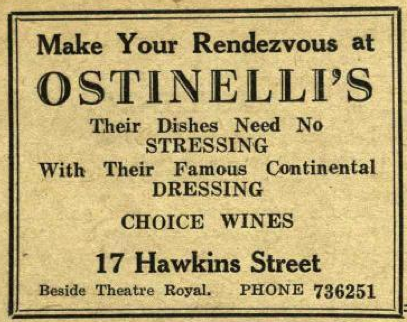
Ostinelli’s at 17 Hawkins Street was offering pizza as early as 1957:
In The Irish Times on 20 July 1959, Moira Molony offered advice on ‘Giving a Party On a Shoestring”. She described pizzas as “absolutely scrumptious, but learning how to make the wafer thin pastry requires a practised hand”. Smartly, she advises readers to try “the concoction first on your family”.
A year later, the same paper reported on a “very gay reception” held by the Italian Ambassador at Lucan House (described as “the most beautiful embassy in Dublin”). At this soirée “Pizza, washed down with Ovrieto, was consumed in great quantities”.
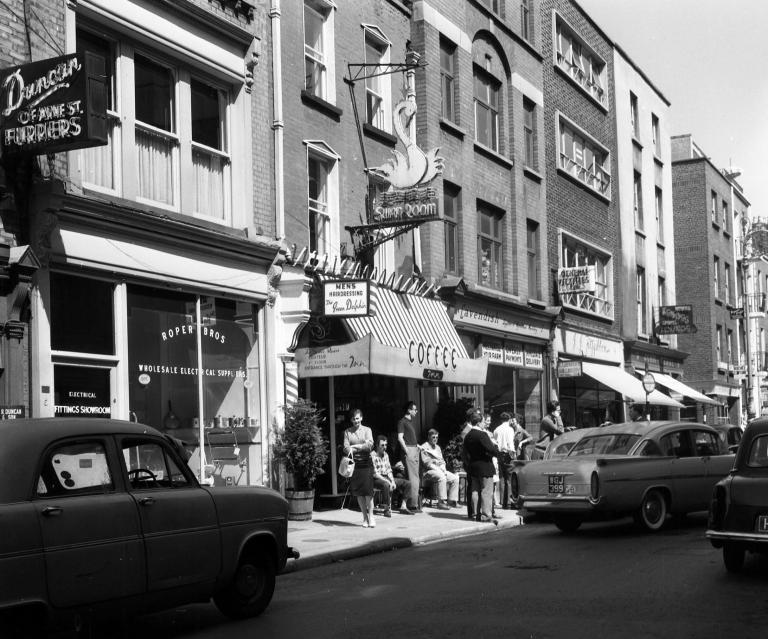
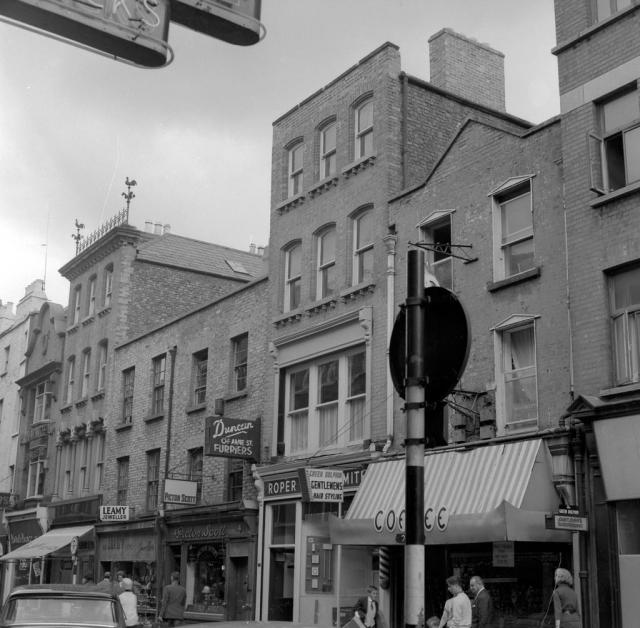
The legendary Coffee Inn who operated from South Anne Street from 1954 – 1995 had pizza on the menu by 1962. This was confirmed by a comment left by Tex Browne:
It was a favourite haunt of art students and teenage would-be bohemians. The proprietor was a very patient Italian called Mario who allowed his young clients to congregate without let for the price of a coffee. You could have any pizza topping you desired as long as it was mozzarella and anchovies!
The Coffee Inn, South Anne Street, 1960s. Fáilte Ireland Tourism Photographic Collection, Dublin City Library & Archive.
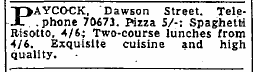
A restaurant called Paycock at 32 Dawson Street offered the dish by January 1965 (Irish Press) with Bernardo’s at 19 Lincoln Place offering “pizza napoletana” by March 1967 (Irish Times).
The Irish Press, Jan 14, 1965.
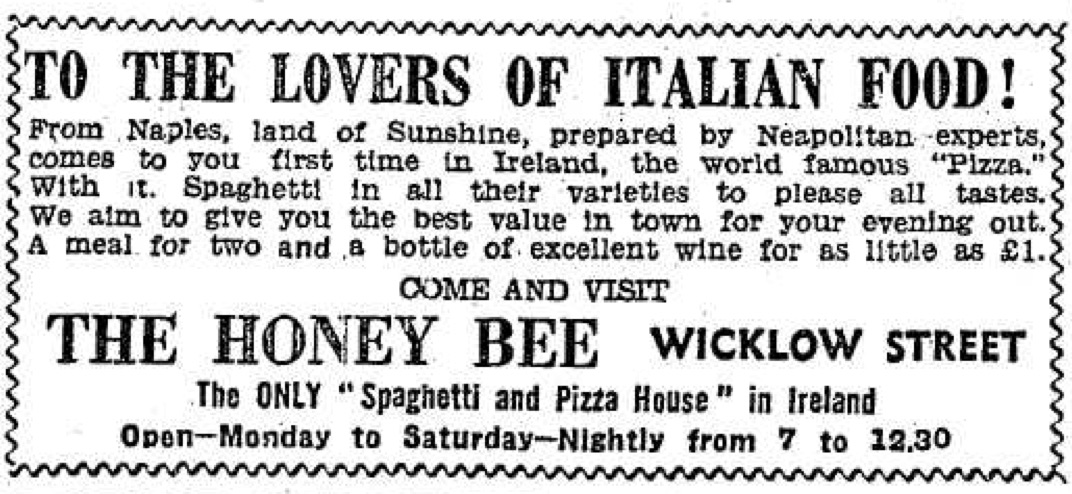
The Honey Bee on Wicklow Street described itself the “ONLY ‘Spaghetti House and Pizzeria’ in Ireland'” when it was opened in July 1967. The owners were Dr. DionisioTullio and his Scottish-born wife Irene. Dr. Tullio who was from Gallinaro, Italy and served as a Lieutenant during the Second World War. The restaurant’s pizza chef was Joe Forte from Naples. Dr. Tullio’s son Paolo (1949-2015) was an award-winning chef and food critic in his own right.
Advertisement for The Honey Bee. Evening Herald, 4 July 1967.
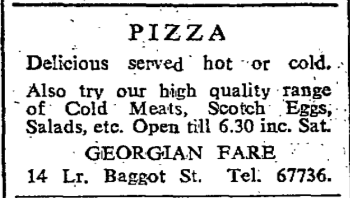
By a the mid 1970s and early 1980s, a lot of Dublin’s American style restaurants started to offer pizza on their menus. Places like TJs Pizzera on Lower Grafton Street and Georgian Fare at 14 Lower Baggot Street.
The Irish Times, 21 July 1972.
Not forgetting Murph’s Gasworks Cafe at 21 Bachelors Walk (1976 – 1985), Thunderbird at 84 Grafton Street (1977 – early 1980s) and Solomon Grundy’s at 21 Suffolk Street (1978 – 1986).
Though now associated as a take-away, Mizzoni’s opened its first restaurant in Rathgar in 1974 and is still open today (as of 2018).
The Irish Times, 10 Dec 1975.
Flanagan’s at 61 O’Connell Street (1980 – Present) and the Bad Ass Cafe at 9-10 Crown Alley (1983 – Present) are the only two restaurants, who fit that bill, that are still open today.
Pizzaland which opened a branch at 52 Lower O’Connell Street in 1976 and at 82 Grafton Street the following year should also be mentioned at this point. They were part of a UK chain of pizza restaurants which was wound down in the mid 1990s.
The Chicago Pizza Pie Company, on Stephens Green where TGI Friday’s is now, was also a popular spot in the 1980s.
Pizzaland (beside Avis), St. Stephen’s Green, 1990. Credit – Dublin City Photographic Collection
Italian-run places also started to offer pizza in this period. Some of the ones that have come and gone include The Pizzeria at 12 St. Andrews Street (early 1970s), La Caprice at 12 St. Andrews Street (1976-?), Pizzeria Italia at 23 Temple Bar (1986 – 1996), Chew ‘n’ Chat at 112 Ranelagh (c. 1987 – 2007) Da Vinceno’s at 133 Upper Leeson Street (1988 – 2011) and Da Pino at 38-40 Parliament Street (1993 – 2010).
Advertisement for La Pizzeria, Evening Herald, 12 July 1972.
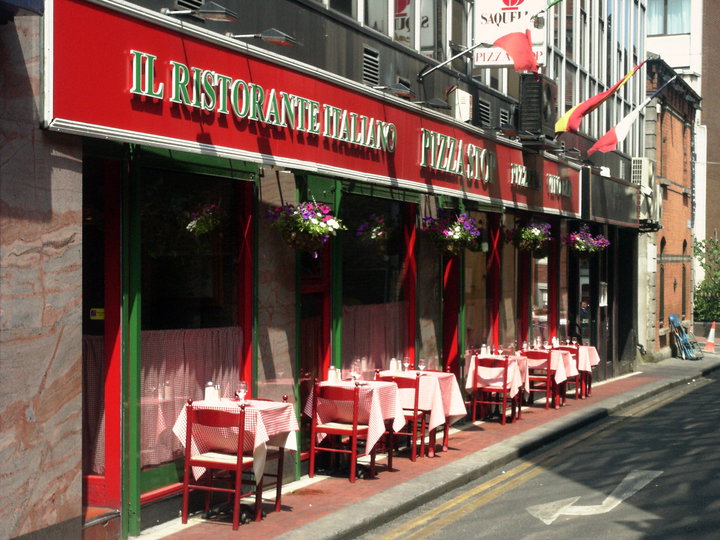
Of those still operating, Pizza Stop at Chatham Lane can definitely be described as the oldest operating Italian pizzeria in Dublin City having being on the go since 1982.
Writing in the Irish Press on 12 Jan 1989 critic Ruth Tooth described their experience:
We loved the atmosphere… The smell of garlic hits you in the minute you walk in the door. The kitchen is visible to all. It is clearly very popular and the business and bustle of the place makes for warmth and feeling of being totally at home.
Tooth’s guest described his pizza (medium Margherita for £2.95) as “one of the best he has ever eaten”.
(The three of us from Come Here To Me! and two close friends had a meal there a few weeks ago. All five of us were greatly impressed with the quality of the food. Four starters, five pizzas, nine beers and four expressos came in at €149.)
Pizza Stop, Chatham Lane (2010). (Pizza Stop Facebook)
The Independent Pizza Company at 28 Lower Drumcondra Road wasn’t far behind, openings its doors in 1984. They continue to receive glowing reviews.
In August 1987, self-confessed pizza addict Padraig O’Morain went on search for the best pizza in Dublin for The Irish Times. TJs’ pizza was described as “unexciting but nothing wrong with it”, the Pizza Calzoni at Flanagans was “unforgettable” and got the thumbs up, the Bad Ass Cafe was a given a glowing review, Pizzeria Italia was excellent while O’Connell Street’s Pizzaland was of average quality and on the expensive side. You wonder why he didn’t try Pizza Stop or Independent Pizza Company?
The late 1980s and early 1990s saw a rake of pizza places open that some of which are still in business today: Fat Freddy’s on Crow Street, Miller’s Pizza Kitchen at 9-10 Baggot St Lower, Pinheads at 104 South Circular Road (estd. 1989), Ristorante Romano at 12 Capel Street (estd. early 1990s?), South Street Pizza on South Great Georges Street (estd. early 1990s), Little Caesar’s Pizza at 5 Balfe Street (estd. 1991), Gotham Cafe at 8 Anne Street South (estd. 1993), UK chain Milano at 38 Dame Street (estd. 1995), the Steps of Rome at 1 Chatham Street (estd. 1995) and Cafe Topolis at 37 Parliament Street (estd. mid 1990s?)
Yum… Steps of Rome, Chatham Street. (Stepsofrome.ie)
The 2000s saw many pizzerias come and go. Some of those that were opened in this decade and that are still open include Ciao Bella Roma at 25 Parliament Street (estd. 2003), Enoteca Langhe in the Italian Quarter (estd. 2003), Bar Italia on Ormond Quay (estd. 2004), Bottega Toffoli at 34 Castle Street (estd. 2005), Taverna in the Italian Quarter (est. 2005), Paulie’s Pizza at 58 Upper Grand Canal Street (estd. 2010), Credo at 19 Montague Street (estd. 2010), Da Mimmo in Fairview (est.d 2010), Al Vesuvio at 73 Mespil Road and Manifesto at 208 Rathmines Road Lower.
Di Fontaines at 22 Parliament Street (estd. 2011 but based in Crow Alley for many years before that) deserves a mention for offering New York style slices until the wee hours.
2013 is the year I hope to try all the (great) pizzerias that I haven’t visited yet.
Questions for readers:
What was your first experiences of eating pizza in Dublin?
Back in December we decided that the blog would make an attempt to fundraise for two worthy Dublin charities. We planned to do this in two ways. Firstly, we sold a limited edition print based on the cover of our recent book. For this, we owe huge thanks to Luke Fallon who designed the image, but we are also very much indebted to Mark and his team at Grehan Printers, who produced the top quality prints for the night.
This print was sold on the night of the booklaunch, and €400 was made which was then donated to the Simon Community. Simon do hugely important work for the homeless in Dublin, and against the backdrop of an awful winter were a very fitting charity.
—
In early January, we done something totally new and embarked on a Come Here To Me! Walking tour of Dublin. Over two days, we took over 50 readers of the blog on a tour of Dublin which looked at the offbeat side of the capitals history. We owe huge thanks to all who came on these tours, and personally I want to thank Ci and Sam who found themselves acting as tour guides for the first time, but who were both fantastic in the role. These tours raised €540, which has been donated to ALONE.
ALONE do vital work on behalf of the elderly in Dublin, and the charity was established by Dublin firefighter Willie Bermingham, a hero of mine and a man who embodied all that is good, decent and honest about Dublin and Dubliners. Willie penned his own epitaph before his death, in which he wrote that he:
Joined the Dublin Fire Brigade in 1964 and spent a long time pushing for the pension. Favourite food, good old irish stew and lots of fish. For breakfast several mugs of tea at work. Also loves to eat lots of red tape to teach the bureaucrats a little manners.”
Thanks to everyone who supported these two efforts, which raised €940 in total. We hope that in the future we can use Come Here To Me! again to fundraise for deserving Dublin causes, and we thank everyone for their continued support.
Over the years, a few animals have managed to carry out ‘The Great Escape’, ditching the surroundings of the Phoenix Park for a life of freedom. In many cases, the escaped animals were captured and returned to the zoo, but on occasion they had to be killed. The below are just a few examples of animals who have the trip over the wall or out the gate, some didn’t make it beyond the park, while others made it as far as city centre shopping centres.
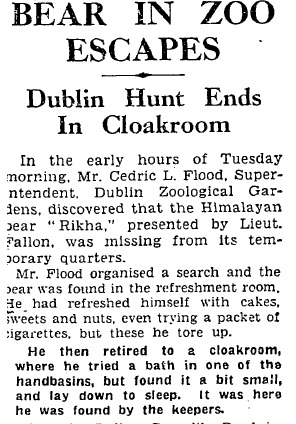
The bear who feasted on sweets, and passed out.
In March 1939, a bear escaped from its enclosure only to be discovered in the refreshment rooms of the zoo, thankfully closed to the public at the time. He had feast on cake, sweets and nuts, and was discovered sleeping in a cloakroom!
Irish Independent, March 16 1939
The pelican who ended up in Drogheda, September 1961.
In September 1961 one of the two pelicans in Dublin Zoo escaped, and was spotted by many Dubliners “perched on houses and public buildings on the northside of the city.” Missing for three weeks, he was eventually recaptured. He was found in Drogheda, where he spent some time in the Civic Guard station before his return to the capital. This adventurer was following in the footsteps of an earlier pelican, who in September 1943 vanished from the zoo.
The stag who explored the Magazine Fort, February 1924.
In February 1924, a Wapiti stag spent a lonely night on a small island near the Castleknock gates to the park, having only arrived days earlier at the zoo from New Brunswick. Making short work of an eight-foot railing, he found himself occupying the small island instead. When approached, he darted towards the Magazine Fort, jumping its barbed wire fence with ease. After a long day of avoiding park authorities, the animal collapsed with exhaustion and died soon after his recapture.
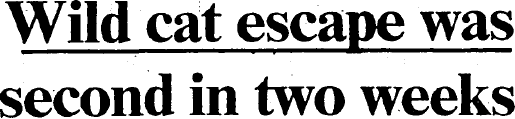
Two cheetah’s in two weeks.
In August 1990, two Cheetah’s managed to escape from the zoo, only a week after one another. The second of these animals was shot dead, in an incident involving plain clothes Gardaí. When zoo vets fired two tranquillisers into the animal, it only seemed to become more agitated and Gardaí were required to kill it.
The incident was highly embarrassing for Dublin Zoo, coming so soon after another cheetah had escaped its premises. On a Saturday in August, the park was packed with families, and newspapers reported that children as young as twelve had witnessed the cheetah being shot five times at close range.
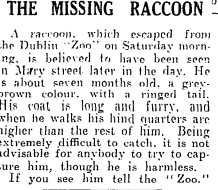
The Mary Street Raccoon.
In December 1942, a raccoon escaped from the Zoo and was later spotted wandering around Mary Street. His exploits were reported in The Irish Times on the 14th and 15th of December.
December 14th 1942
The following day, it was said he “continued to do the sights of Dublin”, and was “seen in various shopping centres.”
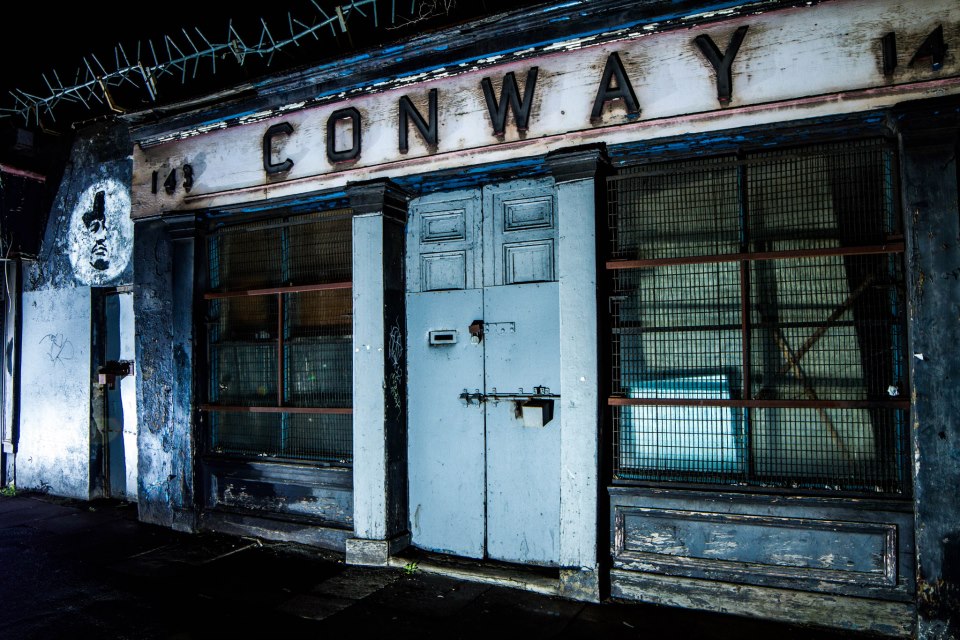
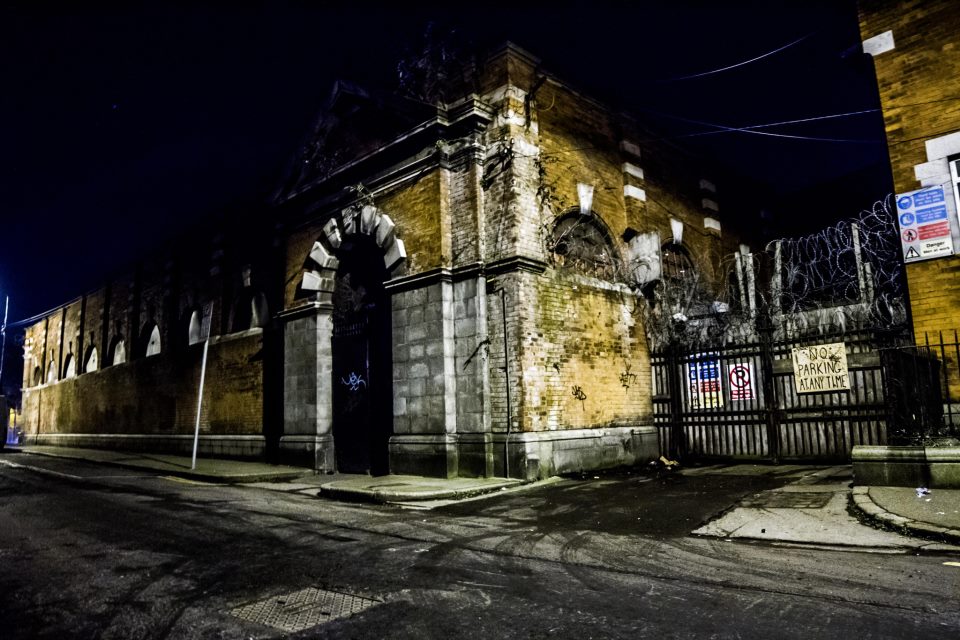
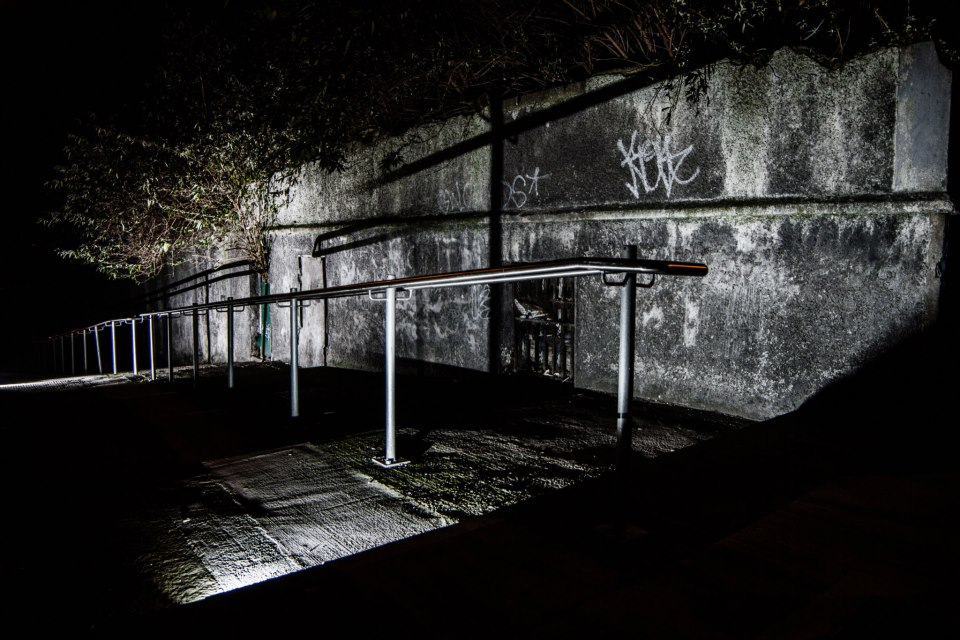
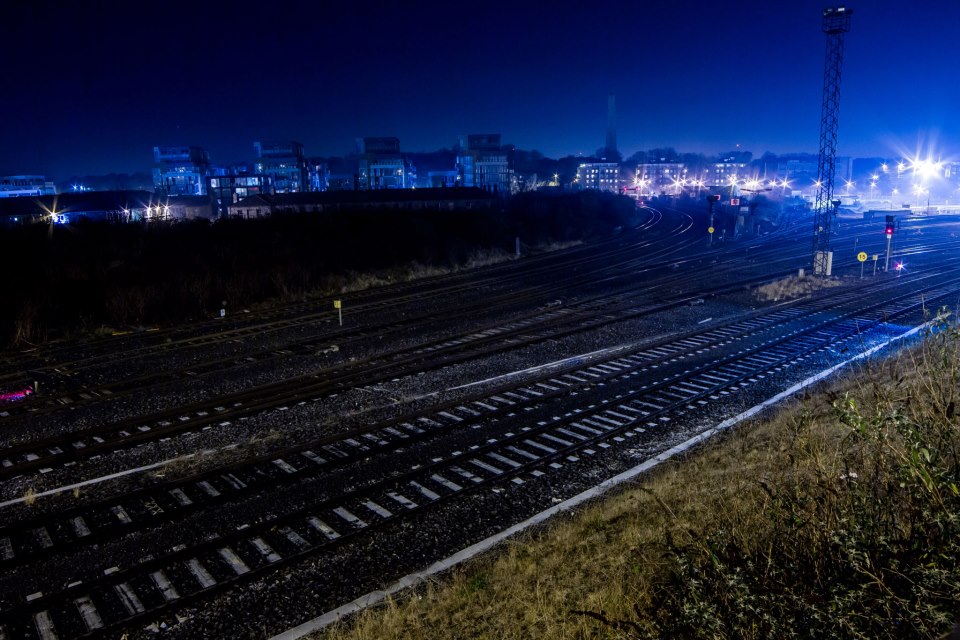
Photographer Paul Reynolds contributed many photographs to the recent Come Here To Me book, and is a regular contributor to Rabble magazine like ourselves. I was very taken by these images he just posted online, which show the effect of photographing with a night strobe on the streets of the capital. Some of these sites are historic, and have featured here in the past.
Conway’s, opposite Guinness.
The below shot of the Iveagh Market is a personal favourite, I’m fascinated by the building and its former life.
Heuston Station has always struck me as a natural stomping ground for a photographer, with people coming and going and the tracks themselves for inspiration. This is a lovely shot.
“To subvert the tyranny of our execrable government, to break the connection with England, the never-failing source of all our political evils and to assert the independence of my country- these were my objectives. To unite the whole people of Ireland, to abolish the memory of all past dissensions, and to substitute the common name of Irishman in place of the denominations of Protestant, Catholic and Dissenter – these were my means.”– Theobald Wolfe Tone
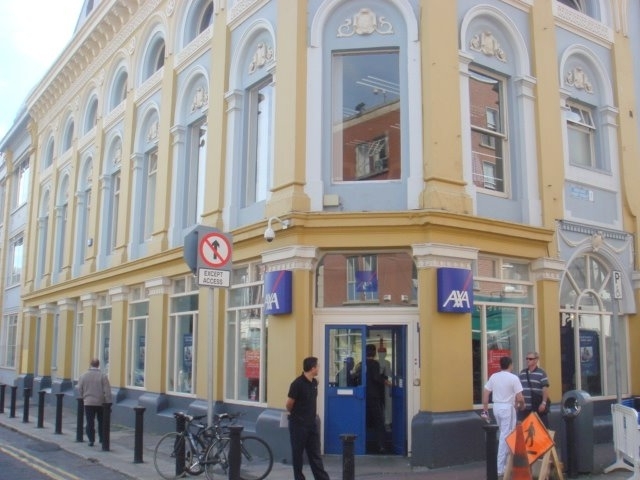
One of the oldest plaques in Dublin on street level must be that marking the birthplace and boyhood home of republican icon Theobald Wolfe Tone. The plaque is on the Axa Insurance building on what is today known as Wolfe Tone Street but was formerly Stafford Street.
Henry Boylan, biographer of Tone, has noted that:
Tone’s background and education in no way foreshadowed his romantic and tragic life. His father, Peter Tone, was a coachmaker and the son of a prosperous freehold tenant on the estate of the Wolfes of Blackhall, near Clane, in Co. Kildare. He called his first-born after the young squire, Theobald Wolfe.
Axa Insurance building (image credit: ratemyarea.com)
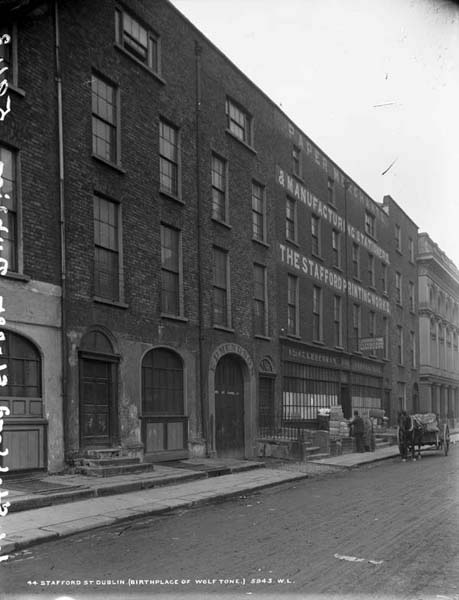
The National Library of Ireland have a fantastic image of Stafford Street from between 1880 and 1900, which was taken by Robert French. The street was crucially important to the development of Tone as a youngster, and he was also educated in a school on Stafford Street, noting in his memoirs that he learnt Latin and Greek at this school. In time Tone’s father would lose not only his home on Stafford Street but another property owned at Summerhill, with Tone noting in his memoirs that both ‘were sold much under their value’ in an hour of financial need.
44 Stafford Street, birthplace of Wolfe Tone (Image rights: NLI)
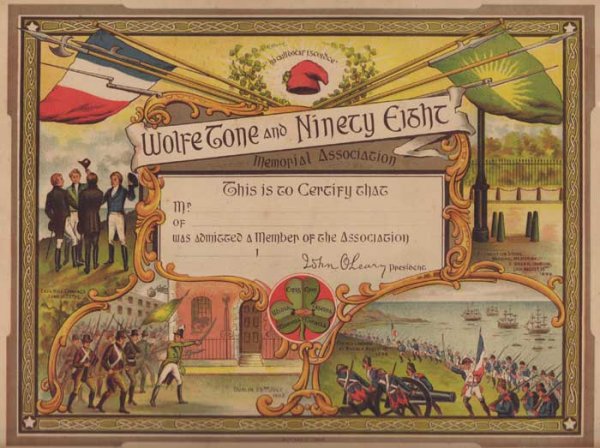
A plaque was placed on the boyhood home of Wolfe Tone by the ‘1798 Centenary Committee’, which was established to mark the centenary of the 1798 rebellion. Among those involved in the organising of events to mark this centenary were Maud Gonne, James Connolly and W.B Yeats. A beautiful coloured certificate associated with The Wolfe Tone and Ninety Eight Memorial Association recently came up for auction at Whyte’s in a lot of items connected to the centenary.
A certificate associated with the 1898 centenary. Notice the French tricolour appears alongside the harp of Ireland. (Image credit: http://www.liveauctioneers.com)
A leading-light in the United Irishmen movement which first consisted of liberal Protestants aligned to the constitutional reforms demanded by Henry Grattan, but which later turned to militant revolutionary republicanism, the combination of Tone’s writings and his romanticised role in the uprising of 1798 has led to him frequently being regarded as the ‘father of Irish republicanism’. The centenary of the uprising in 1898 was a significant moment for Irish nationalism, and as Yvonne Whelan has noted it “provided an opportunity for nationalists to commemorate what they saw as Ireland’s loyalty not to Britain but to Irish heroes and the struggle against British rule.” (more…)
Irish journalist Jack Smyth, who was held captive in a Nazi concentration camp for eight months, and his wife Eileen were tragically killed when their car plunged into the River Liffey on a cold December night in 1956.
Born in Galway, Jack began his career at The Connacht Tribune before leaving for London in the early 1940s to join Reuters news agency. Swapping a quiet civilian life and desk job for the dangerous life of a war correspondent, he underwent secret training as a paratrooper before being dropped with British airborne forces in the Arnhem landings of September 1944. In the thick of battle Jack, the only reporter at the frontline, wrote:
On this fifth day our force is still being heavily mortared, sniped, machine-gunned and shelled … When the Second Army arrives and relieves this crowd, then may be told one of the epics of the war. In the meantime, they go on fighting their hearts out.
Most of the airborne force, that Jack dropped with, were wiped out. Injured in the bloody battle, he was captured by the Nazis. For 17 days he was tortured under Gestapo interrogation and overall spent eight months as a Prisoner of War in a concentration camp before finally being released by American troops. On his return he told a friend and fellow journalist:
Jaysus, they beat the s*** out of me!. There was I, in British Army officer’s uniform, telling ’em I was a neutral and demanding to see the nearest Irish ambassador. Well, they were having none of that.
He wrote and published his experiences in a book, “Five Days in Hell”, in 1956. Lucky to get out alive, five of Jack’s fellow war correspondents and friends at Reuters had been killed in the War.
Cover of Jack Smyth’s 1956 book “Five Days In Hell”. Credit: market-garden.info
After Germany, Smyth traveled East and was aboard the last British cruiser to bombard Japan. Later, he was one of the first journalists to enter Tokyo and visit the ruined city of Hiroshima.
Leaving Reuters to take up the post of Managing Editor at The Waterford Star, he stayed there for sometime before joining the staff of the Irish News Agency in Dublin. Taken on as Assistant Editor of the newly fledged Evening Press, it was this capacity that he was involved in the sensational finding of the kidnapped Ashmore baby. He was appointed Managing Editor of the Irish Press in 1955, the year before his untimely death.
On the night of the 2nd of December 1956, Jack and Eileen were driving home to their house in Rathfarnham. He had to drop into the offices of the Press, on Burgh Quay, to help with the next day’s front page showcasing Ronnie Delaney’s sensational win at the Melbourne Olympics.
Driving from the office, the car accidentally entered the river at the junction of Lime Street and Sir John Rogerson’s quay. It was noted in The Irish Times on December 5 1956 that:
At this point there is a dockside warehouse, the gable end of which might be mistaken for a continuation of Lime Street and cause a driver unfamiliar with the area to overshoot the quay
The body of his 35-year-old wife Eileen Smyth, originally from Limerick, was found in the car when it was taken from the river on December 4th.
Jack’s body was unfortunately never recovered. He was 38. The couple left two young children behind.
A picture of Eileen and Jack after the announcement of their engagement. The Irish Press, July 13 1946
In a bizarre, tragic coincidence that occurred two-year later a relative, John Shannon, who was looking after the two orphaned Smyth children was also was killed after he accidentally drove his car into the Liffey. It was noted in the 1958 newspaper report that eight similar accidents had occurred around Sir John Rogerson’s quay over the last twenty years. Today, there is better lighting and more road bollards to prevent such disasters.
That accident in December 1956 was a very sad ending to the lives of a brave war correspondent and his devoted wife.
Italian restaurants have flourished in Dublin since at least the late 1930s. Some of the first and and most influential of these were:
The Unicorn at 12B Merrion Court (1938 – Present)
Originally based at 11 Merrion Row, it moved around the corner to Merrion Court in the early 1960s. Ran by the Sidoli family from Bardi for 57 years, it was taken over by Giorgio Casari in 1995.
In ‘The Book of Dublin’ (1948) it was described as offering “central European cooking and very good of its kind. A quiet place for a slow meal and good conversation. The clientele is cosmopolitan, literary or artistic.”
Ostinelli’s at 17 Hawkins Street (1945 – 1963)
Opened by Ernest and Mary Ostinelli, this restaurant was a popular spot for 18 years. A WW1 veteran, Ernest from Como in Italy came to Dublin in 1944 (after spells in Leeds and Belfast) and lived in Clontarf until his death at the age of 78 in 1970. Ostinellis was purchased by the Rank Organisation and demolished to make way for Hawkins House.
Advertisement for Ostinellis restaurant. Trinity News, 27 May 1954.
Alfredo’s at 14 Marys Abbey (c. 1953 – late 1960s?)
From Ospedaletti in Northern Italy, Alfredo Vido ran this popular late-night restaurant for nearly a decade. In Fodor’s Ireland guide (1968), it was described as “a place for an after-theater meal … in one of the oldest parts of the city and, as the location suggests, is on part of the site of a one-time abbey. Small, but has character and good food.” Ulick O’Connor, in February 1978 in Magill magazine, called it “Dublin’s first late-night restaurant … You banged on the door which looked like a knocking shop and a little spy hole opened like a Judas in a prison cell. If Alfredo liked you, he let you in and gave you a flower for your girl. When he didn’t like you – and a lot of people who used to flash the green backs he didn’t like – Alfredo just wouldn’t open the door.”
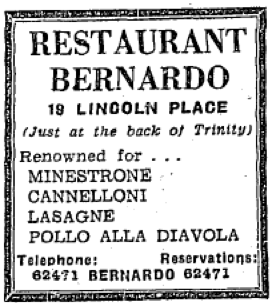
Restaurant Bernardo (aka Bernardo’s) at 19 Lincoln Place (1954 – c. 1991)
Moving to Ireland from 1952 from Rieti, Bernardino Gentile opened this restaurant with his brother Mario who later took it over. It was a popular spot for 37 years. It was described in 1998 by Patricia Lysaght as Dublin’s “first restaurant to offer an exclusively Italian menu using authentic Italian ingredients”
Advertisement for Restaurant Bernardo. The Irish Independent, 29 March 1960.
The Coffee Inn at 6 South Anne Street (1954 – 1995)
An Italian snack bar run by Bernardino’s other brother Antonio Gentile. Very popular with the art, student and music set of the 1970s and 1980s especially Phill Lynott.
The Coffee Inn from 1967. Dublin City Photographic Collection.
Quo Vadis at 15 St. Andrew’s Street (1960 – 1991)
Also opened by the trendsetting Bernardino Gentile. He worked here until his retirement in 1991, he passed away in 2011 at the age of 91.
La Caverna at 18 Dame Street (1963 – early 1980s)
Ran by Bernardino’s other brother (!) Angelo Gentile who later opened Le Caprice Restaurant with his wife Feula. 1960s guide books describes how in La Caverna “dancing is also an added attraction”
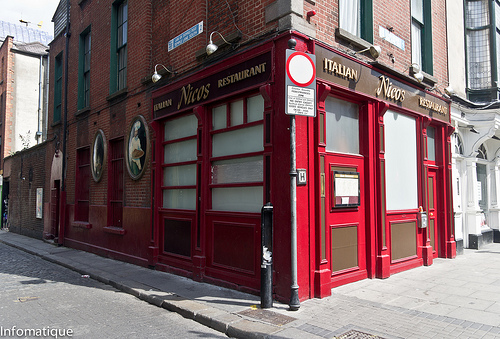
Nico’s at 53 Dame Street (1963 – Present)
Long-established Italian, celebrating 50 years of business this year.
In the depths of the Coombe in Dublin’s Liberties lies the memorial below. Dedicated to the memory of the many women who gave birth in the Coombe Lying-In Hospital, it has to be amongst the most impressive monuments in the city. The plaque at it’s base reads as follows:
“Towards the end of the 1825, two women in a vain attempt to reach the Rotunda hospital perished, together with their new born in the snow. When this became known, a number of benevolent and well disposed people founded the Coombe Lying-in Hospital in the year 1826 for the relief of poor women. Leading the charitable Committee was a Mrs. Margaret Boyle of Upper Street, Dublin.
The portico surrounding this plaque formed the entrance until the year 1967, when the hospital moved to a new location in Dolphin’s Barn. The old portico having been retained and restored by Dublin Corporation as a memorial to the many of mothers who gave birth to future citizens of Ireland in the Coombe Lying-in Hospital and also to the generosity of the staff and friends of the hospital.”
The Portico of the first Coombe Lying-in (Maternity) Hospital
There had been a hospital on this site for close to 200 years, with the foundation stone for the “Meath Hospital and County Dublin Infirmary” being laid in 1770. This hospital operated in this guise for over fifty years until it was closed in 1823. In 1826 Mrs. Margaret Boyle founded the Coombe Lying-In Hospital on the site, with the Guinness family as one of the hospital’s benefactors. It was Dublin’s second maternity hospital, the first being the Rotunda.
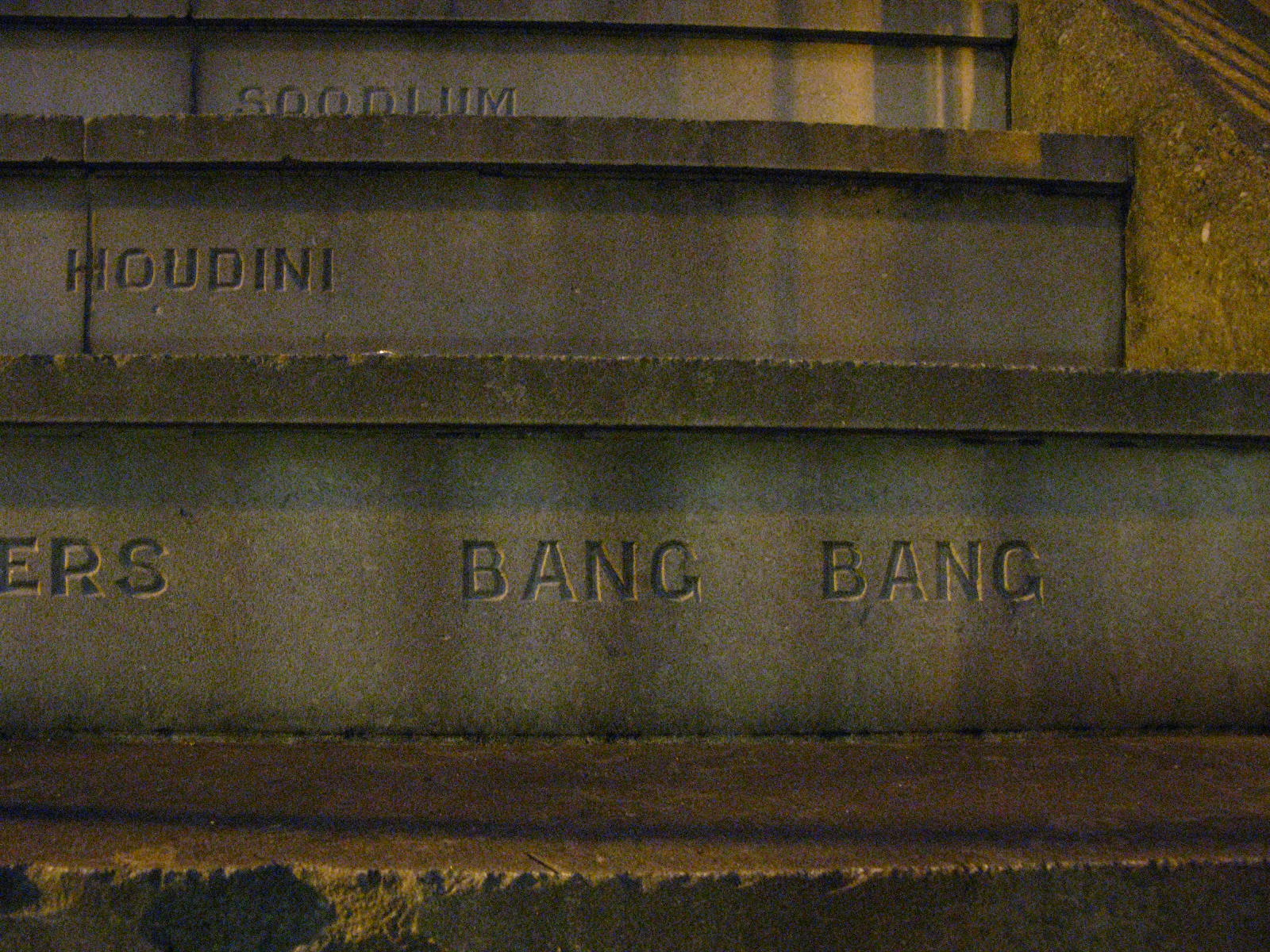
The old Coombe hospital closed and relocated to a newly built premises in 1967. The building was demolished in order to make way for Dublin Corporation housing. Interestingly, the steps at the back of the monument are a memorial to Dublin’s characters of old. Bang Bang and Johnny Forty Coats feature, along with a host of others.
If you’re interested in taking a look for yourself, the monument can be found near the corner of the Coombe and Brabazon Street.



















 Click on the book for more.
 Click on the book for more.
 Donal
Donal Ciarán
 Sam
Sam


 Come Here To Me!