Feeds:
Posts
Comments

Archive for the ‘Dublin History’ Category

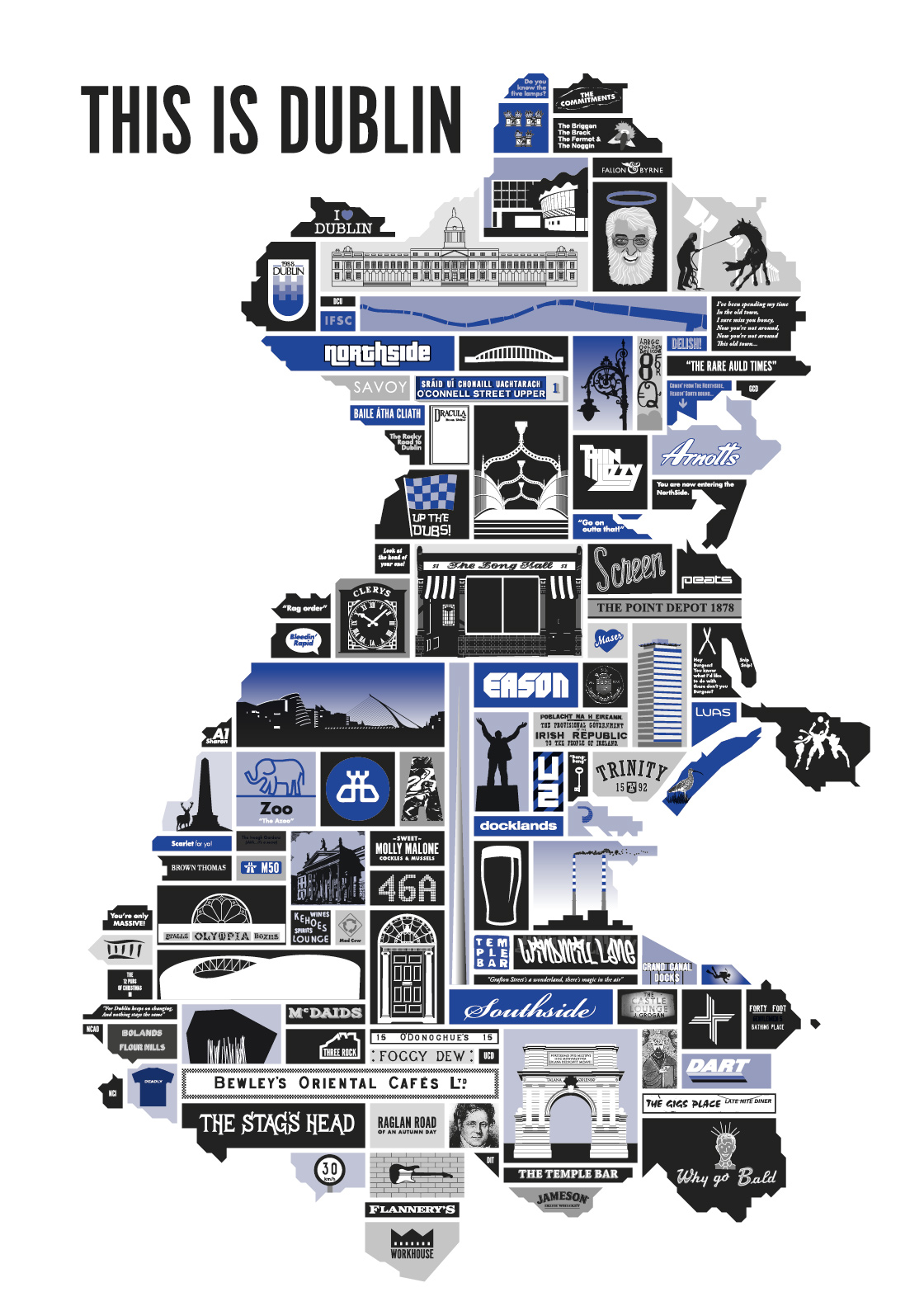
There was a great reaction on our Facebook page to Alan Wall’s brilliant recent Le Cool cover, featuring some iconic Dublin images. Over 100 likes, and 27 shares, indicated that many Dubliners took to Alan’s tribute to the city.

Alan sent on this image below, which shows even more classic Dublin features. This image is available to purchase in poster form from dublinposter.com. A few of my favourites from the image are Ronnie Drew (shown here as a saint!), the logo from Dublin’s ‘fake’ millennium in 1988 and the classic Why Go Bald? sign.

‘This Is Dublin’ by Alan Wall (Workhouse)

Read Full Post »

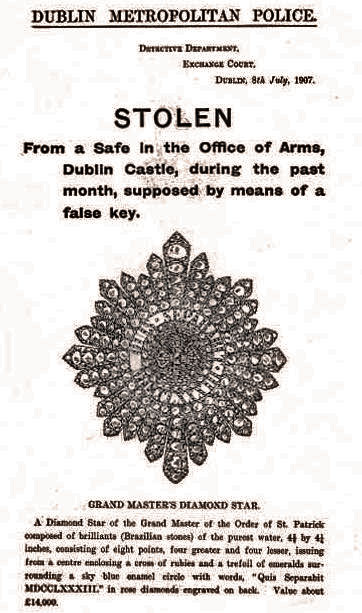
The theft of the Irish Crown Jewels is a mystery that goes back over a century, and remains unsolved. The Jewels were not the equivalent of the English Crown Jewels, rather the insignia of the Order of St. Patrick, the British Order of Chivalry associated with Ireland and disappeared in June 1907.

Supposed to have been assembled from diamonds belonging to Queen Charlotte, they were presented to the Order by King William IV in 1831.The Order itself technically still exists, although there has not been a granting of Knighthood since 1936. The Queen remains the Sovereign of the Order, and the Ulster King of Arms, the position of the person entrusted with the safe keeping of the regalia, still exists today.

Taken from the National Archives, NAI CSORP/1913/18119

The Jewels, valued at $250, 000 in the clipping from the New York Times below, were stolen from a safe located in the Office of the Ulster King of Arms, in the shadow of the then Detective Headquarters in Dublin Castle. The theft occurred in 1907; they were last seen in the safe in which they were stored on June 11th of that year, with the theft not discovered until the third of July, three weeks later. King Edward VII and Queen Alexandra were due to arrive in Dublin for the International Exhibition and plans were afoot to knight Lord Castletown during their visit. The process would have required the regalia of the Order and was postponed as a result. Although the King is said to have been angered by the theft, the visit went ahead.

(more…)

Read Full Post »

I stumbled across this advertisement in the newspaper archives for the unveiling of the millennium countdown clock in the River Liffey. 10,000 people had turned up to see the clock turned on for the first time in March 1996. The project, funded by the National Lottery, was a total failure to put it lightly. The clock was plagued by the issue of visibility in the River Liffey, and in the end the National Lottery chairman John Hynes told The Irish Times that “the Liffey beat us”.

The idea of placing a clock in the River Liffey was first put forward in 1994, when the National Lottery appealed to the public for entrants to its ‘Countdown 2000’ competition. The winning clock design was proposed by Gráinne Hassett and Vincent Ducatez, two architects living in Dublin. For their proposal, they received a £10,000 reward.

In a 1994 newspaper report on the clock for The Irish Times, it was noted that:

Surrounding the clock, which will start ticking at midnight next New Years Eve, will be ‘reeds’ of metallic-coloured carbon fibre, fixed on buoys from which loudspeakers will send out, at 30 second intervals, recorded sounds of Dublin life- the clank of Guinness barrels on pavements, foghorns, seagulls cries and the calls of Moore Street traders.

Video footage of the unveiling of the clock features in the 1996 episode of Reeling In The Years, at the very beginning of the show. Gay Byrne, Joe Duffy and Ruairí Quinn were on hand for the event. A massive fireworks display marked the event.

Dublin’s Millenium Clock.

Three days after the clock was placed in the River Liffey, it vanished from its location. One Dubliner was reported in the media as joking “I’ve heard of moving statues, but this is ridiculous.” When approached by the media, the National Lottery at first insisted it didn’t know where its own clock was, before telling the media a day later that it had been removed for the purpose of facilitating boat races. Bizarrely, The Irish Times reported that there had been a rumour magician Paul Daniels had “mad it disappear” while in Dublin!

To compliment the clock in the river, the National Lottery placed a postcard booth on O’Connell Bridge, where Dubliners could purchase a postcard for 20p bearing the exact amount of time left at that moment until the new millennium. Images of the postcard were uploaded to our Come Here To Me Facebook page by Lois McGrath after we issued an appeal to see one.

Millenium Postcard. Image uploaded by Lois McGrath.

(more…)

Read Full Post »

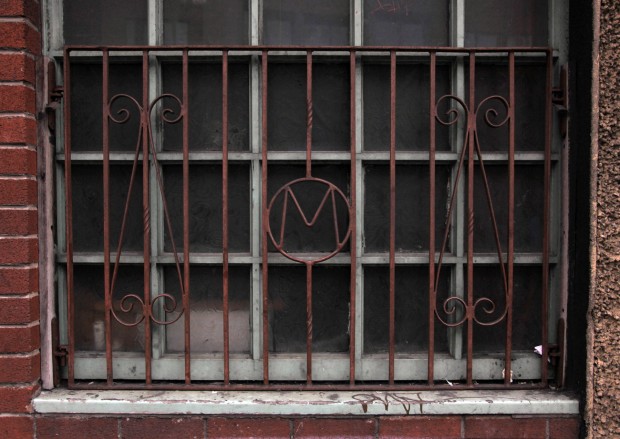
Detail of the shopfront. All credit – Lisa (http://builtdublin.com)

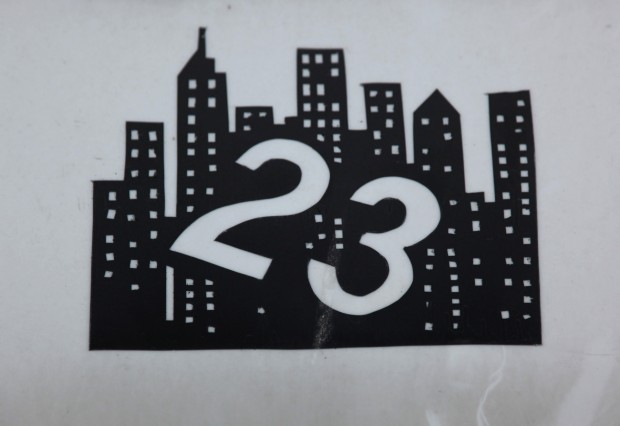
The Manhattan on 23 Harcourt Road was a late night cafe ran by the Woods family from about 1954 until the late 2000s.

A cafe on the same premises was ran by Anthony Tighe in the 1940s known as Tony’s. In April 1941 he was up in court for allegedly  ‘selling or permitting to be sold intoxicating liquor without holding an Excise licence’. On February 1st, it was put to the judge, Tighe had been selling intoxicating liquor between the hours of 5 a.m. and 6 a.m. Evidence was given that customers with porter in cups were found on the premises by Gardaí. Tighe told the judge that ‘none of the drink was paid for and that he was only treating the people’. The case was dismissed as there was not sufficient evidence to convict. In February 1952, the Performing Rights’ Society was granted an injunction to restrain Tighe from permitting his cafe to be ‘used for the performance, in public, for profit, of musical works of which the right of performance was in the society, without its consent’.

The Woods family opened The Manhattan in 1954. It was known widely as Aunty May’s. It was popular with several generations of late night revellers, students, taxi men, shift workers and musicians.

Detail of the shopfront. All credit – Lisa (http://builtdublin.com)

Lisa Cassidy’s excellent Built Dublin blog, which focuses on details of Dublin architecture, recently wrote about The Manhattan:

The main sign, on white backlit plastic, looks an awful lot like it might have been hand-painted. It’s pretty sharp and I hadn’t noticed until standing right underneath. You can see it around the edges and the curves of the letters, or inside the windows of the skyline, where the brush didn’t quite follow the lines. Letters are steadily disappearing with time, leaving us the two bookending skylines, a bit of the ‘m’ and the second ‘a’, and just ‘ttan’ unobscured. The skylines are probably the best part (a vague suggestion of tall buildings totally undermined by there being very few, rather big windows) and if the building is ever demolished, I’ll be scavenging for them.

On the window railings below, there’s an ‘m’ held in the centre above the small, thick panes of glass. It’s slightly silly, like a monograph on a beach towel, but it also disturbs the closed-down domestic look by putting the business at the forefront. There’s little possibility that the customers in search of soakage would have spotted the detail, sure, but it’s a nice oddity in daytime.

A recent post on the Come Here To Me! Facebook page generated a whole load of memories:

Nicko Farrell –  “Never went home without hitt’n the manhattan for a mixed grill and a bottle of the house white (milk!), served up by aunty may, the stairs up to da loo was like a ladder it was that steep at least half a dozen punters fell down it most nites, but due to embarrassment or the gargle they just got up and headed off, don’t think anyone ever claimed, twas a different era but good times none the less.”

Colm Carty –   “I used to run a club in McGonagles in the late 80s and afterwards always brought the guest DJs there for a fry up. Coldcut, Dave Dorrell and Norman Jay amongst others all loved it. As far I remember they had Tyson versus Bruno on the TV one”

Brian Coyle – “This is the only place I was ever a regular in my life. Most times the breakfast was on the table before I’d taken my jacket off. One memorable night was ignited by an aul fella who baited a few lads from Cork with the “you shot Michael Collins” line… to which someone retorted “It might have been an eskimo that shot him but we’d still buy frozen fish.”

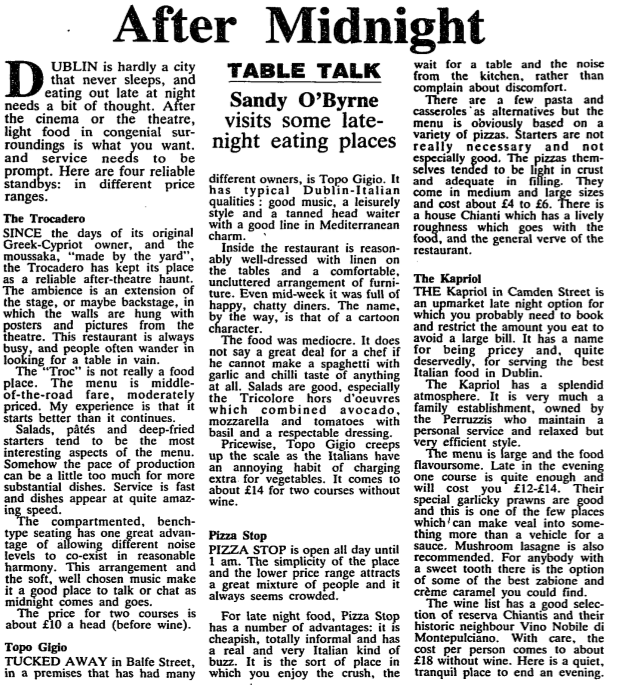
The Irish Times looked at the topic of late night cafes and restaurants later in 1990.
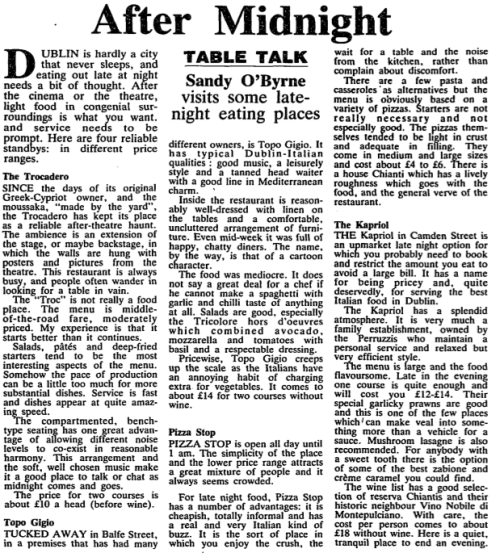
‘After Midnight’. The Irish Times, 03 March 1990.

While the Trocadero and Pizza Stop are both still open, neither remain open late. Topo Gigio on Balfe Street is closed while The Kapriol on Camden Street is now Zaytoon.

Today the Gigs Place and Tandoori Bite on Richmond Street South and Afsana and Shans’ on Temple Lane South remain favourites  for hungry revellers after a night out.

Read Full Post »
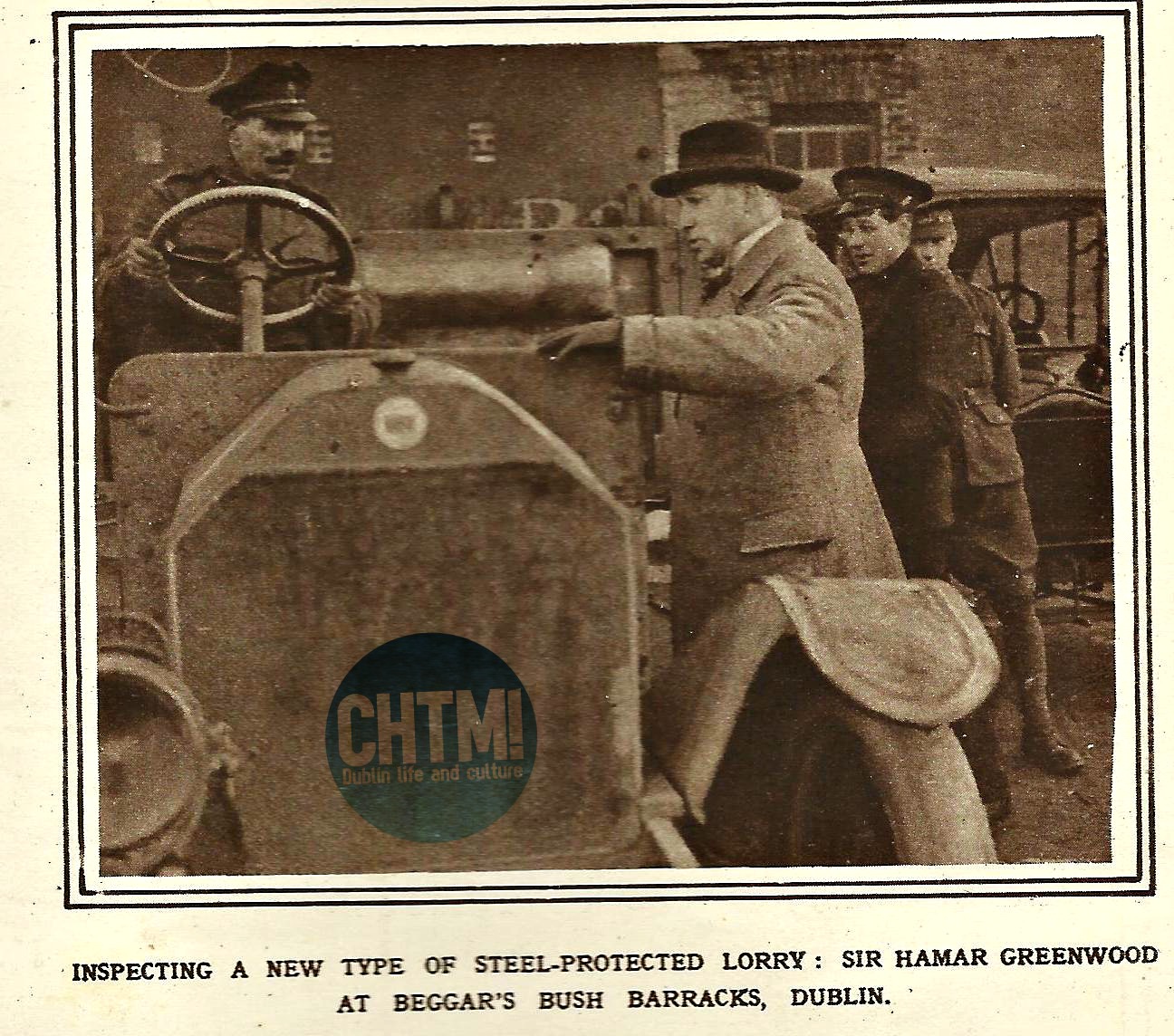
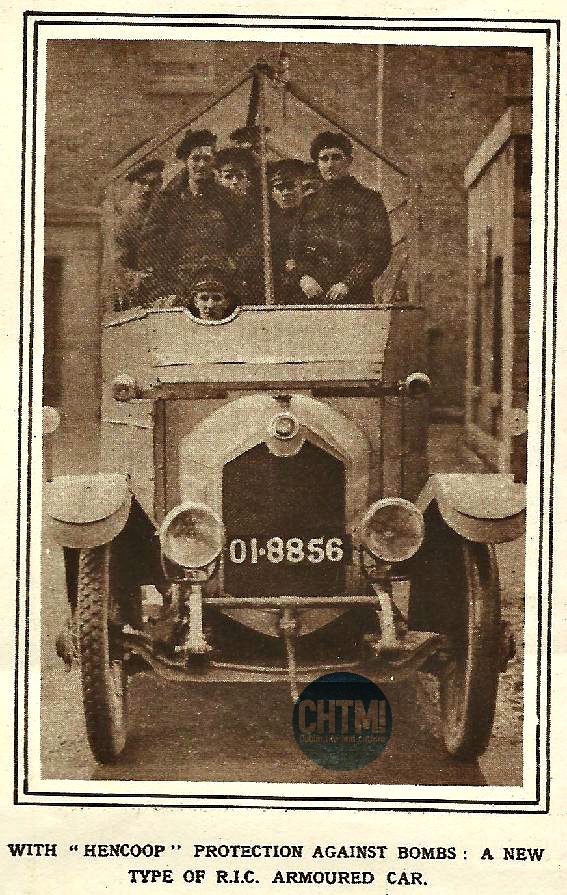
The images below are scanned from an original copy of the Illustrated London News from January 1921. They show Hamar Greenwood, Chief Secretary for Ireland, inspecting R.I.C Auxiliaries in Dublin at Beggars Bush Baracks.As D.M Leeson has noted in his study of The Black and Tans, Greenwood ‘described the Irish insurgency in almost hysterical terms’ when he noted that “For years past now Sinn Féin extremists and their Soviet colleagues in Ireland – their Sovietism in a marked degree in Ireland- have conspired to smash the empire.”

Greenwood was one of those who essentially endorsed a policy of reprisals at the height of the War of Independence. Greenwood had famously told the House of Commons that “things are very much better in Ireland” only days before Michael Collins obliterated what he called the ‘Dublin Castle Murder Gang’ on a November morning in 1920.

Below these images the page contains a quote from Greenwood, telling the men he inspected that:

You are here to rescue Ireland from the assassin, to save her from the small minded misguided minority of her people. You are here to maintain the United Kingdom intact, and to break up that conspiracy which has for its object the smashing of the British Empire!

This is an interesting example of British war propaganda during the Irish War of Independence, and this is also the first time I’ve seen several of these images myself.

From: Illustrated London News, Jan 29 1921.

This second image is interesting, as it shows how the British armed forces attempted to deal with the guerrilla warfare tactics of the IRA, with new “protection against bombs” in the field.

From: Illustrated London News, Jan 29 1921.

(more…)

Read Full Post »

Constable Sheahan memorial (Photo: Donal Fallon)

While many Dubliners have not heard of Constable Patrick Sheahan before, the vast majority will be familiar with the monument in his honour which until recently stood at the junction of Hawkins Street and Burgh Quay, at least to walk past. It has been removed in recent times as construction is underway on the Luas bridge which will span the Liffey. Constable Sheahan was a member of the Dublin Metropolitan Police force, hailing from County Limerick. He lost in life in tragic circumstances in May 1905 when he was overcome by deadly gas in the sewers of Dublin as he attempted to rescue unconscious workmen. The events of that tragic day are well-documented in an article by Tom Donovan for the Old Limerick Journal, available to read in full here:

On Saturday May 6th 1905, a workman named John Fleming opened a manhole- cover at the corner of Hawkins Street and Burgh Quay at around 3 p.m. He descended a ladder into the 24foot sewer to investigate a broken pipe and he was immediately overcome by the deadly gas, as were two of his colleagues who rushed to assist him. Christopher Nolan, a who witnessed the incident, ran for help. He found Constable Sheahan, of College Street Station, standing at O’Connell Bridge. Tragically for him, he was on duty to relieve a friend who wanted to go to the theatre.

Sheahan’s heroics touched the heart of native Dubliners, as this young man of only 29 had given everything in an attempt to save others. In 1906 a monument to Sheahan was erected, paid for my public subscription, and placed at the site of the tragedy. Interestingly, it contains both Irish and English language inscriptions, and notes that: “This memorial was erected in memory of Patrick Sheahan,a constable in the Dublin Metropolitan Police Force who lost his life on the 6th day of May 1905.”

Illustration of Captain Patrick Sheahan from Jim Herlihy’s excellent ‘The Dublin Metropolitan Police’ (Dublin,2001)

Sheahan was a well-known and much liked character in Dublin, and stories of his bravery had existed in the city long before his death. One of my favourite stories about Sheahan related to him ‘single-handily’ wrestling an escaped bull on Grafton Street. Wondering how much fact and how much folklore was involved in the tale, we went looking for the newspaper reports of the day.

The Irish Times of 24 March 1904 details a ‘Exciting Incident In Dublin’ during which a number of police officers wrestled an escaped bull on Grafton Street. The paper reported that:

A large roam bullock which escaped from its keeper, between six and seven o’clock last evening, while being driven along Harcourt Street, created quite a scare in the locality, and before it was finally captured and slaughtered in the vicinity of Grafton Street, after a prolonged struggle with several policemen, it injured two persons, who were subsequently removed to hospital.

The animal had made a dash from Harcourt Street station in the direction of Wexford Street, knocking down a young girl by the name of Kathleen Regan in the process. Running madly through the city, it made its way to Whitefriar Street where the five year old Christopher John Walsh was struck. Its appearance on Grafton Street caused pandemonium, and it was here that men of the Dublin Metropolitan Police confronted the animal. Sheahan was not alone, as folklore has had it, but in the company of another DMP man, Constable Kerby. A local stableman named Thomas Arbuthnot joined the two police officers, as they followed the bull into Anne’s Lane. An extraordinary twenty-minute tangle with the animal would result in the two DMP men using a rope to essentially ‘lasso’ the animal, and when they succeeded in wrestling it to submission with the assistance of bemused Dubliners, they called on Martin Tierney. Tierney was a butcher on Capel Street. The bull, marked JSC on the left hip, found itself next in an Abattoir.

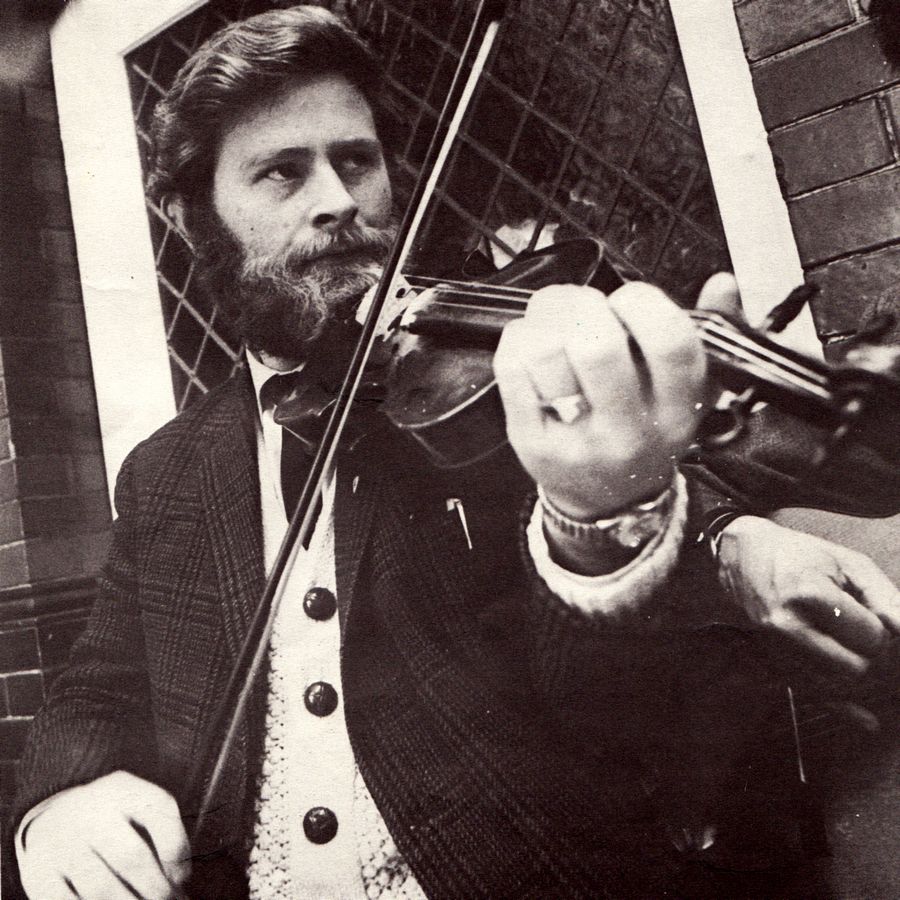
Just over a year after this incredible incident, Sheahan himself was dead. On an interesting aside, Shehan is a relation of John Sheahan, a fine traditional musician who is now the longest-serving member of The Dubliners folk band!

Image of John Sheahan from the fantastic It’s The Dubliners website, at: http://itsthedubliners.com

Read Full Post »

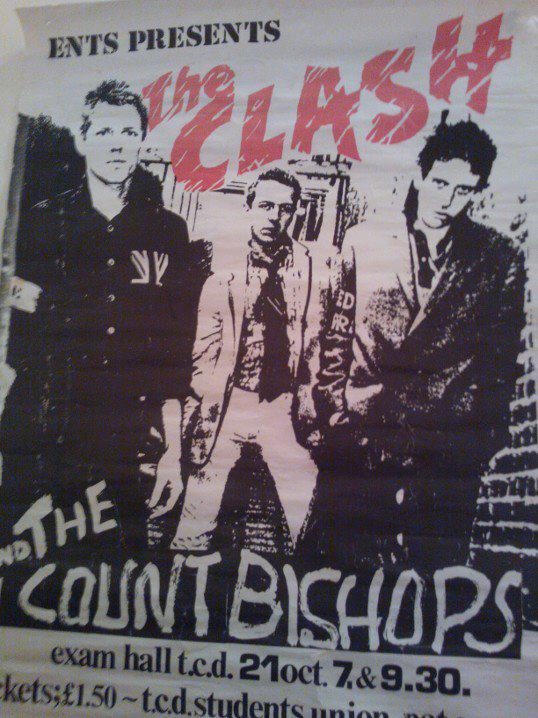
The Clash & The Count Bishops. TCD, October 1977.

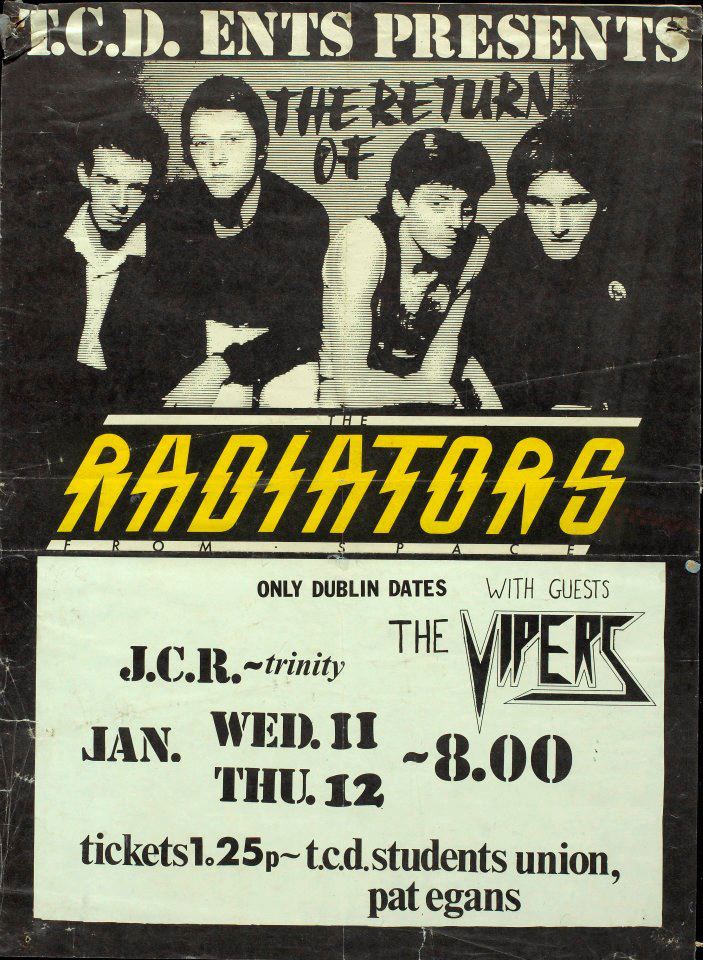
A number of Facebook pages have sprung up lately for Dublin punk & new wave bands of the 1976 – 1983 period. It’s allowing former band members and fans to leave comments and post up pictures and gig posters.

If you know of any more, let us know.

The Atrix

The Radiators From Space

The Sussed

The Virgin Prunes

The Vipers

The Zen Alligators

The Radiators & The Vipers. TCD, nd.

Read Full Post »

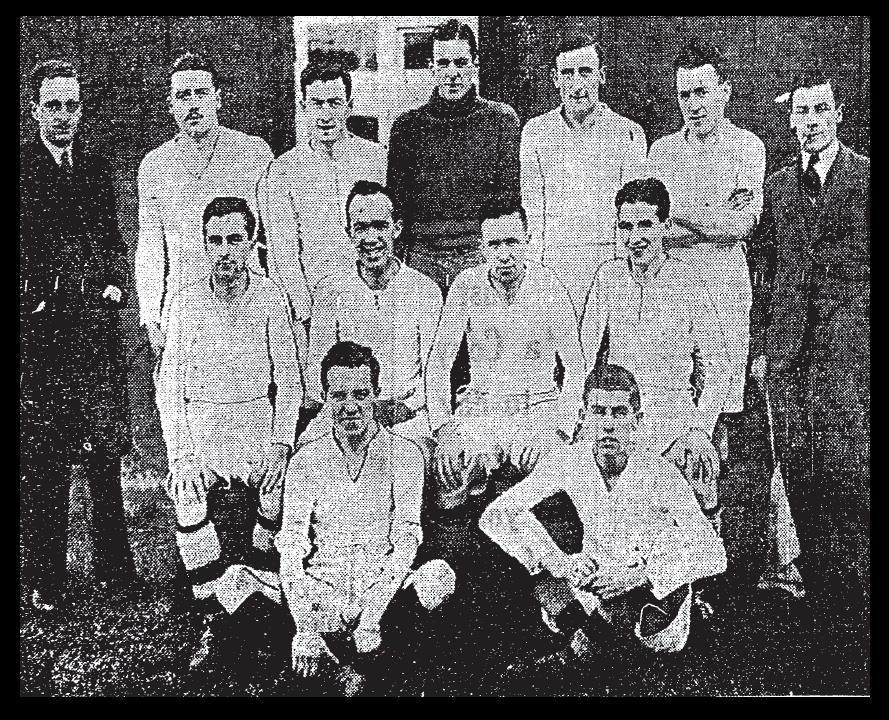
A Dublin university side (TCD and UCD) who faced Bohs in 1930.

A brief post to draw attention to an upcoming History Ireland Hedge School, taking place this Saturday at 3pm in Dalymount Park as part of the annual Phizzfest. I was chuffed to be asked to speak at this one, and hopefully I can give the perspective of a younger LOI devotee as well as looking at some of the historic aspects of the game we’ve covered on the site here. Dalymount Park really is the perfect setting to talk about the beautiful game.

In the spirit of hedge schools of yore, where wandering school masters taught pupils in improvised surroundings, this year’s History Ireland Hedge School @ PhizzFest moves to the home of Irish football, Dalymount Park, for a discussion on the history of the game. Why was it called the ‘garrison game’? What were the circumstances of the split with the Belfast-based Irish Football Association in the 1920s? Why are League of Ireland clubs so poorly supported and resourced? Join Hedge School master, Tommy Graham, to address these and related questions with the panel: Paul Rouse (sports historian, UCD); Donal Fallon (Come Here To Me blog); Brian Trench (PRO, Bohs); and David Toms (Waterford supporter & UCC).

Read Full Post »

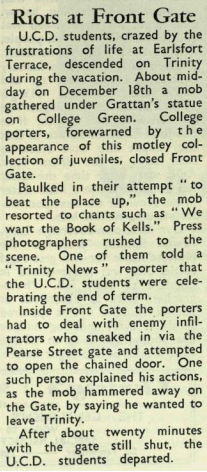
The rivalry between UCD and Trinity College Dublin is long-standing in Dublin, but with UCD now located in the suburbs the banter between the two universities isn’t quite as strong as in the past. I stumbled across this great newspaper report recently, which comes from Trinity News, a student newspaper at Trinity College Dublin. The report from January 1965 is fantastic, blaming the “frustrations of life at Earlsfort Terrace” for an incident which saw UCD students taunting the other university to celebrate the end of term!

Via ‘Trinity News Archive’ (trinitynewsarchive.com)

The Trinity News Archive website is a treasure trove of not alone news reports like the above but also images. This fantastic image for example shows the 1965 film Blue Max being shot on campus. The film, set during WWI, saw Trinity used as a German Army headquarters.

Via ‘Trinity News Archive’.

Read Full Post »

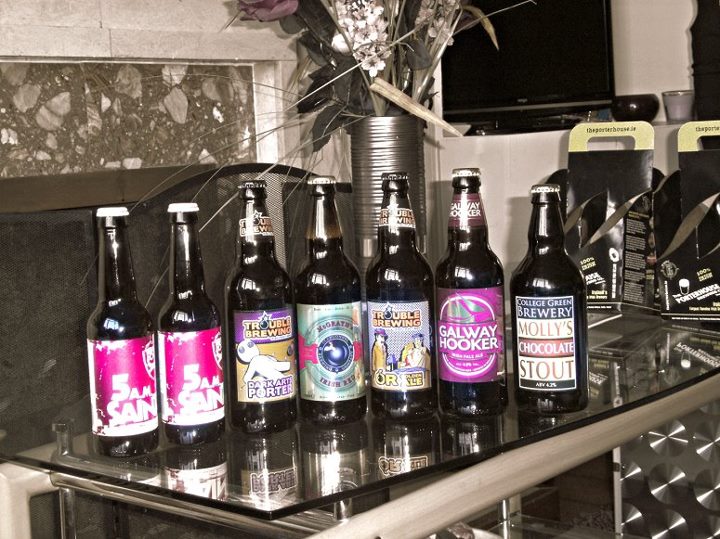
Some personal favourites!


With the Tall Ships Festival and the Electric Picnic behind us now, we’ve moved into September and the days get shorter and colder, if that’s possible. Still ahead of us though is an event we’re really excited about, with the All Ireland Craft Beerfest taking place this weekend.

We’ve always given good time to Irish microbreweries on the site, and even devoted one of our pub crawls to them in its entirety. We’ve also dug up some gems from the brewing history of the city, for example this advertisement for O’Connell’s Dublin Ale, no longer found on tap anywhere in the capital.

It’s a fairly shocking indictment of the Irish pub, that CAMRA (‘Campaign for Real Ale’), the leading craft beer lovers organisation in the UK, was actually established in a pub in County Kerry. Then, it was known as the Campaign for the Revitalisation of Ale. They’ve certainly enjoyed some success. A great history of the breweries of this city has been written by the Dublin Brewing Co., who note for example that:

A city that was once host to over 30 breweries was now reduced to one. Guinness was so dominant in Ireland, that when it started its first advertising campaign in England in 1929 it felt it was a complete waste of money to spend anything in Ireland. Consumers either drank its beer or gave up drinking.

In recent years there’s been a brilliant trend in Dublin which has seen the microbrewery and the craft beer pub both flourish. Not alone craft beer specific pubs like The Black Sheep and Against The Grain, but even pubs like the Bowes and the Cobblestone (two Come Here To Me favourites) have hugely diversified their taps.

We’re certainly popping into the RDS this weekend for the festival. Most of our favourite Irish brewers are on hand, including Trouble Brewing, Metalman and Dungarvin. The festival is open on Friday, Saturday and Sunday, with more information on their site here.

Read Full Post »

What’s in a name?

An impressive seventeen bridges span the River Liffey in Dublin city, and in many cases their names honour dead nationalists of Ireland’s past. Sean Heuston, the 25-year-old rebel executed in 1916 for his role in the Easter rebellion, gives his name to the bridge next to the train station also named in his honour. Today, the LUAS passes over Heuston Bridge. It’s ironic that the bridge was first opened with the name Kings Bridge to commemorate a visit by King George IV in 1821.

Further up the river, one finds Liam Mellows Bridge, named in honour of the progressive republican Liam Mellows, who was executed by the Free State during the civil war. As hxci has noted in an early post on this site, “at 248 years of age, Mellows Bridge is the oldest existing bridge across the Liffey.”

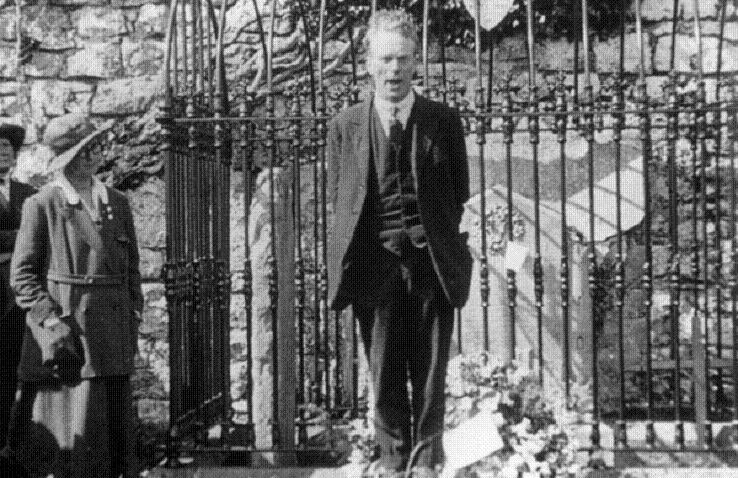
Liam Mellows addressing a gathering at Bodenstown. Today, Mellows Bridge is named in his honour.

Yet in recent times there has been real shift away from naming bridges in honour of political figures. James Joyce, Samuel Beckett and Sean O’Casey have seen bridges named in their honour in recent years. While of course O’Casey was a member of the Irish Citizen Army at one point and a socialist himself, the recent shift has been away from political figures and towards figures who are first and foremost cultural.

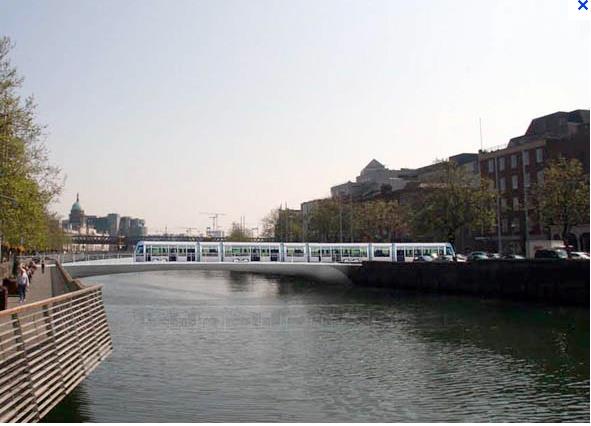
The new bridge currently under construction, spanning the River Liffey from Marlborough Street to Hawkins Street, is being built with the purpose of connecting the LUAS on both sides of the Liffey. The image below gives a good artists impression of the planned completed work:

Various names have been proposed for the new bridge. In the pages of The Irish Times Frank McNally proposed a hero of Come Here To Me, Flann O’Brien (that is Myles na gCopaleen) as being the perfect candidate. Others have proposed Bram Stoker, while others have proposed to name the bridge in honour of the Abbey Theatre next to it. The fact that not a single Dublin bridge has been named in honour of a female figure from our past has been commented on in many quarters too, and the debate continues to rage.

Now, the union movement have entered the debate and proposed to name the bridge in honour of the Edinburgh born trade unionist James Connolly. Connolly’s beloved Irish Citizen Army had its headquarters at Liberty Hall next to the bridge it should be remembered. What I like most about this idea however is something which many commentators may miss or even choose to ignore. Connolly played a central role in the Lockout of 1913, when Dublin tram workers were entangled in the greatest labour dispute in the history of the capital. To see the trams of Dublin today pass over Connolly Bridge would be some sight!

The committee is being led by Brendan Carr of SIPTU, who was stated that the campaign already seems to be enjoying broad political backing, an article on build.ie quotes Carr as stating:

Connolly played a crucial role in the events of 1913, when the working people of Dublin took a stand for better living and working conditions. He also personifies the link between this struggle and the later events of Easter 1916, during which he led the rebel forces.

However Connolly must also be remembered for his importance as a thinker and a writer of seminal works on Irish history and society. He would not be out of place in the modern, cosmopolitan Dublin. Connolly was himself an immigrant. Born into grinding poverty in the Cowgate area of Edinburgh to Irish parents his legacy reaches beyond Ireland to Britain and the United States, where he also worked as a union organiser.

It’s certainly a fine idea to name the bridge in honour of Connolly. I’ve heard one barstool genius already propose the Brian Lenihan Bridge, and no doubt we’ll hear all sorts of other proposals between now and the time Dublin City Council reach their decision in the Autumn, but will Connolly win the day?

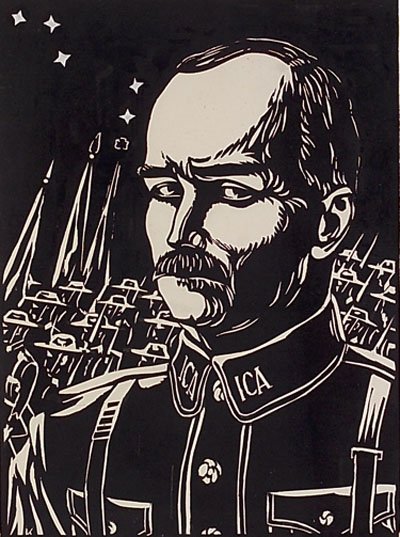
Harry Kernoff’s 1936 woodcut tribute to Connolly.

Read Full Post »

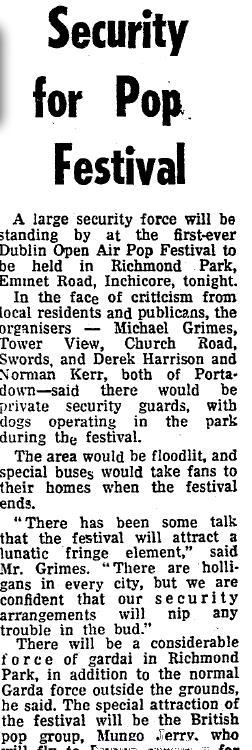
Back in November 2011, we had a post dealing with the first outdoor rock festival in Ireland, which happened in September 1970 in my beloved Richmond Park, the home of Saint Patrick’s Athletic.

Irish Press newspaper report September 4 1970

In the end, the festival proved to be an absolute disaster. This was owing to a number of factors but primarily hysteric media reports, which focused on drugs and violence in the lead-up to the event.

“I’ve been to better wakes” was a quote from one discontented young punter in The Irish Times, which ran with the headline ‘Open Air Festival Hardly Pops’. The paper noted that only several hundred young people had attended the festival, perhaps unsurprising giving the scare-tactics in the media in the run up to the event.

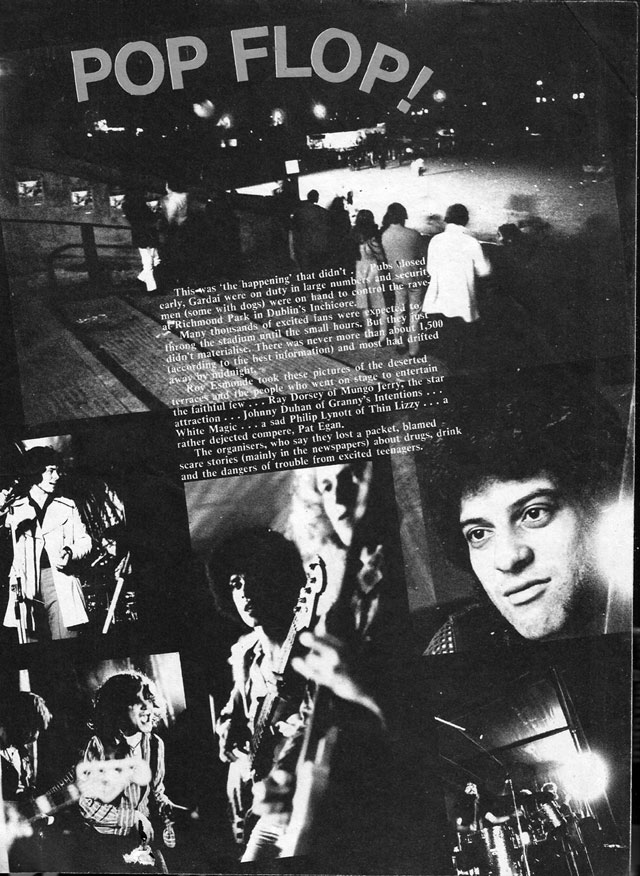
Now, one of our favourite blogs has managed to upload some images from the event.

Via ‘Brand New Retro’

Brand New Retro has scanned up some great photographs from the day. Interestingly, it seems the media chose to refer to the gig in Richmond Park as a ‘rave’. The images of a young Phil Lynott are excellent.

Read Full Post »
« Newer Posts - Older Posts »