Feeds:
Posts
Comments

Archive for the ‘Dublin History’ Category

Matt Stafford. go Irish Press – Apr 01, 1938.

Dublin-born Matt Stafford took part in both The Fenian Rising of 1867 and The Easter Rising of 1916. I have not heard of any other individual who could boast of such an achievement.

He was described by Sean O’Casey as “a fine old skin, & a brave, honest man”. (The Letters of Sean O’Casey: 1942-54, p. 995)

My knowledge of Stafford from reading Harry Colley’s Witness Statement (no. 1687) to the Bureau of Military History in which he remembered:

… one Sunday morning when the whole Battalion was on parade we were doubling around Fr. Matthew Park and after two rounds an elderly man fell out of the ranks. I discovered that this man was Matt Stafford who must have been at at that time 64 years of age, and that he had been “out” with the Fenians at Tallaght as a boy. I always think what marvellous energy and enthusiasm he must have possessed to be able to double two rounds of Fr. Matthew Park at that age. Matt Stafford was later a Senator for a number of years and died at 95 years of age.

In actual fact, Stafford lived until he was 98!

A founding member of Sinn Fein, he played a prominent part in the Rising and then went onto become a founding member of Fianna Fail. Described by The Irish Times at the time of his death as “one of the last surviving members of the Fenian Brotherhood”, Stafford outlived his son Matt Stafford Jr. (d. 1947) who had taken part in the War of Independence and was interned in the Ballykinlar Camp in 1920-21.

A senator from 1937 – 1948, Stafford was also a member of Dublin Corporation, the Central Midwives’ Board and the Grangegorman Mental Hospital Committee.
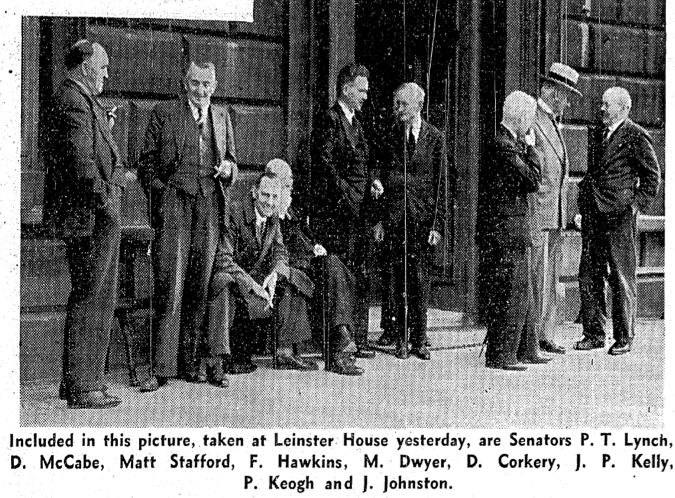
Irish Press – Oct 05, 1939.

In 1945, De Valera described Stafford as the “longest link they had going back to the Fenian days”. (IT, 12/10/45)

Two years later, Stafford was formally honoured by the Fianna Fail party and was presented with his portrait in oils.

Irish Press – May 29, 1947.

De Valera said during this presentation:

The whole history of the past one hundred years can be exemplified in his person. He bridges all that immense period of time, which probably was one of the most eventful in Irish history and, indeed, taking a broader view, of the history of the world. To be able to look back on seventy-five years of active national work is given to a very few.

A 1942 election leaflet of his can be viewed on the wonderful Irish Election Literature blog here.

Read Full Post »

Image of The Patriots Inn from official website.

Interest in our recent post of the stonework of the Lafayette Building and others like it show that Dubliners are always interested in the former lives of the buildings of Dublin. Another building with an interesting historical feature is The Patriots Inn pub in Kilmainham. A more than decent pub, it sits in a fine historic location, with the Royal Hospital and Kilmainham Gaol among its neighbours. There has been an inn located on the site since the 1790s, historically enjoying both the custom of workers of Kilmainham Gaol and those of the Great Southern and Western Railway.

The pub is one of the last buildings in Dublin to boast an insurance firemark upon it:

Thanks to David Power for this image.

Before the establishment of a public fire service, insurance companies offered protection to premises marked by a ‘firemark’. These were essentially emblems (usually of lead) which displayed a company logo and insurance number. Before the establishment of a public fire service, no premises was covered until a firemark was in place.

In his history of the Cork fire service, For Whom The Bells Tolled, Pat Poland noted that:

The firemark served a number of purposes: it marked the property so it was obvious to all that the building was covered by insurance, it acted as an advertisement for the insurance company, and it let firemen responding to a call in no doubt as to which particular building was insured with their office.

There are very few such firemarks left to be seen in the city today. There is perhaps a joke to be made somewhere in the fact that from earlier this year, a €500+ call-out charge has come with a ring to the Dublin Fire Brigade!

Read Full Post »

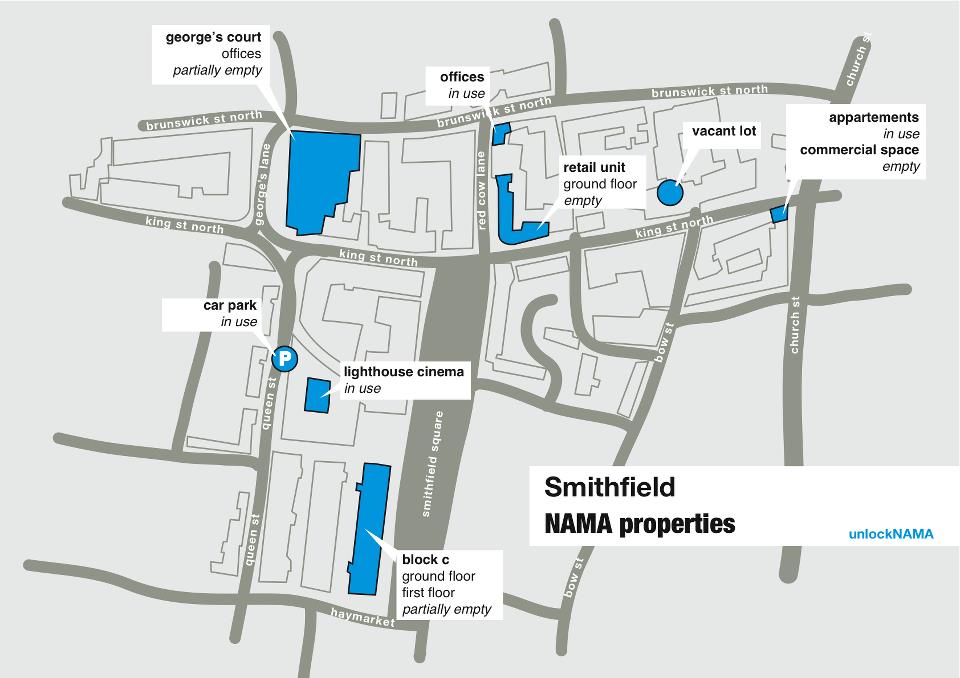
This is a very interesting map compiled by the folks at Unlock NAMA, and I must say the idea of mapping the city like this a good one. It really brings NAMA to life when you see what falls under its ownership list in an area the size of just Smithfield. Unlock NAMA are holding two discussions in the area in the days ahead. The first discussion will take place in the Macro Community Resource Centre on North King St., at 7pm on Wednesday the 20th of June, while the second discussion will happen in the Prussia Street Parish Centre, 7.30pm on Thursday the 21st of June.

Read Full Post »

An upcoming public meeting next Tuesday (June 26, 7:30pm) was brought to my attention, entitled ‘New Perspectives on Republicanism in the 1960s’. It takes place in the Pearse Centre at 27 Pearse Street. The building is instantly recognisable by its fantastic restored front appearance, and the name ‘Pearse and Sons’ is found over what was once the business premises of the father of Patrick and William Pearse.

Brian Hanley (Historian, author of The IRA, 1926-1936, The IRA – a Documentary History, and co-author of The Lost Revolution) will be joined by Matt Treacy (Historian, author of The IRA 1956-69: Rethinking the Republic) for what should be an interesting night.

Read Full Post »

I’m currently doing research for an article in the CHTM! book  on the history of drug use in Dublin from 1964 to 1972.

The Irish Times, 09 Aug 1969.

Primarily focusing on the psychedelic drug LSD and psychoactive drug Cannabis, it’s fascinating to read through The Irish Press, The Irish Times and The Irish Independent and see these types of drugs being talked about for the first time.

You then see the establishment of the Drugs Squad in 1967 (led by the legendary Inspector Denis Mullins) and the general increase in both consumption and arrests relating to the drugs which cumulated in The Yeoman Inn raid in November 1972 which saw 36 police busting the South King Street bar and arresting 34 people. This is where my research ends.

The Sunday Independent. November 19 1972.

So far I’ve only been relying on newspaper articles. I’ve love to hear from anyone who may have any information relating to use of the use of LSD and Cannabis in Dublin in the 1960s and early 1970s. What kind of people were using it first, where were people using it, where were people getting it from etc.

Obviously not looking for names or incriminating evidence (!), just stories or anecdotes. If you can help, drop me a mail at ‘matchgrams(at)gmail.com’. Thanks.

Read Full Post »

One thing we’ve been attempting to do in recent times is get more usage out of the Come Here To Me Facebook page. JayCarax in particular has tried to post interesting third-party links and stories with a Dublin focus, and we’ve posted tidbits there that may not be suitable material for a full post on the blog on their own.

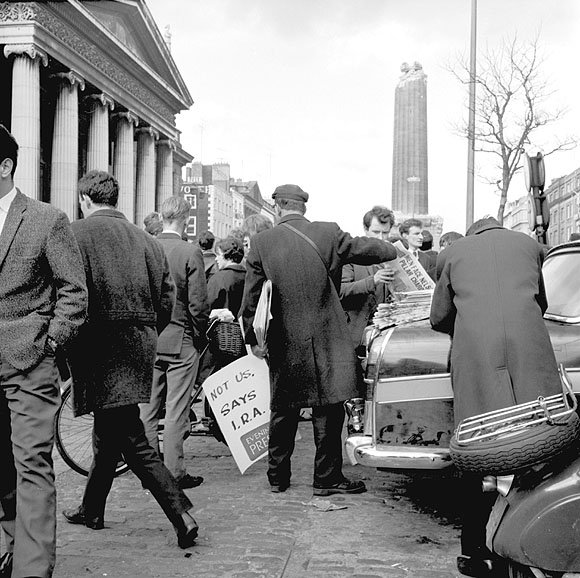
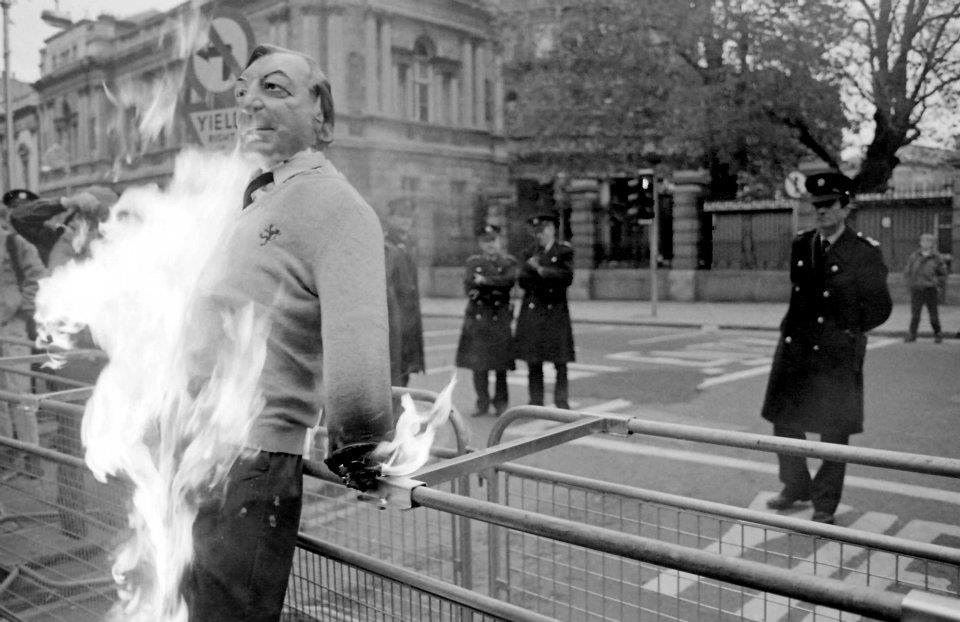
There’s interesting engagement with the page from others too, and people have been very generous with links and images. This fantastic image was left on the Facebook page today by Garry O’Neill, author of Where Were You?. It’s an absolutely incredible image from Wally Cassidy, all the more powerful in black and white. Does anyone know the context of the image?

(C) Wally Cassidy

Read Full Post »

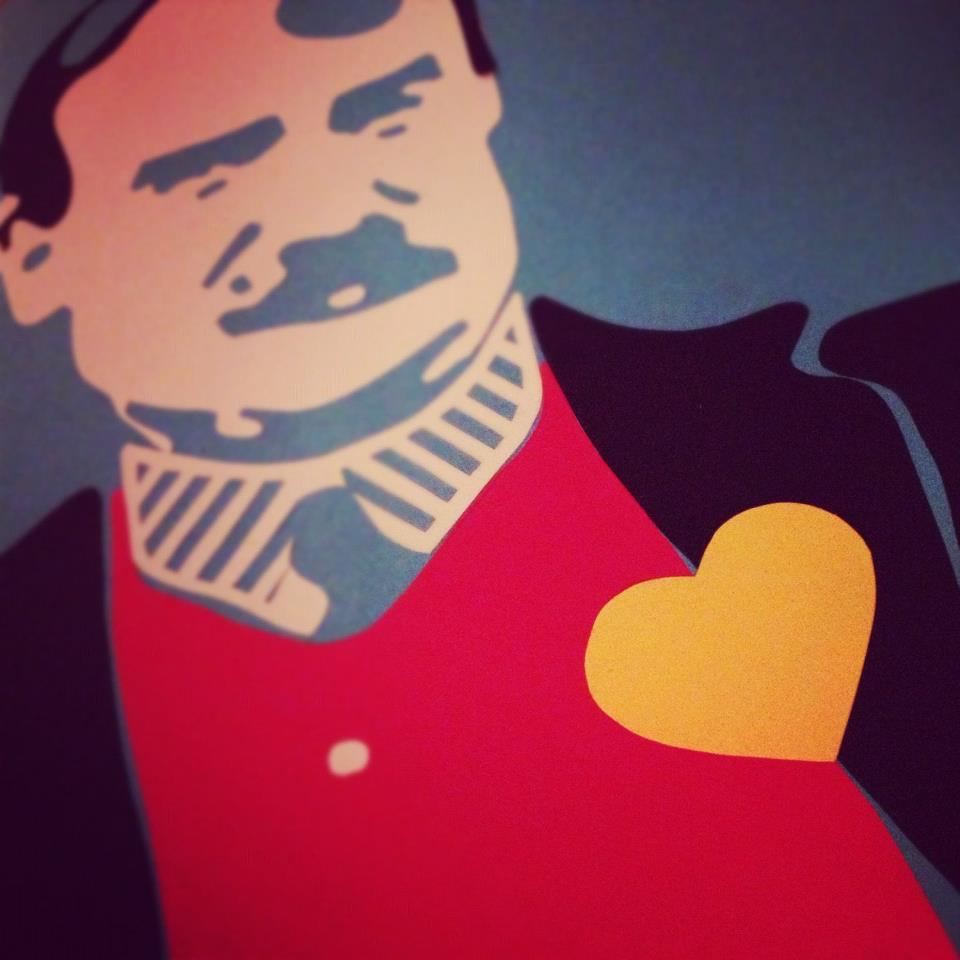
A fantastic image just posted by Dublin street artist Maser, showing the Edinburgh born labour leader James Connolly. Our interview with Maser back in January can be read here.

There is a wealth of history in this city and country that can supply an extensive body of visual work for any artist. There are still a lot of people, places and situations I need to paint and talk about.

Connolly featured also in Maser’s colloborative exhibition effort back in 2010 with Damien Dempsey, entitled They Are Us.

Read Full Post »

The Lafayette Building on the corner of D’Olier Street and Westmoreland Street is a real Dublin landmark, and stands in great contrast to O’Connell Bridge House next to it. It seems younger Dubs refer to O’Connell Bridge House as the ‘Heineken Building’, but the corporate advertising on the building has changed several times! The Lafayette Building, which looks straight down O’Connell Street, is a far more visually pleasing building. It takes its contemporary name from the famous Lafayette photographers. As Christian Casey has noted in her architectural study of Dublin, it was built for the Liverpool and Lanchasire Insurance Company in the 1890s. Casey has described the building as a “Portland stone baronial excercise with Gothic and Ruskinian leanings”. J.J O’Callaghan was the architect, and the work was dubbed ‘O’Callaghan’s Chance’ by his contemporaries!

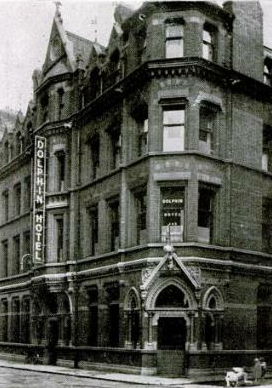
O’Callaghan’s contribution to Dublin’s architecture was significant, and as Frederick O’Dwyer has noted he designed a number of Dublin public houses for example, among them Mooney’s on Harry Street but also pubs on Baggot Street, Amiens Street and South Richmond Street among others. O’Callaghan was the architect responsible for the Dolphin Hotel, which for many years was to be found at Essex Street in Temple Bar. The building remains today.

The Dolphin Hotel in the 1930s.

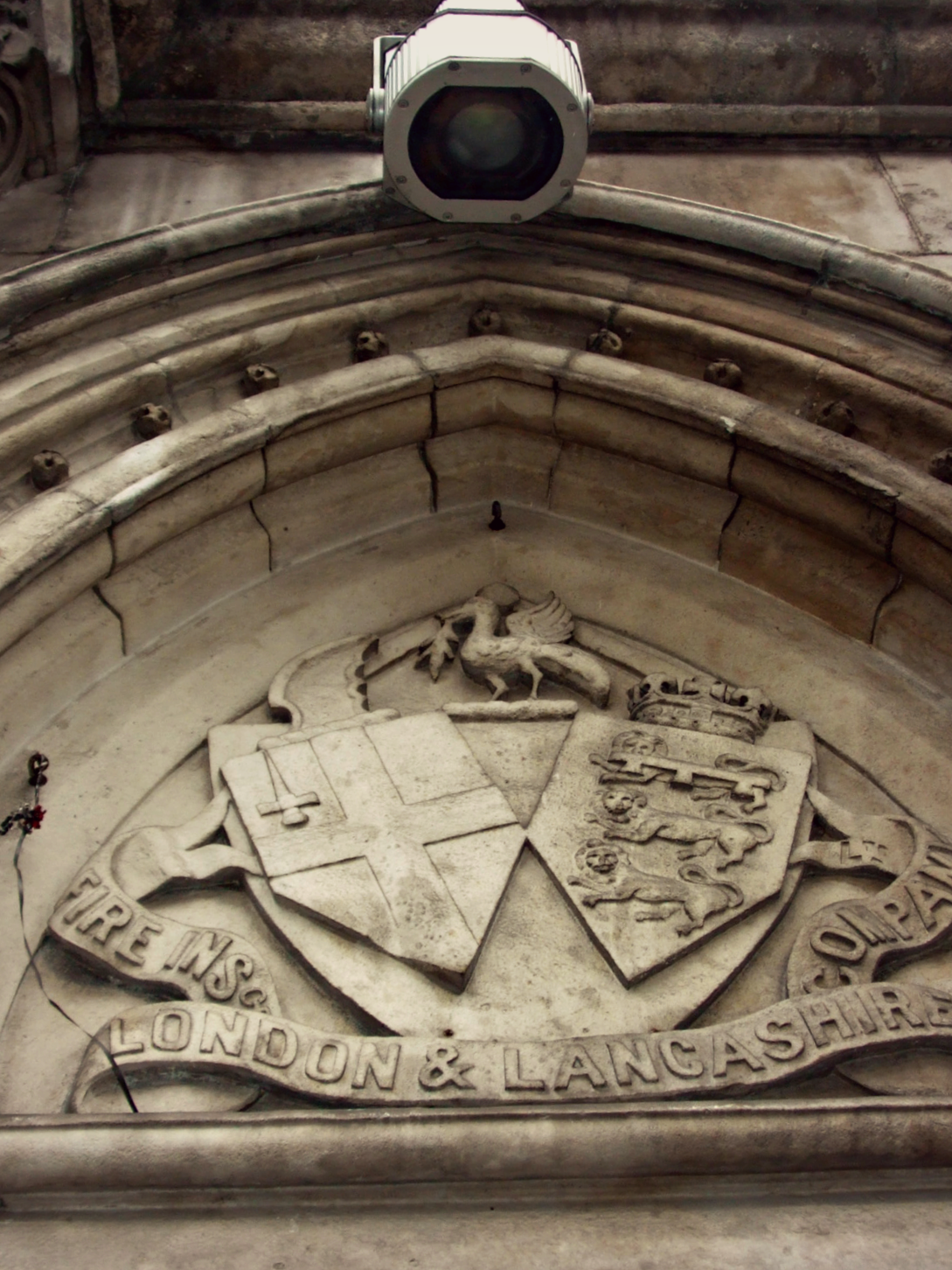
The stonework of the Lafayette Building gives some indication of its former life. Above the Westmoreland Street entrance to the building, the London and Lanchasire Insurance Company logo can be seen. The building was originally constructed for use by this company:

London and Lanchasire Insurance Company.

(more…)

Read Full Post »

This fantastic punch cartoon comes from a London publication and dates from September 10 1913. It relates to the situation in Dublin at the time of the Lockout. James Curry’s recent study of the cartoonist Ernest Kavanagh (‘Artist of the Revolution’) is a great addition to the work on the period, looking at the cartoons of a left-wing artist who worked with the trade union movement of the day, depicting scenes like John Redmond as ‘The New Liberator’ standing upon the body of an Irish suffragete. Cartoons like this one however, from the London press, give fantastic insight into the ‘establishment’ take on the Lockout in Dublin. I scanned this image as this particular cartoon was absent from the internet as far as I could see.

The police man is shown shackled and unable to respond to the riot around him. In the background we see a mob hellbent on destruction.

‘The Rioters Ideal’

Read Full Post »

We All Partied.

Via the good people at Rabble, this made me smile. They’re edging closer to the 1,000 likes there, go on.

Read Full Post »

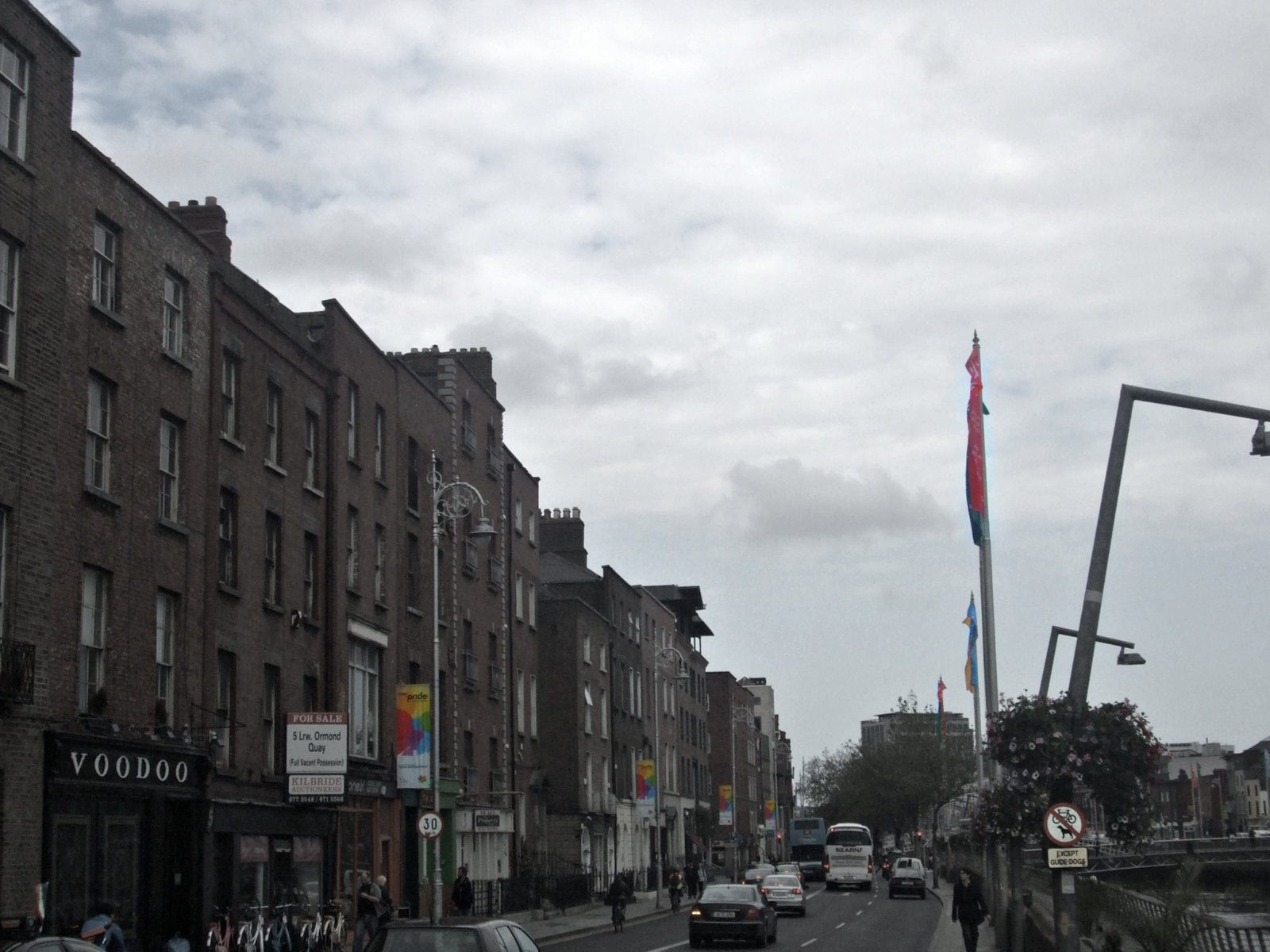
Changing times.

I took this photograph on my way home from work today. On the left, are banners for the upcoming Dublin Pride event, an annual march by the LGBTQ community. On the right, flags can be seen flying for the Eucharistic Congress. It’s a remarkable sign of the times, and made me think just how much Ireland has changed since the Eucharistic Congress was hosted here in 1932.

Recently I’ve been doing a bit of research on the Congress in 1932, mainly looking at the anti-communism of Catholic newspapers and magazines at the time. The Irish Monthly, a Catholic magazine of the period, used the year of the Eucharistic Congress to inform readers that there was a coming confrontation between the two ideologies of Christianity and Communism in Ireland. The magazine frequently ran articles around the dangers of the foreign ideology of Communism, and in his article The Coming Conflict: Catholicism Vs. Communism, Capt. T.W.C Curd noted that:

The times are not without their significance for Ireland. In this year of Congress, the eyes of the world are upon her- a Catholic nation with a Catholic government and the social encyclicals of Leo and Pius open books before them.

I suppose, the times are not without their significance for Ireland once more. Just like in 1932, the streets are decorated with flags and bunting. Unfortunately for the organisers of the event though, it seems football is our religion now. Ole Ole Ole.

Read Full Post »

Definitely the best yet. Both me and Donal have a few pieces in it. Pick it up in Easons for the recession-friendly price only €2. Keep up to date with the magazine on Facebook.

The latest, 48-page edition of LookLeft is in shops now. Stories include:

* Another Europe is Possible

* Interview with Mandate General Secretary John Douglas

* Michael Taft on the possibilities for building a progressive future

* Conor McCabe on the myth of NAMA’s ghost estates

* Gavin Titley on the media’s reporting of the economic crisis

* The Price of Corruption

* Belfast: Divided by Walls, United by Poverty

* Debate: Prostitution by Denise Charlton and Wendy Lyon

* Brian Hanley on Frank Ryan’s Street Fighting Years

* Lauren Arrington on Delia Larkin and the Irish Women Workers’ Union

* What Now for the ULA?

* Egypt’s Permanent Revolution?

* Stormont’s Policies a Recipe for Poverty

* The Politics of The Pogues

* St Pauli – the new commie chic image?

Read Full Post »

« Newer Posts - Older Posts »