Feeds:
Posts
Comments

Archive for the ‘Dublin History’ Category

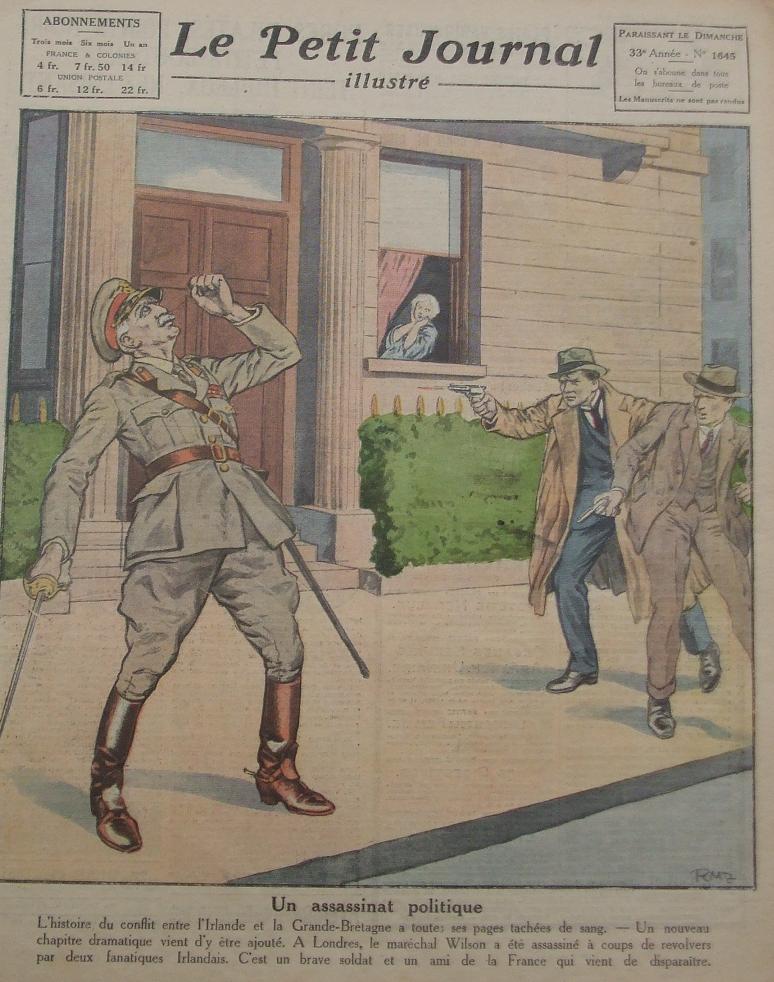
'Un assassinat politique' Le Petit Journal (Fallon collection)

This is a fantastic illustration from ‘Le Petit Journal’ showing the assassination of Sir Henry Wilson by Irish republicans in London, an event which would ultimately lead to the Free State moving in against republicans occupying the Four Courts premises in Dublin. Henry Wilson was assassinated in London on the June 22 1922, only hours after unveiling the Great Eastern Railway war memorial at Liverpool Street Station in London. Reginald Dunne and Joseph O’Sullivan were the two London volunteers responsible for Wilson’s death. O’Sullivan had lost a leg at Ypres in 1917 fighting for King and Country, while Dunne had also seen service in the Great War with the Irish Guards. Wilson was assassinated on his own door step, only hours after unveiling a memorial to those who died in the Great War, by two of its veterans. The men were hanged at Wandsworth Prison on August 10th 1922.

In August of 1929 a memorial was erected at Dean’s Grange Cemetery to Dunne and O’Sullivan, at a ceremony attended by over 500 people. In July 1967 the bodies of the two Volunteers were buried in Dublin in Dean’s Grange, following years of campaigning by the National Graves Association.

The attack on the Four Courts by the Free State attracted huge international media attention, and the images below come from the London Illustrated News of July 8 1922.
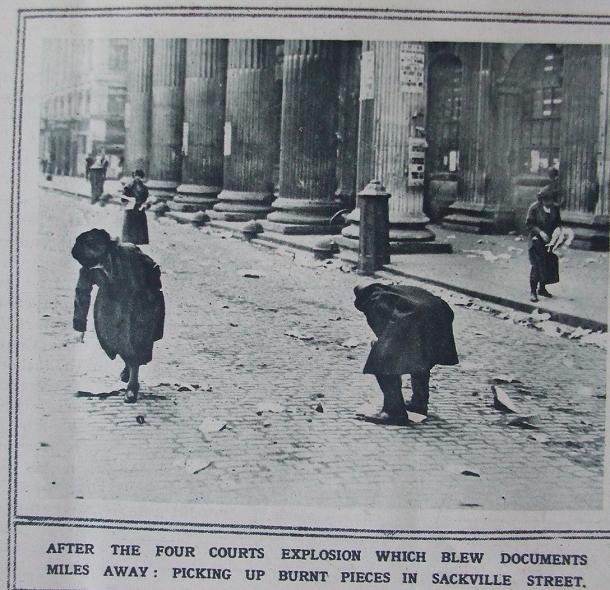
Documents from the Four Courts litter the streets.(Fallon collection)
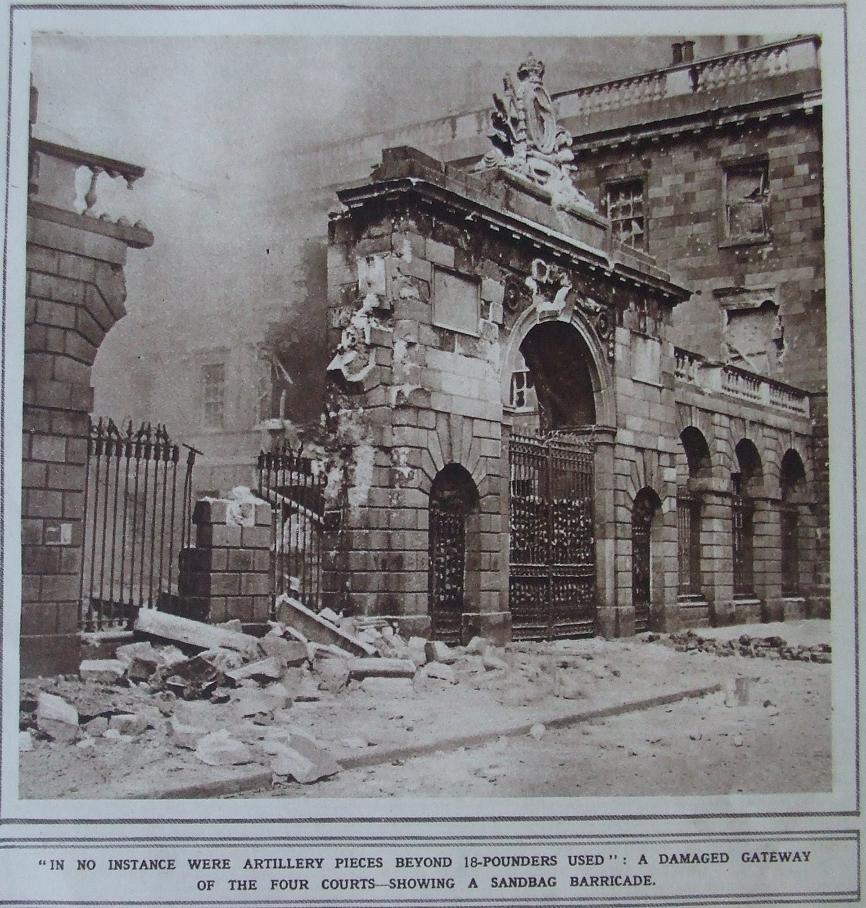
Damage to the Four Courts. (Fallon collection)

The execution of Henry Wilson was not the only Irish interest story to make the front page of the Le Petit Journal. Below is their take on the execution of Michael Collins at Béal na mBláth.
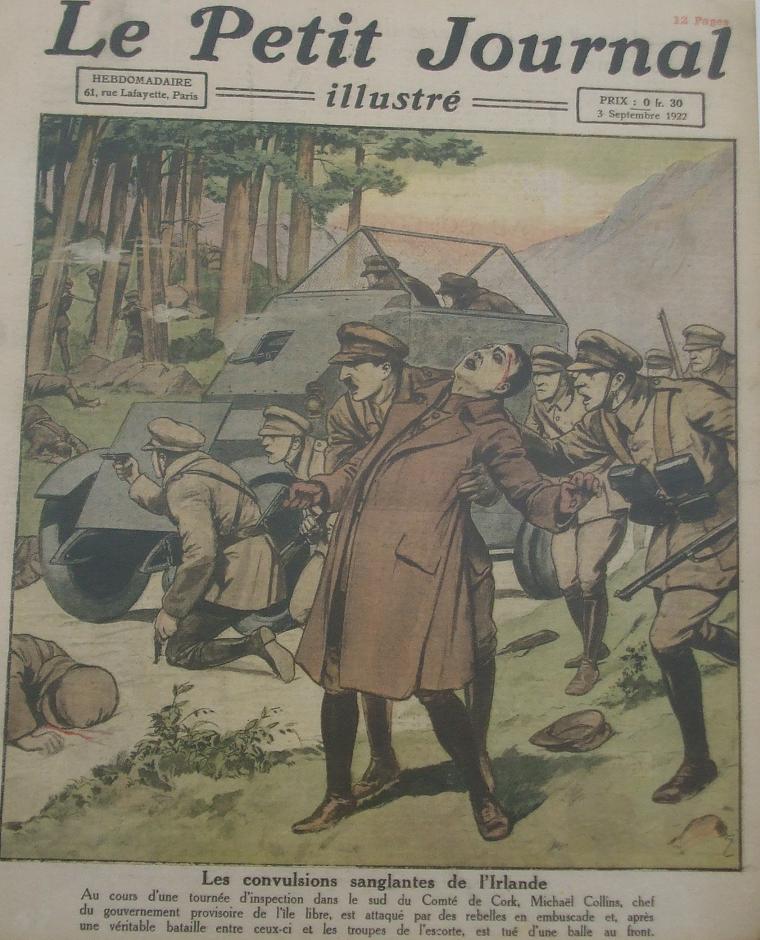
'Les Convulsion sanglantes de I'Irelande' (Fallon collection)

Update: The folks at the Dublin Review of Books have linked to this piece on their site, and in the process have taken the time to translate the caption on the Wilson illutration:

Come Here To Me! does not translate the caption to the illustration of the shooting. It reads: “L’histoire du conflit entre l’Irlande et la Grande-Bretagne a toutes ses pages tâchées de sang. – Un nouveau chapitre dramatique vient d’y être ajouté. A Londres le maréchal Wilson a été assassiné a coup de revolvers par des fanatiques Irlandais. C’est un brave soldat et un ami de la France qui vient de disparaître.” (Every page of the history of the conflict between Ireland and Great Britain is stained with blood. – Another dramatic chapter has just been added. In London Marshal Wilson has been assassinated by the revolvers of Irish fanatics. A brave soldier and friend of France has died.)

Read Full Post »

The Lion and the Unicorn on display at the Custom House today (Dfallon)

While the bombing of iconic Dublin statues by militant republicans in the decades following independence is well documented, other attacks on the iconography of the city have largely been forgotten. Recently, I stumbled across an interesting file in National Archives dealing with the issue of the Royal Coat of Arms, which remained in place on many magnificent Dublin buildings in the years following independence. In the 1930s, following an explosion at Exchange Court targetting one such piece of symbolism, senior figures inside An Garda Síochanna called for the removal of the Royal Coat of Arms from public buildings in the interest of safety and security.

On November 11th 1937 militant republicans were responsible for an explosion at the building which was home to the Engineering Branch of the General Post Office, at Exchange Court. The premises had once been home to ‘G Division’ of the Dublin Metropolitan Police, and it was at Exchange Court that Peader Clancy, Conor Clune and Dick McKee were to lose their lives on Bloody Sunday in 1920.

At half-six on a quiet November morning in 1937, an explosion destroyed the plaster cast of the Royal Coat of Arms, with The Irish Times reporting that:

The force of the explosion broke the plaster cast of the lion and the unicorn into pieces, blew a large hole in the wall of the building, and shattered hundreds of panes of glass in surrounding houses, shops and offices. Bricks and mortar were hurled into rooms of the premises, smashing furniture and damaging official documents.

Windows were broken at the Olympia Theatre, and even on Parliament Street, by the force of the blast.

In the Garda report in the immediate aftermath of the explosion, Chief Superintendent Thomas Clarke noted that Garda intelligence believed republicans had been planning an attack on a symbolic target early in November of 1937, and that Gardaí were monitoring memorial statues, poppy depots and the Ex-Servicemen’s Park. Clarke would write that:

It is the practice to have a Garda in uniform detailed to patrol a special beat in the vicinity of Cork Hill but there was no member available on the night of the 10th/11th,instant, for duty at this point owing to the other demands made on the available strength for protection of Poppy depots, memorial statues, halls etc.

It was noted that Gardaí believed the IRA were likely to cause an explosion at the Ex-Servicemens’ Park, or at some other prominent centre, between the first and the eleventh of November, in the run up to Armistice Day. The Garda report would note that the removal of the Royal Escutcheon from buildings in the city under the control of the Board of Works should be considered, owing to the damage caused through such explosions and the risk to the civilian population. In May of 1937 the statue of King George II in Stephens’ Green had been blown to pieces, and such attacks were undoubtedly seen as a very real threat.

Discussion around the Royal Coat of Arms and its presence on Dublin buildings continued into the following year. In a 1938 Garda report it was noted that if the Royal Coat of Arms could be removed from places “…without attracting press notice”, such a policy should be considered.

The 1938 confidential Dublin Castle report, on the Suggested Removal of the Royal Crest from Courthouse at Kilmainham, noted that “the protection of the buildings on which it is displayed cannot very well be effectively carried out.”

Inspector P.Killeen noted that in the case of the Kilmainham Courts, which display the Royal Coat of Arms to this day:

In view of the attitude adopted by a section of the population of this country to such emblems as this, and inv iew of the damage caused on several occasions within the last few years to statues and monuments associated with the British regime here, I think it should be advisable to have the emblem removed, and I suggest that representations should be made to the Office of Public Works to have this done.

The removal of the object now may save a great deal of trouble to the Police later, and may also save the Rate Payers and perhaps lives of citizens.

The National Graves Association had spent some time calling on the ‘Lion and the Unicorn’ at Exchange Court to be replaced with a memorial plaque to the three republicans who lost their lives there on Bloody Sunday in 1920. Today, such a plaque exists right next to City Hall, where the Royal Coat of Arms had once gazed down on Dubliners.

The Royal Coat of Arms can still be seen in several locations across the city, not only at the Kilmainham Courthouse but also at College Green on the Bank of Ireland (the historic Irish Parliament), at the top of Henrietta Street at the Kings Inns and at the magnificent Custom House.

Read Full Post »

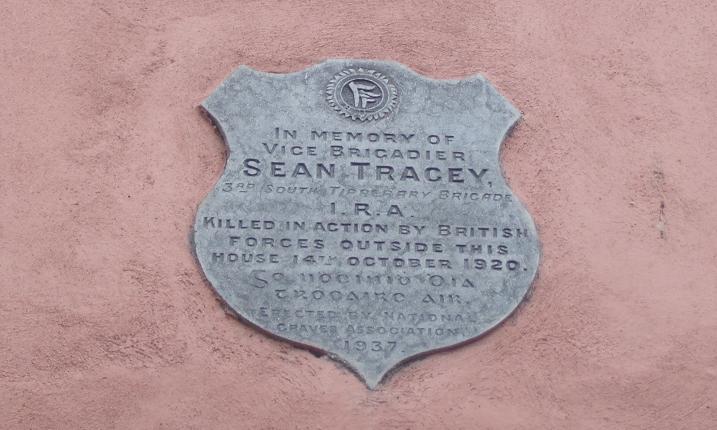
Sean Treacy is a character of great importance to the War of Independence period, indeed he was among the men of the Third Tipperary Brigade who fired the opening shots of that conflict at the Soloheadbeg ambush. Treacy would lose his life on October 14th 1920 on the streets of Dublin, owing to a shoot-out on Talbot Street that would also leave Gilbert Price of the British Secret Service lying dead on the street. A small plaque on Talbot Street today marks the spot where Treacy was killed. The incorrect spelling of his name should be noted, a common error.

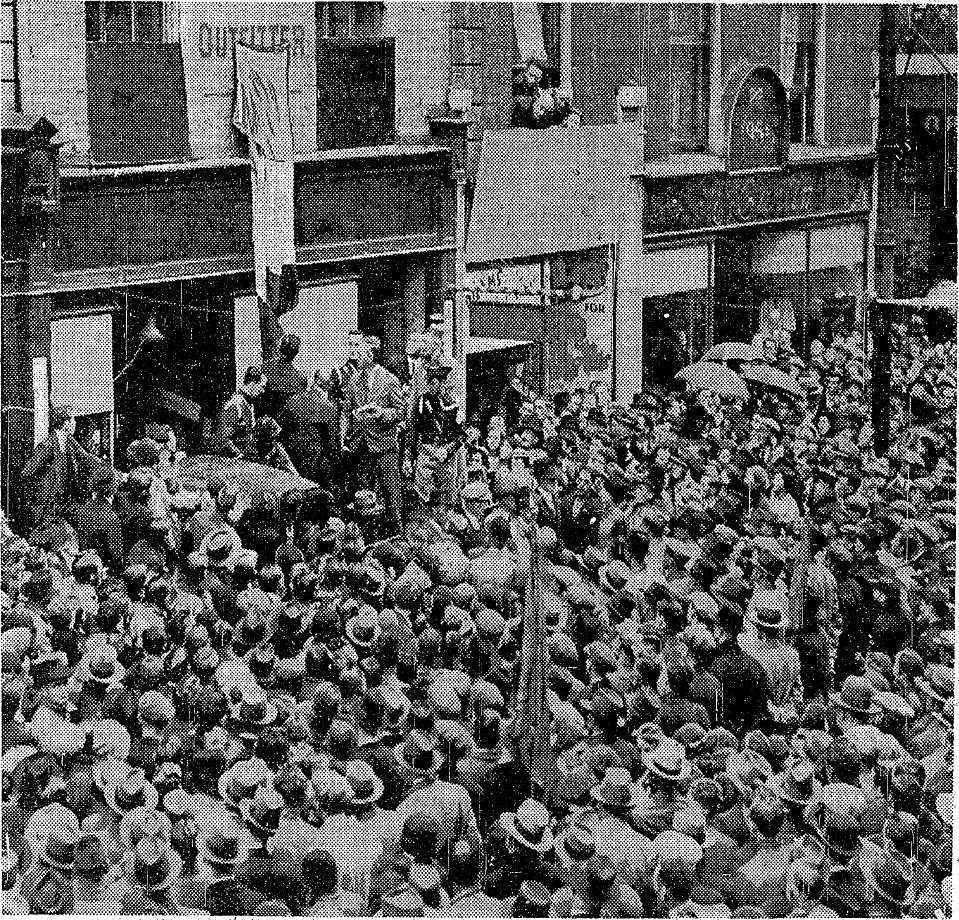
The plaque was unveiled by the National Graves Association in 1937, with a huge crowd gathering for proceedings.

Image taken from the front of The Irish Press newspaper, September 13 1937.

Each time Tipperary reach an All Ireland Final, Tipperary fans gather at the spot on Talbot Street to remember Sean Treacy. The video below shows the 2011 commemoration at the site.

Following Irish independence, the renaming of streets became common place in Dublin. In March 2011 I posted a copy of a 1922 Dublin Corporation report which recommended a number of street name changes in the capital. That report proposed radical changes, including the re-naming of Beresford Place (home to Liberty Hall) as Connolly Place, and not all of its recommendations were implemented. Interestingly, absent from the list was the issue of Talbot Street. In the decades following independence, members of a wide variety of nationalist organisations would call for the renaming of that street to honour Sean Treacy.

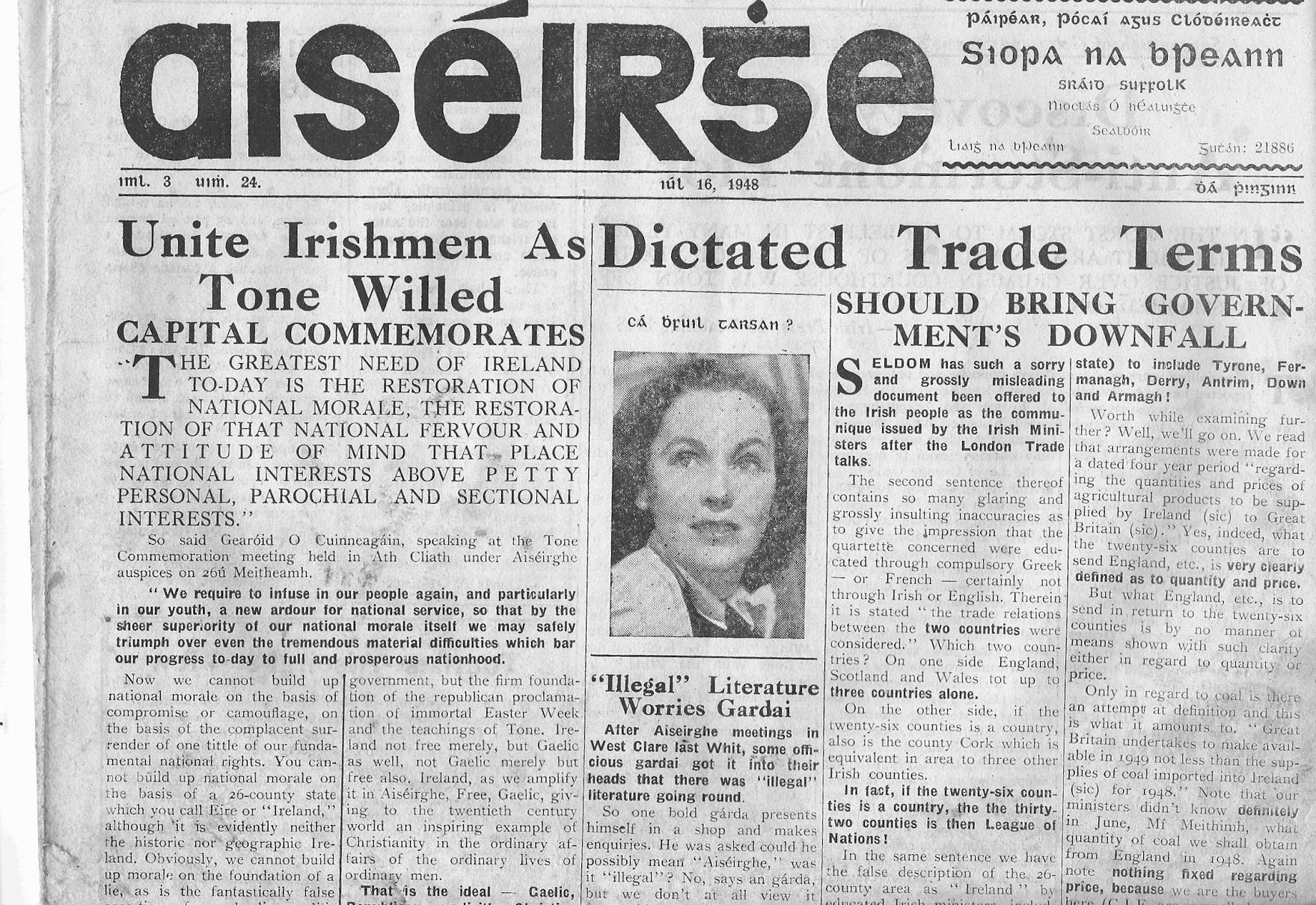
Among the organisations demanding the changing of the name Talbot Street in the 1940s were Ailtirí na hAiséirghe, a fascist movement whose name translated into ‘Architects of the Resurrection’ and who were led by Gearóid Ó Cuinneagáin. The movement produced the paper Aiséirghe, a copy of which was previously uploaded to this very blog. The politics of the movement very much fused European fascism with a deep sense of Irish Christianity and cultural nationalism. An impressive collection of election literature and propaganda from the group has been uploaded to the Irish Election Literature Blog, which provide interesting insight into the ideology of the group. In their 1943 General Election leaflet outlining principal points of policy, the organisation noted that: “Your duty to Ireland does not end with the casting of your vote. Serve Ireland always. Speak the language. Encourage others to speak the language. Help everything Irish and national and clean!”

An edition of Aiséirghe's newspaper.

On November 1st 1943, members of Ailtirí na hÁiseirghe created uproar at a meeting of Dublin Corporation, by shouting from the public galleries while the Corporation was sitting. At the time of the interruptions, the Corporation was discussing the planned removal of Queen Victoria’s statue from Leinster House. One man rose and shouted: “Get rid of all the symbols of slavery in the streets! We demand that Talbot Street be renamed Sean Treacy street. Young Ireland is awakening.”

It was reported that another member of the group shouted: “Honour Sean Treacy, despite the shopkeepers of Talbot Street. If you do not, you are not worthy of the name of Irishmen.”

(more…)

Read Full Post »

I’m far from finished exploring the street level plaques of Dublin, but recently it was suggested to me to move my search indoors. Hospitals, schools, churches and more besides all boast great historic plaques in this city, and some are real hidden gems. Church of Ireland churches can throw up interesting stuff in particular, for example often containing significant overlooked WWI memorials. St. Ann’s Church on Dawson Street contains the above plaque, to a man who took part in the defence of Trinity College Dublin during the 1916 Rising.

On Saturday August 5th 1916 a presentation was made in the Provost’s gardens of Trinity College Dublin to members of the Officers Training Corps (OTC) who had defended the university during the uprising, and used its vantage points to fire on rebels. The Sinn Féin Rebellion Handbook noted that:

To the prompt measures, defensive and offensive, organised by the Corps was due the preservation of valuable life and property in Grafton Street, Nassau Street, College Green, College Street, Dame Street and Westmoreland Street, including not only the historic buildings of the College itself, but the Bank of Ireland and many other of our finest buldings.

Interestingly, members of the OTC were joined by Canadian and Australian soldiers in the defence of the college. W.J Brennan-Whitmore wrote at length in his memoir of the rebellion of exchanging fire with a sniper at Trinity College Dublin, later meeting an Australian Sergeant and asking “Are you the so-and-so that was sniping at us out of the corner of Trinity College?” Indeed, the man was!

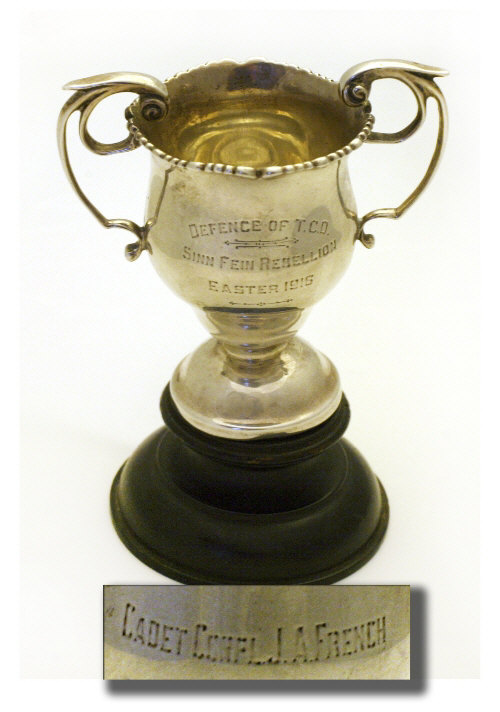
Appreciation for the efforts of the OTC materialised in a fund, exceeding £700, gathered via contributions from ratepayers in the area and citizens. Each member of the Corps was presented with small beautiful silver cup which marked their participation in the week, with the engraved inscription: ‘DEFENSE OF T.C.D – SINN FÉIN REBELLION – EASTER 1916’. One of these cups, pictured below, sold for €3000 at Adam’s last year.

Image from Adams Auctioneers. This cup was sold in 2011 for €3000.

(more…)

Read Full Post »

Of all the legends and stories the Easter Rising produced, I’ve always taken an interest in that of The O’Rahilly. Born to a prosperous merchant family in Co. Kerry in 1875, he had a privileged upbringing and received his secondary education in Clongowes Wood College. He began studying medicine in 1893, but was forced to take a hiatus after a year after contracting tuberculosis and quit altogether after his fathers death in 1896, when he moved home to look after the family business. Not long afterwards, he sold the business and moved to the US, where he married in Philadelphia.

His next ten years were spent back and forward between the States and Ireland, and O’Rahilly and his bride, Nancy Brown, traveled Europe and Ireland extensively. They settled in Dublin in 1909 where he took up a job managing the journal An Claidheamh Soluis, later publishing the article by Eoin MacNeill that lead to the foundation of the Irish Volunteers. Despite being a founder member of the Irish Volunteers, he was not privy to the plans for the Rising, but took part in it regardless, arriving at the mobilisation at Liberty Hall and uttering the infamous line, “Well, I’ve helped to wind up the clock — I might as well hear it strike!”

The O'Rahilly around the time of his marriage to Nancy Browne

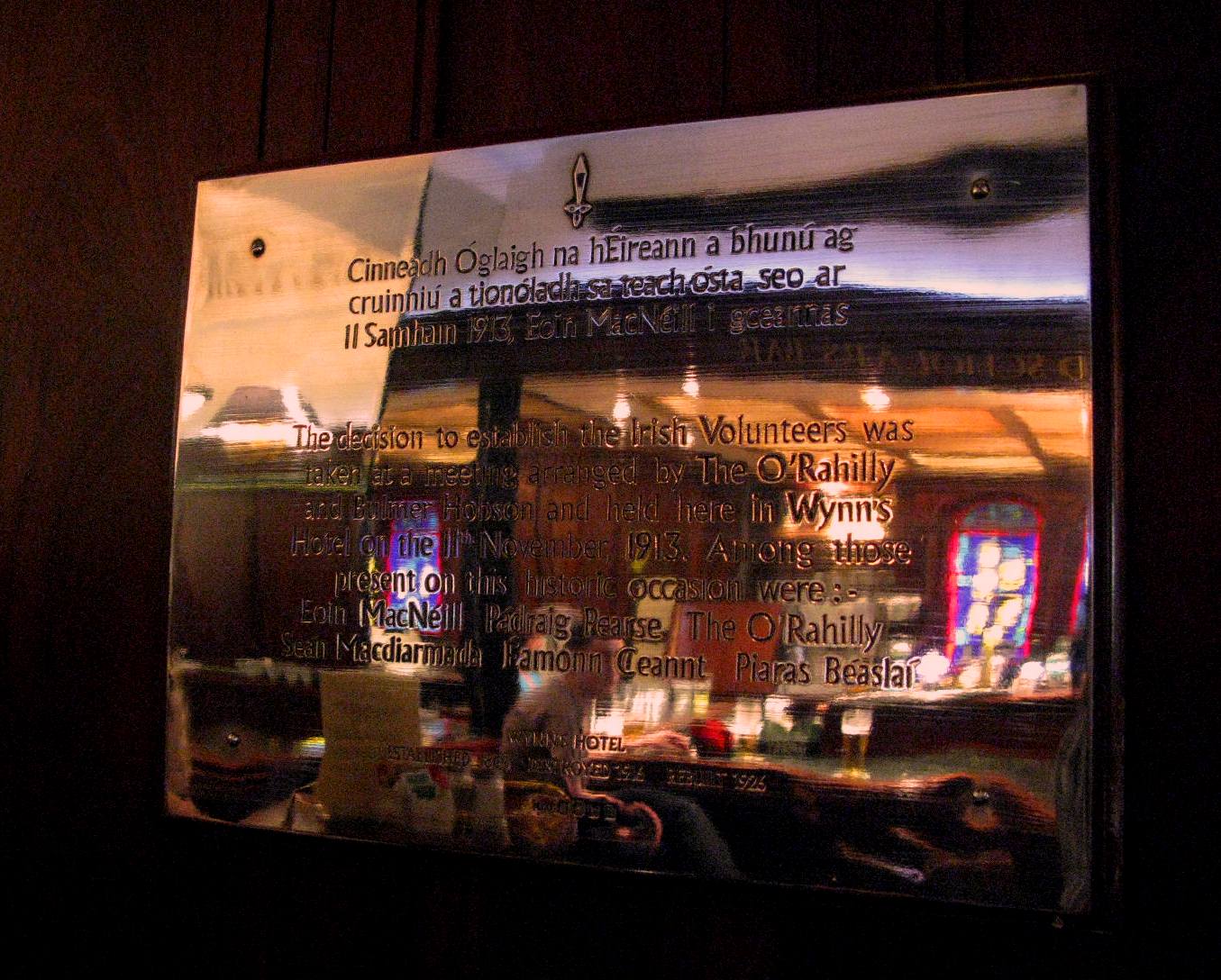
While most of the above is an ode to The O’Rahilly, and I hope to do another piece on him shortly, the subject of this piece is the plaque in the bar of Wynn’s Hotel on Abbey Street commemorating the founding of the Irish Volunteers there by The O’Rahilly and Bulmer Hobson in 1913. Hobson’s legend is that he never partook in The Rising, and was in fact kidnapped by the IRB before it in case he tried to pull the plug on it. Apologies for the quality of the picture below, Wynn’s obviously take great pride in it, and the sheen off it made it close to impossible to photograph. Inscription below.

The plaque reads:

Cinneadh Óglaigh na hÉireann a bhunú ag cruinnií a tionóladh sa teach ósta seo ar 11 Samhain 1913, Eoin MacNéill i gceannas.

The decision to establish the Irish Volunteers was taken at a meeting arranged by The O’Rahilly and Bulmer Hobson and held here in Wynn’s Hotel on the 11th November, 1913. Amongst those present on this historic occasion were: Eoin MacNéill, Padraig Pearse, The O’Rahilly, Seán MacDiarmada, Éamonn Ceannt (and) Piaras Béaslaí.

Wynn’s Hotel, Established 1845, Destroyed 1916, rebuilt 1926.

Given the weekend that’s in it, I’ll finish the piece by quoting another O’Rahilly line… When he realised the rising could not be stopped, he reportedly turned to Markievicz and said “It is madness, but it is glorious madness.” Hopeless romantics the lot of them.

Read Full Post »

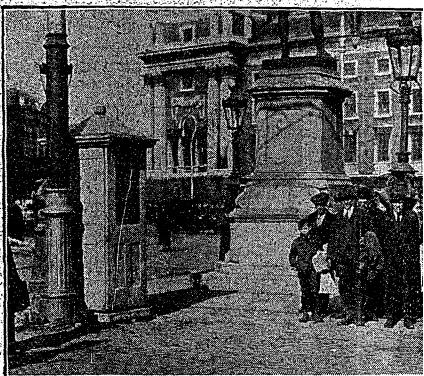
The Grattan statue at College Green, the location for Dublin's first public telephone kiosk.

Dublin’s first telephone kiosk was installed in May of 1925, next to the Henry Grattan statue on College Green. One contemporary newspaper report noted that Stockholm had in excess of 500 such public telephones at the time, so perhaps like our first escalator (which we featured here recently!) we were a bit behind once more.

The kiosks were concrete, similar to those in use in the UK at the time and were available to use at all times. The Irish Times reported that the inauguration of the scheme was due to the initiative of Mr. P Mulligan, Chief Engineer to the Post Office. “If the experiment succeeds many more kiosks will be erected in various parts of the city” the paper noted.

Prior to its opening, newspaper reports noted that the kiosk would be designed in such a way as not to become an eyesore but rather would be “built of reinforced concrete, with glazed panels, and is designed so as to present a pleasing appearance and be in harmony with the surrounding buildings.”

Dublin's first telephone kiosk, shown in The Irish Times.

By 1926, it was reported kiosks had been added to Dublin’s railway stations, and the city saw scores of public telephones dotted around it in 1932 for the Eucharistic Congress. In the October 10 1932 edition of An Irishman’s Diary it was noted that:

Among the few traces which now remain of this years Eucharistic Congress are some scores of telephone kiosks which were provided for that world event. Unfortunately, these welcome facilities seem to be concentrated in groups, while they are missing, and badly wanted, in other districts.

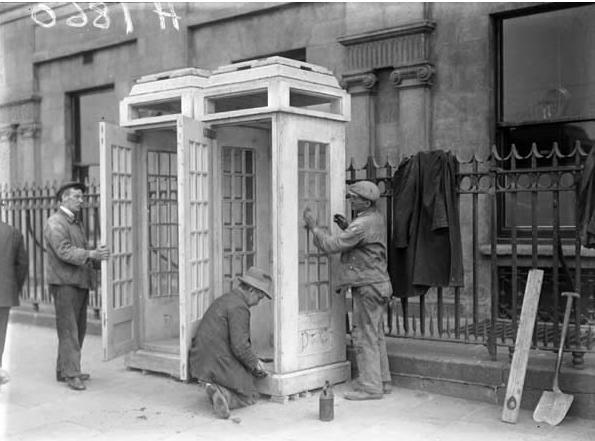
NLI Collection.

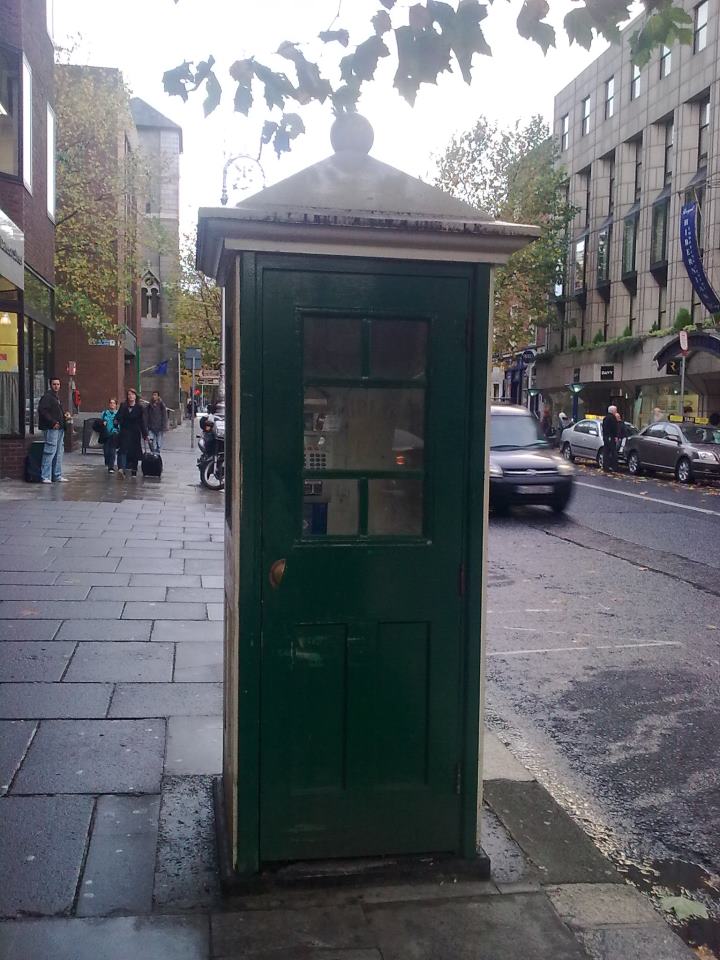
This NLI collection image shows phoneboxes being prepared for public use in Dublin prior to the 1932 Eucharistic Congress. The last such old fashioned phonebox to be seen in the city centre today is on Dawson Street.

Image thanks to jaycarax, of Come Here To Me fame.

Read Full Post »

Barney McKenna image comes from the pricess itsthedubliners.com

I’m saddened today to hear of the loss of Barney McKenna, the legendary banjo player of The Dubliners. Barney was the last surviving member of the original line-up of The Dubliners, known at first as the Ronnie Drew Ballad Group.

At a loss for what to post today as a fitting tribute, I thought this excellent short documentary was perfect, capturing the humour of the man and the deep love for him among those near him.

Read Full Post »

The historiography of any period is never complete. For young historians, the period known commonly as the ‘Irish revolutionary period’ can appear one with little room for new writers, with so much written on the pivotal events and personas.

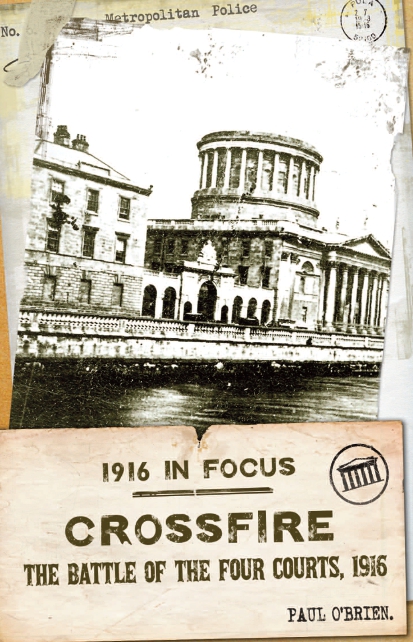
Thankfully, recent years have seen historians engage with the ‘Irish revolution’ in new and exciting ways, moving beyond the macro and looking at individual events and themes in greater detail. A particular effort of note would be Mercier’s top class ‘Military History of the Irish Civil War’ series, but in the field of biography O’Brien’s new ‘Sixteen Lives’ series will see first biographies of some of the executed leaders of 1916 published. New Island books have launched ‘1916 In Focus’, with Paul O’Brien’s study of the Four Courts garrison during Easter Week the first work in the series.

O’Brien’s last effort, ‘Uncommon Valour’, which looked at the South Dublin Union, was reviewed here on the blog in February 2010. Looking at key battles and events in Easter 1916, O’Brien has managed to turn events that take up a few paragraphs in broad-histories into full works, which gives you an in-depth look at some characters who somehow often manage to escape from the narrative of other works.

The Four Courts is more so associated with the Civil War in the popular memory of Dubliners, but some of the bloodiest events of the Rising occurred in the area around the courts. The area which saw heavy fighting during the Rising between the 1st Battalion of the Irish Volunteers and British Military Forces was an area home to some of the poorest Dubliners in tenement dwellings, not far for example from the buildings which had collapsed on Church Street in 1913, killing seven. Edward Daly commanded the forces which occupied the Four Courts and surrounding areas. He would later be executed for his role in the week.

(more…)

Read Full Post »

Firemen Nugent, McArdle and Malone. All three perished in the Pearse Street Fire of 1936.

The Dublin Fire Brigade turns 150 years old this year. We’ve had some excellent material on the site in the past relating to the DFB, most of it courtesy of my father Las, a former curator at the Dublin Fire Brigade Museum and a serving member of the Brigade.

It’s an important aspect of the history of the city, and indeed of the working class of the city in particular. From the very origins of the modern force to the industrial disputes of its more recent past, we’ve shared a wide variety of content here on the site. My particular favourite posts from the below have been the architects drawing of Pearse Street station, the feature on the assistance provided by the Dublin Fire Brigade in Belfast during WWII and the leaflets relating to the 1988 industrial dispute.

'FBU' coverage of the Dublin 1988 strike.

Collection of posts:


The Pearse Street fire, 1936. Three fireman died in a blaze on Pearse Street.

Arthur Guinness and Sons Fire Brigade.

Saving the Pram (The Abbey Theatre fire, 1951)

‘Rats with Matches’ (Dublin Fire Brigade 1914 Annual Report)

‘Politics and the Parish Pump’

An Interesting Tug-of-War! The DFB versus the DMP

Original architects drawing for Tara Street Fire Station.

When Dublin Fire Brigade rushed north during WWII.

Dublin Fire Brigade 1988 industrial dispute leaflet (Sinn Féin)

The British FBU (Fire Brigade Union) and the 1988 Dublin Fire Brigade strike.


Irish Workers Group- Class Struggle (1988 strike)

Willie Bermingham 1942-1990

Going to answer ‘Joe Edelstein’s Alarm’

Members of the Arthur Guinness and Sons Fire Brigade in training at the Brewery.

Read Full Post »

The 1947 funeral of ‘Nazi master spy’ Hermann Goertz at Deansgrange Cemetery, Dublin has been discussed quite a bit recently. The Irish Times as part of their ‘From the archives’ column reprinted the paper’s original article on the funeral back in May and the incident was also included in Shane MacThomas’ new book Dead Interesting which features stories from Dublin’s graveyards.

A scene from the funeral. Published first in The Irish Independent, Oct 22 1961.

Much has been made of the major role that women played at the funeral. The Irish Times reported that it was women who wore “most” of the Swastika badges in the crowd, that it was a woman who placed a large swastika flag on the coffin and it was also a woman who whispered ‘Heil, Hitler’ and gave a Nazi salute just after the burial. The paper also noted cards on wreaths announced they were from “Maisie”, “Mary” and “My dearest friend – from Bridie”.

A woman makes the Nazi salute at the funeral. The Irish Times, May 27 1947.

There can be no doubt that the “Mary” and “Bridie” were the Farrell Sisters from Glenegeary whom Goertz lived with up to his suicide.

Spinster sisters Mary and Bride (aka Brigid or Bridie) Farrell (sometimes misspelled as O’Farrell) lived at 7 Spencer Villas in Glenageary, South Dublin. It was this address that Goertz gave when he was in the High Court in April 1947 fighting his deportation order.

Like the other women, such as Caitlín Brugha, Iseult Gonne, Mary Coffey, Helena Molony, Maise O’Mahony (another name on a wreath), who helped Goertz it can be accepted that the Farrell sisters held anti-British and pro-Irish Republican sympathies.

Letter from Bride Farrell to The Irish Press. June 17, 1947.

Bride, who was the youngest daughter of Sylvester and Maria Farrell, died on May 11 1966 at St Michael’s Hospital. It is not known when her only sister Mary passed away.

In 1974, under the cover of darkness, a group of German ex-army officers exhumed Goertz’s remians and re-interned them in the German War Cemetery in Glencree, Co. Wicklow where they remain to this day.

German Military Cemetery, Glencree, Co. Wicklow.

Read Full Post »

Stein Opticians

The Irish-Jewish family, Stein, have run an optician’s in Dublin for nearly seventy years. They are perhaps best known for their 1983 David vs Goliath battle, where they fought bitterly to save their practice on Harcourt Road from the developer’s bulldozer.

Dublin born Mendel Stein (1915 – 2000) grew up in Victoria Street in the heart of Portobello, then known as ‘Little Jerusalem’. Studying to become an ophthalmic optician, he set up his practice at 36 Harcourt Road in 1944.

Advertisement for Stein's. The Irish Independent, Mar 05, 1946.

For the next forty-one years, he remained one of the most popular opticians in the city and his practice, known as ‘The Eye’, became “a place for encounter, conversation and spirited views on the life of Harcourt Road and the universe beyond” [1]. Mendel became a close friends with Michael MacLiammoir, Hilton Edwards, Harry Kernoff and others at the heart of Dublin’s art and theatre scenes.

But then in 1983 the Clancourt Group announced that they wanted to build a seven-storey office block which would involve demolishing the terrace to make way for the new Harcourt Centre.

While other property owners and lessees of buildings due for demolition accepted the substantial compensation, Mendel decided that he wasn’t going to give in so easily. He said that he would not leave until they gave him a new shop in the immediate vicinity and a guarantee that his (beautiful) shopfront would be preserved.

The Irish Press. Oct 12, 1983.

This window of the shopfront was “in the shape of an eye, whose pupil is reflected in a circular mirror on a facing wall inside”. Frank McDonald of The Irish Times described it at the time as “a masterpiece of its period (which) arguably should have been officially listed for preservation”. [2]

By the end of it, his single-story shop was the “only surviving remnant” of Harcourt Road despite the fact that the tiny building was perched on the edge of a ‘cliff’ while the new block was under construction. The late Brendan Glacken later recalled a story that during this time a young quick-witted Dubliner shouted into Mendel “Hey mister, your extension is coming on great!”.

"Stein's Opticians at Harcourt Road with the new office block behind it". The Irish Times, May 31, 1983. Photographer - Peter Thursfield.

Spurred on by local support, Mendel held out and eventually received a guarantee that the shop would be taken down intact and re-erected at a new location in nearby Grantham Street off Camden Street.

Joined at this stage in the practice by his daughter Ameila, Mendel worked at his new Grantham Street address until he reached his 80s. He passed away in June 2000.

Amelia, an award-winning photographer who has worked with Irish artists such as The Hothouse Flowers, Aslan, The Cranberries, still runs the family optician business  today from 4 Camden Market, Grantham Street.

Stein Opticians, Grantham St.(Google street view)

[1] The Irish Times. Dec 7, 2000.
[2] The Irish Times. May 31, 1983.

Read Full Post »

Architects drawing for fire station (L Fallon Collection)

Above is the original architects drawing for Tara Street Fire Station. In the mind of many Dubliners the building is on Pearse Street, but owing to its postbox being on Tara Street it is ‘Tara Street Fire Station’. This image has not appeared online before.

The station was opened in 1907, by the then Lord Mayor Joseph Nanetti. Nanetti was not only Dublin’s only Lord Mayor to come from the Italian community, he was also the first Lord Mayor to come from the Labour movement.

The site of the fire station holds a special place in the history of the Italian community in Dublin, because as Vinnie Caprani noted in A View From The Dart (1984), the Lord Mayor of Dublin “…found himself opening a fire station on the exact spot where Giuseppe Cervi had set up Dublin’s first mobile chipper, “thus giving Dubliners the ‘wan-and-wan’, a meal which quickly became as popular on the working-class menu as the more traditional coddle or tripe-and-onions.”

Looking at the architects drawing and the building today, it’s clear the final tower design was different from that envisioned by the architect at first. It is said the tower of the fire station was used by British forces in 1916 to attack rebel outposts, and Liberty Hall which it was believed at first was the rebel headquarters. Shane MacThomáis noted in his day by day account of the Rising that:

From Wednesday onwards rifle and machine-gun fire on the GPO and its outposts, particularly those at the junction of O’Connell Street with the Quays, became heavy and ceaseless. Much of it came from Trinity College and the tower of Tara Street Fire Station across the river.

In this image below, showing members of the Irish Citizen Army on the roof of Liberty Hall, the tower can clearly be seen in the distance.

This postcard below comes from the time of the opening and shows the building more or less as it is today. It is difficult to understand today just what a presence this building would have had on the capitals skyline. The purpose of the tower was to serve as a lookout post, and also to allow for full lengths of the canvas hose used at the time to be hung up to dry.

Ironically, Liberty Hall is a considerably taller building than it today.

"The new fire brigade station, Gt. Brunswick Street Dublin." (L.Fallon collection)

Read Full Post »

« Newer Posts - Older Posts »