Feeds:
Posts
Comments

Archive for the ‘Dublin History’ Category

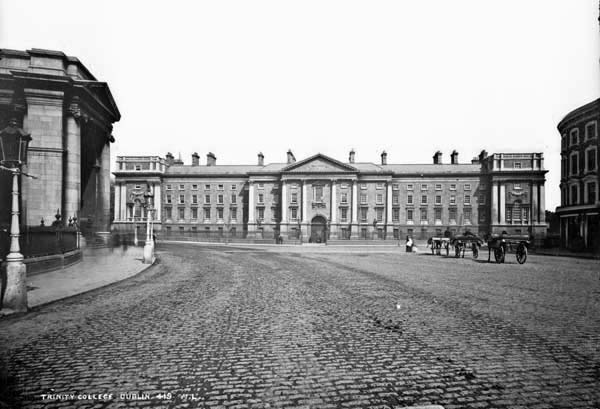
Robert French collection, NLI.

I had to jot this down recently when I stumbled across it, excellent. The railings of Trinity College Dublin are now fair-game for natives, tourists, large groups of Spanish secondary school backpackers or anyone else to sit on it seems.

Once upon a time, the students of Trinity College were in the habit of spending the fine summer afternoons seated on the railings between the front gates and the archway, sunning themselves and contemplating the world as it passed by. About five years ago the Board issued an edict which made it illegal for any student to sit on the railings ever again. The loungers in the sun withdrew to prepared positions behind the classical facade, the statues of Burke and Goldsmith, and the porters in black velvet jockey-caps.

This rather curious regulation was prompted, apparently, by the Boards constant concern for appearances. As far as one can judge, without inspection of the minutes of that secret conclave, it felt the sight of students lounging on the railings gave the outsider the impression that Trinity students never did any work. And the Board, with some justice, is tired of being misunderstood. As far as the average citizen of the new Ireland is concerned, Trinity College is still the retreat of the sons of the Big House, young men with more money than sense, every Trinity man has imperialism in his blood, and is only waiting his chance to re-establish the British Raj in Dublin Castle; they are the undying West Britons, and they are all snobbishly contemptuous of everything Irish.

Read Full Post »

The Irish Press, April 15 1981.

In the past, we took a brief look at some unusual Dublin pirate radio stations here on the site, such as Radio Jacqueline, a 1967 schoolboy effort which made its way into the national media.

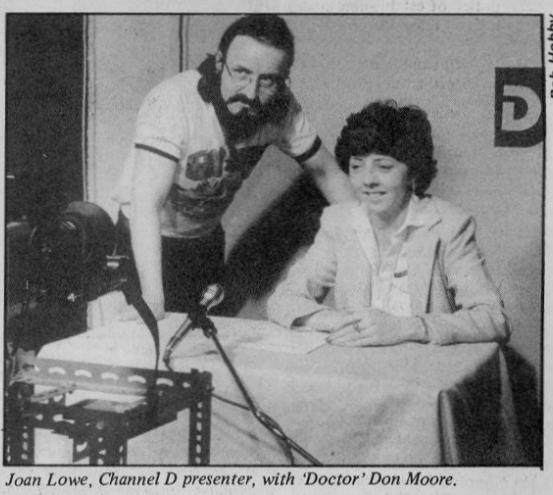
With RTE television turning 50 this year and much nostalgic feeling coming with that, perhaps some of you will remember Channel D, the first Irish pirate television station which popped up in April of 1981. Channel D, subtitled as ‘Independent Television Dublin’, lasted only a number of months due to pressure from state forces, and ultimately failed to establish any sort of loyal base like the pirate radio stations had succeeded in doing. Jim Reidy, one of the stations directors, and ‘Doctor’ Don Moore were among those involved with the station. Don Moore had played a leading role in the development of the pirate radio format in Ireland. Indeed, many involved in the earliest pirate television efforts in this city had come from that background.

Channel D snap from In Dublin (scanned by daxarchive.com)

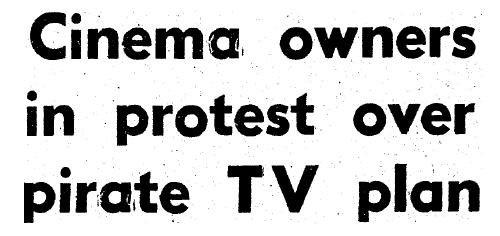
Even prior to Channel 3 (as the station was first known) taking to the small screen, the buzz around the station led to The Irish Press of April 21 1981 reporting that:

“All the means at its disposal” are to be used by the Department of Posts and Telegraphs to prevent the operation of the country’s first pirate television station which intends to start transmissions from north Dublin in the next few days. Action, in the form of the seizure of equipment, will be taken against this unlicensed station in others in Cork and Limerick which also mean to begin operations soon.”

Some of the fears around the stations had come about as a result of cinema owners taking to the media and complaining of their fears of uncensored films being shown on such stations. Jack Bourke, an owner of two cinemas, told The Irish Press that if films were to be shown on pirate television uncensored or prior to their cinema release, “cinemas will close or we will not bother about submitting films to the censor.” This led to a situation where a Limerick based consortium planning to soon commence pirate transmissions found themselves telling the national media they were prepared to submit their films to the film censor, Frank Hall.

It was April 25th when Channel 3, the nations first pirate telly station, took to the air. This was an incredible new experiment for those involved of course, which brought all sorts of difficulties with the task. An In Dublin feature on the station that summer noted that with these earliest transmissions:

The signal was weak, the reception in black and white and the frequently-repeated material irritating. One observer described the operation as ‘amateur-land’. But somebody, somewhere, had succeeded in putting a picture on my screen.

In its infancy, the station was broadcast out of the Camelot Hotel on the Malahide Road, and was only obtainable within a five mile radius of that location. Still, despite its incredibly small potential audience, it grabbed the national attention through the newspapers of the day. The station went to great lengths to stress the fact it didn’t want to be seen as a threat to the national broadcaster, with a spokesperson telling The Irish Press that the station only went on air after RTE had ceased transmission and that “we are not posing a threat to anyone.”

The Irish Times was completely correct when it stated that Channel D was “strangled at birth”, with a High Court settlement see ing the station banned from showing any films less than thee years old. The station had planned to show ‘Kramer versus Kramer’, but alas this wasn’t to be.

So, what did they show? Irish-TV.com notes that that it was said that Channel D’s stock of video cassettes was “burnt out in a ‘freak’ accident at a Dublin petrol station, so Channel D constantly repeated the same film, No.1 of the Secret Service in the evenings and a magazine programme filmed on a domestic camera in the day.” Also broadcast with great frequency was Don’t Swim on the East Coast by The Sussed. The song was about the Windscale Nuclear power station, Sellafield to me and you today.

'The Sussed', taken from the bands MySpace account.

The In Dublin feature noted that “broadcasts begin very suddenly, without any ceremony. The equipment consists solely of a video-cassette recorder linked to a transmitter and thence to an aerial in the roof.” By the time the In Dublin feature was written in August of 1981, the station was broadcasting from the State Cinema in Phibsborough. The feature noted that “Channel D is financed by a large consortium of business interests whose main concern was to provide Dublin with local independent television at no extra cost to the viewers, since funds would be generated by advertising.”

Ultimately, Channel D was not the success it could have been, with state interference and poor equipment to blame. The station had ambitious plans which even included breakfast television, unheard of in Ireland at the time. Other pirate television stations would follow, with Radio Nova attempting to make the leap to the format too, but like Channel D these efforts would be shortlived.

At the time when Radio Nova attempted the move to the small screen, chairman of the RTE Authority, Mr. Frank O’Donovan, described pirate telly as nothing but “a two finger excercise to the government, to RTE and to the law of the land.” These stations represent a fascinating and forgotten piece of Dublin’s social history.

——————-

Sources consulted:
Newspaper archives
The DX Archive ( a brilliant site dedicated to pirate radio)
Irish Rock Discography

Read Full Post »

I’ve long been a fan of The Bell, which ran from 1940-1954, a fantastic monthly magazine under the editorship of the great Sean Ó Faoláin and then Peadar O’Donnell.

The magazine featured Flann O’Brien, Hanna Sheehy Skeffington, Ernie O’Malley, Patrick Kavanagh and many other excellent writers among its contributers, and was an outspoken voice of liberal criticism of the state and the strict censorship regime in this country.

One of its frequent features under Ó Faoláin’s editorial period was entitled Mise Éire. This feature offered book vouchers to members of the public who could send it the best humourous clippings or quotations from public life, in the form of a newspaper report or politicians statement which may have gone under the radar. It wasn’t a constant feature in the magazine, appearing on occasion with varying numbers of clippings. Below are some of my favourite clippings from Mise Éire 1942 and 1943 features, which I stumbled across while researching something else entirely. Always the way.

“If the average young Irishman and woman knew better how to spend their leisure time this would certainly be a happier and possibly a much more thickly populated nation”

-The Irish Press, 17/8/1942

“In a few words the work before our young men today is to establish a Model Christian State: to bring the whole world under the spiritual control of Ireland: to make ourselves mistress of the Atlantic as Japan wishes to make herself mistress of the Pacific, except that we shall also be masters of the Pacific….Anyway, with the help of God we can settle the fate of the world for another 2000 years.”

– Aiseirghe (fascist newspaper) May 1942.

“The growth of crime in England is due to the unfettered reading in that country.”

-Senator Goulding on the censorship debate, 18/11/1942.

“Gombeen men are now a thing of the past, thanks to good government.”

– The Irish Press, May 1st 1943.

(The below observation was sent to ‘Mise Éire’ by a reader, commenting on the Countess Markievicz memorial in Stephens’ Green. This is a literal translation of the memorial)

“Bean chalma chróda a throid i gcat ar son na h-Éireann…um Cháise imbliadhain an Tighearna a 1916”

“A brave, valiant woman who fought in a cat for Ireland about cheese in the year of the Lord, 1916.”

Read Full Post »

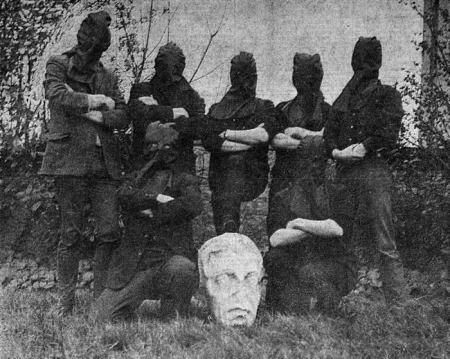
NCAD Black Bloc

After the Nelson’s Pillar was blown up in 1966, the head was stolen by NCAD students from a storage shed in Clanbrassil Street as a fund-raising prank to help clear their debts. Wearing sinister black masks, they held a very civil press conference explaining their motives.

The head made several secret appearances over the next six months including making its way onto the stage of a Dubliners concert in The Olympia Theatre!

Nelson’s head now rests peacefully in the Gilbert Library in Pearse Street.

Read Full Post »

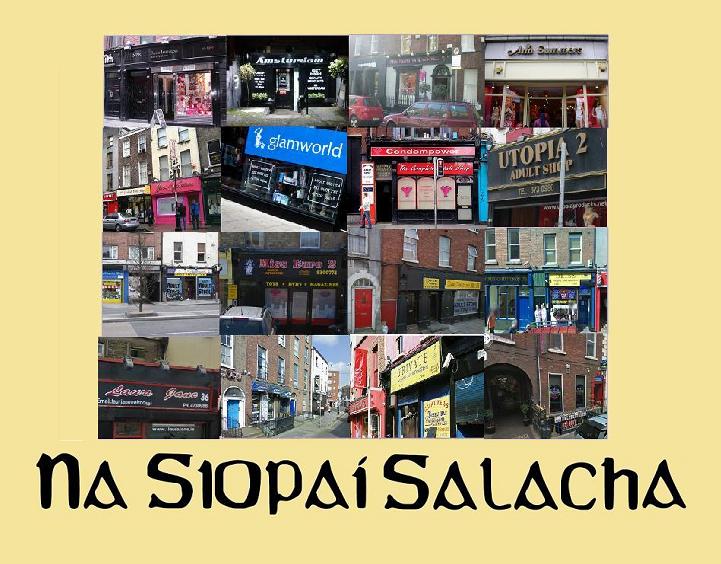
Below is a brief look at the history of Dublin’s sex shops, taking in some of the hysteria and protest that existed around such shops on the island well into the late 1990s. It’s an interesting story, in many ways surprising, looking at shops which today dot the city.
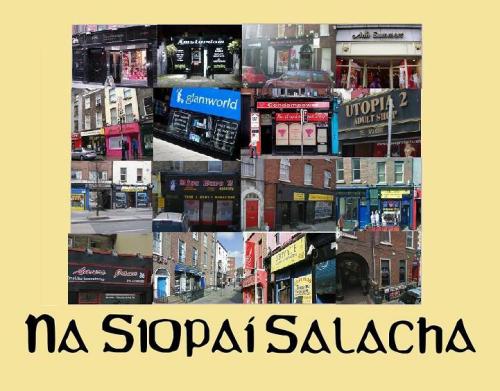
Previously posted to Come Here To Me, the poster I expect no Arts Council funding for.

Ah, the sex shops of Capel Street. Those neon signs and tacky window displays are as much a part of Dublin today as the Chinese restaurants, discount shops and early houses which also dot the street. Yet a great many Dubliners will be surprised to hear just how new such shops are to Dublin. There can be a belief among younger Dubs that with the end of Archbishops MacQuaid’s rule the lights came on (or in this case went off)overnight, and all changed in Irish society. Suddenly, Catholics went to Trinity, censorship ended and vibrators arrived. It’s not quite that simple, and indeed it was February 1991 before even talk of Dublin’s first sex shop hit the national media.

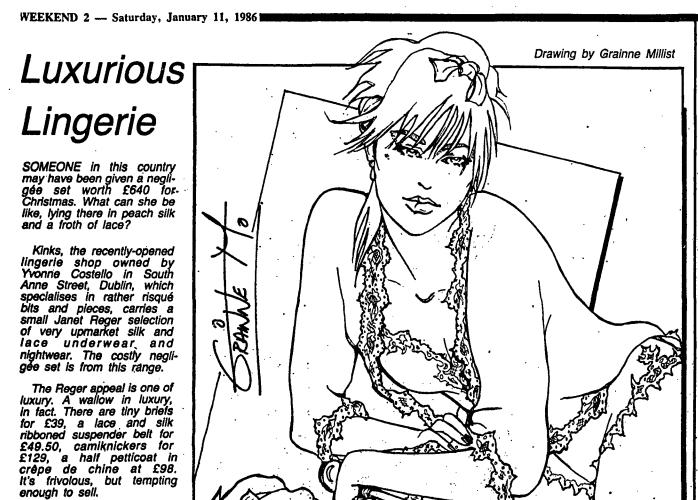
Prior to Dublin’s earliest adult shop, and often mistaken for it, there had been Yvonne Costello’s store Kinks in the 1980s, a lingerie shop which carried some ‘novelty items’ but never went far enough as to bring the force of conservative elements knocking on the door. Costello was of course a former Miss Ireland and a character with which the media held some fascination. Kinks was about as risqué as things were to get in Dublin or the south for some time, and while adult shops thrived north of the border, they were yet to land in the capital. Kinks on South Anne Street even featured in the weekend supplement of The Irish Times, and while widely remembered by Dubs as the first sex shop in Dublin, this labeling just doesn’t suit.
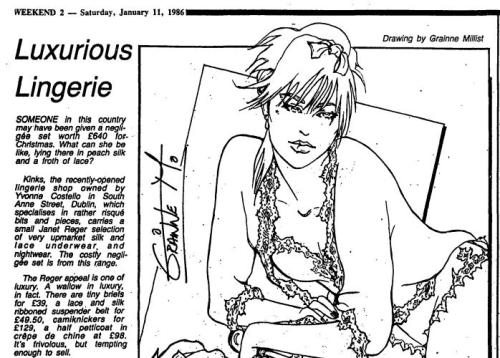
Kinks features in The Irish Times, January 1986. Soon, sexshops would feature in the national media in a very different way.

Frank Young, owner of the Belfast sex shop Private Lines, was interviewed by the Sunday Independent in February of 1991 about his intentions to bring the store to the sexually conservative heart of the Republic. Young, the paper noted, “looks more like an accountant than someone who sells sex for a living”, and in his interview he said that many of his customers were coming from across the border anyway, making a move into Dublin logical in his eyes. Responsible for the Esprit and Excel mags, which were subject to censorship south of the border, Young believed that were it not for the two menaces of “raving feminists and various Christian group”, the magazine would have a circulation on the island to rival the Sunday World. There was, Young insisted, a strong desire for adult shops further south than Newry. Belfast’s first sex shop had opened in 1982, with huge pickets from Christian groups making the owners of ‘Mr Dirty Boots’ perfectly aware they were unwelcome on the Castlereagh Road!

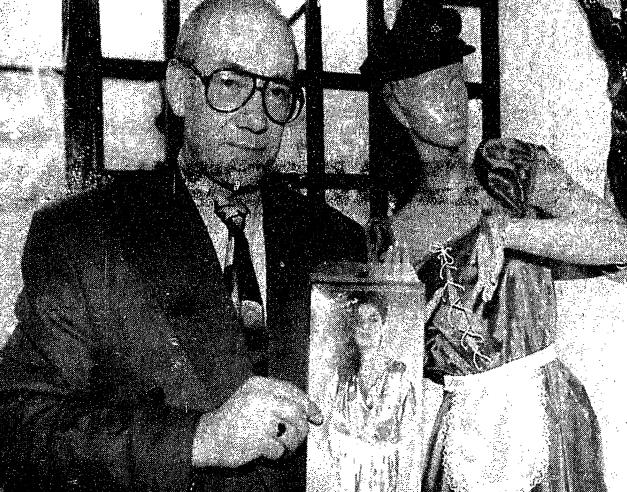
When sex shops did ultimately land in the Republic later on in the 1990s, few could have predicted the backlash. As Diarmaid Ferriter wrote in his excellent history of the Irish and our sexuality, Occasions of Sin, these shops on one level represented the normalisation of sexuality “by its being transformed into a commodity”, but to others this was very much a threat to the very moral fibre which held our society together. Jim Bellamy, an Aberdeen native, was responsible for the earliest sex shops in the south, opening Utopia outlets in Bray,Dublin,Dundalk and Limerick in very quick succession. In Limerick, one protestor told The Irish Times that “paedophiles and other sex perverts feed off these kind of places”, but the sales figures suggested that Jim Bellamy’s store held a wide appeal to the general public. Thousands joined “pray-ins” against Bellamy’s shop in Limerick and throughout the Provence, organised by the ‘Solidarity’ movement. The Irish Times image of Mr.Bellamy, standing alongside a mannequin in a maids outfit, must be one of the most unusual images the paper has ever printed. Bellamy’s Bray outlet, opened late in 1991, was the first sex shop in the Republic. I don’t suppose we’ll ever see a plaque upon the site.
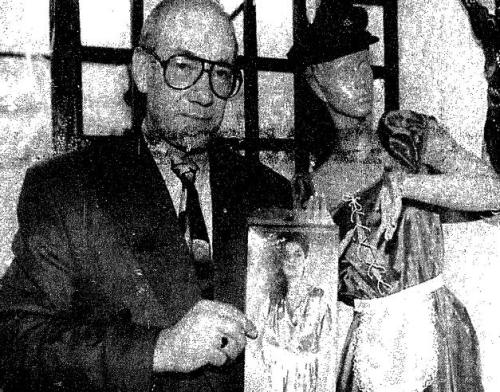
Jim Bellamy in his newly opened Limerick branch, The Irish Times January 17 1995

When Utopia made the short journey into the Irish capital in 1993, it arrived on Capel Street, today home to more sex shops than any other street in Dublin. Utopia however, was about to become Utophia. While the signwriting tradition is sadly dying out in Dublin today, and hand painted shop fronts are few and far between, a painter was given the honour of putting the name above the door of Dubin’s first sex shop. Incredibly, and in the spirit of a good Dublin story, he spelt it wrong and Utophia was born, as it was to remain.

Dublin’s early sex shops found themselves in a very unusual place, coming head to head with the rather extreme censorship laws still in place at the time. While inflatable people and inflatable sheep were both harmless enough in the eyes of the state, the printed word and image still posed the greatest threat to the moral decency of a people. As Bellamy was to tell Sean Moncrieff in a 1994 interview for The Irish Times, what we had was “four old men and a judge deciding the morals of the country”. Through 1995, the shops were raided on numerous occasions by customs officers and Gardaí in relation to the selling of indecent or obscene materials, in the form of video tapes. In many cases such materials were returned to the shops afterwards when they were deemed to be within the law. This situaion saw Bellamy take court proceedings to challenge the decision of the authorities to raid his stores with such frequency.

Heading into the mid 1990s, Utophia was joined by Condom Power, Miss Fantasia and other outlets which remain in Dublin to this day, ironically rather recession proof despite the early controversies around them. Remarkably, by the late 1990s, another scandal would blow up with the opening of Ann Summers on O’Connell Street.
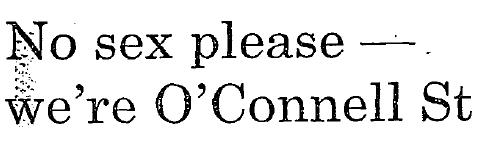
The letters page of the Independent, September 24 1999. Business owners from the area were unhappy with the opening of UK store Ann Summers in Dublin.

It says a great deal about Dubliners today that more of us are offended by the ugly and plentiful ‘temporary signs’ and ill thought-out shopfronts on our main thoroughfare than what is essentially a lingerie store, but in 1999 Ann Summers found itself in hot water over its chosen Dublin location. It would take a High Court challenge to secure the future of the shop, with Ann Summers informed by Dublin Corporation that there use of the premises and their range of products were unacceptable and in conflict with the objectives of the O’Connell Street Integrated Area Plan. Today, it is one of the best performing stores on a street where ‘To Let’ signs have become an all too familiar sight.

How quickly things change in Irish life. While the earliest sex shops on the island were met by rosary beads and placards, today the island is dotted with them. Over time, they have become a ‘normal’ feature on the capitals streets, and much of the hysteria of the early 1990s has proven unfounded. George Bernard Shaw once asked ‘why should we take advice on sex from the Pope?’, and it appears safe to say in the twenty-first century, very few on the island do.

Read Full Post »
Dublin, as  you’ve not seen it before. Spurred on from a post on boards.ie, I started to take a look into the USSR’s mapping of the world and was pretty dumbstruck by what I came across. At one stage, it is reckoned that the Soviet had upwards of 40, 000 cartographers and surveyors working on mapping the world in detail of 1:100,000 and some cities, including Dublin, in detail of 1: 10,000.

The Dublin map was compiled in the early 1970’s and spanned four pages.  The purpose for the maps was to forward plan for a worst case scenario, should an invasion need to take place. As “places of interest,” The GPO, King’s Inns on Constitution Hill, The Four Courts, Trinity College, The Old Parliament Building on College Green and the Royal College of Surgeons are marked. Oddly enough, Leinster House and Dublin Castle go unnoticed.

Part of me just loves the fact that they picked the College of Surgeons, Four Courts and the GPO. Who knows, if they extended the map out further, would they have marked Mount Street Bridge, Bolands Mills and the South Dublin Union? Maybe  Joseph Mary Plunkett’s plans weren’t so outlandish; that the sites marked for strategic importance in Easter Week remain every bit as important for military planners now. Either that or the Russians had some sentimental Stickies on their payroll. Its a scary thought.

For Maps and further reading, check out: http://sovietmaps.com/

Read Full Post »

The building today.

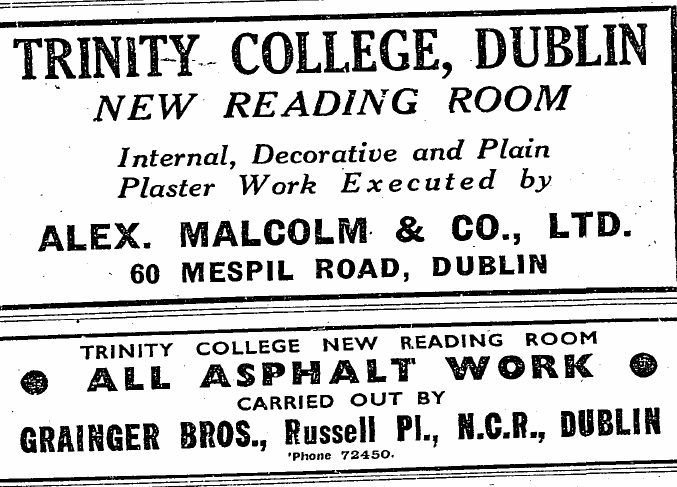
The Trinity College Dublin ‘Post Graduate Reading Room’ has a long history, with the structure dating back to 1928 with the erection of a ‘Hall of Honour’ for Trinity men who gave their lives in the Great War, added to on July 3rd of 1937 with the reading room opened by President de Valera. It’s a beautiful building, one of the most unusual in the city, but easy to miss as you take the shortcut through Trinity College Dublin.

The Weekly Irish Times, July 1937

As early as 1919, newspapers were reporting on meetings of “past and present members of the Dublin University” which aimed to promote the idea of a permanent war memorial at the college to those who had fallen during the Great War. Following a meeting in early November of 1919, The Irish Times noted that the Lord Chancellor proposed a resolution which noted ‘That it is desired to promote a College War Memorial of a permanent character, and that the names of members of the University who fell in the Great War may be kept in honour and remembrance’.

Money was raised from a variety of sources, including graduates of the institution, and by the summer of 1920 discussions had moved onto what form of memorial would be most appropriate. A resolution was adopted by the committee responsible for the memorial which read: “That,as at present advised, the executive committee are of opinion that the College War Memorial should be a dignified building in proximity to the West End of the Library to be used as a reading room for students and graduates.”

Of course, all this talk of a College War Memorial was occurring at a time of national rebellion, a rebellion from which Trinity College Dublin couldn’t hide. A tragic incident would occur at the college for example in early June of 1921. The college, steadfastly loyal, was host to a cricket match in connection with Warriors Day which saw the ‘Gentlemen of Ireland’ take on the ‘Military of Ireland’ on June 3rd. The IRA saw this as a legitimate target and opened fire from the railings of Nassau Street, which tragically resulted in the death of Kate Wright, a young student at the college. Kate was only 21 at the time.

The Irish Independent reports on the shooting at Trinity.

It was November of 1928 before the grand permanent College War Memorial would be unveiled, with the honour falling to ‘Lord Glenavy’, the Vice-Chancellor of the Dublin University, a one time member of parliament and appointed Lord Chief Justice in 1916. The building was to commemorate the 463 Trinity College Dublin men who died in the Great War. A large assembly of students and staff gathered for the opening of the Hall of Honour, and witnessed the Memorial Committee handing the War Memorial over to the care of the Provost of the University. Below is the War Memorial as shown in The Irish Times of January 10th 1929. The paper looked at the building in some detail as part of their ‘Building and Reconstruction’ feature, noting that: “The building is in the Doric style of architecture. It is raised on a platform approached by a flight of seven stone steps….The hall is about 36 feet long with a staircase on one side leading to the future reading room….The names of the fallen are inscribed in gold letters on five statuary marble panels.”

In 1937, to the tune of £25,000, the new Reading Room was finally ready to open. Ironically, it was a vetaran of the 1916 rising who was to open the Reading Room attached to the College War Memorial, in the form of President de Valera. In his speech the President talked of Thomas Davis, a graduate of the college, quoting his words: “Beside a library, how poor are all the other greatest deeds of men”

It was undoubtedly symbolic of changing times at the institution that Dev should open the new Reading Rooms, and that he should arrive to the sound of the Garda band playing the national anthem!

Clever advertising in the Independent following the 1937 opening of the Reading Room!

One thing which baffles Dubliners about the Post Grad Reading Room today are the letters NIKH above its doors.The letters NIKH on the front is the name of the Greek goddess of victory. It’s a beautiful building with a complex history, but easy to miss, dwarfed today by the architecture behind it.

When you’re strolling through Trinity, for another piece of unusual ‘Great War’ era history, pop around to the cricket pitches and you’ll find a monument to a young British soldier buried at Trinity College during the 1916 uprising, Arthur Charles Smith of the Royal Hussars.

NIKH

Read Full Post »

Last week, I posted a link to my ‘Storymap’ contribution, which was a look at what I consider the most unusual military grave on Dublin, that of the horse Vonolel. On the day I filmed it, I noticed an old copy of ‘The Navy and Army Illustrated’ from 1898 on eBay at a very low price. I couldn’t resist snapping it up. The frontpage below shows Vonolel with ‘The Right Hon. Field-Marshal Lord Robers V.C, K.P etc.’ (phew!) upon him, and there’s a brief feature on Vonolel inside which I’ve scanned up too.

The story of Vonolel’s life, death and burial:

Read Full Post »

The Dubliners F.C.

I came across this picture on Facebook. It seems to show most of The Dubliners kitted out before a football game.

Can anyone give any more background information?

KBranno reckons it could be taken in Tolka Park.

The Dubliners

Read Full Post »

Valentines Day 1900.

The image above is undoubtedly one of the iconic Dublin snapshots, showing The Wicklow, which was carrying cattle, suspended over Hatch Street having smashed through the buffer stops and even the outer station wall. The train has left from Enniscorthy earlier in the day, filled with cattle bound for the Dublin Metropolitan Market. On board too were driver Walter Hyland, guard Robert Doran and fireman Peter Jackston.

The Irish Times report of the following day gave a great account of the dramatic scenes, noting that:

All went well with the train until it was approaching Harcourt Street Station, at half-past four o’clock, when Hyland, it is believed, found he could not get his brakes to act, owing to the slippery nature of the wheels and rails combined with the fact that the train was very heavy. Speed could not be slackened, and the engine with its heavy load dashed through the station to the great alarm of the people on the platform, who saw that an accident of a serious nature must result, nor were they mistaken.

The train dangled 30 feet above Hatch Street, but thankfully there was no loss of life as a result of the crash. Hyland, the driver from Bray, was sadly to need his trapped arm amputated following the accident. 29 wagons made up the trains load, and passengers looked on as it continued towards the buffers. James Scannell noted in his article The Train Now Standing Over Hatch Street for the Dublin Historical Record journal that fireman Peter Jackson, upon realising the train was not going to stop, jumped off the locomotive footplate prior to the collision and avoided injury.

Scannell’s article concludes by noting that both Hyland, and The Wicklow, would recover from their ordeal.

When he recovered from his ordeal Driver Hyland return to work with the company and served until the 1930’s as a goods checker in Bray. The locomotive ‘Wicklow’ was repaired and returned to traffic, continuing in service until 1925 when it was assigned No 440 by the Great Southern Railways and was withdrawn in 1929.

Today, it’s a different rail network that makes its way up Harcourt Street of course with the Luas running in front of what was Harcort Street Station. The line from Harcourt Street was closed in 1958. The Odeon, a restaurant and bar, occupies the space today.

For years afterwards, it was said Dubliners would jokingly ask ‘does this train go through Hatch Street?’ in reference to the crash. On an interesting aside, one of the regular club nights in the Pod venue on Harcourt Street was titled Trainwreck!

Sold! The end of an era.

Read Full Post »

In Sheehy-Skeffington, and not in Connolly, fell the first martyr to Irish Socialism, for he linked Ireland not only with the little nations struggling for self-expression, but with the world’s Humanity struggling for a higher life – Sean O’Casey.

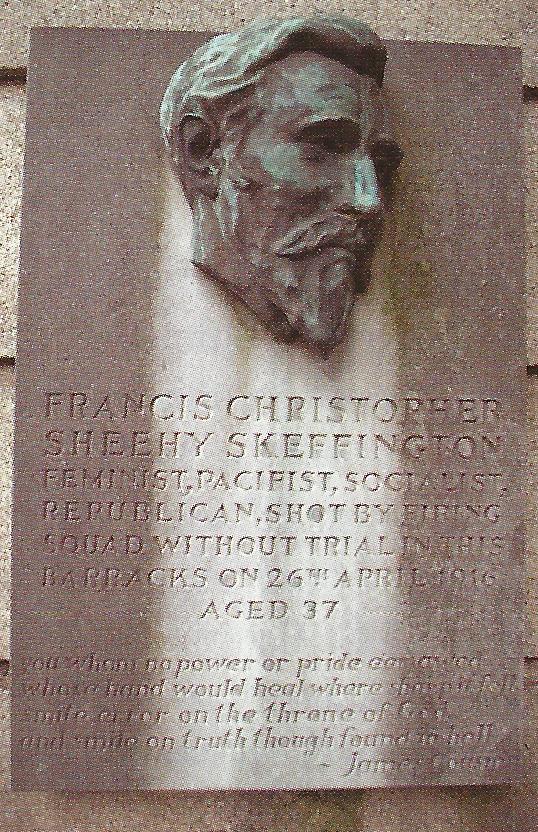
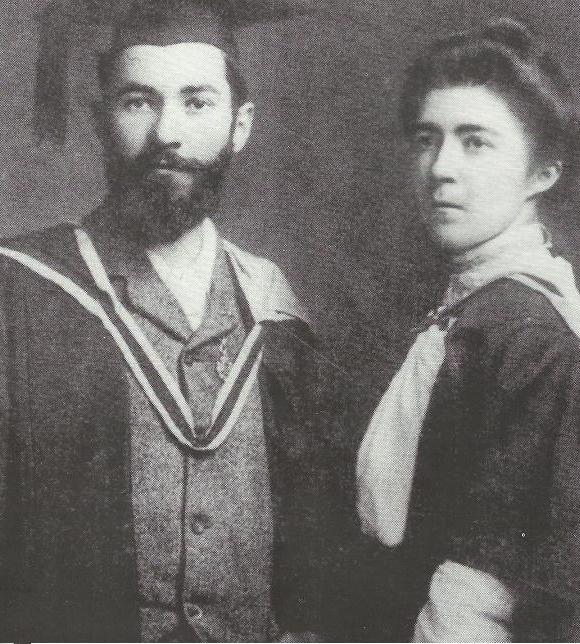
A plaque connected to the 1916 rising, but often overlooked, is that to Francis Sheehy-Skeffington inside what is today Cathal Brugha Barracks. Feminist, pacifist, vegetarian,journalist and activist, Francis was married to Hanna Sheehy-Skeffington, undoubtedly one of the most celebrated feminists in Irish history herself. His death during the rebellion is one of the most tragic episodes of the week, as Francis was not a participant in the rising, but rather had gone to the city on April 25th with the aim of attempting to establish a ‘Citizens Peace Patrol’, to prevent more scenes of looting and criminality among Dubliners following the breakdown of law and order.

The plaque was unveiled on April 1 1970 by Nora Connolly O’Brien, daughter of James Connolly, in the presence of Senator Owen Sheehy-Skeffington, son of Francis, and others. It was sculpted by Gary Trimble, and includes an inscription bearing the words of James Cousins:

‘For whom no power of pride e’er awed
Whose hand would heal where sharp it fell
Smite error on the throne of God
And smile of truth though found in hell.’

Owen Sheehy Skeffington and Cathal O'Shannon view the memorial in 1969, when it was still being completed.

Writing in June of 1916, Padraic Colum noted in the pages of Emma Goldman’s Mother Earth paper:

I shall remember Francis Sheehy-Skeffington as the happiest spirit I ever knew. He fought for enlightenment with a sort of angelic courage, austere, gay, uncompromising. Since he wrote his student pamphlet on Women’s Liberation he was in the front of every liberalising movement in Ireland. He was not a bearer of arms in the insurrection- he was a pacifist…..But Skeffington is dead now, and the spiritual life of Ireland has been depleted by as much of the highest courage, the highest sincerity and the highest devotion as a single man could embody.

Francis was a well known feminist, having co-founded the Irish Citizen feminist paper in 1912, and adopting the surname of his wife, Hanna Sheehy, upon their marrying. He had been involved with the Irish Citizen Army upon the foundation of the workers army, but left when he felt the organisation to be at odds with his pacifist ideology, i.e moving from a purely defensive role towards militarism. He had attended University College Dublin, where he counted James Joyce among his friends, and was well known and indeed liked in the college on a social level, even becoming auditor of the College L&H (Literary and Historical Society) in 1897.

Francis and Hanna Sheehy-Skeffington

(more…)

Read Full Post »
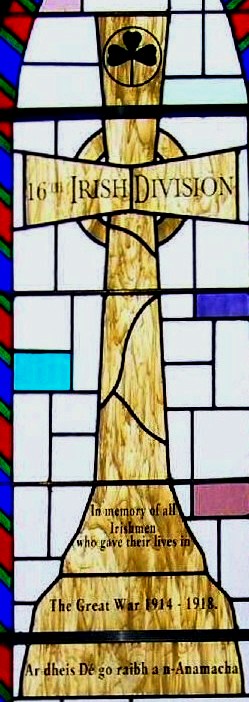
Over 200, 000 Irishmen and women enlisted in the Great War, 1914-18. Over 35, 000 were killed, including Jack Coleman, my mother’s uncle. This is something I only found out about in the last couple of weeks, and something I plan on researching more. His sister married a British soldier, Jack Moore and was somewhat ostracized from the family for doing so, whilst his brother, Jim “Pops” Coleman, my grandfather, was a member of the Mullingar Batallion of the old IRA.

Irish family histories are often steeped in rumour and heresay; positive discrimination when it comes to involvement in the War of Independence, mixed discrimination when it comes to the Civil War, and often ignorance when it comes to the Great War or WWII.

I came across the above pictures a week or so ago on the dublin.ie forum, a stained glass window in Cathal Brugha Barracks dedicated to the memory of the 16th Irish Division. It was from looking at this that my mother started talking about the family history so I thought it was worth sticking these up here.

Credit to Breener for the images.

Read Full Post »

« Newer Posts - Older Posts »