Feeds:
Posts
Comments

Archive for the ‘Dublin History’ Category

Where were you?

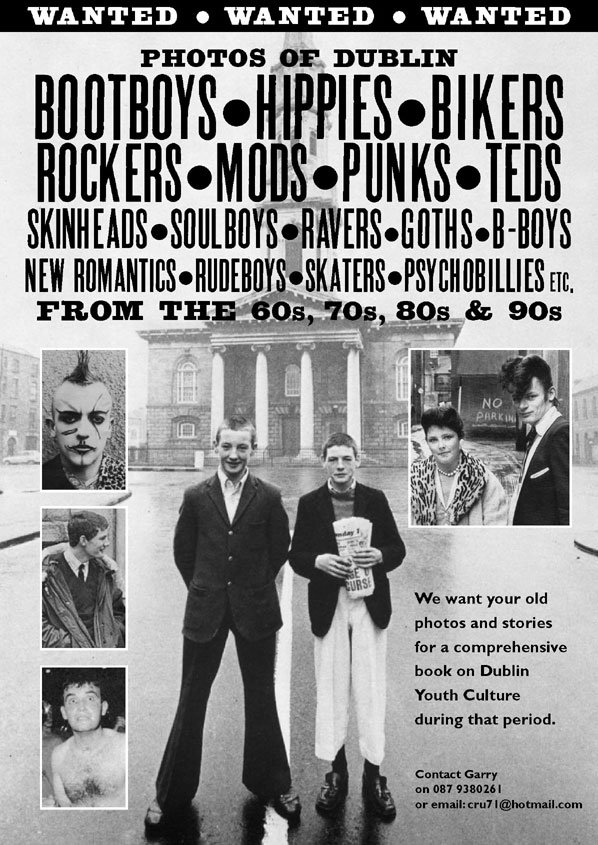
Dust off, scan up and send on your photos to Garry if you haven't already!

WHERE WERE YOU? is a visual social document of young Dublin. The book is a photographic journey through five decades of the city’s youth cultures, street styles and teenage life, from the early 1950s to the end of the 1990s.

After four years of hard work, Garry O’Neill, a close friend of CHTM! has announced that he will finally publish his long awaited book Where Were You? in September 2011. It will then be independently released through Niall McCormack’s Hi Tone in a limited edition hard-back of two thousand copies.

All the material was sourced over four years or more of constant advertising to the general public through posters and flyers, and also from photographers, newspapers and books.

Garry has divided the book up into four chapters
1. 1950s and 1960s
2. 1970s
3. 1980s
4. 1990

Each chapter will also include a collection of memorabilia, made up from newspaper and magazine articles, ticket studs, club flyers, ads, membership cards etc.

The material sourced for the project covered roughly the 14 to 23 year old age groups. The photographs range from individual or crowd shots, taken at or outside gigs, clubs, discos, pubs etc, to scenes shot in streets, houses and parks.

In more exciting news, it has been announced that Sinead Ni Bhroin and Maya Derrington (Still Films productions; Pyjama Girls, His and Hers and The Pipe) are going to be teaming up with Garry to produce an accompanying feature length documentary. They’ve an innovative distribution campaign for the release of the book and film, and even have discussed the possibilities of releasing a soundtrack of Dublin bands to accompany this book.

To help fund the research and development of the project and the completion of a short documentary, which will be used to secure funding for a feature length documentary, the team have asked people to contribute to the project via Fund It. The Punky Reggae Party donated €50 today.

Read Full Post »

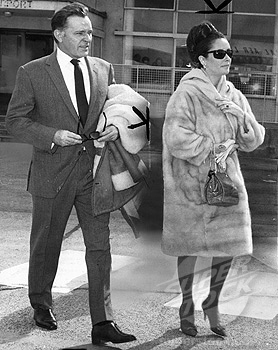
Richard Burton and Elizabeth Taylor, Dublin Airport, 4 April 1965. © Science and Society / SuperStock

As the world mourns the death of Elizabeth Taylor today, a number of people on RTE radio earlier this afternoon were telling their own stories about meeting Taylor during her visits to Dublin in 1965 and 1967. (You can listen to the podcast here.)

Taylor stayed first in Dublin in 1965 with her husband Richard Bruton who was filming the classic The Spy Who Came in From the Cold. The Oscar-winning adaptation of the novel by John Le Carre starred Burton as a Cold War-era British spy.

Though set in Berlin, Smithfield Market was used as stand in.

For several weeks in the late winter of 1965, the lead-grey skies of the Irish capital deputised for those of East Germany and, in the opinion of director Martin Ritt, were more convincing than the real thing. Dublin’s architecture helped too.

Scenes were shot in Cork Street, North Strand, and elsewhere. But the star performer was Smithfield: a run-down plaza north of the Liffey, where the fulcrum of Cold War-Berlin, Checkpoint Charlie, was recreated. – Frank McNally, Irish Times.

[The opening shots of the movie were filmed in Smithfield. You’d recognise those cobbled streets anywhere!]

One woman recalled that they both used to drink in Kavanagh’s in New Street on the corner of the Long Lane. Apparently Liz herself was partial to a pint of Guinness. While Bruton used to enjoy a drink in The White Horse in the Liberties as well, Liz, a woman, was refused.

Another caller remembers meeting the couple in Malpas Street in the Blackpitts when they were using a part of a derelict wall there as a substitute for the Berlin Wall.

The couple and their children took over a full floor of The Gresham Hotel on O’Connell Street and stayed there for two months during the filming.

An additional listener told Joe Duff that he met the couple briefly in The Comet Pub in Santry.

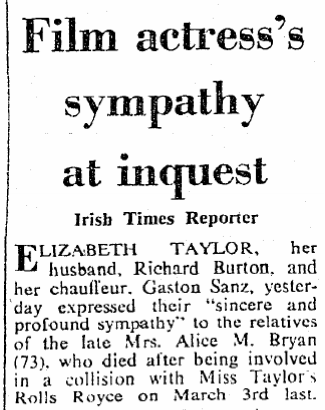
In 1967, Taylor returned to Dublin in more somber circumstances. During her initial visit two years previously, her chauffeur-driven car had knocked down and killed an elderly pedestrian on the Stillorgan Road. Taylor returned to attend the coroner’s report and court hearing. To make it even more tragic, the chauffer himself, Gaston Sanz, had just returned from France where had buried his 16 year old son who was killed in a shooting accident.

The Irish Times. Wednesday, March 17, 1965.

Read Full Post »

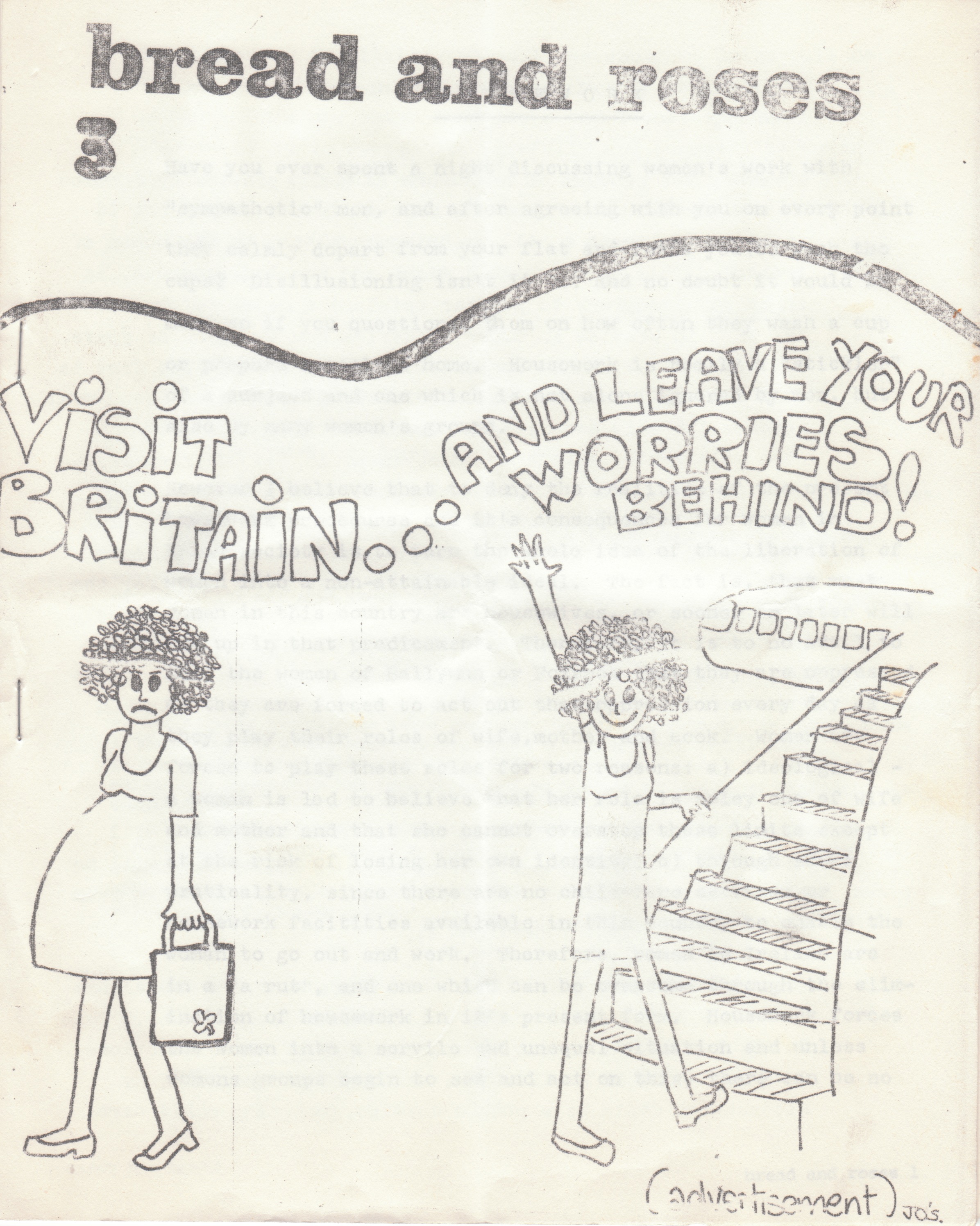
Bread and Roses was a feminist fanzine published by the UCD ‘Women’s Liberation Group’ in the mid 1970s. It was a crudely designed, black and white  stapled zine. This issue is 18 pages and is from early 1975.

I featured issue 2 on the UCD Hidden History blog a while back.

On the title:

The slogan “Bread and Roses” originated in a poem of that name by James Oppenheim, published in The American Magazine in December 1911, which attributed it to “the women in the West.” It is commonly associated with a textile strike in Lawrence, Massachusetts during January-March 1912, now often known as the “Bread and Roses strike”.

This issue features a fairly provocative front cover showing a “before and after” shot of a woman, pregnant and unhappy and then the same woman, smiling, alighting from a plane with the caption “Visit Britain … and leave your worries behind”

Front cover. Bread & Roses (Issue 3). 1975.

Contents:

Housework – Marion Connolly

Italy: Abortion At Issue –  Cristona Cona (Italian Women’s Lib Movement)

The Next Purge … Radical Feminism? – Tony Dunn

Political ‘Science’ or Apologetics for Women’s Oppression? – Betty Purcell

A Commentary on UCD Women’s Week – Fiona Nolan

Doctors Report – C. Fisher

The Subservient Woman – Fiona Nolan

Read Full Post »

© Dublin City Council. Mary's Lane. Derelict Dublin, 1913

Derelict Dublin 1913 (Dublin City Council)

(c) Rogan's Pics (Flickr user). Dublin 2011.

Derelict Dublin 2011. (Flickr Group)

Read Full Post »

Thanks to Garry for flagging and as always to Rashers uploading.

Documentary on the social life of Dublin’s Sherrif Street in the 1960s broken up into seven parts all just under five minutes each.

Read Full Post »

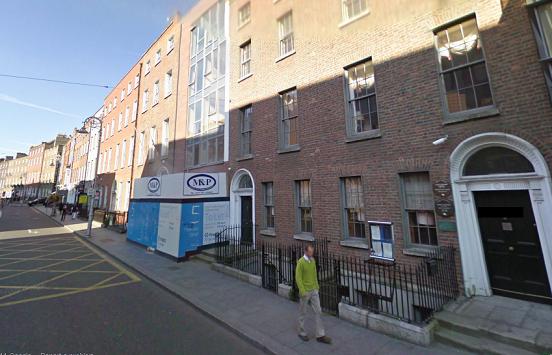
4 Harcourt Street.

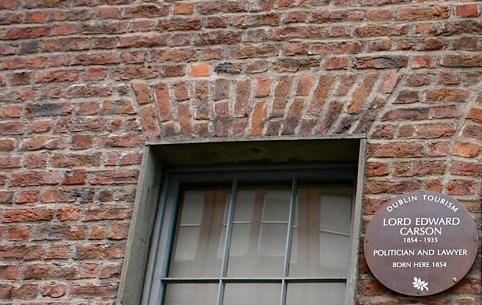
Only a few doors down from Conradh na Gaeilge, on the godforsaken street that plays home to Copper Face Jacks, there is a small plaque one could easily overlook. It commemorates Edward Carson, the father of Irish loyalism, a barrister commemorated on the walls of unionist estates in the north as the founder of the Ulster Volunteer Force, and a complex Dubliner to say the least.

Of course, we should not forget Carson himself was a keen Gaeilgoir. When coupled with his ability as a hurler, praised in the Irish Sportsman journal of his time, it is apparent Carson represents a great diversity of Irishness.

It’s a great irony that only two doors up from the father of Irish unionisms historic home is 6 Harcourt Street, famous for being the office of Sinn Féin in the time of Griffith, and indeed the location of the offices of The Irish Bulletin paper, produced by the Department of Propaganda during the Irish War of Independence.

(more…)

Read Full Post »

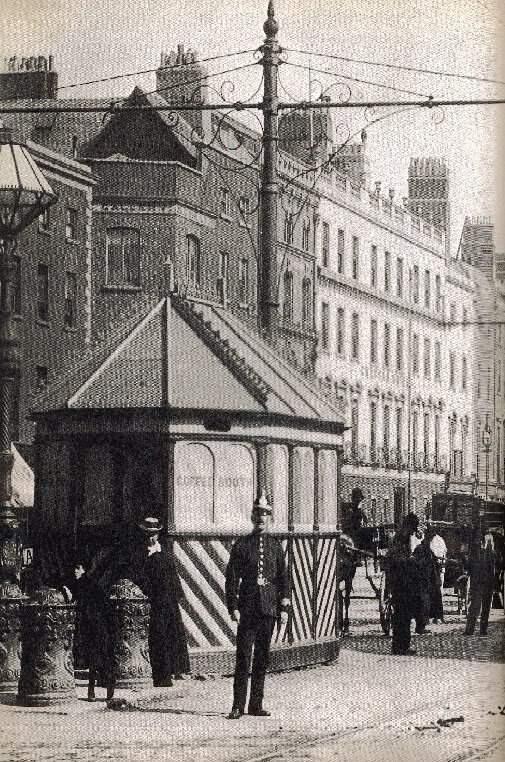
date unknown.'Coffee Booth', O'Connell St. Credit to Valerie Kennedy for uploading onto Facebook

This is an unusual snap of a long demolished structure on O’Connell Street.

The photo was described, when uploaded onto Facebook, as showing a taxi shelter but I’m not so sure. If you look carefully, you can see the words ‘Coffee Booth’ on the window. Judging that it dates from the early half of the 20th century, I’m surprised that both coffee and coffee kiosks were in operation that far back.

Update: I think we were both right. The structure is a “coffee booth” used by the taximen whose rank was beside it. In his Dublin Diary, Stanisluas Joyce, James’ brother, describes on page 61 that he ‘like(s) the City at night, wide O’Connell Street (I have O’Connell blood in me and an O’Connell face. nimbling quietly along, the horse walking, without noise but for an occasional shout of laughter from the cabman’s coffee booth”

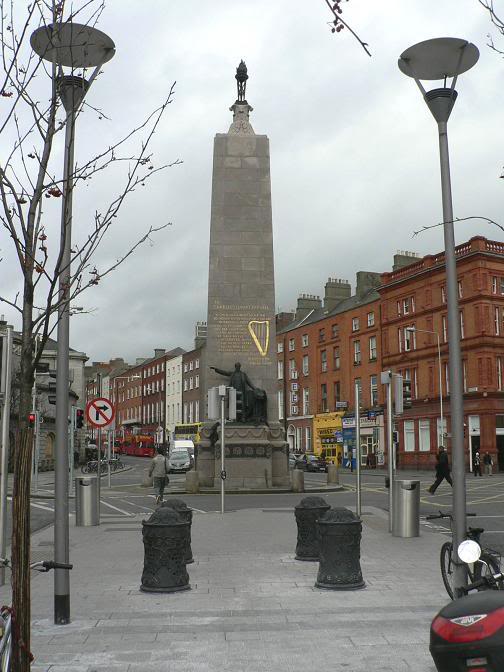
If there was any doubt that this wasn’t Dublin, those bollards on the left can be seen as certain proof.

(c) GrahamH

Read Full Post »

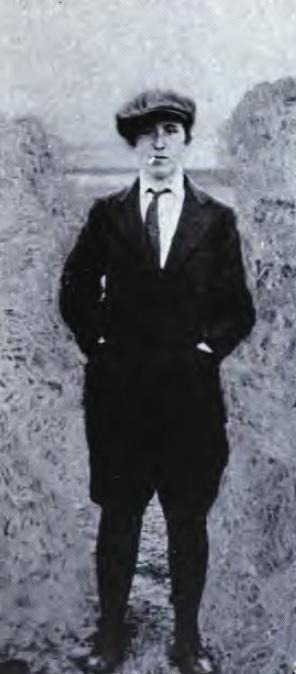
I’ve read many of the memoirs of those who took part in the 1916 rising and later went to write of their experiences, but Margaret Skinnider’s work has always eluded me. It has passed me by once or twice on eBay, and library copies have vanished before I got to them.

Skinnider was born in Coatbridge, Scotland and was a member of Cumann na mBan in Scotland. She fought with the Irish Citizen Army as a sniper during the rebellion and was wounded in the battle. Her book provides interesting personal recollections on the build up to the rising and her experiences during it, and also includes a fascinating list of songs sung by rebels during and after the rebellion. Among these is the song of the Irish Citizen Army, to be sung to the tune of ‘John Brown’s Body’.

It’s an interesting read for those studying or interested in the period. It is available over here, on the Open Library site.

Read Full Post »

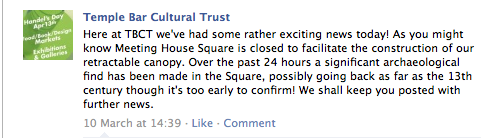
What better way to announce such a thing on Facebook. 😀

Some eagle-eyed spotter in the Evening Herald perhaps noticed it as well, as there was an article about the discovery in the paper two days later (March 12).

TEMPLE Bar’s giant umbrella plans at Meeting House Square have been delayed after an unexpected archaeological discovery. Preliminary excavation work on the square began in January, in preparation for the construction of a large retractable canopy.

The Temple Bar Cultural Trust (TBCT) hoped that the facility would expand the use of the square for events during unsettled weather. Dublin City Council gave the green light to the TBCT to install the 21-metre tall structures.

But now the reopening of the centre will be delayed after city archaeologists uncovered a 13th Century structure.

“The finds were made on Wednesday afternoon, so at this stage it’s very early,” a spokeswoman for TBCT told the Herald. “We believe that it is a 13th Century structure. It will add time with our plans, but we have every confidence that we will be able to go ahead with our project.”

Read Full Post »

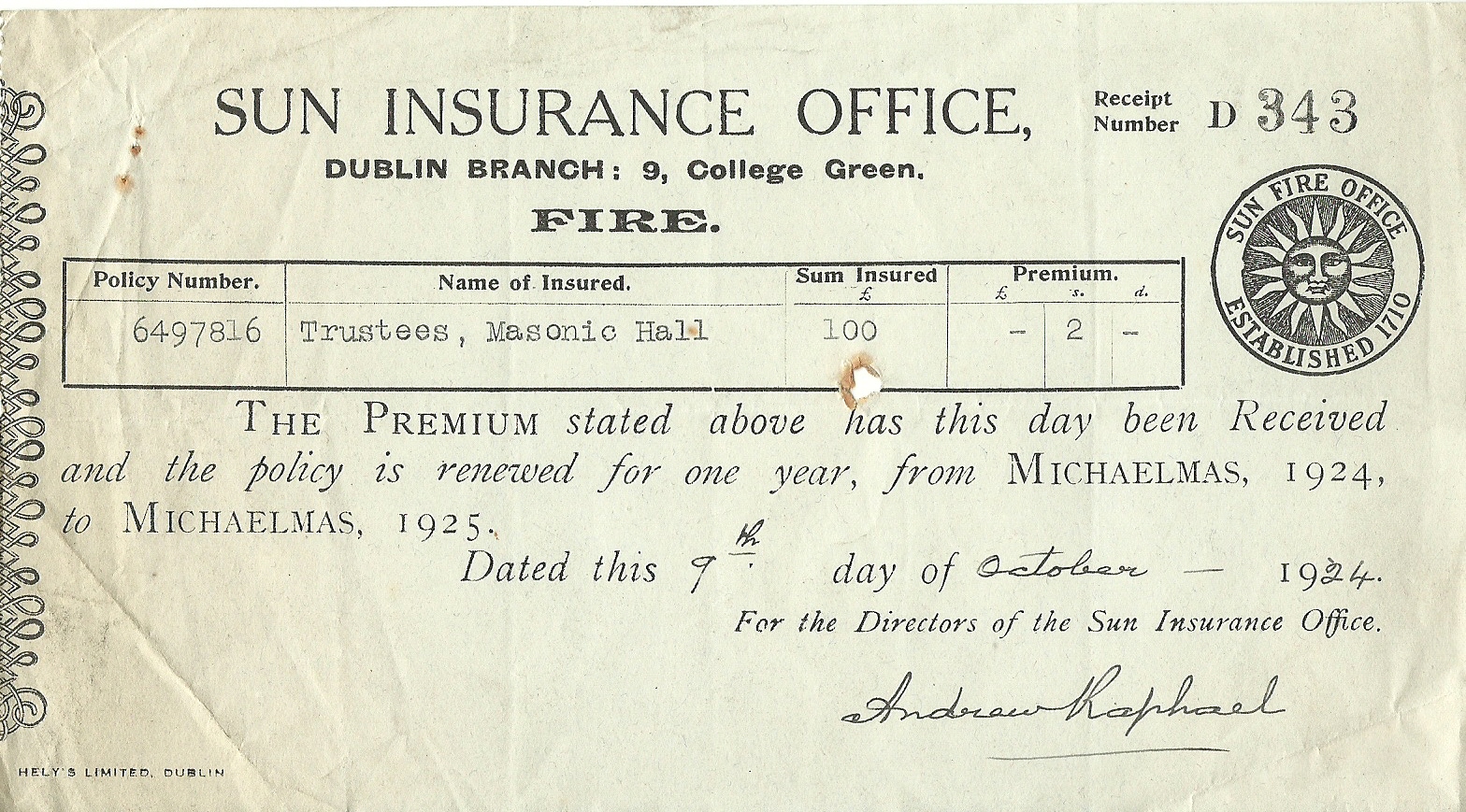
This is a great oddity, the 1924 fire insurance policy for the Masonic Hall on Molesworth Street. It’s the latest item in a long line of fascinating stuff my father has produced for Come Here To Me!

It’s interesting to note that the insurance policy was taking out with Sun. Sun had a long history in the city with regards fire prevention. They were one of the insurance companies who, before the establishment of a public fire service, offered protection to premises marked by a ‘firemark’. These were essentially emblems (usually of lead) which displayed a company logo and insurance number. Before the establishment of a public fire service, no premises was covered until a firemark was in place.

In his history of the Cork fire service, For Whom The Bells Tolled, Pat Poland noted that:

The firemark served a number of purposes: it marked the property so it was obvious to all that the building was covered by insurance, it acted as an advertisement for the insurance company, and it let firemen responding to a call in no doubt as to which particular building was insured with their office.

So while Dublin of course had a public fire service at the time this policy was taken out, the name ‘Sun’ had a long history in the fire prevention field in the capital. Notice the company logo on the right hand side of the policy, which states an establishment year of 1710.

The Masonic Hall on Molesworth Street had of course been involved in the Civil War only two years previous to this policy. The Irish Masonic Jewels website contains some information on the seizure of the building by anti-treatyite forces:

In April during the Civil war of 1922 Freemasons Hall was seized by Irregulars, along with the Kildare Street Club and held for a period of six weeks. No damage occurred at all and Colonel Claude Cane, the Deputy Grand Secretary at the time, paid tribute to the courtesy and consideration that he received from the Provisional Government during negotiations for the return of the building.

Read Full Post »

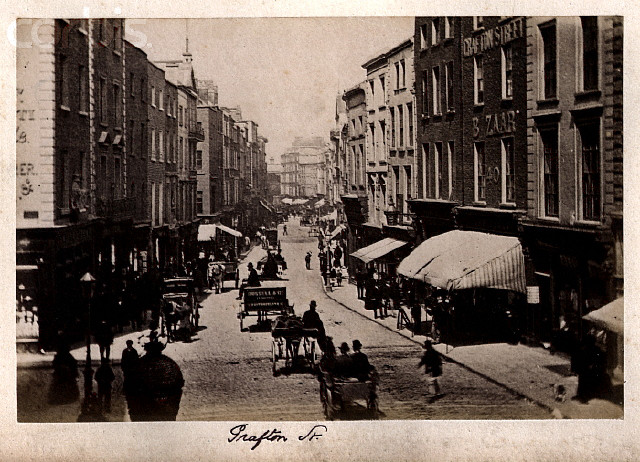
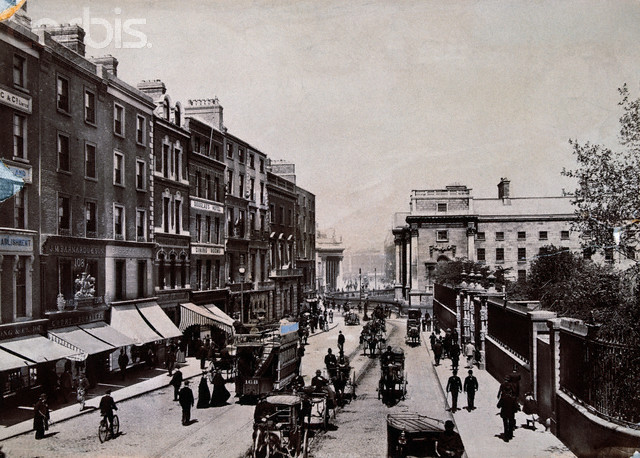
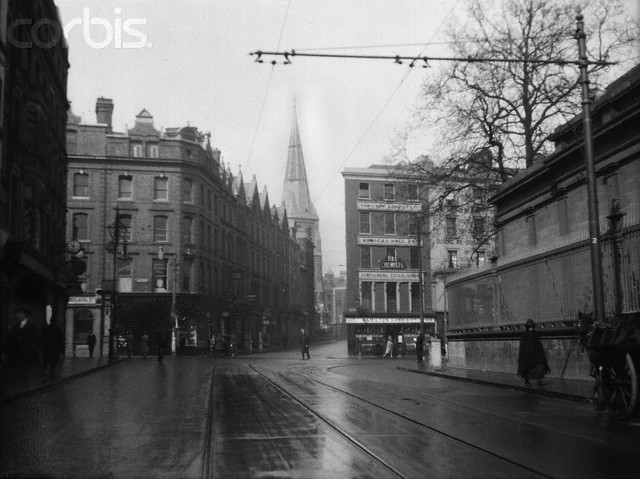
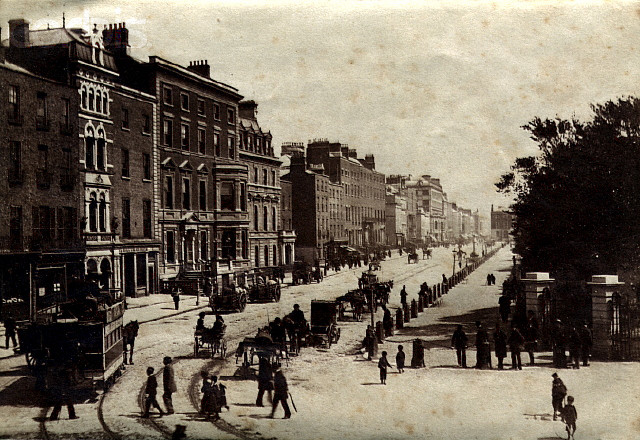
Some more interesting images from the Corbis site, this time of Grafton Street and the St. Stephens Green area.

How odd does Grafton Street look with sidewalks.

Grafton Street (c. 1890). ©Sean Sexton Collection/CORBIS

The second shop from the left is J.M. Barnardo & Sons furriers. You can just about read their sign above their awning. The shop is still there to this day.

Very bottom of Grafton St., 19th c. © Hulton-Deutsch Collection/CORBIS

What strikes me is so little has changed to the overall environment, the only thing really being the tram lines.

Nassau Street, facing bottom of Grafton St, 1926. © E.O. Hoppé/CORBIS

So, it looks like there’s been a taxi rank of some description in that same spot for 140+ years!

St. Stephens Green (c. 1870). ©Sean Sexton Collection/CORBIS

Read Full Post »

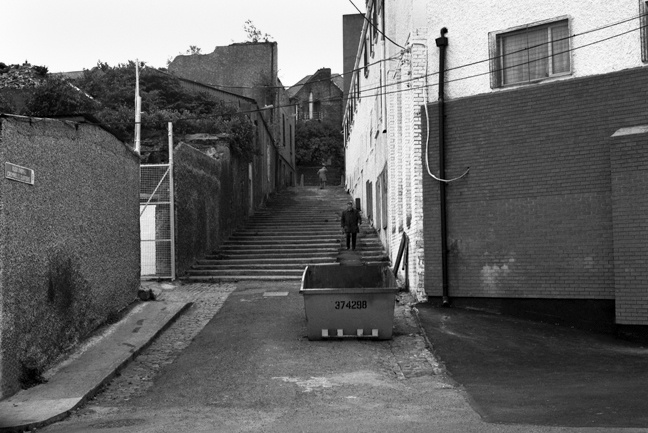
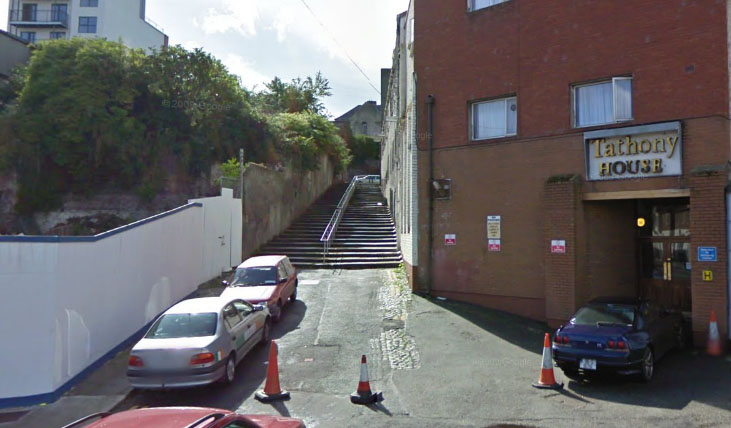
DFallon recently uploaded a great document regarding the etymology of some Dublin place names and of a 1922 proposal to change some of them. One place name that skipped the Corpo’s attention in that report, and funnily enough ever since then (given that the name involved invokes little but hatred in most Irish people,) is “Cromwell’s Quarter’s,” an unmarked alleyway connecting Bow Lane and James’ Street.

Cromwell's Quarters, 1991. By Tom O'Connor Photography

You can just about make out the street sign in the top left of the photograph, but as you’ll see below, that wall no longer exists, and the street sign has disappeared with it; I’d love to know whose attic its in! Aptly enough, the lane was only renamed Cromwell’s Quarters sometime around 1892, having been recorded in places as “Murdering Lane” in the 18/1900s and “The Murdring Lane” before that, as far back as 1603. A bone of contention this one- whilst many Dublin historians call the haunted steps around St. Auden’s the Forty Steps, Cromwell’s Quarters can also go by the same name. Either way, its not somewhere I’d like to hang around at night…

20 Years later and not much has changed!

Any other references to the man Teflon Bertie once refused a meeting with British Foreign Minister Robin Cook because of in Dublin placenames? (Ahern was due to meet Cook in a room in which a portrait of Cromwell hung. He famously walked out and refused to return until the portrait of “that murdering bastard” had been removed.)

Read Full Post »

« Newer Posts - Older Posts »