Feeds:
Posts
Comments

Archive for the ‘Dublin History’ Category

Directed by the late Bob Collins (1945 – 2000), who also had a hand in the production of the video for Phil Lynott’s Old Town, The Blades’ Bride Wore White captures great street scenes of a grey, 1980s Dublin.

In the Hotpress National Poll of 1982, The Bride Wore White was voted best single while The Blades were voted ‘the most promising act in Ireland’ and Paul Cleary ‘best Irish songwriter’.

Note: Your able to buy The Blades two album boxset, Those Were The Days, here at the Reekus Records website.

Read Full Post »

Opinions on M.C. or on the Collins 22 organisation aside, they’ve uploaded a fascinating amount of archive newspapers here. As well as dozens of old, high -res photos and information on Collins’ various safe houses in Dublin city.

And yes, the Collins 22 group is selling a 50 minute DVD documentary called The Blueshirts for €20 on their online shop.

Read Full Post »

It’s one of those great Dublin pub quiz questions. What links the bandstand in Herbert Park and the Long Hall on South Great George’s Street?

Well, both feature heavily in the video to Phill Lynott’s classic 1982 single Old Town. The video was produced by Dave Heffernan and stars the actress Fiona McKenna.

The Dublin locations are as follows:

– Opening scene on Ha’Penny bridge
– Ringsend
– Grafton Street
– The Long Hall
– Bandstand (Herbert Park)
– Ringsend Pier

Read Full Post »

A look at the Dublin story of ‘Joe Edelstein’s Alarm’ in Little Jerusalem.

Back in September, I paid a visit to the Irish Jewish Museum in Portobello, a pretty incredible gem covering everyone from the fictional (Leopold, I’m talking to you…) to the very real Jewish characters in Dublin history.

One of the characters touched upon was Joe Edelstein. Joe’s name would have been very well-known in the area that became Dublin’s ‘Little Jerusalem’. He was a businessman and writer of some importance in the Jewish part of the city. The Irish Times of September 11 1908 noted for example that he spoke at a meeting of the Judaeo-Irish Home Rule Association at the Mansion House in Dublin and proposed that “….this great meeting of Jews resolve to support such measures as will tend to secure for the people of Ireland a full grant of self-government.”

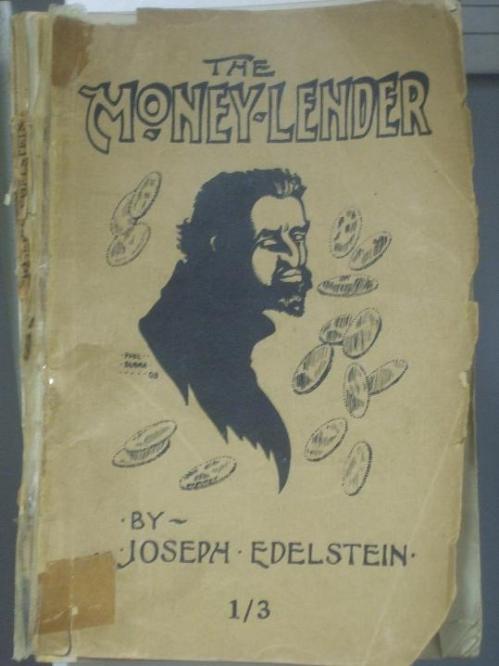
Edelstein wrote a most controversial work, The Money Lender, which was not well received in the Jewish community of the capital. A copy of it can be seen in the museum today. It was felt by some that the book re-inforced negative stereotypes about the community. It was published in 1908. Despite objections to the work, Joe remained an influential figure in the Jewish community, and newspaper archives show he continued to speak at many public events, continuing to champion the Home Rule movement.

Sadly, Edelstein, once an influential figure in his community, was to fall on hard times and turn to drink. The Irish Independent of November 11, 1939 noted that he was fined a sum of 40s for an offence arising out of being drunk. On one occasion Edelstein was fined by damaging works in the National Library.

Manus O’Riordan has done some excellent research on the Jewish community in Dublin, and noted that:

Edelstein was a man with a serious drink problem, and was subject to frequent psychiatric breakdowns, with resulting periods of hospitalisation. In fact, one such commitment to the Richmond mental hospital for a whole nine months stretch stemmed from the scandal of his 1911 conviction for the crime of indecent assault….

… Edelstein lived on New Street, the central venue for James Connolly’s outdoor public meetings during his 1902 Wood Quay election campaign, and a straight continuation of Clanbrassil Street, the principal thoroughfare of Dublin’s “Little Jerusalem”.

(more…)

Read Full Post »

TODAY MARKS the newest chapter in the storied history of Dublin’s oldest surviving charity. The Sick and Indigent Roomkeepers Society is probably also the one with the oddest name.

Today the society – which was established in 1790 – is moving up in the world, sort of, as it changes location from 34 Lower to 74 Upper Leeson Street.

In reality, the change, which moves them farther from the city centre, is necessary for the organisation’s survival. Put simply, it can no longer afford the rent during a time when donations are scarcer and requests for help more frequent.

So yesterday, paintings came down, mementos were taken off the shelves and hundreds of years of Dublin city’s history was packed into boxes to be moved to a new home across the Grand Canal. – The Irish Times

We learn today that the The Sick and Indigent Roomkeepers Society is moving address once again. Before Leeson Street, they were based on Palace Street (Dublin’s shortest street with only two addresses) from 1855 to 1992. Here they left one of Dublin’s best loved Ghost Signs.

Read Full Post »

While historically, and perhaps understandably, The Abbey Theatre takes centre stage in this city, mainly because of it’s connections with Synge, Yeats and O’Casey and their associations with the 1916 Rebellion, its sometimes easy to forget that there are, and were a plethora of other theatres, not only The Gaiety, The Olympia, The Gate, but a long list of many more.
I came across the picture below, of a building on the corner of Poolbeg Street and Hawkins’ Street with a stone columned pallisade and cast iron and glass canopy while flicking through the excellent dublin.ie forum recently. It started me thinking about the recent publishing by the Dublin City Council of images of Dublin’s vanishing and forgotten features (see JayCarax’s piece on that here ) and about actually how much of this city has been erased. Streets, buildings and sites of archaeological significance were destroyed; eradicated in the name of progress without thought of their value, socially and historically, to future generations.
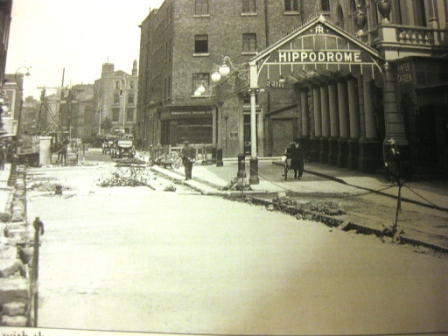
The Theatre Royal Hippodrome, Credit to Cosmo on dublin.ie for the picture

One such building is the Theatre Royale Hippodrome/ Winter Gardens on Hawkins’ Street. The only reason I know of its existence is because of a flash of interest when I first saw the picture above, did a quick search and found the poster below. Dating from 1919, these were turbulent times in Dublin. The Declaration of Independence was declared at the 21st January assembly of Dáil Eireann, and hostilities in the War of Independence began on the same day with Dan Breen and Seán Treacy’s attack on two RIC constables who were escorting explosives in Soloheadbeag, Co. Tipperary.

The Evening Telegraph front page, from the morning of January 22nd, 1919

There is not too much information on the Theatre Royal Hippodrome available. It is known that there were four in existence; the first was on the site of the still running “Smock Alley” theatre, the second on Hawkins Street, (the site of the image above,) where it ran until it burned to the ground in 1880. This theatre re-opened in 1897 with a capacity of 2, 300 (compare this to the Olympia, which nowadays holds 1, 100) and ran until 1934 when it was demolished and replaced by the fourth theatre which opened in 1935 and ran until 1962. The picture is estimated to be from around 1906/ 07, which suggests it is from the third incarnation of the Theatre.
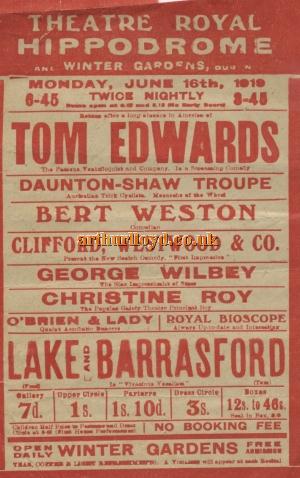
Poster for the Theatre Royal Hippodrome for 16th June 1919, credit to Matthew from http://www.arthurlloyd.co.uk for permission to reproduce here.

Two events stood out for me in reading about the theatre. The first was Charlie Chaplin’s appearance here as a young man in 1906 as part of an act called The Eight Lancashire Lads (1.) The second was the attempted assassination of British Prime Minister Herbert Asquith here on July 19th 1912, not by Irish Revolutionaries but by militant English Suffragettes (2.) Their first attempt involved a hatchet thrown at him by one woman as his carriage passed the GPO on O’Connell Street. While it missed him, she did succeed in striking John Redmond, the nationalist leader. The second involved three women who attempted to set fire to the Theatre as Asquith was about to speak.

The Irish Times report stated:

Sergeant Cooper, accompanied by his wife and Colour-Sergeant and Mrs Shea, was sitting in the dress circle of the theatre. About a quarter to nine, when the performance had concluded and the people were going out, he saw a flame in the back seat, just in front of the cinematograph box.

With the presence of mind that one should expect in a soldier, he rushed to the place, and found that the carpet was saturated with oil and ablaze. He and Colour-Sergeant Shea beat the fire out with their mackintoshes. Just as they had succeeded in this, under the seat there was an explosion, which filled the dress circle with smoke.

At this moment Sergeant Cooper saw a young woman standing near. She was lighting matches. Opening the door of the cinematograph box, she threw in a lighted match, and then tried to escape. But she was caught by Sergeant Cooper and held by him. She is stated to have then said: “There will be a few more explosions in the second house. This is only the start of it.”

From the Irish Times archive.

From the posters, I get the feeling that the Theatre was the anti- thesis of the Abbey which stood a mere 100 yards away as the crow flies, albeit the other side of the River Liffey. An advertisement which I have been unable to reproduce (but can be seen here on the arthurlloyd.co.uk website) has the adage “God Save the King”  amid advertisements for “Hammam Turkish Baths, Sackville Street” and open daily “Winter Gardens” serving “Teas, coffees and light refreshments,” delights the majority of Dubliners at that time could only dream about.

As far as I know, nothing remains of the Theatre Royal Hippodrome today. From the photograph above (and from deductions that the construction work in the background was the construction of he Sheehan Memorial on Burgh Quay,) its been worked out that the National Aviation Authority  stands on the site formerly occupied by it. There is now a housing scheme off Pearse Street named after the Winter Gardens, but searches for more information have thrown up little more than (apart from advertisements for apartments for sale and to let,) the poster above, the picture of the Hippodrome, the Irish Times article and a brief history of the theatre in a book called “Dear, Dirty Dublin: A City in Distress.” Published in 1982, this book has a great paragraph on the Gaelic Leagues denunciation of the demise of Irish culture as a product of the hegemony of imported English popular culture. While in the early twentieth century, the Abbey Theatre put paid to the notion that Irish culture was condemned to obsucurity, the book also has a great quote from Padraig Pearse as he proclaimed the Dublin of his day held:

Nothing but Guinness porter. Her contribution to the world’s civilisation (3.)

Due in part to some of the works that have made their debuts in The Abbey Theatre, Dublin has proven itself to have contributed more than just Guinness porter to the world. Who knows how much more we could have contributed if sites of historical and cultural relevence such as the Theatre Royal and the Viking Settlement at Wood Quay not half a mile down the same side of the river weren’t trampled on and replaced by drab, dour, and most importantly “conventional” buildings.

Footnotes:

(1.) http://en.wikipedia.org/wiki/Theatre_Royal,_Dublin

(2.) http://www.irishtimes.com/newspaper/opinion/2010/0719/1224275016332.html

(3.) Dear, Dirty Dublin: A City in Distress by Joseph V. O’Brien, Page 23. Can be read here.

Read Full Post »

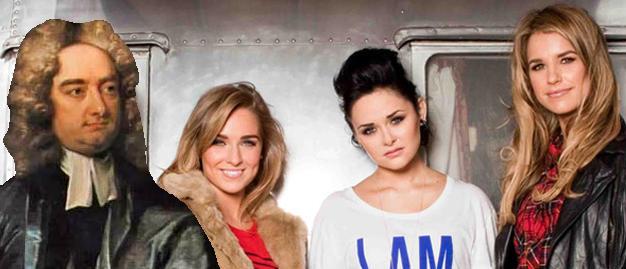
Jonathan Swift: unlikely to appear in Fade Street.

Finished the exams (YES!) for a few hours now, and I decided to mark it by picking up a book from the library that I wasn’t actually obliged to read. Post exams, reading is actually a pleasure again. I went with a work from the Civic Trust, as they’re among my favourite Dubliners. I’ve always loved the irony in their offices being located so close to the Wood Quay monstrosity.

They’ve published some excellent studies of individual Dublin streets, looking at the development of the street and the factors that make them unique, with a particular focus on architecture. I ran with the Thomas Street edition,my great-grandmother was from Cornmarket and I’ve long been fascinated by the Liberties.

The information provided on Number 34 Thomas Street was particularly interesting:

The site of Frawleys is also significant, as it was formerly owned by the Quaker, Joseph Fade. Fade established himself in business on the site around 1715, and rapidly became one of the city’s most important bankers, having two streets named after him: Joseph Lane, which has subsequently been demolished and Fade Street, both off South Great George’s Street.

The book noted that Fade had been mentioned in some of the poetry of Jonathan Swift, and a look around revealed one example quite quickly. Within Will Wood’s Petition To The People Of Ireland (1725) there is mention to Fade and another famous Dublin banker of the day.

You will be my thankers,
I’ll make you my bankers,
As good as Ben Burton or Fade
For nothing shall pass
But my pretty brass,
And then you’ll be all of a trade.

(more…)

Read Full Post »

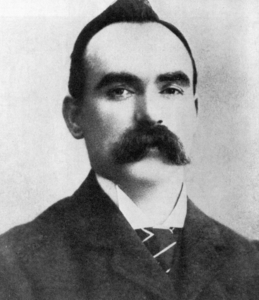
We’ve already touched on James Connolly’s 1902 Yiddish election leaflet before. Below is the translated version copied from Saothar 13. Also worth reading in the issue is Manus O’Riordan’s excellent article entitled ‘Connolly Socialism and the Jewish Worker’.

The following is the 1902 Yiddish leaflet authored by Boris Kahan, Secretary of the East London Jewish branch of the SDF, as translated for Saothar bu Sid Resnick, of the US Yiddish Communist newspaper, Morning Freiheit, on 12 May, 1987, the 71st anniversary of Connolly’s execution.

Friends!

On 15th January, the Municipal elections will take place and you are asked to consider for whom to cast your vote. But, before your reach your decision we, Jewish Social Democrats, wish to say a few words.

There are three candidates on the list for the Wood Quay Ward: you have here a Home Ruler, another a publican, and one labour candidate of the Irish Socialist Republican Party, James Connolly, who is supported by the Dublin United Labourers Union.

For which of the candidates will you vote on 15th January? For the Home Ruler, the candidate of the bourgeoise?

No, you cannot and you ought not do that! It is the bourgeoise which always has the bag of gold before its eyes. Everything that stands in its way, everything that does not agree with its gut interests it tramples underfoot no matter how sacred that may be. It is the bourgeoise that arouses race hatered, incites one people against another and casuses war. The bourgeoisie is the cause of Anti – Semitism; with its press it provokes hatered of the Jew and seeks to throw the blame for everything upon the Jew in order to deceive the people and conceal its sins against its own people.

No, you cannot vote for the Home Ruler, the candidate of the bourgeoisie! The Home Rulers speak out against the English capitalists and the English landlords because they want to seize their places so that they themselves can oppress and exploit the people. No mater how nicely and well the Home Rulers talk or how much as friends of man they seek to appear or how much they shout about oppressed Ireland – they are capitalists. In their own homes they can show their true colours and cast off their revolutionary democratic disguise and torment and choke the poor as much as they can. And you, Jews, what assurance do you have that one fine day they will not turn on you?

You ought to vote for the Socialist candidate and only for the Socialist candidate. The Socialists are the only ones who stand always and everywhere against every national oppression. It is the socialists who went out onto the streets of Paris against the wild band of anti-Semites at the time of the Dreyfus case. In Austria and Germany they conduct a steady struggle against anti – Semitism. And in England , too, the Socialists fight against the reactionary elements who want to shut the doors of England against the poorer jews who were driven to seek a refuge in strange land by the Russian government’s brutality and despotism.

The Socialist candidate is the only one for whom you ought to cast your vote.

In conclusion, a few words to you, Jewish workers of Dublin. Upon you rests the obligation to support the Socialist candidates as much as you can. The aims of the Irish Socialist Republican Party ought to be close to you. These are your own interests, the interests for which every knowledgeable worker must fight. These are the objectives for which every worker must strive. What does this party want? It wishes to abolish that system of private ownership under which the working class is condemned to labour, to create the wealth of the world and enjoy for itself absolutely nothing It wishes to construct a system in which the worker shall have the right to benefit from his labour and live a free, happy and enlightened life without bosses and rulers over his body and soul.

Jewish workers! No matter how small your numbers as you can achieve much. Do your duty and work earnestly had in hand with your Irish brothers. Canvass for votes, vote yourself and persuade others to vote on the 15th of January for the Socialist candidate, James Connolly.

With Socialist greetings,
The East London Jewish Branch of the
Social Democratic Federation.

You must cast your vote at the New Street School
James Connolly, 26 Fishamble Street, Dublin.

James Connolly (1902)

Read Full Post »

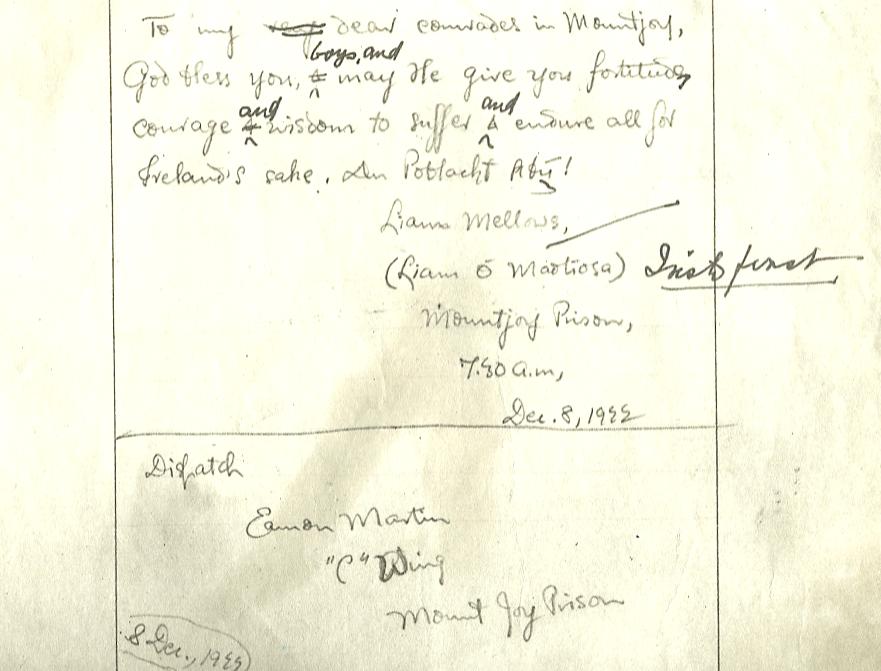
Mellows’ last message was delivered to Eamon Martin by a prison officer. It was written at 7.30am and ran:

To my dear comrades in Mountjoy. God bless you, boys, and give you fortitude, courage and wisdom to suffer and endure all for Ireland’s sake.

An poblacht abu!
Liam O Maoiliosa (Liam Mellows)

The above is taken from C Desmond Greaves wonderful biography of Liam Mellows, entitled Liam Mellows and the Irish Revolution. Undoubtedly one of the most complex characters of the anti-treaty republican movement, I’ve always been fascinated by Mellows. A great account of what Mellows was like as a man inside Mountjoy can be found in Peadar O’ Donnell’s prison memoirs The Gates Flew Open.

Recently, I saw the letter below. It is the final letter of Liam Mellows, the letter published above in Graves biography. It comes from the personal papers of Paddy Kelly, whose father was a republican prisoner in Mountjoy at the time. Look closely at it however. There are a number of clear edits made to the letter, for example the first line, where “to my very dear comrades…” becomes “to my dear comrades”. “God bless you,” becomes “God bless you boys” and the word “and” is added at various points, replacing the & symbol.

At the end of the letter “Irish first” is added and underlined next to Liam’s name.

Were these edits made by Mellows himself, or are they an early example of spin doctoring? Was the letter edited by republicans for propaganda impact before publication? Several of the letters seem completely different to those in the original letter, yet with others it’s a little less clear.

Read Full Post »

160 Parnell Street

The Hop House on Parnell St, for some unknown reason, has been a popular haunt for lefties, radicals and fellow travelers for a number of years. There has been a public house on the premises for at least 163 years. It was first named The Rotunda Tavern and then The Shakespeare.

I’ve tried my best to give you a snapshot of the history of 160 Parnell Street (formally Great Britain Street).

Thanks to Shaneew147 for looking up Thoms directory:

1948 – P. O’Shea, Shakespeare Bar
1938 – A.T. Duffy, wine and spirit merchant
1927 – Michl. Hayes, wine and spirit merchant
1914 – Mrs. Potter, grocer & wine merchant.
1894 – Sarah Daly, grocer. & wine merchant.
1884 – Andrew Daly, grocer & wine merchant
1879 – Sarah Ward, spirit merchant
1872 – John Ward, spirit merchant
1863 – John Ward, spirit merchant
1852 – John Ward, Rotunda Tavern
1848 – Daniel Shelly, vintner

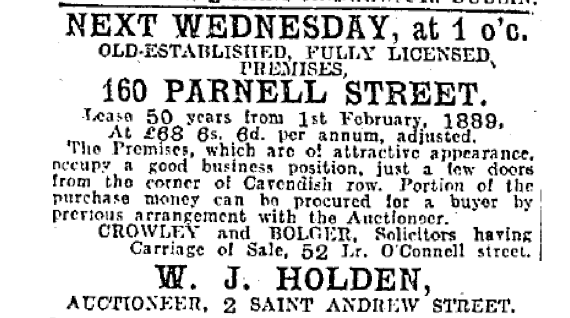
The first newspaper reference I’ve found is from 1917 and shows the bar up for sale:

May 21, 1917. The Irish Independent

In 1921, Edward Bullock was up in court for selling whiskey, which he said was, ‘watered by mistake’:

August 27, 1921. The Irish Independent.

In 1923, The Freeman’s Journal reports that the proprietress was fined £10 for having customers in the bar at 10:20pm:

Jan 27, 1923. The Freeman's Journal.

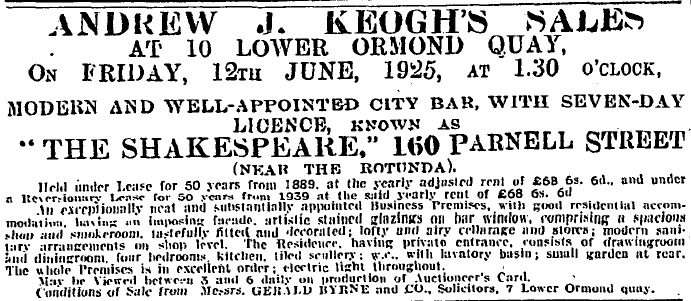
In 1925, The Shakespeare is put for auction:

12 June 1925. The Irish Times.

In 1971, The Irish Independent gave an interesting description of the pub:

Jan 16, 1971. The Irish Independent.

Jan 16, 1971. The Irish Independent.


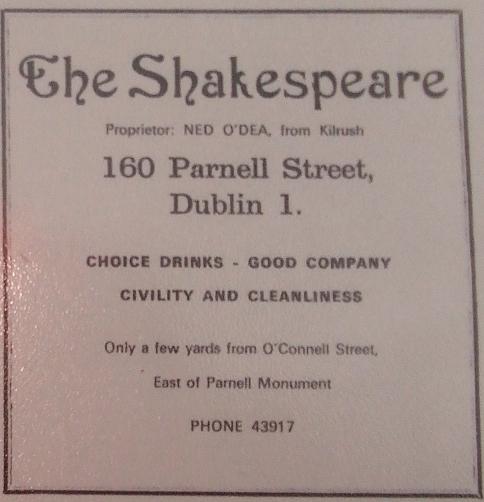
Also from 1971, this old advertisement which was found by DFallon:

An tÓglach, Summer 1971 (DFallon)

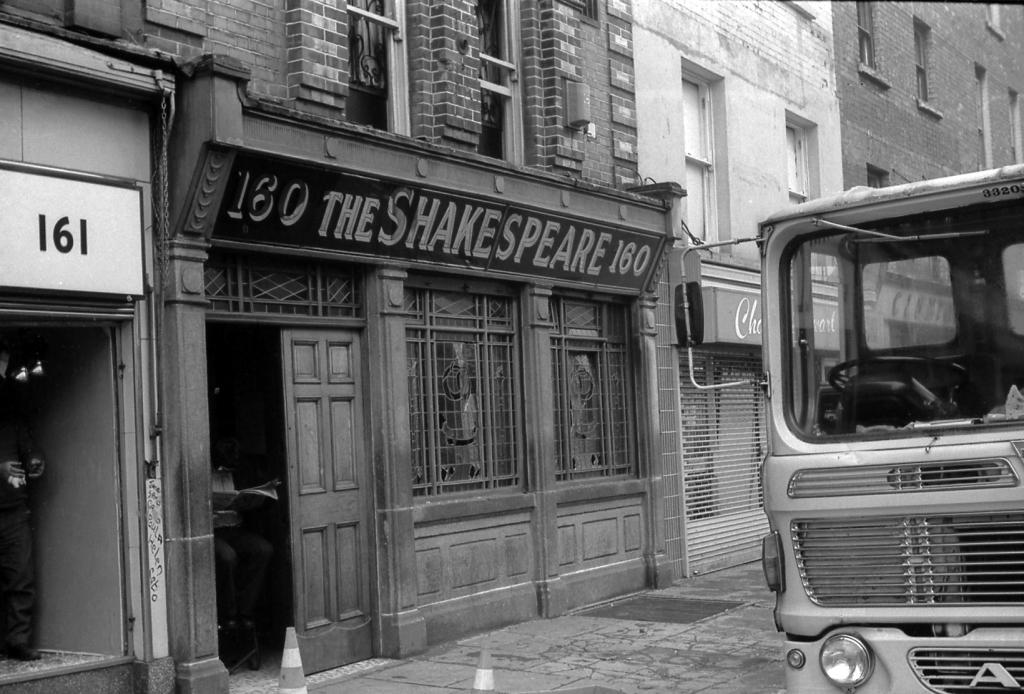
Two snaps from 1974, in the aftermath of the loyalist bombing.

The Shakespeare, 1974.

Another image of the pub in the 20th century.

”]”]The Hop House (with old Shakespeare sign) in 2010:


The Hop House/The Shakespeare. 2010 (Photo - JayCarax)

Read Full Post »
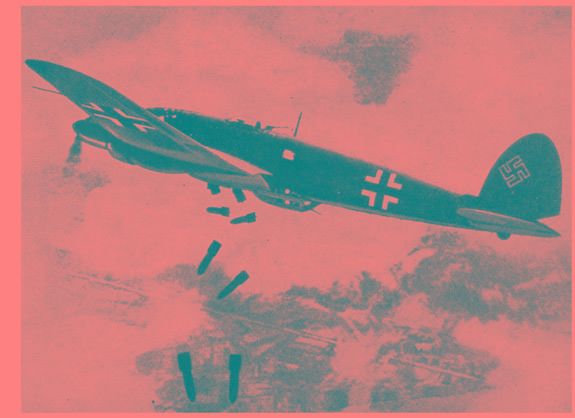
Heinkel III German bomber.

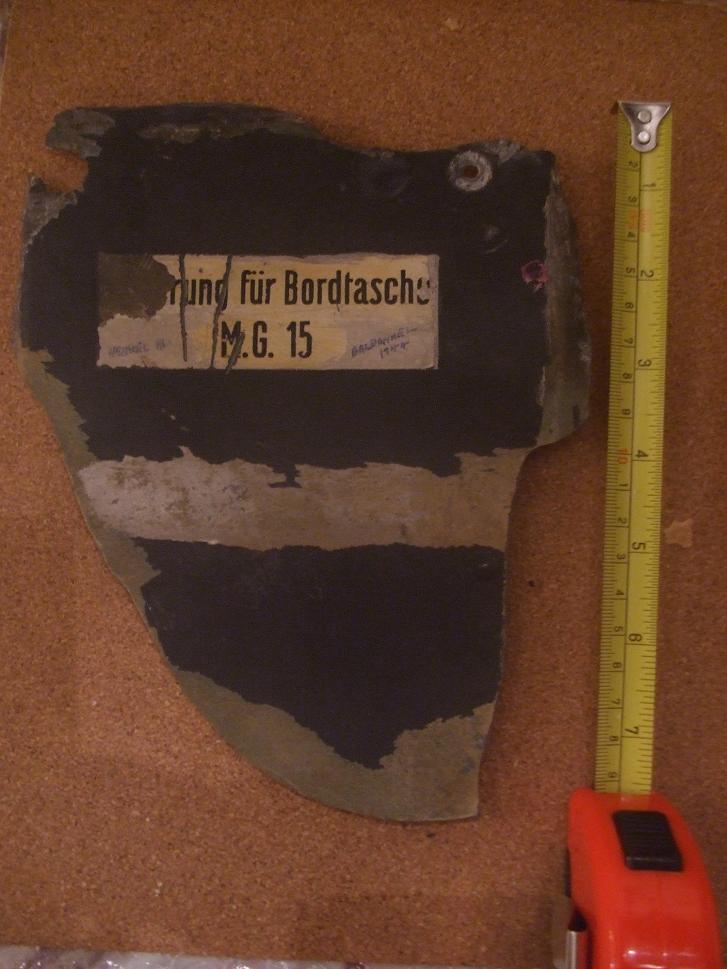
An unusual one this, a piece from the wreckage of a Heinkel III German bomber. The Heinkel’s were the mainstay of the German bomber squadrons during the Blitz and several crash landed in the Irish Free State, resulting in their crews being interned in the Curragh. Some German bombers did not survive such crashes, and a number of men found their final resting place in the German war cemetery in Glencree.

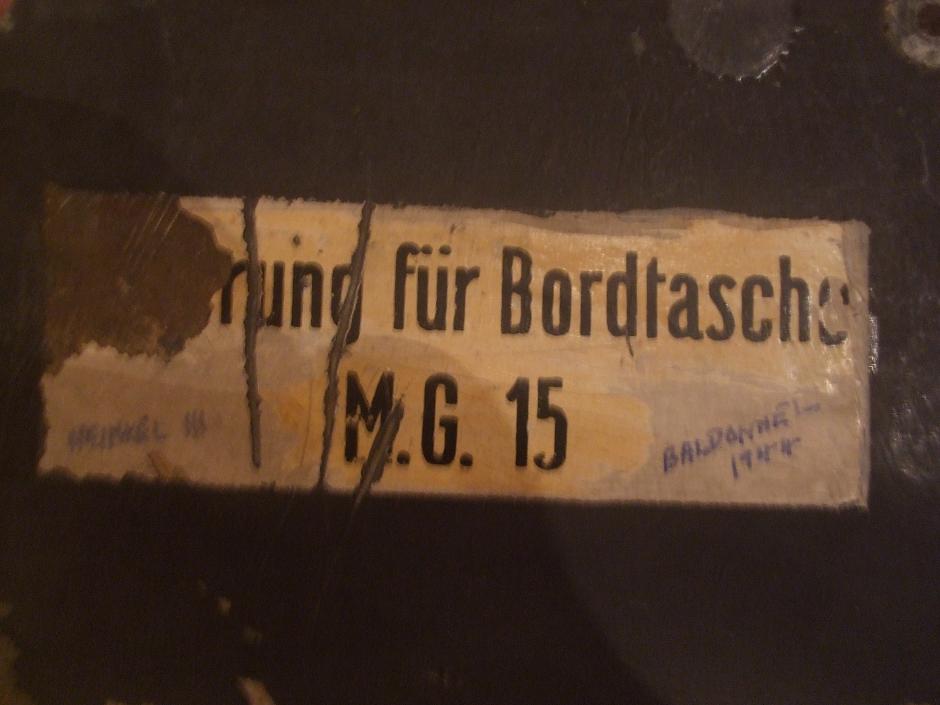
This piece was salvaged in 1944 at Baldonnell Airdrome by a young Irish army officer and remains in the possession of his family. It was loaned to my father for a project he is working on, in relation to the 70th anniversary of the Belfast Blitz in April.

The piece comes from the planes fuselage and has markings which indicate that it was part of the housing of one of the planes M.G 15 machine guns.

German Kampfgeschwader (A unit of the Luftwaffe) flying out of airfields in France and the low countries carried out the raids over southern and western England and Ireland. The attacks on Belfast on April 15 and May 5 inflicted huge casualties and according to Luftwaffe records involved up to 180 aircraft. Dublin was bombed too, not just at North Strand but also at Dolphin’s Barn and the South Circular Road. More information on the the lesser known Dolphin’s Barn and South Circular Road bombings can be found in Eoin C. Bairéad’s The Bombing of Dolphin’s Barn, Dublin, 1941. This work has only just been released as part of the Maynooth Studies in Local History series.

(more…)

Read Full Post »

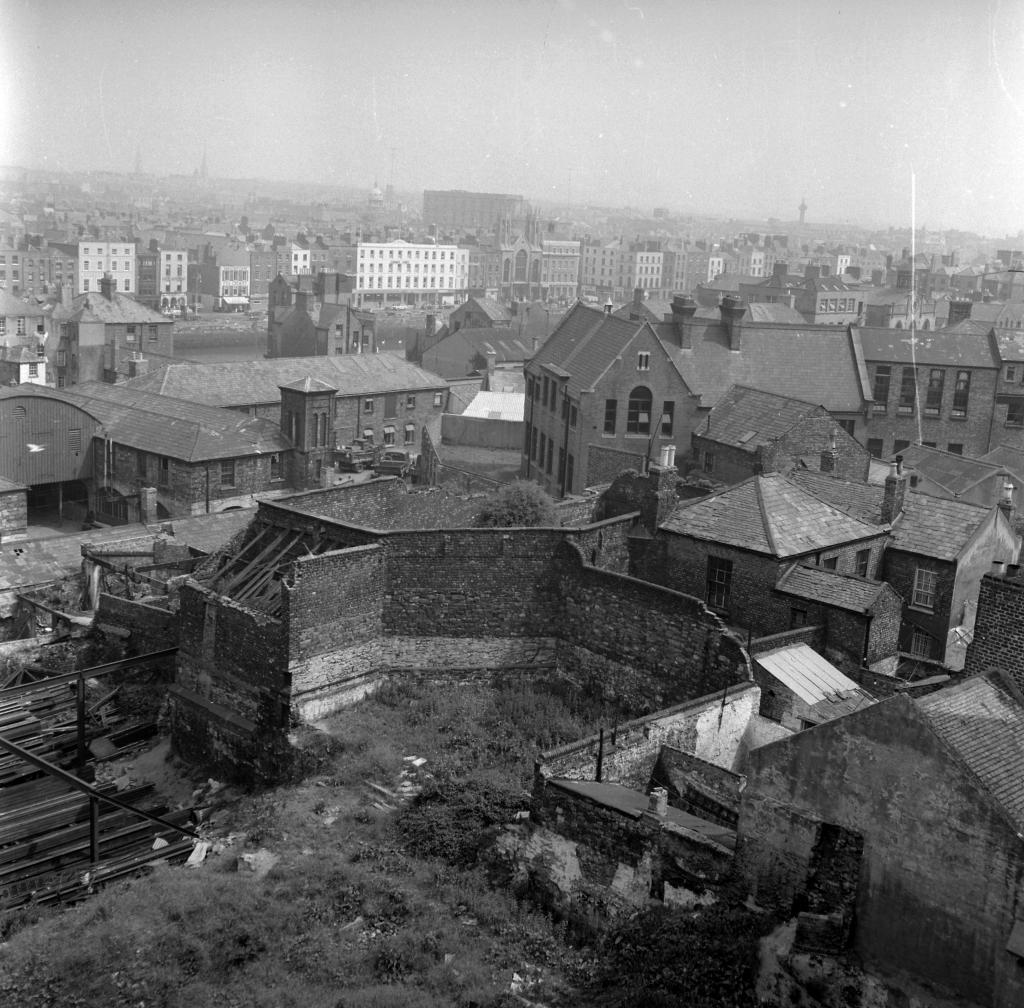
Dublin City Council have launched a new digital collection called Vanishing Dublin which show ‘features of Dublin that have disappeared or changed utterly during the second half of the twentieth century’.

Some of the change is welcome. Few will miss the deprivation of the tenements. Other images are portals into our civic past – we can imagine the workers from Stoneybatter harrying through Thundercut Alley on their way to work at Smithfield or children rummaging for ‘hidden treasure’ through the debris of George’s Pocket.

The photos also tell stories of communities now dispersed. The residents of the Gloucester Diamond and Chamber Street saw their communities transformed. What remains of where they lived is digitally preserved here for them and their descendants.

The gallery depicts a ‘vanishing’ rather than a ‘vanished’ Dublin – one that persists in the memories of those who walked its streets, worked in its shops, drank and sang in its pubs, and called it ‘home’.


Scriven's Alley Racquets Court, John's Lane East, Wood Quay (1950)

Merchants's Arch (1974)

Greene's Bookshop, Clare Street (1971)

Parnell Street (1987)

Read Full Post »

« Newer Posts - Older Posts »