Feeds:
Posts
Comments

Archive for the ‘Dublin History’ Category

So Eamon Sweeney brilliantly summed up the state of Irish Drama on the Dave Fanning show earlier in the week. Sweeny, author of the recently published book Down Down Deeper and Down: Ireland in the 70s and 80s, was on the show to give his Top 10 Irish pop culture moments of the 1980s.

In particular relation to Dublin is No. 6:

The Atrix’s ‘Treasure On The Wasteland’ (1980). Readers and friends alike know that I’m a particular champion of this band. So, it was great to see them included in the list.

and No. 3:

The broadcasting of Strumpet City in 1980. Without a doubt, one of the best things ever to come out of Montrose. Anyone with an interest in Irish history or television drama should get their hands on a copy of the DVD.

The Radiator’s From Space’s Ghostown (1980) made it no. 9 while U2’s famous 1985 Croke Park gig was no. 1. The part on Dermot Morgan’s Scrap Saturday (no. 5) was particularly hilarious. Sweeney recalled how someone once asked Dermot Morgan ‘Why he supported UCD?’ in which he replied ‘Because I hate crowds’.

Listen back to the show here at the wonderful Fanning Sessions site.

Read Full Post »

There’s a quite a number of historic spots around the city that fall between the ‘this really deserves a plaque’ and ‘let’s keep it our little secret’ categories. Obviously no one wants a city where every building is covered with two or three plaques. This, of course, would only belittle the importance of the plaques. On the other hand, there’s lots of alluring stories, kept alive by walking tour guides and Dublin pub quizzes, which should be given the importance that they deserve.

One of the best, in my mind, is the old Finn’s Hotel building on Leinster Street, the eastern extension of Nassau Street. Small (with only twelve rooms) and shabby but respectable and central, Finn’s occupied the first two of the row of red brick eighteenth century houses that forms part of the wall around Trinity College. [1]

Front of the old Finn's Hotel

On the afternoon of the 10th of June 1904, James Joyce first laid eyes on his future wife Nora Barnacle as she stepped out of Finn’s Hotel where she worked as a chamber maid.

This single event changed the course of Joyce’s life.

They had their first date six days later and he cast the action of Ulysses on that day, 16 June. As such, Bloomsday is always celebrated on this date.

A ghost sign for Finn's Hotel

So, there you go. Impress with your friends next time you pass the Hotel with that anecdote.

Do you know of any another important Dublin tales that aren’t remembered by plaques?

==

[1] Brenda Maddox, Nora: The Real Life of Molly Bloom (New York, 1988), p. 24.

Read Full Post »

From the back page of The Irish Monthly, August 1945. Excellent.

Read Full Post »

Orson Welles (1915–1985), the celebrated American filmmaker, actor, theatre director, screenwriter, and producer, visited Dublin at the age of 16. Here, he made his professional theatrical debut at the Gate Theatre.

Following his graduation from The Todd School for Boys, Welles left for a tour of Ireland. For a brief (and depressing time), he traveled about the countryside (including a visit to the Aran Islands) on a donkey and spent his time painting “a lost Eden rich in romance and bounteous beauty”. [1]

Finding himself in Dublin, Welles visited the Gate Theatre, which had been founded three years previously. He fell in love with the atmosphere of the theatre, describing it as a place where “everyone works for the joy of working, the phrase ‘nobody works for money’ being particularly applicable” [2]

He presented the manager Hilton Edwards with an audacious note that proclaimed:

“Orson Welles, star of the New York Theatre Guild, would consider appearing in one of your productions and hopes you will see him for an appointment.” [3]

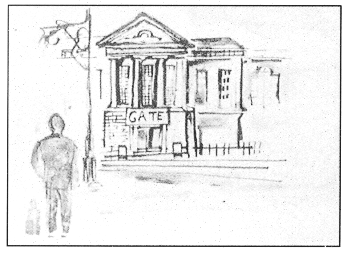
Welles's sketch of himself standing before the Gate Theatre in Dublin (1931).

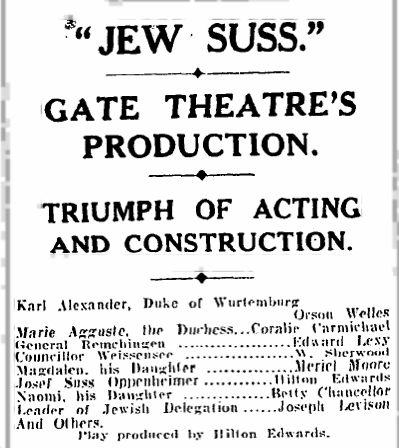
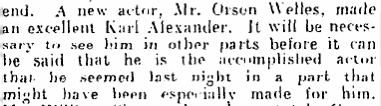
Welles read for the part of the evil Duke Karl Alexander in an adaption of Lion Feuchtwanger’s Jew Suss and did enough to impress Edwards and partner Micheál Mac Liammóir that he got the part. His first night was marred by mishaps but he won a standing ovation in a brilliantly erratic performance. [4] Mac Liammóir later wrote that Welles’ put on “an astonishing performance, wrong from beginning to end but with all the qualities of fine acting tearing their way through a chaos of inexperience.” [5]

The Irish Times. Wednesday, October 14, 1931.

Review of Welles' performance. The Irish Times. Wednesday, October 14, 1931

He had earned his place as a bone-fide member of the company of the rest of the season and later went on to play Cldaius and the Ghost in a production of Hamlet. Apparently, he received some some bad reviews for Cladius but some very good ones for the Ghost.

While in Dublin, Weelers also wrote a ‘Chitchat and Criticism’ column for a weekly paper under the pseudonmyn Knowles Noel Shane. [6] Anyone know which paper?

Welles was unable to repeat his success in either London or New York and in March 1932, some eight months after leaving, he returned to Chicago.

Between October 1931 and February 1932, a teenage Welles played in five Gate productions; Jew Suss, Hamlet, Death Takes A Holiday, The Dead Ride Fast and Czar Paul. An experience which undoubtedly helped to shape and his professional career.

There you go.

========

[1] Charles Higham, The films of Orson Welles (London, 1971), p. 6
[2] Richard France, Orson Welles on Shakespeare: the W.P.A. and Mercury Theatre playscripts (New York City, 2001), p. 7
[3] France, Orson Welles, p. 7
[4] Higham, The films of Orson Welles, p. 6
[5] Orson Welles and Mark W. Estrin, Orson Welles: interviews
(Mississippi, 2002), p. xxvii
[6] Michael MacLiammoir, All for Hecuba: an Irish theatrical autobiography (Boston, 1967), p. 129

Read Full Post »

O commemorate me where there is water,
Canal water preferably
Greeny at the heart of summer. Brother…

O commemorate me with no hero courageous
Tomb – just a canal bank seat for the passer-by.

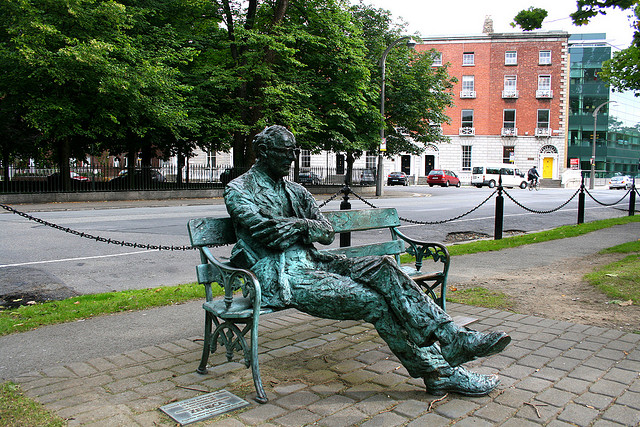
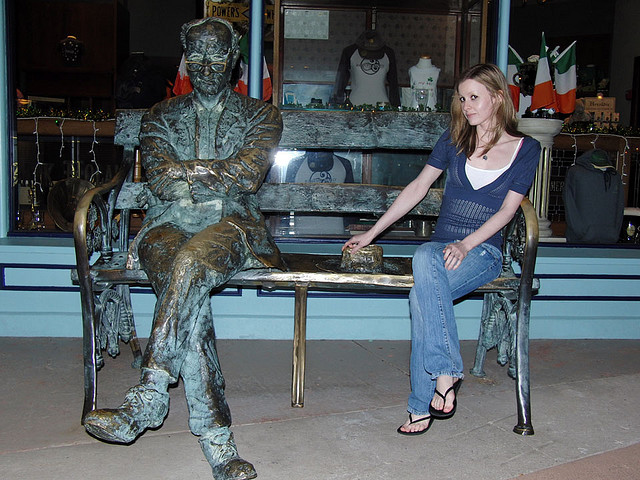
It may come as a surprise, it certainly did to me, that Patrick Kavanagh is commemorated by not one but two seats along Dublin’s Grand Canal.

The one that is known to most Dubliners and tourists is the bench which has a life sized statue of Kavanagh sitting on one side. This was made by the sculpture John Coll and was unveiled in June 1991 by Mary Robinson. It is situated on the north bank of the Grand Canal on Mespil Road.

Photo credit - Andrew B47 (FlickR)

The second statue predates the first by 23 years and was unveiled only a few month’s after the poet’s death. It is a simple ‘wood and granite’ seat that was designed by the artist Michael Farrell (1940 – 2000). A fantastic account of the fundraising and committee work that went into commissioning the seat can be read here. This seat is located on the South Bank at the Lock Gates close to Baggot Street Bridge.

The first and original 1968 bench (The Irish Times 2.2.68)


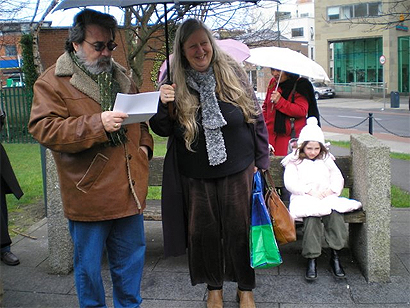
Every St. Patrick’s day, old friends and fans of Kavanagh gather at this bench to remember his life and read extracts of his work.

The 2007 gathering. (Photo credit - http://kavanaghseat.com/photos.html)

So, there you go. There are in fact two seats dedicated to the memory of Patrick Kavanagh on the Grand Canal. Let’s do our best not to forget the first. (Many thanks to the beautiful Kavanagh Seat website that first brought my attention to the above)

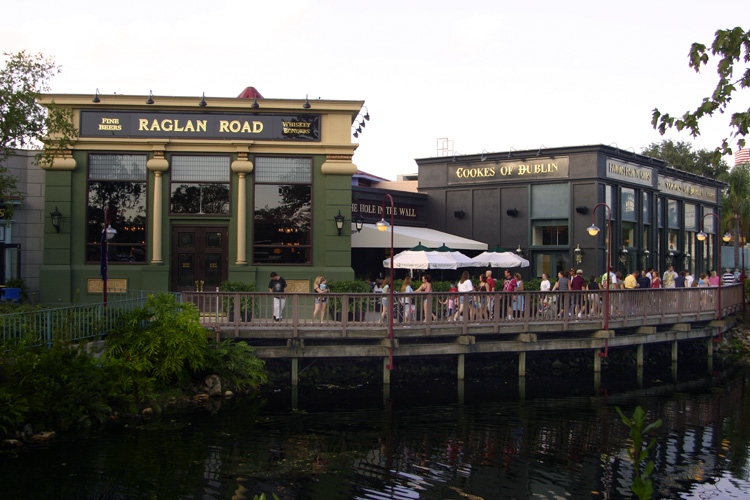
Now for a bonus question. Besides the canal seat, can you tell me where the only other statue to Patrick Kavanagh is in the world? Give up? Disneyland, Florida! I know, hard to believe but it’s true. There’s a statue to him, based on the Grand Canal seat, outside the Irish pub and restaurant, Raglan Road, at Walt Disney World’s Downtown Disney in Orlando, Florida.

Disneyland, Florida. "Step inside Raglan Road Irish Pub & Restaurant and you'll feel you've been transported to the Emerald Isles"

The Kavanagh statue outside Raglan Road restaurant, Disneyland. Photo credit - Eric J. Lubbers (FlickR)

Read Full Post »

Yesterday, I wrote a piece on the assassination of Kevin O’Higgins and briefly discussed the theory on whether we should commemorate historical events regardless of whether we have strong positive or negative feelings on the individual or individuals involved.

Today, I plan to do a little research on the O’Higgins’ three killers:

1. Archie Doyle (? – 1980)
2. Bill Gannon (? – September 12, 1965)
3. Tim Coughlan (1906 – 28 January 1928)

1. Archie Doyle, described as ‘one of the more shadowy figures in the IRA’[1] , is believed to have fought in the War of Independence and on the anti-treaty side of the Irish Civil War.. He was interned afterwards and was then involved in the assassination of O’Higgins in 1927. Doyle took an active part in the IRA’s 1940s campaign including the September 1942 attack on the RUC barracks in Crossmaglen, County Armagh and the July 1943 robbery of a van outside the Willa Tobacco Factory on the South Circular Road, Dublin. [2]
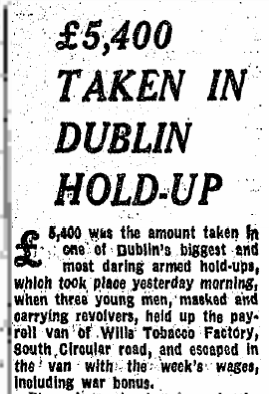
The Irish Times, Friday, July 2, 1943.

Proinsias Mac Aonghusa in a Sunday Press article has described Doyle leading a double life between an unobtrusive private existence in the Dublin suburb of Rathgar in which he worked initially for the Board of Works and later for Woolworths where he was buildings manager travelling the country, and active service in the IRA during which he was ‘generally thought to be responsible for all or nearly all assassinations’ according to former IRA Chief of Staff[3]. Doyle died in St. Jame’s Hospital in 1980.

2. Bill Gannon is also believed to have fought in the War of Independence and on the anti-treaty side of the Irish Civil War. He joined the refounded Communist Party of Ireland in the early 1930s and was one of the defenders of Connolly House in the March 1933 attack [4].
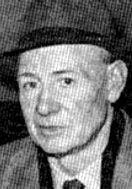
Bill Gannon, founder-member of the CPI, 1933, recruiting officer of volunteers for Spain, 1936–38 (From CPI Website)

During the Spanish Civil War, he along with Frank Ryan and Peadar O’Donnell helped to organise Irish Volunteers to travel to Spain to fight on the Republican side. He died in September 1965 and was buried in Mt. Jerome cemetery with military honours. His coffin was draped with a red flag and the Irish tricolour.

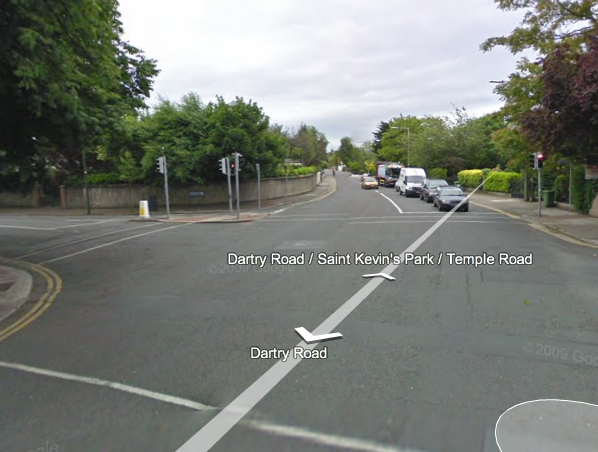
3.Tim Coughlan , the second eldest in a family of nine, lived with his parents at 24, Ring Street, Inchicore. Coughlan played a role in both the Tan War and the Civil War. Interned for much of the latter, he re-immersed himself in republican activities upon his release. He was killed in very mysterious circumstances in January 1928. That day Coughlan and another IRA volunteer were on Dublin’s Dartry Road, opposite ‘Woodpark Lodge’, the home of Sean Harling – a former IRA comrade-in-arms turned government informer. It is accepted by most and Coughlan and co. were there on a fact-finding mission. At around 6:55pm, Harling returned home from work and he noticed two men watching him from the other side of the road. A gun fight broke out in which Coughlan was fatally wounded. Harling claimed he killed him in self-defence.
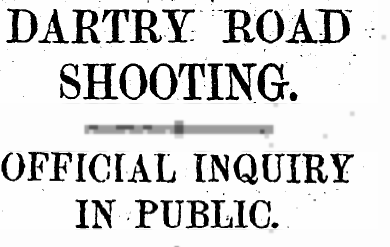
The Irish Times, Thursday, February 16, 1928

However, there are lots of unanswered questions surrounding the night which prompted the IRA to claim at the time that Coughlin was in fact ambushed and in effect extrajudicially executed. This version is especially supported by the autopsy carried out by Dr. Wilfred Lane which “amongst other anomalies, discovered that the IRA man died as a result of being shot in the back of his head”. Also, the doctor found a cigarette butt in his mouth, which again indicated he had been caught unaware and killed, and tenants on Dartry Road testified that there had been unusual police activity that evening and that they heard more shots than mentioned in Harling’s account.
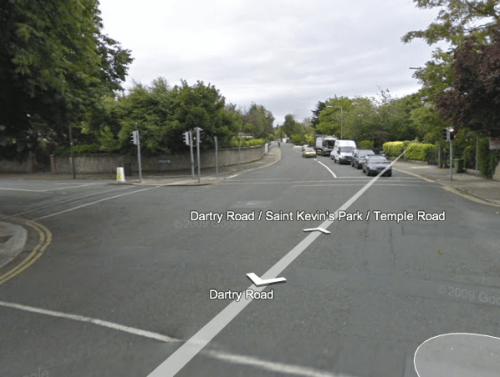
I could not find Woodpark Lodge but this, the corner of St. Kevin's Park and Dartry Road, is where Harling first saw Coughlin and the other IRA volunteer.

Harling, fearing for his life, was relocated to the United States. Though blocked for a time, he returned to Ireland several years later and was given a job in the Revenue Commissioners. He lived on New Grange Road, Cabra unil his death in 1977. (The above was based on articles by Aengus O Snodaigh and Gabriel Doherty)

==

Footnotes:

[1] The Irish Times, Monday, October 7, 1985, p. 9
[2] Saoirse, Issue 65. September 1992.
[3] The Irish Times, Monday, October 7, 1985, p. 9
[4] Uinseann MacEoin, The IRA in the twilight years:
1923-1948 (Dublin, 1997), p. 136
[5] Brian Hanley, The Storming of Connolly House, History Ireland Volume 7 (2), Summer 1999, p5-7

Read Full Post »
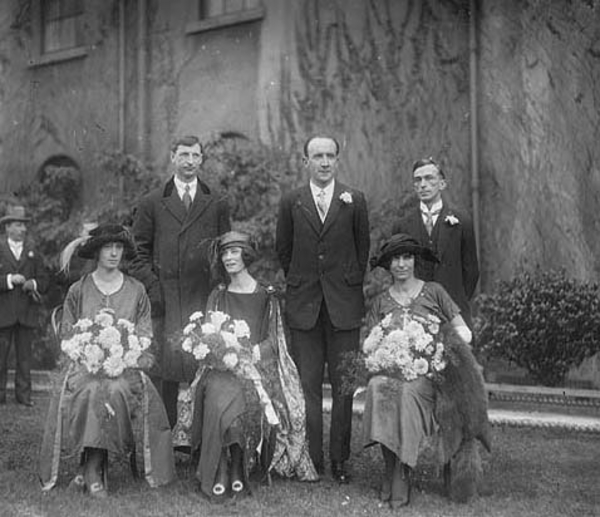
O’Higgins, who was once called the ‘Irish Mussolini’,  is one of the most notorious Free State figures and has been a figure of hate of republicans for generations. Between 1922 and 1923, he personally ordered the execution of seventy-seven republican prisoners including Rory O’Connor (who had been best man at O’Higgins’ wedding), Liam Mellows and Erskine Childers. A unapologetic social traditionalist, he famously remarked that was part of a generation of ‘the most conservative-minded revolutionaries that ever put through a successful revolution’. [1]

back row l-r: Eamon de Valera, O’Higgins and Rory O’Connor at O’Higgins’ wedding, 1921.

He was killed just before midday on Sunday, 10 July 1927 as he walked from his home Dunamase House on Cross Avenue to the Church of the Assumption on Booterstown Avenue. As he approached the junction of Booterstown and Cross Avenue, a man stepped out of a parked motor car and fired at point-blank range.

O’Higgins staggered, turned and began to run, followed by the man firing. O’Higgins collapsed on the other side of the road and two men came from the rear of the car and fired down at O’Higgins as he lay on the ground. The men then leaped into the car and drove off.[2]

The three anti-Treaty IRA men who killed him – Archie Doyle, Bill Gannon and Tim Coughlan – apparently saw him by chance. Gannon later recalled:

‘seeing him … we were just taken over and incensed with hatered. You can have no idea what it was like, with the memory of the executions, and the sight of him just walking along on his own. We started shooting from the car, then getting out of the car we continued to shoot. We all shot at him, he didn’t have a chance’.[3]

The motor car in which they used was believed to have been stolen from a Captain McDonnell on the night before. After the shooting, the car was later found abandoned at Richmond Avenue in close by Milltown. [4]

A weekly mass goer, O’Higgins was usually accompanied by his wife or by P. J. Hogan the Minister for Agriculture and his closest friend. This week however he was escorted by Detective O’Grady. When the two men were ‘between their house and Booterstown avenue’, O’Higgins sent the detective back to collect something that he had forgotten. It was later believed that the Garda escort was in fact sent to Blackrock to buy cigarettes [5]

O’Higgins was found lying by a ‘lamppost outside the gates of the house Sans Souci, which directly faces up Cross Avenue’ [6] by locals on their way to mass who heard the shots. Apparently local resident Eoin MacNeill was one of the first people to reach the dying O’Higgins. He was moved to his house and miraculously lingered on for another five hours. (Tens of thousands attended his funeral. You can see footage of it here.)

The Boards.ie user GusherING believes that there used to be a ‘little cross’ to mark the spot in which he was shot ‘near the entrance to Sans Souci’. A local history site confirms that there a ‘small cross inscribed on the present footpath’ that identified the location.

The question that now has to be asked is whether ‘historians’ like ourselves should be pushing to replace the cross that marked the spot of O’Higgins assassination. I think we should be. No matter your political views or opinions on individuals, historical moments in our city’s life should be properly identified.

===

[1] Joseph Lee, Ireland 1912-1985: politics and society (Cambridge, 1989), p. 105
[2] J. Bowyer Bell, The secret army: the IRA (New Jersey, 1997), p. 61
[3] Richard English, The Armed Struggle (London, 2003), p. 45
[4] The Irish Times, Monday, July 11, 1927, p. 7
[5] The Irish Times, Monday, June 11, 2007
[6] The Irish Times, Monday, July 11, 1927, p. 7

Read Full Post »
The Dublin team of the day.

An anniversary that might pass you by….

It is very unusual for the anniversary of Bloody Sunday to fall on a Sunday. Sunday, November 21 was one of the most intense and horrific days of the Irish War of Independence.

Michael Hogan, Thomas Hogan, Jane Boyle, Joseph Traynor, Jeremiah O’Leary, Thomas Ryan, James Burke, Daniel Carroll, William Robinson, James Matthews, Michael Feery, John William Scott, James Teehan and Jeremiah O’Dowd were all gunned down at Croke Park in Dublin, while Dick McKee, Peadar Clancy and Conor Clune were killed at Dublin Castle. While Clune was not a member of the Volunteers, McKee and Clancy were leading members of IRA GHQ, and Ernie O’ Malley noted in his article Bloody Sunday how the organisation had developed owing to their leadership and influence.

“The four Dublin city battalions had a very intimate knowledge of the metropolis, its lanes, by-lanes, alleys and back yards, its enemy barracks and the habits of its opponents”

Of those killed in Croke Park, three were children. 10,14 and 11 years old.

Trade union leader William O’ Brien noted in Forth The Banners Go that intelligence efforts against republicans, trade unionists and the like intensified after Bloody Sunday. Following a raid on Liberty Hall, where copies of the Black and Tans internal The Weekly Summary were found, O’ Brien noted that those arrested at Liberty Hall were taken to Dublin Castle. “We were brought into the very room that had been occupied by McKee, Clancy and Clune and where they were killed the previous Sunday. The marks on the walls (…) were still there.”

The day had of course begun with the attacks by ‘The Squad’ of Michael Collins upon the intelligence services which attempted to combat republicans in the city. It was a calculated effort to remove the ‘Cairo Gang’ from the scene, a series of early morning raids for the most part in a small area of south Dublin.

The Irish Times of November 22 ran the below ‘Official Report’ into events at Croke Park.

“It is believed that a number of gunmen came to Dublin today under the guise of a wish to attend a Gaelic football match between Dublin and Tipperary, but that their real motive was to take part in a series of murderous outrages which took place in Dublin this morning. In this belief it was decided to make investigations at the match itself, and for this purpose a mixed party of military, R.I.C and Auxiliary Police were detailed”

Interestingly, Winston Churchill would tell a Cabinet meeting that no reprisals had taken place for the attacks upon the British intelligence machine in Dublin on the morning of Bloody Sunday. Those at Croke Park would no doubt disagree.

Today is a very important Dublin anniversary. Let us hope that in 2020, the day is marked with a game between Dublin and Tipperary perhaps. Great praise is due to John Campbell at the Croke Park Museum for marking the day so fittingly today with two walking tours of the stadium.

Read Full Post »

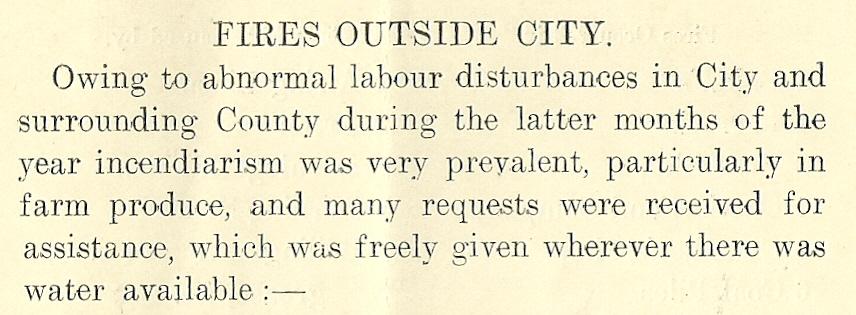
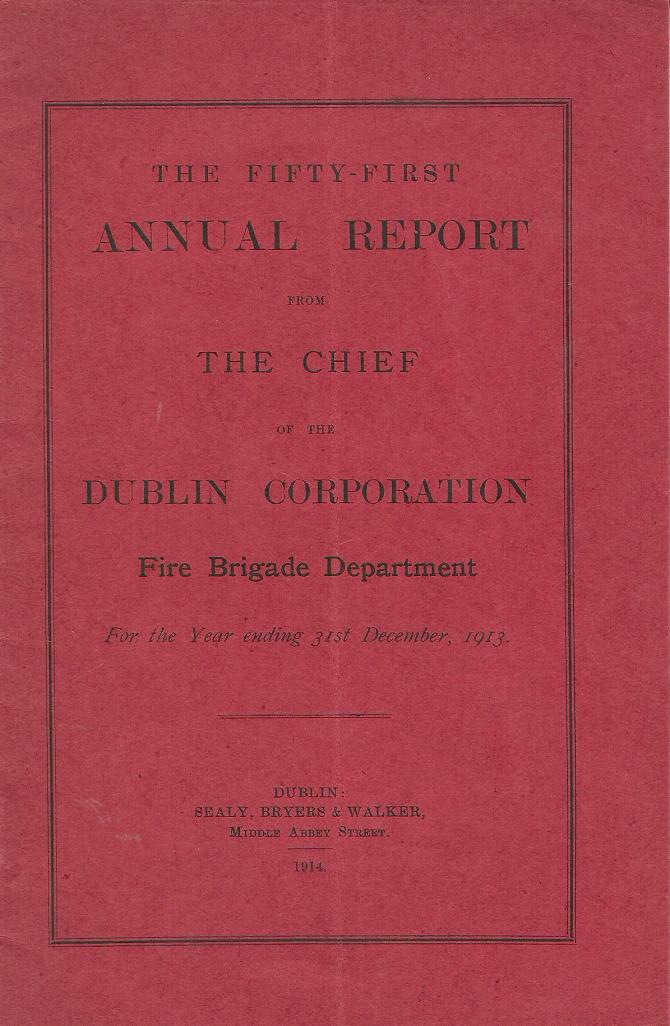
Below are some scans from the Annual Report of the Dublin Fire Department, as the service was known, in 1913. It details the work carried out by the fire service in 1913. The scans below offer some interesting insight into what was going on in the city at the time.

The report is signed off Thomas P. Purcell, Chief Officer. It was concluded on March 6th at Central Station,Tara Street.

(more…)

Read Full Post »
This quote is not in relation to last week’s police violence at the student demonstration but instead is taken from The Irish Times editorial of May 14, 1968. It is in reference to a Garda baton charge on 50 supporters of the Dublin Housing Action Committee, most of whom were students, outside City Hall the night before. The attack left three protesters needing hospital treatment.

The baton-charge on City Hall was the start of one of the most eventful weeks, in one of the most eventful years of radical student politics in Dublin.

A couple of days after, Gardai attacked around a dozen members of the left-wing group The Internationalists, outside Trinity Library, who were protesting against the visit of the Belgian King and Queen. The violence was prompted after the police took exception to the student’s banner which read ‘Lumumba – Killed by Belgian Imperialism’.

The sight of police beating students on campus along with the uninformed press coverage that followed prompted an almost spontaneous demonstration against police brutality. Over a thousand students marched on Pearse Street police station the day after. (This has to be one of the biggest anti-police brutality marches in Dublin’s history). After reading out a letter of protest, they marched on the Independent House on Middle Abbey Street to voice their anger at the way the Evening Herald covered the story.

The newspaper reports show an eerily similar rundown of events to what happened at the student protest last week.

“… a group of peaceful demonstrators, including students, were carrying on a picket when, without provocation, Gardai moved in and physically manhandled them. Many of these Gardai were without visible identification numbers. In the ensuing fracas is (sic) seems many Gardai used methods which would justify the use of the term ‘police brutality'” – Mr. Alan H Matthews (President, TCD SRC). The Irish Times, May 14, 1968 (Note: Alan is now a Professor of Economics at TCD)

“… But there are too many accounts by reliable witnesses of acts of unnecessary roughness and sometimes brutality by individual guards to make the most recent complaint seem frivolous” – Editorial, The Irish Times May 14, 1968

“Later in Grafton street students were again manhandled. We deplore as police brutality this needless use of force involving the striking of students and onlookers. We must further protest at the inaccuracy of the press reports.” – Labour Party, TCD. The Irish Times, May 16, 1968
 

If anyone has photographs or memories from this period of student protests, please get in touch.

These two articles may also be of interest:

+ A brief look at UCD’s radical history from 1968-70; The move to Belfield and the ‘Gentle Revolution’.

+ One activist’s account of student politics in TCD in the 1980s; http://anarchism.pageabode.com/andrewnflood/dublin-student-activism-tcd-1980s

Read Full Post »

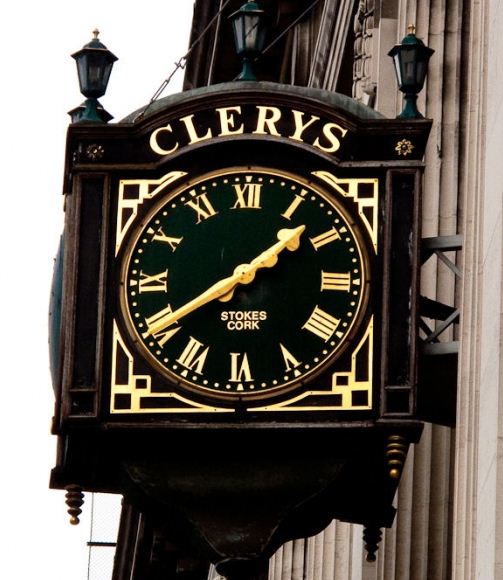
It is said that countless country folk have used it as a rendevous point, and that thousands of relationships, amorous and otherwise have been formed under it. Phillip Chevron of The Radiators even wrote a song about it. As landmarks go, it’s pretty, though rather unimpressive, but the saying “I’ll meet you under Clery’s Clock ” has been coined for generations.

The spot of many a life changing moment; Clery's Clock

Clery’s is an integral part of the social history of Dublin, as much as it is the actual history. It’s ties with the Imperial Hotel and the Martin Murphy empire, the lockout of 1913 and Jim Larkin, and the events of Easter week in 1916 are irrefutable. It was the scene, as has been mentioned here before, of Jim Larkin’s arrest for addressing the crowd at a rally from the upper balcony of the building while dressed in a priests robes and a fake beard.

But as I said, there is an important social history to be told about the building, and Media Arts Student Sinead Vaughan is looking for people to tell it. I came across this plea for help this morning while browsing the Dublin City section of boards.ie and thought it an excellent idea. So anyone with a story about meeting there, or especially anyone who was at the unveiling of the new clock in 1990, contact sineady_vaughan@hotmail.com

Read Full Post »

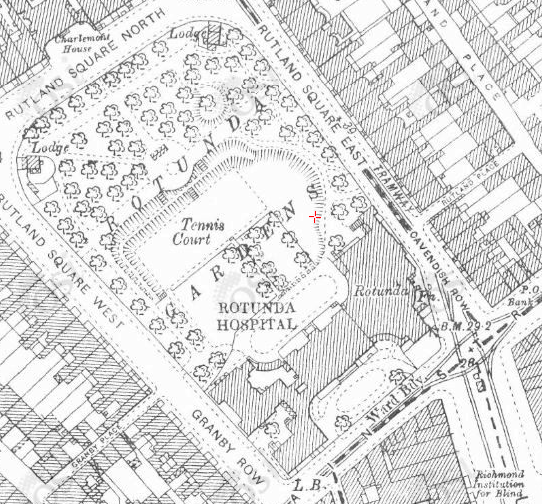
Spotted this on the OSI historical map, a tennis court in the grounds of the Rotunda Hospital. I can only presume that it’s well gone?

Rotunda Hospital (c. 1888-1913)

Rodunda Hospital (c. 2010)

Read Full Post »

« Newer Posts - Older Posts »