I wanted to mark the fact International Women’s Day falls this week with a feature looking at a publication which was banned by the state and a situation which led a group of 20 young women to board a train at Connolly Station one morning in 1977 to acquire copies. There’s a lot more to be written on this I’m sure, but this is a modest effort to tell the story of Spare Rib for the week that is in it.
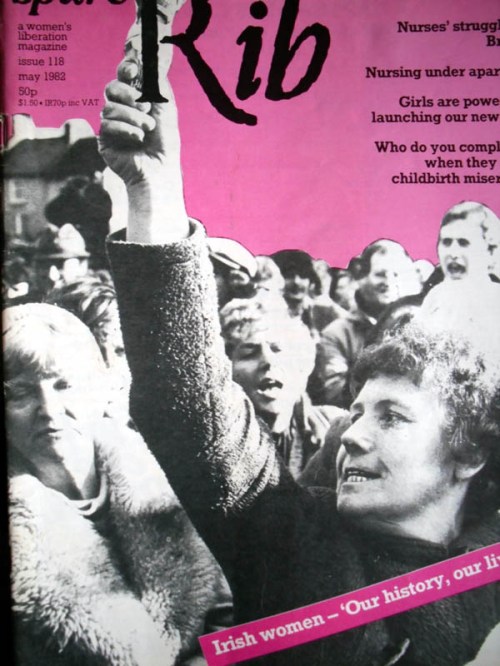
Spare Rib was a second-wave British feminist publication set up in 1972, to provide a feminist alternative to commercial women’s magazines. It was very much a publication of the left, for example often writing critically of Britain’s role in Ireland, along with giving coverage to labour disputes. The excellent study Women and Journalism notes that W.H Smith refused to stock the first issue of the magazine, which contained such shocking content as a feature on skin care and an interview with George Best! It also included articles on sex, gender equality and women’s role in history.
Quite unsurprisingly, the publication was banned in Ireland. In February of 1977 following a complaint to the Censorship of Publications Board, it was decided that the magazine was unfit for the eyes of the Irish public. A statement from the Board noted that having examined recent issues of the British magazine, the magazine was found to have been “usually or infrequently indecent or obscene, and that for that reason the sale or distribution in the state of the said issues or future issues of the said periodical publication should be prohibited.”
Immediately following the banning of Spare Rib, there began a strong feminist campaign to overturn the ban. Ironically, while the magazine had enjoyed miniscule readership in Ireland prior to the banning, the debate over the decision of the Censorship of Publications Board saw Spare Rib make its way into the letters pages of the national print media.
The secretary of Irishwomen United, an outspoken feminist organisation, would write to the editors of the national daily papers on February 11 1977 stating that “we see the censorship of Spare Rib as a direct attack of feminism and the women’s movement.” Nell McCafferty would describe the organisation in a 1979 feature for the Irish Times as being “composed, significantly, of trade unionists, professional women and the unemployed, who had scarcely heard of motherhood.”
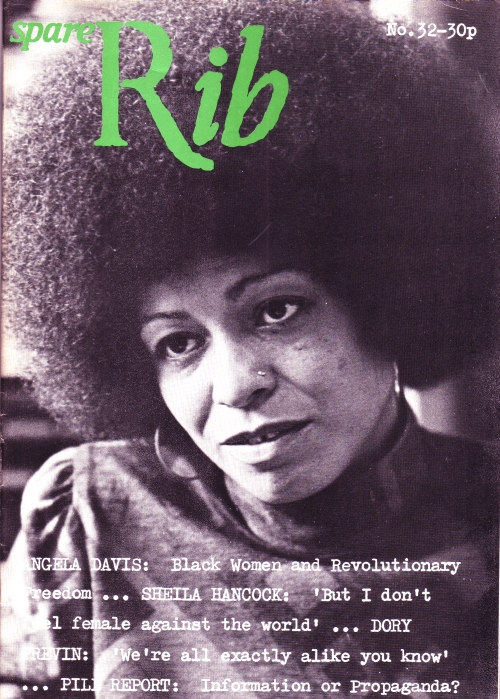
Like large sections of the British left at the time, the people behind Spare Rib weren’t entirely sure how to deal with matters relating to the island next door. Rose Ades, one of the women on the collective behind the publication, remarked that they did not wish to be seen to be imposing any sort of “British cultural imperialism” and that “we don’t want to be thought of as foisting something essentially alien on Irish people if they don’t want it.”
Yet Irish feminists did want it. Enough to fight for it. Three days after the letter from Irishwomen United appeared in the national daily papers, on Valentines Day, 20 members of the feminist organisation boarded the 8am shoppers special train for Belfast with the intention of returning with 150 copies of the publication. As Nell McCafferty wrote in the pages of the Irish Times:
The publishers of the magazine had donated the copies free and sent them over to Belfast as a contribution to the women’s’ struggle in the south. The women intended to return to Dublin on the 5.30pm train, depending of course on what happened to the banned magazine during Customs Inspection in Dundalk.
The women managed to bring the publication into the south with no opposition from Customs in Dundalk, and arrived at Connolly station as planned that night, where the assembled media awaited the inevitable showdown with the Guardians of the Peace. In the end three Gardaí approached the women, attempted to apprehend one, failed, and not a single copy of the publication was seized by the state.
Two weeks later, on February 28th, the organisation would challenge the law banning the publication by openly selling it on the streets of Dublin. A packed protest meeting at the Mansion House saw speakers denounce the ban, and three women told Gardaí formally that they intended to sell the publication there and then to all interested. They were Marie McMahon and Joanne O’Brien of Irishwomen United and Sue Burns of the Irish Family Planning Service. No attempt was made to stop them. Interestingly, Marie McMahon had been involved in the Hume Street occupation and the Irish Civil Rights Association.
(more…)
Read Full Post »












 Click on the book for more.
 Click on the book for more.
 Donal
Donal Ciarán
 Sam
Sam


 Come Here To Me!