Feeds:
Posts
Comments

The Bells of Dublin (1991)

There are few things as magical about Dublin as a New Year announcing itself through the bells of Christchurch Cathedral. Ideally, you have a pint from the Lord Edward in your hand or someone in your arms as you take it in.

A visit to the belfry is possible, and is an experience we Dubliners shouldn’t leave entirely to visitors. The oldest of the bells in usage today dates from 1738, with a number coming from the time of the Roe whiskey distillery funded restoration of the cathedral in the nineteenth century.

One place you can hear the bells is The Chieftains remarkable Christmas album, The Bells of Dublin. Released in 1991, it both begins and ends with the sound of the church bells ringing. As John Glatt writes in his biography of the band, “intrepid sound engineer Brian Masterson crawled out on to the roof of Christchurch and set up various microphones to record the majestic peels of the bells. For the recording Moloney [Paddy Moloney of the band] joined the bell ringers in the belfry to play his part.”

81lcOQmcEoL._SL1500_.jpg

The Bells of Dublin cover (RCA Victor)

Coming four years after The Pogues and Kirsty MacColl gifted the world Fairytale of New York, it once again demonstrated that Irish traditional music could hold its own when it came to Christmas magic. The Chieftains had been a mainstay of the Irish music scene since the 1960s, though unlike The Pogues who followed they were much more about the tradition. Paddy Moloney would recall:

I had great faith that one day what we did best– playing traditional Irish music– was going to soar, and I wasn’t going to be stepping down the ladder by changing the style. Our first concert in the Albert Hall was just music– no flashing lights or smoke screens, and we didn’t have dancers or singers– so to see the crowd dance around the theatre, coming back for encore after encore, was just magic. There were tears in our eyes that night. We didn’t realize that people from the rock world were listening to us, like The Rolling Stones, Marianne Faithfull and Paul McCartney, so the whole social thing started to develop and word got out. We were taking our time and gradually creeping in. Then in ’75, we were on the front page of Melody Maker as Group of the Year. That was huge!

The album included guest appearances from Elvis Costello, Marianne Faithfull,  Kate and Anna McGarrigle and Jackson Browne among others. Browne’s contribution, which he wrote, is a rejection of the crass commercialisation of Christmas as he sees it, and a reminder of what he feels Jesus stood for:

Well we guard our world with locks and guns
And we guard our fine possessions
And once a year when Christmas comes
We give to our relations
And perhaps we give a little to the poor
If the generosity should seize us
But if any one of us should interfere
In the business of why there are poor
They get the same as the rebel Jesus

The St. Stephen’s Day Murders, on which Elvis Costello appears, captures the cabin fever of the season with great wit:

I knew of two sisters whose name it was Christmas
And one was named Dawn, of course the other one was named Eve
I wonder if they grew up hating the season
Of the good will that lasts till the Feat of St. Stephen
For that is the time to eat, drink and be merry
Until the beer is all spilled and the whiskey has flowed
And the whole family tree you neglected to bury
Are feeding their faces until they explode.

The album was recorded primarily at the Windmill Lane Studios. Though primarily associated with U2, ,acts as diverse as David Bowie, New Order, Erasure and Sinead O’Connor have also recorded there.

The Chieftains output includes an acclaimed collaboration with Van Morrison, a tribute to the heroic fighting men of the San Patricio Battalion and the story of the 1798 rebellion. For me, The Bells of Dublin remains their finest hour, and it should be essential listening this week.

james-connolly-4 (1)

Evening Herald, 2 October 1920.

In the early twentieth century, some of the most interesting voices in Irish public life, including Socialist leader James Connolly, expressed their support for the idea of an international language.

A constructed international auxiliary language (differing from natural languages, which develop over time), Esperanto was the brainchild of Polish inventor L. L. Zamenhof. In 1887, under the pseudonym Doktoro Esperanto (Doctor Hopeful) he published Unua Libro, in which he introduced and described this new international language. Zamenhof did not believe that his constructed language would replace existing national tongues, but that it could exist alongside them and make human communication easier. The father of this ambitious project was twelve times nominated for the Nobel Peace Prize, and there are streets named in his honour all over the world, including in Israel, Italy, Brazil, Catalonia, the UK and Poland. Zamenhof’s vision of international parity was certainly a romantic one, telling one gathering in 1905:

In our meeting there are no strong or weak nations, privileged or unfavoured ones, nobody is humiliated, nobody is harassed; we all support one another upon a neutral foundation, we all have the same rights, we all feel ourselves the members of the same nation, like the members of the same family, and for the first time in the history of human race, we -the members of different peoples- are one beside the other not as strangers, not like competitors, but like brothers who do not enforce their language, but who understand one another, trustfully, conceitedly, and we shake our hands with no hypocrisy like strangers, but sincerely, like people.

Writing to the Freeman’s Journal in 1902, E.E Fournier expressed a belief that “it is high time that the attention of the Irish people should be directed to a language which appears to have completely solved the problem of providing an international means of communication without prejudice to the use and study of an existing national language.”  Anyone curious about “a movement so full of possibilities for good” was encouraged to attend classes at the offices of the Celtic Association, 97 Stephen’s Green. Fournier, a distinguished intellectual and physicist, was at the very forefront of the Celtic Revival in Ireland and an early champion of Esperanto.

james-connolly-4 (1).jpg

James Connolly

Even earlier that this in 1899, James Connolly used the pages of his weekly The Workers’ Republic to outline his own belief in the need for a universal language, though not one that stood in conflict with existing languages:

I believe the establishment of a universal language to facilitate communication between the peoples is highly to be desired. But I incline also to the belief that this desirable result would be attained sooner as the result of a free agreement which would accept one language to be taught in all primary schools, in addition to the national language, than by the attempt to crush out the existing national vehicles of expression.

Continue Reading »

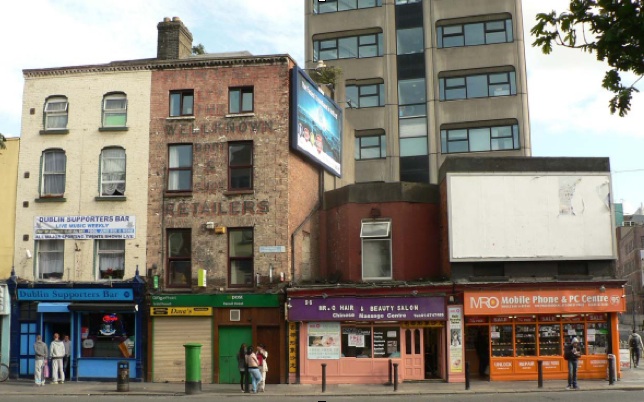
Number 98 Parnell Street (previously Great Britain Street) is a “terraced two-bay four-storey house” built in circa 1810. It served as the Healy family grocers from the mid 1800s until the early 1960s.

Unusually the proprietor James Healy was a Dublin-born publican as can be seen here for the 1901 census for the family.

1901 Census Return form for James Healy and family, 98 Parnell Street.

It was taken over  by well-known Dublin hurler Mick Bermingham and was under his stewardship until around 1982.

An advertisement for Mick Bermingham’s, 98 Parnell Street. Credit – Munster Express, 3 September 1971.

The pub was known as The 98 in the late 1980s; The Thornbush in the 1990s and then operated as Zagloba for the growing Polish community in the mid 2000s.

Its most recent carnations – the Dublin Supporters Bar and The Dubliner- were known for its cheap drink offers and all-day karaoke.

Dublin Supporters Bar, 2011. Credit – Paolo Trabattoni.

Dublin Supporters Bar, 98 Parnell Street pictured in 2013. Credit – Broadsheet.ie

In the last couple of months, it has closed, revamped and re-opened as The Luggage Room Bar. Going for the budget hipster look, it offers ‘student nights’, ‘pitcher Wednesdays’ and ‘Brazilian parties’.

The Luggage Room Bar, Halloween 2017. via Facebook.
Sindo1

Evening Herald, 4 September 1978.
In a former life, one of my great areas of academic interest was the so-called ‘Animal Gangs’ of 1930s and 1940s Dublin, and some of that research was eventually published. I was fascinated more by the folk memory around the gangs than anything else I think, and enjoyed delving into the newspaper archives and Garda intelligence files.

Recently I’ve been reading a lot about Dublin in the 1970s (before my time, but by considerably less than the Animal Gangs). Just as the media panicked in the 1930s about the Animals, the so-called Bugsy Malone Gang of the north inner-city frightened the powers that be and the press. Taking their name from the hit 1976 gangster comedy film, the gang was comprised of very young teens who made a name for themselves primarily through a series of daring ‘jump overs’ in the city, that is leaping over bank counters before making off with their takings. In time, the name seems to have been applied more widely to all youth crime by some journalists. The gang have warranted passing mentions in studies as diverse as Diarmaid Ferriter’s Ambiguous Republic: Ireland in the 1970s, Garry O’Neill’s Where Were You? and several histories of Dublin crime gangs. The primary reason for their passing mentions in the later is the alleged involvement of Gerry Hutch, or ‘The Monk’, in the gang. A 2000 article in the Irish Examiner went as far as to claim that “in the 1970s, the Bugsy Malone gang was effectively led by Hutch. This gang of Dublin inner city youngsters were in to all kinds of crime, especially so called jump overs.”

The first most people would have heard of any such gang was a report in the Sunday Independent in late January 1978, which noted the presence of a young gang “being compared to the mini Chicago criminals in the box-office film hit, Bugsy Malone“. It detailed how the gangs 13-year-old “Godfather” had been arrested in the aftermath of a raid on the O’Connell Street Northern Bank, during which £1,400 was snatched after “the daring raid was carried out by hurling a bottle through a plate glass door.”

Sindo1

Sunday Independent, 23 January 1977.

Reports of the gang sometimes appeared only pages away from advertisements for the film of the same name. By the early months of 1978 the movie was out of the picture houses, but the gang remained, now being refereed to as “infamous”. The Minister for Defence bemoaned how an organised gang of juvenile criminals was “roaming the streets of Dublin, openly cocking their noses at the Gardaí and courts.”

It all took place against the backdrop of an explosion of cases in the Children’s Court, where the number of charges brought against juveniles had reportedly soared from some 5,000 to  25,000 in just a decade. While not excusing the actions of any gang, the Irish Democratic Youth Movement, aligned with Sinn Féin the Workers’ Party (SFWP), rightly pinpointed “appalling housing conditions, inadequate education and the total lack of recreational facilities” as issues which “create an environment which breeds crime and violence.”

The sheer volume of bank robberies in the city in the late 1970s was remarkable in itself – spanning everything from paramilitary organisations to organised crime groups. Some went unreported until court dates (if there were any) but the youth of this particular gang ensured their escapades were always covered in the press. It was even suggested that they’d established something of a headquarters on Lower Gardiner Street in a former trade union building, which the Independent christened the “Bugsy School.” The gang were sometimes pinpointed by the press for other criminal activity, such as arson:

Sindo1

Irish Independent, 1 June 1978.

Continue Reading »

self at 70

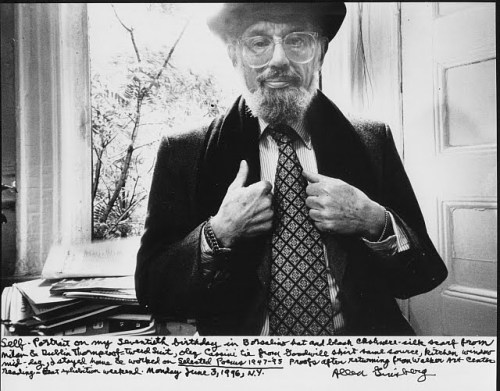
“Self portrait on my 70th birthday, in Borsolino hat and cashmere silk-scarf from Milan, and Dublin Thornproof-tweed suit, Oleg Cassini tie from Goodwill shirt from same source, kitchen window mid-day, I stayed home and worked on Selected Poems 1947-’95 after returning from Walker Arts Center reading – Beat exhibition weekend. Monday, June 3, 1996. N.Y – Allen Ginsberg (photo c. Allen Ginsberg Estate)]” (Image from Allen Ginsberg Project)

In 1993, the celebrated poet Allen Ginsberg arrived in Ireland for the first time. Always counter-cultural and sometimes controversial, Ginsberg was his own man throughout his entire life. The Irish Press noted before his visit that “Ginsberg is now in favour with a new generation who find the music their parents listened to more exciting that their contemporary soulless techno-pop”.

Ginsberg’s political activism often made headlines. An active opponent of the Vietnam War and American aggression in South America, he was deported from Cuba in 1965 for publicly condemning the treatment of homosexuals there. In terms of his own literary output, he is undoubtedly best remembered for Howl, a masterpiece which was dragged through the courts in a 1957 obscenity trial. Widely considered one of the great works of contemporary literature, it captured the madness and spirit of the Beat Generation to which Ginsberg was so central, alongside people like Jack Kerouac, William S. Burroughs and Herbert Huncke. In my youth, I stumbled on it after becoming obsessed with Kerouac’s On The Road (a teenage rite of passage for the angsty), which began a journey into the output of related writers.

I saw the best minds of my generation destroyed by madness, starving hysterical naked, dragging themselves through the negro streets at dawn looking for an angry fix, angelheaded hipsters burning for the ancient heavenly connection to the starry dynamo in the machinery of night, who poverty and tatters and hollow-eyed high sat up smoking in the supernatural darkness of cold-water flats floating across the tops of cities contemplating jazz.

– From Howl.

Ginsberg performed in Dublin’s Liberty Hall before a packed crowd in October 1993. In interviews leading up to his visit, he noted what lured him to Ireland wasn’t money, but the promise that Theo Dorgan of Poetry Ireland would procure him a new tweed suit. One contemporary report noted that “after a little shopping around, Dorgan found that Kevin and Howlin tailors on Nassau Street did a variety of the ‘thornproof’ tweed and it was there that Ginsberg was outfitted. The irony of the company’s name wasn’t lost on him either.”

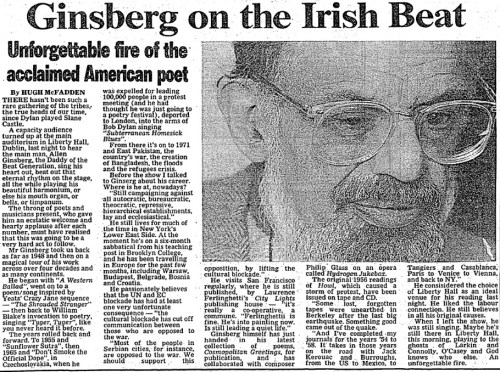
Ginsberg’s Liberty Hall appearance was the stuff of legend, leading one journalist to write that “there hasn’t been such a rare gathering of the tribes, the true heads of our time, since Dylan played Slane Castle.” The great, the good and Bono were among the attendees. The Irish Press noted:

He considered the choice of Liberty Hall as an ideal venue for his reading last night. He liked the labour connection. He still believes in all his original causes. When I left the show, he was still singing. Maybe he’d still there in Liberty Hall this morning, playing to the ghosts of Larkin, Connolly, O’Casey and God knows who else. An unforgettable fire.

self at 70

Irish Press report on Ginsberg visit.

In a postcard, Ginsberg noted with delight that “Part of my Dublin fee was great grey tweed suit so now I look like an elder Irish gentleman crossing customs borders.”

The suit meant a lot to Ginsberg. Three years after his Dublin visit, he donned it for a self portrait,along with his “Borsolino hat and cashmere silk-scarf from Milan”. Some accounts suggest he was buried in it. Kevin and Howlin remain open for business today on Nassau Street, almost twenty-five years after dressing one of the greatest poets of his generation (or any other).

In terms of music history, we’ve generally been more focused on punk, soul, reggae and rockabilly but Come Here To Me! has looked occasionaly at the city’s rave, dance and club culture. For example, we’ve examined legendary 1980s gay-disco Flikkers;  iconic DJ Paul Webb; the 1998 techno tune ‘Northwall’; a general overview of sources for the history of Dublin’s dance culture; a look at the after-party scene in 2011 and a reference to the early-morning techno gigs in The Dark Horse (now a Starbucks).

Soundtracksforthem.com was an Irish group blog active from 2006 until 2010. It was a wonderful mix of music, politics, film and art. The architect was one James Redmond (aka Reddy). Highly influential to the development of Come Here To Me!, Soundtracksforthem.com gave a deserved platform to a gang of mischief makers and friends of ours with enigmatic nicknames like ‘Chief’, ‘Krossphader’ and ‘Cogsy’.  From 2010 onwards, Reddy transferred his work and energy into Rabble magazine and I take great pleasure in remembering those early organising meetings and first number of issues. But all during this time, Reddy was working away on researching, producing and editing a documentary film called ‘Notes on Rave in Dublin’.  Premiered at the Dublin International Film Festival 2017 over two-sold out dates in February, the film explores the glorious, early days of the underground dance music scene in Dublin.

One of those interviewed in the documentary is Simon Conway. Throughout the 2000s, Simon ran the much-lauded Electric City nights and Selectah Records. I first got to know Simon through his wonderful Forza Italo disco nights in the Odessa club. Along with the Con Artist thinking-man’s football nights in the Sugar Club and the Out to Lunch takeovers of Tengu, Simon somehow also has time to run The Yacht pub in Ringsend which is one of the best boozers in the city. Full stop.

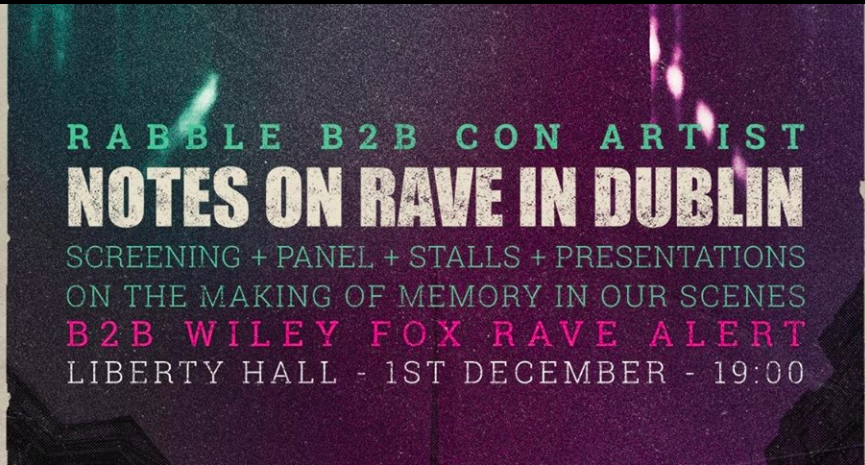
These two powerhouses – Reddy and Simon –  have joined forces to bring you a solid night of entertainment this Friday 1st December across two venues.

Things kick off in Liberty Hall at 7pm with three presentations from individuals working on some exciting cultural projects:

  • John Byrne will talk about a forthcoming compilation called Quare Groove which unearths a collection of Irish Groove, Punk-Funk, & Electro tracks from the 1970s to 1990s. It’s due out on Allchival (All City) in January 2018.


  • Ciaran Nugent of Power FM will chat about his many years of collecting flyers from the golden era of Dublin clubbing.


  • Garry O’Neill, editor of the vital ‘Where Were You? Dublin Youth Culture and Street Style 1950 – 2000, introduce his new book which focuses on the history of record shops in Dublin.

This will be followed by a panel discusison, hosted by music journalist and DJ Kate Butler, with author Kevin Barry, DJs Liam Dollard, Francois Pittion and Aoife Nic Canna who were at the forefront of things in the late 1980s and 1990s and Sunil Sharpe who is Ireland’s most significant contemporary Techno export.

Event poster.

Around 9pm, ‘Notes on Rave in Dublin’ will be shown on the big screen.

But the night doesn’t end there. Oh no. The party is moving next door to The Wiley Fox (formerly The Pint). Here, a collection of the city’s best DJs will be spinning tunes until the wee hours.

Upstairs:

Breen (Vision Collector/DDR) x Sias (Repeater Collective/DDR) x Melly (Repeater Collective/DDR)
+
DJ Kit-Kat Tennis League

Downstairs:

Garry O’Neill / Francois + more TBC

Tickets for the screening –  €12. Tickets for the after party – €12. You can pick up a combo deal for €20. Available from Eventbrite.ie


restored

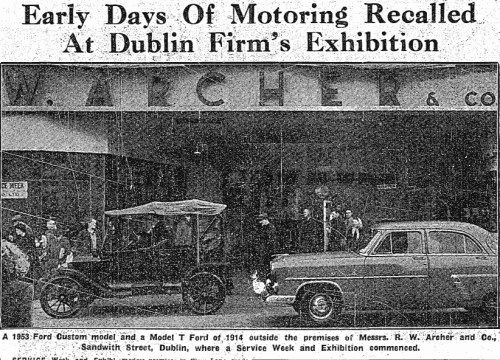
The original Archer’s Garage, Irish Independent 11 March 1953.

Archer’s Garage, where Sandwith Street meets Fenian Street, is a beautiful Art Deco building – but it isn’t quite as old as it looks.

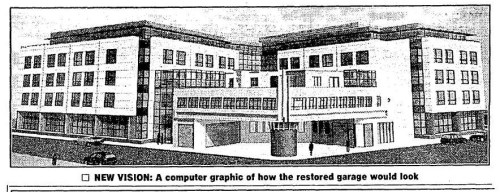
Over the June Bank Holiday weekend in 1999, one of Dublin’s more peculiar buildings was illegally razed by a developer, leading to massive controversy. The developer in question signed a legal agreement with Dublin Corporation to rebuild the structure, which prevented prosecution for the act of senseless vandalism, and was preferable to a fine of a million or jail time! An Taisce noted that “it is the first time a developer has had to restore a listed building in Dublin.”

restored.jpg

Evening Herald, 12 October 1999.

Archer’s Garage took its name from R.W Archer, the first man to import Ford cars into Ireland. Archer attended Dublin’s first motor car show in the RDS in 1907, which began a love affair with cars. At ninety years of age, he was still reportedly working three days a week in the garage in 1967!

Completed in 1946, the garage was designed by Arnold Francis Hendy, who was also responsible for the beautiful Pembroke Library.  While Art Deco buildings certainly stand out in the city (the GAS building on D’Olier Street being particularly popular), there is a richer history of Art Deco style architecture in this country than one might first think, highlighted recently by this excellent piece in Village magazine. Perhaps the most celebrated Art Deco architect to work in Dublin was Housing Architect Herbert Simms, whose public housing units (in particular the Chancery House scheme beside the Four Courts) remain popular. The Art Deco buildings of Dublin are, like most schools of architecture, a mix of public and private buildings.

The reconstruction of the demolished garage was scheduled to begin in September 1999, just months after its demolition, though work didn’t start until 2001. When completed, the building was widely praised. Still, it is difficult to disagree with the assessment of BuiltDublin.com that something just isn’t right:

For me, it’s impossible to shake off the Pet Sematary feeling about the building – not the demonic possession aspect, but the creepiness of reanimation. There isn’t an ‘undo’ function after demolition, and however grand words like ‘reinstate’ might make the process sound, this is a building completed in 2000 to a best-guess version of an 1940s design, and I can’t see how that’s desirable or anything other than a very particular pastiche.

Archers_garage_dublin.JPG

The reconstructed Archer’s Garage. (Image Credit: Creative Commons, Kolleykibber )


Check out our music history section for lots more articles on the bands, venues and records of the late 1970 and early 1980s Dublin music scene.

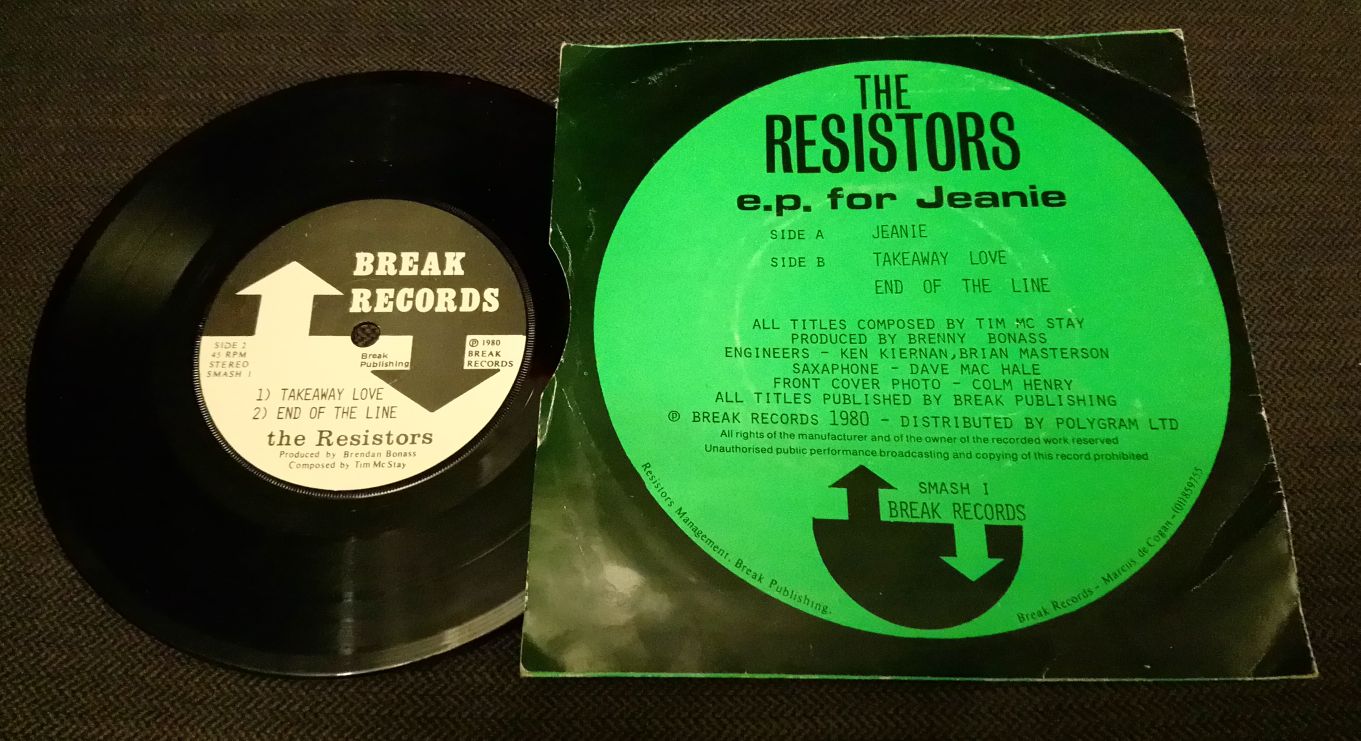
The Resistor EP front. Credit – Sam (CHTM!)

The Resistor EP back Credit – Sam (CHTM!)

After a number of years of searching, I finally got my hands today on a rare Dublin New Wave 7″ from The Resistors.  All thanks to the wonderful photographer Wally Cassidy who is helping to sell his friend’s record collection.

Titled ‘EP for Jeanie’ and released in 1980, it was the the one and only output from the band’s own label ‘Break Records’. The contact person for the record company listed on the single is Marcus de Cogan who was Ents officer of UCD Student’s Union  in 1976/77.

The Resistors, who were active from 1978 until 1983, were described by music journalist Neil McCormack at the time as playing “reggae tinged new wave pop”. The band comprised of:

  • Peter McEvoy – Vocals
  • Paul O’Reilly – Guitar
  • Pat Hamilton – Guitar
  • Tim McStay – Keyboards
  • Valentine – Bass
  • Brian ‘Bun’ Curran – Drums

Three of the band had previously performed together in The Noise Boys (1978-79).

All three songs on ‘EP for Jeanie’ were composed by keyboardist Tim McStay.

The Resistors live. Credit – Bert Versey (via http://u2theearlydayz.com/)

The record was produced by Brendan ‘Brenny’ Bonass who had played guitar with a host of Dublin beat/blues/rock bands in the 1960s and 1970s including The Inmates, The Uptown Band, The Stellas, The Chosen Few, Rockhouse and Stepaside.

It was engineered by Ken Kiernan, who had co-founded Keystone Studios in 1977 and played guitar and keyboards with Pulling Faces, and Brian Masterson, who had co-founded  Windmill Lane studios in 1978, and played played bass with jazzy-rock groups Jazz Therapy and later Supply, Demand and Curve .

The record featured saxophonist Dave McHale, formerly of Stagalee, The Boomtown Rats amongst others, who sadly passed away in 2009.

The front cover photograph was taken by Colm Henry.

Side A

‘Jeanie’ is an up-beat track with strong two-tone and mod revival influences.

Side B

‘Takeaway Love’ is a decent power-pop tune.

More of the same with ‘End Of The Line’

The band’s second single ‘That’s It‘ (1983) is probably even more rare with not a single copy ever sold on Discogs since 2000. It’s a collector’s item as Phil Lynott produced the b-side. Luckily, I was recently passed down a copy and will get around to digitising it as soon as possible.


LarryAdler

Evening Herald, 29 April 1991.

Morrissey’s father phoned the Gerry Ryan Show once in its early days to complain about the lack of airplay given to his son’s music on Irish radio.

-Dermot Hayes writing in the Irish Press.

Friday sees the release of Morrissey’s new record, Low in High School. Its cover features a child holding an axe outside Buckingham Palace, clinging to a placard that says ‘Axe The Monarchy’. One would expect nothing less.

His solo career has now produced a remarkable eleven albums, beginning with 1988’s Viva Hate. If you care, my favourite remains You Are The Quarry. Next February, Morrissey returns to Dublin to play the Point Depot, a venue we will never call by any other name. He is strongly bound to Dublin through blood, but also a passion for Irish literature, which included reference to Brendan Behan on his last recorded album.

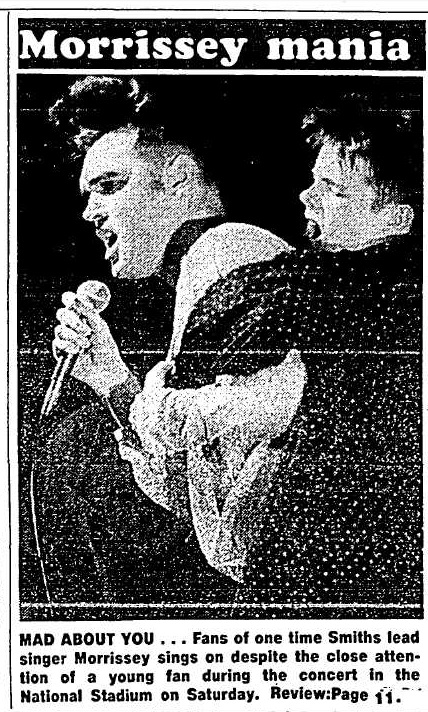
It’s an interesting part of the Morrissey story that his first proper solo concert was here in Dublin, with a sold-out concert at the National Stadium in April 1991. There had been a gig in December 1988 in Wolverhampton, but it was in many ways the remnants of The Smiths, and largely consisted of Smiths songs. Dublin was the beginning of the first ever Morrissey solo tour, backed by a new band and performing only his own songs.

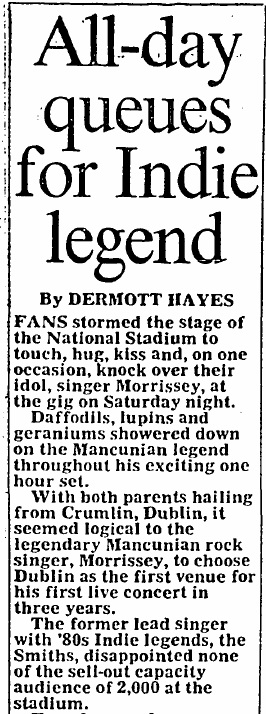
A negative review in the Evening Herald inspired full pages of letters from disgruntled fans over subsequent days, but for most who were there the concert was nothing short of a revelation, with tickets selling out in an impressive forty-seven minutes (before the internet). The Irish Press couldn’t quite get the appeal, asking just what was it about “the bard of bedsit psychoses” that appealed to Irish teenagers. It was all front page news the following day, viewed as nothing less than the latest youth culture craze in the eyes of curious journalists.

Daffodils, lupins and geraniums:

LarryAdler

Irish Press, 29 April 1991.

The constant stage invasions at the National Stadium were one feature of the concert that fascinated journalists, with the Press commenting on how “Daffodils, lupins and geraniums showered down on the Mancunian legend throughout his exciting one hour set.”

Over in the Herald, the review could have been about Bill Hailey and the Comets or The Beatles, both of whom had caused their own scenes on Dublin stages decades earlier:

To say Morrissey is idolised by his fans is an under-statement. They could not be kept off stage – although at times it looked as though even the narcissistic Morrissey was getting fed up with being kissed repeatedly on the ear.

Dressed in jeans and a glittering lurex style v-necked vest, Morrissey, to the delight of a packed arena, spent much of the evening wrapping his arms around his own body, running his hands through his hair and letting his tongue shoot back and forward lizard-style.

The youth of the crowd was commented on in many places, NME joking that “the only way they could have bought Meat Is Murder is by being wheeled into the store in a pram.”

Emerging on stage, Morrissey told the audience that “it’s very nice to be here, and it’s really touching but if you don’t come on the stage then we can play better.” Nobody listened. One great account of the gig comes from David Bret’s Morrissey: Scandal and Passion. The concert had a large Garda presence, who had done their research into the fandom surrounding the artist, and Bret writes “his opening number, ‘Interesting Drug’, was virtually inaudible on account of the fans excitement. One of these grabbed the microphone from him to yell ‘I love you Steven!; Morrissey grabbed it back and growled ‘Thank You, but I don’t know who Steven is!'”

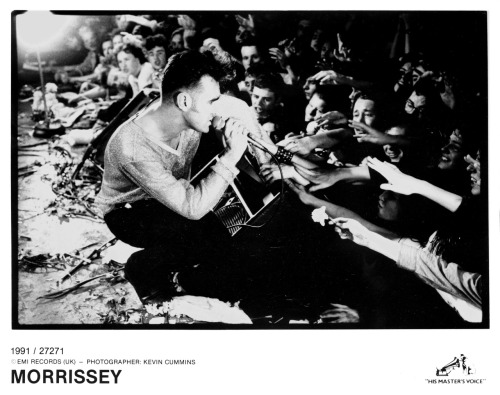
tumblr_mc6u2xboiP1qimibko1_500

Notice the flower-covered stage! This image from the concert was later used by EMI Records.

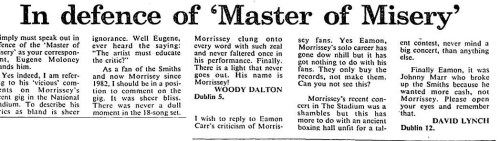
After a few days, the Herald had to guillotine Morrissey related letters, as fans had taken such offence to their review of the gig. Woody from Dublin 5 insisted that “there is a light that never goes out. His name is Morrisssey”, while David in Dublin 12 agreed that the concert hadn’t been great, maintaining “this has more to do with an ancient boxing hall unfit for a talent contest, never mind a big concert, than anything else.”

LarryAdler

The set list included no Smiths numbers (it was far too early for that), but there was a cover of the New York Dolls song ‘Trash’, dedicated to the great Johnny Thunders who had died shortly before the concert. Despite what the Herald maintained, it seemed to everyone else that the man who would later describe himself as “ten parts Crumlin, and ten parts Old Trafford” was off to a flying start. A few months later he returned to the much larger Point Depot, his boxing stadium days behind him in Dublin for a while at least.

SET LIST, APRIL 27 1991:

Interesting Drug
Mute Witness
The Last Of The Famous International Playboys
November Spawned A Monster
Will Never Marry
Sing Your Life
Asian Rut
Pregnant For The Last Time
King Leer
That’s Entertainment (The Jam Cover)
(I’m) The End Of The Family Line
Everyday Is Like Sunday
Our Frank
Disappointed
Piccadilly Palare
Suedehead
Trash (New York Dolls Cover)
I’ve Changed My Plea To Guilty

https://www.youtube.com/watch?v=dwGGfcycPEU

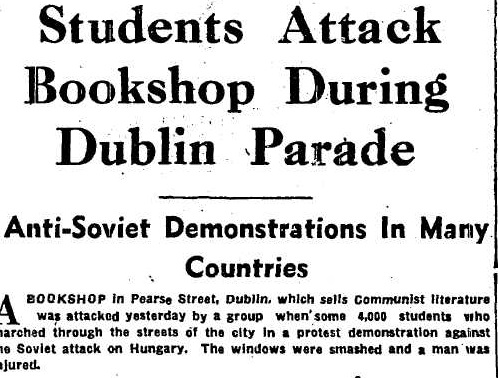
The Attack on New Books, 1956.

dub

Irish Examiner, 9 November 1956.

The idea of hundreds of people laying siege to a bookshop or a political party office is a strange one that we might not associate with Dublin, but it has happened here on more than one occasion.

Yesterday was the centenary of the birth of Michael O’Riordan, a remarkable figure in Irish political history. Born in Cork in November 1917, just days after the Bolshevik revolution had transformed world politics forever, O’Riordan devoted decades of his life to the cause of communism in Ireland. It wasn’t always (or ever) a popular cause to promote. In 1989, he joked in one interview of how “we are becoming more acceptable, people no longer cross the street when they see me coming and bless themselves.” O’Riordan, a veteran of the Spanish Civil War, remembered the more difficult days no doubt.

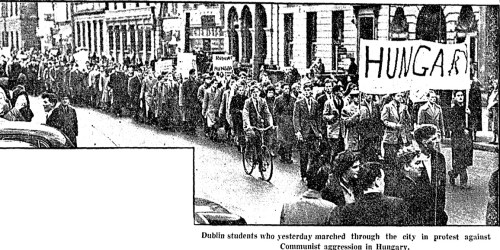
In the early 1930s, anti-communist sentiment in Ireland was sharpened by events on the continent, and in particular the rise of the left in Spain. It spilled over in March 1933 with the siege of Connolly House on Great Strand Street, the headquarters of the Revolutionary Workers’ Group, a forerunner of the Communist Party. Just over two decades later, in 1956, events in Hungary brought thousands onto the streets of the capital again, this time directing their anger at New Books on Pearse Street, the forerunner of what is now Connolly Books and the home of the Communist Party in the city.

The anti-Soviet uprising in Hungary in the winter of 1956 received much sympathetic coverage in the Irish press. When Soviet troops took control of Budapest and other urban centres from 4 November, the resulting violence led to hundreds of deaths. In Dublin and many other cities across Europe, protests followed.

dub.jpg

Irish Press, 9 November 1956.

A protest of some 4,000 students on O’Connell Street saw placards reading ‘Communism: Down With It’, ‘Aggression: We Know What It Means’  and ‘Save Crucified Hungary’ carried. Banners identified the students as coming from UCD, Trinity, the National College of Art and other institutions. It was all standard protest fare, but at New Books on Pearse Street things took a turn, with the Irish Examiner detailing how attempts were made “to rush the seven policemen outside the shop, but this failed, and cries of ‘burn it down!’ were heard.” The windows of the bookshop were smashed, as well as an unfortunate neighbouring business premises. Its owner told the press he was in full sympathy with the objectives of those who had damaged his premises!

dub

Sunday Independent, 11 November 1956.

dub

The Irish Democrat, newspaper of the Connolly Association, reports on the attack.

Not all opposition in Dublin to the behavior of the Soviet Union in Hungary came from the traditional religious right, the instigators of much of the violence in the 1930s. The meeting organised by the National Students’ Council on College Green following Hungary was described as being “both anti-imperialist and anti-communist”, with one speaker insisting that “if there was an armed insurrection in the Six Counties there would be a repetition of the brutality of the scenes in Budapest.” Among the speakers was Count Nickolai Tolstoy, described as a “White Russian now a student in Dublin” (though born in London) and an Egyptian student who condemned Britain’s actions in Suez and Cyprus. In some ways, it was not unlike the huge demonstrations in Dublin in 1949 over the imprisonment of of Cardinal Mindszentry,  which was also an unlikely coming together of the right and some from the left, including the Larkinite Workers’ Union of Ireland.

New Books continued on, moving to Parliament Street in 1971, before finding its current home on East Essex Street, where it is known today as Connolly Books. In the words of Irish Times writer Frank McNally, it has somehow survived “the rise of that flagship of rampant western consumerism known as Temple Bar.”

lasttango

Irish Independent, 17 July 1919.

There was something of a furore this week when Leo Varadker wore a remembrance poppy into the Dáil. Personally, I think it is the right of anyone to wear or not wear any commemorative symbol they choose. I wear a white poppy each year, primarily in memory of my great-grandfather, one of the tens of thousands of Irish victims of the slaughter of the First World War. A white poppy (intended as an anti-war symbol and created in the 1930s) probably annoys both sides in the debate, but that isn’t the intention.

Commemoration of the past in Ireland is a loaded thing. When Sinn Féin TDs wore Easter Lilies into the Dáil in 2013, Charlie Flanagan lambasted them on the basis that “some members of this House may find the wearing of such emblems offensive.” When Fine Gael TD  Frank Feighan wore a remembrance poppy into the Dáil, nobody from the otherside of the floor objected. Why would they bother?

There has been a lot of work in recent years by historians, academic and otherwise, on remembrance of World War One in Ireland. The myth that the First World War was somehow ‘forgotten’ in Ireland is surely laid to rest by now, thanks to work highlighting Remembrance Sunday’s attended by tens of thousands in the capital, and the phenomenal public appetite for films like Ypres and The Battle of the Somme. In an account of childhood in working class Dublin, Brendan Behan remembered the importance of the memory of the war in parts of the city:

When the singing got under way, there’d be old fellows climbing up and down Spion Kop til further orders and other men getting fished out of the Battle of Jutland, and while one old fellow would be telling how the Munster’s kicked the football across the German lines at the Battle of the Somme, there’d be a keening of chorused mourners crying from under their black shawls over poor Jemser or poor Mickser that was lost at the Dardanelles.

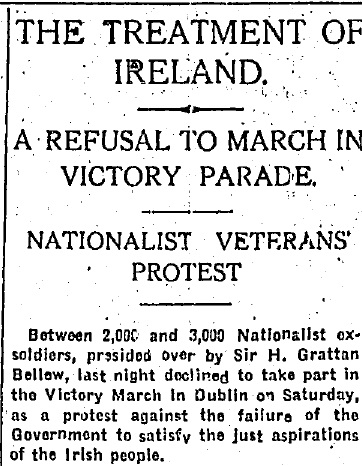
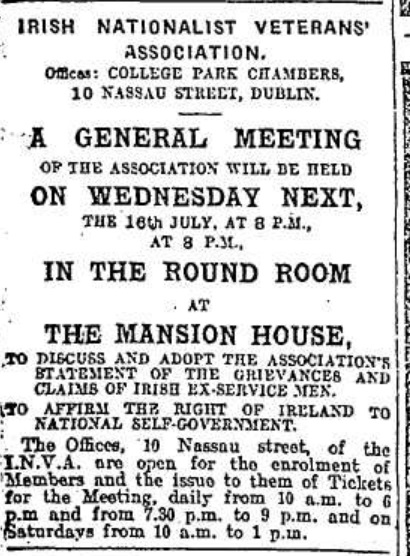
It was in the very immediate aftermath of the war that the question of how it should be remembered was first being asked of course, and one interesting intervention was the Irish Nationalist Veterans’ Association (INVA), founded at a meeting in Dublin’s Mansion House in May 1919.

With some 2,000 to 3,000 men refusing to march in the 1919 victory parade through the city, the body claimed that “they did their part to resurrect ancient nationalities and to redress grievances in other oppressed nations, and on return they find in Ireland a larger occupation than Germany found necessary to keep down Belgium.”

lasttango

July 1919 advertisement.

The War after the War:

Certainly, significant numbers of ex-servicemen did enlist in the ranks of the Irish Republican Army, the Citizen Army and other separatist bodies during the War of Independence, most famously men like Tom Barry and Emmet Dalton. Paul Taylor has noted that “the witness statements of IRA veterans contained in the Irish Military Archives refer to 109 ex-servicemen serving in the IRA….They include 24 commanders (almost all on active service),34 instructors (at least 15 on active service), 42 other Volunteers on active service and eight intelligence officers.” There were several hundred such men across the country, a frightening prospect for the authorities.

Yet for many veterans of the war, their fighting days were behind them. At the first meeting of the INVA the anger in the room was palatable, something captured in contemporary newspaper reports. Widows, the maimed and others demanded Irish nationhood be recognised, with war veteran Brigadier General Hammond in the chair. Men who had followed the Redmondite line that the interests of all of Ireland were served in the War now found themselves feeling abandoned, as “they believed honestly in the adhesion of the democracy of England to the just claims of Ireland when they entered the war, and they now told English statesmen that the eleventh hour had struck.”

Among veterans themselves, there were questions of what form Irish self-government should take. Some shouted ‘Up the Republic’, while a Captain Sheehy was booed for proclaiming his belief in “Colonial Home Rule”. The widow of Tom Kettle, who had been a founding member of the Irish Volunteers and an Irish Parliamentary Party MP in the years before his death on the Western Front in 1916, proclaimed boldly that “the men who went to France have been betrayed.”

Spreading beyond Dublin,the INVA had a presence in Belfast too, where Richard Grayson notes “in 1920 it took in political events such as a May Day labour rally in Belfast, but it was increasingly concerned with representing its members. In particular, it lobbied the local War Pensions Committee.” Beyond demanding recognition of Irish nationhood, the INVA in Dublin also made financial demands, with Mrs Kettle insisting “there should be an increase of all existing pensions and gratuity rates”, while there were demands that “work be started to give employment to ex-service men.” In the 1920 local elections, a 21 year old veteran of the war, Alderman Harkin, President of his local Nationalist Veteran’s Association, was elected in Belfast. He “romped home by a huge majority in a division hitherto exclusive to the Orange party.”

lasttango

Letter in Freeman’s Journal, May 1920.

After independence, the question of remembering World War One was a complex one. Foolishly, some IRA men chose to attack those who participated in remembrance services, while on the otherside some uniformed British Fascisti used the day to provoke republicans and the left. The Gardaí themselves complained that the day was being exploited for “imperialist displays”. In the middle of all of this were tens of thousands of people who just wanted to remember their own dead with dignity.

On Remembrance Sunday 1934, an appeal to Irish ex-servicemen was issued, claiming that “the Armistice Day parades under the British Legion have been proved for the last ten years to be an insult to the dead and a mockery to the living.” Frank Ryan, one of those who had been prominently involved in shutting down earlier Remembrance Sunday events, shared a platform with Irish veterans of the war who marched through the city. Patrick Byrne of the Republican Congress remembered years later that “I had urged this new approach because of the disgust I felt when I saw some ex-servicemen being set upon for wearing their medals and poppies on their ragged coats.”

The men and widows of the INVA should not be forgotten. When the war was over, a conflict between empires, it left tens of thousands of people without fathers, husbands and sons. People had the right to mourn,to be angry, and to remember.


LastTango

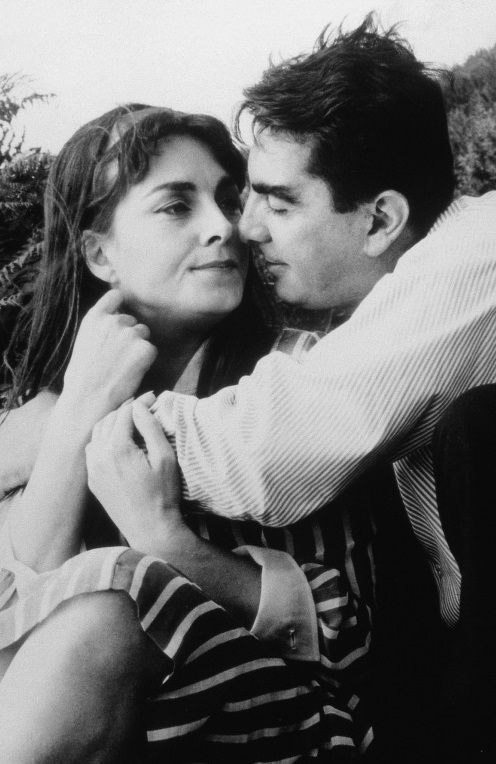
Barbara Jefford as Molly Bloom and Milo O’Shea as Leopold Bloom in Joseph Strick’s 1967 Ulysses.

Fifty years have passed since one of the great Irish cinema controversies, when James Joyce’s Ulysses made it to the big screen, only to be banned here. The work of American director Joseph Strick, it would remain banned until 2000, giving it the rather dubious honour of being the longest banned film in the Irish state. In New Zealand, it was only shown to gender-segregated audiences.

Ulysses had long been a controversial work. When Sylvia Beach made the brave decision to publish the work in print in February 1922, the book was widely condemned, often by people with no intention of reading it. The Sporting Times, a weekly British newspaper, regarded the book to be the work of “a perverted lunatic who has made a speciality of the literature of the latrine.” The Dublin Review went further still, wondering how “a great Jesuit-trained intellect has gone over malignantly and mockingly to the powers of evil.” To D.H Lawrence, himself a victim of censorship, the book was “the dirtiest, most indecent, obscene thing ever written.” It wasn’t only British and Irish sensibilities that were offended by the book; in the United States, some libraries refused to stock the book, denouncing it as pornography.

Yet whatever about the printed word (and it should be noted that Ulysses was never actually banned in Ireland, though condemned) it was the 1967 film version of the tale which shocked Irish sensibilities most. Denounced by the authorities as being “subversive to public morality”, it remained banned in Ireland for more than three decades. The film proved controversial globally, even inspiring a walkout protest at the Cannes Film Festival, with the audience of critics who booed the film denounced as “illiterates” by a festival official. The use of the word ‘fuck’, coupled with a nude man shown from behind, was too much for some.

LastTango

Liberty Hall, a very new Dublin landmark.

Joseph Strick’s Ulysses is true to the text, but also very much of its own time. Though Joyce set the story on 16 June 1904 (now eternally known as Bloomsday), Strick made no attempt to hide 1960s Dublin from the cameras, and the city itself emerges as one of the stars of the film. I like to think that Joyce, a true modernist, would welcome Strick’s playfulness with the contemporary city. We see Liberty Hall, Desmond Ri O’Kelly’s sixteen storey building by the Liffey. Then the tallest building in the state, such a building was a distant dream in the Dublin of 1904. We also get a great look at the much-missed Irish House pub on the corner on Winetavern Street, sadly lost a decade later to the regeneration of Wood Quay for the Civic Offices.

Strick originally intended to make the film more than eighteen hours in length, though financial constraints thankfully prevented this. The film divided critics; to the Sunday Independent, it was “a sincere if rather tedious homage to Joyce – very much a filmed book. It is totally innocuous visually.” It received an Academy Award nomination for Best Adapted Screenplay, and the cast was something of a who’s who of Irish stage and screen acting. Leopold Bloom, the central protagonist, was portrayed by Irish stage actor Milo O’Shea, while Barbara Jefford was one of the few non-native talents, taking on the role of Molly Bloom. To her fell some the most controversial lines in Ulysses, and her characters bluntness about sexual matters like masturbation stood little chance against the Irish censor. Her performance is masterful, at its best in her closing soliloquy.

Continue Reading »