Feeds:
Posts
Comments

Farewell to Liam Sutcliffe

liamsutcliffe

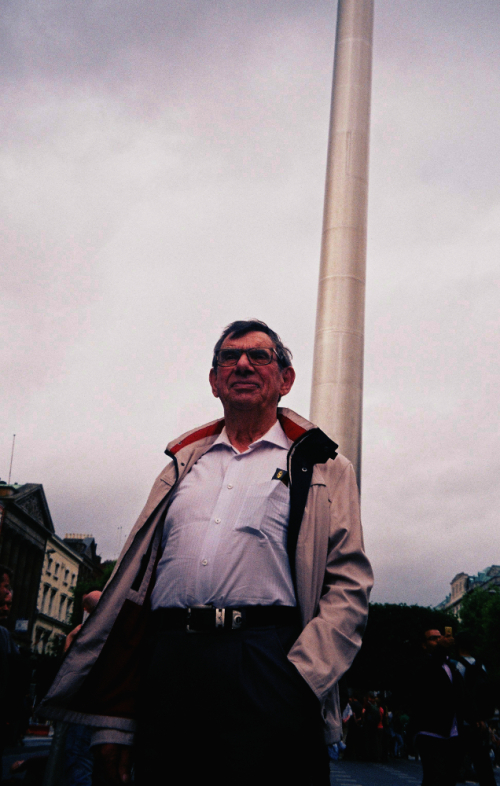
Liam Sutcliffe at the Spire, previously published on CHTM in Dear, Dirty Dublin series.

Whether or not the removal of Admiral Horatio Nelson from the Doric column on which he stood for so long was a good or bad thing will be eternally debated by Dubliners.

In the immediate aftermath of the blast, there were mixed reactions too. An American journalist wrote home that “Dublin’s mood was one of gaiety. Crowds jostled and joked around the police cordons at the scene.” By comparison, The Economist condemned the blast, as “Nelson’s fall may be good for a laugh; but it is comical only by the greatest good luck. Post-colonial Dubliners being safely in their beds by 1.30 a.m, nobody was hurt.”

In recent years I got to know Liam Sutcliffe, one of the men responsible for the bombing of the Nelson Pillar, who died last Friday. When I wrote The Pillar in 2014, he signed more copies of the book than I could dream of. He also had a remarkable ability to hear about any talk on the Nelson Pillar in the city. On one occasion, I got a good laugh out of seeing him stroll into Store Street Garda Station where I was giving a lecture for the Garda Historical Society on the Golden Jubilee of the blast. There may have been familiar faces in the room.

Liam Sutcliffe’s time in the republican movement did not begin or end on 8 March 1966. From Dublin’s south inner-city, he joined the IRA in 1954, shortly before the ill-fated Border Campaign. He was to become an IRA agent inside Gough Barracks in Antrim, gathering important information. Liam was among the (primarily young) men who followed the charismatic Joseph Christle out of the organisation; the ‘Christle Group’ were viewed as dissidents by IRA leadership, soon launching their own attacks north of the border. Joseph Christle had been among the students who climbed to the top of the Nelson Pillar in October 1954 and hung a banner of Kevin Barry from the viewing platform, carrying with them instruments they hoped would help remove Nelson. On that occasion, efforts to remove the Admiral failed, but his days were numbered. Gough, William and George could tell him as much.

Liam remained active in republican politics after the destruction of the Nelson Pillar, joining Saor Éire in 1970. In this capacity, he “was involved in the arming and training of the Nationalist Defence Committees in Belfast and Derry. He became a leading volunteer in the group, active in many of its engagements.” Saor Éire’s manifesto proclaimed that “in the Six Counties today the Butchers are at work again. The ghetto uprising of the Catholic-Nationalist population is the latest round in the Irish struggle for self-determination. But the rulers in the Free State are not in the least interested in the people North of the Border.” For Liam, there could be no question about the need to assist the besieged nationalist population.

In recent years, Liam was frequently to be found at commemorations honouring friends who had given their lives in the 1960s and 1970s, but he was also politically active in campaigns like that to Save Moore Street. A regular in Tommy Smith’s wonderful establishment, Grogans on South William Street, he had a great love for discussing history and politics and a wonderful friendly manner, not to mention a fine sartorial touch, never shying away from a pink shirt. He will be missed by many, and I will think of him every time I pass O’Connell Street.

Magazine

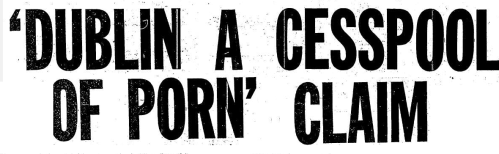
Evening Herald, October 1975.

My apologies for a relatively quiet CHTM!

I’ve spent the last few weeks traversing across Ireland with the National Treasures project. We set out to “crowd-source everyday objects that explore the history of the island of Ireland over the past 100 years”, and I feel confident in saying we did that. There will be an exhibition and a telly series in 2018, so it is all ahead of us.

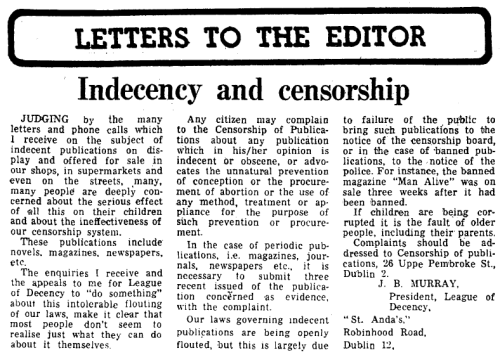
Anyway, a few items that came forward around Ireland really took me by surprise. In Belfast, we had a stall from the Brand New Retro team, and Brian McMahon and Sinead Kenny brought some wonderful periodicals from the Ireland of yesteryear. One which was most unusual was Man Alive (see issue 1 here), a short-lived magazine from the 1970s aimed at Irish men which included culture, sports, politics, art and…..a bit of nudity. The magazine attracted the predictable ire of the League of Decency, whose President described the banning of the mag as “a victory for morality.” The outlawing (temporary) of the magazine was front page news to the Irish Independent:

Magazine.png

Irish Independent, 25 October 1974.

Published for the first time in April 1974, Man Alive was too complex a publication to just dismiss it as an ‘Irish Playboy‘, or even the Playboy Of The Irish World. In its first editorial, it noted that “despite some of advance speculation it is definitely not, nor will it be, a pornographic magazine.” Man Alive insisted that it was “in fact the first general interest man’s magazine in the modern international mold. Our package is aimed at today’s increasingly sophisticated Irishman in his 20s and 30s.”

Contributors to issue one included Jim Fitzpatrick, the artist then best known for his series of posters celebrating Irish literary figures, not to mention the iconic Che Guevara poster of 1968. J.P Donleavy wrote about the response to The Ginger Man, which had infuriated Ireland’s moralists, while Alan Coran was an interesting international voice, a regular contributor to Playboy and The Times.

The magazine was produced by the Creation Group, responsible for titles as diverse as New Spotlight, Woman’s World and the Sunday World. The publication was decidedly liberal (not least beside the Sunday World!), with Issue One including a profile of Senator Mary Robinson. A British newspaper, baffled by the controversies around Man Alive, insisted that “it offers no more titillation than that endured almost daily by readers of the British popular newspapers, all of which except The Sun circulate freely and uncensored in the Republic.” To The Sunday Times, “what appears to have shocked the Irish most is the fact that local models were prepared to sell their modesty for £100 a session and appear on the pages of the magazine.”

High profile interviews included Charlton Athletic footballer Eamon Dunphy, who proclaimed that “football is run by an ignorant, amoral petite-bourgeoisie and it shows.” Philosophical as ever, Dunphy’s views on the state of the game wouldn’t have been welcome in a tabloid, but here he proclaimed:

There’s a crisis in football: the signs are everywhere – violence at the game, violence coming from the game, dull football. And of course, the thing which really worries the management, falling gates. People are beginning to realise that football is in part a con: that’s why there’s falling gates.

Profiles, sometimes critical, of leading figures in Irish life included Conor Cruise O’Brien, a man who had his own obsessions with censorship (though in his case, limited to political opponents with Section 31). There were difficult issues addressed in the magazine too; an article by Carol Shaw noted that while there organisations like The Union for Sexual Freedoms in Ireland, “it’s difficult for a movement like Gay Liberation to get off the ground in Ireland – mainly because of attitudes to sex.” An article on men’s sexual health issues  included an interview with a representative from the Irish Family Planning Association, which discussed the issues of men who attended their weekly psycho-sexual help clinics.

Clearly, there was a demand for the magazine.  Whether most people read the articles or not remains a subject of debate, but the sheer volume of sales told its own story. Issue 3 of the magazine boasted of the growth of the magazine, as “we printed 15,000 more than the first issue and it was a sell-out”. A circulation of 40,000 was claimed at the height of Man Alive‘s popularity.

Against the backdrop of the controversy, the League of Decency’s Joseph Murray was interviewed in the Irish Independent, outlining a belief that “what this country needs to stem the tide of depravity and corruption was not less censorship but more”, before singling out Christy Brown’s Down All The Days as a “very disgusting book and certainly not a book that should come from the pen of an Irish writer.”  Murray claimed that the League was heading towards boasting “eight significant branches in Dublin…ten in Cork and branches in at least 30 counties.” For someone who hated Man Alive, he could boast of owning a few copies, and showed one to the interviewing journalist:

I find that revolting and disgusting, a gross display of indecency.Those pictures are without doubt an incitement to sexual immorality. These days you cannot pick up a book or magazine or even so-called newspapers without seeing a naked or almost naked woman. This is bound to affect young and impressionable minds.

Magazine.png

Letter from the League of Decency to the Irish Press, December 1974.

The Censorship of Publications board ruled against the magazine on the basis it was “indecent or obscene”,  meaning that after four issues it temporarily disappeared from the shelves. Returning later in the year, they were warned a second ban would mean the “permanent banning of the magazine.” Man Alive limped on, with the Summer 1975 edition noting that it included “a new short story by John McGahern” and “Gorgeous girls galore.”

By October 1975, the magazine was no more, but foreign imports remained. It was all enough to lead the Catholic Young Men’s Society to declare Dublin a “cesspool of porn… the filthy literature that litters the streets of Dublin is on par with any cesspool in Europe.”

For a look inside the magazine and more from the weird and wonderful world of Irish publications, visit Brand New Retro.


Youth culture in Dublin is a reoccurring theme on the blog, from the Beat Clubs to the Teddy Boys.

This year marks the fiftieth anniversary of the birth of The Grove Social Club, an important local disco with a difference on Dublin’s northside which ran for an incredible three decades. A proudly alternative disco, this Raheny night achieved something of a legendary status, with the Northside People noting that it was “a safe haven for Northside teens; a melting pot where rockers could hang with Mods, Goths, geeks, hippies and Cureheads.” The club has inspired a dedicated website which tells its story, not to mention television documentaries and radio features. The club was such a part of the northside that one journalist was moved to write in the early 90s that “anyone between the ages of 15 and 40 living north of the Liffey has its name emblazoned on their souls.”

thebestdays

Evening Herald, December 1993.

The Grove club owed its very existence to Cecil Nolan, who the writer Tara Delaney would honour as “the man whose disco-spinning nursed generations through spots, break-ups and exam stress”. Emerging out of members of the Belgrove Football Club, Cecil was a natural DJ fit for the new local endeavor, already known locally as ‘The Music Man’ for his eclectic collection of records. He later recalled that “I played whatever I wanted because I knew there was a market out there for it and if it failed,well I didn’t care, at least I was enjoying myself.”

Beginning life at the Belgrove Football Club on Mount Prospect Avenue in 1967, it immediately acquired a reputation as a night with a difference. Attendees of the club remember the unique music it offered, from Led Zeppelin to Deep Purple, and from Elmore James’ Dust My Broom to Procol Harum’s A Whiter Shade of Pale. Much like DJ Paul Webb would recall Dublin’s Hirschfeld Centre as a break from “the same twenty clubs up on Leeson or Harcourt St all playing the same twenty songs” in the 1980s, The Grove introduced young suburban Dubliners in the 1960s to entirely new music, far removed from that in the charts. Following a fire at Belgrove, it moved to St Paul’s school in Raheny in the mid 1970s, though it retained its original name through subsequent decades. A recent video marking the fiftieth anniversary of the club shows its St Paul’s hall, with Cecil recalling his memories of the place:

Moral panic around youth discos in the 1960s was very real; readers of one newspaper were warned in 1967 that “a young boy or girl put on the way to becoming regular drinkers can only finish up as moral wrecks.” Plenty of column inches were lost on purple hearts and marijuana. Yet while plenty of newspaper ink went on that, there were also advertisements from young men and women looking to rent spaces across the city for discos.  In an affectionate remembrance piece on the youth discos of 1970s Dublin, the journalist Niall Bourke recalled how “your arse wouldn’t touch the ground until you hit the tarmac of the car park outside if you were found in possession of any dodgy substances.” It would be foolish to suggest drink wasn’t a factor in it all – Jason Duffy recalled “finishing off a few drinks in St. Anne’s Park before making our way into St. Paul’s” – but anyone who thought it the main attraction of a night out missed the point.

Whenever a journalist did darken the door of a youth disco, they found them to be places of community and enjoyment, and well-needed escapism from school and the stresses of life. The Grove in particular had a transformative effect for many, with broadcaster Marty Whelan (who met his wife at the club) recalling:

Every time I hear certain songs I’m right back there remembering the Grove. There was just a vibe. I think a place like that is special because someone like Cecil,who was from another generation, came up and related to every teenager who went over a thirty year period.

Hard rock took over for a period, but as Bourke noted, Cecil “knew how to work a crowd…during his career he presented the different genres of metal, punk, gothic and grunge to the ever-enthusiastic punters who lapped it all up with absolute relish.” A discussion on a forum dedicated to the club gives a sense of its 1980s playlist. The Damned and Motorhead competed for time against The Smiths, XTC and 10cc. Leonard Cohen’s Suzanne is recalled too, presumably a ‘slow dance and snog’ type of number. The last song played at The Grove in 1997 was Nirvana’s Smells Like Teen Spirit, a classic teenage angst anthem which includes the line “Here we are now, entertain us.” For thirty years, The Grove entertained without disappointment.

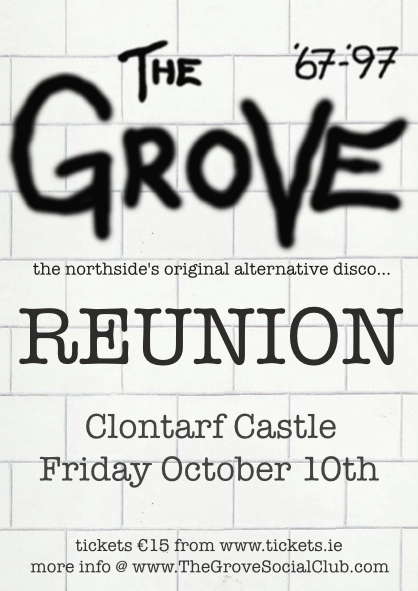
In 2006, RTÉ produced a True Lives feature special entitled The Grove: More Than A Feeling. Including contributions from RTÉ’s own Eileen Dunne, Marty Whelan and the comedian Brendan Bourke, it was a nostalgic but important piece of social history. It captured the sense of community which existed – and continues to exist – around the club. Reunion nights, instigated by former Grover Andy Colbert and featuring the original club DJ Cecil Nolan, have ensured that the community remains today.

TheGroveReunion

A Grove Reunion Poster.

As well as inspiring documentary features and reunion nights, The Grove has even made its way into fiction. In the trailer for the award winning 2007 feature film 32A, the story of teenage years in the suburban Dublin of the late 70s and early 80s, the all-important question “are you going to The Grove tonight?” is asked:

We salute all involved on fifty years of a club culture in Dublin, and may their reunions continue long into the future!


For a membership card from The Grove, see this recent addition to The National Treasures project. My thanks to Dr. Linda King, with whom I am working on National Treasures, for putting the idea for this article into my head!

The Winter Garden Palace was situated on the corner of 106 St. Stephen’s Green West and 24 Cuffe Street for over 200 years.

From the newspaper archives, it seems that the business was in operation from at least 1866. Described as the ‘Winter Garden’s Gin Palace’, its first proprietor was James Brady.

The Winter Garden Palace, The Irish Times (31 March 1866).

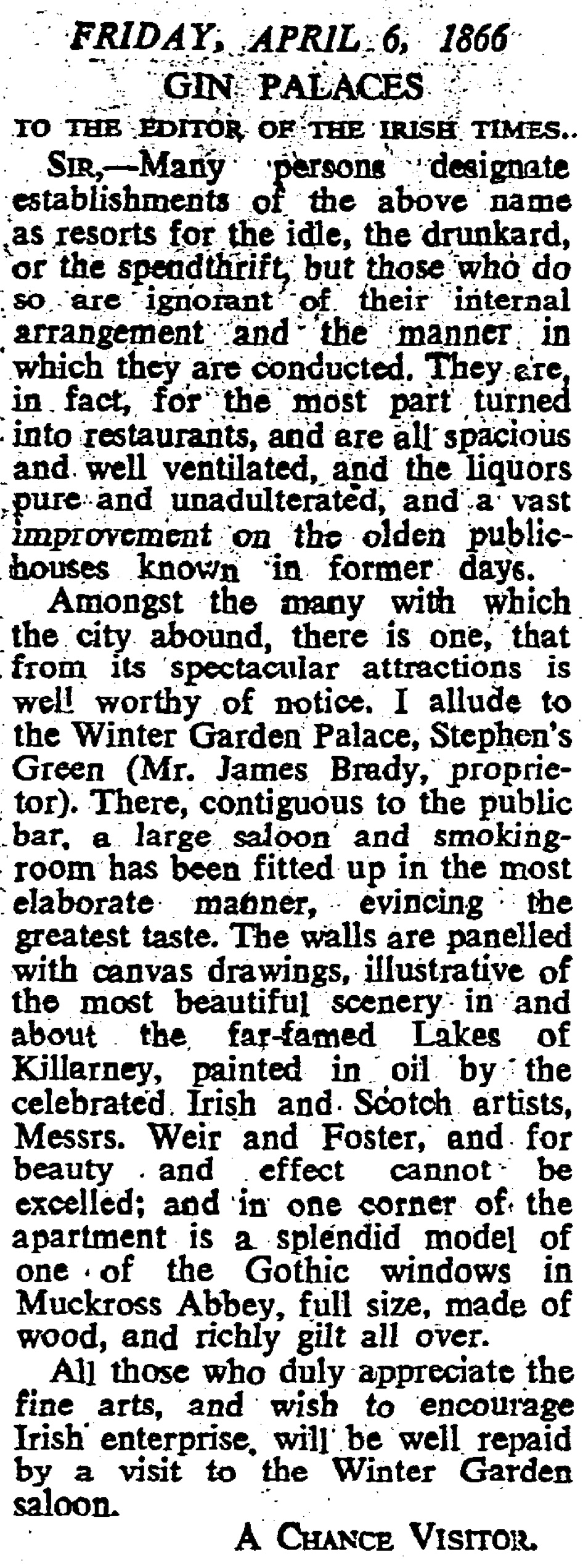
It received a glorious review in The Irish Times in April 1866. The unnamed writer wanted to put on record that a  Gin Palace was just for the “idle, the drunkard or the spendthrift”. The Winter Garden Gin Palace  on St. Stephen’s Green could boast of a “public bar, a large saloon and smoking room”. Its walls were decorated with beautiful scenic canvas drawings and in one corner there was a model of “one of the Gothic windows of Muckross Abbey”.

The Winter Garden Palace, The Irish Times (6 April 1866).

Philip Little, who first began his publican career in Dublin in 1863, appears to have re-opened the Winter Garden Palace under his own patronage in August 1877.

The Winter Garden Palace, The Irish Times (20 Aug 1877).

In the 1880s, the pub was referred to as a favourite meeting spot for the Invincibles (Fenian-splinter group)

The 1901 census shows that Phillip Little (65), a “Grocer and Spirt Merchant” from County Cavan, lived in the property with his wife Bridget Little (62) from County Kildare and their four children. On the night of the census, a visitor Mary Molloy and her son were in the house. Little employed a domestic servant (housekeeper) and six young male grocers assistants. Five of whom were from his home county of Cavan.

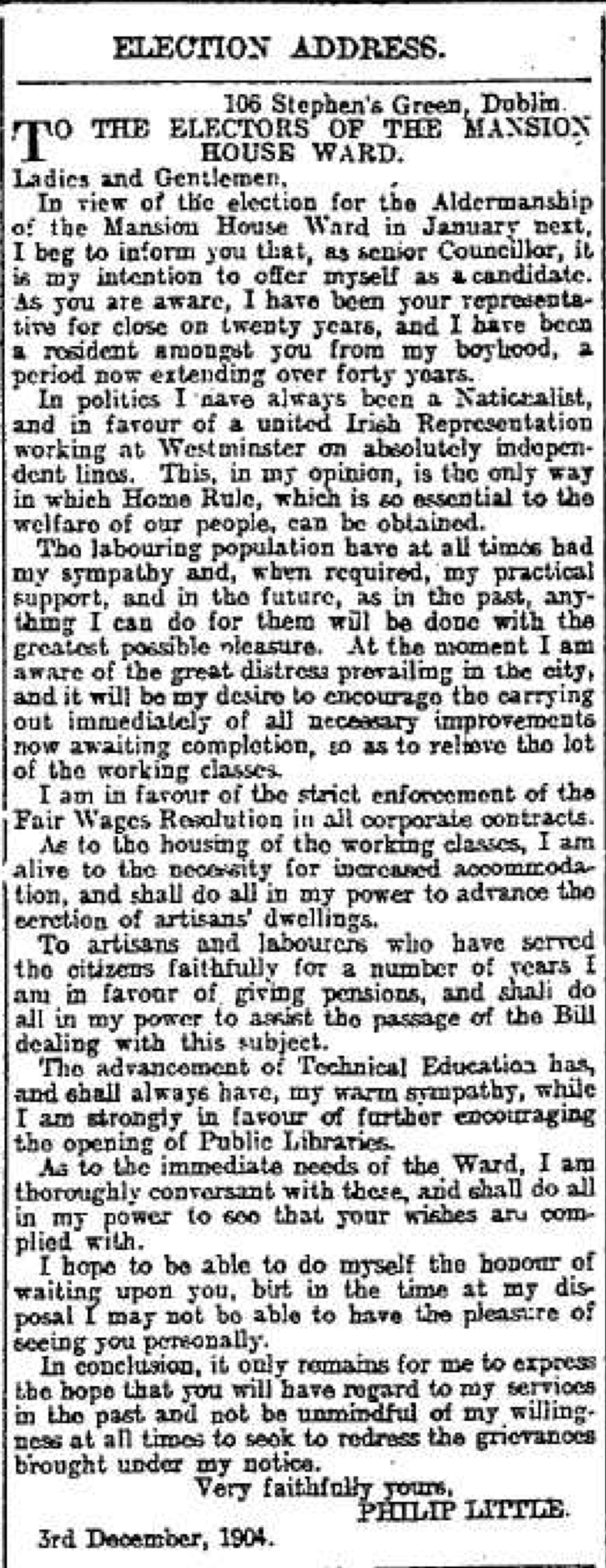
Proprietor Philip Little was a Dublin Corporation councillor from 1884 and seeked re-election in the 1905 election. He described himself as a Home Rule Irish Nationalist, a friend of the Labouring Classes, a supporter of social housing and in favour of more public libraries and expanding Technical Education.

Philip Little, election address. Evening Herald, 3 Dec 1904

The 1911 census shows that Phillip Little (75) lived in the house with his wife Bridget Little (70), a son, a daughter and two grandsons. The employed a coach-man, cook and maid. While five male groces assistants worked in the Little’s Winter Garden Palace.

During the 1916, Easter Rising, a number of building’s overlooking St. Stephen’s Green were commandeered by rebel forces. These included Little’s public house (Winter Garden Palace) at the corner of Cuffe Street and the Royal College of Surgeons at the corner of York Street. The pub was occupied by an eight-man team, a mix of Irish Volunteers and Irish Citizen Army, under the command of James Kelly. Most of them had retreated from Davy’s pub at Portobello and from Leeson Street bridge.

Philip Little put in a claim into the Property Losses (Ireland) Committee, 1916 for £189 5s 8d. This was a result of damage to his business from rifle fire, the looting of goods and the use of his property for barricades. A payment of £158 was recommended by Committee. Among the list of goods that Little claimed for included one feather mattress, 42 pieces of “best china”, six silver spoons and one gents suit.

Continue Reading »

DraculaFirstEdition

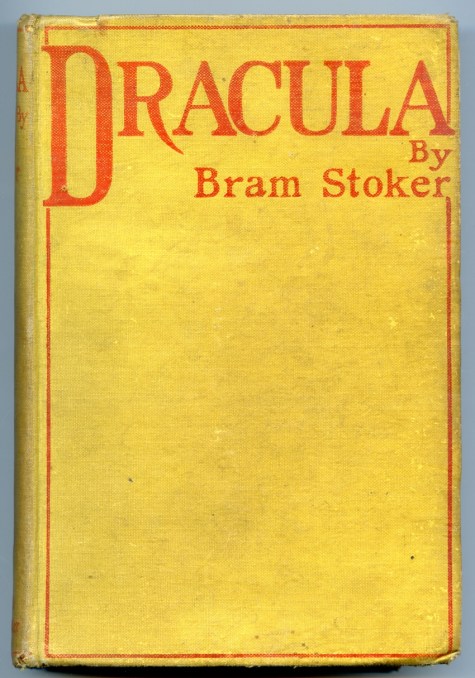
A first edition copy of Dracula, 1897.

Nothing is too small. I counsel you, put down in record even your doubts and surmises. Hereafter it may be of interest to you to see how true you guess. We learn from failure, not from success!

I was delighted to be asked to curate an event for the forthcoming Bram Stoker Festival, which returns to Dublin from October 27 to 30. It is a fitting time of year to remember the Dubliner who brought the world what is undoubtedly the most celebrated Gothic horror novel.

Stoker was born in Clontarf in 1847, and educated at Trinity College Dublin, before going onto a career as a civil servant in Dublin Castle. Like his contemporary Oscar Wilde (who Stoker proposed for membership of the TCD Philosophical Society), he is  thought of not as an Irish writer, but someone who left Ireland at a young age and was shaped by other places and things. I don’t think this is fair, and this event will aim to put him in the context of the Victorian Dublin he worked in, lived in and knew as home.

What I’ve done is gathered together a team of writers, for the purpose of going on a bit of a ramble through Stoker’s Dublin, but we won’t be leaving our seats. It is a sort of ‘Psycho-Geography’ in the Little Museum of Dublin, using old photos and other sources to open up a discussion. Le Blurb:

Without even leaving your seat, take an imaginary trip through the streets and alleyways of the Dublin of Bram Stoker and his literary contemporaries, Lafcadio Hearn and Sheridan le Fanu.

Vivid conversations with striking visual images describe the lit erary, social and political scenes of Victorian Dublin.

lisamarie

Stones of Dublin (Collins Press)

Lisa Marie Griffith was a natural fit for any such panel, owing to her excellent study Stones of Dublin: A History of Dublin in Ten Buildings. Beautifully illustrated, the book examines places like Trinity College, Dublin Castle and the Old Irish Parliament and looked at their importance in shaping the city. She knows the bricks and mortar of the city so well, but also the important contexts (political, cultural, social) of the times in which these buildings were constructed. It’s a great read,and just part of her excellent output on Dublin in recent years.

Frankie+Gaffney

Frankie Gaffney (Liberties Press)

Frankie Gaffney’s debut novel, Dublin Seven, was described as being akin to “Love/Hate meets Ulysses.” Set very much in the here and now, there’s a reason I asked Frankie onto this panel. His knowledge of the written word through time, and his obsession with the evolution of the novel (see this Tedx talk), is part of his great love for literature and the journey it has come on. He is completing a PhD in Stoker’s Alma mater, not to mention teaching there. He is an important voice on Dublin today, but I look forward to hearing his views on Stoker’s place in the literary canon.

lisamarie

A Fantastic Journey (University of Michigan)

Finally, Paul Murray was not only a natural addition to this panel, he was an essential part of it. An expert on not only Bram Stoker, he has also examined the more forgotten Lafcadio Hearn, another important horror writer of the nineteenth century. That study won the 1995 Koizumi Yakumo Literary Prize in Japan, and was awarded the Lord Mayor of Dublin’s Prize too. Stoker is just one of the horror writers Ireland has produced, so let us briefly examine the others.

This is a chance to learn more about Dracula, yes, but also Dublin. How did Dublin shape Stoker? Come along and find out!

Time 3pm
Date October 28th
Location The Little Museum of Dublin, 15 St. Stephen’s Green, Dublin 2

TICKETS FROM BRAM STOKER FESTIVAL.


guevarastamp

New commemorative stamp from An Post.

Today marks the fiftieth anniversary of the passing of Ernesto ‘Che’ Guevara, shot in Bolivia having been captured leading a small revolutionary force against the Bolivian army.

In Ireland, there has been considerable controversy around the decision of An Post to issue a commemorative stamp to mark this anniversary. That the stamp is very much a celebration of one of the most important pieces of twentieth century Irish art, Jim Fitzpatrick’s Viva Che!, seems to have passed many commentators by.

In an Irish context, Guevara is very much associated with Fitzpatrick’s iconic artwork and the words of his father, who proclaimed following his sons death that “the first thing to note is that in my son’s veins flowed the blood of the Irish rebels.” They were powerful words, even finding their way to the painted gable wall of a Derry house in time.

In 1949, General Tom Barry published Guerrilla Days in Ireland, considered by many to be the classic War of Independence memoir. While Ernie O’Malley would poetically capture the spirit of the people in On Another Man’s Wound, Barry’s memoir focused primarily on the IRA’s Flying Columns, the bands of men who terrorised patrolling Auxies and Black and Tans in the Irish countryside.

The IRA of 1919 did not invent guerrilla warfare, in an Irish (Michael Dwyer of the United Irishmen may claim that honour) or international context. In South Africa, the Boers adopted guerrilla army tactics so effectively during the 1899-1902 war, that the widespread internment of Boer women and children in concentration camps was used to break their morale. Zapata had his ‘dynamite boys’, the Italians their ‘Brigands’. What the Irish War of Independence did produce however was a remarkable volume of literature on guerrilla warfare.

In her biography of Barry, historian Meda Ryan discusses the international influence of Barry’s memoir, noting that its influence was significant enough to move many international fighters to contact Barry. One such figure was the Zionist radical (for radicalism is not exclusive to the Left) Menachem Begin, founder of the militant group Irgun and later sixth Prime Minister of Israel. Begin’s appeals to Barry are all but forgotten, but the same cannot be said of Che Guevara.

Guevara’s outreach to Barry was, Ryan notes, unsuccessful. Barry believed that the fight of Irishmen was at home, and though opposed to the Blueshirt threat in 1930s Ireland, had strongly discouraged Irish participation in the Spanish Civil War. It remains an interesting footnote in Irish history.

maureenhavana

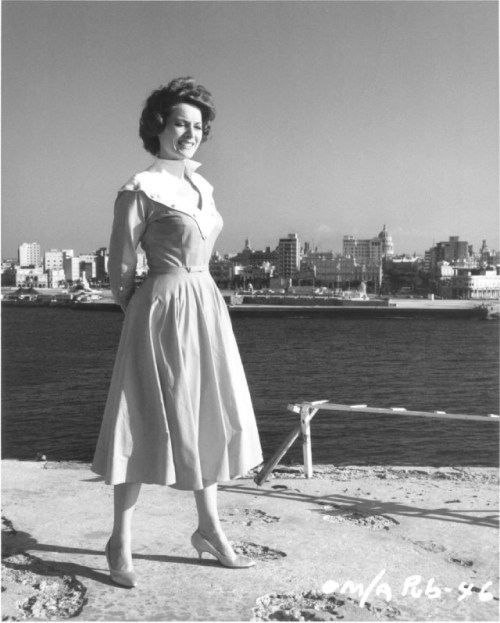
Maureen O’Hara in Havana, 1959.

While Guevara may not have encountered Tom Barry in the flesh, he did cross paths with many Irish people, including the celebrated Dublin-born actress Maureen O’Hara. Filming Our Man in Havana there in 1959, she was clearly smitten by the Guevara she met, remembering later in her memoir:

When we arrived in Havana on April 15, 1959, Cuba was a country experiencing revolutionary change. Only four months before, Fidel Castro and his supporters had toppled Fulgencio Batista… Che Guevara was often at the Capri Hotel. Che would talk about Ireland and all the guerrilla warfare that had taken place there. He knew every battle in Ireland and all of its history. And I finally asked, “Che, you know so much about Ireland and talk constantly about it. How do you know so much?” He said, “Well, my grandmother’s name was Lynch and I learned everything I know about Ireland at her knee.” He was Che Guevara Lynch! That famous cap he wore was an Irish rebel’s cap. I spent a great deal of time with Che Guevara while I was in Havana. Today he is a symbol for freedom fighters wherever they are in the world and I think he is a good one.

O’Hara found it hard to believe “how young and idealistic Che was…he had already helped to topple a dictator and liberate a nation.”


The second printed volume of CHTM! articles has just arrived on the shelves in all good bookshops. The book follows on from our first volume, which was described by The Sunday Times as “one of the most amusing and valid social/cultural/political history books of recent times.” We’ll take that.

sittingpretty

Sitting pretty on a bookshelf (with thanks to Donal Higgins)

Volume 2 is another diverse selection of articles, including pieces examining things like the social phenomenon of Heffo’s Army in 1970s Dublin, the history of Bartley Dunne’s and Rice’s public houses, the Hirschfeld Centre, Watkins’ brewery, the chaotic Donnybrook Fair and faction fighting in eighteenth-century Dublin.

Some wonderful characters from the history of the city emerge throughout its chapters, including the housing architect Herbert Simms, wandering French artist Antonin Artaud, the Latvian revolutionary Konrad Peterson, and the visiting English Suffragettes who found themselves on hunger strike in Mountjoy in 1912.

The book is published by New Island Books. In Dublin, it is stocked by Hodges Figgis, The Gutter Bookshop, Chapters, Hodges Figgis, Books Upstairs and many other stores (indeed, if you run a bookshop and are stocking it please get in touch, we’d be delighted to include mention of your business here.)

It is as diverse as the blog itself, and will be launched on 5 October by historian Lorcan Collins at Cleary’s pub on Amiens Street.

backofbook

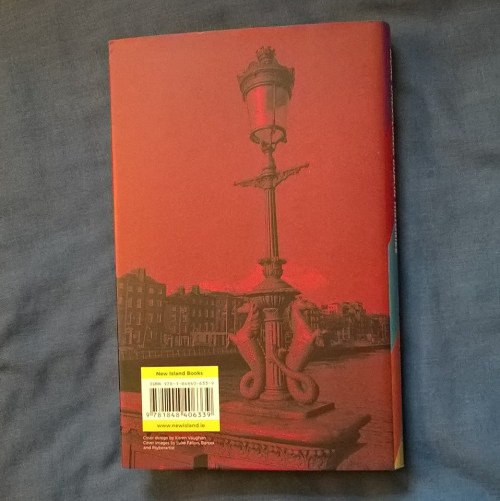
The back of the book.


vtls000641960_001.tif

Thomas Ashe

The centenary of the funeral of Thomas Ashe occurs next week, a defining moment of a year in which the revolutionary forces continued to reorganise themselves after the Easter Rising.

In some ways, 30 September 1917 was a replay of 1 August 1915, the day when P.H Pearse told the gathered mourners at the funeral of Jeremiah O’Donovan Rossa that “life springs from death, and from the graves of patriot men and women spring live nations.” Now, Pearse himself was dead and gone, and the Volunteer movement had lost both men and rifles to Easter Week. The logistics of the Ashe funeral were to prove a challenge to a revolutionary movement reemerging from the shadows.

The Thomas Ashe funeral, much like that of O’Donovan Rossa, was political theatre and a propaganda spectacle, and as Fianna Éireann boyscout Seán Prendergast remembered it, “the funeral of Ashe epitomised not the burial of a man of a dead  generation but one who represented a living generation of men who had fought and suffered and were fighting and suffering in Ireland’s cause.”

That Thomas Ashe made it into 1917 was surprising in itself. Major John MacBride, a veteran of the Second Boer War, had wisely advised the young Volunteers in Jacob’s factory before their surrender that “if it ever happens again, take my advice, and don’t get inside four walls.The failed tactic of seizing buildings in the heart of the capital and proclaiming a Republic before the world stood in stark contrast with the tactics adopted by the men who fought under Ashe at Easter Week. In scenes more akin to the subsequent War of Independence, Volunteers under Ashe’s command attacked the RIC Barracks at Ashbourne in County Meath. In a vicious five hour battle, eleven RIC men and two Volunteers lost their lives.  The men under Ashe caused chaos for the RIC in North County Dublin too, raiding the RIC at Swords and Donabate.

Sentenced to execution following the insurrection, his sentence was commuted to penal servitude for life. Much like Éamon de Valera, Ashe perhaps owed his escape to sheer timing. He was court-martialed on the 8 May, by which stage it was clear the tide was turning against further executions. Even John Redmond, the constitutional nationalist leader who condemned the Rising as a German plot, understood the executions to be an “insane policy”, correctly warning that “if more executions take place in Ireland, the position will become impossible for any constitutional party or leader.” Ashe, like many revolutionaries, did his time in the internment camps that followed. Ashe took a leading role in the reorganising of the Irish Republican Brotherhood, the secret society central to bringing about the rebellion through its clandestine networks in Ireland and the United States.

271

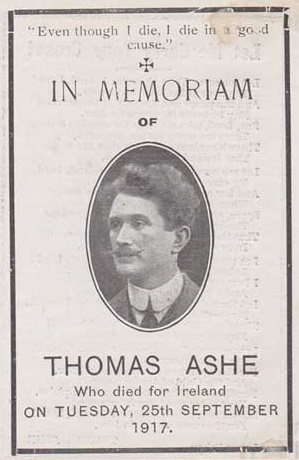
A memorial card for Thomas Ashe.

Ashe may have cheated death in 1916, but he died on 25 September 1917, having gone on hungerstrike after his arrest under the Defence of the Realm Act for a seditious speech he had delivered at Balinalee in Longford. He had earlier courted the attention of the authorities with a speech delivered at Ardfert in Kerry, in which he outlined a bizarre hope that “Ireland might be preserved from the tyranny of the Jews and moneylenders of London who are at present running the World War.” The decision to force feed Ashe proved fatal, and the later inquest into his death would condemn prison authorities for the “inhumane and dangerous operation performed on the prisoner, and other acts of unfeeling and barbaric conduct.”

Richard Walsh, a senior Volunteer in Mayo, remembered that the response to the death of Ashe demonstrated something to the leadership of the nationalist movement:

Ashe’s funeral proved that there existed an unsuspected enthusiasm for the organisation of the Volunteers all over the country, which the men at the head of affairs had not suspected. The country at that time was travelling faster than the leaders anticipated.

NFE

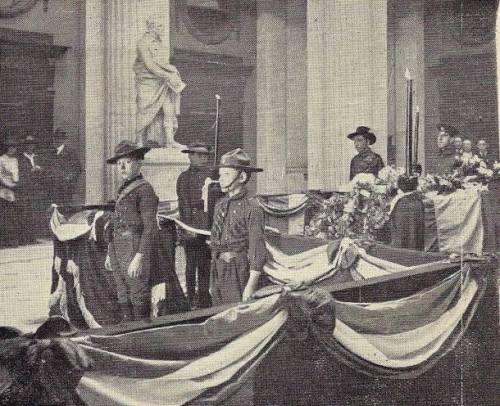
Republican boyscouts from Na Fianna Éireann provide the guard of honour at City Hall. (Image Credit: History of Na Fianna Éireann)

Continue Reading »

ASKIII

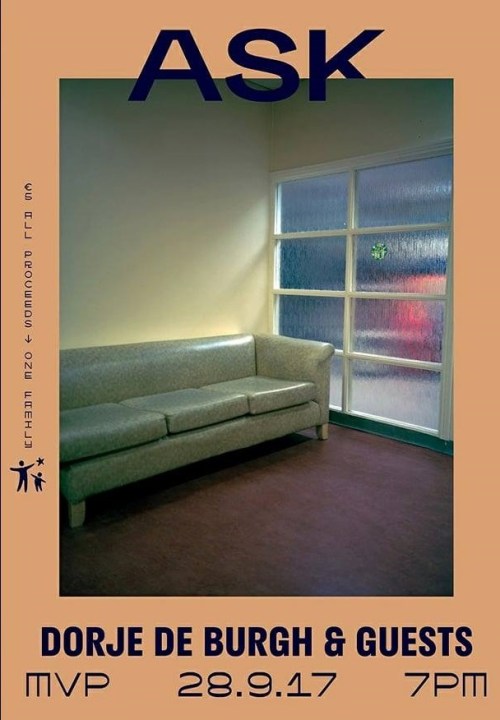
ASK is a monthly(ish) night in MVP, which aims to bring together people with eclectic music tastes and raise money for good causes in the process. It draws together people from this parish, Sunday Books, Foggy Notions and more besides. So far, we have raised money for MASI (Movement of Asylum Seekers in Ireland) and the Gay Switchboard.

The night returns next Thursday after a brief hiatus, with a night to raise funds for One Family, a national organisation supporting lone parents. We are delighted to be joined by Dorje de Burgh, whose late mother Sherie was central to One Family. With the Irish Family Planning Association and One Family, Sherie truly made a difference to the lives of many people, and has been recalled as a “visionary who worked tirelessly to support women, couples and parents through the difficult landscape of unplanned pregnancies, relationship separation, parenting and family conflict.”

The nights are good fun, bringing together a mix of music I don’t think you’ll find anywhere else in the city, not to mention plenty of visuals pulled from the archives of yore, Fintan Warfield’s remarkable collection of tambourines, whatever flowers we can haggle from the sellers and more besides. You probably won’t hear the Bothy Band and Chicago House played one after the other anywhere else, and that’s ok.

Event page is here.

MVP is located at 29 Upper Clanbrassil, Dublin 8.

MansionHousePoster

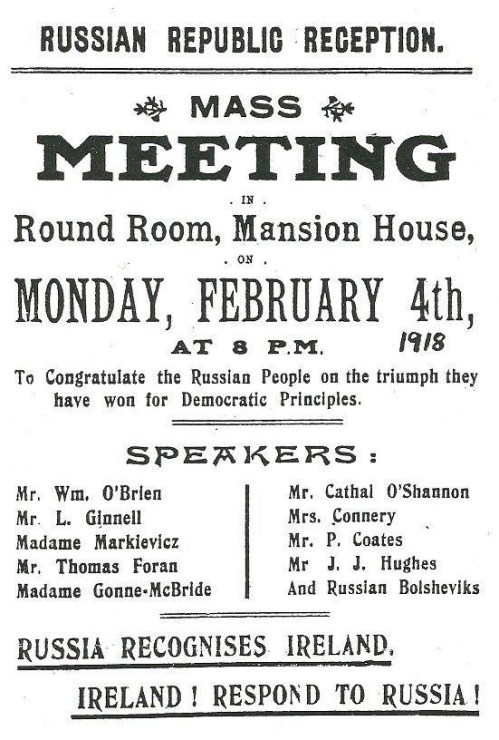
Poster for Mansion House meeting referenced in below article, February 1918.

The following article appeared in the 23 February 1918 edition of Irish Opinion: The Voice of Labour.  Written in the immediate aftermath of a phenomenal meeting at Dublin’s Mansion House, when thousands thronged the venue and surrounding streets to herald the Russian revolution, Thomas Johnson of the Labour Party offers some vision of what may happen “if the Bolsheviks came to Ireland.”

Johnson, born in Liverpool to Irish parents in May 1872, served as leader of the Labour Party for ten years, beginning in 1917. He was elected in 1922 to the Dáil as TD for Dublin County in an election which saw a surprising Labour vote, with 17 of the 18 candidates put forward by the party elected, and 21.3% of the overall vote secured.

In may was, Johnson is remembered as a reformist political figure and not a revolutionary; he himself asked in 1925 “shall the aim be honestly to remove poverty…or are we to agitate and organise with the object of waging the ‘Class War’ more relentlessly, and use ‘the unemployed’ and ‘the poverty of the workers’ as propagandist cries to justify our actions…I do not think this view of the mission of the labour movement has any promise of ultimate usefulness in Ireland.”

Here though, we see a Johnson who is looking on at the events in Russia with great hope and optimism in their immediate aftermath. Notice the references to the “Irish Republican army”, to the “Dublin housing problem” which could be resolved through socialist change, and to the need for political education and the study of Russian tactics.

My thanks to Dr. Brian Hanley for providing me with a copy of the article, which I have transcribed.

IF THE BOLSHEVIKS CAME TO IRELAND.

The great gathering of Dublin citizens at the Mansion House to acclaim the social revolution in Russia was a sign to all parties in Ireland that the people in demanding independence are not going to be satisfied with a mere political change, no matter how drastic. What they need, and are quickly coming to recognise, is a change of social and economic relations. It is not only to British authority that this is a warning: it is a call to the conservative forces of all political parties to rally to the defence of the existing social order. All those people whose prosperity is dependent upon the institutions of rent, interest or profit or who can be persuaded that the national well being can only be built upon a basis of capitalism – “the most foreign thing in Ireland” – will be told that their own and their country’s future is endangered if any countenance is given to the doctrine that Labour is king.

Labour also must take warning. We acclaim the Russian revolution, and our hearts respond to the call of the Russian people to join with the workers throughout war stricken Europe in dethroning Imperialism and Capitalism in our respective countries. But, as we asked at the meeting in the Mansion House, are we prepared to take action if opportunity offers? Is Labour organised sufficiently? Are our trade unions and our trades councils, our co-operative societies and our Labour parties properly supported and in close enough relations to become the centres of economic life in a new society? Are our working class leaders or spokesmen devoting time and effort in reading and study to fit themselves for the duties that may be forced upon them?

The framework of the new Russia consisted of 50,000 co-operative groups in town and country, organised within the past six or seven years. The archive men and women who made the revolution had devoted years to the work  of propaganda, to study mental discipline and self-sacrificing service of the people. While Ireland has produced but one Connolly, Russia has produced hundreds; men and women of great intellectual power, devoting their lives entirely to the work of organisation, education and agitation, and receiving in return no reward but persecution, imprisonment, poverty and the love of the people.

The Soviets – the councils of workmen, of peasants and of soldiers – who are now in power in Russia have their Irish equivalents in the trades councils, the agricultural societies, and – dare we say it?- the local groups of the Irish Republican army.  An Irish counterpart of the Russian revolution would mean that these three sections co-operating would take control of the industrial, agricultural and social activities of the nation. Power would no longer be in the hands of the wealthy nor authority be wielded by the nominees of an Imperial Majesty. Industry would be diverted towards supplying the wants of the Irish people and agriculture towards providing food for those engaged in industry. Food and houses, clothing and education, these would be provided for all the people by the labour and service of all the people before luxuries or superfluities were allowed to any. The private profit of the private proprietor would not then determine what class of goods should be produced, whether cattle should be raised or corn grown, the needs of the people would decide.

Probably, as in Russia, the first act found to be necessary would be following the example of the capitalistic governments at the outbreak of war, to declare a moratorium  (“I thank thee, Jew, for teaching me that word!”) suspending temporarily the repayment of debts and making illegal all interest!By this act alone, the income of the workers would be increased about 25 percent.

The land of the country would be made free of access to those who were willing to cultivate it to the best communal advantage. The Dublin housing problem would be immediately tackled,and might be made less pressing by a distribution of the congested population from the tenements over the partially occupied mansions of the suburbs!

These are a few of the things that would happen if the Bolsheviks came to Ireland. it is right that our friends who join with us in acclaiming the Bolshevik revolution should understand its implications. It means that as society is based upon labour, Labour shall rule. And that means a complete overturning from the present state wherein, though society is based upon labour, capital and property rule.


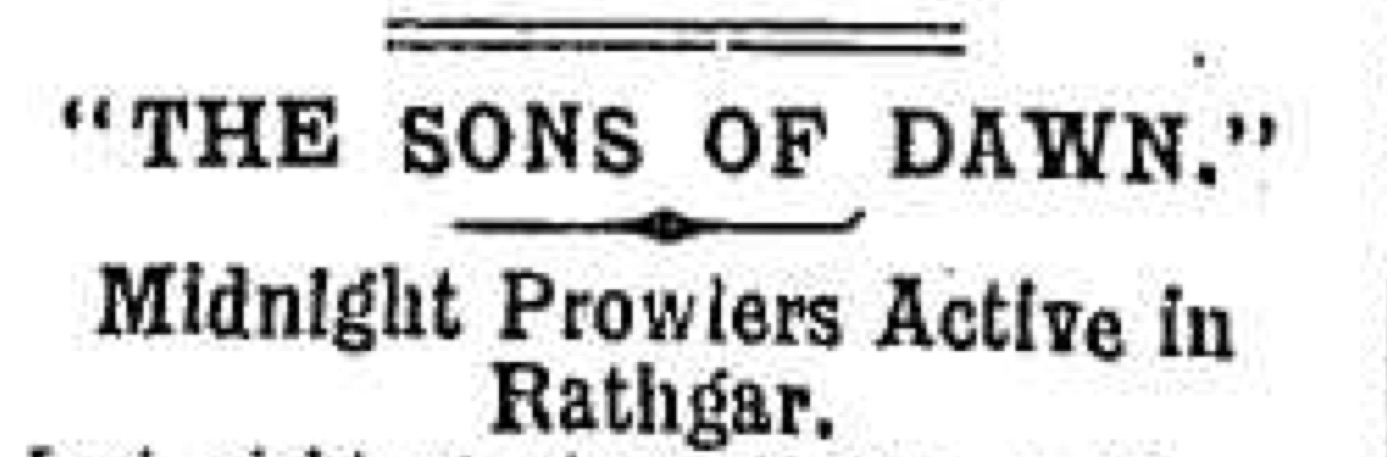
In the early 1920s, a criminal street-gang from Dublin’s North Inner city named the ‘Sons of Dawn’ terrorised citizens and business-owners . Amidst the backdrop of a violent guerilla War of Independence, it would seem that easy-access to firearms and a general breakdown in law and order helped the group to operate in an already strained and tense city. After a successful intelligence operation, the gang were finally caught in the midst of a robbery and arrested by the IRA.

The first mention of the ‘Sons of Dawn’ in the newspaper archives comes from January 1920. On the night of the 16th, three masked men robbed Roger Pollock on Ailesbury Road in Ballsbridge.  A half an hour later, the same group robbed another passerby John Connolly. At least one of the gang was armed with a revolver. As the Evening Herald (17 Jan) reported, the robbers told Connolly – before they took his money and pocket-watch  – that he had met the ‘Sons of Dawn’.

The Evening Herald, 23 January 1920

On the night of 22 January, a “well-known” but unnamed resident of Garville Avenue, Rathgar was held up by a gang of three men as he posted a letter close to his home. They helped themselves to his watch and a measly three shillings. The Irish Independent (24 Jan 1920) said that one of the gang told the victim : “If you are going to make anything about this. Say it was the Sons of Dawn. Good Night.”

Under the heading of ‘Murty’s Letter’ in The Irish Times (31 January 1920), a journalist described the ‘Sons of Dawn’ as a:

… a new order of Irish reformers and men of action, with a way of its own. Their plan of campaign is to wait around the corner on dark nights and when you go to post a letter in the letterbox , (they) demand your watch and your money at the muzzle of a gun. Or they may vary that programme by raiding a post office or burgularin’ (sic) a house and carrying off the safe and its contents…

The Nationalist and Leinster Times (7 Feb 1920) reported that the ‘Sons of Dawn’ had been active in Athy, County Kildare and had broken into a pub on William Street. It seems unlikely however that the Dublin ‘Sons of Dawn’ would travel up to 80km to undertake such a burglary. If anything though, it would seem to illustrate that a gang of robbers with a menacing name can prompt journalists farther afield to pin similar crimes on them.

The gang was active in Dublin throughout the year and they obviously made an impact on the hearts and minds of Dublin residents. After gunfire was heard in Dublin one night, The Freeman’s Journal (16 June 1920) wrote theatrically that:

The anxious and sleepless citizen, the late reveller in the mansion, the guardians of the city’s peace, paused a moment to wonder what daring marauder, what anarchist, what Son of Dawn, had ventured forth to shoot, loot, or be shot at.

This period saw the establishment of the Irish Republican Police (IRP) under the authority of Dáil Éireann. Liam O’Carroll, a Dublin IRA captain, described in his Witness Statement (no. 594) how the organisation undertook a:

a considerable amount of police work … in conjunction with the Dáil Courts … with a view of undermining the [Dublin Metropolitan Police] … The duties involved were varied and concerned a large number of personal cases, robberies, house-breaking and the like.

The brazen activity of the ‘Sons of Dawn’ brought them to the attention of the IRA in Dublin. Volunteers Sean Brunswick (BMH WS No. 898) and Nicholas Laffan (BMH No. 703) also make reference to this particular gang in their witness statements.

O’Carroll stated that the group were also known as the ‘Moore Street Gang’ and:

… usually met in a billiard saloon connected at the time with Woolworth’s of Henry Street, and Woolworth’s themselves had engaged Volunteer police to keep the premises under observation.

Downfall

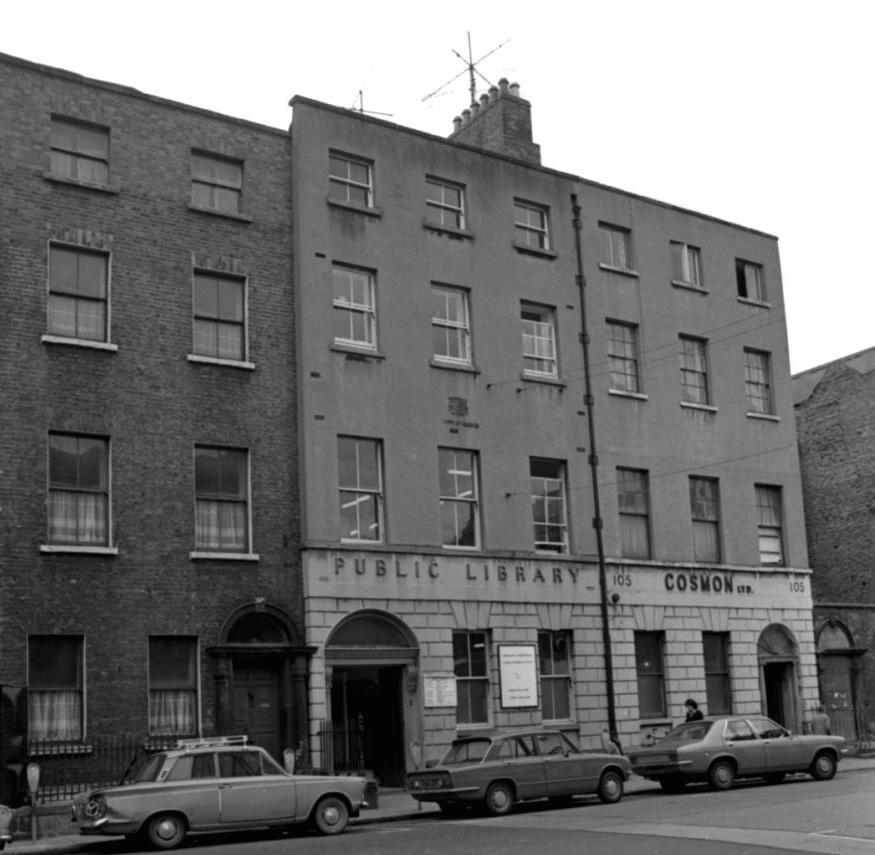
An IRA Volunteer obtained information that the gang planned to rob a wholesale tobacco business owned by Patrick McEvoy known as Magill’s at 105 Capel Street (now the Outhouse LGBT community centre).

No. 105 Capel Street ‘Cosmon Ltd’ in 1978. It was previously known as Magill’s. Credit – Dublin City Council Photographic Collection

At around 10.30pm on 22nd September 1920, four members of the ‘Sons of Dawn’ robbed Magill’s of tobacco and about 20 packets of cigarettes. As they were leaving the building through the back door, they were greeted by 16 armed members of the IRA. The gang of four were marched away blindfolded to a “house unknown” where they were placed in a cellar and kept until 9pm the following day.

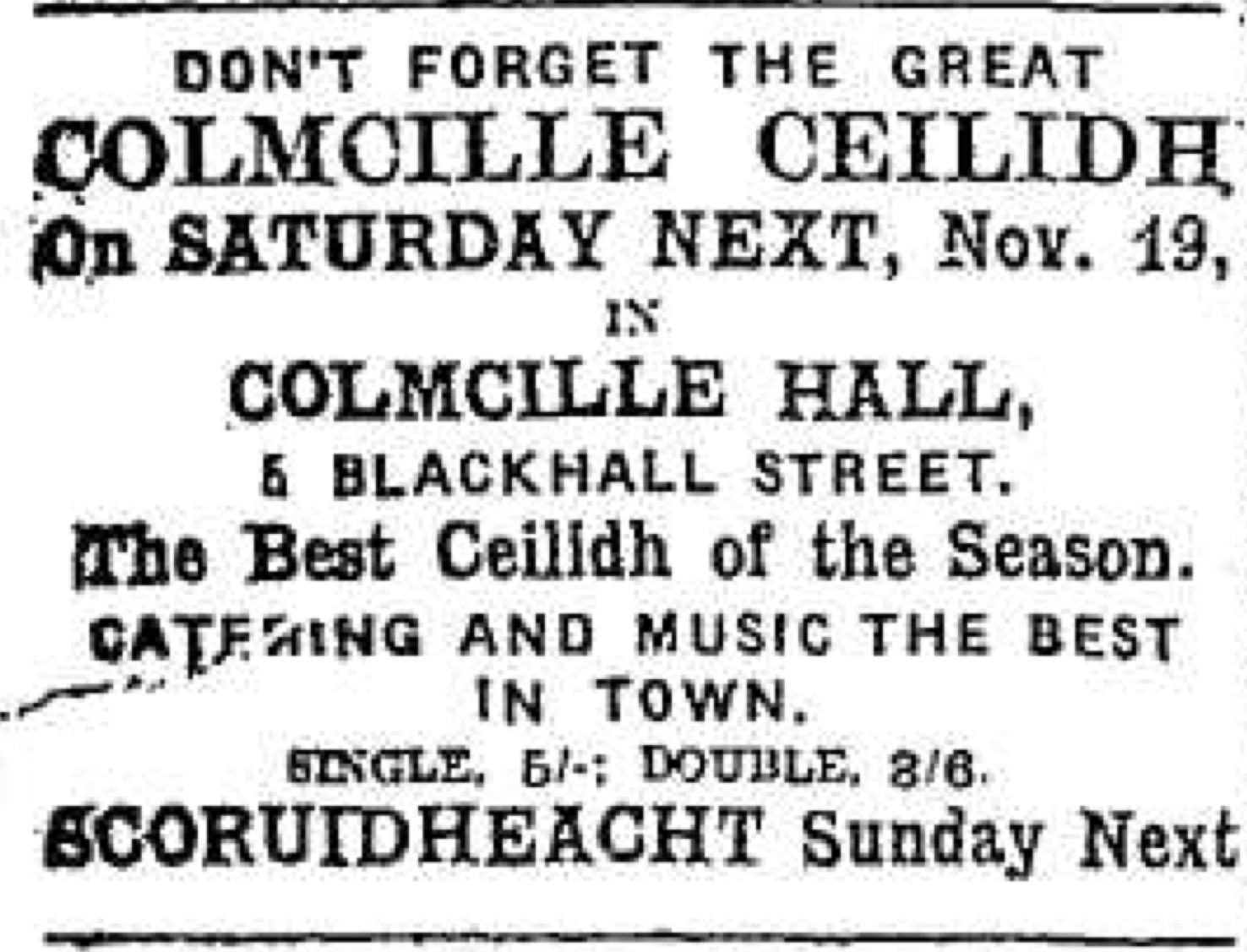
Liam O’Carroll’s Witness Statement reveals that the gang was brought to the Colmcille Hall at 5 Blackhall Street in Smithfield. A brisk 10 minute walk from Capel Street. This building had been owned by the Gaelic League since 1900 and was used as the HQ of the 1st Battalion, Dublin Brigade of the Irish Volunteers/IRA from 1914 to 1922.

Advertisement for a Ceilidh dance in the Colmcille Hall, 5 Blackhall Street. Evening Herald, 16 November 1921

Besides being caught red-handed immediately after the robbery, the IRA searched the boys and found a photograph of the four of them with “The Sons of Dawn, 1919, 1920” and “The Boys of Dublin” written in ink on the back.

The four were named in the newspapers as :

  • Thomas Corlett of Cole’s Lane [off Moore Street]
  • James Gannon of Moore Street
  • Matthew Reid, No Address Given
  • Henry Thomas of Dominick Street [off Parnell Street]

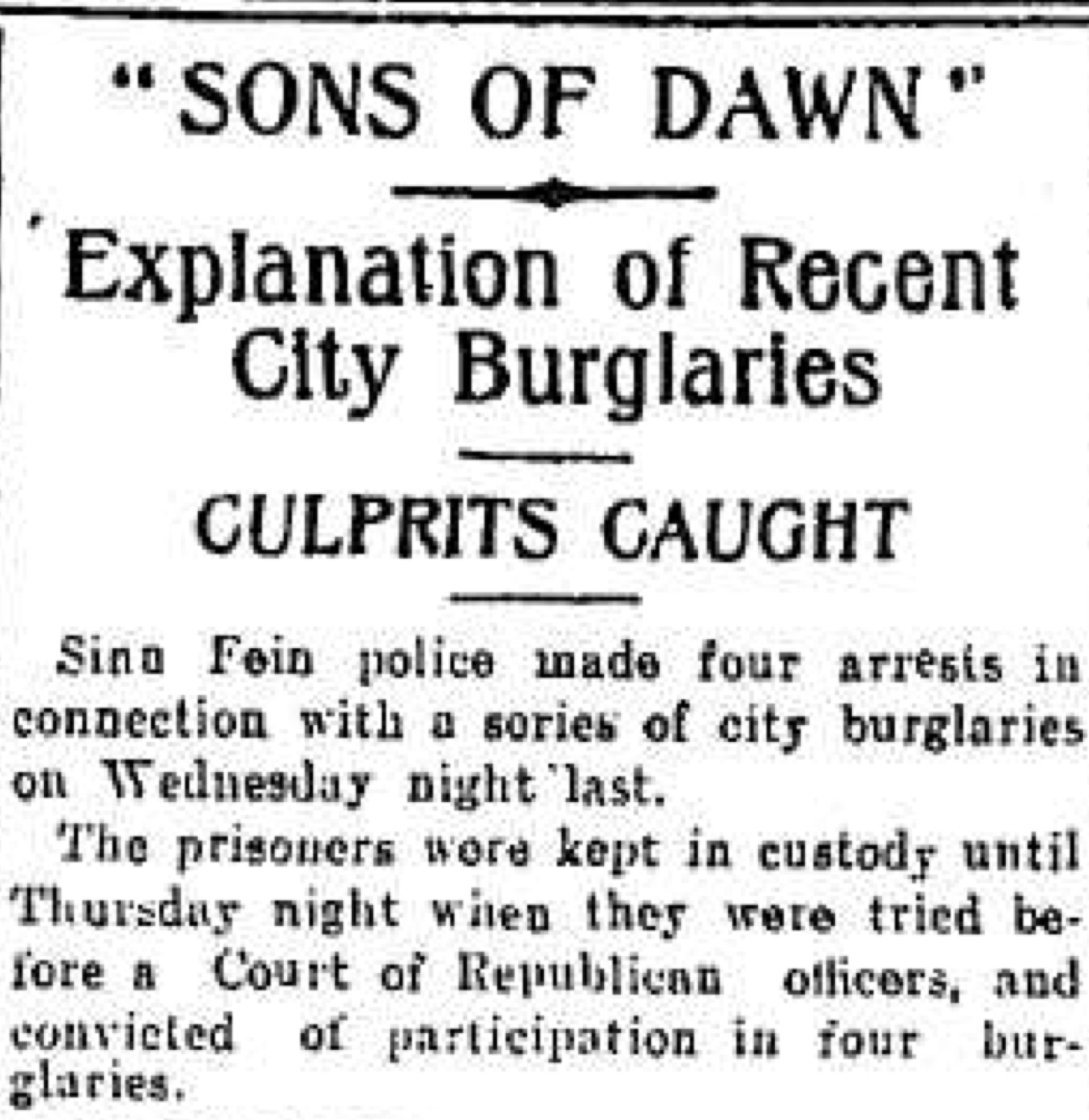
They were tried before a five-person “Court of Republican officers” and found guilty of robbing the Capel Street premises along with other three businesses on Henry Street: Menzies and Co.,  Lipton’s Ltd. and Burton’s. The armed robberies in Ballsbridge and Rathgar were not mentioned.

The Evening Herald, 25 September 1920

Continue Reading »

Merchants’ Arch Through Time.

MerchantsHallDescription

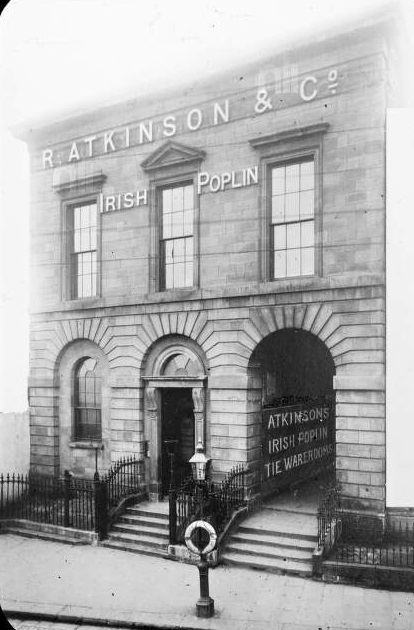
R. Atkinson & Co, Irish poplin manufacturers (Image: National Library of Ireland)

Like many Dubliners, I pass through Merchants’ Arch a few times a week, normally in a hurry somewhere. Connecting Liffey Street and the Temple Bar district via the Ha’penny Bridge, the archway even pops up in Ulysses, as Leopold Bloom searches for a (rather naughty) book for his beloved Molly. Much has changed since the time of Bloom, but there are still people selling goods in the Arch from time to time, not to mention buskers and long-established businesses.

Like much of what is beautiful and old about the city today, the Wide Streets Commission is to thank for this arched passage, insisting on it as a necessary thoroughfare. Established by an Act of Parliament in 1757, this body reshaped Dublin as the people knew it, creating networks of new streets and leading Dublin into a new era.  As the masterful study Dublin Through Space and Time notes, “the Wide Streets Commissioners brought a truly European vision of urban design to Dublin.So many of the streets we enjoy today – Parliament Street, D’Olier Street, Westmoreland Street – are part of the vision of this body.

Merchants’ Arch forms a part of the Merchants’ Hall, built to the designs of the celebrated architect Frederick Darley in 1821. Today occupied by a public house and restaurant, the building was constructed for the use of the Merchant’s Guild, who originally had their premises at the Tailors Hall in Back Lane, near to Christchurch Cathedral. In the eighteenth century and well into the nineteenth, Dublin was home to a number of Guild Halls which reflected industry in the city. The Tailors’ Hall and Merchants’ Hall were joined by Weavers’ Hall in the Coombe and the Bricklayers Hall on Cuffe Street. As Frank Hopkins has noted, it seems almost every group of skilled Dublin workers were represented by a Guild. He points towards “the Goldsmiths Guild, the Guild of Carpenters, Millers, Masons and Heliers, the Cooks and Vintners Guild, and the Guild of Tallow Chandlers….”, not to mention “the Guild of Barber-Surgeons and Apothecaries”.
MerchantsHallDescription

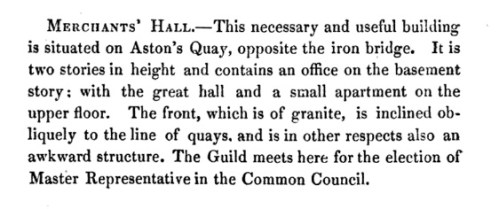
A contemporary description of the new Merchants’ Hall.

Continue Reading »