Feeds:
Posts
Comments
Speech Of A Man Against The Embargo In Ethiopia At Trafalgar Square In 1935

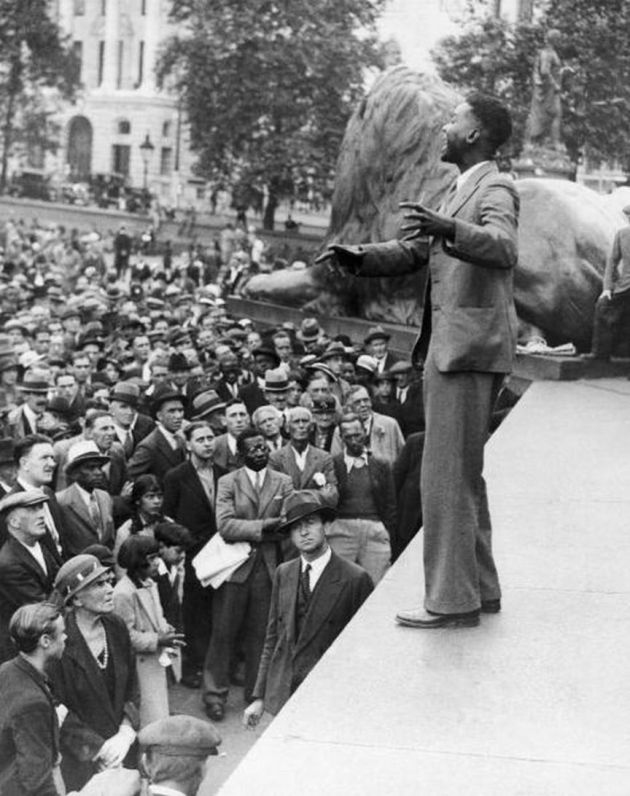
C.L.R James speaking in Trafalgar Square, London. (1935)

Whether cricket or Marxism is your bag, C.L.R James is a towering figure in each world. They are, I concede, two worlds that tend not to meet. His 1963 memoir Beyond a Boundary, which he himself described as “neither cricket reminiscences nor autobiography”, is widely regarded as one of the finest books ever written on any sport. He maintained that “cricket is first and foremost a dramatic spectacle. It belongs with theatre, ballet, opera and the dance.”

Born in Trinidad in 1901, Cyril Lionel Robert James made important contributions in many fields of life. As a historian, he penned The Black Jacobins, an acclaimed history of the Haitian Revolution, and he would make many important intellectual contributions to the field of postcolonial studies. A lifelong political activist, he was highly critical of the Soviet Union under Stalin, and was aligned with Trotskyist movements in the turbulent 1930s. He arrived in Britain in 1932, taking up a job as cricket correspondent with the Manchester Guardian and throwing himself into political activism in London.

In 1935, he arrived in Dublin, lecturing on the Italian invasion of Ethiopia. Here, he befriended Nora Connolly O’Brien, the daughter of James Connolly, and encountered opposition from some surprising quarters.

The response to the invasion of Ethiopia: 

An imperial grab for Africa, Mussolini’s invasion of Ethiopia was condemned by the League of Nations by fifty votes to one (the single dissenting voice being the Italians themselves).  Despite condemnation, little real action was taken by the European powers after the commencement of the invasion in September 1935, and the annexation of the country allowed Mussolini to proclaim that “the Italian people have created an empire with their blood. They will fertilize it with their work.” The following year, Mussolini would send men and planes to Spain to crush democracy there, but 1935 demonstrated his disregard for the sovereignty of other nations to all who were paying attention. From Dublin, Éamon de Valera had been one of the few political leaders to loudly condemn the actions of the Italians, warning the League of Nations that “if on any pretext whatever we were to permit the sovereignty of even the weakest state amongst us to be unjustly taken away, the whole foundation of the League would crumble into dust.”

James, then a member of the Independent Labour Party, wrote extensively on the fascist invasion, writing in The New Leader:

Let us fight against not only Italian imperialism, but the other robbers and oppressors, French and British imperialism. Do not let them drag you in. To come within the orbit of imperialist politics is to be debilitated by the stench, to be drowned in the morass of lies and hypocrisy.

He was a founding member of the International African Friends of Ethiopa, and in this capacity lectured all over Britain, speaking at a protest rally in Trafalgar Square on the need for solidarity. In December 1935, he arrived in Dublin to address a meeting opposing Italian fascist aggression, finding a weak left but some welcoming faces. James would later recall that “he didn’t really understand what it meant to be revolutionary until he went to Ireland.”

Continue Reading »

Since March of this year, I have been delighted to contribute to the Dublin Inquirer newspaper, an independent and very important news source for the capital.  My monthly historical contribution is always exclusive to that publication, and an earlier version of this piece on the architect and activist Uinseann MacEoin appeared there. 

uinseann.png

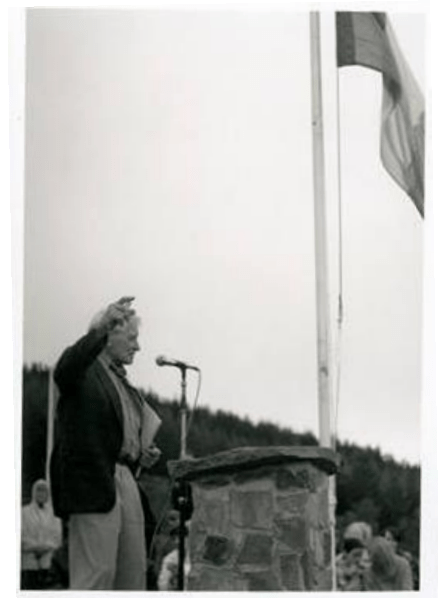
Uinseann MacEoin speaking in 1996 at the unveiling of the restored Liam Lynch memorial, Tipperary. (Image with thanks to Ruadhán MacEoin)

Uinseann MacEoin lived a remarkable and colourful life, which brought him from the ranks of the Republican movement to the frontlines of the battle for the heart and soul of Dublin city, as developers and preservationists struggled for influence in the 1960s and 70s. He left his mark -quite literally – on Henrietta Street, which is soon to witness the opening of a museum dedicated to the story of tenement Dublin. As editor of the influential (and controversial) Plan magazine, he sought to expose poor developments and abuse of planning laws in the capital, never afraid to call out other architects when it mattered.

Uinseann Ó Rathaille MacEoin was born in Pomeroy, Co. Tyrone, in 1920. His middle name was a nod towards Michael Joseph Ó Rathaille, a participant in the 1916 Rising who was killed in action in Moore Lane during the evacuation of the General Post Office. This alone said something of family convictions, but so did the fact his father was interned upon the Argenta, a prison ship moored in Larne Harbour in the early 1920s. The MacEoin family would resettle to Dublin while Uinseann was still a boy, and he himself drifted into republican politics as a young man in the 1930s. He served a year in prison for IRA membership, before being interned in the Curragh during the period ridiculously known here as ‘The Emergency’.

While MacEoin never lost his republican convictions, it was architecture and planning which would come to dominate much of his life from the time of his release. This journey began with studying and correspondence while in the Curragh, and as an early career architect he worked with Michael Scott and Partners and Dublin Corporation, before establishing his own practice. His background made him somewhat unusual in the days of the great debates over the future of Dublin’s urban landscape, with Hibernia magazine describing him once as “a rabid republican cum architect cum town planner of definite convictions cum determined preservationist and exposer of shady planning applications.” In not dissimilar terms, The Irish Times wrote in 1963 that MacEoin was “already well known for his trenchant criticisms of the workings both of his own profession and that of central and local government.”

jbh

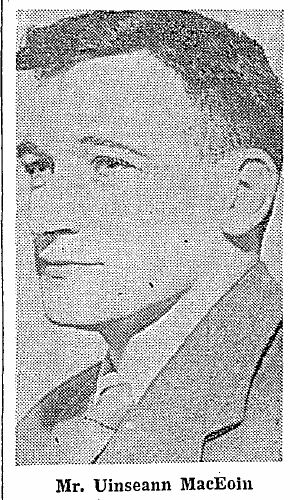
Uinseann MacEoin in the Irish Press, 1963.

The destruction of Georgian Dublin was sometimes cheered on by narrow minded gombeens wrapped in green flags, who regarded the eighteenth century city as “the creation of an alien aristocracy”, seeing it as something that said nothing of Irish life and experience and was out of place in the capital of an Irish Republic. The Irish Times warned its readers at Christmas 1959 that it was becoming increasingly clear “the days of Dublin’s Georgian heritage are numbered”, but MacEoin and other preservationists and activists fought bravely. There were victories, but more often defeats; in 1964, MacEoin was one of those to sign a letter to the Taoiseach deploring the plans to gut Georgian houses for the Electricity Supply Board premises near Merrion Square. Shortly afterwards, a journalist joked that MacEoin had “acquired the reputation of being a consistently Angry Young Man”, though at least “his thunderbolts are aimed in all the right directions.”

MacEoin took on those he disagreed with, yet provided them a platform to put forward their arguments too. In the pages of Build, a publication he edited, he interviewed the brilliantly talented but controversial Sam Stephenson, who made the case that “a city must live. It must evolve and keep changing.” In response, MacEoin accused Stephenson of “cheque book planning”, clearing some of the finest parts of the city.

Continue Reading »

On Monday evening it pissed rain.

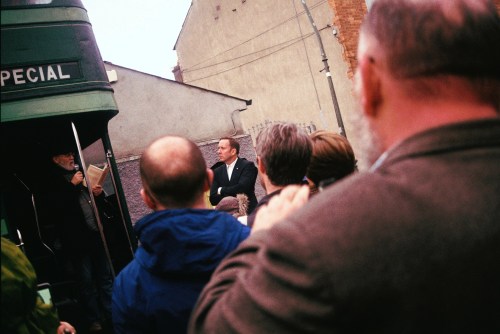
This was a foregone conclusion, as an outdoor event had been organised. Despite the weather, they came in their droves to Phibsboro for a day to celebrate Lord Dudley, known to generations of Dubliners as ‘Bang Bang’.

With the great street character buried in an unmarked grave in Drumcondra, the team behind the Bang Bang Cafe in Phibsboro decided it was time to mark the final resting place of Thomas Dudley. A new plaque was unveiled in his honour, The Mero was sung with gusto, and then it was back to Phibsboro.

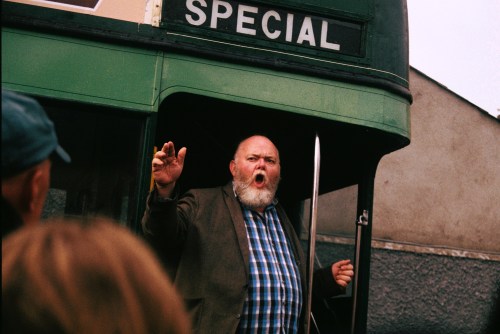
My thanks to photographer Luke Fallon for capturing these images of the street celebration. Pat McGrath beautifully brought Bang Bang to life,performing from a play by Dermot Bolger. Dermot himself said a few words and read poems about the street and those who made it. I said a little about the Dublin of Bang Bang’s time, and Shane Coleman of Newstalk kept it all together as MC.  Thanks to Mary Clarke of Dublin City Library and Archives for bringing along the key.

bolger1

DermotBolger reads. (Image: Luke Fallon)

coddle.jpg

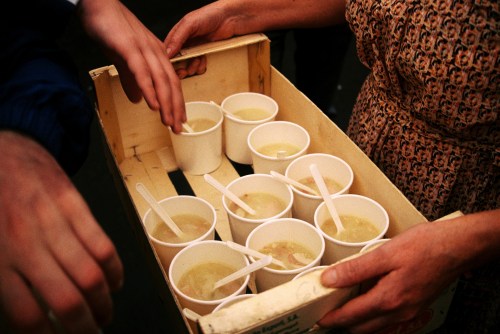
Coddle! (Image: Luke Fallon)

play1.jpg

Pat McGrath (Image: Luke Fallon)

play2

Pat McGrath (Image: Luke Fallon)

Continue Reading »

Once again, the History Ireland Hedge School rolls into the Mindfield area of Electric Picnic this weekend, and once again I’m participating. We have two discussions lined up that hopefully will appeal to CHTM readers that find themselves in a field in Laois this weekend, and both of which were picked around historic anniversaries.

Both panels take place in the Leviathan tent of the Mindfield area.

lenin-connolly-1920

The Radiators from Space, via peteholiday.com

The summer of punk, 1977.

Saturday, 12:45PM (Note the earlier start time than normal)

Forty years ago the Sex Pistols chart-topping ‘God Save The Queen’ thumbed its nose at the pretentions of the rock establishment — ‘prog-rock’, ‘concept albums’, long hair and interminable guitar solos. Meanwhile in Dublin bands like the Boomtown Rats, the Radiators From Space, The Atrix and U2 (yes, U2!) burst upon the scene, and from the North, the Undertones, Stiff Little Fingers and Terry Hooleys ‘Good Vibration Records’. Join History Ireland editor, Tommy Graham for a stroll down musical memory lane with Donal Fallon (Come Here To Me), Pete Holidai (Radiators from Space), Eamon McCann (journalist) and Anne Byrne (sociologist, NUIG).

lenin-connolly-1920

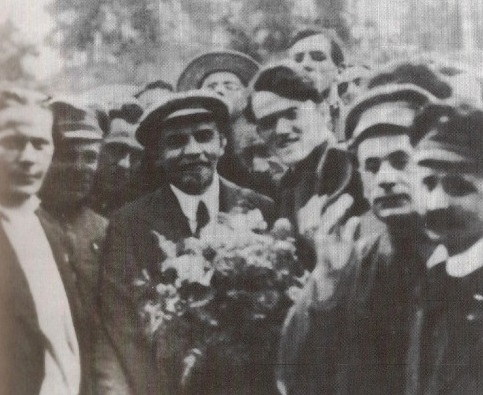
Vladimir Lenin and Roddy Connolly, 1920.

The Bolshevik Revolution — in the dustbin of history?

SUNDAY: 3PM. 

In the face of claims of the total triumph of neo-liberal capitalism and a generation after the collapse of the Soviet Union, how should we mark the century of the Bolshevik Revolution? Should it be consigned to the ‘dustbin of history’ — or can it be recycled? Join History Ireland editor, Tommy Graham, for a no-holds-barred discussion with John Horne (historian, TCD), Oliver Eagleton (playwright & activist), Brian Hanley (historian, Uni. of Edinburgh) and Frank Barry (economist, TCD).


queen_victoria-2

The removal of Queen Victoria from Leinster House, 1948.

As a historian with a particular interest in the areas of memory, commemoration and the role of monuments in society, I’ve had more than a passing interest in what has been happening in the United States in recent weeks with the removal and destruction of a number of monuments to the Confederacy and the losing side of the American Civil War.

Interestingly, we’ve seen a noticeable spike in traffic to articles on this blog which looked at the historic issues around monuments in Dublin, and the destruction and removal of imperial monuments here in the aftermath of independence.

Writing in 1920, the Austrian writer Robert Musil joked that “monuments are so conspicuously inconspicuous. There is nothing in this world as invisible as a monument.” Musil, an important modernist writer best remembered today as the author of the unfinished novel The Man Without Qualities, believed memorials to be an invisible feature in the landscape, but was writing at a time when impressive monuments were coming to redefine urban landscapes right across the continent and beyond, in the aftermath of events like the First World War and the Russian Revolution.

C.S Andrews, a veteran of the revolutionary period and an Anti-Treaty fighter in the Civil War, would proclaim that “there are no monuments to victory or victors, only to the dead.” Yet in truth, memorials have played a central role in trying to change historical narratives both here and abroad, and are rarely mere memorials to the dead. As Yvonne Whelan rightly notes in her study Reinventing Modern Dublin, “as powerful regimes and ruling authorities seek to underpin and legitimate their authority, the past and public memory play a crucial role and find tangible representation in the cultural landscape.” It isn’t only “powerful regimes and ruling authorities” who have sought to reshape the landscape through memorials however, as the Anti-Treaty IRA memorials dotted across the city remind us.
lordgough

The Irish Times, December 18 1961. After the bombing of Lord Gough, only his pedestal remained.

Many monuments unveiled in Dublin in the eighteenth and nineteenth centuries sought to create a cultural landscape that expressed Ireland’s place in the British Empire, and were condemned in the nationalist press as alien to the city. The Nation, a newspaper to which diverse voices like Thomas Davis and Lady Jane Wilde contributed, noted that:

 We now have statues to William the Dutchman, to the four Georges  -all either German by birth or German by feeling –  to Nelson, a great admiral but an Englishman, while not a single statue of any of the many celebrated Irishmen whom their country should honour adorns a street or square of our beautiful metropolis.

As monuments sought to redefine public spaces in Dublin in the interest of the British state, they also became frequent targets of political assault. The most divisive monument in the city for many years was that to King William of Orange, erected in 1701, a mere eleven years after the Battle of the Boyne where William had soundly defeated King James II. A publication in 1898 noted that:

This equestrian statue of William III stands in College Green, and has stood there, more or less, since A.D 1701. We say “more or less” because no statue in the world, perhaps, has been subject to so many vicissitudes. It has been insulted, mutilated and blown up so many times, that the original figure, never particularly graceful, is now a battered wreck, pieced and patched together, like an old, worn out garment.

Continue Reading »

On Grattan Bridge.

Like many Dubliners, I love the Grattan Bridge which connects Parliament Street to Capel Street. The bridge includes beautiful representations of the mythical hippocampus (half horse, half fish) in its lamp designs, not unlike the figures that appear in the lamps at the Grattan monument on College Green and at the Vartry Reservoir.

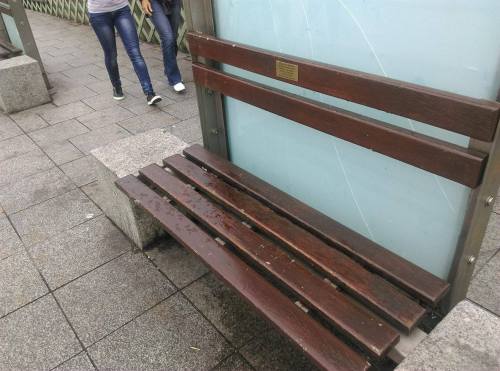
Grattan Bridge is also somewhere you can just sit down and take things in for a while, with a series of benches. Passing it yesterday on a rainy day, I noticed a funny little addition to one such bench:

bench2

bench1

It brought to mind a few other such interventions in the city over the years, most famously of course the Father Pat Noise plaque on O’Connell Bridge, placed in the spot where the control box for the ill-fated Millennium Clock had once been.

Anyway, thanks to those responsible! Such people brighten up life in this city.


lucian4_1952768i

Brendan Behan with Lucian Freud in 1952, the year this article was published. One of a series of images of the men captured by Daniel Farson.

The Irish Digest magazine enjoyed great commercial success in the 1940s and 50s, bringing together content from a range of publications including The Bell, Dublin Opinion and Hibernia. It reflected a wide variety of opinions, ranging from conservative Catholic voices to the anti-censorship cries of The Bell’s team. Because of the diversity of sources it drew from, significant names like Brendan Behan, Seán Ó Faoláin and others emerge from time to time in its content pages.

This little piece came from a radio broadcast of Behan in 1952. At the time, Behan was praised in The Irish Times as “a young Dublin writer who is rapidly winning a reputation as an accomplished broadcaster with an original style of approach.” Perhaps Behan’s finest biographer, Michael O’Sullivan, has noted that “there were conservative elements in the radio service who believed that the earthy vernacular performances of Brendan Behan had no place on national radio. They would gladly have kept him off air had they been able to do so.”

The piece may interest readers of the blog as it deals with things like sporting loyalties, with Behan noting that “we never played Gaelic football and knew nothing about it”, insisting that “we went mostly to Tolka Park or Dalymount.” As one comes to expect from Behan’s output of the time, it includes a few street ballads too.


20668026_160214637877358_227145167_n

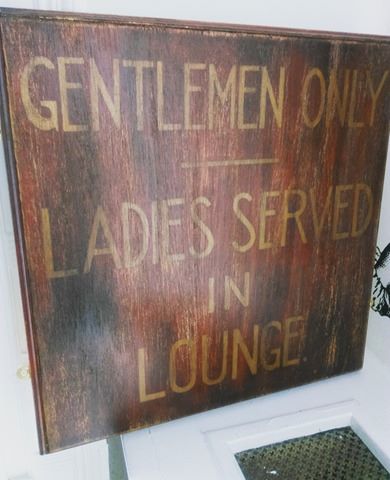
‘Gentlemen Only – Ladies Served in Lounge’

Following on from their excellent exhibition on Heffo’s Army and the phenomenon of Dublin’s 1970s GAA support, the Little Museum of Dublin is currently hosting an exhibition dedicated to the history of the Dublin pub. Avoiding all cliches, it includes sections on things like the temperance movement in the city historically, the Vintners Association and some of Dublin’s historic public houses which now exist only in the annals of history.

A recent addition to the exhibition is this sign, ‘Gentlemen Only – Ladies Served in Lounge’.  Posting it on my Instagram, it led to some excellent comments. Gerry posted:

When I worked as a lounge boy in The Kilmardinny Inn the women picketed the pub as the bar was men only.  The husband’s were put out as they could not cross the picket with their wives on the picket line! RTE had it on a news report circa 1974/75 if memory serves me right.

Similarly, Carey remembered:

The Blue Haven in Templeogue in the early 70s had the sign ‘No Dogs, No Women’ pride of place on the front door. My mother refused to allow my father or uncle to go anywhere near it!

20864602_162586457640176_1828485619_n

Irish Independent, September 1977.

In 1972, when Terry Kelleher published The Essential Dublin, he noted that “No pubs are barred to women though there is an unstated convention that women use the lounge bar if there is one. ” It’s quite difficult to tell just when things changed in Dublin public houses, indeed it seems to even vary between city and county. In his excellent social history of the Dublin public house, Kevin Kearns notes:

Changes began in the postwar forties when women were gradually admitted, lounges created and comfortable furniture installed. These were healthy changes which served to “civilise” the social setting without destroying the original character of the bar area.

Regardless, the sign in the corner of the exhibition is a relic of a different time entirely now, but an important one in telling the history of the Dublin public house.

In April 1846, the Dublin street performer Michael Moran passed away. Known as Zozimus, the ‘Blind Bard of the Liberties’ had spent years reciting poetry and verse on the streets of the capital, much of it composed by himself. Fearful of grave robbers, Moran was buried in Glasnevin cemetery, which boasted watch towers to keep the ‘sack-em-ups’ away from the corpses of the recently deceased.

A work dedicated to his memory was published in 1871, and noted that:

When arrived at his destined spot, Zozimus would spread out his arms, as if to catch all comers-and-goers- and say with his own great and peculiar accent:

‘Ye sons of daughters of Erin, attend.

Gather round poor Zozimus, yer friend.

Listen, boys, until yez hear

My charming song so dear.

Zozimus lay in an unmarked grave until 1988. In that year of Dublin’s so-called Millennium (a historically dubious claim, but a year that led to much positive civic pride), a headstone was placed over Michael Moran in Glasnevin Cemetery by the Smith Brothers of the Submarine Bar in Crumlin and the Dublin City Ramblers.

ZozimusGrave

The grave of Zozimus, Glasnevin.

Just as the marking of the grave of Zozimus was a lovely gesture, we were delighted to hear recently of efforts to properly mark the final resting place of Thomas ‘Bang Bang’ Dudley, a much loved figure in the Dublin of the 1950s and 60s. Roaming the streets with his ‘Colt .45’, a large key he carried at all times with which to host fake shoot outs, he was a frequent site for anyone who entered the city centre via public transportation, jumping onto buses and trams. Everyone got in on the act, and as Paddy Crosbie recalled:

His favourite hunting-ground was the trams, from one of which he jumped, turning immediately to fire ‘Bang Bang’ at the conductor. Passengers and passers-by took up the game, and soon an entire street of grown-ups were shooting at each other from doorways and from behind lamp-posts. The magic of make-believe childhood took over, and it was all due to the simple innocence of ‘Bang Bang’.

At the time of his passing in 1981, he was recalled in the press as “one of Dublin’s best known and most beloved characters.” Like Zozimus, his fame didn’t follow into the gates of the cemetery, and he was buried in St Joseph’s Cemetery in Drumcondra into an unmarked grave.

Great credit goes to our friend, the ever unpredictable Daniel Lambert of Phibsboro’s Bang Bang Cafe, who decided it was time to mark the resting place of Bang Bang, fundraising through his cafe. It didn’t take long to accumulate the funds necessary, and soon a marker, complete with trademark key, will be unveiled in St Joseph’s.

Keep an eye on Bang Bang’s social media for more information on their plans to mark the life of Thomas Dudley in the weeks ahead.

bangbangshoots

Image Credit: Bang Bang Cafe,Phibsboro.

EnnisPubb

Seamus Ennis on the Pipers Corner, Marlborough Street.

Seán O’Casey’s public house is no more. I always presumed it took its name from the playwright, who was something of a devout teetotaler, a habit he acquired from labour leader Jim Larkin.

While O’Casey’s name no longer graces the street, it was a pleasant surprise to pass recently and see the familiar Séamus Ennis gazing down. Born in Finglas (where a street today carries his name) in 1919, Ennis was a giant of Irish traditional and folk music, both as a performer and a collector of songs and tunes.

From 1942 to 1947, Ennis traveled rural Ireland on bicycle. At the age of twenty-three, he began his journey to capture the vanishing oral and folk traditions of rural Ireland. As Gearóid Ó hAllmhuráin has noted, “his only tools were a pen, a satchel of music sheets and a tin whistle to verify his transcriptions.” By the time Ennis had completed his work for the Irish Folklore Commission, he had amassed more than 2,000 pieces of material, “an achievement unsurpassed by any of his predecessors in the field.”

EnnisPubb

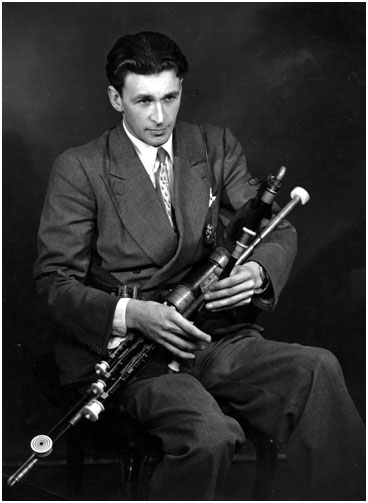
Ennis photographed in 1955.

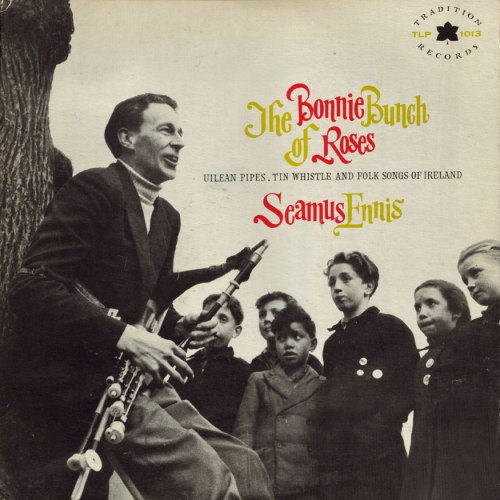
As a masterful player of the uileann pipes, Ennis helped to found Na Píobairí Uileann, and demonstrated his abilities as a player on a number of important records, beginning with 1959’s The Bonny Bunch of Roses.  The striking LP cover shows Ennis playing before an audience of children in Dublin’s Phoenix Park, one of several great images of Ennis contained in the Ritchie-Pickow Collection, striking images of 1950s Ireland today hosted online by NUI Galway.

1956_tlp_1013

Later, Ennis championed emerging traditional acts like Planxty, believing that just as he had collected a tradition, it had to be maintained and handed on. In Leagues O’Toole’s history of Planxty, the masterful piper Liam O’Flynn recalled that “Séamus was so willing to part with all the information he had, whether it was tunes or techniques or whatever. There’s that desire to pass it on.” Séamus would leave his pipes, more than a century old, to Liam in his will.

Ennis died in 1982 at the Naul in North County Dublin. There were many words of praise, perhaps the finest coming from musician and broadcaster Tony MacMahon, who has recalled how “he made me realise music is magic and a spiritual experience. It cannot be taught in any university. It is beyond that.”


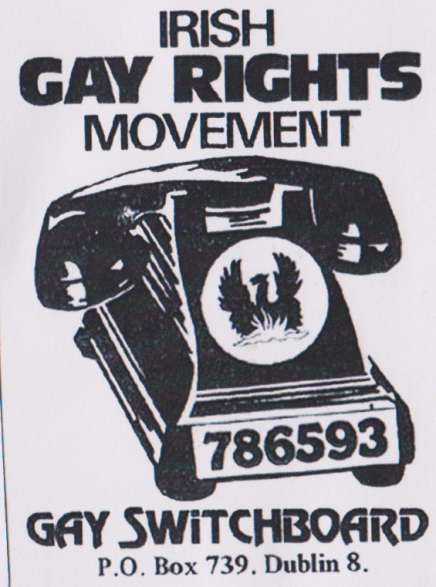
Last month, a number of friends (drawn from this parish, Sunday Books, Foggy Notions and more besides) launched ‘ASK’, a new monthly night which aims to bring together people with eclectic music tastes and raise money for good causes in the process. Our first night in the MVP bar benefited MASI, a migrants rights group. Our second night is for the Gay Switchboard, and includes guest DJ Tonie Walsh. It takes place next Thursday and begins at the earlier time of 7pm.

switchboardhirschfeld

Historic Gay Switchboard promotional material, scanned from Brand New Retro exhibition at the Little Museum of Dublin.

In March 1979, the Hirschfeld Centre in Dublin’s Temple Bar opened its doors. A gay community centre named in honour of the pioneering gay rights campaigner Magnus Hirschfeld, a speech heralded the centre as “living proof of gay people’s new found pride…testimony to the fact that the gay citizens of Ireland need no longer fear to be openly ourselves.” David Norris would later recall the the enormous crowds who arrived to celebrate the new venture:

The first night the Hirschfeld Centre opened there were three or four hundred people in the place, and when I went to check downstairs I could the floorboards were bouncing. A member who was also a structural engineer approached to say it could be dangerous, so I had the music switched off. I addressed the the throng and told them they could have a refund, or they could stay and chat to their friends and the coffee bar was free for the night, but there would be no more dancing that evening. I was booed and hissed at before one guy stood up and said ‘Hold on a minute, Isn’t it just as well there is someone who does give a shit about our safety?’ and the boos turned into cheers!

flikkers1

“Like any disco in town, except….”

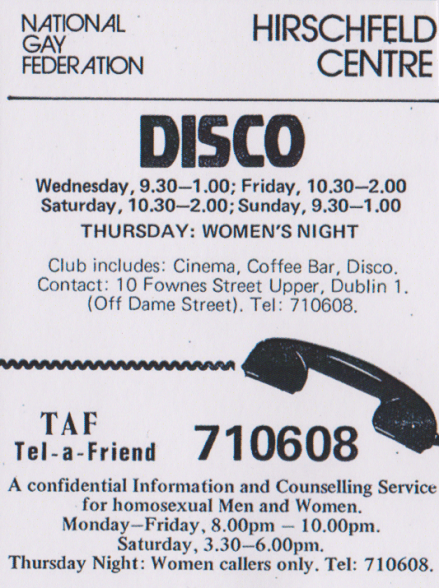
Predating even the Hirschfeld Centre, the Gay Switchboard has been providing a crucial service for more than four decades. Beginning life as TEL-A-FRIEND in the days before decriminalisation, it is now the longest running LGBT voluntary organisation in Ireland. The body does not receive state funding, instead depending on the good will and support of the public and the community it benefits.

tafhirschfeld

Historic Gay Switchboard promotional material, scanned from Brand New Retro exhibition at the Little Museum of Dublin.

We’re delighted that our second night in MVP will benefit this important cause. Special Guest DJ on the night is Tonie Walsh, who requires no introduction but who I will wax lyrical about anyway. As archivist of the Irish Queer Archive (housed in the National Library of Ireland) and through his famous walking tours of LGBT Dublin, Tonie has done much to promote the history of Ireland’s LGBT community. As an activist of decades standing, he has fought for change in Irish society. As a DJ, he knows a good tune and was central to the story of Flikkers, the now legendary club dimension of the Hirschfeld Centre. Tonie’s reminiscences to the recent documentary Notes on Rave in Dublin were one of the highlights of that project.

Visiting the Hirschfeld Centre at the time of its opening, The Irish Times commented on “the massive disco speakers and imported record collection straight from New York’s most up-to-date record shop.” While we may lack the massive speakers, we promise a fun night of great music, visuals and more besides in the wonderful surroundings of MVP.

MVP is located at 29 Upper Clanbrassil St, Dublin 8. Bígí Linn.

20045747_1483348165046132_3870702335902092769_o


TheLabPlaque

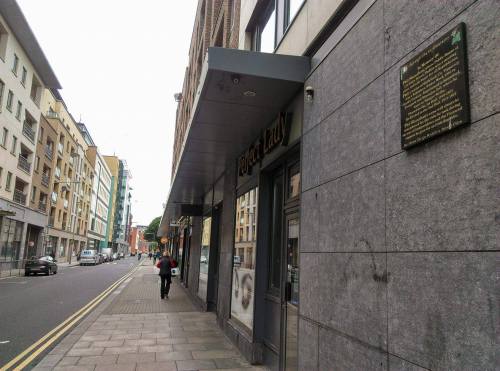
A plaque commemorating Phil Shanahan on The LAB Gallery, James Joyce Street.

Located in the heart of Dublin’s ‘Monto’ red light district, Phil Shanahan’s public house was perhaps an unlikely rendezvous point for republicans during the years of the Irish revolution. British soldiers, Irish radicals, prostitutes and others all seem to have frequented the premises, which was located at 134 Foley Street. Dan Breen, one of those who instigated the War of Independence with the Soloheadbeg ambush in Tipperary, recalled that:

The lady prostitutes used to pinch the guns and ammunition from the Auxiliaries or Tans at night, and then leave them for us at Phil Shanahan’s public house. I might add that there was no such thing as payment f or these transactions, and any information they had they gave us.

At Foley Street, Shanahan’s was right in the thick of the Monto, described beautifully by Michael Foley in his history of Bloody Sunday as “a playground for adventurers, crooks and acute observers of the human condition.” Immortalised by Joyce as ‘Nighttown’ in Ulysses,  the area had emerged as a centre of prostitution from the 1870s.

Daniel_Breen_police_notice.jpg

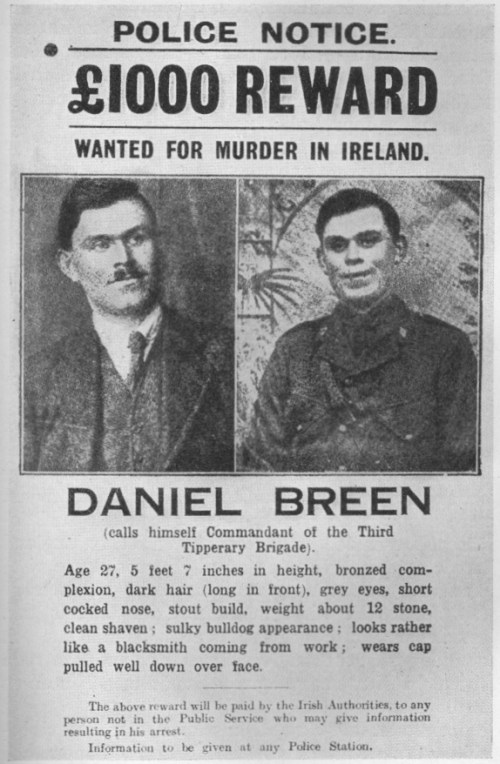
1919 wanted poster for Dan Breen, who remembered the pub as  ‘the rendezvous of saints and sinners’.

Phil Shanahan  (1874–1931) was not a product of inner-city Dublin, hailing instead from Tipperary’s Hollyford.  As a young man he had hurled for his native county,  and could boast of being ‘out’ at Easter Week, fighting with the Irish Volunteers in Jacob’s factory. Timothy Healy, the nationalist politican and lawyer, recalled meeting Shanahan after the Rising, when he faced difficulty holding on to his public house licence:

I had with me to-day a solicitor with his client, a Dublin publican named Phil Shanahan, whose licence is being opposed, and whose house was closed by the military because he was in Jacob’s during Easter week. I was astonished at the type of man – about 40 years of age, jolly and respectable. He said he “rose out” to have a “crack at the English” and seemed not at all concerned at the question of success or failure. He was a Tipperary hurler in the old days. For such a man to join the Rebellion and sacrifice the splendid trade he enjoyed makes one think there are disinterested Nationalists to be found. I thought a publican was the last man in the world to join a Rising!

Unsurprisingly, the pub was popular too with British soldiers, an important part of the Monto economy. Luke Kennedy, a senior IRB man, recalled that soldiers returning from the front and soldiers based in Dublin were often willing to part with guns for cash; “We procured quite a large number of arms by purchasing them from British military. A lot of British soldiers used to frequent Phil Shanahan’s public house and it was there most of the contacts were made.” Similarly, Thomas Pugh of the Volunteers recalled:

Sometimes an Australian fellow would come in, throw a .45 revolver on the counter and put out his hand for a pound. That was a recognised thing. The women used to steal rifles and .45 revolvers and anything they could get their hands on.

Shanahan’s functioned as something of a drop off point for acquired weaponry. Unsurprisingly, given Shanahan’s Tipperary connections, plenty of what was left there seems to have made its way into the hands of the very busy Tipperary IRA. Seamus Reader, O/C of the IRA in Scotland, recalled that having succeeded in having explosive material shipped to Dublin, “It was taken to Phil Shanahan’s and, I understand, the No. 3 Tipperary Brigade got the bulk of it.” Thomas Leahy, a Dublin docker in the ranks of the Irish Citizen Army, remembered that “many a rifle and ammunition was brought to Phil Shanahan’s shop in Foley Street.”

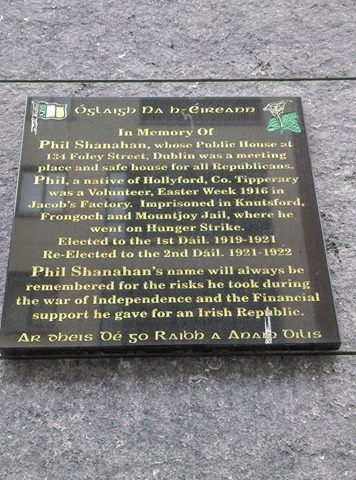
TheLabPlaque

Plaque to Phil Shanahan on the LAB Gallery, July 2017.

Shanahan was a republican first and foremost, but also a reluctant politician. In 1918,  Shanahan was chosen to contest the election as a Sinn Féin candidate against Alfie Byrne, perhaps the most celebrated local politician in the history of the capital.  It was a rare electoral defeat for Alfie. Thomas Leahy recalled:

Alfie Byrne was the sitting member and Phil Shanahan the proposed. We had all our work cut out in that Ward, for it was the biggest industrial area in Dublin, composed mostly of the ex-British soldier element, whose wives looked on Alfie Byrne as a tin god; so, knowing what was in front of us, we got a very strong group of men and women to organise an election committee and Phil himself worked hard, not for himself, but for the Republic. As he often reminded his followers, he was a soldier and not a politician.

Shanahan would later oppose the Anglo-Irish Treaty, failing to secure election to the Third Dáil in 1922. He left the capital in 1928, living out his final years in his home town of Hollyford, County Tipperary.

Today, the location of Shanahan’s is occupied by The LAB Gallery.  This important site of the revolutionary period could have been forgotten entirely, but at Easter 2014 a plaque was unveiled by Terry Fagan and the North Inner City Folklore Project, with  Shanhan’s native Tipperary well represented in the gathered crowd. It is one part of Monto that certainly deserves to be remembered.