Feeds:
Posts
Comments

Previous ‘Plaques of Dublin’:
The Eagle Tavern, Lord Edward Carson, Sean Healy- Irish Volunteers
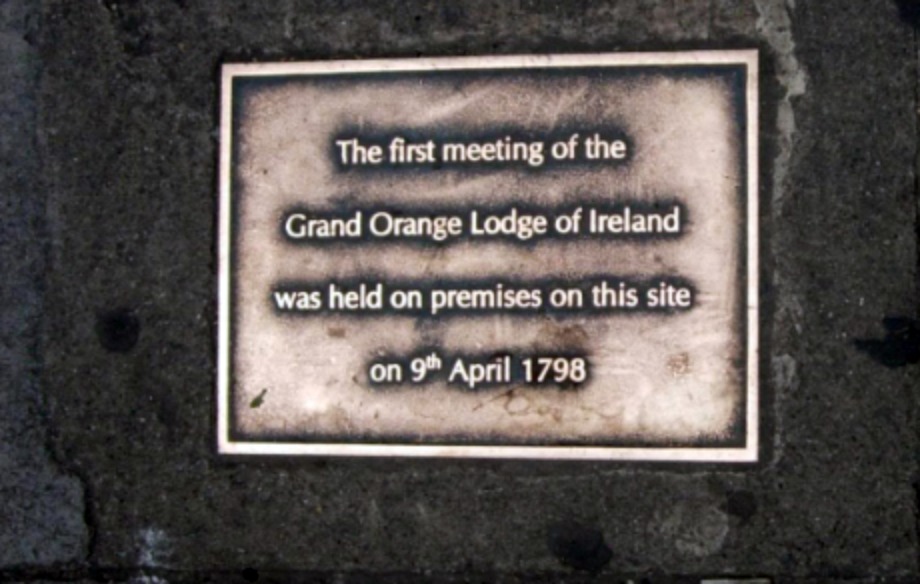
The Grand Orange Lodge, in the wake of the Love Ulster fiasco and riots in Dublin, posted an article to their site relating to a 1998 planned plaque unveiling on Dawson Street.

Dublin has a long history of such intolerance, and Orangemen have only to reflect on what happened in 1998 to prove the depth of this intolerance.

That year the Dublin and Wicklow Orange Lodge had planned to have a small ceremony at the unveiling and dedication of a small plaque in Dawson Street, close to the city centre.
(…)
No march was involved, and it would have been a low-key and non-contentious event, involving mostly Southern Orangemen, and a number from Northern Ireland who wanted to be present at a truly historic affair.
(…)
However, republicans had other ideas, and weeks before the unveiling ceremony, pressure was exerted on local traders and shop-keepers, who produced a statement expressing their opposition.
(…)
The plaque was unveiled, but without any Orange presence and the affair proved that the Republic of Ireland had not matured to the extent that it could accommodate even a small Orange ceremony in its capital city.

The plaque in question is one I’ve been walking past for years, but never really noticed. It sits in the ground by busy bus stops.

The plaque had made its way into the national media in May 2000 when plans to unveil it proved controversial. The Dublin Wicklow Lodge had planned a short parade and ceremony to unveil the plaque, but claimed politicians in the south had stood in the way of such an event.

An Irish Independent report at the time noted:

“We came to a compromise about four weeks ago with Dublin Corporation under which the Lord Mayor Mary Freehill would have a civic unveiling of the plaque and we’d have a parade and our own unveiling. We weren’t happy but we agreed. A week later, we received a letter demanding that we `enter dialogue and lift the siege of the beleaguered Nationalist community on Garvaghy Road’. That’s ridiculous and deeply insulting. We are citizens of, and loyal to, a different state.”

The Lodge decided to postpone the march. It is now considering whether or not to attend the civic unveiling. “We will have to discuss whether we should be seen to lend credibility to a State that has betrayed us,” said Mr Cox.

So, while a very small, hidden and unassuming plaque- this one must surely be among the most controversial in the city?

And the beat goes on…

This article, on Dublin’s burgeoning underground dance scene, was written in March 2011, and published in shortened form in the latest issue of Look Left and has now been uploaded in full on the blog.

The economic recession coupled with tight nightclub licensing laws has led to a proliferation of D.I.Y., independent after-hour parties, raves and club-nights in Dublin. People have become fed up with being overcharged for alcohol in bars and being turfed out at 2:30am due to the strict licensing laws. It is still a little known fact that Ireland has the earliest nightclub closing times in Europe. Instead of sitting around and simply complaining, various groups are channelling their anger and efforts into coming together and organising their own events which often bend or break the rules.

The response of the Garda has been swift and harsh. Numerous underground, late night and BYOB events have been shut down by the police in the last six months. Undeterred, music and art collectives have reacted to this clampdown by adjusting the way they publicise and organise events in order to dupe the authorities.

Last November this author along with around three-hundred other individuals boarded a fleet of double-decker buses on the quays on a cold Saturday night at 1am. After a twenty-minute drive we found ourselves stepping out from the bus and into an empty industrial estate in the south-west of the city. We were here for a large, after-hours rave in a disused warehouse which was rented for the night by a small group of DJs and promoters. It was a unifying experience. Young lads barely out of school from local housing estates chatted to middle-aged ravers who had been around for the first wave of Acid House in 1988 – 1992. Some people were on the chemical MDMA otherwise known as ‘ecstasy’, others weren’t. Some people brought along beer or other alcoholic drinks, others didn’t.

Warehouse Collective, November 2010. Photo - Lucia Mather

There was no reported acts of violence or theft, an all too common occurrence in our city’s clubs and streets at night. Everyone had come to listen to the music, dance and have a good time in an environment that was outside of the control of overzealous Garda, greedy publicans or thuggish bouncers. Events like these, albeit on a smaller scale, are happening every weekend in the city. Nights don’t finish at 2:30am anymore, people see it as half-time.

Continue Reading »

I stumbled across this little gem from the Indo, relating to the 1998 league winning season in Inchicore, and the madness which brought Blue Flu Day to a very quick conclusion for the local guardians of the peace. Those were the days.

The story of how it all happened is a great one, retold on RTE’s Monday Night Soccer below. A draw for Shels would have been enough to give them the league. Alas…

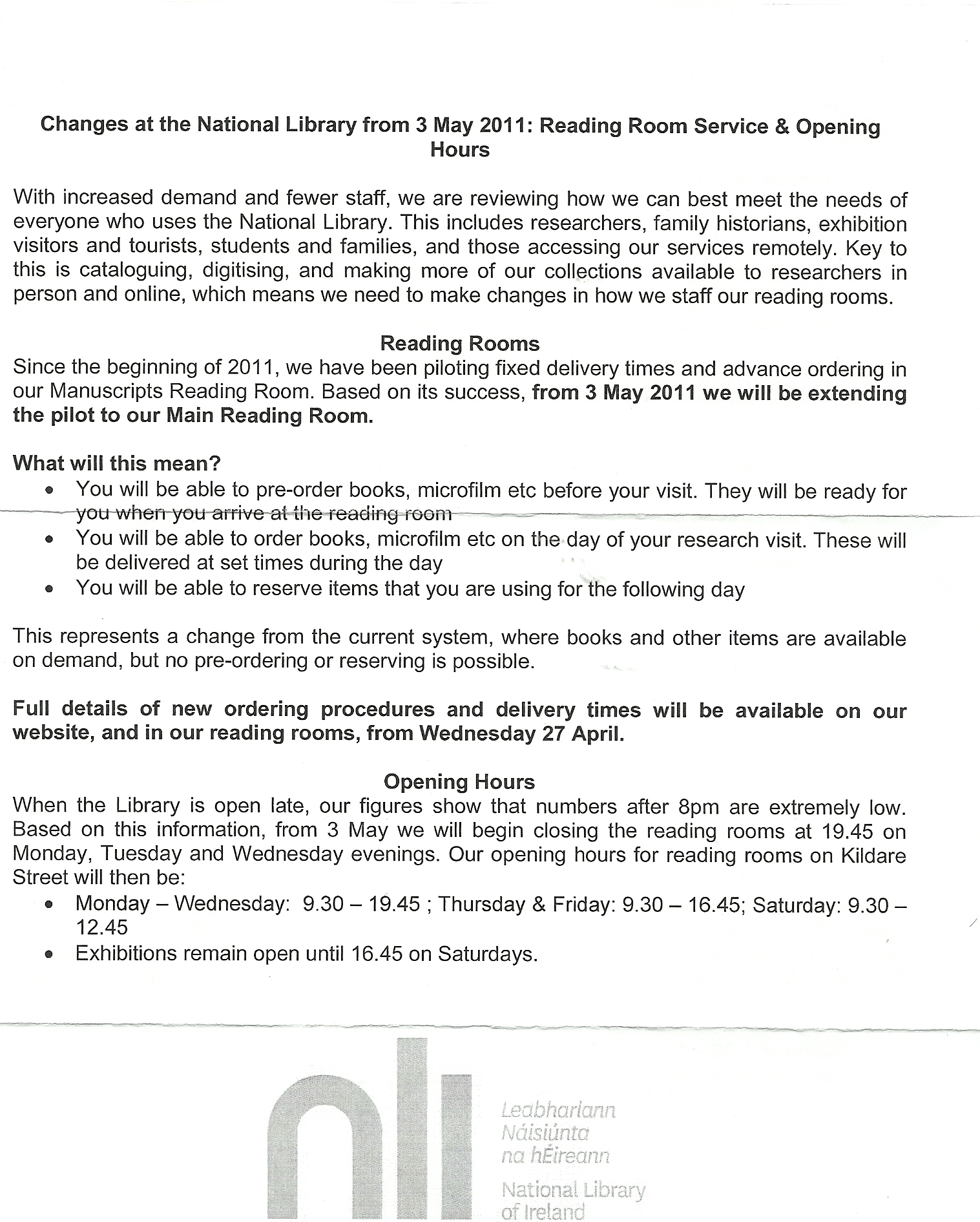
I got this interesting letter in the post this morning, about changes to the National Library. When a letter begins “with increased demand and fewer staff” you know the kind of road it’s heading down.

From now on books and items are no longer available on demand. While the library is currently open late, it is noted here that “…our figures show that numbers after 8pm are extremely low” and as such the library will now close at 7.45 on Monday, Tuesday and Wednesday. This one is a real pity as myself and a few other Maynooth students used to avail of the later openings after a day in college.

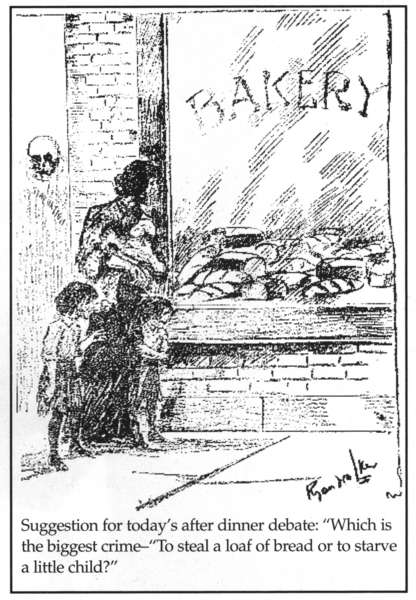
You can’t blame the staff of course, in the face of cutbacks across the board these things are inevitable. For a historymad people, I deemed this worth sharing here:

In Yisser Newsagents

The latest Lookleft is out, and it’s a good one. There are articles in it that should appeal to the historyheads, with pieces on the great Máirtín Ó Cadhain and The Irish Worker newspaper. On other fronts there are pieces on issues as diverse as Dublin street-art, international politics and more besides. This here parish is well represented with a piece on the emerging late night (why stop at 2:30am?) music scene in Dublin and a match night report on the southside Dublin derby between Saints and Hoops. It’s available from Easons, Books Upstairs and the vendors on O’Connell Street.

The latest History Ireland should be arriving in newsagents and bookshops around Ireland this week. In it, you’ll find a brief piece from me on the role of Dublin firefighters in assisting Belfast following the bombings of that city during World War II.

The men were warmly welcomed to the city, with the Irish Independent of April 18th noting that “the fire brigades which attended from Éire have been greatly praised for their work, and as they passed through the city’s streets homeward bound after their errand of mercy they were heartily cheered by a grateful people.”

History Ireland are over on Facebook now by the way. My mother is perhaps the only person I know in real life still missing from the Facebook revolution.

Red Pepper April/May is still knocking about with a piece on radical Dublin in it. It’s available from Books Upstairs among other places. A British publication, I suppose it’s always nice to be given a platform from which to tell outsiders “Rumours of our demise have been greatly exaggerated.”

Wexford Street fire

Pic: Lynsey Kiely

Four people were pulled from burning flats on Dublin’s Wexford Street early today. The blaze erupted on the first floor above Eddie Rocket’s City Diner at 4.15am.

It’s not the first time there’s been a late night fire on the street. Remember the panic that went with the fire in the Village nightclub back in March 2008?

No Rare Old Times- but a city with a great story to tell.

The cultural landscape of Dublin will change this summer, when the Little Museum of Dublin opens at 15 St Stephen’s Green. This new non-profit museum will tell the story of Dublin in the 20th Century, and the collection will be completed with the help of the public. In other words it will truly be a people’s museum.

I stumbled across this yesterday by pure chance and have to say it’s quite an interesting idea. Of course many of our cities have museums dedicated to their own history, such as Cork and Galway. The Little Museum of Dublin looks set to open this summer.

In Dublin, we are obviously very lucky to have the National Museums, and also the Story of the Capital at City Hall. The fact the National Museums are free is a huge kudos too.

When on the job with walking tours, I normally direct tourists towards a few places if they want to get to grips with the city a bit better. There’s the Writers Museum, the prior mentioned Story of the Capital at City Hall, the folks at the Dublin Civic Trust and then a number of smaller specialist museums like the excellent Garda Museum or the GPO in-house museum.

I’m interested in seeing how this new venture marks itself out. It’s interesting to note they seem to be looking for people to become patrons of the Museum at this very early stage:

Become a member
As well as donating artefacts, individuals or companies can become Patrons, Life Members or Friends. We have an exclusive programme of benefits for those who support the Little Museum:

Patron (Annual subscription €5000)
Life Member (€1000)
Friend (Annual subscription €95)

A report in todays Irish Times suggests the museum will have a focus on twentieth century Dublin.

Come to think of it, we’ll consider anything to do with Dublin in the 20th century.

Surely the best and cheesiest Dublin ad ever? Or at least since Dubliner cheese.

I’ve a lot of time for some Irish rappers. We had Street Literature from the northside on here before, but I love what Nugget has been doing on this site of the river. Hailing from Ballyfermot, this is a cracker.

This looks excellent, a really good idea.

Hollywood Babylon -Dublin’s Midnight Movie Film Club Running Saturdays fortnightly April to October 2011 and devoted to our favourite ‘disreputable’ movies.

Roughly speaking- movies best seen after Midnight, in company and with beer.

Curated guest screenings, re-imagined film posters by some of our favourite artists and designers, BYOB, intervals, trashy trailers, cigarette girls…

Hollywood Babylon, of course, is one of the best Misfits songs. Hollywood Babylon, we salute your name.

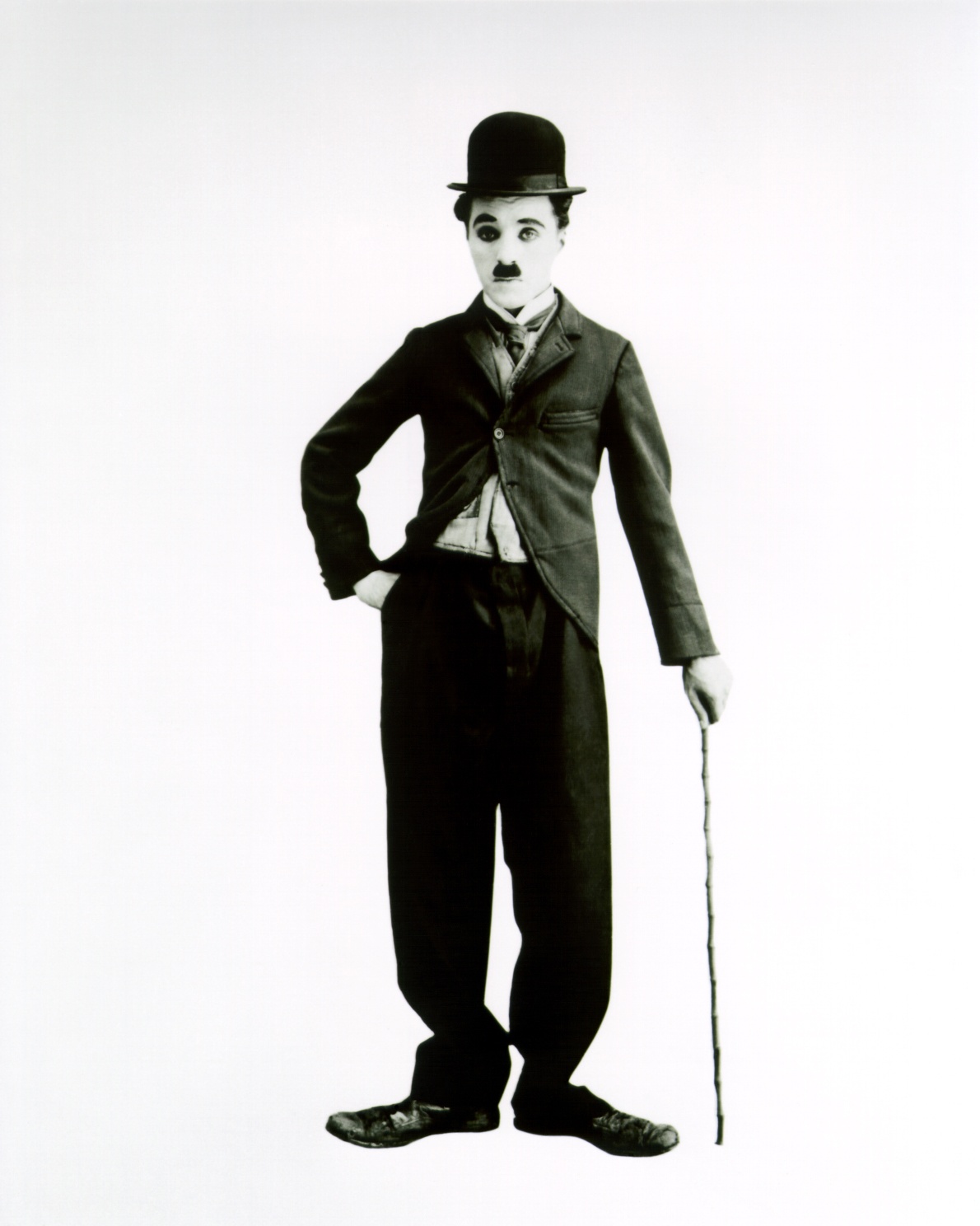
It’s often forgotten that the late and very great Charlie Chaplin has a statue in this country, located in Kerry, where he spent happy times as a visitor.

In recent times, whenever I’m on the job and providing tours of the city to tourists, I’ve stopped at the statue to another great man, Jim Larkin. When I stand there I think of Austin Clarke’s wonderful words of tribute, when he wrote:

What Larkin bawled to hungry crowds
Is murmured now in dining-hall
And study. Faith bestirs itself
Lest infidels in their impatience
Leave it behind. Who could have guessed
Batons were blessings in disguise,
When every ambulance was filled
With half-killed men and Sunday trampled
Upon unrest? Such fear can harden
Or soften heart, knowing too clearly
His name endures on our holiest page,
Scrawled in a rage by Dublin’s poor.

One of the giants of Irish history, Larkin stands proudly and defiantly on the very street where workers he organised were hospitalised and even killed on a Bloody Sunday.

“Who is missing a statue here?” I always ask. The answer is Charlie.

It was through Emmet O’Connor’s wonderful biography of Larkin I first stumbled across a most unusual episode in Larkin’s life, which occurred when he was imprisoned in the United States. Larkin had found himself imprisoned for “criminal anarchy”, essentially a sentence placed upon him as a result of his radical politics.

While sentenced to five to ten years, Larkin found himself in Sing-Sing Prison. Among his more unusual visitors was Charlie Chaplin.

Chaplin wrote of the visit:

The last day in New York, I visited Sing-Sing with Frank Harris. Jim Larkin, the Irish rebel and labour union organiser, was serving five years in Sing-Sing, and Frank wanted to see him. Larkin was a brilliant orator who had been sentenced by a prejudiced judge and jury on false charges of attempting to overthrow the Government, so Frank claimed, and this was proved later when Governor Al Smith quashed the sentence, though Larkin had already served years of it.
Frank inquired about Jim Larkin and the warder agreed that we could see him; although it was against the rules, he would make an exception. Larkin was in the shoe factory, and here he greeted us, a tall handsome man, about six foot four, with piercing blue eyes but a gentle smile.

It was noted in O’Connor’s biography that Chaplin felt compelled to send presents to Elizabeth (the wife of the union leader) and the Larkin children after this visit.

More detail on the visit to the prison can be found on charliechaplin.com, where it is noted:

Other highlights of this tour included meeting Irish radical Jim Larkin and sitting in the electric chair for a few moments. Charlie visited this prison again shortly before his 1931-2 tour, presenting his new film, City Lights, free for the prisoners’ entertainment.

Something to think about this May Day.

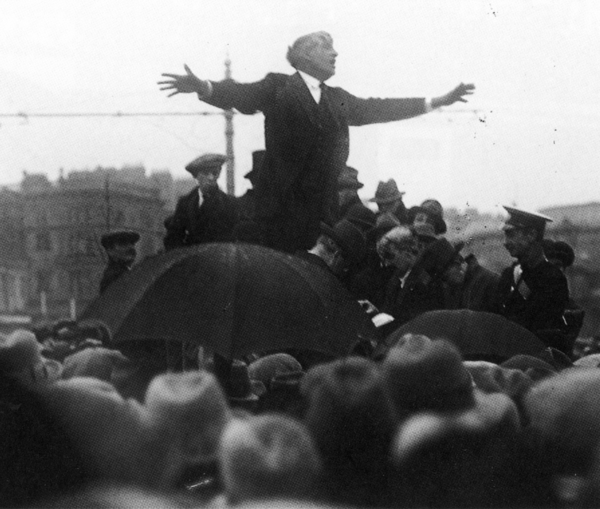
Larkin upon his return from America.

Six years later

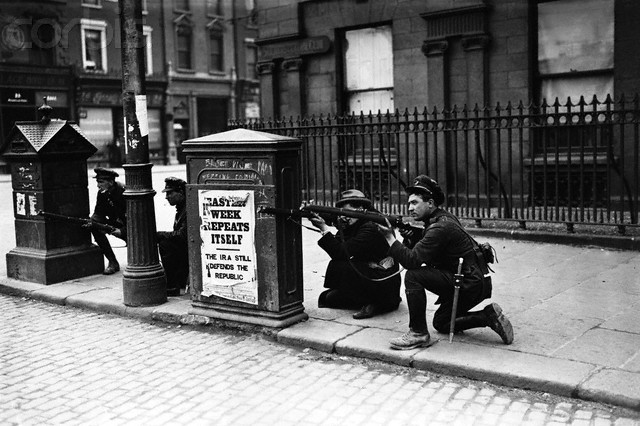
For the week that’s in it. A great snap of Free State soldiers in Dublin in 1922 during the Civil War.

The flyposter beside them reads:

EASTER WEEK REPEATS ITSELF

THE IRA STILL DEFENDING THE REPUBLIC.

Notice the soldier’s sword as well.

© Hulton-Deutsch Collection/CORBIS