Feeds:
Posts
Comments
CapelStWalshes

159 Capel Street.

When buildings are undergoing considerable work, signs of previous incarnations can appear. At 159 Capel Street, the name Walsh’s is once again visible over the shutters of the premises (a better image here, from the excellent ‘Dublin Ghost Signs’). The people behind the Temple Bar seafood favorite Klaw have acquired the site, and it will be reopening to the public soon as PoKē.

While it’s great to temporarily get a look at the Walsh’s signage again, it isn’t only such signage which can reveal the history of buildings, and sometimes there are further clues of the past in the brickwork. Looking at this building earlier as I made my way up Capel Street, I wondered how I never spotted the faded ‘Stars and Stripes’ painted onto the exterior of the building.

18217801_115830898982399_336581707_n

159 Capel Street.

In a former life, the building was home to the American Hotel, which operated there in the 1930s. The proprietor was Michael Costello, “a noted athlete and hurler in his day”, who died at the address in 1938. It appears that the American Hotel was a short-lived venture, but more than eight decades on the flag remains visible on the premises.

While Walsh’s name will no doubt disappear once more in the weeks ahead, as a new business makes 159 Capel Street home, the fading reminder of the American Hotel will remain.

CapelStWalshes

Irish Press, 1934.

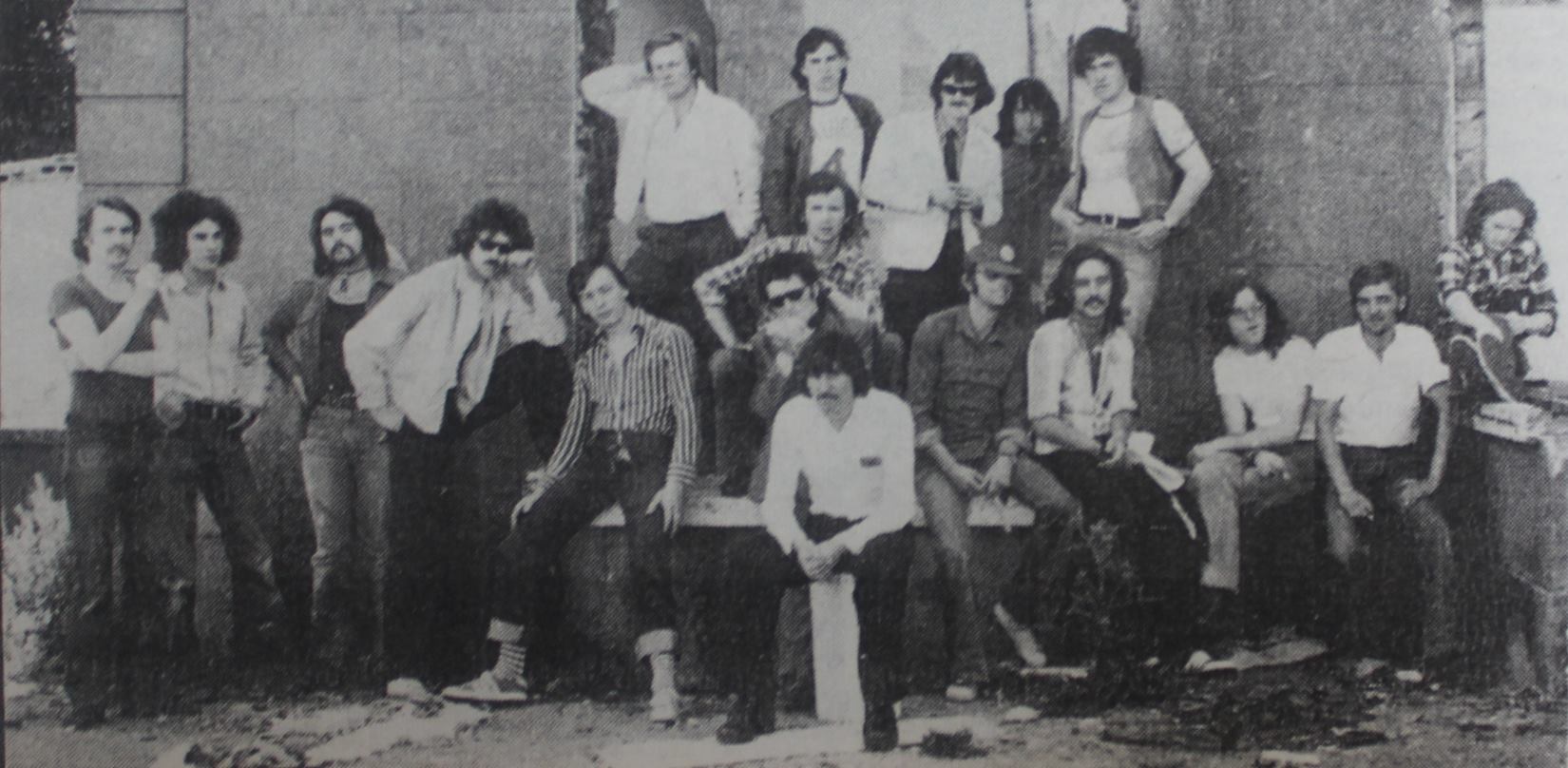
The brilliant resource ‘U2 & Dublin ’76 to ’80‘ published a photograph yesterday from the 1976 ‘Falling Asunder’ music tour which had never been digitised before.

The Boomtown Rats, Cheap Thrills, Nightbus plus Billy McGrath (tour organiser) and Phay McMahon (lights). July 1976

This groundbreaking ‘rock revue’ showcased The Boomtown Rats, Nightbus and Cheap Thrills  and was the first nationwide tour of Irish rock bands. A 29-seater bus toured all over Ireland in July 1976 taking in at least 15 different venues.

The ‘Much More Music Disco’ and the ‘Taylor Lightshow’ were part of the four-hour package. Admission was usually £1.

The Munster Express (16 July 1976) wrote

Each of these bands play a different and varied set musical set of which at least fifty per cent is original material. The Rats music has been described as a sound summit of Rhythm and Blues whereas others prefer the funky sound of Nightbus or the more pastoral mellow music of Cheap Thrills

Tour Dates – JULY 1976
14th – Little Theatre, Gorey, Wexford
15th – Atlantic Ballroom, Tramore, Waterford
17th – City Hall, Cork
18th – Caroline Ballroom, Clonmel, Tipperary
19th – Town Hall, Killarney, Kerry
20th – Mount Brandon, Tralee, Kerry
21st – Glentworth Hotel, Limerick
22nd – Town Hall, Westport, Mayo
23rd – Hotel Ormond, Nenagh, Tipperary
24th – Teach Furbo, Galway
25th – The Crescent, Athlone, Westmeath
27th – ?, Newbridge, Kildare
28th – National Stadium, Dublin
29th – Town Hall, Dundalk, Louth
30th – White Horse, Drogheda, Louth

In terms of identifying the individuals pictured.

18192363_1276497499134998_2222071988525214452_o (1)

Front row (from l-r)

1. Dave McHale RIP (Keyboards, Nightbus. Later ‘Stagalee‘ and ‘The Rats’)
2. Greg Boland (Guitar, Nightbus. Previously ‘Supply Demand & Curve‘ and later ‘Stagalee’)
3. Gary Dixon (Guitar, ‘Cheap Thrills’)
4. Bob Geldof (Vocals & Harmonica, ‘The Rats’)
5. Garry Roberts (Guitar, ‘The Rats’)
6. Pete Briquette in dark glasses (Bass, ‘The Rats’)
7. Dermot ‘Dosser’ O’Sullivan (Keyboards, ‘Cheap Thrills’)
8. Deke O’Brien in baseball cap (Singer & Guitar, ‘Nightbus’)
9. Billy McGrath (Tour organiser & Manager. Later TV producer/director incl. Wired (Channel 4); Completely Pogued (WLP/C4); and Citizens of Boomtown – Story of the Boomtown Rats (BMG Films/BBC Imagine).
10. Sean O’Reilly (Drums, ‘Nightbus’)
11. Joe Lahart
12. Brendan O’Keefe (Guitar, ‘Cheap Thrills’)
Back Row (l-r)
13. Simon Crowe (Drums, ‘The Rats’)
14. Johnnie Fingers (Keyboards, ‘The Rats’)
15. John Quinn (Lead Singer, ‘Cheap Thrills’)
16. Gerry Cott (Guitar, ‘The Rats’)
17. Tom McDermott (Drums, ‘Cheap Thrills’)
18. Phay ‘Taylor’ MacMahon (Lights) [Later Production Management, Site Co Ordinator and Lighting Designer for many artists including Paul McCartney, George Michael, Meat Loaf, Def Leppard, Aerosmith and Westlife]

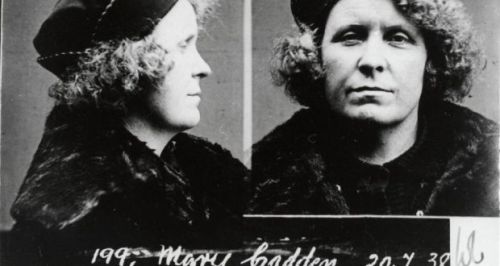
In a very grim way, Mamie Cadden (1891 -1959) found her way into the folklore of Dublin city. Dublin’s most infamous ‘backstreet abortionist’, her name was almost synonymous with evil in the city for a generation, and she emerges in several memoirs of Dublin in the mid-twentieth century. Edna O’Brien remembered hearing of Cadden, “to some an angel of deliverance, to others a murderer, and who would die, declared insane, in a lunatic asylum in Dundrum.”

MamieCadden.jpg

Mamie Cadden, photographed following one of several arrests.

Yet Mamie Cadden, whose story has inspired books (Ray Kavanagh’s Mamie Cadden: Backstreet Abortionist) and documentaries was just one part of a much bigger tale. In the Dublin of her time, there were many others who emerged as so-called ‘backstreet abortionists’, and across the city men and women like Cadden offered to provide terminations to women who found themselves in crisis pregnancies.

In 1941, The Bell noted that when faced with a crisis pregnancy, “The well-off young woman confesses to her parents; she is hustled off, normally to London, Paris, Biarritz, comes back without the baby, and nobody is any the wiser.” For working class women unable to travel to Britain for terminations, Dublin provided options, but to what extend did the authorities know this was going on, and what motivated people like Cadden and others discussed in this piece?

Exporting Abortion, “An English Solution to an Irish Problem”:

In his groundbreaking history of sex and Irish society, historian Diarmaid Ferriter clearly demonstrated that there is little new about Irish women traveling to the UK for terminations, noting that:

There were no prosecutions in Ireland for illegal abortions between 1938 and 1942…but as a result of the travel restrictions imposed during the war years, there were 25 cases prosecuted in Ireland between 1942 and 1946, while after the war the number of prosecutions decreased, with only 12 cases between 1947 and 1956.

The late 1930s witnessed the beginning of moves towards the liberalisation of British abortion laws (though it was still a long journey towards the 1967 Abortion Act) and it has been argued that “the trek of pregnant women from Ireland to England to have abortions really began in the late 1930s, not the late 1960s as is usually stated“. As British abortion laws changed in subsequent decades, and travel became more affordable, more and more women availed of the option of terminations in Britain. In 1975, June Levine wrote in the Sunday Independent that:

If England closed her doors to Irish clients, Ireland would be beset with a major problem of backstreet abortion. The savage treatment of single mothers in our society is in the main the cause of the abortion trek to England.

William Henry Coleman of Merrion Square:

Were it not for Cadden, perhaps William Henry Coleman would be the most widely known of Dublin’s ‘backstreet abortionists’ historically. Certainly, plenty of column inches went on reporting on trials of Coleman in the 1940s, as his Merrion Square clinic was on the receiving end of much police attention. As Cadden’s biographer has noted, “he was very different to Mamie Cadden especially in that he had no medical qualification whatever….He was an electrician with a criminal record. In 1933 he had been convicted of arson, attempts to procure money under false pretences and a bankruptcy-related charge, and had received three years penal servitude.”

Coleman advertised his services in Dublin newspapers, offering to deal with “psychological, nervous [or] sexual troubles.” There was nothing new about cryptic newspaper advertisements for such services, advertisements like Coleman’s had been appearing in the international press since Victorian times. His services were not cheap; Tim Pat Coogan has recalled hearing of Coleman’s business operation:

I later discovered that he had run a flourishing abortion practice, charging Dublin’s better-off women IR£60 a time, a very large amount of money in those days. Other well-known abortionists of the period charged approximately half that amount, but such fees were still utterly beyond the reach of working class women who lived in a world where labouring men earned two or three pounds a week….

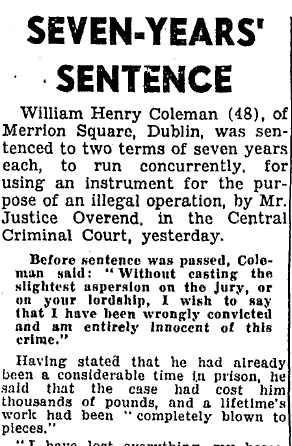
Coleman and others like him benefited from the travel restrictions imposed here during ‘The Emergency’, which made it difficult for women to access terminations in Britain. In April 1944, Coleman was arrested and his premises raided. When he made it to the courts the Prosecution went as far as to say that “no fouler being has ever crossed the threshold of the dock: Your Lordship has never had before you a man so consummate in his infamy, so depraved and vile in his occupation and in so many aspects of his life.” Coleman was sentenced to fifteen years penal servitude, later reduced to seven years.

WHC.jpg

1945 press report on the conviction of William Henry Coleman.

Before the suppression of Coleman’s premises, an earlier police operation had closed a Parkgate Street abortion clinic, which was said to be the busiest in the city. On that occasion, a woman was sentenced for “nine counts concerning an illegal operation”, receiving ten years penal servitude. It was clear the authorities were cracking down.

Continue Reading »

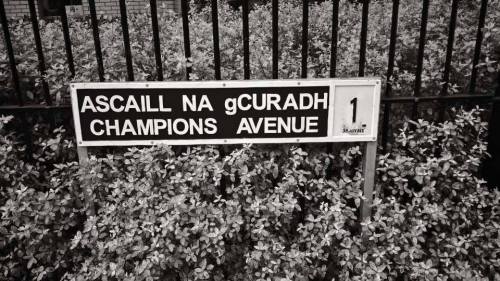
Within sight of O’Connell Street, a plaque adorns the wall of an innocuous red brick house that reads: ‘A tribute to the champion boxers and the people of the Sean McDermott Lr. Gardiner Street area 1930-1940.’ The house sits on the corner of the aptly named ‘Champions Avenue,’ the street taking its name from the several boxing champions the area produced throughout the thirties and forties. Gardiner Street and Sean McDermott Street spawned a good many talented fighters- Paddy Hughes, Peter Glennon, Mickey Gifford and Mylie Doyle among them. But arguably the most famous was John ‘Spike’ McCormack.

Though Spike would become synonymous with the north inner city, he was born in Listowel, Co. Kerry in 1919. The McCormack family moved to Dublin when he was eight and Spike would take up boxing soon after, fighting amateur by the early thirties. In 1939 along with Peter Glennon and Mickey Gifford he went to America with the Irish amateur boxing team to fight against the Chicago ‘Golden Gloves’ (amateur champions) in Soldiers’ Field, Chicago. The trio returned home as victors with the Irish team matching their hosts, gaining five victories apiece.

Either side of his trip to the US Spike enlisted in the British Army, his strength and physical fitness leading him to become a Commando. It was his sense of adventure that led him to join the British Army rather than the Irish one, his son Young Spike remembering him saying ‘Hitler took Poland by storm and Ireland by telephone.’ Initially stationed in Scotland, he boxed over there and was highly thought of, even receiving an offer from a promoter to buy him out of his service. Once, while there according to Frank Hopkins ‘the night before St. Patricks Day in Kilmarnock, he painted a statue of King Billy green to aggravate the town’s Orangemen.’

championsavesign

In 1943 during his second spell with the army, an expeditionary raid down the French coast ended in a short but brutal clash and Spike sustained an injury to his thigh from a grenade blast. He returned to Ireland and whilst recuperating in the Mater Hospital was approached to fight Jimmy Ingle in what was to be the latter’s last amateur fight but not the last fight between the two men who had a competitive rivalry throughout their careers. Feeling the exertions with the injuryhe was carrying he went down in the third round, exhausted. According to his son ‘Young Spike’ in Kevin Kearns’ Dublin Voices

They took off his shorts and saw this big hole in his side and they said ‘Jesus Christ, he shouldn’t have been able to stand. So Jimmy Ingle turned professional but my father said ‘I’ll get him back when I’m good.’ So my father turned professional- just to get back at Jimmy Ingle.

Continue Reading »

Within the railings of St. Stephen’s Green, the monuments dotted around the park commemorate suffragettes, socialists, poets and writers. Many of the people remembered are bound to the history of the park; James Joyce immortalised it within Ulysses, while Countess Markievicz patrolled it her Citizen Army uniform during Easter Week.

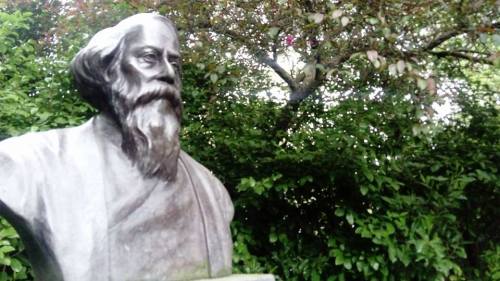
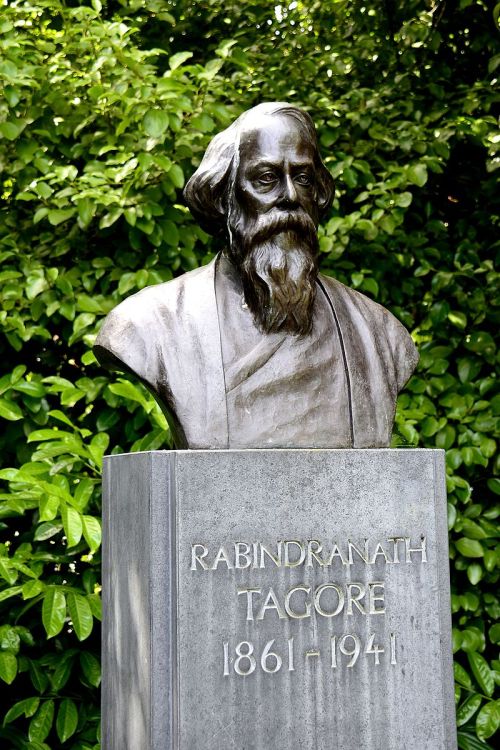
A monument that could easily be missed commemorates someone with no connection to the park, born on another continent entirely, yet still bound to the Irish story. A bust of Rabindranath Tagore in the south side of the park, unveiled in October 2011, is a reminder of the historic ties between the people of Ireland and India. Presented by the government of India, it is a fine tribute to a man who had a significant impact on the thinking of William Butler Yeats, and who achieved fame as the first non-European to win the Nobel Prize for Literature in 1913.

TagoreMemorial.jpg

Tagore bust, St. Stephen’s Green.

Sometimes called the “Bard of Bengal”, Tagore was born in May 1861 in Calcutta. A true polymath, Tagori’s contributions to the arts and culture spanned many fields, and he was a published poet by the age of sixteen. The national anthem of India, Jana Gana Mana, is a Hindi version of a song he originally composed in Bengali. He was a critic of imperialism and an advocate for educational reform, and both of these things are particularly important to this story of his influence in Ireland.

In 1913, Tagore’s play The Post Office was performed at The Abbey Theatre, in a fundraiser for Patick Pearse’s school St. Enda’s. In some ways, it was the meeting of two kindred spirits.  Pearse’s school was groundbreaking in its approach to education; as Richard English has noted, Pearse “seen his school as – in part – an experiment in the cultivation of national identity. ” Maintaining that the education system of the day was broken, and designed merely to produce “willing or at least manageable slaves”, Pearse argued for a new approach to education in his pamphlet The Murder Machine:

..the Irish school system of the future should give freedom—freedom to the individual school, freedom to the individual teacher, freedom as far as may be to the individual pupil. Without freedom there can be no right growth; and education is properly the fostering of the right growth of a personality. Our school system must bring, too, some gallant inspiration.

Like Pearse, Tagore believed in radically new approaches to education. William Butler Yeats would label Tagore’s own school in Shantiniketan as “the Indian St. Enda’s”, and as the writer Prasenjeet Kumar has noted, “he held that proper teaching should not explain things, but just stoke curiosity. He depicted beautifully his hatred of rote learning in ‘The Parrot’s Training’, in which a cage bird is force-fed textbook pages – to death.”

Rabindranath_Tagore's_bust_at_St_Stephen_Green_Park,_Dublin,_Ireland

Tagore bust, St Stephen’s Green (Image Credit: Neuroforever, WikiCommons)

The respect was mutual, as in 1915 Pearse’s play The King (which had been written As Gaeilge) was performed in Tagore’s school. The Abbey Theatre performance was a great success, and provided much needed funds to St. Enda’s, a school Pearse was totally committed to but struggled to finance. A contemporary remembered that “he was a dreamer, but unfortunately never had the money to bring his dreams to fruition.

While Tagore and Pearse never met, he did meet Yeats in 1912, during a visit to Britain. Yeats agreed to write the introduction to a translated collection of Tagore’s poems, and he was clearly moved:

I have carried the manuscript of these translations about with me for days, reading it in railway trains, or on the top of omnibuses and in restaurants, and I have often had to close it lest some stranger would see how much it moved me. These lyrics . . . display in their thought a world I have dreamed of all my live [sic] long . . . a tradition, where poetry and religion are the same thing.

In a History Ireland article on the relationship between Yeats and Tagore,  Malcolm Sen argued that “it is easy to understand why Yeats would be fascinated by Tagore. The Irish poet often spoke of the possibility of a shared cultural memory that brought distant civilisations together, and Tagore would echo such idealistic universalism in his writings.” Sen notes too that Yeats found something familiar in Tagore’s writings, as for him “Tagore’s Bengal and the west of Ireland shared an affinity that counterpointed the materialistic modernity of imperialism. He compared Tagore’s work to Douglas Hyde’s Love Songs of Connaught.”

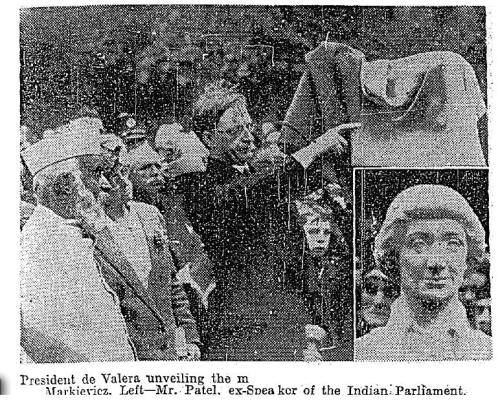
Tagore died in 1941 at the age of eighty, and he is widely commemorated in India and internationally. In 2011, the bust in St. Stephen’s Green was unveiled by Prennet Kaur, India’s Minister of State for External Affairs. It is worth noting that when the nearby bust of Countess Markievicz was unveiled in 1932, one of those in attendance was a former Speaker of the Indian Parliament, in recognition of the close bonds between the two nations.

stephensgreenindian.jpg

The 1932 unveiling of the Markievicz memorial (Irish Press)

We were very sorry to hear the devastating news this morning that renowned Irish keyboard and piano player Pat ‘Fitzy’ Fitpatrick had passed away after a short illness aged 60.

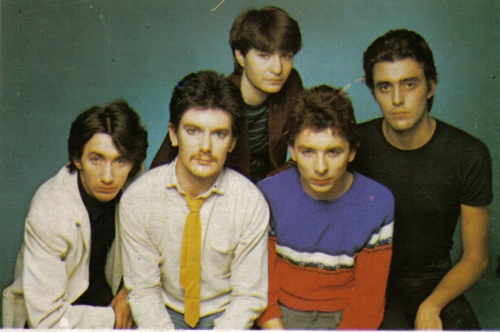
Katmandu, c. 1980. Fitzy in blue and red jumper. Credit – http://www.spitrecords.co.uk/

Originally from Belfast, he studied at the Royal College of Music in London.

Fitzy’s 35 plus year music career saw him play with an array of the island’s best rock groups including Katmandu (1980s), The Music People (mid 1980s), The Fountainhead (late 1980s), Swim (1980s-1990s), The Blades (1983-2017), Something Happens (1990s-2010s) and Aslan (1990s-2010s),

He also worked with Van Morrison, Mary Coughlan, Phil Coulter, Anne Bushnell (RIP), Colm Wilkinson, the RTÉ Concert Orchestra and Lúnasa.

Fitzy joined The Blades on tour in late 1983 not long after they released their iconic single ‘Downmarket’.

He played keyboards on one of the “most iconic piano intros in Irish rock history” – ‘Parachute’ by Something Happens which was released in 1990.

In terms of film credits, he performed on the soundtrack to ‘The General’ (1998) and is listed as being a keyboard player in the restaurant band in ‘Agnes Browne’ (1999).

Christy Dignam, lead singer of Aslan, said today:

Fitzy has left a huge hole behind in our lives both as a musician and a friend.It wasn’t just music, Fitzy was a lovely human being. He played with such feeling.

Tom Dunne, lead singer of Something Happens, was “devastated” to hear the news and told The Irish Sun:

He was a beautiful man and the only piano player I know who could play ‘God Only Knows’ by The Beach Boys (properly).

Brian Foley, bass player with The Blades and formerly of The Vipers, wrote:

He was classically trained and had attended the Royal College of Music in London. Still I suppose nothing could have prepared him for the nights of mayhem that ensued in ‘ The Baggot Inn’ ‘the TV club’ and many a country venue where Pat was confronted with the heaving masses of mods and disaffected youth that engulfed the stage during those raucous, riotous early gigs.

Not forgetting his early training he would throw in a snatch of Mendelssohn’s wedding march before the start of ‘the bride wore white’ or at a soundcheck he might play ‘the Liberty Bell March’ (theme from the Monty Pythons’ flying circus).

Once, he even gave us a tutorial on how alike the chords and structure of the mod anthem ‘Heatwave’ was to the old 1930’s song ‘the Charleston’!

That skinny kid from Belfast had music coursing through his veins. I remember one time out in RTE, we were sitting in the dressing room where there just happened to be a piano. Invariably, we would ask Pat; ‘can you play this song or that song’ and he’d play the requested song no problem. Then it would all get silly and we’d ask him to play different advertising jingles. Which of course he could. All note perfect!

Still, barely three weeks ago, even though he was very ill he insisted on playing with us in ‘Whelans’ and that was the measure of this beautiful man. A musician to the very end.

May his gentle soul rest in peace.

Though he was extremely ill, he managed to play his last gigs with The Blades in Whelan’s on 31st March and with Aslan in the Cork Opera House on 8th April.

Come Here To Me! offer our sincere condolences to his wife, family and friends.

Pat in action, Dec 2014. Credit – Mill Butler.

pg14-23.jpg

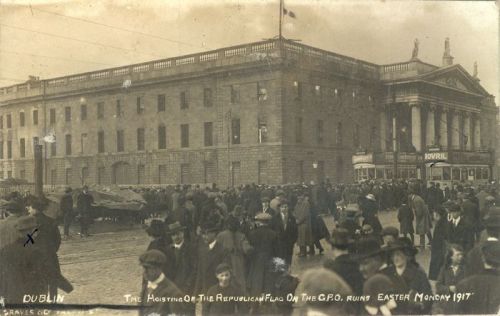
“The hoisting of the Republican flag on the GPO ruins, Easter Monday 1917.”

With the weekend that has just passed, there was considerable emphasis on Easter 1917 and the first anniversary of the Easter Rising. Yesterday, a special edition of Liveline looked at how the first anniversary was marked in Dublin, while both The Irish Times and An Phoblacht  produced interesting articles which examined the manner in which republicans reproduced the 1916 proclamation and utilised the ruins of the GPO as a place of commemoration, defiantly raising the tricolour over the building once again.

Certainly, in the years immediately after the Rising, the GPO had taken on a huge symbolic importance for Irish nationalists. The building would remain closed until 1929, an indication of the severity of the damage done to it. In an incredibly ill-advised move, a British Army recruitment banner was hung across the ruins of the building during the interim period between the Rising and the War of Independence. The banner met a predictable end.

Seán Harling of Na Fianna Éireann (republican boyscouts) remembered that:

There was one very big canvas streamer tied across the top of the GPO, with a picture of Kitchener and him pointing his finger at the people  – “We Want You.” So my commandant came to me and said, “I’ve been instructed to get you to destroy that poster.” So I went down and I looked and I thought, “How the hell am I going to destroy that thing?”

The image of Lord Kitchener, drawn by graphic artist Alfred Leete, has become one of the iconic images of the First World War. In time, it inspired many copycats, from Uncle Sam to Soviet propaganda. For Harling and his comrades, getting Kitchener down from the GPO was a difficult talk:

It was way up near the roof, you see, and I knew if you put ladders up the police would be on top of you before you where you were.Then I had this bright idea. We went into a shop and bought a sod of turf and then let the turf steep in a bucket of paraffin oil. We put some wire around the turf then, because if you put twine on it it would just burn along with the turf. Then we died some twine on to the wire, lit the sod of turf and fired it up across the banner. Within a few minutes the whole thing was blazing, roaring. It was shocking.

When the Fire Brigade arrived on the scene, Harling recognised the familiar face of Joe Connolly, a Dublin firefighter who was also a Captain in the Citizen Army. He remembered that “they all looked and saw what was burning and turned around and went back.”

There are conflicting versions of just what the recruitment banner on the GPO proclaimed; Fianna Éireann activist Gary Holohan was adamant that the banner burnt was “a large scroll or banner of bunting across the top of the columns on the GPO, on which was painted an appeal for recruits for His Britannic Majesty’s Navy.” Holohan, like Harling, felt the banner was designed “to add insult to injury”, and remembered “this was too much for us.”

Regardless of what it proclaimed, it was destroyed by members of Na Fianna. It was clear that the GPO was considered sacred ground for Irish nationalists.


Seán Harling’s account of burning the Kitchener banner is taken from Kenneth Griffith and Timothy O’Grady’s classic Curious Journey: An Oral History of Ireland’s Unfinished Revolution.

… to organise the workers of Ireland for the attainment of full economic freedom.”

So reads a section of the rules submitted to the Registrar of Friendly Societies on 15th July 1924 by Peter Larkin for the creation of a new union, the Workers Union of Ireland. The trades and occupations organised by the WUI were listed as ‘dockers, coal carters, builders, bakeries, public services, distributive and productive and miscellaneous.’

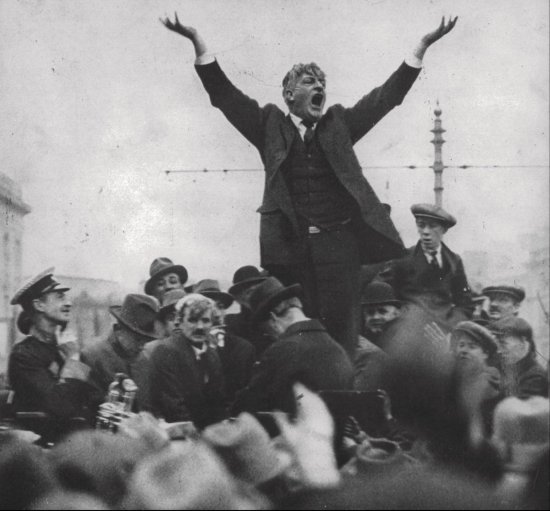
The Union was in part a product of a very public falling out between the leadership of the ITGWU, (in particular General Secretary William O’Brien) and Jim Larkin on his return from the United States, where he served three years of a five to ten year sentence meted out in the midst of the first ‘Red Scare.’ Larkin’s return was well heralded, and there was an assumption on his part that he would walk back into a leadership role in the union, something which was not forthcoming. His stubbornness to adapt his anarchic oratory style and organisational methods did not endear himself to the leadership of the ITGWU, though in a short time many of that Union’s members would abandon en-masse to join the new Union, swayed by the personality cult around Larkin. Harry Pollitt, General Secretary of the Communist Party of Great Britain said of him around the time

Jim Larkin and his most immediate associates can think of nothing else but Jim Larkin. It is difficult to argue or venture any opinion that does not coincide with his own, and yet the man is undoubtedly a leader.

A bitter pay dispute between the Shipping Federation and the ITGWU added to the conflict, with the latter sensing (correctly) Larkin’s influence on a number of workers unwilling to accept a compromise won by the ITGWU on their behalf. A third factor was a dispute between the Union and one of it’s members who on being promoted, refused to give up their ITGWU membership. Strike action was approved at branch level in support of their case, but William O’Brien refused to sanction Strike Pay. Larkin was (again correctly) assumed the instigator, putting the final nail in the coffin. This incident led to an occupation of Liberty Hall by a group of men including Larkin. The occupation ended after Liberty Hall was surrounded by the new Free State army with truck mounted guns, and the men arrested and charged with trespass.

C3Z9GyiWIAAAlKk

The image that would immortalise Jim Larkin, taken by Joe Cashman in 1923

Following on from this incident, and with Larkin having left Dublin on 27th May 1924 to attend the meeting of the Comintern in Russia, his brother Peter announced the foundation of the new union- arguably despite instructions to the opposite. Regardless, Jim would join the Union as General Secretary on his return from Moscow on 25th August 1924. As previously mentioned, membership of the ITGWU temporarily hemorrhaged with upwards of 40, 000 workers deflecting to the new WUI, the latter now known now colloquially as ‘Larkin’s Union,’ and its members proudly identifying as ‘Larkin’s Men.’

There was to be nothing but acrimony between the two unions whose members would not work peacefully alongside each other as comments in this letter from William Smith O’Brien to Thomas Johnson show-

Things have gone fairly smoothly with us here, especially in the coal dispute where we are getting stronger every day that passes. We have now a very large number of men engaged and are putting on extra men practically every day. There have been a considerable number of attacks on our men, but the position is not as bad as we expected. A bomb was thrown last Saturday into the Custom’s House docks where a number of our men are housed, but no damage was done.

The dispute above occurred in July 1925, when the Coal Merchant’s Association, fed up of the constant conflict between members of the two Unions, temporarily locked both sets of workers out and refused to re-admit them until men employed in the coal yards could work amicably together. The ITGWU would break, with scabbing members returning to work under no little intimidation from WUI members- newspaper reports tell of ITGWU men and their families suffering harassment at the hands of their WUI counterparts, with fights a regular occurrence, and a near riot breaking out at Alexandra Basin where coal was being unloaded.

larkinfuneral

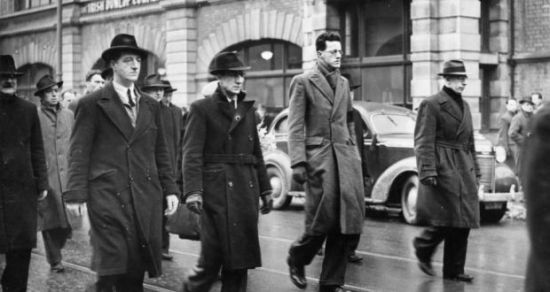
Larkin’s Sons Denis, Fintan, Bernard and Jim Jnr. leading the cortege at his funeral. Photograph: The Irish Times

The feud culminated in a Mill’s bomb (a type of hand grenade) being thrown into an ITGWU manned dockyard near Connolly station. Though without much damage or destruction, the incident could have been a lot worse. The blast, which rang out across the north inner city occurred near a shed in which the Union men, all but permanently stationed at the site were resting. An Irish Times article sub headed ‘Supposed Attempt at Intimidation’ reported

The eight coal workers were in their hut, just thirty yards from the office and close to the high wall and the ‘up’ platform of the station. It appears that only one piece of the bomb struck the hut. It pierced the iron side and buried itself in the bed of one of the men, who was on the point of falling asleep at the time. He had a wonderful escape, for the hole made by the bomb splinter was about two inches from his head.  (IT, 28/9/1925)

The report also spoke of the ‘professionalism’ of the attack- the distance and accuracy of the throw suggesting that the bomb was thrown by someone who knew what they were doing; unsurprising given the country wasn’t long out of the horrors of the Civil War.

In an attempt to gain the upper hand in the feud, Larkin struck a deal with a Welsh pit owner, and imported hundreds of tonnes of coal which he sold to WUI members and Dublin’s poor at cost price, killing two birds with one stone- providing affordable fuel which was dubbed ‘Unity Coal’ to Dublin’s needy, and part funding his strike in the process. Larkin would claim that provision of affordable coal to the poor of Dublin ‘taught the employers of Dublin the old spirit of militant unionism is not dead in this country.’ With Larkin’s Union owing £12, 000 to the pit-owner, supply was threatened- in return, Larkin argued that if the strike should fall, then there would be no money to pay for the coal; an argument he would win, though its highly probable no payment passed hands. The Lockout was not to end amicably- the workers returned to the yards but a bitterness between the two Unions was to remain for decades.

Many thanks to Aileen O’C and Donal for their help with this article. 

JFOR.jpg

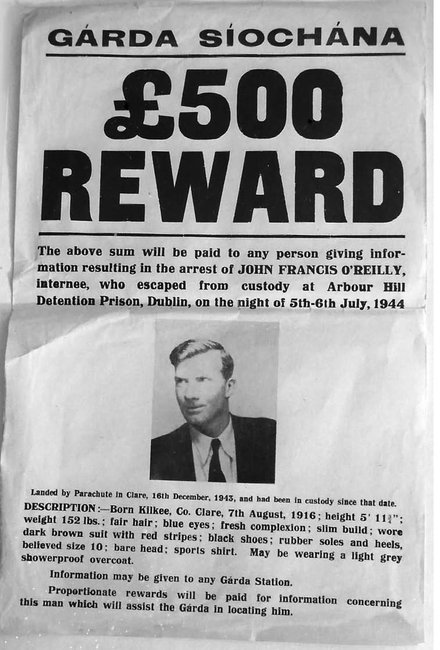
Reward poster for John Francis O’Reilly (Image Credit: RTÉ The History Show)

With Joe Joyce’s wonderful Echoland the current choice for ‘One City, One Book’, there is great focus on the period of the so-called ‘Emergency’ and Dublin during World War Two.

It’s sometimes joked that the Second World War passed us by totally. The poet Louis MacNeice would remember being in Dublin on the day Hitler invaded Poland, and that in the pubs “the Dublin literati…hardly mentioned the war but debated the correct versions of Dublin street songs. Dublin was hardly worried by the war…her old preoccupations were still preoccupations.” Yet despite this seeming indifference to the outbreak of the conflict from some, the war would make itself felt here in different ways. Nazi bombs fell on the city, Nazi spies parachuted into the countryside, thousands of Irishmen joined the British armed forces and rationing and censorship became parts of life here too, though to a much lesser extent than on the neighbouring island.

There are, of course, countless fascinating individual stories around Ireland and World War Two. Some, like IRA Chief of Staff Seán Russell or Hermann Gortz (the Nazi spy who parachuted into Ireland in full Luftwaffe uniform) are relatively well-known. Then there are the tales of those who sought political asylum here, including Breton collaborators and others who managed to assimilate themselves into Irish life, in some cases avoiding prosecution for their activities during the war.

One rather strange story of Ireland and the conflict concerns John Francis O’Reilly, a figure who parachuted from a Luftwaffe plane into West Clare in 1943. He and his associate, John Kenny, have been described as “the last of the motley band of fanatics, adventurers and misfits in the pay of Nazi Germany who landed in neutral Ireland as spies.” Having escaped from captivity in Arbour Hill detention centre after being captured within hours of his arrival in Ireland, a sizeable reward was offered for information leading to the detention of O’Reilly, which his father availed of by reporting him to local Gardaí when his son had arrived back in Clare. Later, his father presented him with this reward money following the end of the war, which O’Reilly used towards the purchase of a pub and hotel on Dublin’s Parkgate Street.

From Clare to Berlin and back again:

How did a Clareman come to be parachuted into Ireland by the Luftwaffe in the first place?

David Murphy’s entry on O’Reilly for the Dictionary of Irish Biography gives good insight into a life that was somewhat nomadic before World War Two. Born in Kilrush in 1916, O’Reilly was a son of the RIC sergeant who arrested Sir Roger Casement upon his arrival at Banna Strand immediately before the Easter Rising. Murphy writes:

He worked as a clerk in the Customs and Excise Department (May 1936–September 1938) but left this job after failing an Irish exam and went to the Benedictine abbey at Buckfast, England, to become a monk. This plan was soon abandoned and he went to London and worked as a reception clerk in an hotel. He was in London when war broke out but, in May 1940, went to Jersey and was still there when the Germans occupied the Channel Islands in July 1940. Managing to ingratiate himself with the German administration, he initially worked as an interpreter and helped the German commander, Prince Von Baldeck, to recruit a party of Irish workers in exchange for papers to go to Germany. He later stated that he had hoped to go to Germany, contact the Irish legation in Berlin, and then organise his return to Ireland.

Continue Reading »

MarketPrussiaStreet2

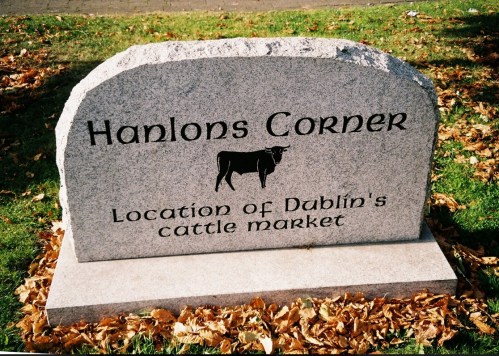
Hanlon’s Corner marker (Luke Fallon)

Dublin’s thriving cattle market is recalled well into the recent history of the city.  In his excellent memoir Another Country: Growing Up in 50’s Ireland, Gene Kerrigan wrote:

The cattle were tended by cowboys on bicycles, men with overcoats and hats, furiously pedaling this way and that, whacking the cattle with their sticks and shouting at them, the bewildered beasts leaving heaps of shit on the road as souvenirs of their passage.

There had been a cattle market in Smithfield since the late seventeenth century, and the sight of cattle being moved through the local streets was a common one, with one nineteenth century publication talking of how “droves of cattle are constantly pushed through the streets to a marketplace called by the somewhat grandiloquent name of Smithfield.”

Work on the development of a new Cattle Market in the Aughrim Street/Prussia Street area  commenced in February 1863 and it was officially opened in November of that same year. It became a hive of activity, and from here animals would be driven through the streets of the capital to boats moored along the North Wall. As Joseph V. O’Brien noted, there were moments of “mass excitement and general merriment” on occasions when animals should make a break for it, citing one bull who made it a fine distance, “”reaching Kingsbridge Station and following the railway tracks to Inchicore, stopping only when it charged head on into a train at Ballyfermot bridge, all the while being pursued by mounted constables and sundry citizens.”

Today, two historic plaques in the area mark what was once an enormous local employer. One, affixed to the side of the City Arms public house, appears to be the original marker of the market:

MarketsPrussiaSt1.jpg

City Arms public house plaque,marking the opening of a market in November 1863 (Luke Fallon)

The rise and demise of the market is well documented in Bernard Neary’s recent local history study, Dublin 7, where he notes that “during the 1920s it was the busiest of its kind in Europe; throughput in one year numbered nearly three-quarters of a million animals”. In spite of this, the following decades were difficult:

During the late 1960s business at the markets started to decline as railway cattle-wagons were replaced by road-transport vehicles and provincial markets grew. The prominence enjoyed by the Dublin Cattle Market in the meat industry began to decline and finally in the early 1970s it ceased operations. However, the death-blow that the closure was forecast to bring to the area, known locally as Cowtown, never materialised.

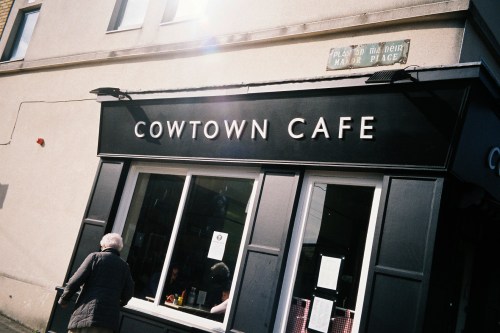
Much of the site of the market is now occupied by the Drumalee housing estate. In addition to the two historic markers, another reminder of the history of the district is the naming of a nearby cafe, the Cowtown Cafe on the corner of Manor Street and Manor Place:

cowtown.jpg

Cowtown (Luke Fallon)

The Bolsheveki Bookies

Now more than ever is it possible for those with an interest and an internet connection to study family history. From the online availability of 1901/1911 Census’ and the Bureau of Military History’s Pensions and Witness Statements collections, to the Newspaper archives it takes time and unfortunately at times a little money to delve into the past. In investigating my own history, I came across two interesting associates of my Great-Uncle William Murray; James and Thomas Redican.

James and Thomas were born to Sligo parents, Thomas and Annie Redican. Thomas Snr. was a gardener by trade and an Irish musician by passion, and the boys along with their siblings Dorothy, Patrick and Lawrence attended school in Donnybrook. On finishing school, James became a bookmaker and was a Volunteer in E Company, 3rd Battalion, Dublin Brigade. He was active in Boland’s Mills during the Easter Rising and would suffer injuries to a hand, an ankle and took a bullet to a thigh which would plague him for the rest of his life; he was imprisoned in Frongoch after the surrender. His younger brother Thomas also made an appearance during the Rising, showing up at his brother’s garrison but was turned away by DeValera for being too young.

Sometime after the general release of prisoners from Frongoch, James Redican makes an appearance in Mullingar, as can be read in the witness statements of Michael Murray, Capt. Ballinacarrigy Company IRA and Michael McCoy, Capt. Mullingar Company. Murray mentions raids for arms ‘under the command of James Redican,’ and a successful raid on the Hibernian Bank in Mullingar. His statement also speaks of Redican and a party of Volunteers, including William Murray holding up a mail train just outside of Mullingar, destroying communications and removing moneys from letters. Interestingly, the statement continues

It now transpired that Redican was not a member of the Volunteers at all. He was an ex-prisoner from Mountjoy Jail. Apparently while in Mountjoy he got acquainted with some Volunteer prisoners from the Mullingar area and convinced them he was up for political reasons while in reality he was doing time for some criminal offence. On his release, he came to the Mullingar area nosing as staff officer from G.H.Q. and soon was OK with the Battalion O/C and other officers. G.H.Q. now sent down instructions that he was to be put out of the area, much to our surprise… It was really a pity he was of that type because he had plenty of guts and courage and would be an asset to the Volunteers anywhere

The Hibernian wasn’t Redican’s only experience of bank raids. By late 1920, he was leading a gang of men (including his brother Thomas and several of those involved in the Hibernian raid) on a series of sorties against banks in Dublin, ostensibly under the orders of Brigadier T.J. Burke of Mullingar (Noel Redican’s ‘Shadows of Doubt.’)

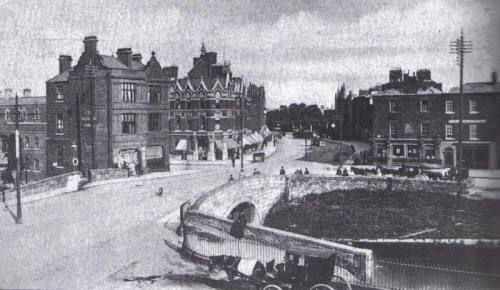
BaggotStbridge1905

On the left, The National Bank at Baggot Street Bridge. Circa. 1905. Raided twice by Redican’s gang.

In November 1920 and February 1921, the National Bank of Upper Baggot Street was raided, with sums of £2, 789 and £1, 237 being appropriated. The day after the February raid, the brothers, along with Thomas Weymes (another of the Mullingar men,) were picked up and brought to the local police barracks where they were paraded in front of witnesses, arrested and charged. According to ‘Shadows of Doubt,’

They (the IRA) had come to the conclusion that Redican (James) had pocketed the proceeds from the robberies, which were therefore of a criminal nature, and disowned the raiders.

As a result, their arrests may not have been wholly down to sleuth like  police work. Michael McCoy’s witness statement would seem to corroborate and goes further to say

… a series of bank robberies occurred around Dublin. David Burke had a suspicion that Redigan (sic) and his party might be the culprits, and so informed Michael Collins. Collins passed on the information to some friends in the D.M.P., and Redigan and a man named Weymes were arrested and sentenced to a term of imprisonment. It was suspected that Redigan then gave information to the British authorities as to the location of the arms in Mullingar. In February, 1921, after David Burke was arrested, an R.I.C. man told him that they had information that arms were stored in a disused oven in McDonnell’s bakery in Dominick St. Their information was perfectly correct. Burke got a message out to me and we had them removed shortly before the place was raided.

The three men still regarded the offences with which they were being charged as political, insisting the raids were ordered by superior officers and that the proceeds from same had been removed by another two of the Hibernian men, Tormey and Murray for return to their Brigadier for dispersal. Their trials were held separately and weren’t without controversy- witnesses seemed confused as to who they were meant to be pointing out, and Thomas Redican, though in prison in Arbour Hill for another offence at the time of the February raid, was charged with same. The three men were sentenced to penal servitude.

Capture

The Freeman’s Journal, May 23rd 1922

Their time in prison was to be cut short, with the signing of the treaty and the subsequent amnesty for republican prisoners in February 1922 only for them to be re-arrested within weeks for questioning regarding the monies raised through their bank raids and the whereabouts of same- upwards of £5, 000 was unaccounted for. They were tried by a Republican Court at the Court of Conscience on South William Street in what was widely regarded at the time by the papers ‘an amazing story.’ Several newspaper reports make the point that the money used from the raids was used to finance a bookmaking business.

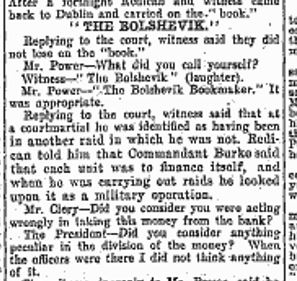
In November, Tormey, James Redican and witness raided the Baggot Street branch of the National Bank. They got about £3, 000 there. They went to Tara Street after, taking the money from the bank. Tormey went away that evening. Witness handed over the stolen money to him and he took some of it with him. Witness was acting under Tormey at this time. Witness followed Tormey to Westmeath and there was a division of the money but Witness got none. Witness carried on the book in the meantime. In October, the book was making money. They called themselves the ‘Bolsheveki Bookmakers.’

(Cork County Eagle and Munster Advertiser, June 3rd 1922.)

Under the newly formed Free State, the men’s stay in prison was far from comfortable, with neither side willing to give concession to the other. Throughout the Civil War they remained guests of the State, who though petitioned, refused to sanction the release of Thomas even though it was proved could not have been present for the raid which he was serving time for. The men in turn didn’t make it easy for the prison services, and until their release in July 1924, frequently engaged in acts of disobedience, refusing to wear uniforms, attacking warders and undergoing several hunger strikes, one of which in particular almost cost James his life.

Their story does not end there. In 1928 Seán Harling, a brother-in-law to the Redican brothers (having married their sister Dorothy) shot and killed Timothy Coughlan, a 22-year-old IRA Volunteer outside the house he was sharing with the Redican family. Harling, a Republican interned during the Civil War had joined the Secret Services of the Free State in part due to economic reasons, and in part due to enormous pressure exerted by Free State agents. He alleged he was ambushed while returning home from work and retaliated in self-defence. However, medical evidence would suggest otherwise, Coughlan’s wound looking more like an execution rather than a shot fired in haste whilst fleeing. The Redican brothers would take the stand once more, this time for questioning in relation to Coughlan’s death having been present in the house during the shooting; a case that is almost as inconclusive today as it was at the time.

In a post-Sackville Lounge world, I have little reason to wander down Sackville Place, the street to the side of Clery’s department store. Indeed, Clery’s itself is now no more, and last winter some its historic signage disappeared without trace.

Thankfully still affixed to the building is a plaque in honour of Paweł Edmund Strzelecki (1798 -1873). An explorer and geologist of considerable fame abroad, Strzelecki’s contribution to the distribution of Famine Relief in the west of Ireland during the Great Hunger is remembered on the plaque in English, Polish and As Gaeilge. It is a beautiful tribute, unveiled in March 2015 at a ceremony that was attended by members of the Polish community in Ireland and representatives from the city of Poznan.
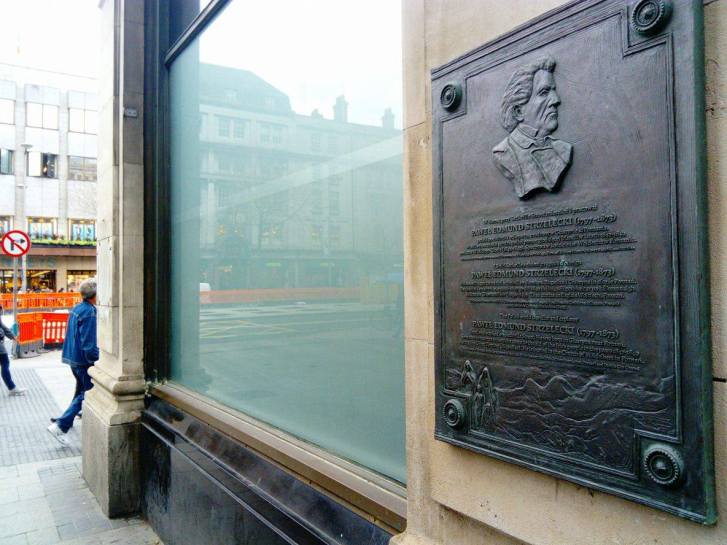
PawelPlaque

Sackville Lane, March 2017.

There are many stories of international assistance and interventions in the story of Ireland’s Great Hunger. Some, like the assistance of the Choctaw Nation of displaced Native Americans, have been well remembered and commemorated. There were also numerous interesting individuals who were moved to action by the calamity in Ireland; French chef Alexis Soyer would establish a soup kitchen at the site of what is now the Croppies Acre memorial, feeding thousands. Strzelecki’s story is much less widely known than Soyer or the Native Americans however, but was brought to prominence by the Polish community in Ireland in recent times.

Born in Głuszyna (near Poznan) in 1797, Strzelecki lived a remarkable life on a number of fronts. Firstly, he served within the Prussian army for a period, though his service was brief, and he was instead destined for exploration. Denis Gregory, author of Australia’s Great Explorers, has noted that traveling around Europe he developed “an interest in science, agriculture and meteorology. History notes that he had a look around the mines in Saxony and Mount Vesuvius in Italy.” Such travel and intellectual curiosity was the preserve of only a small wealthy elite of course,and his travels were not confined to the European continent. He traveled widely in North and south America, and made it to New Zealand in the early months of 1839.

As an explorer, he is best remembered for his time in Australia. On the invitation of the Governor of New South Wales, Strzelecki conducted a mineralogical and geological survey of the the Gippsland region, where he discovered gold in 1839, yet his finding was suppressed by the Governor, who “feared the social disruption that a gold rush would inevitably cause in what was still demographically a convict colony.” Strzelecki would chronicle some of the remotest parts of Australia, and an impressive monument in his honour stands today in Jindabyne, New South Wales.
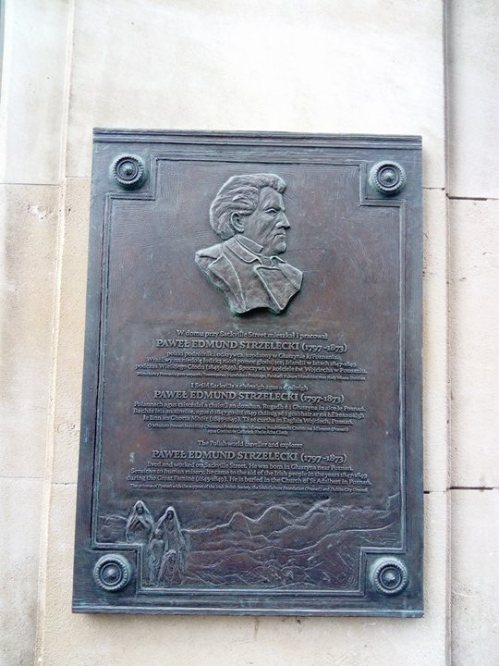
PawelPlaque2.jpg

Sackville Lane, March 2017.

The failures of the British State in relation to the suffering of the Irish peasantry throughout the years of the Great Hunger is well documented. Sir Charles Trevelyan, a senior British civil servant and colonial administrator, believed that:

The judgement of God sent the calamity the teach the Irish a lesson,that calamity must not be too much mitigated…The real evil with which we have to contend is not the physical evil of the Famine, but the moral evil of the selfish, perverse and turbulent character of the people.

Such beliefs were not those of some hack, but rather a political administrator who could directly impact on the lives of the suffering masses. As Melissa Fegan has noted, Trevelyan and many of those around him were “convinced that the Famine was providential in nature, and even if political economy had not forbidden a radical intervention in the markets, who could challenge the hand of God?”

Despite such abhorrent views from some in authority,  huge sums of money were raised for the purpose of Famine relief in Britain. This came from migrant Irish workers, Quakers, sympathetic businessmen and a wide cross section of society. The most significant body to operate in Ireland during this period was the British Relief Association, described by historian Christine Kinealy as the body which provided “the greatest amount of relief” in Ireland. It was for this body that Paweł Edmund Strzelecki laboured over a period of eighteen months, overseeing the distributing of relief in the west of Ireland, which was worst affected by the failure of the potato crop. At first, Strzelecki had responsibilities for the Mayo, Donegal and Sligo regions, and he was one of only twelve agents working on behalf of the British Relief Association in Ireland. As Enda Delaney has noted, “his confidential reports to the committee in London chronicled the descent of this region into complete starvation”. He wrote that:

The population seems as if paralysed, and helpless, more ragged and squalid; here fearfully dejected…stoically resigned to death; then, again, as if conscious of some greater forthcoming evil, they are deserting their hearths and families. The examination of some individual cases of distress showed most heart-breaking instances of human misery, and of the degree to which that misery can be bought.

In Dublin,things were miserable too. The Freeman’s Journal reported in May 1847 of a woman named Eliza Holmes, arrested by the police while begging on Sackville Street with her dead infant child in her arms. Refugees from the country side flooded into the urban centres. Many were, of course, destined to leave the island via the port of the capital. As David Dickson has written,this was in many ways to the benefit of the city, as “if access to either Britain or North American ports had been denied to Famine refugees during the late 1840s, Dublin would have been catastrophically overwhelmed by those seeking institutional protection”.

Strzelecki both lived and worked in the Sackville Street area during some of his time in Ireland, basing himself in the Reynold’s Hotel in Upper Sackville Street. For a time he himself was incapacitated by ‘Famine Fever’, but he continued to carry out important administrative work from Dublin.

For his troubles, the Polish explorer was made a Knight Commander of the Honour of Bath in 1848. Remarkably, so too was Trevelyan. Unlike Trevelyan, Strzelecki received and sought no payment for his work in Ireland during the Great Hunger. One early historian of the period would later note that “the name of this benevolent stranger was then, and for long afterwards, a familiar one if not a household word in the homes of the suffering poor.”

Strzelecki died in October 1873, and he was buried in London’s Kensal Green Cemetery. In 1997, his remains were returned to Poland. It is fitting that he is remembered on the streets of Dublin today.