Introduction
Konrad Peterson/Konrāds Pētersons (1888-1981) was a Latvian-born revolutionary, socialist and civil engineer who lived for most of his life in his adopted home of Ireland.

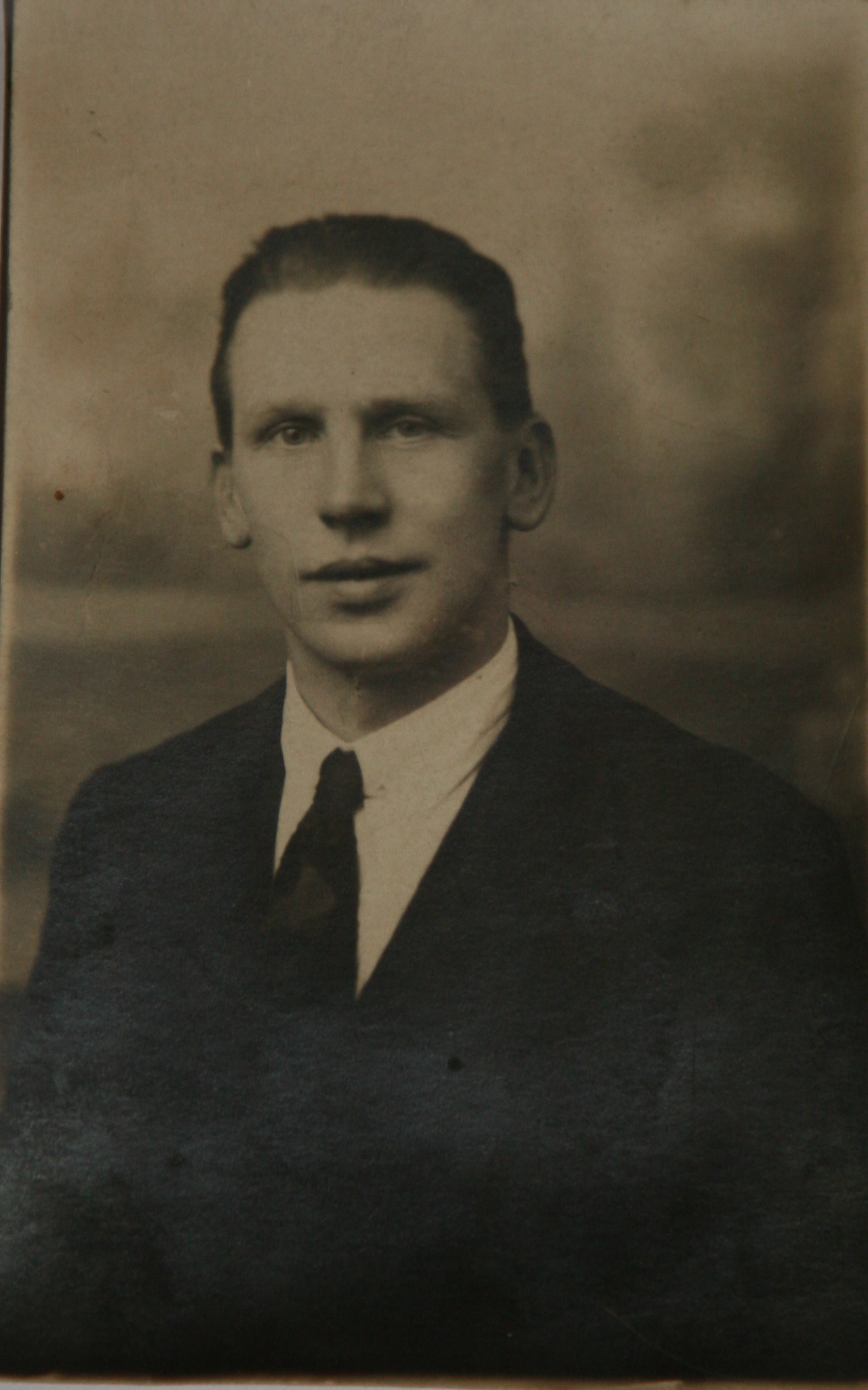
Konrad in Dublin, ca. late 1910s. Credit : Brady Collection via Sandra Bondarevska.
At the age of only 17, he participated in the Russian Revolution of 1905. Forced to flee to Dublin in its aftermath, he was active in socialist and Irish Republican politics in Dublin during his time living in the city from 1906 to 1919. Returning home to a newly declared independent Latvia, he was witness to the Nazi and Russian invasions of his home city during the Second World War. He returned to Ireland in the mid-1940s to work with Bord na Móna and lived in Athy, County Kildare where he died in his 90s.
Peterson’s story is a fascinating one that has largely been forgotten. Especially in labour history and republican circles in Dublin. Sandra Bondarevska within the Latvian community and local Athy historian Frank Taaffe has done much to help ensure his memory hasn’t been totally neglected.
Note: his first name is sometimes spelt ‘Conrad’ and his surname ‘Petersen’. For the purpose of continuity, I will spell it as Konrad Peterson which is the most commonly used form and the spelling which is on his grave.
Early life (1888-1905):
Peterson was born in Riga in the Russian Empire (now Latvia) on 15th October 1888. He studied at Tilo (Tilava) primary school and then at the Mangali Maritime school from which he was expelled for refusing to speak only Russian.
According to nekropole.info, his father ran a tavern in the suburb of Zasulauks outside Riga city.
Sandra Bondarevska in an unpublished history article states that Konrad had been been a member of Revolutionary movement in Latvia from a young age and had “had close ties with the famous social democrat and renowned poet Rainis, who had emigrated to Switzerland with his wife Aspazija after the events of 1905.”
During the 1905 Russian Revolution, it is believed that Konrad participated in two major events in Riga. The first was the 10,000 strong workers demonstration on 13th January in protest at the Bloody Sunday massacre. Three days earlier in St Petersburg, Russia, over 1,000 unarmed demonstrators were shot dead by soldiers of the Imperial Guard as they marched towards the Winter Palace to present a petition to Tsar Nicholas II of Russia.
In September 1905, Peterson was involved in the daring raid of Riga Central prison which involved the rescue of two imprisoned comrades. His involvement is in the revolutionary movement is covered in Fēlikss Cielēns memoir ‘Laikmetu main̦ā’.
John Langins (History of Science professor, University of Toronto) met Peterson in later life and retold in his memoirs how:
Conrad took part in the bloody demonstration in January. Jumping over the wall, one Kazaks tried to spear him (in the) the bottom but (the) spear (went through his) thick coat out the back.. (Konrad was) later was an active combatant in Riga and in the countryside. These revolutionary instincts remained with Conrad (his whole) lifetime.
In wake of the brutal repression following the revolution, Peterson was smuggled out of Riga in December in a cargo ship and traveled to Ireland via Scotland where he had family.
Langins memoirs elaborates how:
Konrad fled from the terror of the Tsar. (He) hid (in a) ship that traveled to Scotland with a few comrades. Some were concealed (amongst) potatoes and some Linos. Those (in) potatoes (were) found, and right there on the ship (were) shot, but those who had Linos, was moved to one (friendly) small cabin, where they spent several days and nights in meetings, motionless on one bed … When (they) jumped down from the board in Scotland, they almost could not walk and was accepted as heroes of the English trade unions.
Dublin (1906-1919):
Arriving in Dublin about 1906, he moved in with his uncle Charles Peterson, of the well-known pipe firm Kapp & Peterson, who lived on Leinster Road, Rathmines.
He was enrolled at Padraig Pearse’s famous school St. Enda’s in Rathfarnham. In the year 1908-1909, he is listed as being a pupil in Fourth Class, Division II.
Peterson would have been about 20 years of age in 1908 (!) but as he had only been in Ireland for two years, with presumably little or no English, it makes sense that he would be in a class for much younger children.
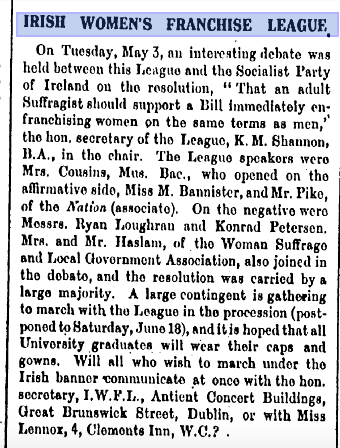
His english much have improved greatly as on 3rd May 1910, he is listed as taking part in a debate between the Irish Women’s Franchise League and the Socialist Party of Ireland. The resolution was “That an adult Suffragist should support a Bill immediately enfranchising women on the same terms of men”. Speaking in favour were Mrs. Cousins, Mrs. Bac, Miss B. Bannister and Mr. Pike of The Nation newspaper. Speaking against were Mr. Ryan Loughran and ‘Konrad Petersen’. Presumably both were representing the Socialist Party of Ireland.
Whether Peterson actually believed in that viewpoint or was speaking against for argument’s sake is unknown.

Newspaper ‘Votes For Women’, 6 May 1910.
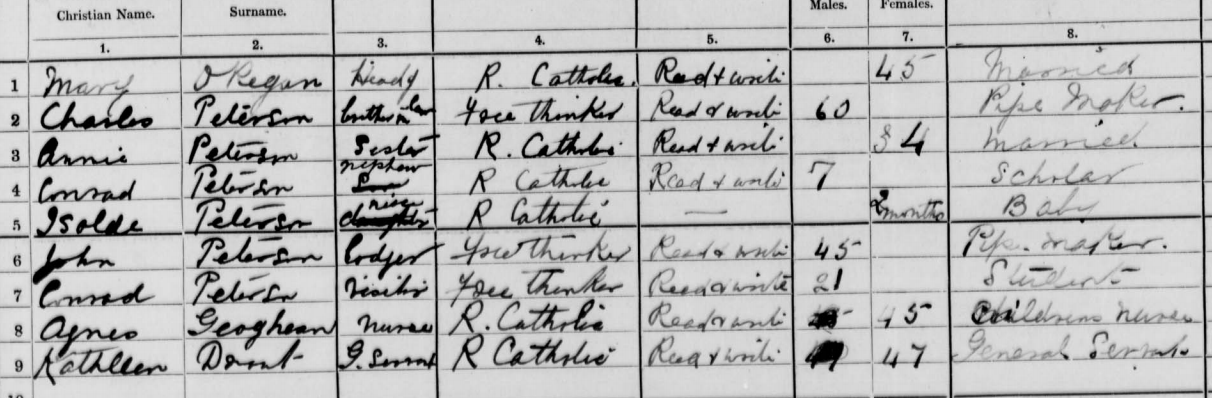
In the 1911 census, the Peterson family were living at 114 Leinster Road, Rathmines, Dublin 6. Konrad, aged 21, was listed as a scholar. He listed his religion as a “Free Thinker” as did his uncles Charles (60) and John (45), both pipe-makers. Charle’s wife was a Dublin-born Catholic called Annie Peterson (nee Forde).
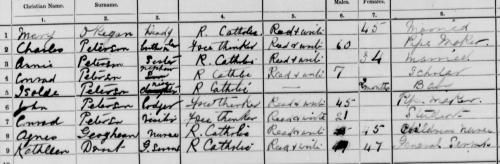
Peterson family. 1911 census return, 144 Leinster Road. Via census.nationalarchives.ie
The Peterson family home was just a few minutes walk from ‘Surrey House’ at 49b Leinster Road, Rathmines. This was the home of Constance Markievicz and a hotbed of revolutionary activity. Markievicz became friendly with Konrad and his uncle Charles.
Around this time, he enrolled as a Engineering student at the Royal College of Science for Ireland (RCScI). This college later absorbed into University College Dublin (UCD) as the faculty of Science and Engineering.
Peterson continued his activity with the Socialist Party of Ireland and the milleu surround it. In 1911 he offered his advice and help to Irish Republicans organising protests against the visit of King George V and Queen Mary to Dublin. In her Witness Statement (No. 909) to the Bureau of Military History, Sidney Czira (aka ‘John Brennan’) recalled:
It was suggested to us by Conrad Peterson who was a student in the College of Science and who had some experience of shock tactics in Czarist Russia – he was from Riga – that we should adopt the methods used by demonstrators in Russia i.e. fold all the leaflets in two and catching them by the corner, fling them into air if we saw the police approaching. They would fan about the crowd and be picked up.
Sidney Czira (nee Gifford) was an officer of Cumann na mBan in Dublin and sister of Grace Gifford, the widow of Joseph M. Plunkett who was executed after the Rising.
He was certainly active in labour politics in Dublin in 1913 but it is not known to what extent he participated in the turbulent events of the Lockout.
In this wonderful picture from around 1913 published in Fearghal McGarry’s book ‘The Abbey Rebels of 1916: A Lost Revolution‘ you can see Konrad Peterson, Constance Markievicz, Helena Molony, Michael Gorman and George Doran dressed in costume for a performance or fancy dress party.
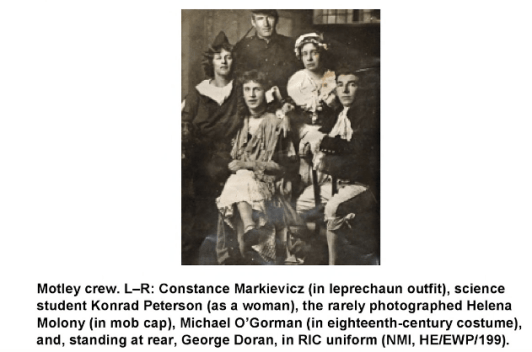
Peterson pictured in c. 1913. Fearghal McGarry, The Abbey Rebels of 1916: A Lost Revolution (Gill & Macmillan, 2015)
C.S. Andrews wrote that during this time Peterson:
formed close links with many of the literary and theatrical figures of Dublin … including, in particular, the famous Daisy Bannard and the man who she afterwards married, the Republican journalist Fred Cogley (‘Man of No Property, p. 188).
Peterson graduated in 1913 with an Engineering degree from the College of Scienc . Afterwards, as retold in CS Andrew’s book ‘Man of No Property’ (p. 188), he worked on a number of engineering projects. These included a survey, carried out by a group of private entrepreneurs before the First World War, into the possibility of harnessing the Shannon for Electricity Production. The project came to nothing and the idea remained dormant until revived by Dr. TA. McLaughlin in the 1920s.
On May 4th 1915, he was granted naturalisation by the British government. He was listed as ‘Konrad Peterson, from Russia. Resident in Rathmines, Co. Dublin’.
Around this time he married Helen Yeates from Dublin. From the process of elimination, I believe this is our Helen Yeates, born 9th February 1893 to Joseph and Bridget Yeates living at 10 Beresford Place. By 1911, eighteen-year old Helen was living at 107.1 Amiens Street.
Peterson was living and working in Dublin during the 1916 Easter Rising and was friends with many of its leading personalities including Connolly and Marchievicz. According to The Irish Press (24 May 1951), Peterson “helped in the organisation of communications for the Rising”. But there is no more reliable sources or references to back up claims he took an active part during Easter Week.
Many will know the story of the Finn and Swede who fought in the GPO making references to Russian and British imperialism. Interestingly, there is also some evidence to suggest that a handful of Russian revolutionaries may have visited Dublin in the immediate aftermath of the Rising.
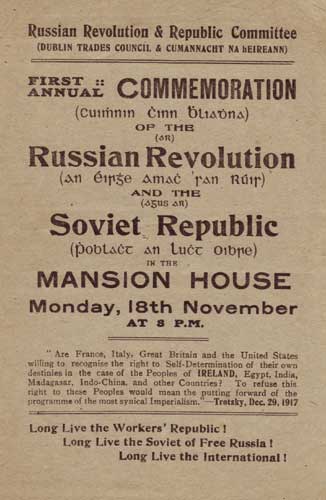
In February 1918, Peterson was present at large meeting that took place at the Mansion House to celebrate the Russian Revolution. The Irish Times (9th February 1918), reported that those present wished “to congratulate the Russian people on the triumph they have won for democratic principles“. During the proceedings, “The Red Flag” was sung and red and republican flags were waved.
The Irish Independent (5th February 1918) wrote:
Mr. Conrad Peterson who announced himself as a Russian Social Democrat spoke strongly in support of “the great struggle for peace, liberty and bread”.
Those present also included Cathal O’Shannon, Dr. Kathleen Lynn, Countess Marchievicz and Mrs. (Maud) Gonne-McBride.
In June 1919, Peterson was listed as a committee member of the ‘James Connolly Birthday Celebration’ in the Mansion House. Tickets were one shilling and all proceeds were to be devoted to the establishment of a ‘Connolly Memorial Worker’s College’.
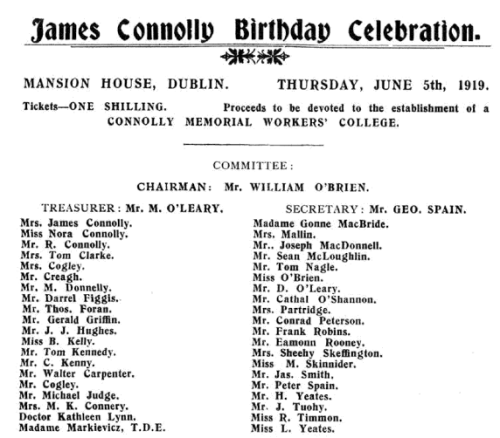
Peterson listed second row in the middle. Republished in ‘Songs of Freedom: The James Connolly Songbook’ (PM Press, 2013), page 33.
Continue Reading »

















 Click on the book for more.
 Click on the book for more.
 Donal
Donal Ciarán
 Sam
Sam


 Come Here To Me!