Feeds:
Posts
Comments
Pollitt

Harry Pollitt (1890-1960)

To be a communist in the Ireland of the 1930s was tough work. Clerical denunciation was fierce, and so too was the media. To the Irish Independent in 1933, it was simple: the “Russianisation” of this country had to be prevented, as “communism must be treated as a deadly and soul destroying peril.”

Condemnation from the pulpit or the newsstand was one thing, but physical confrontation was another thing entirely. In March 1933, over three nights, Connolly House on Great Strand Street was besieged by a mob whipped into a frenzy by a Jesuit preacher in the Pro Cathedral, who told them that “here in this holy Catholic city of Dublin, these vile creatures of Communism are within our midst.”

While Irish communists got a hard time of it, particular scorn was reserved for those visiting the country. The Communist Party of Great Britain (CPGB) frequently sent representatives to Dublin in the 1920s and 30s, often to address public gatherings.  The visit of Harry Pollitt, General Secretary of the CPGB, was enough to instigate a riot in Rathmines in January 1936.

Pollitt had become General Secretary of the party in 1929.  Born into a working class family in Greater Manchester in 1890, his mother had been a member of the Independent Labour Party of Keir Hardie, and as a young man he joined Sylvia Pankhurst’s Worker’s Socialist Federation. He was a very capable leader,  however the CPGB (like its Irish equivalent) was ultimately accountable to the Comintern, and the control of Moscow.

IrishTimes12January

Irish Times, 13 January 1936

A public speech by Harry Pollitt on 11 January 1936 was, rather unsurprisingly, the target of protest. On that occasion, the Catholic Young Men’s Society (CYMS) were the instigators of opposition, but in the Dublin of the 1930s there were any number of groups who could be behind such scenes. The Saint Patrick’s Anti-Communist League and the Irish Christian Front were just two of the anti-communist bodies operating in the city.

Coming prepared, the CYMS gathered outside Rathmines Town Hall long before the meeting began, with banners proclaiming that ‘Dublin Rejects Communism’ and ‘For Faith and Fatherland’. Their leaflets warned that “prominent communists from overseas are assisting the local propagandists to convey the message of Moscow to Catholic Ireland.”

What is remarkable about the meeting, before even getting into the violence, was the number of people who came to hear Pollitt. The Irish Times reported that “four or five hundred people” were in the room. Before the meeting had even begun in earnest, the Irish Independent  reported that “scuffles and free fights took place, and chairs, pokers and sticks were freely used as weapons.” It was reported that:

The fight was waged fiercely in the  hall, and in the attack chairs were used by the ejectors. One chair came flying through a side door to the lecture hall, but was caught in its flight.The objectors were eventually driven by force of rushes to the outside door when the Gardai came on the scene.

Politt did speak in Rathmines, not allowing the chaos to interfere in the business of the day, and likewise Jim Larkin Jr. spoke before the crowd. The organisers promised that “this was the first of a series of meetings proposed to be held to which they proposed to bring over to Dublin men and women who represented the best thought in Europe.” This was met by boos, and when one young lad at the back of the hall seized to moment to stand upon a chair and “make an appeal to the Catholics present”, it didn’t take long for him to end up on his arse and the trouble to begin again.

Continue Reading »

The Typist with the Webley.

Great credit is due to those at Northern Visions TV (NVTV) for this recent documentary on Winifred Carney. Born in Bangor, she was raised on the Falls Road in West Belfast and became an active trade union campaigner in Belfast. The Dublin connection is that Winnie was present in the General Post Office in 1916, as Secretary to James Connolly. In the folklore of the rebellion, she has become known as ‘the typist with the Webley’.

Carney was one of three women to remain in the General Post Office after the roof of the rebel headquarters caught fire, and she took part in the dangerous evacuation to Moore Street. Carney stood as a Sinn Féin candidate in the 1918 Westminster elections, though unusually her manifesto included her call for a Workers’ Republic. Standing in the solidly Unionist  Central East Belfast, she unsurprisingly failed to take a seat.

ICA

The Irish Citizen Army at Liberty Hall following the Easter Rising. Notice the damage to the building. Carney is sitting in the front row, beside the street lamp.

This documentary includes great contributions from Margaret Ward, the author of one of the most important studies in Irish historiography, in the form of Unmanageable Revolutionaries. First published in 1983,it  was the first in-depth study of women in the Irish revolution. The documentary also includes fine contributions from relations of Carney and Belfast local historians.

This is a great effort and hopefully we will see a lot more like it in the year ahead, highlighting the often overlooked contribution of women a century ago.


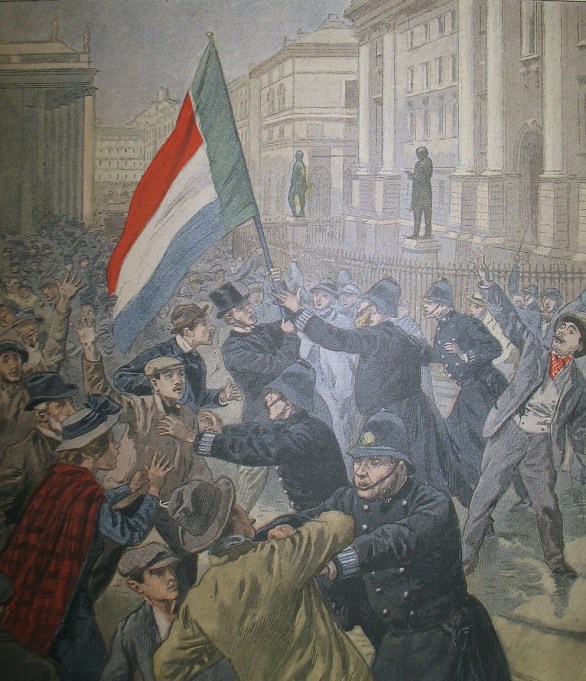
A riot on College Green, 1899.

BoerWar

Le Petit Journal. “En Irlande: Manifestation contre Chamberlain”


Le Petit Journal, an illustrated French news magazine, gave plenty of coverage to Irish affairs in the late nineteenth and early twentieth centuries, but this is one of my favourites of their Irish features, showing a riot on College Green.

The flag that is being hoisted by the crowd is the flag of the Transvaal, and the scene depicted here is outside Trinity College Dublin on the day Joseph Chamberlain M.P was given an Honorary Doctorate from the university. The protesters had gathered in support of the Boers, who many in nationalist Ireland felt a strong affinity with at the time of the Second Boer War. Seamus Robinson, a participant in the 1916 Rising and later in the Soloheadbeg Ambush that began the War of Independence, remembered: “Heavens! What thrills we got out of that great struggle. Bonfires in the streets on the news of a Boer victory, complete disbelief in Boer reverses!”

The Second Boer War formally broke out on 11 October 1899, following an ultimatum issued two days earlier to the British government by Paul Kruger, President of the South African Republic. President Kruger gave the British 48-hours to withdraw from the borders of both Boer Republics, stating that failure to comply with the ultimatum would result in a declaration of war.

In Ireland, passionate demonstrations followed on from these events. There had been sizable protests in the days before the ultimatum was issued, as people denounced what was seen as British aggression in the region. On 1 October 1899, a crowd numbering more than 20,000 had gathered at Beresford Place, where the Transvaal flag flew proudly and Irish nationalists made speeches condemning Britain. A letter was read from the Mayor of Kilkenny, who proposed that two maxim guns be sent to the Boers by the people of Ireland with which they could defend themselves. One could be called ‘Parnell’, and the other ‘Wolfe Tone’. Among those who had gathered at Beresford Place were numerous elected Members of Parliament such as T. D. Sullivan, author of the ballad God Save Ireland, and other public personalities such as W. B. Yeats.

Chamberlain.jpg

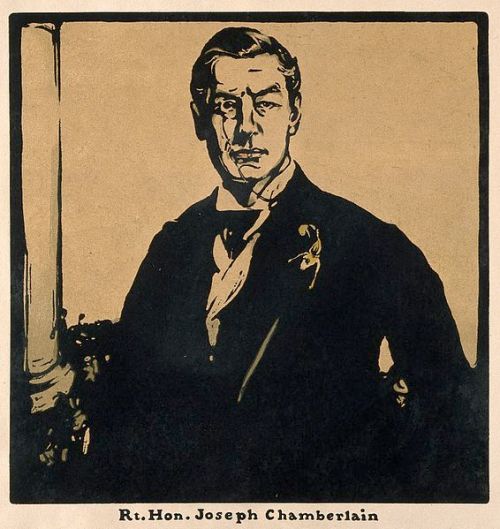
A woodcut of Joseph Chamberlain (Wiki commons)

The movement that emerged in Ireland in opposition to British actions in South Africa was broad. It spanned all nationalist organisations, from the emerging radical socialist left to veteran Fenians, and from emerging women’s organisations to cultural and literary societies. Among the bodies central to promoting protest of the conflict was the fledgling Irish Socialist Republican Party (ISRP), the small political party of Edinburgh born radical James Connolly. When Chamberlain came to town, it was the ISRP who instigated a picket at the front gates. One British newspaper reported that the ISRP “is composed of a number of the most extreme and least reputable representatives of the nationalists of Dublin.” In his own newspaper Connolly noted that in the run up to the Chamberlain demonstration there had been a raid on the offices of the party, and that “one red flag, one green flag, two Boer flags, and the historic black flag which led the anti-Jubilee procession of 1897 were captured by the police.”

The fictional Leopold Bloom would recall the scenes outside Trinity that day in James Joyce’s Ulysses:  “That horsepoliceman the day Joe Chamberlain was given his degree in Trinity, he got a run for his money. My word he did!”

Yet in spite of these protests, it should not be forgotten that huge numbers of Irishmen fought in the Second Boer War in the uniforms of British soldiers. Sean O’Casey recalled his brother Tom going off to do just that, and the effect it had on him. Writing of his youth, and of a time when he was still identified as Johnny Casey and not yet Sean O’Casey, he recalled:

Johnny’s whole world was divided against itself. England was at war with the Boer Republics. His brother Tom […] had been called up; had been dressed in khaki, helmet and all; had marched, with a contingent of his regiment, the Dublin Fusiliers, through the city, Johnny by his side, carrying his rifle… Thousands of Irishmen were out there on the veldt, risking all for England; for her honour, and, Johnny thought bitterly, for the gold and diamond mines of Johannesburg.


For more on Ireland and the Boer War, see ‘Sixteen Lives:John MacBride’ by Donal Fallon of CHTM. It is available in all good bookshops now.

Christmas 1915 in Dublin.

Dipping into the newspaper archives, it’s interesting to look at how Christmas was celebrated in Dublin a hundred years ago. Indeed, celebrated might not be the right word. This was the second Christmas of the First World War, and it was becoming apparent to people in towns and cities right across Europe that they may have been sold a pup when they bought into the idea that the war would be ‘over by Christmas’ of the previous year.

The absence of many sons,  brothers, fathers and husbands from Dublin households ensured a sombre feeling in the city, primarily but not exclusively in its working class districts (it should be remembered that over four hundred students and graduates of Trinity College died in the war too). The Irish Times wrote that “the second Christmas since that doomful August of 1914 finds the war still undecided: for seventeen months we have been witnesses and victims of the greatest strife of arms that the world has ever known.”

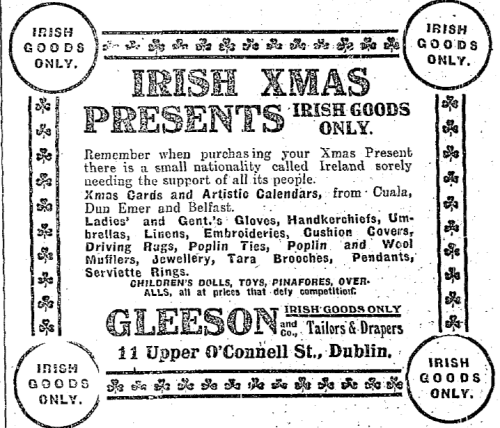
IrishPresents

Gleeson and Co. (Notice they describe themselves as being on O’Connell Street, and not Sackville Street, as the street was then officially known)

The football kickabouts and informal truces of Christmas 1914 seemed a world away now, both to those actually fighting in the war and those at home. At Christmas 1915, in a Daily Chronicle report reprinted in many Irish newspapers, a journalist from the frontlines wrote that:

The war did not stop, although it was Christmas Eve, and the only carol I heard in the trenches was the loud deep chant of the guns on both sides and the shrill soprano of whistling shells, and the rattle on the key boards of machine guns.

The war effected almost every aspect of life of course, including the toy industry. One Irish newspaper wrote that:

Everywhere toy sellers complain of a dearth of mechanical toys of all kinds such as toy engines, steamers, walking animals, cranes, clockwork motorcars, and the like. The reason is that the plant necessary to make them is not available. Firms have frequently approached manufacturers, only to find them too busy “war working” to think about making toys.

Toy shops in Dublin, like Lawrence’s on O’Connell Street, reportedly did a strong trade, as did Clery’s. Within a few months of Christmas 1915 many of the businesses who were selling toys found themselves giving them away for free, though not exactly by choice. Toy shops proved particularly popular with the looters of the Easter Rising.

Continue Reading »

It seems not even sports annuals, political memoirs or celebrity cookbooks can match the Easter Rising industry this year.

Dozens upon dozens of books have been published in recent months on the 1916 insurrection, with the floodgates well and truly opened in recent weeks. With all of this, you could easily forget that some of these books are actually quite good! Many of the books below are labours of love that have long been in the pipeline, and I hope this list comes in handy for anyone who has to brave Hodges Figgis, Chapters or Easons in the days ahead. My own contribution is a biography of John MacBride, recently released as part of the on-going 16 Lives series.

Jimmy Wren: The GPO Garrison Easter Week 1916: A Biographical Dictionary (Geography Publications)

GPO Garrison

It is always the way, that for all the academic conferences and edited collections, that the finest works will be labours of love that come from left-field. Jimmy Wren’s study is a triumph of local studies that has to be seen to be believed in terms of ambition and scale. Jimmy Wren’s father, James, and his father’s first cousins, Paddy and Tommy, were members of the GPO Garrison during Easter Week. The problem, of course, is that depending who one asks, it seems half of Ireland was within the four walls of Francis Johnstone’s General Post Office.

In this book, Jimmy has provided brief biographical sketches of every member of the GPO Garrison in 1916, from Mary Afrien (Cumann na mBan, 1875-1949) to Nancy Wyse Power (Cumann na mBan, 1889-1963). A talented artist, he also provides wonderful pencil sketches of many of the men, women and children in the GPO Garrison. For 1916 nuts, the appendix list alone is worth seeing. One appendix lists the “political involvement of members of the GPO Garrison post-1916”, while another is bound to cause a row or two: “People whose obituaries state they were in the GPO  Garrison but do not appear in official sources.”  My copy is already well-thumbed, and this is the kind of book that you might not read in the traditional sense from cover to cover, but rather will constantly dip into as a reference guide.

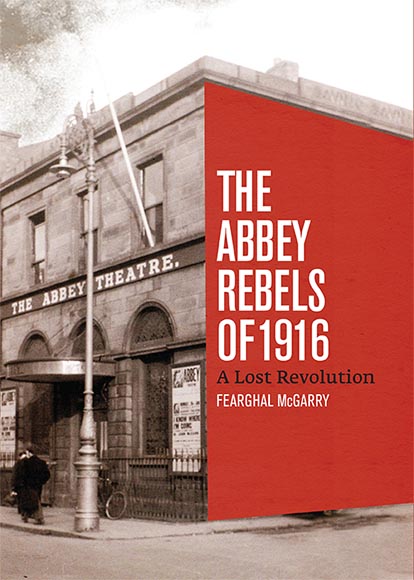
Fearghal McGarry: The Abbey Rebels of 1916: A Lost Revolution. (Gill & MacMillan)
AbbeyRebels.jpg

I have long been an admirer of McGarry’s work on 1930s left-wing and right-wing political movements in Irish society. He is an authority on the Spanish Civil War in an Irish context, and has also produced strong biographies of Eoin O’Duffy and Frank Ryan. Recent years have seen him take a keen interest in the earlier revolutionary period, and his book The Rising was one of the first to draw on the Witness Statements of the Bureau of Military History, capturing the madness of the week from firsthand accounts, right down to the looting of Noblett’s sweetshop.

This study sees McGarry looking at the Abbey Theatre and its role in the Easter Rising, looking at the diverse figures associated with the institution who took part in the drama off-stage. He notes that it was inspired by the Abbey’s commemorative plaque in the foyer of the Theatre, which includes a line from Cathleen ni Houlihan; “It is a hard service they take that help me.”  For the most part, the names upon it “were working class Dubliners, followers rather than leaders, whose role on the historical stage seemed to come to an end after Easter Week.” Here, a spotlight is shown on these lives. Seán Connolly, the talented actor who was to be on stage in the theatre that week, instead found his place in history as the first rebel to die in the scrap, shot on the roof of City Hall. Arthur Shields (brother of Barry Fitzgerald) fought in the Sackville Street area, and later became a respected screen actor, even bizarrely appearing alongside John Loder in How Green Was My Valley? in the early 1940s. Why was that bizarre? Well, John Loder was none other than John Lowe, son of General Lowe to whom P.H Pearse surrendered at the end of the Rising. John can be seen in the famous image of the surrender, standing alongside his father.

McGarry’s book is beautifully illustrated, drawing  from the archives of the Abbey Theatre themselves, and the collaboration between historian and institution is what makes this book work so well. In his concluding remarks, McGarry correctly notes of the year ahead of us that “the centenary will see the Easter Rising reinterpreted in ways that are relevant to the present. Rather than simply re-enacting the past, the most successful commemoration, as the revolutionary generation demonstrated through their appropriation of 1798, draws on its energies to imagine alternative futures.”

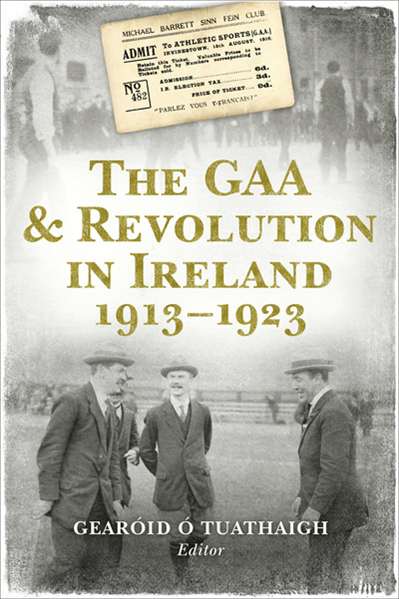
Gearóid Ó Tuathaigh (Ed.): The GAA & Revolution in Ireland 1913-1923 (Collins Press)
GAARev

This book succeeds in bringing together some of the most important figures in the writing of Irish sports history, including Paul Rouse (whose recent all-encompassing history of sport in Ireland is a fine achievement),  Richard McElligot (who has looked at the intersections between Kerry GAA and Kerry IRA in great detail) and Cormac Moore, author of The GAA vs. Douglas Hyde, which examined the fallout following the Irish President daring to visit Dalymount Park in 1938. Its editor, Gearóid Ó Tuathaigh, is one of the most respected historians in Ireland today, and a man who established himself as an important voice in Irish academia with the publication of Ireland before the Famine in  the early 1970s. Despite the strong academic credentials of many of the names in this book, it manages to be both scholarly and accessible, and will appeal both to historians and the passionate GAA community.

Ross O’Carroll’s chapter, The GAA and the First World War, 1914-18,  will certainly shatter some illusions, showing how the organisation supported the war effort in parts of Ireland, and noting how some of the most promising players of the age were lost on foreign battlefields. We read of Lance Sergeant William Manning, who played for Antrim in the 1912 All Ireland Football Final, and who died in the uniform of the Royal Dublin Fusiliers in France in May 1918. In The Gaelic Athlete, it was written that “the European crisis has been responsible for many of our most prominent teams ‘going weak’, with the Saint Peter’s club having lost ‘no less than nine of their best players.'” O’Caroll quotes a source from the early 1930s that bemoaned the fact that while most of the GAA stood firm to its “old ideals and to the principles of its founders…it is sad to relate that a few one-time prominent members of the GAA turned recruiting sergeants for England…” From reading this chapter however, it is clear that like many other aspects of Irish life, the GAA was affected by battles far from home, as well as battles here.

The book also throws interesting light on how the authorities viewed the GAA in the aftermath of the Easter Rising, while trying to make sense of what had taken place. The Royal Commission into the causes of the rebellion, McElligot tells us, believed that the Irish Volunteers had “practically full control over the Association”,  while one former GAA Secretary basked in the inclusion of the GAA’s name in the inquiry, as it would “be most uncomplimentary to the Association if it were omitted.”

Conor McNamara – The Easter Rebellion 1916: A New Illustrated History (Collins Press) 

EasterRising


Conor McNamara is currently the ‘1916 Scholar in Residence’ at NUI Galway,  and readers may be interested in the recording of a recent History Ireland Hedge School on the theme of the 1916 Rising in Galway and the West of Ireland, to which McNamara contributed. We can sometimes forget that the Rising was not envisioned by its planners as an almost entirely Dublin-centric event,  and this new illustrated history is particularly strong on the background to the Rising, both in terms of the key protagonists and the planning of the event. Any true history of the 1916 Rising can’t begin on the 24th April 1916 – The Gaelic Revival, the rise of militant trade unionism, the re-emergence of the Irish Republican Brotherhood as a serious political force and many more factors must be examined, and McNamara does that well here. He draws on some unusual sources,  including a great republican cartoon from c.1915, showing John Redmond dressed in the attire of Charlie Chaplin, with the caption “The Irish political Charlie Chaplin, with apologies to the real Charlie.”

Great credit has to go to Collins Press for getting this book totally right in terms of production. Many illustrated histories have suffered to cost-cutting measures with regards size and quality of images, but here images are reproduced in their full glory, including a fine series of World War One recruitment posters given a full page each. “Who can beat this plucky four?” one poster asks, showing soldiers from the four nations of Great Britain with their respective national flags attached to their rifles.  Beautiful postcards from the collections of the National Library of Ireland appear too,  including one entitled “Across the gulf of time”, showing a Redmonite ‘National Volunteer’ shaking the hand of a Volunteer of the 1780s. This is a treasure trove of great visual primary sources.

Dublin Songs and Stories was an idea spawned many moons ago during a chance conversation between ourselves at CHTM! and the legend that is Johnny Moy. After many attempts at sitting down to organise something, we finally got around to hosting our first night in the Sugar Club earlier this year.

The atmosphere that night in June surpassed anything we could have dreamed of. We had this idea of taking a slice of Dublin life- of music, arts, politics and history, and putting it on a stage to see what we would come up with. We had Maser to Jim Fitzpatrick, Lewis Kenny to Barry Gleeson- with an absolute barrel of laughs and memories to take home with us. As we had decided beforehand, any money made from these events would go to a charitable organisation. With that in mind, Pieta House was our benefiting charity for the evening. Our second night followed on from the same theme- a wide mix of great people onstage with amongst others, BP Fallon, ADW, Ailbhe Smith and Steve Averill doing their bit for the Rape Crisis Centre.

C__Data_Users_DefApps_AppData_INTERNETEXPLORER_Temp_Saved Images_chtm_webposter

Poster for Dublin Songs and Stories Chapter 3

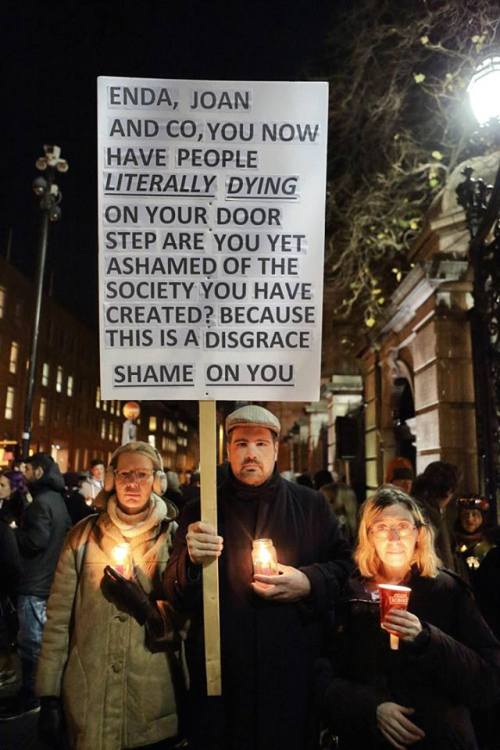
Our event on 20th December will be benefiting Inner City Helping Homeless, a charity working with the homeless of Dublin. It has been a harsh winter so far, and in recent years we have seen numerous deaths on our streets. These nights are about loving the city of Dublin and, in some small way, helping those in it who require assistance.

Tickets in advance are recommended, the last night was near a sellout. You can get them hereIt kicks off at 7:30pm in The Sugar Club once again. We advise getting there on time! The event page is up now too, be sure to click attending if you’re coming along.

image

The GPO 1916, by Robert Ballagh

Robert Ballagh is a national treasure, but before he was making iconic art he was playing with the showband The Chessmen.  Always politically outspoken,  Bobby was centrally involved in the 75th anniversary commemorations of the Easter Rising in 1991 with the ‘Reclaim the Spirit of Easter’ campaign, and he is likewise taking an active role in the alternative centenary celebrations. Having interviewed Jim Fitzpatrick at our last event, this is another chance to catch a  legendary Irish artist being interviewed about their work and influences.
Photographer_John_Minihan_and_Frank_Murray_RHA-88_grande

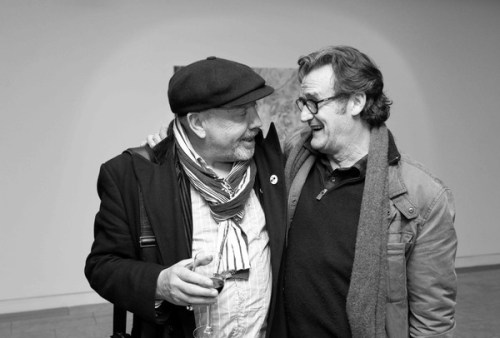
Frank Murray (r) with photographer John Minihan (Image Credit, http://maireaddeblacajewellery.com/

Frank Murray: In keeping with our love for Thin Lizzy and The Pogues we take a trip down memory lane and host their original manager. Frank was one of Philo’s closest mates back in the heady day when they were London based and just about to break. Thin Lizzy are still regarded by old and new rock bands as being the best ever rock band, hard to argue that point. The Pogues should need to introduction and Frank guided them through their most successful eras and was also around for the most hedonistic period of the band career, come down and hear what he has to say.

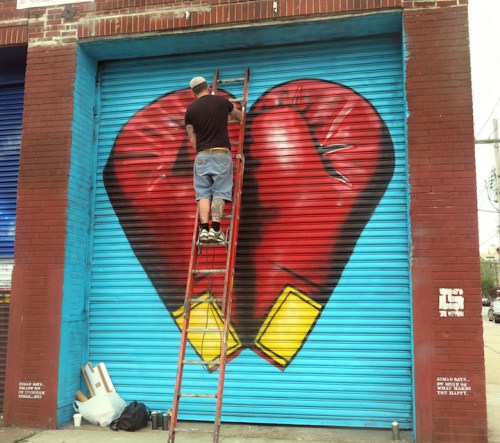
solus-street-art-bushwick-collective-2

Solus Art

Solus’ work tells a story of a boy in a man’s world, growing up too fast “trying” to fit into society, or the underdog rising up against hard times, victorious against all odds. His sense of humor, positive attitude, and struggles are recognizable throughout his striking bold images. Solus works on large outdoor murals and additionally has become a gallery artist, producing works on canvas and limited edition prints. Solus has gained notoriety not only for his work in Ireland, but also North America, Asia, Australia and Europe. Solus currently works with galleries in New York, Miami, Montreal, Australia and Dublin. This year he painted at the prestigious Art Basel in Miami. Continue Reading »

1798-1898-the-Political-Implications-of-Sheppards-Monument-1

“Tis only jokin’ I was – Sure I’ll go wid ye to Donnybrook Fair!”

I picked up this postcard recently. It made me laugh as the image doesn’t really match the popular folklore around the infamous Donnybrook Fair, which ran for over six hundred years, having begun life in 1204.

We’ve looked at it on the site before, in this 2012 piece from Ciarán. The Fair was renowned for its debauchery,  and The Dublin Penny Journal asked their readers in 1833 “have you ever seen the Donnybrook Fair, that far famed spot for drollery and drunkenness, for courting and cudgeling, for gambling and gymnastics, for frolicking and fighting.” Maybe the most colourful account described it as “a perfect prodigy of moral horrors – a concentration of disgrace upon, not Ireland alone, but civilised Europe.”

The Humours of Donnybrook, a song written in the days of the Fair, captures the diversity and eccentricity of it all:

Oh you lads that are witty, from famed Dublin city
And you that in pastime take any delight
To Donnybrook fly, for the time’s drawing nigh
When fat pigs are hunted and lean cobblers fight
When maidens so swift run for a new shift
Men muffled in sacks, for a shirt they race there
There jockeys well booted and horses sure-footed
All keep up the humours of Donnybrook Fair

On a serious note, there were major social problems, as far as the authorities were concerned,  and not alone in terms of violence. Police complained about “intemperance orgies”, while clergy stated that “the scenes of immortality, prostitution and the sickness which originate in it are too appalling and too forcible to believe that these proceedings which have led to the destruction of thousands could ever be considered entertainment.”   The powers that be were sickened by every aspect of the fair, and as Ciarán noted:

By the second half of the 19th Century, the establishment had enough of the annual bout of debauchery in Dublin’s suburbs, and a committee, imaginatively called “The Committee for the Abolition of Donnybrook Fair” was established with the aim of raising the £3, 000 required to purchase the license for the fair from it’s holder.

The madness of all of this, coupled with folklore and gossip, even impacted on the English language, with ‘Donnybrook’ ending up in a dictionary as “an inordinately wild fight or contentious dispute; brawl; free-for-all.”

Not that you’d get a sense of any of that from the postcard.


[vimeo 147347750]

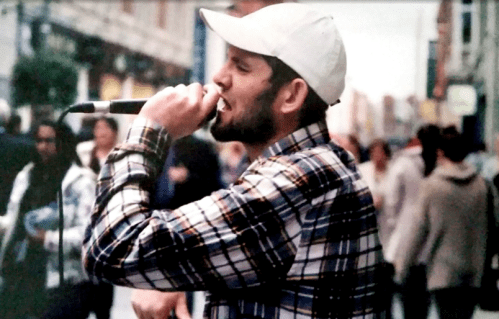
Thanks to Patrick for sending along this excellent and powerful video by Donal Moloney, who has been documenting homelessness on the streets of our fair city in recent times. Donal’s photography in general is excellent and is worth checking out here.  His photo album ‘There’s a Human in There’ includes several familiar faces for anyone who passes through town regularly. Donal notes that “In November of 2013 I met Martin. It sparked this project.” He has continued to photograph Martin in recent times, but meeting him also inspired Donal to document the lives and stories of other homeless people in Dublin.

DonalM.jpg

Image from: Donal Moloney Photography, http://www.facebook.com/donalmoloneyphotography

The song  is ‘Homeless’ by Tommy KD, formerly known as Man & The Machine. Tommy has been a familiar face on the streets of Dublin for many years, attracting attention while rapping in the city centre.  He even popped up on Love/Hate in 2014, during a particularly brilliant scene. Tommy was recently interviewed by thejournal.ie about this collaboration with Donal Moloney.

front-cover

Tommy KD.

This track is available to download for 99c from iTunes, with the music benefiting very worthy causes that help the homeless.

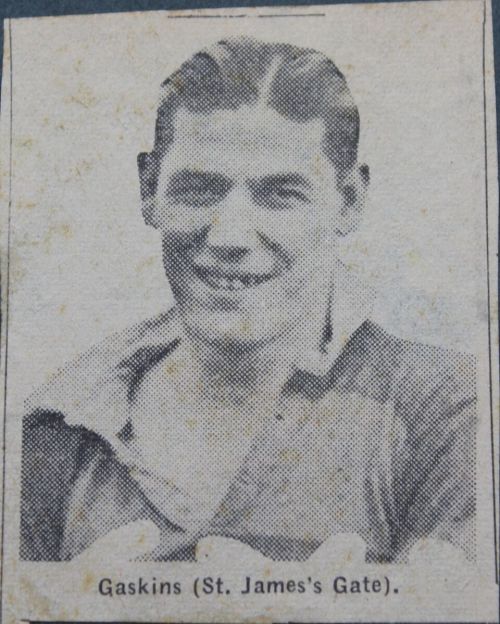
PeadarGaskins1

Peadar Gaskins (Image credit: Colm Hughes)

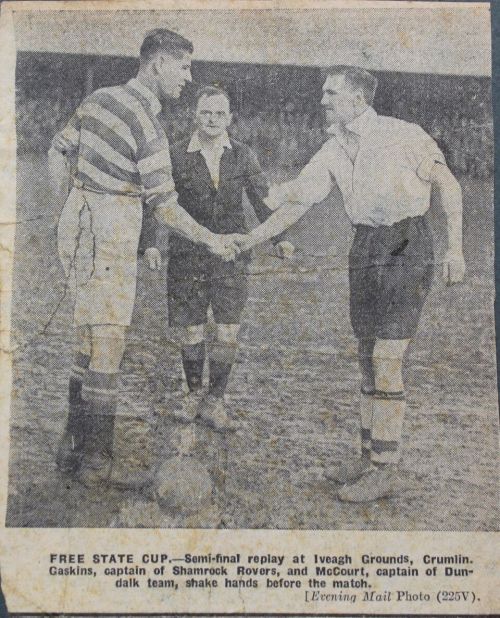
Every now and then somebody will contact us with material that they think will fit nicely on the blog. I am incredibly grateful to Colm Hughes for sharing a photo album of Peadar Gaskins with me. Peadar, a Dubliner, played with a very successful Shamrock Rovers side in the early 1930s, and was also capped by Ireland on five occasions, captaining the team.  He also spent some time with St. James’s Gate, a team that are now a part of the history of Association Football in Dublin. Reporting on a 4-1 victory for James’s Gate over Rovers in 1937, the Irish Press wrote that “Gaskins was impassable. His head or foot was there every time to check lively Rovers raids, and send his own forwards on a goal-hunt.”

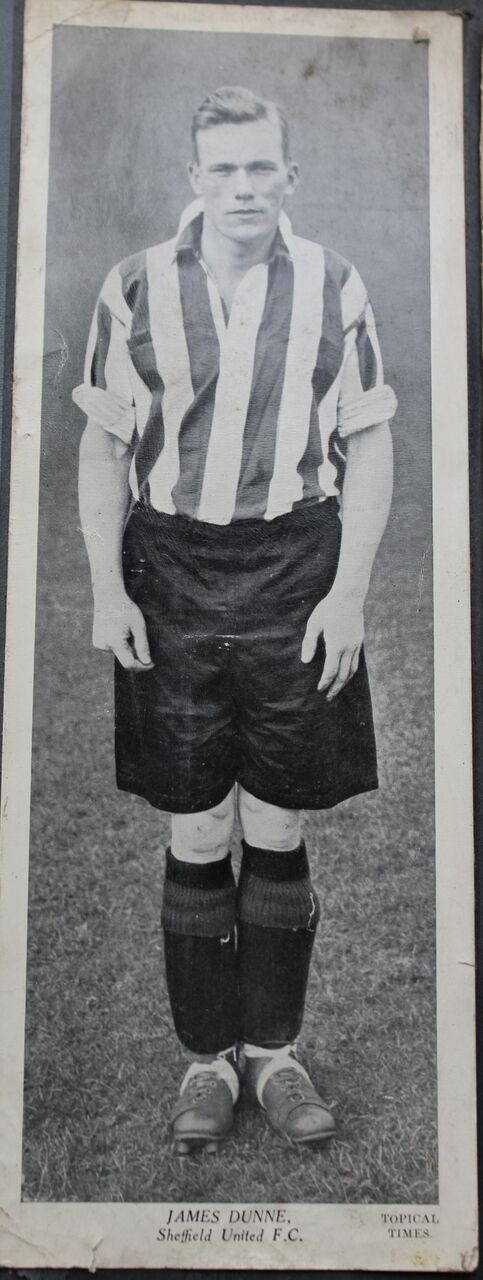
Peadar, who was living in the Iveagh Buildings at the time of his passing, died in 1949 at only 40 years of age. This family photo album was compiled by Beatrice Gaskins, the wife of the full back footballer, and will certainly interest historians of Irish football or indeed League of Ireland and Irish national team supporters. There are images here of iconic teams and important places, and I particularly like the images of a packed Dalymount Park, a reminder that the domestic league still had huge crowd pull in the 1930s. In addition to images of Peadar himself, it includes plenty of ephemera and momentos from Irish away trips, some images of other footballers of note (including the great Jimmy Dunne) and other bits and pieces.

Jimmy Dunne is in the papers in recent times, as his record of scoring in twelve games in a row in English league football remains unbeaten. In addition to his football abilities, an obituary at the time of Dunne’s passing noted that he was “a former member of ‘D’ Company IRA who was interned at Curragh and Portlaoise where he spent a term on hunger strike.”

This is merely a selection of the images, but I’ve tried to take a mix of league football and international games.

Comments are particularly welcome sharing information on these images.

PeadarGaskins2

Iveagh Grounds,Crumlin (Image Credit: Colm Hughes)

PeadarGaskins3

Shamrock Rovers with FAI Cup (Image Credit: Colm Hughes)

PeadarGaskins4

A packed Dalymount Park (Image Credit: Colm Hughes)

PeadarGaskins7

The great Jimmy Dunne, Sheffield United (Image Credit: Colm Hughes)

Continue Reading »

They’re looting the town.

Looting1916

Thanks to Luke Fallon for this illustration.

The latest edition of Rabble is now available to pick up around the city in the usual locations, such as All City (Crow Street), Block T (Smithfield) and heaps of other places you can find via Rabble’s Facebook.

As ever, it looks great and contains a wide mix of content. This issue includes a piece looking back on the history of Indymedia.ie, an interesting little piece on Henrietta Street and Uinseann MacEoin (a very overlooked character certainly deserving of a blog post here at some point in future!), a piece from Liam Hogan on the issue of Irish slavery historically and much more besides. There’s also plenty of humour there, including the finest ‘horrorscopes’ you’ll find in any newspaper. I promise that much.

As ever, page 5 is a collaboration between myself and my brother, the illustrator Luke Fallon. This time, I’m looking at looting in Dublin during the Easter Rising, a favourite subject of mine at the minute. I enjoyed Luke’s illustration so much I felt it worth posting here on the blog!

I have also updated (today)  an  old Come Here To Me post on the theme of looting in 1916. The piece continues to grow, but I feel confident in saying it’s one of the most unusual bits on our site, and it was certainly my favourite piece to research. I particularly enjoy this quote from a contemporary newspaper:

When the fighting started all the hooligans of the city were soon drawn to the spot in search of loot. Half the shops in Sackville Street were sacked. Children who have never possessed two pence of their own were imitating Charlie Chaplin with stolen silk hats in the middle of the turmoil and murder.

In five minutes the crowd emptied the windows of Noblett’s sweetshop. Then they went on to neighbouring shops. McDowell’s, the jewelers, was broken into and some thousands of pounds worth of jewelry taken. Taafe’s, the hosiers; Lewer’s, Dunn’s hat shop, the Cable shoe shop, all were gutted, and their contents, when not wanted, were thrown pell-mell into the street.

The title of the Rabble piece, and this blog post, is a nod towards The Radiators From Space.


When looking for something else entirely, as often happens, I stumbled on this! Here we have a 1915 newspaper advertisement for the Central Rifle Range at 126 Upper Abbey Street. It advertised the chance to fire at “stationary, disappearing and moving targets”,  offering punters a “Short Lee Enfield, Long Lee Enfield, war office or Martini rifle” for the  job:

RifleRange

The National Volunteer, 1915.

The Abbey Street rifle range was advertised in The National Volunteer, a newspaper affiliated to the Redmondites who had supported the appeal for Irishmen to fight in the First World War, believing that it would help secure Home Rule for Ireland. When the Volunteer movement split in 1914, the vast majority of its membership followed Redmond, while a minority of the organisation opposed his call, some of whom later participated in the Easter Rising.

There was no shortage of guns in the hands of Irishmen in 1915, regardless of their political affiliations. As such, rifle ranges became quite popular, whether legal or otherwise. It was reported in October 1914 that following a meeting of the National Committee of the Redmondite Volunteers “arrangements were made whereby the Dublin [National] Volunteers will have facilities in the way of drill halls and rifle ranges, and a central rifle range will be ready for use by the Volunteers early in the coming weeks.” Given that the above advertisement was appearing in The National Volunteer early in 1915, I presume this is the referenced rifle range.

RifleRange

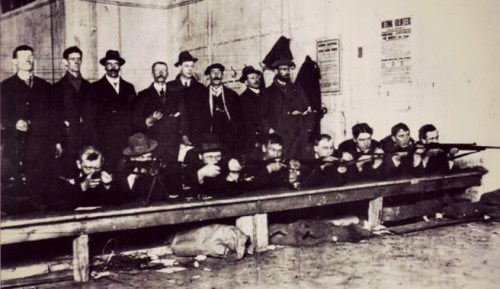
National Volunteers at an indoor rifle range, Dublin.


The Irish Volunteers and the Irish Citizen Army also developed their own (illicit) rifle ranges, providing members with required practice as much as recreation. Frank Robbins of the ICA remembered that the workers’ militia had a rifle range in Croydon Park, and that “a miniature rifle range was also constructed in a large room in Liberty Hall and was used extensively during the winter nights by those who could afford the charge of three shots per one penny, and believe it or not this small sum was too much of a financial strain for many of our members to endure.”

1280px-Short_Magazine_Lee-Enfield_Mk_1_(1903)_-_UK_-_cal_303_British_-_Armémuseum

Short Magazine Lee Enfield Mk 1 (1903) – Image via Swedish Army Museum.

A trip to the Abbey Street rifle range would have offered men the chance to hold superior weapons to what many in the Irish Volunteers or the Citizen Army would have had access to.  Those organisations remained largely (though not entirely) dependent upon what were popularly known as ‘Howth Rifles’, weapons which had been landed in spectacular fashion by the Asgard  in 1914. Bulmer Hobson remembered that “the guns were Mauser rifles, old-fashioned and heavy, but were in perfect order. They were, I believe, the rifles with which the German Army re-armed after the Franco-Prussian War.” While “almost antiques”, even by the time of the Howth gun-running, Jonathan Bardon has correctly pointed out that “these single-shot weapons, loaded with black powder cartridges, were nevertheless deadly.”


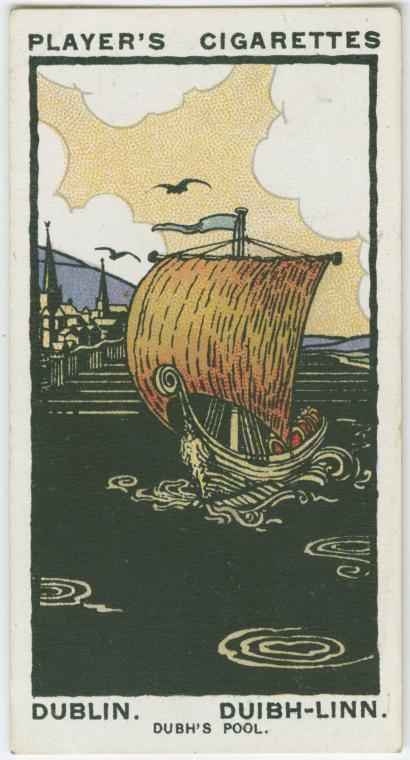
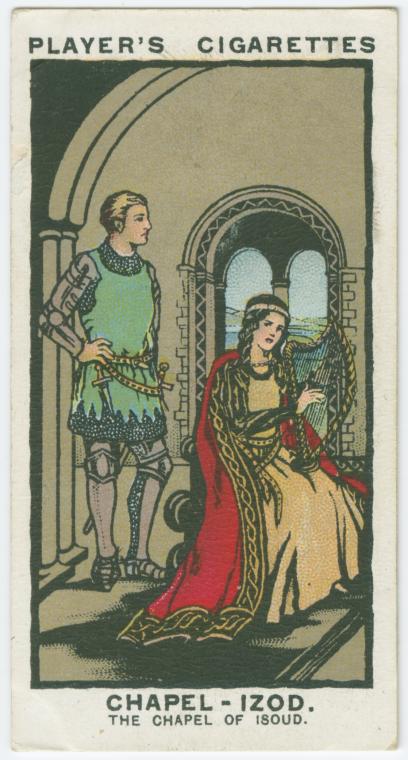
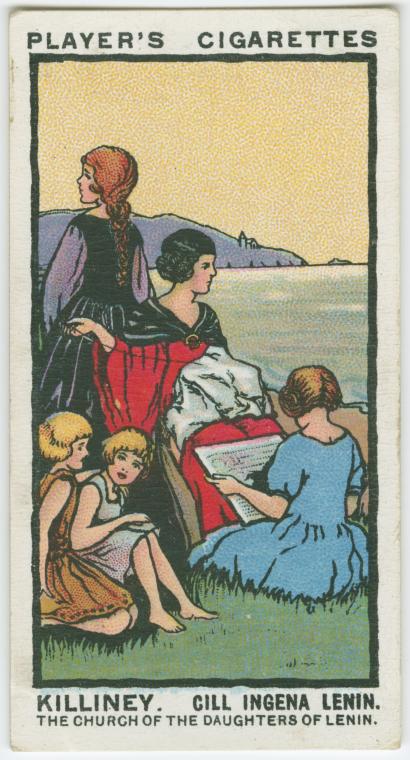
These beautiful cards from the late 1920s come from the collection of the New York Public Libraries, and are part of a much broader collection of fifty cards dealing with historic Irish place names. They were produced by Player’s Cigarettes in two sets of twenty-five, and while I’ve just chosen a selection of Dublin related cards here, the whole collection is worth seeing. They include some beautiful traditional iconography and are today very collectable. Credit is due to the NYPL for scanning them and making them available online to the public.

According to Adam’s auctioneers and to the National Library of Ireland, they are the work of the celebrated artist Jack B. Yeats (1871-1957), who is today best remembered for works like The Liffey Swim. Indeed, that particular painting was so celebrated it won him an Olympic medal in 1924. His medal can be seen on this page of the National Gallery website, where it is noted that “art competitions formed part of the modern Olympic Games during its early years, from 1912 to 1948.” Given that his brother William won the Novel Prize for Literature the year previously, they were good times for the Yeats siblings.

nypl.digitalcollections.5e66b3e8-d815-d471-e040-e00a180654d7.001.w

‘Dublin’ by Jack B. Yeats (New York Public Libraries Collection)

nypl.digitalcollections.5e66b3e8-aaf9-d471-e040-e00a180654d7.001.w

‘Chapelizod’ by Jack B. Yeats (New York Public Libraries Collection)

nypl.digitalcollections.5e66b3e8-6c2a-d471-e040-e00a180654d7.001.w

‘Killiney’ by Jack B. Yeats (New York Public Libraries Collection)

Continue Reading »