As Joan FitzPatrick Dean has written in the entertaining All Dressed Up: Modern Irish Historical Pageantry:
The largest and most memorable public spectacle in twentieth century Ireland was the Eucharistic Congress held in Dublin in 1932. In good weather over five days, June 22-26 1932, “the congress demonstrated that the Irish Free State was, to all intents and purposes, a Catholic state. There was a definite air of Catholic triumphalism about the Congress.”
Dermot Keogh describes the event in his history of Irish and Vatican relations as a “showpiece of Global Catholicism”, and quotes one contemporary French newspaper, amazed by the reception afforded to the Vatican offificals:
From Dun Laoghaire Harbour to the Pro-Cathedral, a distance of ten kilometers, there was an unbroken mass of people, compact, deep, on both sides of the route. In the city the pavements and the squares were completely covered by the multitude. Nor are to be forgotten the bouquets of heads in all the windows, and the daring spectators seated on the roofs of the houses.
One participant in it all wrote joyously to the Irish Independent of how events in Dublin were the an thesis of the menace of the “Bolshies”, and that “the Soviet Government’s aim is to wipe clean out everything we in Ireland hold dear…those of us who took part in the glorious Eucharistic Congress may feel secure from the curse of the Soviet.”
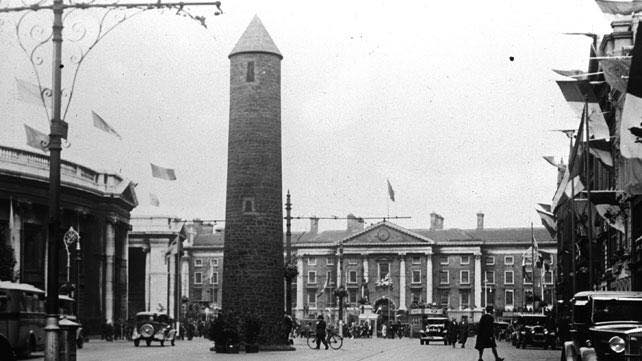
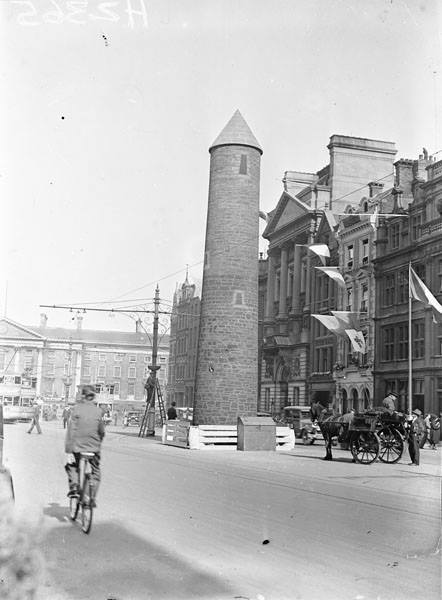
One of the remarkable things about the Congress was the lavish decoration of the city. Tenement slums were decorated in Papal colours, while a temporary round tower found a home on College Green. Standing in the footprint of the recently-departed King William of Orange statue, it left a real impression on visitors:
Round Tower in College Green, 1932.
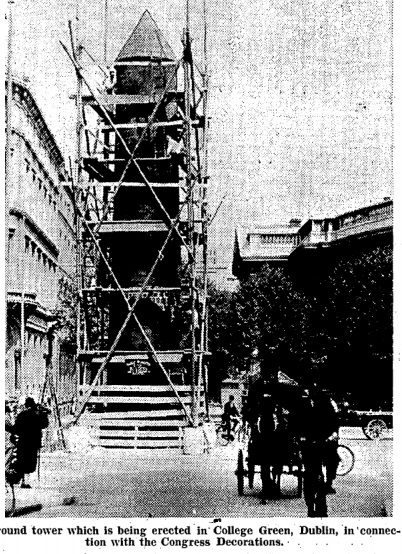
The Irish Times wrote that “Messrs. Watson of Killiney” produced the round tower, and that “no visitor, let alone a Dubliner, can readily miss this, as it stands some 45 feet high, on the site formerly occupied by the King William statue.” William’s statue had been subject to many attacks, in fact one publication went as far as to say “It has been insulted, mutilated and blown up so many times, that the original figure, never particularly graceful, is now a battered wreck, pieced and patched together, like an old, worn out garment.” An explosion in November 1929 led to its removal from College Green, where it had stood since 1701.
Under construction (Irish Press)
The structure was only ever intended as a temporary one. As Norman Vance has written, “Post-independence Catholic triumphalism encouraged the identification of ancient Ireland with Catholic Ireland.” So, was it “vulgar tourist kitsch” or something of artistic merit? Regardless, it is certainly difficult to picture it today, sitting halfway between the waxworks on one side and Abercrombie and Fitch on the other!
In the history of association football in Dublin, Ringsend holds a special place. Shelbourne F.C were born there in 1895, and in 1901 it was to prove the birthplace of Shamrock Rovers. The first meeting of the club took place at 4 Irishtown Road. Depsite beginning their football playing days in Ringsend Park, Shamrock Rovers will forever be synonymous with Glenmalure Park, which was commonly known as just ‘Milltown’.
Milltown was home to the club from 1926 until 1987, when it was put on the market by the Kilcoyne family, who had been the owners of the club since 1972. An obituary at the time of the death of Louis Kilcoyne in 2012 noted that:
The Kilcoynes were applauded for digging deep into their pockets and laying a superb pitch before embarking on the experiment of full-time professionalism under their brother-in-law John Giles in 1977. Giles arrived at Rovers from West Bromwich Albion, where he had been player-manager and led the club to promotion to the Football League’s first division (then the top tier of English football) in the 1975-76 season. He signed Eamon Dunphy, Paddy Mulligan, Ray Treacy and former Chelsea captain Bobby Tambling; his aim was to be a force in European football. Reflecting this ambition, Kilcoyne had plans to redevelop Glenmalure Park into a 50,000-seater stadium.
The Kilcoynes claimed that it was in the face of falling attendances that they lost faith in the Milltown project, and developed ambitions of moving the club across the River Liffey to a groundshare scenario at Tolka Park with Home Farm. Magill magazine highlight the fact at the time that the fact “the Kilcoyne family make their living from a property development company named Healy Homes has led many of their detractors to believe that the decision to leave Milltown had more to do with their entrepreneurial streak than their passion for soccer.”
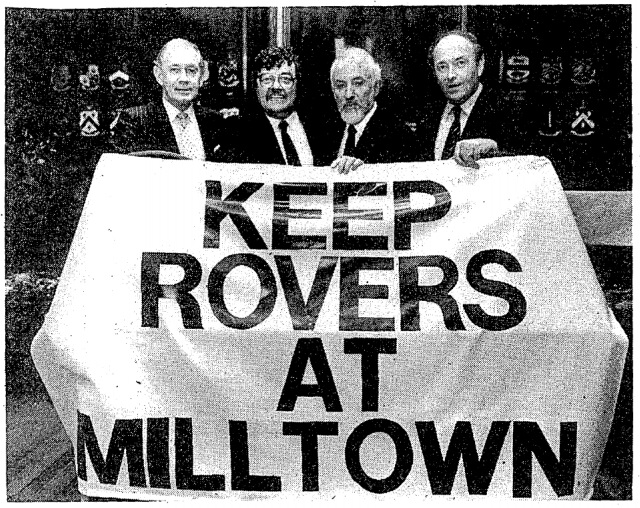
Out of fan frustration with the proposed move to Tolka Park, the Keep Rovers at Milltown (KRAM) campaign was born in 1987. Games at Tolka Park were picketed by Rovers supporters, while a sometimes vicious war of words broke out in the press, with Eamon Dunphy claiming in his Sunday Independent column that the KRAM campaign was “unconvincing, funny, sad and in some respects, outrageous.”
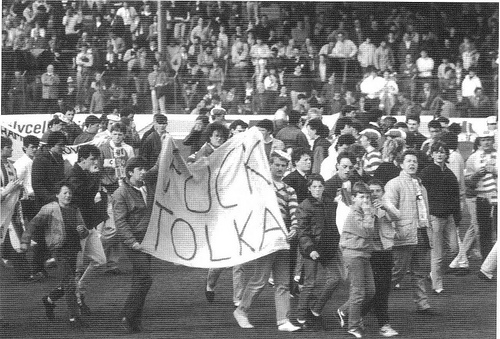
The last game Shamrock Rovers played at Milltown was an FAI Cup Semi-Final against Sligo Rovers on 12 April 1987, which brought in a crowd of six thousand spectators. The Irish Press called the occasion “a day of nostalgia and angry protests.” RTE asked Rovers fan entering the ground if they would follow the club across the river to Tolka Park. Some were adamant they wouldn’t, one man said he “probably would” but at that moment in time it was a no from him too. The game played out a one-all draw, but is best remembered today for the half-time pitch invasion of Shamrock Rovers fans, some of whom carried banners with slogans including Fuck Tolka and the question Will Greed Kill The Hoops?
The fan protest at half time.
The journalist Ken Curtin recounted the passionate scenes on the pitch:
Hundreds of fans converged on the pitch at half time and voiced their opposition to the proposed move to Tolka Park next season. The second half of the Cup semi-final against Sligo Rovers was delayed by 10 minutes. At one stage, the Rovers fans were joined by Sligo supporters in front of the grandstand. A large force of Gardaí present did not interfere with the protesters and it was left to Rovers player/manager Dermot Keely to persuade them to leave the pitch.
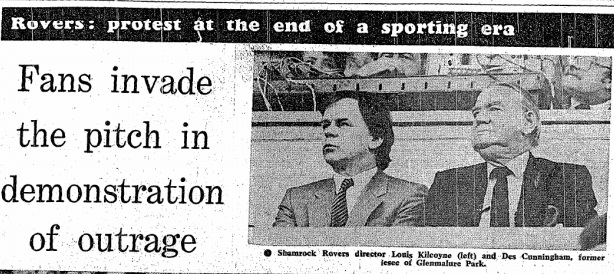
The half time protest was front page news the next day, with the Irish Independent describing what had just happened as the “end of an era.” Noel Dunne wrote that while the fans “were not amused”, they were well-behaved, though “admittedly one of the banners waved aloft carried a rather unprintable slogan, with that four-letter preceding ‘Tolka Park’, and some pretty uncomplimentary remarks were also directed at the directors’ box.”
Irish Independent, 13 April 1987.
It didn’t take long for the frustration of supporters to find an outlet. Magill magazine wrote that:
Within days of the announcement of the leaving of Milltown, Rovers fans and former players rallied to form KRAM. They included Brian Murphy, Chief Executive of the Diners Club in Ireland,Gerry Mackey, the former marketing manager of BP–who has subsequently become spokesman for KRAM, former Irish youths coach Liam Tuohy and Paddy Coad. The latter three all played for what most veteran Milltown fans regard as the best Rovers team of all time.
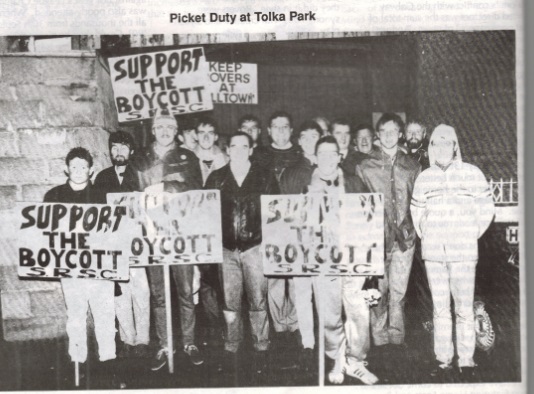
When Rovers moved to Tolka Park in the 1987/1988 season, many supporters boycotted the games there, something that Paddy Kilcoyne admitted in an interview with the Sunday Press was “effective”, before stating that “in real terms there isn’t any public interest in this issue and the behavior of these people had not really affected our determination to succeed at Tolka.” The Irish Times wrote too that the KRAM boycott had “undeniably been successful.” A meeting of fans in the Clarence Hall to discuss the boycott tactic received plenty of press attention. Fans ultimately decided only to boycott home fixtures, and to attend away fixtures. The boycott tactic was aimed at hurting the Kilcoyne owners financially. By attending away matches, fans could continue to voice and display their displeasure.
Picketing Tolka Park (From ‘Hoops Upside Your Head’ fanzine)
Boycotts, by their very nature, are divisive affairs. For the fans who chose not to pay in to Tolka Park however, there was a real camaraderie in it all. Reflecting on the tactic, the Glenmalure Gazette fanzine recalled that:
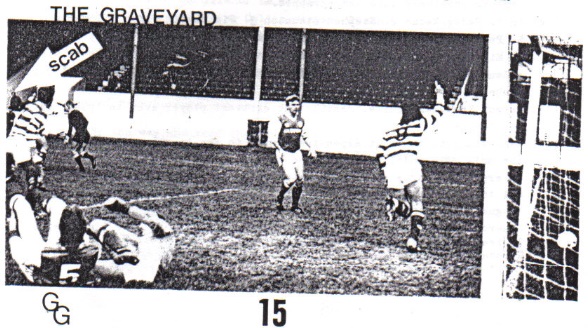
The first match to be boycotted at Tolka Park was a League Cup match against Athlone where no more than 300 people went in. Louis (instead of giving the crowd as lower than it actually was, as he did when he was on the fiddle at Milltown), inflated the gate. But there was no disguising the fact that Rovers fans hadn’t fallen for the lies and the aroma of pretense which surrounded the move to ‘The Graveyard.’ We certainly had some good craic outside Tolka despite the hardship we had to endure in not going to see the team we loved.
Like a lot of people, I am very much looking forward to seeing The Queen of Ireland, Conor Horgan’s new documentary telling the story of Panti Bliss,or Rory O’Neill. It has been a few years in the making now, and little could they have known when they started out that Panti would become something of a household name in Ireland, thanks in no small-part to the recent marriage referendum, and a run-in with the Iona Institute.
Last winter, the Little Museum of Dublin hosted a great exhibition entitled Dublin Unpublished, made up of photos Conor has taken over the years of some remarkable people here in Dublin, including Morrissey, Mary Robinson, Christy Moore and… Panti. That Horgan and Panti have been working together on this for many years, long before recent events, has me particularly keen to check the documentary out.
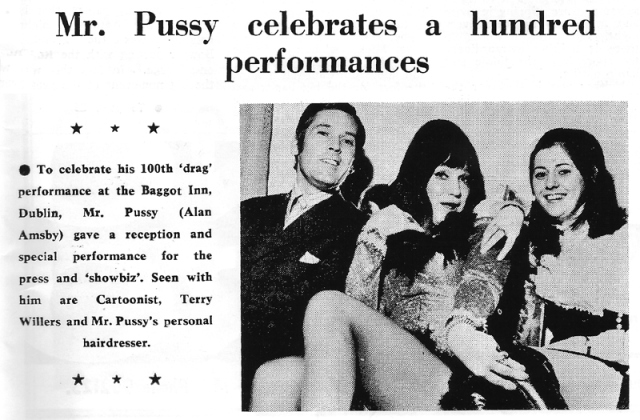
Before Panti, there were drag acts in Irish society, and none as important to the story as Mr. Pussy, who drew in huge crowds in the 1970s, and who baffled some in the Irish media, who couldn’t quite get their heads around the idea of a drag queen in Dublin. “If this is what female impersonation is about, the sooner it’s buried the better!”, complained one writer in 1970. Others saw things differently. “If anybody has helped to lure Irish audience into a broad-minded era”, the Sunday Independent said a few short years later in 1974, it was Mr. Pussy.
In reality, Mr. Pussy was (and is) Alan Amsby,a Londoner by birth. In one of the earliest feature pieces on Mr. Pussy, Donall Corvin wrote in the June 1970 edition of the New Spotlight that “Pussy’s act is slick. He/she gets full marks for professionalism. But I’m surprised there hasn’t been an outcry from indignant bishops and moderators.” Amsby it was noted, had arrived in Belfast three months earlier, and “he was to do six shows.Now he has done more than 50 appearances and has become the most successful cabaret act ever to visit Ireland.”
Showcase Magazine, 1971 (With thanks to Brand New Retro)
Paul O’Grady, the popular broadcaster and a friend of Amsby’s, recounted in his memoirs that Mr Pussy became “Ireland’s foremost and, at the time, only drag queen. During the sixties he’d been working on the flourishing drag scene in London as part of an established act called Pussy and Bow.” While that act broke up, Amsby came to Ireland, where O’Grady noted “drag queens were rare as hen’s teeth in Holy Ireland. he caused a sensation and never came back.” Of the London days, he remembered in 1987 that “all the other acts were doing the glamour bit, but we were in the miniskirts and the modern look. Everyone came to see us – Judy Garland, Ringo Starr.”
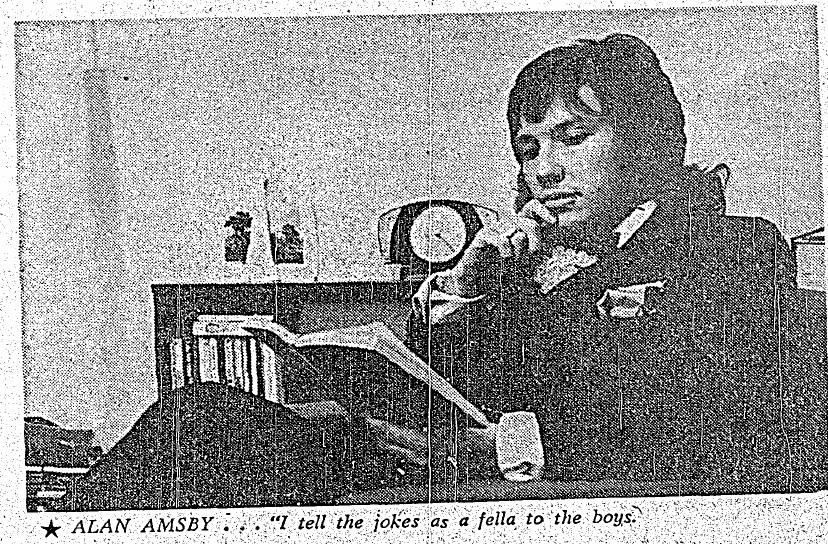
Journalists rushed to interview Amsby, almost all commenting on his male appearance and youth. At the time of Donall Corvin’s feature in New Spotlight, Amsby was a mere 22 years old. Ginnie Kennealy informed Irish Press readers in January 1972 that he was a “slight figure, startlingly young… with shoulder-length fair hair.” To her, he was “neither effeminate nor pointedly masculine. Instead he has very much the unisex look of the seventies.”
No doubt, the Ireland of the 1970s was in many ways a socially conservative place. Yet beyond the very occasional condemnation in the press, it seemed drag was very much in fashion in the early 1970s. A glance at the entertainment page of one Irish newspaper from 1973 shows Mr. Pussy bringing in crowds, not only in Dublin but across the island. Looking over the page, it’s surreal to see the name alongside those of Planxty, the Wolfe Tones, the ‘Women’s Lib Carnival Dance’, Gerry Walsh and the Cowboys and more besides.
Being a drag artist in the Dublin of the 1970s could bring you to some interesting places. In her women’s interest section of the Irish Press in February 1971, Mary Kenny recounted sharing the floor with Mr. Pussy during a debate in the Historical Society,or the ‘Hist’. It was a time of great change in Trinity College; in fact the Hist had “only opened its historic portals to the female sex some two years ago.” In attendance for the discussion was “poor Father Heffernan, the Chairman, and incidentally the first Catholic chaplain to be appointed to TCD.” Kenny remembered that “Pussy certainly added a note of gaiety to the whole debate.”
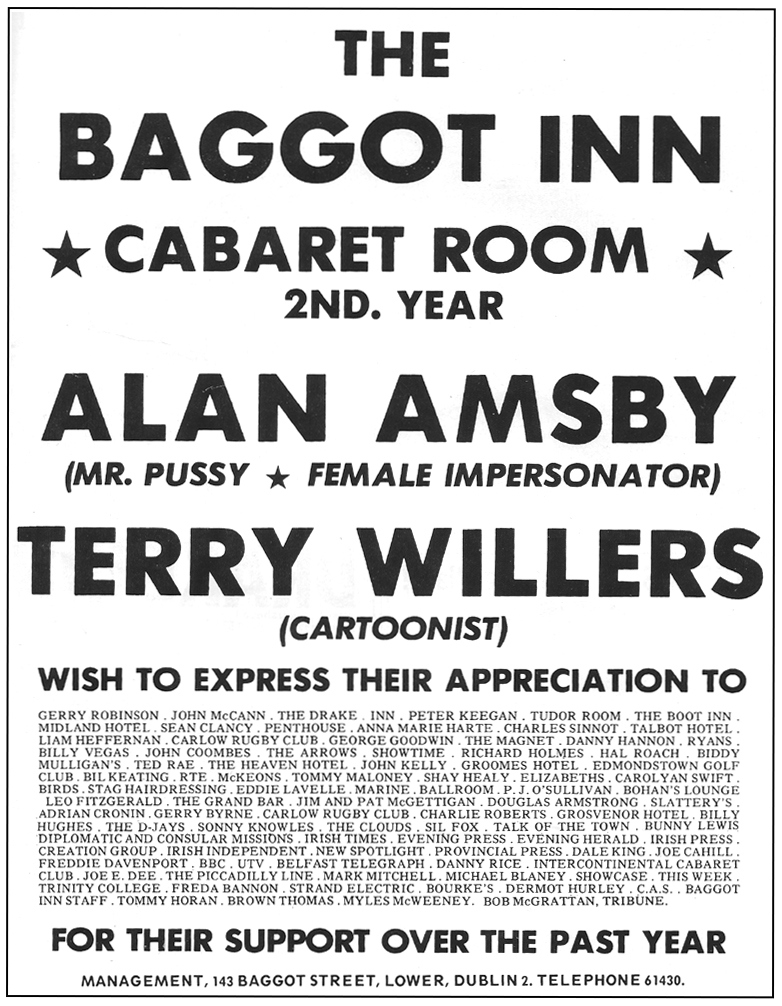
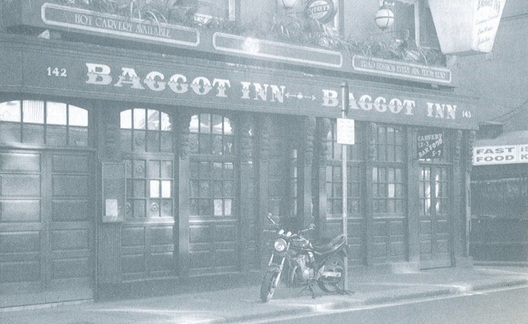
In the early days in Dublin,Mr. Pussy primarily performed in the legendary Baggot Inn on Baggot Street, which will forever be remembered for witnessing some great gigs in the 1970s and 80s, as a popular venue across all kinds of genres.When we interviewed Christy Moore on the site, he remembered that “the Baggot hosted all sorts of gigs from Mr Pussy to Paddy Reilly.” Of his time in the venue, the Sunday Independent wrote that “at first, he was playing to just a handful of people”, but that within a short period “he was filling the Inn six nights a week and doing private parties before or after his show.”
Having seen Mr. Pussy there in July 1970, an Irish Press journalist wrote that:
It was absolutely packed. Frightfully hetero audience, as someone had warned me, but still they appreciated Mr. Pussy like mad. Mr. Pussy is a gorgeous looking dame, the spitting image of Sandie Shaw, he sings appallingly and has the bluest line of patter I have ever heard. He is screamingly funny but frankly I couldn’t reproduce a single one of his jokes here.
Sunday Independent, 11 August 1973.
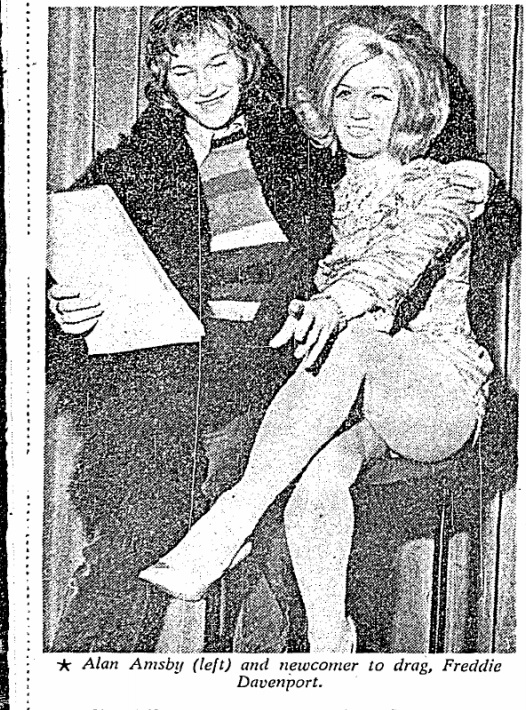
Mr. Pussy quickly made the leap from pub stage to theatre stage, with Little Red Riding- Would at the Eblana Theatre early in 1972, which the Sunday Independent described as “off-beat, way out by traditional panto standards.” In many ways, Mr.Pussy paved the way for similar acts to perform in Dublin, though not all were as carefree about their identities. In January 1972 the Sunday Independent interviewed Freddie Davenport, “the latest arrival on the drag scene, and that’s not his real name.” Davenport joked that if the paper printed his real name, “I’ll lose my job in the morning.” Davenport and Mr. Pussy shared a manager, who insisted that “with the exception of a drag artist in Limerick, there are no other genuine performers of drag in Ireland.”
Sunday Independent, 30 January 1972.
When interviewed in 1994, Amsby stated that “the boy who came to Ireland 25 years ago with his act,Mr. Pussy, for one week’s booking only, is still here because I love it here.” His story continued into subsequent decades, and part of that story is well told here, in the story of the Cafe de Luxe on Suffolk Street.
In the Dublin of the 1970s, Amsby was a trendsetter, known as Ireland’s “leading misleading lady”, and bringing something totally new to the nightlife of the city. He is still at it today. While Dublin may be home to a significant number of drag queens now, it all began in the Baggot Inn.
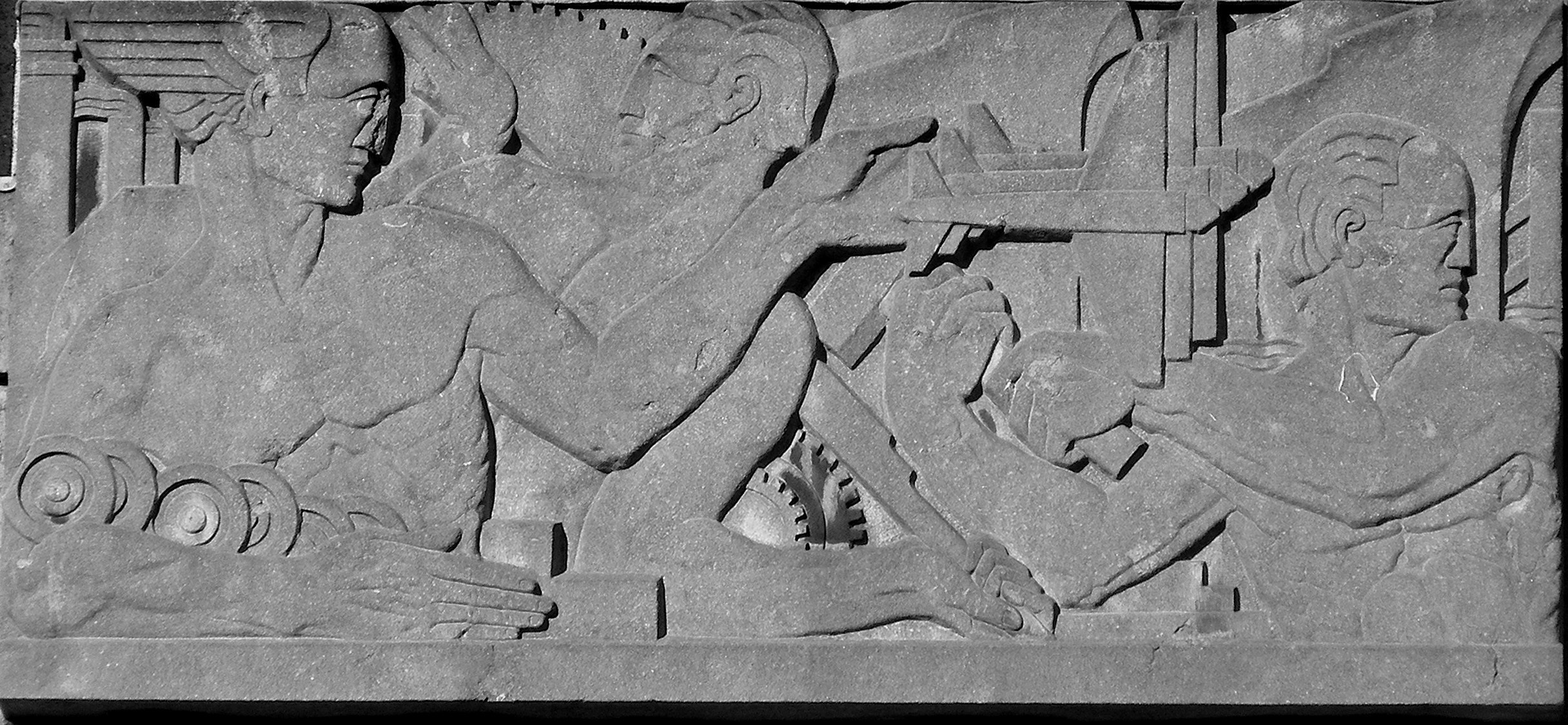
The Department of Industry and Commerce, Kildare Street (Wiki,Creative Commons)
The Department of Industry and Commerce building on Kildare Street is one I’d walked by all the time, before something caught my eye recently. The building was designed by Cork architect J.R Boyd Barrett, and constructed between 1939 and 1942, “being greatly delayed by the difficulty of obtaining materials, particularly steel, owing to the outbreak of the Second World War.”
The Buildings of Ireland website describes the premises as “one of Dublin’s most interesting twentieth-century architectural gems.” What caused me to stop recently passing by it were the bas-reliefs by Gabriel Hayes, depicting Irish industry through the ages. Described by Paula Murphy as being “carved in a vigorous socialist-realist style”, they are a remarkable artistic achievement.
The work of Gabriel Hayes on the Department of Industry and Commerce (Creative Commons)
Gabriel Hayes, James Durney has noted, was the daughter of a member of the Royal Irish Constabulary, who later became an architect with the Board of Works. Born in Holles Street in August 1909, she was educated at the Dominican College on Eccles Street. Having studied art in Paris and Montpelier, she spent five years in the National School of Art,Dublin. Durney notes that:
In her second year at college she won the teachers-in-training scholarship, and in 1933 she had five works exhibited at the Royal Hibernian Academy. In her masters certificate Gabriel came first in Ireland. She began exhibiting at the RHA in 1932 and continued to exhibit there until 1947.
While initially she focused her artistic endeavors on painting, she would later establish herself firmly as one of the leading sculptors of her time in Ireland. Married to Seán Ó Ríordáin, an academic and archaeologist based in University College Cork, she moved there in 1936.
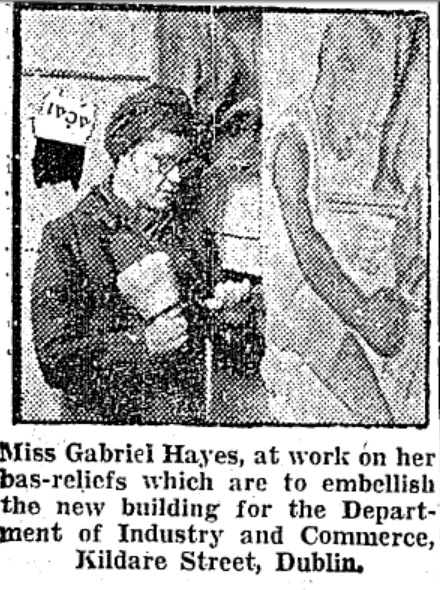
Gabriel Hayes at work (Irish Press, 13 March 1942.)
That she carried out the works on Kildare Street at all is interesting, as she was not among the original group of sculptors invited to submit designs. This group included Laurence Campbell (responsible for the excellent Seán Heuston memorial in the Phoenix Park) and Oliver Sheppard (who gave us Cuchulain in the GPO in 1935). As Murphy has noted, “Hayes was subsequently approached and her designs and estimated cost of £930 met with approval. This is the work for which Gabriel Hayes is now best known.” Seán Lemass himself inspected the designs for the proposed works and gave them the go-ahead.
When she got down to the business at hand, journalists were impressed by the heights she was willing to scale.A journalist in the Irish Independent commented on 21 April 1942 that “when I arrived on a January day of snow and sleet,I was told that she was in the sort of built-up cage slung over the roof to work the ‘keystones over the two toweringly tall windows – 76 feet up. Being built by nature for comfort and not meant for high altitudes I promised to come back”
That a woman was carrying out the work grabbed plenty of column inches too. “Mother of two infants, aged 1 and 4, this Dublin-born artist has interrupted her life in Cork for one of the most important sculpturing tasks in Dublin for a some time” the Irish Press proclaimed. David Dickson, in his groundbreaking study of Dublin through the ages, makes the point that “the prospect of a mother working outside the home was contrary to the whole drift of government thinking in the pre-war years. Opportunities for women to stay at work had been seriously impaired by legislation in 1936 that overturned statutory advances in 1919 and required all women to resign from the public service with no hope of re-employment, even on widowhood, and excluded all women from certain categories of work.”
Still, Hayes was more than qualified, mother or not. The Press went on to state that:
Her work on the Kildare Street building is original in conception and strongly executed.Beside the head of Eire at the main entrance there is a head of St. Brendan, Ireland’s first navigator, at the side.Along a 30-foot gallery, Miss Hayes is to carve a further series of scenes in low relief depicting Irish industry and commerce. Her subjects include: The Shannon Scheme, the Cement Factories, the Wool Industry,Ship-Building.
Paula Murphy correctly points out that for the most part, journalists seemed to overlook the quality of her work on the building, instead fixating on trivial things, as “little was written about this significant work at the time. Journalists seemed more excited that a woman had received the commission and that she was brave enough to work on scaffolding hanging high outside the building.”
An article in a regional newspaper in 1957 stated that “for many years, sculpture was regarded as the Cinderella of the Arts in Ireland. A few small pieces – carvings, in wood or stone, modellings in clay or plaster, were scattered around the floor of the Hibernian Academy Exhibition as if for people to lean against while they admired the paintings.”The same piece however praised the work of Hayes, and noted that “modern Irish sculpture is closely linked with architecture.”
Hayes would later design the halfpenny,penny and two pence coins introduced here in 1971. She died in 1978, recognised in obituaries not as a “woman sculptor” or a working mother, but a brilliant talent by the definition of anyone.Next time you’re passing by, stop and have a look at her work on Kildare Street.
After the Kildare Street project, Hayes went on to produce ‘Three Graces’ in 1943 for the ST. Mary’s College of Domestic Science, now DIT Cathal Brugha Street. This image is from 1942.
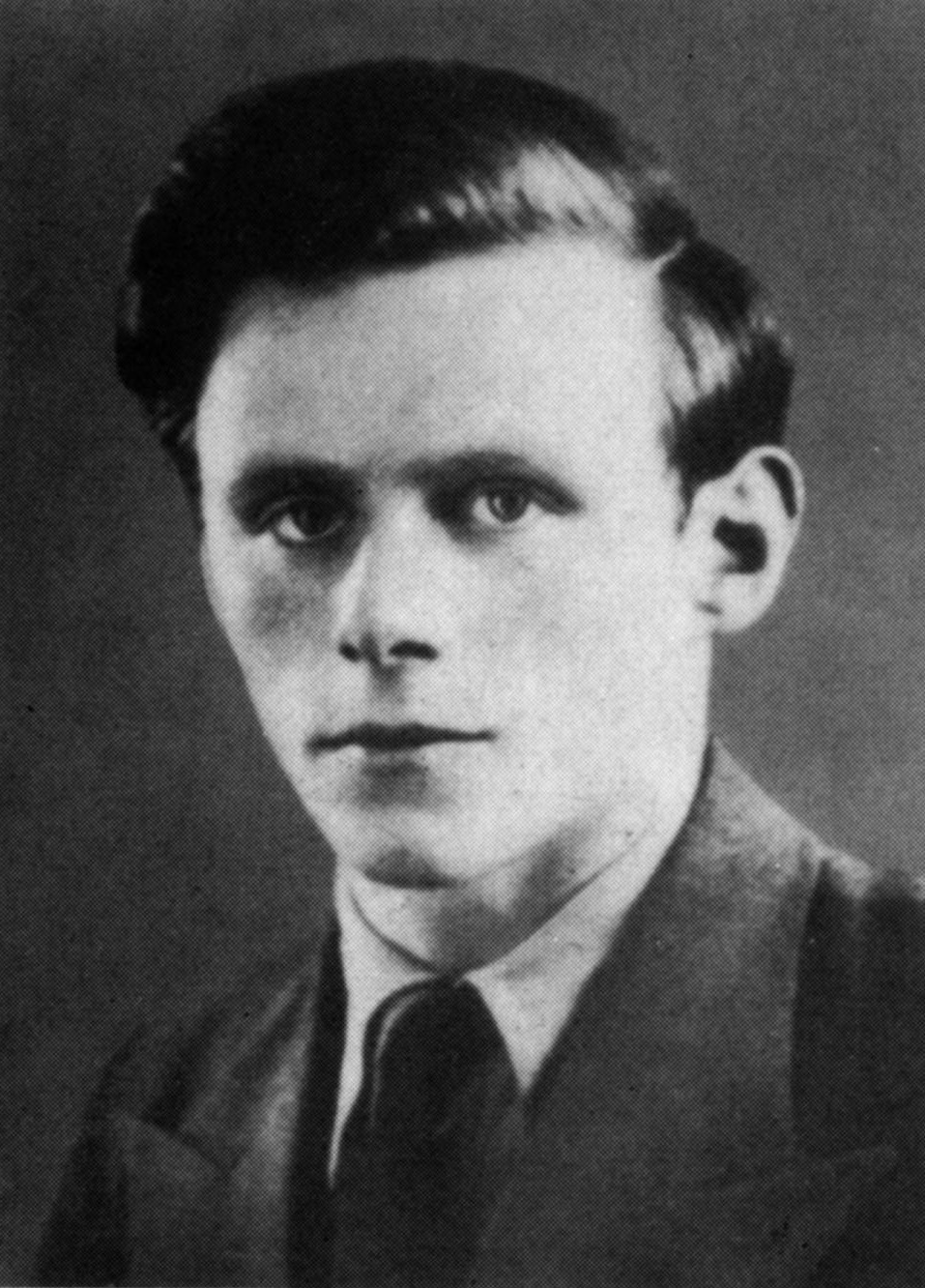
Charlie Donnelly. Former UCD student, the Republican Congress veteran and poet died in the Spanish Civil War.
When we think of the Civil War that raged in Spain from 1936-1939, a generation of idealistic writers come to mind. We might think of George Orwell as he walked Las Ramblas, Ernest Hemingway who reported on the war for the North American Newspaper Alliance (NANA), or even the young Tyrone poet Charlie Donnelly. The later, a former student of University College Dublin, would lose his life at the bloody and brutal Battle of Jarama. A Canadian anti-fascist volunteer who fought alongside young Donnelly recalled being there, and that “I hear him say something quietly between a lull in machine gun fire: Even the olives are bleeding.” The words have become iconic.
Yet, did the Spanish Civil War unite an entire generation of writers and poets against Fascism? Things are never so straightforward. One remarkable document from the period of the war, which has interesting Dublin dimensions to it, is the 1937 survey of writers entitled Authors Take Sides of the Spanish Civil War. It can be downloaded by clicking on the title. The brainchild of Nancy Cunard, the survey asked writers and poets from across these islands to comment on what was occurring in Spain. There, a Nationalist uprising sought the overthrow of the Spanish Republic.
To the writers and poets of England, Scotland, Ireland and Wales:
The equivocal attitude, the Ivory Tower, the paradoxical, the ironic detachment, will no longer do. Are you for, or against, the legal government and the people of Republican Spain? Are you for or against Franco and Fascism? For it is impossible any longer to take no side. Writers and poets…we wish the world to know what you, who are amongst the most sensitive instruments of a nation, feel.
IRA veteran Frank Ryan speaking in College Green following the release of republican prisoners in 1932. He would later lead Irishmen to the Spanish Civil War.
Cunard is a figure who in some ways has fallen through the cracks of history, as remarkable women in particular tend to do. The daughter of Sir Bache Cunard, a heir to a lucrative shipping business, she was born into the upper-echelons of British society in many ways. Anne Chisholm, her biographer, has noted that:
Cunard was not just a fashionable poor little rich girl and muse, patron or mistress to many of the writers and artists of the 20s and 30s – including Aldous Huxley, Ezra Pound, Louis Aragon, Samuel Beckett, Wyndham Lewis, Constantin Brâncusi and Oskar Kokoschka, but a published poet and a fierce campaigner against prejudice and injustice. She had style in more sense than one.
Cunard was a committed anti-fascist, something which sat poorly with some in her own family. As Lydia Syson has noted, “her mother – a close friend of Oswald Mosley – disinherited her fairly speedily in 1931.” As a publisher, she was responsible for the publication of Negro in 1934, a celebration of black writers, with poetry, fiction and non-fiction contributions. Of the Spanish Civil War, she rightly predicted that “events in Spain were a prelude to another world war.”
Nancy Cunard, who instigated the pamphlet ‘Authors Take Sides on the Spanish Civil War’.
In asking writers and poets to give their take on what was occurring in Spain, Cunard received replies that fell into three categories. 127 of the replies were ‘For the Government’, 16 were deemed ‘Neutral’ and only 5 were ‘Against the Government’, not entirely surprising given the wording of the question asked.
I was quite surprised that one of those who fell into the category of ‘Neutral’ was Sean Ó Faoláin, one of my own favourite writers. Responsible for The Bell journal and the classic The Irish: A Character Study, Ó Faoláin is today regarded as one of the great intellectuals of twentieth century Irish public life. He knew a little about Civil Wars himself, having played his part in the Irish Civil War as an Anti-Treatyite. “Don’t be a lot of saps.”, his reply began. “If X and Y want to cut one another’s throats over Z, why on earth must people who do not believe in the ideas propounded by either X, Y, or Z have to choose between them?”
From ‘Authors Take Sides on the Spanish Civil War’
For other Irish writers, it was much more straight forward. For Samuel Beckett, a simple “UP THE REPUBLIC!” did the trick. His fellow Dubliner, Sean O’Casey, likewise delivered stirring words: “I am with the determined faces firing at the steel-clad slug of Fascism, from the smoke and flames of the barricades.”
Tom Buchanan, in his history of Britain and the Civil War in Spain, believed that “the pamphlet was ostentatiously an exercise in propaganda”, and while I agree with that statement, it’s a very interesting little piece of history nonetheless. For Samuel Beckett, the following decade would bring some excitement with the French Resistance, proving that his opposition to Fascism was more than mere words on paper.
In Ireland, public opinion during the Civil War in Spain was very much against the government of the Republic. The Irish Independent constantly referred to the war as a conflict between “reds” and “patriots”, praising those who helped in “the fight for Faith”. Previously on the site we’ve looked at anti-communism in 1930s Ireland, for example in this piece on the Irish Christian Front. On the other side, check out our piece on the commemorative banner of the Irish men of the International Brigades.
With the Open House festival taking place across the city and county over the weekend, the doors of a few interesting buildings opened to the public. We decided to take in the tour of the Mansion House at 3pm on Saturday, and I photographed a few things that I thought might interest CHTM readers. Sadly, I was armed only with a camera phone but forgive me that.
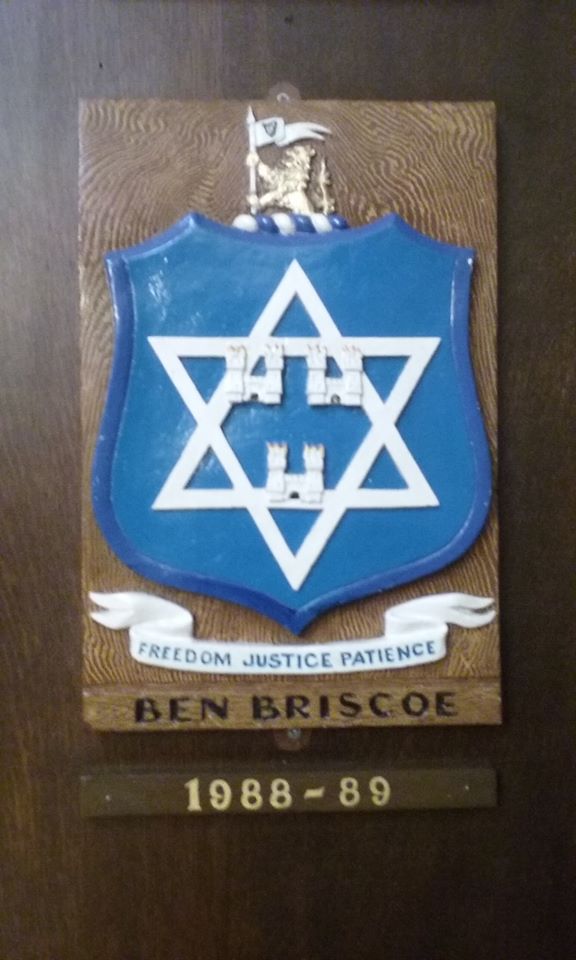
The tour of the Mansion House began in the beautiful Oak Room, where a fine portrait of the nationalist political leader Charles Stewart Parnell greets visitors. The most striking feature of the room I thought was the presence of the personal coats-of-arms of many former Lord Mayors. Rather than heraldic family crests, these are designed to give some insight into the personalities of the individuals. A particular favourite was this one from former Lord Mayor Ben Briscoe. Ben’s father, Robert Briscoe, was an IRA veteran of the revolutionary period who twice served as Lord Mayor of Dublin, becoming the first Jewish Lord Mayor in the history of the city. The Briscoe family were examined in a CHTM article on the Jewish community during the Irish revolutionary period.
The personal coat of arms of Ben Briscoe, incorporating the Star of David.
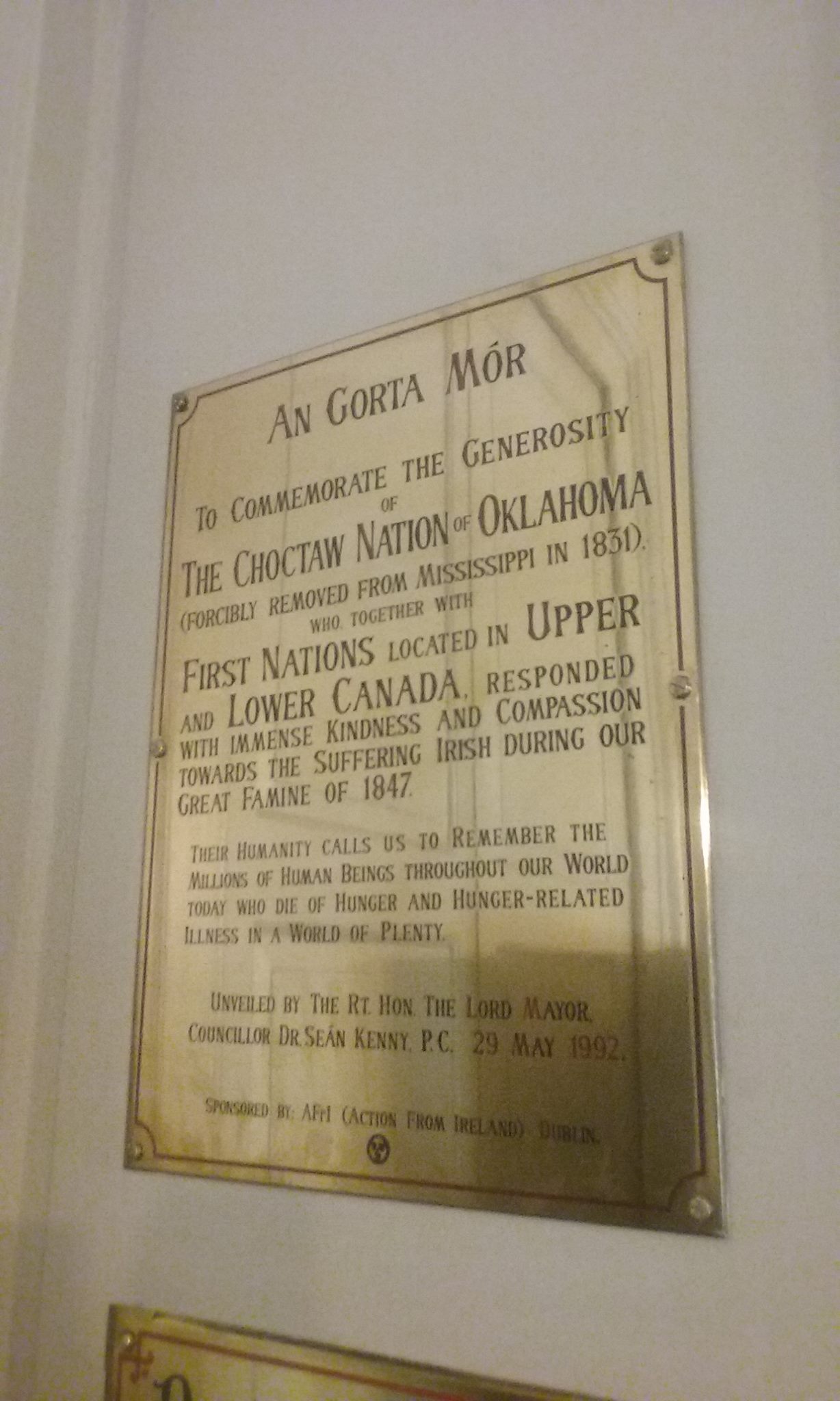
In the hallway of the Mansion House, a plaque commemorates the financial assistance given by the Choctaw Native American people to the Irish during the years of the Great Hunger. A people who had themselves been displaced and dispossessed, it was a remarkable and unlikely act of solidarity. Gary White Deer, a representative of the Choctaw Nation, has visited Ireland and described this moment in history as a “sacred memory.”
Choctaw Nation plaque, Mansion House.
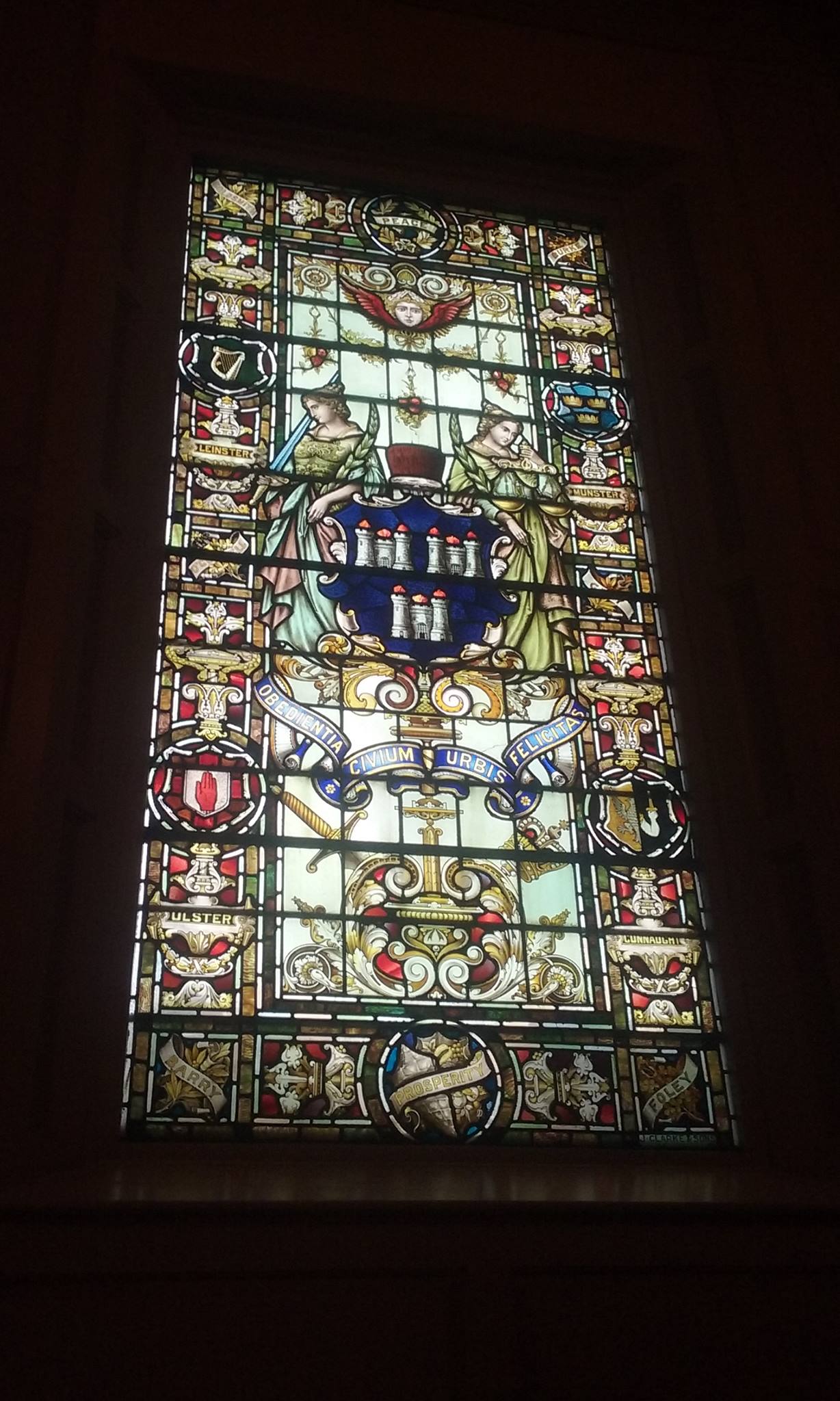
Lastly, this beautiful window on the staircase is the work of Joshua Clarke, the father of the influential artist Harry Clarke, and demonstrates the considerable talent that was no doubt passed on to Harry. The window shows the official coat-of-arms of the office of the Lord Mayor, as well as the four provincial shields of Ireland. The names around it are those of famous Home Rule supporters, though today it is known as the ‘Peace Window’.
Now Boney’s away from his warring and fighting
He has gone to a place where there’s nought can delight him
He may sit there and dwell of the glory’s he has seen
While forlorn he does mourn on the Isle of St. Helena
So ends ‘The Isle of St. Helena’, a song that was truly brought to life by singer Frank Harte, and one of many great songs popular in this country which include reference to Napoleon Bonaparte. His presence in the Irish oral tradition of songs isn’t all that surprising – Napoleon had once been a figure who loomed large over Irish political affairs, building important links here with the United Irish movement, meeting Theobald Wolfe Tone in Paris and even developing an Irish Legion within his French Forces in the years that followed the defeat of the United Irishmen. Frank Harte would record an entire CD of songs relating to Napoleon Bonaparte, in a great collaboration with Donal Lunny. ‘You Sons of Old Ireland’ is a particular favourite of mine:
This year of course witnessed the bicentenary of the Battle of Waterloo, when the Duke of Wellington (born here among us) overcame Napoleon Bonaparte on the 18th of June 1815. Napoleon’s defeat marked the end of his political and military career, but not his time on earth. Napoleon lived out his days in exile on St. Helena, an island in the Atlantic Ocean,located over 1,160 miles from the west coast of Africa.
On the island, Napoleon was cared for by Doctor Barry Edward O’Meara, a Dubliner who some claim had been educated at Trinity College Dublin and the Royal College of Surgeons. O’Meara could speak both Italian and France, enabling him to talk freely with the fallen leader. He had served as a surgeon with the British Army in Egypt and Sicily, before landing himself in hot water for partaking in a spot of pistol dueling. As David Murphy has written:
In 1807 he acted as second in a duel at Messina in Sicily, and his commanding officer, who was determined to suppress the practice of duelling, had him court-martialled. He was dismissed the service in 1808 but entered the RN as an assistant surgeon, initially serving on HMS Victorious in 1810.
O’Meara would later publish a memoir of his time in the company of Napoleon Bonaparte, entitled Napoleon in Exile : or, A Voice from St. Helena. It was a huge commercial success when published in 1822, and provided some great insights into the closing chapter of Napoleon’s life. In a 1952 edition of The Bulletin of History of Medicine, it is claimed that “when the book was first published, police had to keep back the crowds around the publisher’s office”, such was the demand for copies.
In one episode, he recalled an unlikely conversation they had:
“What do you think,” said he, “of all things in the world would give me the greatest pleasure?” I was on the point of replying, removal from St. Helena, when he said, “To be able to go about incognito in London and other parts of England, to the restaurateurs, with a friend, to dine in public at the expense of half a guinea or a guinea, and listen to the conversation of the company; to go through them all, changing almost daily, and in this manner, with my own ears, to hear the people express their sentiments, in their unguarded moments, freely and without restraint; to hear their real opinion of myself, and of the surprising occurrences of the last twenty years.” I observed, that he would hear much evil and much good of himself. “Oh, as to the evil,” replied he, “I care not about that. I am well used to it.
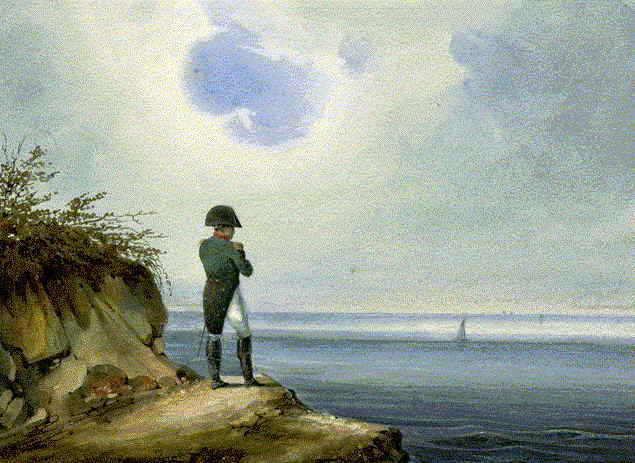
An illustration showing Napoleon after his death of the Island of St. Helena.
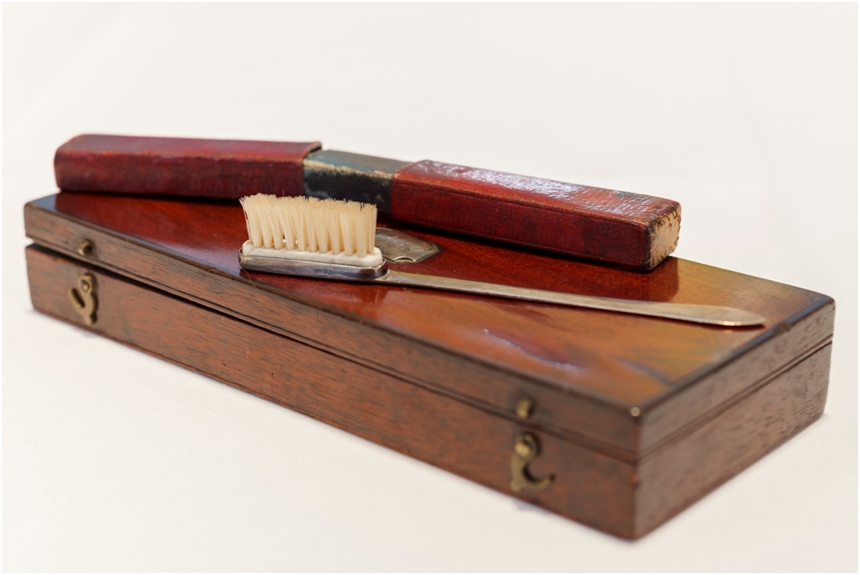
Having little in his final years, Napoleon bestowed unlikely gifts upon close-confidants before his death in 1821 . In O’Meara’s case, a toothbrush and some other mementos. The toothbrush has the letter ‘N’ stamped upon its silver gilt handle, indicating that even at the end there was some pomp and ceremony at least for Napoleon. In time, the toothbrush would find a home in the Royal College of Physicians on Kildare Street, with their excellent blog noting that:
O’Meara’s collection of Napoleon relics passed through the hands of several Irish surgeons, finally falling into the possession of Sir Frederic Conway Dwyer. Dwyer was a leading Surgeon in the early years of the twentieth century, and was both Professor of Surgery at the Royal College of Surgeons and President of that College from 1914-1915 (…) Sir Frederick Conway Dwyer died in October 1935. In his Will he left his considerable fortune to the daughter of a family friend, Mrs Tyrell, which caused some consternation at the time. In 1936 Mrs Tyrell presented Conway Dwyer’s collection of Napoleonic items to the Royal College of Physicians of Ireland.
Today, it is surely one of the most unusual items on display in this city, and a reminder that even Napoloeon Bonaparte was only human and had to brush his teeth twice a day!
The Pillar, my study of the Nelson Pillar on O’Connell Street, is currently on sale from the publisher for €9.99, with free postage in the mix. Rather than just highlighting that,I want to draw attention to a great poem that sadly didn’t make the book – for the simple reason I stumbled across it too late!
Dublin Opinion remains one of the most important publications in the history of this city. Founded in 1922 by Arthur Booth and Charles E Kelly, it was home to biting satire, wonderful cartoons, and even a dash of poetry. As Felix Larkin has noted:
Dublin Opinion was published monthly, a miscellany of quips, short articles, poems and cartoons – all in a humorous vein, but with serious intent. Its masthead initially included a subtitle in Irish that translated as “Seriousness in humour”. The journal, without sacrificing its humour, always retained the capacity for conveying a serious message – and the message had greater impact because it was delivered in a humorous way.
We’ve looked at Dublin Opinion on the site before, with a cartoon that mocked the GAA Vigilance Committee. Another gem comes from Fifteen Years of Dublin Opinion, published in 1937. The poem makes an argument that the Nelson Pillar on O’Connell Street should be left exactly as is, at a time when some were demanding its removal.
Dauntless aloft he sails the skies
An admiral of stone,
Watching with doubtless quiet eyes
A country not his own
Whose memories of sailormen are Bantry Bay and Tone.
Only when winds are from the South
He sees Trafalgar Bay
And hears the belching cannon-mouth
Wreak wreck and disarray,
Giving, with empty sleeve close-hauled, the order of the day.
Long buried is that battle’s bane,
Still stands the column’s stone.
We took the Norman and the Dane
And made of them our own;
And that tall shaft of alien birth to one of us has grown.
I’m sure ’twas scarcely up a year,
As Davis would have said,
When it became a ‘Dubliner’
To Dubliners long dead.
The way the Geraldines once trod was plainly its to tread.
Our winds around its granite pate
A hundred years have blown,
I think if we could put it straight,
To Theobald Wolfe Tone,
His vote would be ‘Don’t spoil the street.
Let the old chap alone.’
While I missed the boat, John Wyse Jackson and Hector McDonnell were wise enough to include this one in their very entertaining Dublin’s Other Poetry: Rhymes and Songs of the City. It was published by Lilliput Press.
Image Credit: William Murphy, Flickr. (Creative Commons) (P.S Thanks as ever to William for sharing such a collection!)
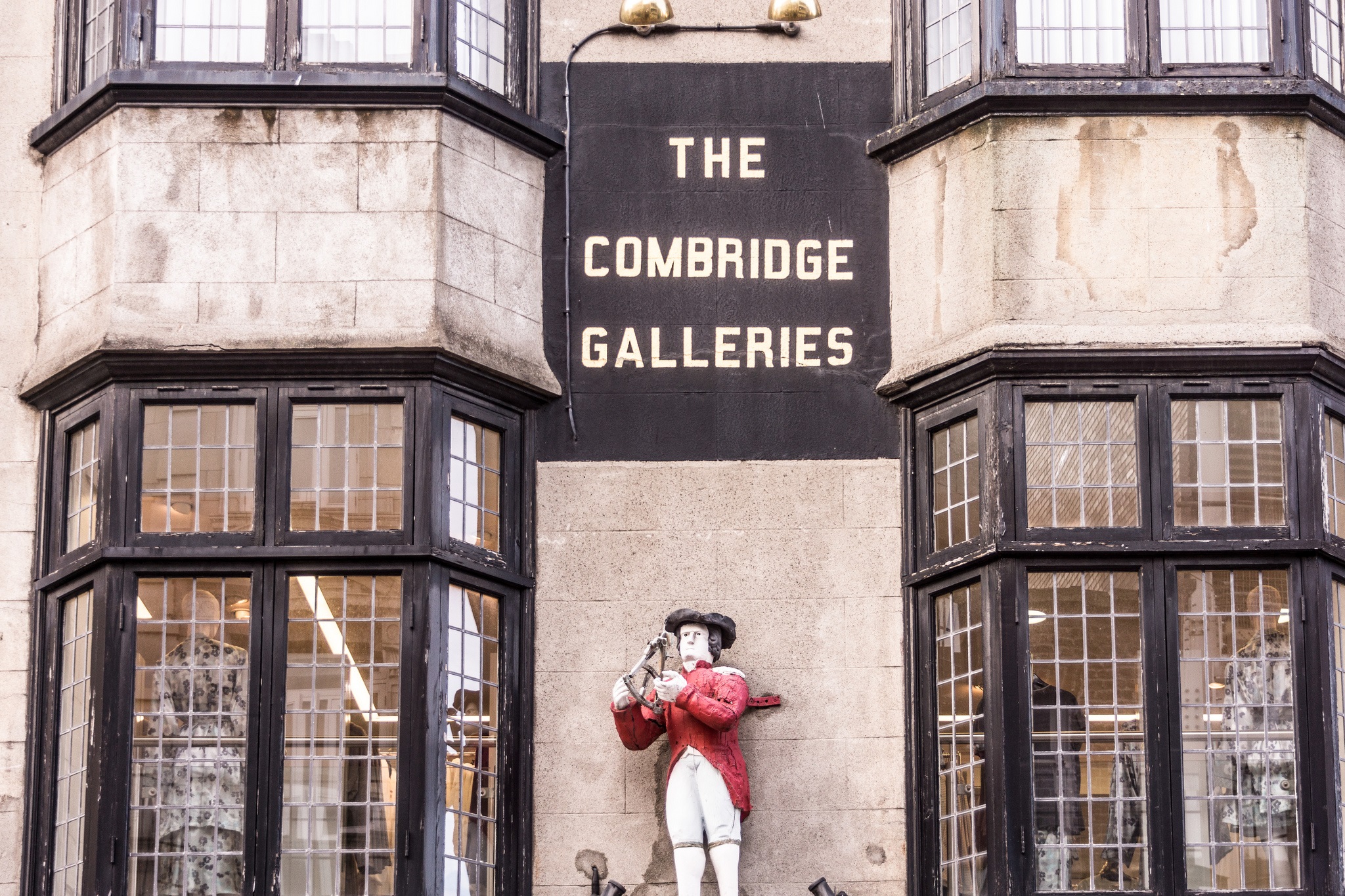
Standing over The Bailey pub on Duke Street, and now between the windows of an upper-floor of Marks and Spencers, this lonely sailor with a sextant in hand has been baffling me for years.
Writing in the Dublin Historical Record in 1939, A.M Fraser stated:
Let us pause a few moments in Duke Street and gaze at the trim little figure of Captain Cuttle in his three-cornered hat, gold-frogged blue tail-coat and cream breeches, as he stands shooting the sun with his old-fashioned brass quadrant…..When Dickens was driving to the rotunda to deliver one of his readings he climbed down from his car and came into the shop to inquire about the figure.
In recent years, there have been a number of blogs and publications dedicated to the celebration and chronicling of Dublin’s ghost signs, the reminders of the city in generations past. In a review of Antonia Hart’s study of ghost signs, Dermot Bolger wrote in the Evening Herald that “This mariner first appeared above a shop in Capel Street in 1810, before he and his owner – the optician, Richard Spears, whose services the quadrant hinted at – moved to College Green”.
The Bailey, Duke Street, 1970. Before its modern expansion. Image from Dublin City Council Photographic Collection.
The name of Richard Spears pops up in Wilson’s Dublin Directory for 1801 on Capel Street, where he was listed as a “mathematical instrument maker” at number 23. Spears,it seems, later took up premises at 27 and 35 College Green, before going into partnership with Edward Clarke from 1815-1817. Some of his handiwork, signed , “R.Spears, instrument Maker to His Majesty’s Crown of Customs in Ireland”, can be seen here. These items are in the collection of the National Museum today.
Pat Liddy, expert on all things Dublin from the time of the Norse to the present day, has written that “the venerable old sailor” kept watch over Murray McGrath’s for many years, writing that “John Murray…found the statue on a quay dump, retrieved it and brought the partly rotting plaster cast to a statue maker or restoration.” Murray McGrath’s optician operated on Duke Street for a long time, and in the 1960s our friend Pól Ó Duibhir snapped the sailor there.
He writes of seeing the sailor years later, and that “instead of my remembered sailor there was a mere gaudy shadow. My real sailor had been replaced by a modern piece of tack.”
His coat was pink and peeling. He was looking at the sextant in his hands as if he didn’t know whether to play it, eat it, or poke somebody’s eye out with it. He was reduced in stature and had clearly put on a bit of weight – puppy fat maybe. He had lost his bearing as well as his bearings. He knew not whence he came or where the hell he was going. And it didn’t really seem to matter. Nothing was expected of him.
1960s and the modern day. (Pól Ó Duibhir)
So, I’m curious – what’s the deal here? How long has the statue on Duke Street been there? It’d be great if someone can clear it up. Next time you’re passing by, have a look up at him.
This is something of an on-going series on the blog, with our full thanks to photographer Luke Fallon. Luke is very much the fourth musketeer of CHTM and we always appreciate his willingness to share his images here. A highlight of the most recent CHTM night in The Sugar Club was the slideshow of Luke’s images, which worked a treat with John Flynn’s musical set.
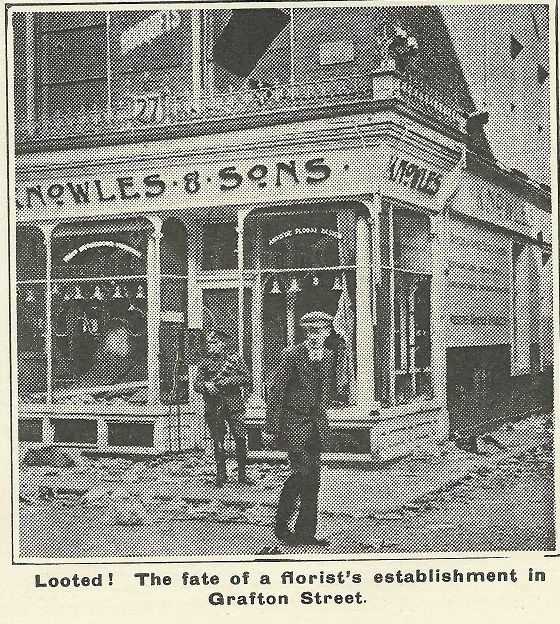
“Looted!” (From an unknown British publication, May 1916)
Where would you have been in 1916?
It’s a question many people will no doubt be asking each other in the year ahead, most likely in a pub. Would you be risking life and limb in a European trench to feed your family, or defending the newly proclaimed Irish Republic on the streets of Dublin? Maybe hiding under the bed? Perhaps though, you might have been somewhere entirely different. Clery’s, Elvery’s or even McDowell’s jewellers? Indeed, that is the choice many people made. In his classic study Dear, Dirty Dublin: A City in Distress, 1899-1916, Joseph O’Brien wrote that “according to police statistics for 1916, 425 persons were proceeded against for looting during the rebellion and 398 of these were either fined or imprisoned.”
The widespread looting that occurred during the Easter Rising is one aspect of the week that participants frequently spoke of in later years when interviewed by the Bureau of Military History. It is also an aspect of the week that filled plenty of column inches in the days and weeks that followed the end of the event, as looters found themselves on trial for their actions. Justifying what they had done, a mother and daughter on trial simply told a policeman that “we were looting, like the rest.”
Easter Monday 1916 began as a beautiful day of fine weather, ideal for the Fairyhouse Races which were getting underway. Sean O’Casey recalled that:
It was a day on which to make merry, and crowded streets proclaimed that the influences of the sun’s geniality was making melody in the hearts of man. Many were climbing joyously on to the trains to seek in Nature’s bosom a place that would hide them for a few hours “far from the madding crowd’s ignoble strife,” while distinct gatherings of people stood by near Nelson Pillar and found happy moments in the contemplation of the passing activities of human life. Curious glances were flung at passing vehicles, burdened with hopeful crews, flashing swiftly by on their way to Fairyhouse Races, and the pulse of human anxiety was scarcely felt besides the quick-beating pulse of human enjoyment.
The beginning of the Rising may have taken many people by surprise, but the breakdown of law and order came almost immediately. In his entertaining memoir On Another Man’s Wound, Ernie O’Malley recalled arriving onto O’Connell Street, or Sackville Street as it was then known, as the insurrection was in its infancy:
Diamond rings and pocketsful of gold watches were selling for sixpence and a shilling, and one was cursed if one did not buy…. Ragged boys wearing old boots, brown and black, tramped up and down with air rifles on their shoulders or played cowboys and Indians, armed with black pistols supplied with long rows of paper caps. Little girls hugged teddy bears and dolls as if they could hardly believe their good fortune.
Where were the police in all of this? The decision of Colonel R. Johnstone to withdraw the 1,100 Dublin Metropolitan Police officers from the streets of the city no doubt facilitated the widespread looting, and as Brian Barton has noted “it soon reached endemic proportions, far beyond the capacity of either the troops or the insurgents to prevent or contain.”
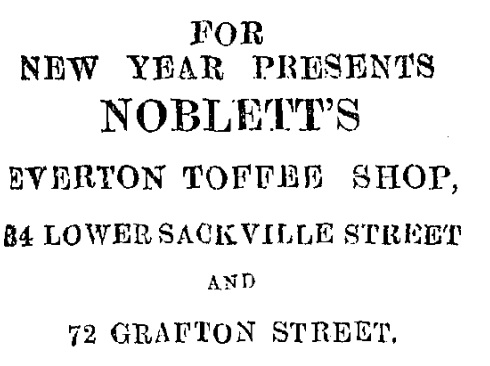
An advertisement for Noblett’s, described as one of the first shops to be looted.
The looting on Sackville Street began in broad daylight, and not long after the declaration of the Republic. Among those who arrived on the street trying to stop the looting were Catholic clergy from the Pro Cathedral. Monsignor Curran, who was serving as Secretary to Archbishop Walsh in Dublin at the time of the Rising, told the Bureau of Military History that:
Before 2 pm the crowds had greatly increased in numbers. Already the first looting had begun; the first victim was Noblett’s sweetshop. It soon spread to the neighbouring shops. I was much disgusted and I did my best to try to stop the looting. Except for two or three minutes, it had no effect. I went over and informed the Volunteers about the G.P.O.
Five or six Volunteers did their best and cleared the looters for some five or ten minutes, but it began again. At first all the ringleaders were women; then the boys came along. Later, about 3.30 p.m. when the military were withdrawn from the Rotunda, young men arrived and the looting became systematic and general, so that Fr. John Flanagan of the Pro-Cathedral, who had joined me, gave up the attempt to repress it and I left too.
One Volunteer described the scene at Noblett’s sweet shop after the windows came crashing in. He remembered the sight of “a gay shower of sweetstuffs,chocolate boxes and huge slabs of toffee” being tossed about by the young crowd.Desmond Ryan of the GPO Garrison also recalled that Seán MacDiarmada made his way across the street and protested “vehemently, his hands raised passionately above his head.”
Jeremiah Joseph O’Leary, later to serve as Sinn Féin Director of Elections in the Pembroke constituency in 1918, recalled attempts to stop the looting. He also remembered entering the General Post Office and being confronted by the sight of two of the rebel leaders enjoying a quick bite:
In the late afternoon (Monday) I observed big crowds in Earl Street and Abbey Street, breaking shop windows and beginning to loot the contents. I went into the General Post Office which, at that time, was apparently a quite easy thing to do, and saw Padraig Pearse and James Connolly sitting on high stools in a little enclosure in the middle of the main hall drinking tea and eating sandwiches.
I went out to the front of the G.P.O., stood up on one of the stones that front the pillars and made a short speech, denouncing the looting and calling for volunteers to help to suppress it. A number of men came forward whom I lined up in front of the G.P.O. And, taking one or two of them in, we collected the batons and distributed them to the men. I then instructed them to parade the main shops and thoroughfares opposite the G.P.O. to try to keep the crowds on the move, and prevent them doing damage. We moved over towards Earl Street, but there was such a dense, milling crowd there that we became broken up and submerged by the crowd immediately. I spent the rest of the night vainly trying to keep people on the move and prevent looting, but with very little success.
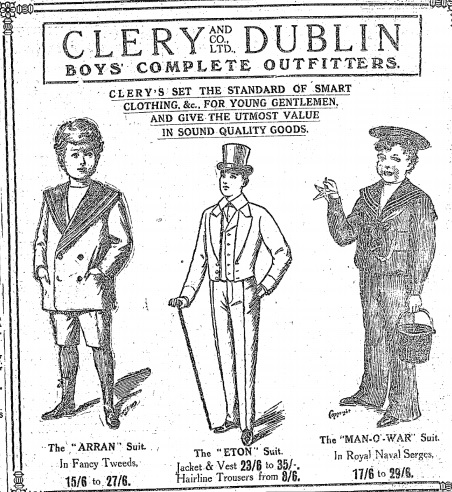
Clery’s was an unsurprising target for looters. (1915 advertisement)
What was the motivating factor in deciding to loot certain shops and not others. One contemporary source made the claim that “the rougher element that existed in the city” seemed to be targeting “stores that bore English names or were known to be owned by the foreigners. In this they followed the example set by the mobs in London who raided and looted German stores in that city as an act of retaliation for the Zeplin raids made during the war.” Personally, I don’t think there is much merit to that line, as public houses, shoe shops and more besides owned by Irish business people were among the first to go. As an aside, there had been politically motivated looting of German pork butchers in August 1914, following the outbreak of the First World War.


















 Click on the book for more.
 Click on the book for more.
 Donal
Donal Ciarán
 Sam
Sam


 Come Here To Me!