Feeds:
Posts
Comments

My thanks to Joe Mooney of the East Wall History Group for sending on this excellent little 1916 story, which he notes comes from a magazine that was contained “Within material donated to the East Wall History Group by the family of Irish Volunteer Richard Roe (Jacobs Garrison 1916)”

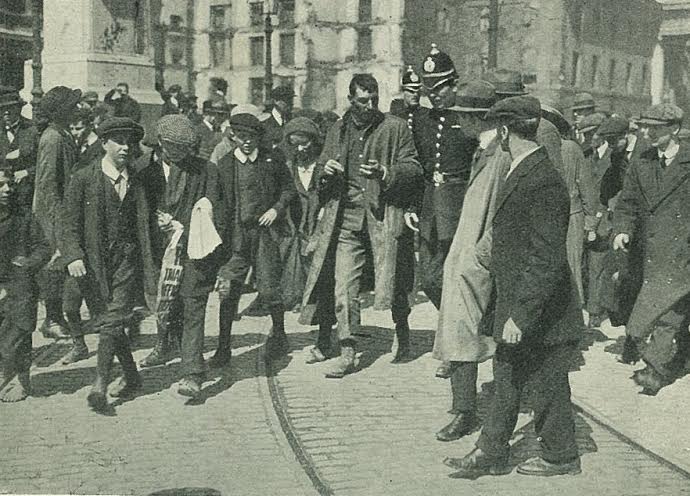
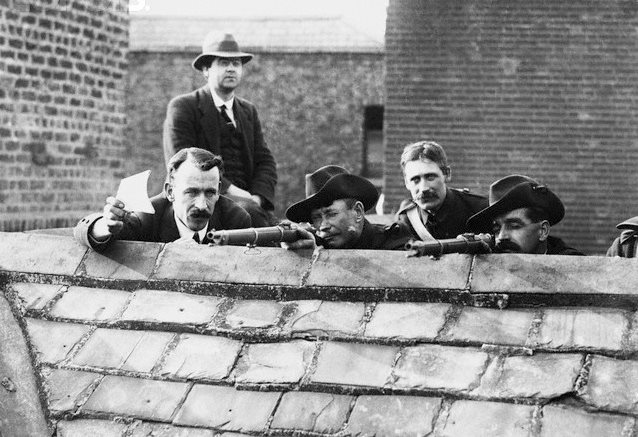
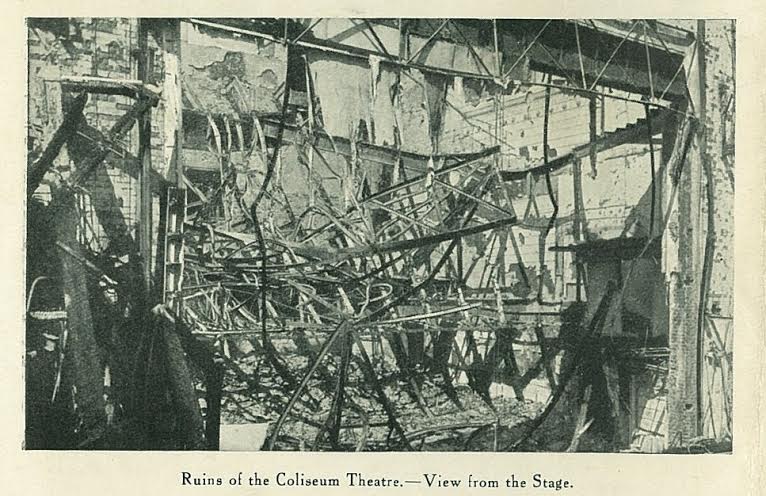
Two soldiers were discovered hiding out in the runs of the Coliseum Theatre in Henry Street on 3 May 1916, confused as the whether or not the rebellion was exactly still underway.  By 3 May the executions of the rebellions leadership figures were already underway.

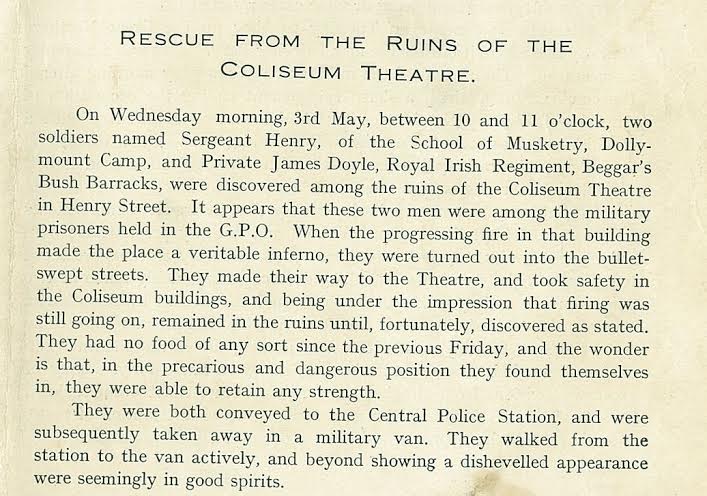
The following account and images were published in a contemporary magazine.


Contemporary magazine report.

Contemporary magazine report.

The ruins of the theatre.

The ruins of the theatre.

Soldiers being escorted through the streets.

Soldiers being escorted through the streets.

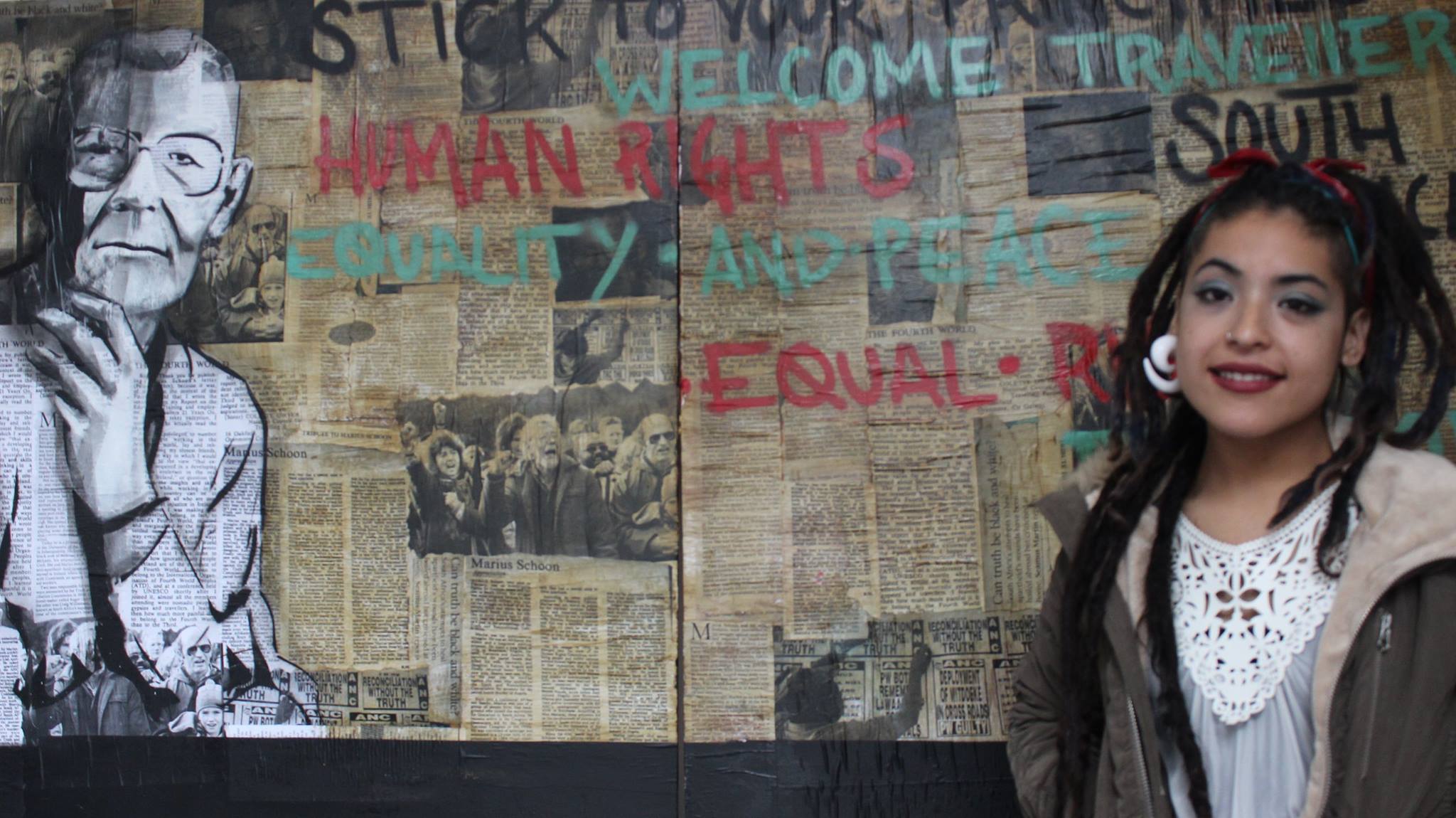
A mural dedicated to South African anti-Apartheid activist Marius Schoon, who lived in Dublin for several years, was unveiled last week in the new offices of Comhlámh at 12 Parliament Street. It was painted by by street artist Katrina Rupert (aka KIN MX). Comhlámh, founded in 1975, is the Irish Association of Development Workers and is committed to “social justice, human rights and global development issues”.

"Kathrina Rupit with her fantastic mural celebrating the life of Marius Schoon, anti-apartheid activist." Credit - Comhlámh FB page

“Kathrina Rupit with her fantastic mural celebrating the life of Marius Schoon, anti-apartheid activist.” Credit – Comhlámh FB page

Marius Schoon (1937 – 1999) was a long-term political prisoner and exile of Afrikaner dissident. He served 12 years in prison for a futile effort to blow up a radio transmitter at a police station in Johannesburg in 1964. On his release in 1976, he joined the African National Congress and the South African Communist Party in exile.

In 1984, his second wife Jeannette Curtis, and their 6-year-old daughter, Katryn, were killed by a letter bomb intended for Schoon. The pair were blown up in front of Fritz, their 3-year-old son, in the kitchen of their house in exile in Angola.

Jeanette and Katryn both held Irish passports due to the fact that one of Jeanette’s grandparents was Irish. After the horrific incident, Schoon and his son moved to Dublin where they were granted an Irish passport by the Fine Gael-Labour government. Fritz later spoke about their relocation to Ireland:

Marius and I arrived in Ireland on the back of what was a very traumatic experience for us both. The Irish government was kind enough to grant us both citizenship on compassionate grounds. Over and above this gesture, Marius and I received compassion and generosity in many forms from Ireland and its people. As testament to this Marius, speaking of his time in Ireland, reported – in the Rift, by Hilda Bernstein – that ‘I really feel that for the last two or three years, for the first time in my life, literally, I’ve got a stability and a security that I’ve never had. I am actually enjoying the security that we have at the moment.”

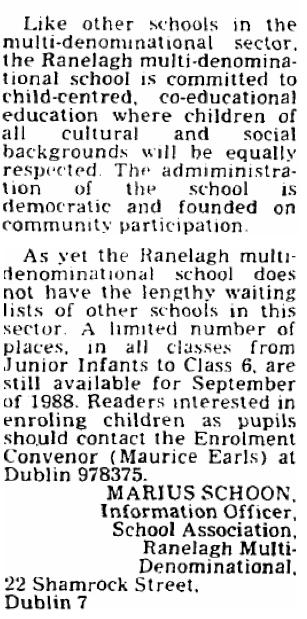
Living at 22 Shamrock Street in Phibsboro, Schoon became active with the Irish Anti-Aparthied Movement, the new Ranelagh Multi-Denominational school and was co-ordinator of Comhlámh between 1988-1991.

Letter titled 'A School Where All Welcome' to Irish Independent (27 June 1988)

Letter titled ‘A School Where All Welcome’ to Irish Independent (27 June 1988)

In January 1988, the Media Association of Ireland hosted a lecture on ‘The Media and South Africa* by Marius Schoon at Newman House, St. Stephen’s Green. In May 1990, RTE Radio 1 produced a 30 minute documentary on Schoon’s life.

During this period, he met and later married Dublin-born anti-Aparthied activist Sherry McClean. From 1985 through 1987, she worked as a volunteer at Solomon Mahlangu Freedom College (SOMAFCO), a school for refugees established by the African National Congress (ANC) in Mazimbu, Tanzania, where she counseled and developed social support for children and adults. An interview was recorded with Sherry in 2004 as part of the African Archivist Archive.

Schoon (with glasses) joins in a clenched fist salute for the released ANC leader in Merrion Square, Dublin, organised by the Irish Anti-Apartheid Movement in February 1990. Photograph : Frank Miller

Schoon (centre with glasses) joins in a clenched fist salute for the released ANC leader in Merrion Square, Dublin, organised by the Irish Anti-Apartheid Movement in February 1990. Photograph : Frank Miller

Schoon, son Fritz and new wife Sherry returned to South Africa in late 1991 where he began work in the Development Bank, overseeing projects to help rural black communities.

In August 1995, he launched a lawsuit against Craig Williamson, spy for the security forces and former family friend, who was responsible for sending the parcel bomb that killed his second wife and daughter. (Williamson also admitted responsibility for the bombing of the ANC headquarters in London and sending the package which killed left-wing Jewish anti-Apartheid activist Ruth First in Mozambique in 1982). In 1998 Williamson and Jerry Raven, his accomplice, applied for amnesty with the Truth and Reconciliation Commission (TRC).

In 1999, Schoon died in hospital after a long battle with lung cancer. A year later the TRC granted both Williamson and Raven amnesty. (In 2008, Williambsurg was declared bankrupt by the Johannesburg High Court which will probably be the only form of legal justice he will probably ever face”).

Nelson Mandela described Schoon after his death as:

an enduring example of the fight for non-racialism and democracy. He destroyed the myth that all Afrikaners were racists and oppressors. He therefore will be greatly missed, not only by his colleagues in the fight against apartheid, but by the entire South African nation.

The event last Thursday was attended by Marius’ widow Sherry, independent social researcher Brian Harvey and Cathryn O’Reilly, one of the Dunnes Stores workers who went on strike  in 1984 over the handling of South African produce. Schoon and his young son frequently joined the picket lines during the two and half-year strike. Cathryn recalled the period:

We were all invited to the AGM of the Irish Anti-Apartheid Movement. They had this man Marius Schoon who got up and thanked us for going on strike. He was a white South African who lost his wife and his six-year-old daughter to a letter bomb because they were opposed to the apartheid system. He had a very profound effect on everyone in that we had nothing to lose only our jobs. He had lost his wife and his daughter for what he believed in. That made us more determined to continue doing picket duty and to speak out about it. Arthur Scargill (president of the National Union of Mineworkers) came down to the picket line. He had a placard and walked up and down with us.

In October 1955, a number of students from University College Dublin were involved in an occupation of the monument to Horatio Nelson on O’Connell Street, locking themselves inside the public viewing area and attempting to do away with the controversial figure of Nelson with flamethrowers. A banner of celebrated UCD graduate Kevin Barry was displayed from the viewing platform, and a large crowd gathered below to witness the spectacle. Nine young men had their names and addresses taken by Gardaí for their involvement in the protest, yet none were arrested, which says something about the atmosphere on O’Connell Street that day.

My thanks to Karl Finlay for these newspaper clippings from the following day. My forthcoming history of the Nelson Pillar has gone to print and should be in bookshops by late May, with plenty on this rather bizarre protest.

The banner of Kevin Barry that students hung over the viewing platform.

The banner of Kevin Barry that students hung over the viewing platform.

A crowd gathers below the Nelson Pillar to observe the student occupation.

A crowd gathers below the Nelson Pillar to observe the student occupation.

There has been very considerable media coverage in the last two days concerning the decision of Joe Higgins not to stand for re-election to the Dáil at the end of this term. Yesterday morning Joe was interviewed at length on the Sean O Rourke programme for RTE Radio, in an interview that focused on his career inside the Dáil. Sean noted that it’s often said all political careers end in failure, and that this could be said of Joe’s – something he completely rejected. I thought it would be interesting to look a little at Joe’s decades long political activism in Dublin briefly on the site here.

Joe Higgins shares a platform with the late Tony Benn, 1982. (This great image was captured by Derek Speirs)

Joe Higgins shares a platform with the late Tony Benn, 1982. (This great image was captured by Derek Speirs)

While Joe Higgins ultimately built a strong political base in Dublin West, he was born in the Dingle Gaeltacht in 1949, one of nine children. He enrolled in the priesthood following his graduation from Dingle Christian Brothers School, not a totally unusual choice for a young Irishman at the time. Sent to a Christian seminary school in Minnesota, Joe was exposed to anti Vietnam war activism and the political left for the first time. In an interview with Village magazine in 2005, he recalled that:

In the 1950s and 1960s, the Church was a big part of life in Ireland, the Catholic faith inculcated into you. Then you move on and develop and begin to see the world differently, you begin to think critically for yourself.

Higgins recalled his time in the United States in an interview with The Kerryman newspaper in 1989, telling them that:

I think being in the US at that time and the experience of the Vietnam war had a big influence on me. What the US was trying to do to the Vietnamese people and the horror of that, made me realise that fundamental changes were needed to end that kind of war which was basically a war of big business.

On returning to Ireland in 1972 he enrolled at University College Dublin, which began decades of political activism in the Irish capital. About this period he has stated “I started reading about socialism when I became active at college but books were never my first inspiration. I’m instinctively a socialist. It doesn’t take much to recognise that there is obviously huge inequality of wealth in the world”. Joe became Chairman of UCD Labour Youth during his time at Belfield. Higgins and others in Labour Youth were vocal opponents of Labour’s time in coalition with Fine Gael during the 1970s, evident from a letter that appeared in The Irish Times in 1975, with Higgins noting:

Within the Labour Party there is a growing call for Labour to seize the opportunity for independent action, and stop being the rubber stamp for Fine Gael’s policies…..At some stage, even the most moderate leaders will have to call ‘Halt!’ to Labour’s disastrous excursion into coalition.

Higgins belonged to a tendency within the Labour Party that became known as ‘Militant’, a term which was also applied to its co-thinkers in the British Labour Party. Essentially this tendency grew around an internal newspaper, which pushed Trotskyite politics as the way forward for the Labour Party and broader left. Early editions of Militant’s newspaper have been digitised by the excellent Irish Left Archive, and I’ve linked to one below. Militant called for a united Socialist Ireland, yet rejected armed Irish Republican violence, noting that “a bloody sectarian war would throw the Labour movement backwards.”

Via Irish Left Archive.  (Available to read here: http://cedarlounge.files.wordpress.com/2009/10/militant-no3-e.pdf)

Via Irish Left Archive. (Available to read here: http://cedarlounge.files.wordpress.com/2009/10/militant-no3-e.pdf)


Continue Reading »

Friday 2nd May (The Black Sheep, 8pm – 1am. €10 entry)

The Stoneybatter & Smithfield People’s History Project are hosting a night downstairs in The Black Sheep (61 Capel Street) to raise funds for their ambitious and exciting ‘Street Stories’ history and cultural festival happening in Dublin 7 this August.

Expect a wild night of 60s Soul, Beat, Garage, Soul and Reggae. DJs include yours truly, Stew Reddin, Barry Gruff and Darren Hawthorn.

More details see Facebook event here.

Street Stories Festival - A Celebration of Dublin Life! Coming to Stoneybatter and Smithfield in late August.

Street Stories Festival – A Celebration of Dublin Life! Coming to Stoneybatter and Smithfield in late August.


Saturday 3rd May (Seomra Spraoi, 10pm – 3am. €10/€5 entry. BYOB)

The city’s favourite underground magazine Rabble is putting on their first fundraiser ruckus in over two years. With issue number 8 just been sent to the printers, come down to Seomra Spraoi to celebrate with the usual dancetastic tunage from Rabble selectors and comrades.

More details see Facebook event here.

Rabble Ruckus event poster.

Rabble Ruckus event poster.

I’ve recently been reading the colourful memoirs of Jonah Barrington, an Irish lawyer, judge and politician from the eighteenth century. Barrington was a vocal opponent of the 1800 Act of Union that closed the Irish Parliament on College Green, and his published memoirs in the early nineteenth century were often humourous but also frequently cutting of his opponents. They give good insight into the life of the Protestant ascendancy in Ireland, not only inside the corridors of political power but socially too.

Jonah Barrington, taken from his published memoirs.

Jonah Barrington, taken from his published memoirs.

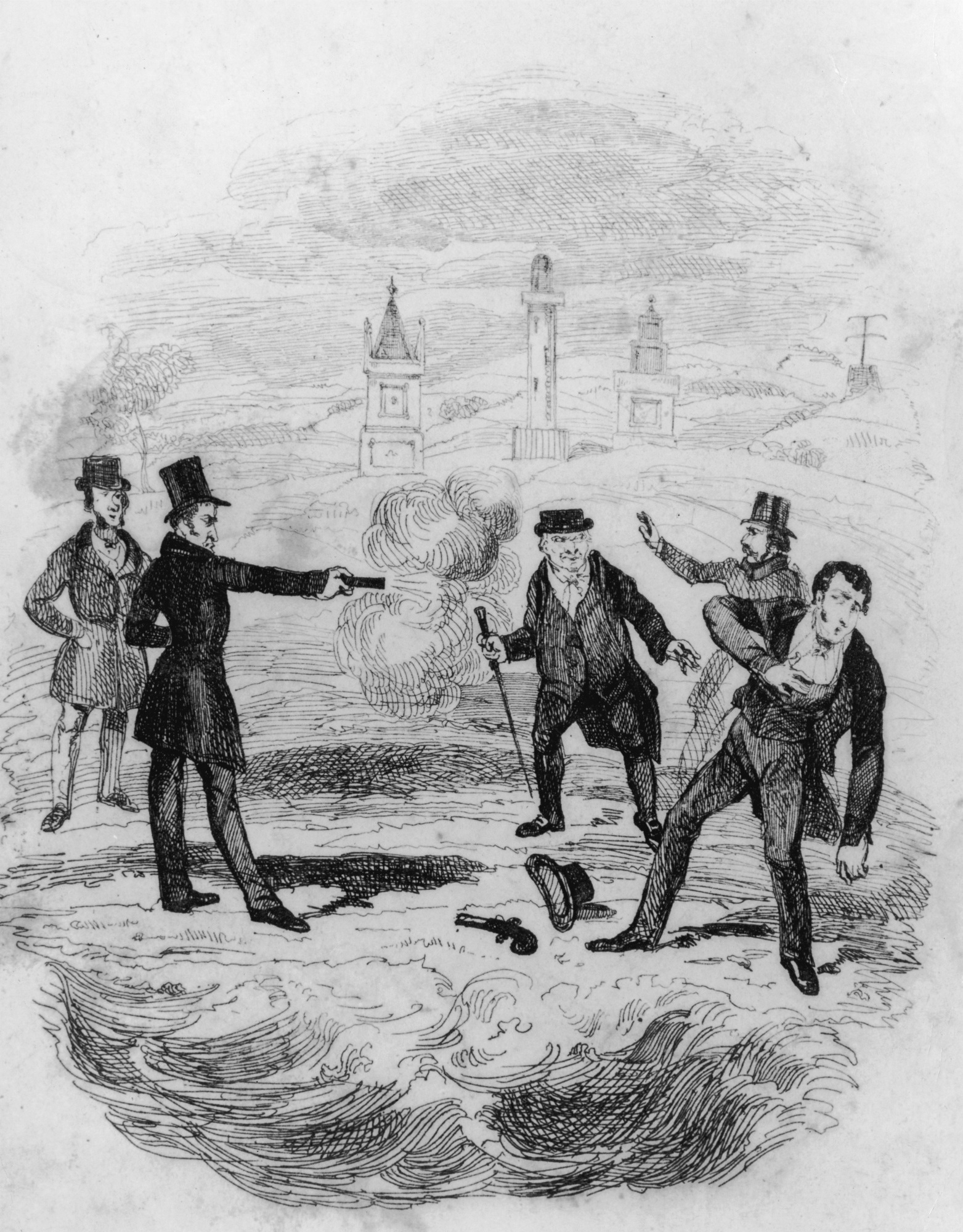
One interesting subject that emerges is the hobby of pistol dueling, with Barrington writing:

It is nearly incredible what a singular passion the Irish gentlemen (though in general excellent tempered fellows) formerly had for fighting each other and immediately becoming friends again. A Duel was indeed considered a necessary pieces of a young man’s education, but by no means a ground for any future animosity with his opponent: – on the contrary, proving the bravery of both, it only cemented their friendship.

Curious for more information, I stumbled upon an interesting article on the subject of dueling in Irish history by James Kelly, who noted that the Phoenix Park enjoyed a particular popularity in the city as far as the hobby went:

In the early and mid-eighteenth century, Dublin city was the dueling epicentre of the country, and the Phoenix Park emerged as the kingdom’s preferred killing field. The appeal of the Park lay in its size as well as its proximity to the city of Dublin. Duelists and their seconds could go there secure in the knowledge that they had an opportunity to blaze away free from interruption but within convenient access of the city should urgent medical help prove necessary.

A striking illustration of two men engaging in a duel (Image credit: http://history1800s.about.com/od/majorfigures/ss/duels19thcentury.htm)

A striking illustration of two men engaging in a duel (Image credit: http://history1800s.about.com/od/majorfigures/ss/duels19thcentury.htm)


Continue Reading »

In recent weeks I’ve been doing some research on how Irish nationalists and the city of Dublin commemorated the Battle of Clontarf in 1914. I had an article on this subject in the History Ireland special on Clontarf and a recent Irish Times supplement. The History Ireland special is still available in shops. Last night this audio piece narrated by me aired on The History Show, hopefully some of you will enjoy it. The piece today is a sort of mixmatch of the two previously published articles.

'The Illustrious Sons of Ireland' - An 1875 print that featured Brian Boru alongside Irish nationalist heroes such as Wolfe Tone and Robert Emmet (NLI)

‘The Illustrious Sons of Ireland’ – An 1875 print that featured Brian Boru alongside Irish nationalist heroes such as Wolfe Tone and Robert Emmet (NLI)

While the millennium of the Battle of Clontarf has captured the public imagination, previous milestone anniversaries of the iconic moment have likewise had an impact on the populace. In 1914 Irish nationalists organised commemorative events around the theme of Clontarf, and attempted to politicise the historic event in the pages of publications like the Irish Volunteer. Against a backdrop of political uncertainty regarding Home Rule, and with armed volunteers once more appearing on Irish streets, the battle was presented as a definitive victory for a native Irish force over a foreign aggressor.

The Irish Volunteer newspaper and Clontarf.

The first edition of the Irish Volunteer appeared on 7 February 1914, following on from the establishment of the nationalist body in November 1913. The inaugural issue of the publication featured articles on everything from ‘modern weapons of warfare’ to first aid training. Alongside these contemporary articles were features, poems and songs drawing on the past, attempting to give a historical narrative to this new force. Clontarf and the struggle against ‘the Danes’ (as the paper saw it) emerge from the pages of the publication as being every bit as important an event as the republican insurrections of more recent times. One song, the ‘Shan Van Vocht’, written in the days of the United Irish movement, was amended to reflect the aspirations of this new body:

And God bless my Volunteers,
Says the Shan Von Vocht.
And God bless my Volunteers,
Says the Shan Van Vocht.
They’ve hot blood in their veins,
And they’ll burst your galling chains,
As they did the robber Danes,
Says the Shan Van Vocht.

The inaugural issue of the Irish Volunteer newspaper, February 1914.

The inaugural issue of the Irish Volunteer newspaper, February 1914.


Continue Reading »

Every year, we try and mark Easter Week in some way on the site. This year we’re looking at an interesting set of artifacts in honour of one often overlooked participant in the 1916 Rising that have only recently come to light. This post wouldn’t have been possible without the help of Las Fallon, whose book ‘Dublin Fire Brigade and the Irish Revolution is available here.

Members of the Irish Citizen Army, an armed trade union force, on the roof of Liberty Hall.

Members of the Irish Citizen Army, an armed trade union force, on the roof of Liberty Hall.

What became of people after the revolutionary period in Ireland? For many veterans of conflict in Ireland, a life in politics followed, with some becoming Ministers and voices inside the Dáil and the establishment, while others remained very much in opposition to the state that was born in 1922 and remained politically active. Many others went on to live a wide range of lives – actors, authors, nurses, cinema managers and more besides emerged from the ranks of those who risked everything between 1916 and 1923.

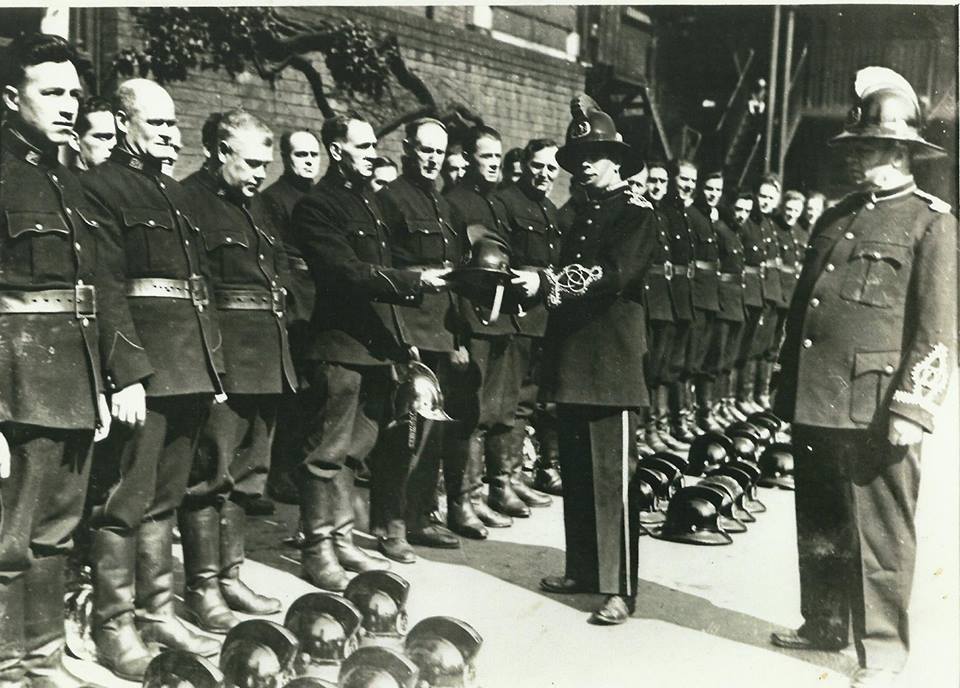
One character I’ve always found particularly interesting is Joseph Connolly. He continued doing what he was doing during the revolutionary years : fighting fires. Joe was an active member of the Dublin Fire Brigade for some time before the 1916 Rising and had even walked out of Tara Street Fire Station on Easter Monday to fight in the uprising! He continued to work in the Dublin Fire Brigade for many years after independence, and this post looks at a beautiful set of commemorative fire buckets presented to him by his comrades in the Irish Citizen Army at the time of his retirement from the Brigade in 1938. The buckets have a nice connection to Thomas Kain and Rosie Hackett, two members of the Irish Citizen Army. The new Luas bridge spanning the River Liffey has of course recently been named in honour of Rosie Hackett, the first female awarded such an honour.

Captain Joe Connolly, Chief Officer Dublin Fire Brigade,presenting the brigade with the new 'electric shockproof' helmets to replace the brass helmet worn since the 1860s. (Thanks to Las Fallon)

Captain Joe Connolly, Chief Officer Dublin Fire Brigade,presenting the brigade with the new ‘electric shockproof’ helmets to replace the brass helmet worn since the 1860s. (Thanks to Las Fallon)

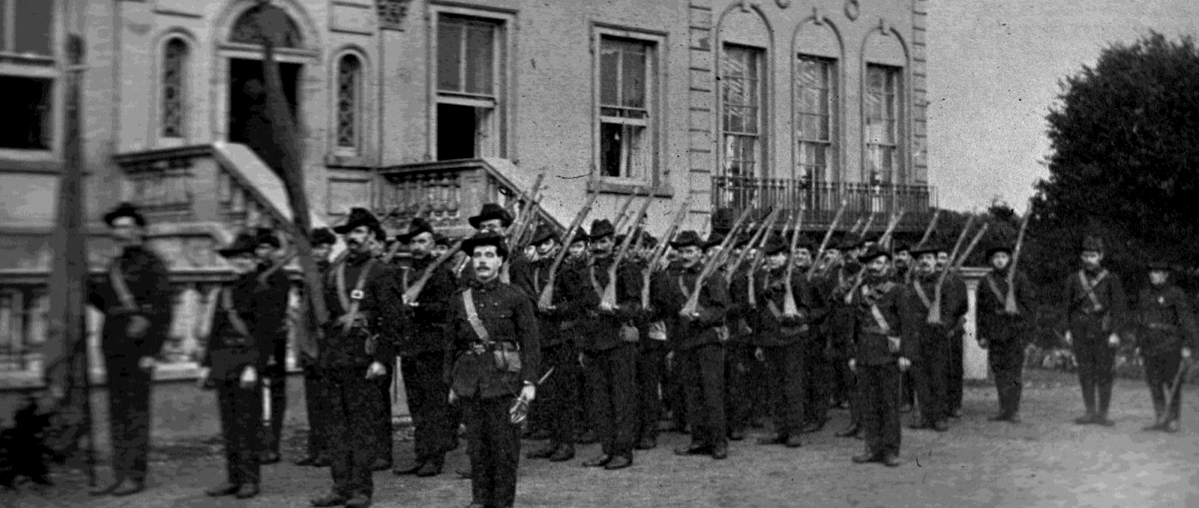
Joseph Connolly was born in 1893, the son of a swing bridge operator on the docks of Dublin and the grandson of a family evicted from their small farm near Straffan in Kildare during the days of the Land War in Ireland. Joseph, listed in the 1911 census as a messenger, would join the Dublin Fire Brigade in 1915. All of his siblings also developed radical republican politics, and all of his four brothers and his sister Kathleen joined the Irish Citizen Army. His brother Sean was the first Citizen Army member and the first republican volunteer to die during the 1916, when he was shot at City Hall, while his sister Katie is visible in the famous photograph below of the Irish Citizen Army at Croydon Park. She stands between the two flag bearers at the front of the group. The names of many of the siblings appear on a monument at City Hall in honour of the garrison there during the rebellion which they participated in, while Joseph Connolly himself fought at Stephen’s Green and the Royal College of Surgeons. Connolly left the fire station he worked in to fight in the insurrection, commandeering a car and using it to carry weapons from Liberty Hall to the General Post Office, before joining his ICA comrades in the Green.

The Irish Citizen Army at Croydon Park.

The Irish Citizen Army at Croydon Park.

Continue Reading »

All you punks and all you teds
National Front and Natti dreds
Mods, rockers, hippies and skinheads
Keep on fighting ’till you’re dead

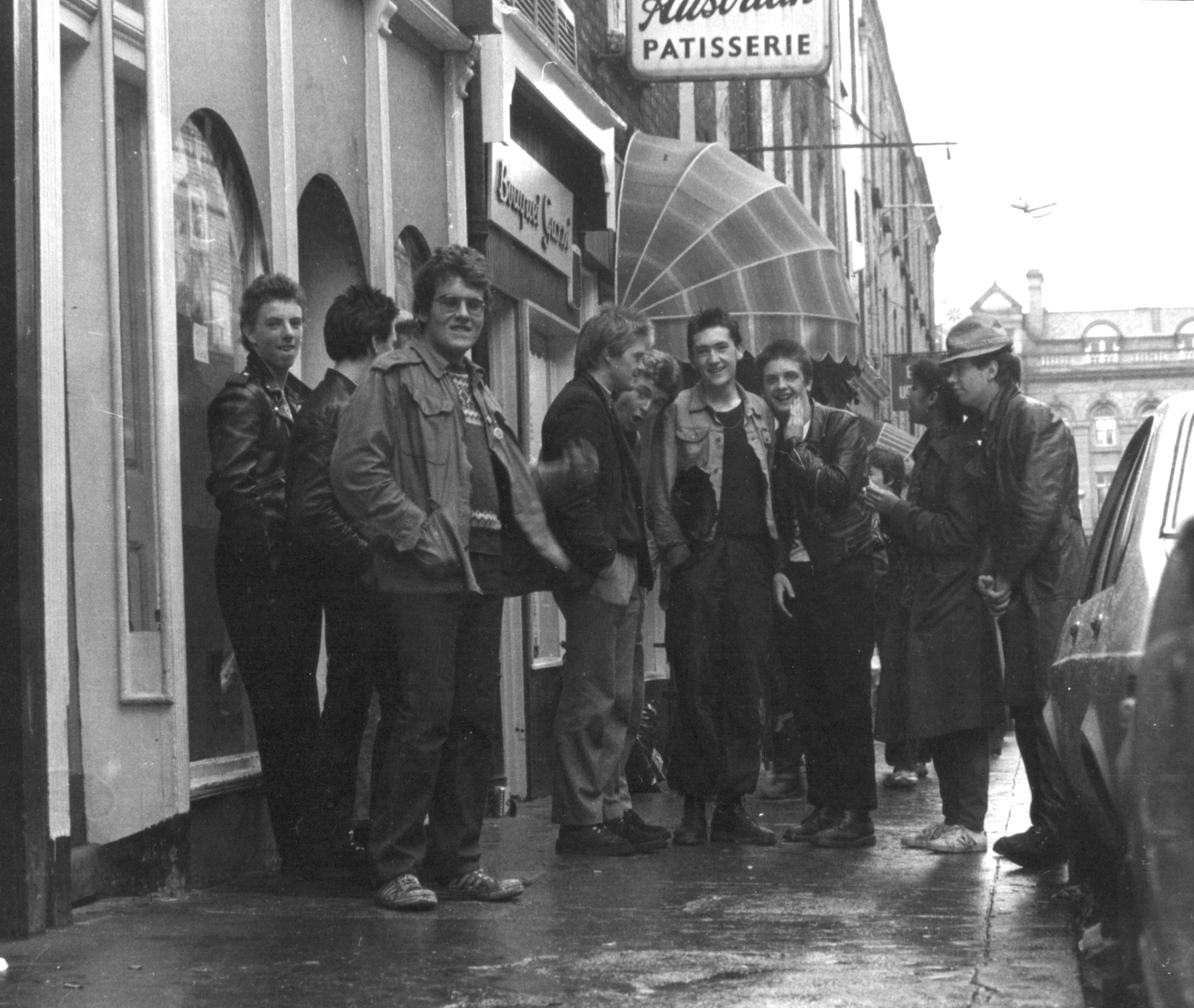
Talking to Come Here To Me!, Garry O’Neill (editor of Dublin street fashion photography book Where Were You?) summed up the violent mood that he felt growing up in Dublin in the mid-1970s:

To me, at that time, Dublin seemed a violent place. It was a social problem that existed before the punk explosion and the skinhead/mod revivals of the late 70s. Growing up in the city centre in the mid 70s there seemed to be a very tribal and territorial element to the violence that occurred. The city’s cold and grey complexion compounded the fear of walking through certain areas where you might be visiting a new girlfriend or friend, meaning that unless you took a bus, you had to safely navigate a way out of said area and through one or two more before finally reaching your home patch, thus avoiding some of the bootboy gangs and odd individuals that seemed to exist purely to take exception to the fact that “You’re not from around here” before meeting out a well placed box or boot to send you on your way.

In regard to its Punk and local live music scene, artist Garret Phelan has signalled out Dublin as being different to other cities in the South of Ireland:

It was bonkers (in Dublin). I would be shitting my pants going to some of these gigs. I was talking to a mate of mine who grew up very much within the music scene in Cork, and he never experienced the fear factor that you would experience in going to gigs here. Going to gigs here, you took your life into your hands.

At Ireland’s first punk festival (25 June 1977) in the canteen on UCD’s Belfield campus, a young fan from Cabra was stabbed twice after a short fracas broke during the gig involving eight or nine people. He later died of his injuries in a hospital in the early hours of the morning. Gavin Friday, lead singer with The Virgin Prunes, believes that it could have been ‘the first murder at a rock gig in the British Isles.

Garry O’Neill, whose eldest brother was at the gig, recalled:

It was the first time I’d heard of violence at a gig. The only other incident I knew about was the Bay City Rollers gig at the Star Cinema in Crumlin in 1974. When into the gig went gangs of girls from all over the city, leaving their gangs of boyfriends outside to run amok amongst themselves.

As the punk scene in Dublin grew in popularity and began to attract fans from all over the city, incidents of faction fighting and recreational violence grew. Some noticeable violence occurred at the following gigs:

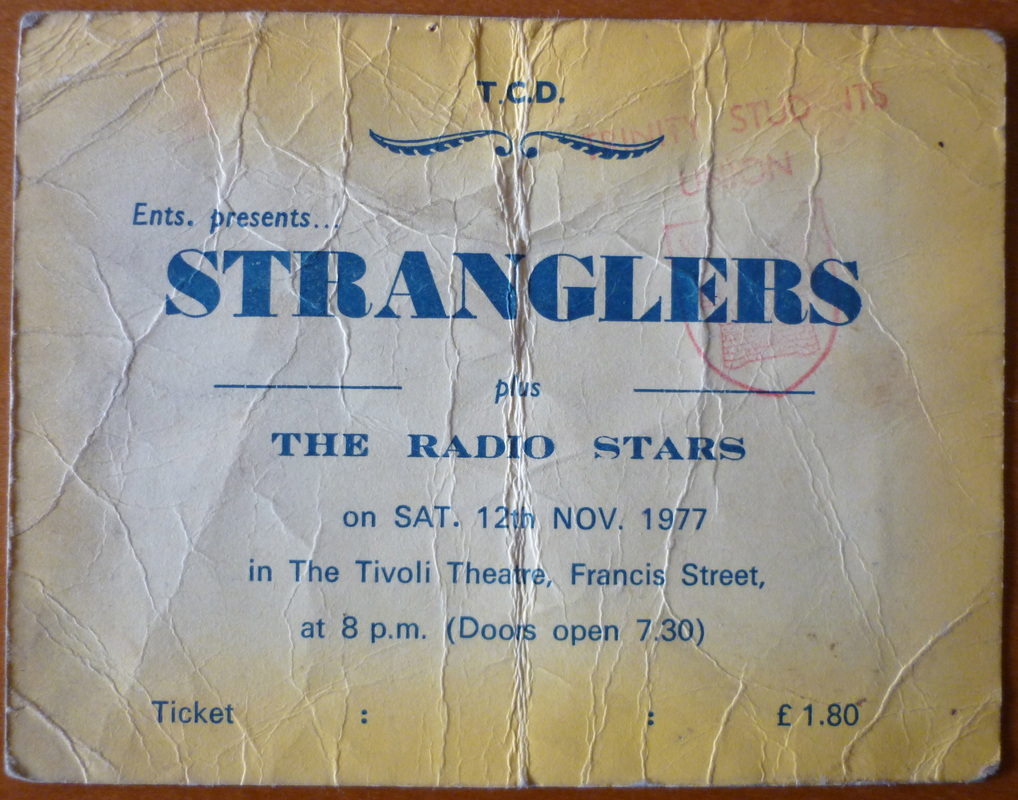
– 12 November 1977: The Stranglers (who didn’t show up), The Radio Stars and The Vipers in the Tivoli Theatre, Francis Street. Original guitarist for The Vipers Ray Ellis recalled:

There was a riot going on when we arrived – seats being ripped up (and) general mayhem. We got into it and the place went wild. While I was playing, a guy in the crowd pointed at my shoe and my lace was open … I gave him a nod and put my foot over to have him tie my lace. He grabbed my foot (and) started to pull me off the stage. The bouncers at the side curtain saw me disappearing but could not see why and thought … it was part of the act till they saw my face so they grabbed my head. There was a tug of was between them and the crowd. Happily they won and I was kept on stage and finished the set.
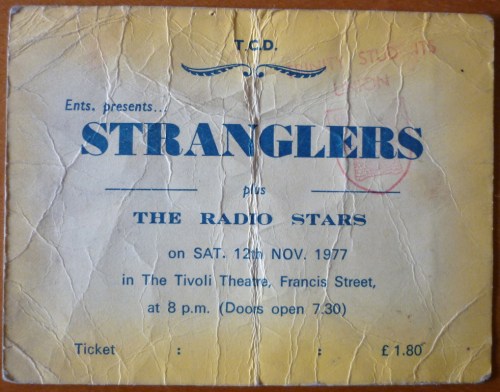
Ticket stub for The Stranglers gig who didn't turn up. Credit - U2earlydayz.com

Ticket stub for The Stranglers gig who didn’t turn up. Credit – U2earlydayz.com

– 12 October 1978: The Virgin Prunes were bottled off stage while supporting The Clash at the Top Hat, Dun Laoghaire. It was their second gig. Gavin Friday remembers:

We came on (with) Guggi wearing a tiny skirt and I had a plastic suit made out of raincoats, no jocks underneath, and pair of Docs. We’d only played two little gigs before that. Steve Averill from The Radiators From Space played synthesizer with us. The crowd just went apeshit. They thought Guggi was a chick. The adrenaline of all these people pogoing kicked in and I started jumping around, the next thing this plastic suit that me ma had made me split completely. I was standing there totally bollock naked, except for a pair of Doc Martins. I turned around and Guggi’s skirt had come off and you could see that he was a bloke. All hell broke loose, there were bottles flying, they were setting the curtains on fire. We were reefed off the stage by The Clash’s tour manager and fucked out the door. We had no money and had to walk with all out gear, back from Dun Laoghaire to Ballymun.

– 20 October 1978: Violence again at The Top Hat with The Jam.

– May 1979: Black Catholics trouble at a U2 gig (supporting Patrick Fitzgerald) in the Project Arts Centre. The late great Bill Graham of Hot Press wrote at the time:

Last weekend at the Project, U2, who were supporting Patrick Fitzgerald were targets of an unprovoked assault. As our man on the move Ross Fitzsimons reports a group arrived down & began taunting the band but the verbal displeasure escalated to direct and seemingly drunken action as critics jumped on stage, threw cider about & in one instance kicked U2 bassist Adam Clayton. After two numbers, the band quit the stage & the situation became so unruly that two Gardai had to called to escort the disruptors from the premises. That was Friday night but the following evening, the vendetta continued. One troublesome patron was speedily ejected by U2 manager Paul McGuinness but after McGuinness returned to the auditorium, a bruising skirmish ensued in the foyer & outside.
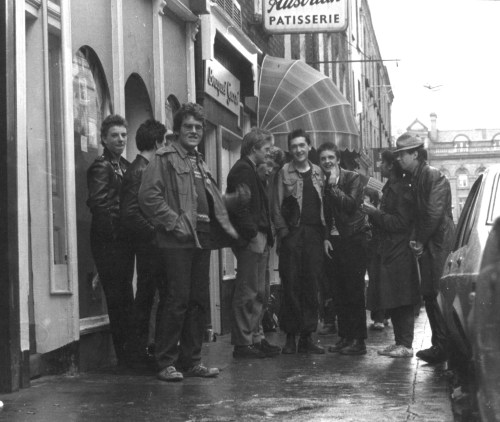
Black Catholics and friends. Advance Records by Stephen's Green. Credit - Patrick Brockleband via Eamon Delaney's blog

Black Catholics and friends. Advance Records by Stephen’s Green. Credit – Patrick Brockleband via Eamon Delaney’s blog

– 17 November 1979: Trouble at the Squeeze gig in Belfield, UCD.

– 1979: Brawls at a fundraiser gig for the UCD Student Union with DC Nein and The Threat at the Student Bar in Belfield. Maurice Foley, guitarist and the lead vocalist of The Threat, remembers:

I remember one time we played with DC Nien in Belfield… and there was a bit of trouble there… Whatever it was, someone from Hot Press came out to ask me about something… we had this old van that kept running out of water and all the lads were waiting to get in the back after the gig and then this car came in really close beside us and it nearly knocked a few of the lads over, they had to jump out of the way… and it pulled up outside the Students Union Bar… then they got out and they were all loud, they’d had a few drinks and the car could have been stolen ‘cos they were driving all over the grass and stuff… so our lads thought they’d go down and have a word with them in the car… so they ended up smashing all the windows in the car… some chains came out and that… so they drove off and went into the students bar and the students all came out with them and they started attacking… there wasn’t a large crowd of us either… so everybody crowded into the back of the van and we started the van to get it going, but it wouldn’t start… they all came close and started firing rocks, and the lads had to get out to chase them off again.

– December 1979: Fighting at The Members gig supported by Stiff Little Fingers in the Olympic Ballroom, Pleasant Street.

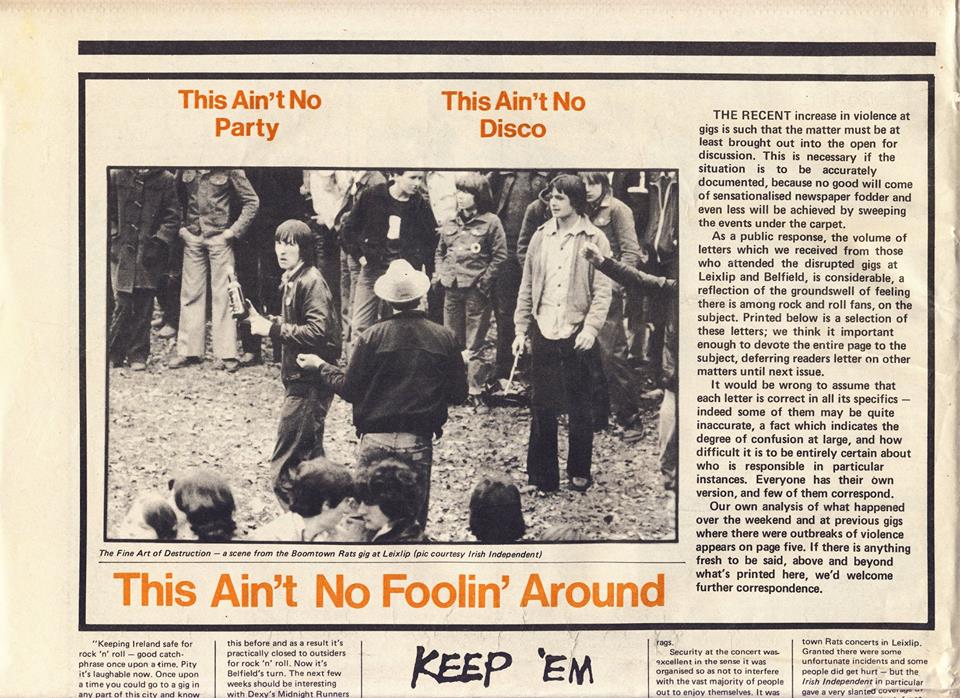
– 2 March 1980: 49 people were injured in the crowd trouble at The Boomtown Rats and The Atrix concert at Leixlip Castle.
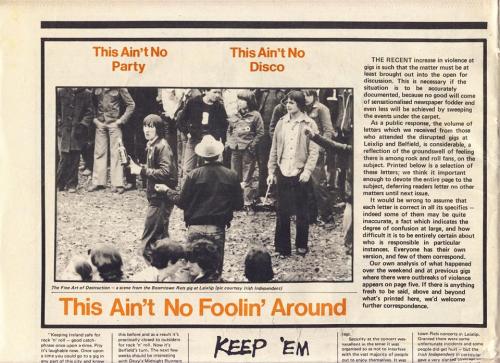
The Boomtown Rats at Leixlip Castle. Hot Press - X 1980. Credit - Where Were You? Facebook page

The Boomtown Rats at Leixlip Castle. Hot Press – March 1980. Credit – Where Were You? Facebook page

– May 1980: Aggro at The Rezillos, The Tourists and The Epidemix gig in Liberty Hall.

– 27 July 1980: Bottle throwing at The Police gig at Leixlip Castle.

– 6 October 1980: A hammer attack at a 4″ Be 2″‘s gig in Trinity College. The band featured John Lydon’s younger brother Jimmy. Lydon (aka Johnny Rotten) was arrested that evening for assault after a melee in the Horse & Tram pub, Eden Quay, Dublin, he was sentenced to three months in jail for disorderly conduct but was eventually acquitted on appeal.

– 8 October 1980: Four people were stabbed after The Ramones gig at Grand Cinema, Quarry Road, Cabra.

– 15 January 1981: Hectic scenes at The Specials and The Beat concert at The Stardust, Artane. Gang violence between the “Edenmore Dragons” from Raheny and the “Coolock Boot Boys” from Coolock marred the legendary gig. Edna on Brand New Retro described it as a ‘ bloodbath of a gig’ while Festeron on the TheSpecials2.com forum recalled ‘The gig .. was ruined by fighting between 2 rival Dublin gangs … They used the dance floor as a battleground that night despite Terrys best efforts to make peace. “‘

– 1981: The Outcasts gig in McGonagles saw the bar being raided by punters and fighting occurring inside and outside the gig.
Continue Reading »
When we think of the years of misery that we now know as ‘The Great Hunger’ from 1845 onwards, it is not necessarily Dublin we think of instantly but rather the impoverished and miserable west of the country, where death and emigration were both at their highest levels. Dublin has its own famine stories to tell however, and one of few places on the island of Ireland where the population increased, as the starving masses flocked into urban areas in search of employment and food.

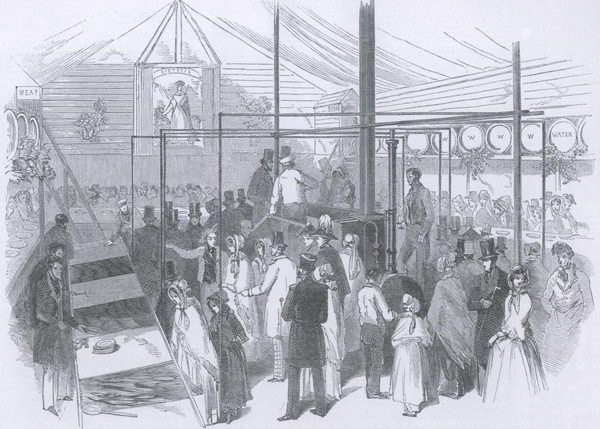
One of the most interesting little stories involving Dublin and the famine is that of ‘Soyer’s soup kitchen’, a temporary structure erected at Croppies Acre for the purpose of feeding the starving masses of the city. My interest in this story was sparked by an Illustrated London News illustration from April 1847, showing a showpiece soup kitchen that was opened in Dublin by a famed French chef, in an attempt at providing much-needed relief to the suffering Irish people.

The Illustrated London News, 17 April 1847. (Digitised by http://multitext.ucc.ie/)

The Illustrated London News, 17 April 1847. (Digitised by http://multitext.ucc.ie/)

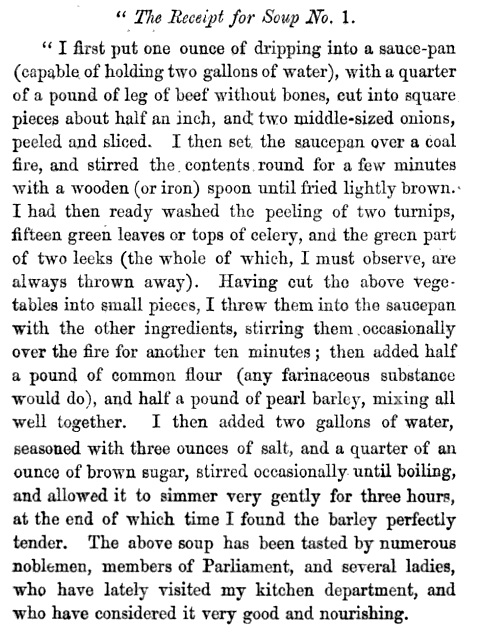
Alexis Soyer, born in 1809, was a high-profile French chef, indeed it has been argued he was among the first ‘celebrity chefs’. In The Great Famine and the Irish Diaspora in America, Jillian Strang and Joyce Toomre note that Soyer as an “affable and eccentric chef with a strong sense of showmanship and a flair for publicity. Soyer loved to dazzle, and to do the seeming impossible.” As chef of the Reform Club in London from 1837, Soyer’s food would have been enjoyed by members of the political class in Britain, though he was greatly moved by the reported suffering of the Irish starving workers and peasantry, and was approached by authorities with the aim of establishing a model soup kitchen in Dublin. Soyer had written to the press in England on the question of the misery in Ireland and what response should be taken to it. Soyer sent recipes to the press which he believed were sufficient to provide nutritional value for those in dire need. Below is one recipe which was published in The Times:

A recipe sent by Soyer to The Times newspaper in 1847.

A recipe sent by Soyer to The Times newspaper in 1847.

Soyer was capable of making up to 100 gallons of soup for under £1, a remarkable achievement, though the soup itself was often derided in the press, with some contemporary commentators noting it was not so much soup for the poor man as it was just poor soup.Regardless, Soyer was warmly welcomed in the Dublin of 1847,and within weeks a temporary structure was erected in front of the Royal Barracks for the task of feeding the masses. A wooden structure, described in contemporary reports as being about forty foot in length, the spoons within the structure were bound by chains to the bowls and tables, to prevent them from being stolen. Frank Hopkins has noted that:

The poor were admitted to the hall in shifts of 100 at a time by the ringing of a bell. When they had finished the soup, they were handed a piece of bread and left by the second door. The bowls were then cleaned and the next batch of people were summoned, again by bell.

The Lord Mayor and the Lord Lieutenant were among those to attend the opening of the soup kitchen, though a hugely controversial feature of the site was manner in which the elite of Dublin were charged to observe the spectacle, with historian Mike Cronin noting that one contemporary newspaper found this so ethically dubious they compared it with a day out at Dublin Zoo. The Freeman’s Journal had little good to say of the event, noting that “of all the impudent and insulting humbugs that ever were perpetrated against a suffering people, we hold the exhibition of yesterday, at the Royal Barracks, to have been the most outrageous.” The newspapers condemnation of Soyer’s experiment was straight to the point:

Five shillings each to see paupers feed!—five shillings each to watch the burning blush of shame chasing pallidness from poverty’s wan cheek!—five shillings each! when the animals at the Zoological Gardens may be inspected at feeding time for sixpence! We hope that, as these “five shillings each” were to be given in charity, the poor unfortunates who earned them with scalding tears and bitter humiliation and galling shame were not forgotten; and that on this occasion they were presented, when the performance was over, with something more than a “fine cake”!

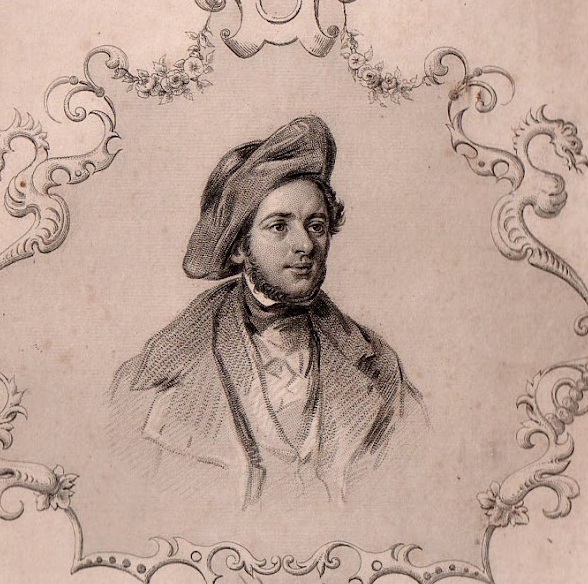
A contemporary illustration of Soyer.

A contemporary illustration of Soyer.

The kitchen served thousands of people on a daily basis during its short existence in 1847, with most accounts suggesting as many as 5,000 people a day were fed. While the health benefits of the soup was questioned, it remains one of the most interesting chapters in the very dark story of Ireland’s famine years. One nineteenth century source gives an interesting account of the reception Soyer received on returning home, though in retrospect perhaps a lavish gentleman’s dinner was not the most fitting of tributes in the context of the times. “On Soyer’s return from Dublin, another public dinner was given to him at the London Tavern, to commemorate his philanthropic….efforts for the relief of the starving Irish. More than 150 gentlemen sat down….It was a most fitting ovation to the unbought talents of the chef.”

Soyer died in 1858, and the Frenchman was buried at Kensal Green Cemetery in London. You can learn more about him here.


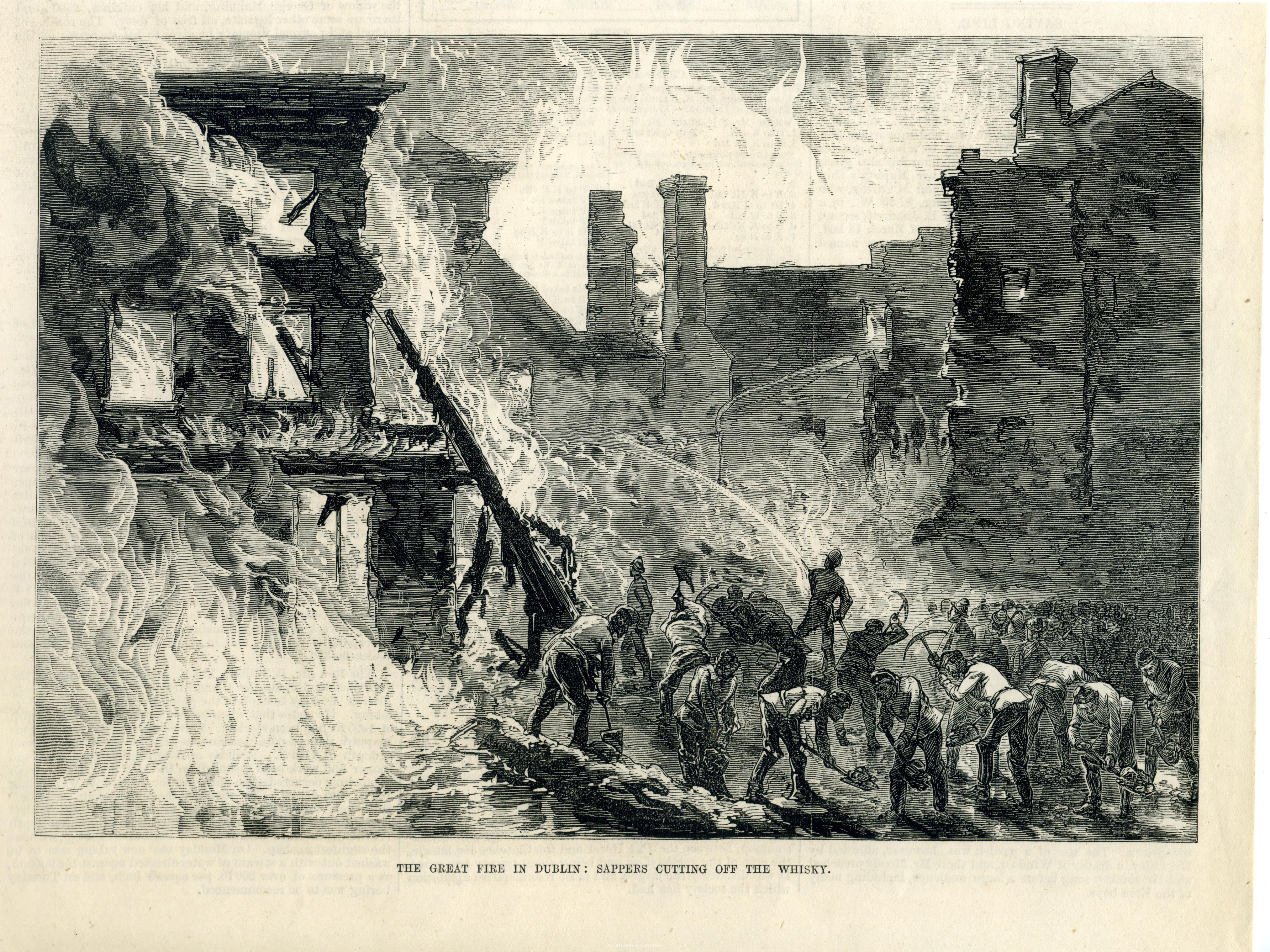
One of the most destructive fires in the history of the city occurred on 18 June 1875, when a disastrous fire in the Liberties area of the city saw burning whiskey flow through the streets of the area like lava. A malt house and a bonded warehouse went up in flames, leaving the burning liquid to flow down Ardee Street and Mill Street. The fire began just after 8pm, and contemporary news reports give an idea of just how much burning booze was involved, with the Illustrated London News reporting:

The fire was at Reid’s malt-house and Malone’s bonded warehouse, in the Liberties. The former had above £2000 worth of malt in it, and the latter, which immediately adjoins it, had 1800 puncheons of whisky, the property of various distillers, and worth £54,000.

The Illustrated London News reports the blaze. (Image digitised by South Dublin County Libraries, http://source.southdublinlibraries.ie/handle/10599/11048)

The Illustrated London News reports the blaze. (Image digitised by South Dublin County Libraries, http://source.southdublinlibraries.ie/handle/10599/11048)

The lava proved devastating to all in its path, at one point seeming to endanger both the Coombe Maternity Hospital and the Carmelite convent in Ormond Street. The wind blew the flames in the opposite direction from the convent, which was hailed by some as a miracle, though the fact many tenement homes were destroyed instead leaves any ‘miracle’ in doubt! In their history of firefighting in Dublin, Tom Geraghty and Trevor Whitehead recounted that the fire wreaked particular havoc on Chamber Street, with a pubic house disappearing in flames, while at another home on the street a wake was in progress, and “the occupants were forced to flee with the corpse to mourn elsewhere, while the home of the bereaved and their belongings were totally destroyed.”

A particular problem in this area of working class Dublin was the presence of quite a lot of animals. At the time animals were frequently to be found kept at the rear of tenement buildings, while horses were still utilised as a widespread form of transport in the city. The presence of confused animals running up and down the streets of the Liberties only added to the pandemonium of the situation, and when a tannery went up in flames the smoke and smell must have been overbearing. Luckily, the Watkins Brewery at Ardee Street somehow avoided both the flames and the flowing lava, though it goes without saying a brewery going up would have compounded an awful situation.

The Dublin Fire Brigade did arrive on the scene, under the stewardship of James Robert Ingram, the first Chief Officer of the brigade. We’ve featured Ingram on the site before. Amazingly given his contribution to public service in Dublin, and the fact the Fire Brigade he established is now over 150 years old, he is buried in an unmarked grave in Mount Jerome Cemetery. Ingram was something of a maverick – a Dubliner by birth, he had learned his trade in the New York Fire Department, and modeled his fledgling Dublin fire service on that of Manhattan, initially christening it the Dublin Fire Department and decking his men out in red shirted uniforms. On one occasion he dealt with a ship drifting into Dublin Port ablaze by ordering the Royal Navy to open fire on it and sink it into the bay, so it’s far to say Ingram was never bound by the restraints of conventional firefighting!
Continue Reading »

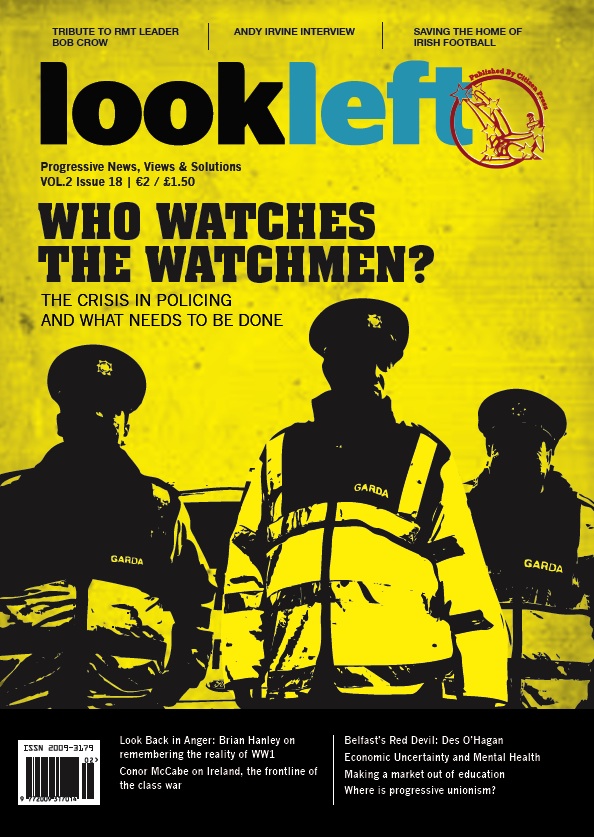
Front cover of Look Left, Issue 18.

Front cover of Look Left, Issue 18.

Issue 18 of Look Left is available now for €2 in Easons and other newsagents. I genuinely think this is the best issue in the last while.

Highlights:

The interview with Des O’Hagan, founding member of the Northern Ireland Civil Rights Association and the Workers Party, was fascinating. Involved in politics for over six decades, he talked about his family’s links to James Connolly, his spell in Crumlin Road Jail in the 1950s and the time he was told by the American consultate in Belfast that “No matter how long you live, no matter what changes take place in the United States, you will never get into America. You’re a communist”.

Historian Brian Hanley’s four-page piece on the the politics and commemoration of World War 1 hits the nail on the head on and is a welcome addition to current articles on the topic. Luke Fallon’s distressing illustration of the trenches helps to bring the piece to life.

The fascinating story of English footballer Robin Friday is told to Look Left’s Barry Healy by music journalist Paolo Hewitt. Friday, who only played top flight played professional football for three years, was known for his heavy smoking, drinking, womanising and drug-taking but scored goals for Reading that “are still considered amongst the best in English football”.

Yours truly has another piece looking at music and politics, this issue focuses on Paul Heaton of The Housemartins and The Beautiful South fame.

Folk musician Andy Irvine is interviewed and talks about his time in London in the late 1950s, travels to Eastern Europe in 1968 and his current work with the Musicians Union of Ireland.

[Andy Irvine’s ballad about the ‘Sydney Twelve’ – members of the Industrial Workers of the World (IWW) in Australia who were arrested and charged with treason for their active opposition to conscription during the First World War. Jim Larkin’s brother Peter and Thomas Glynn from Galway were two of those involved. The group were released after spending four years in jail.]

Last but not least Kevin Brannigan investigates the current threat to Dalymount Park in Phibsboro (“Dublin’s most historic football ground”) and how legislation in England and Wales has helped to save significant football stadiums from the developer’s wrecking ball.

Other pieces include:

Who Watches the Watchmen: The Gardai, drugs and the working class by Francis Devine
A Tribute to RMT leader Bob Crow by Sean Garland
Where is progressive unionism? by Rev. Chris Hudson
Short impressionistic view of a recent trip to Cuba by Vivian Cullen

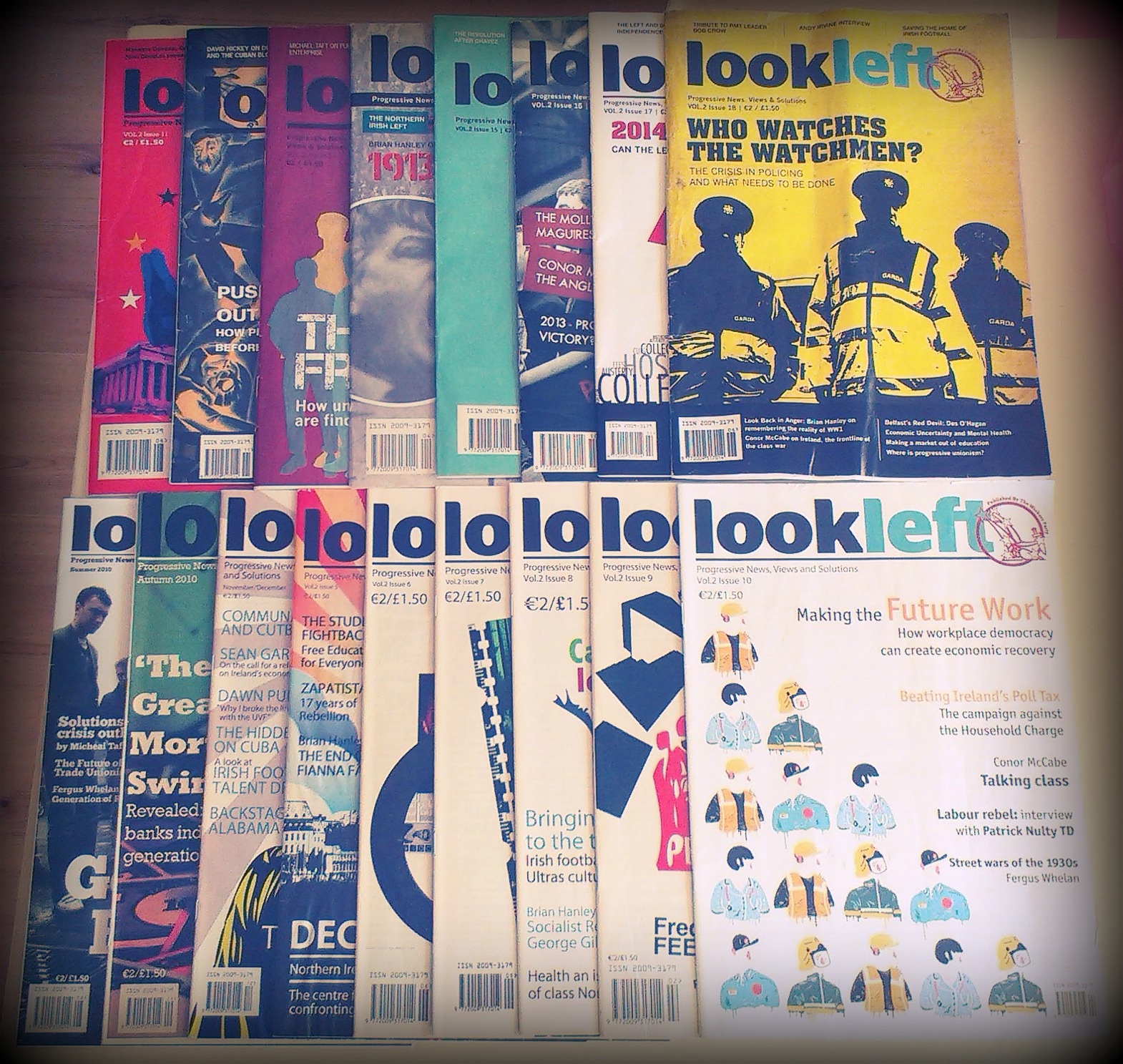
Issues 2 - 18 of LookLeft. Credit - Sam (CHTM!).

Issues 2 – 18 of LookLeft. Credit – Sam (CHTM!).