When I spoke to a healthy Philip Chevron in the lobby of Brooks Hotel in April 2012, I asked him about Paul Cleary and The Blades. He said with much enthusiasm:
I very much admired Paul Cleary. He appears to have retired from Irish music, which is a huge loss, but I don’t blame him. I know how difficult it is. I have utmost admiration for him and the band.
I don’t think anyone could have imagined that just over 18 months later, we would have tragically lost Philip to cancer at the age of 56 and that Paul would be coming out of perceived retirement to play with The Blades on stage for the first time in 27 years.
Both events are somewhat linked.
Paul explained to Pat James on Radio Nova last Sunday night (8th December) that Philip had invited him to play at his testimonial in the Olympia in August 2013. Paul sang two songs, a cover of ‘Enemies‘ by The Radiators From Space and his own ‘Downmarket‘. I’m not 100% sure but I believe this would have been the first time he had played a Blades song in public since March 2002 and before that January 1986.
Eamon Carr summed it up so well during the week when he said:
…the audience agreed on two things. One: the spirit of Philip Chevron would live forever. Two: Paul Cleary had stepped out of some ghost estate of the heart to save Ireland in a time of crisis.
In the same radio interview on Nova, Paul explained that the dignity of Philip and his close family and friends on that special night in the Olympia made a huge impact on him. While he admitted that the two weren’t particularly close friends, he had met Philip at various events down through the years and always liked him. He knew that Phil would have loved to have been able to play himself on the night if he had had the strength. Philip’s emotional testimonial concert, at which the crowd gave Paul such an amazing reaction, was one of the reasons that spurred on Paul to get the The Blades back together.
Besides sharing the same initials (ignoring Philip’s real surname of course), I believe Paul Cleary and Philip Chevron shared quite a bit in common.
Both were proud Dubliners and gifted songwriters who were able to write fantastic love songs as well as tackle serious political issues in their work. Born a couple of years apart, the explosion of punk changed both their lives. Philip formed The Radiators from Space at the dawn of punk in 1976 while the younger Paul had to wait until 1977 to get The Blades together. Both bands received widespread critical acclaim but found little financial success and their first bands suffered from record company woes.
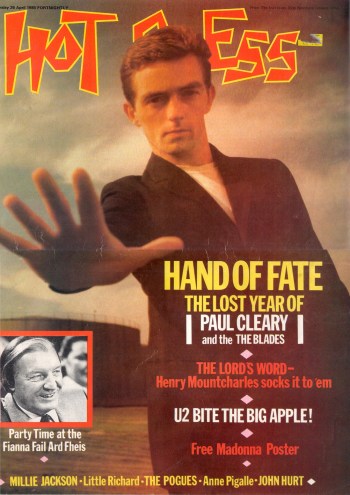
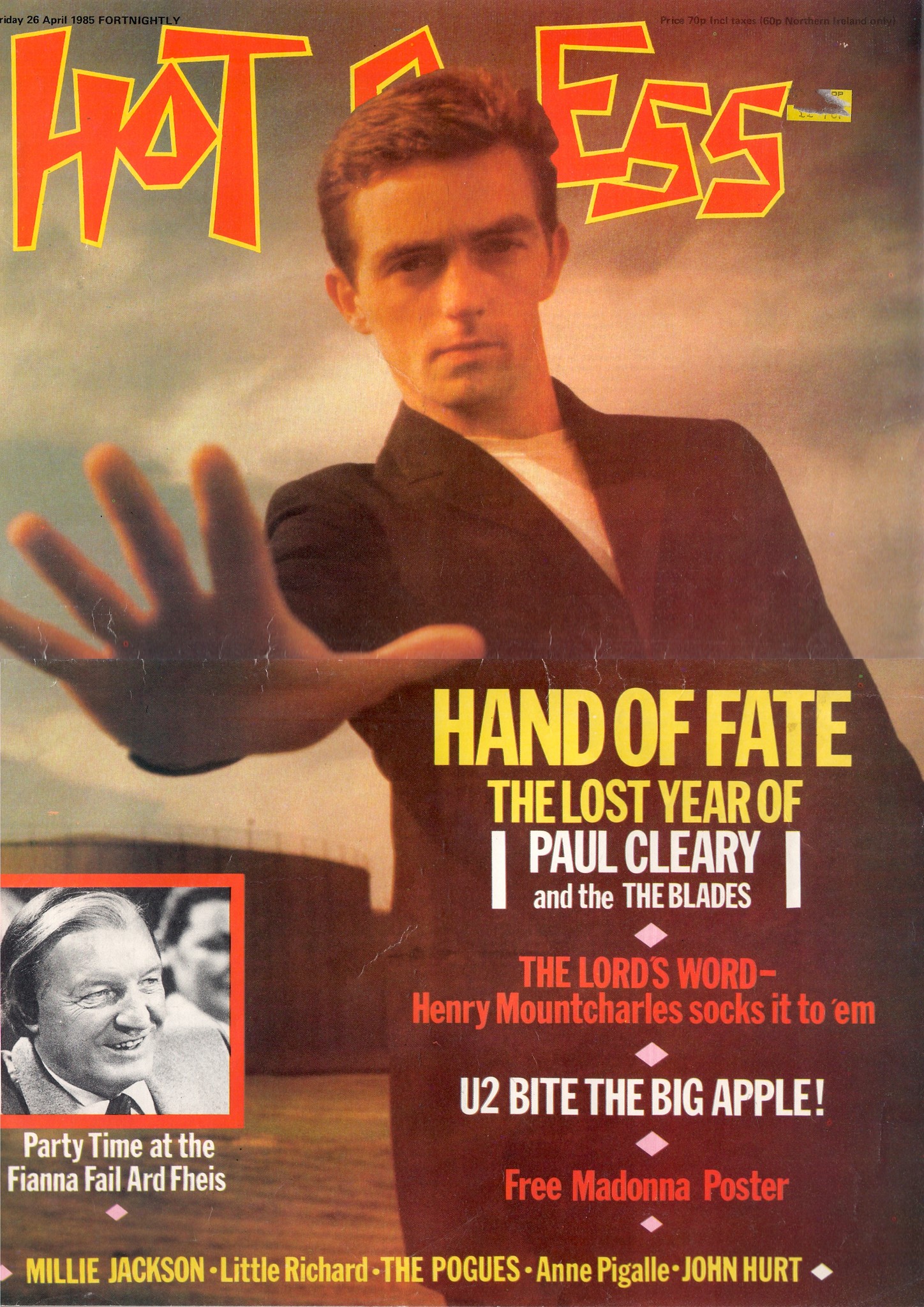
Paul Cleary, Hot Press, 1985.
On the other hand, their song writing was very different. While Philip was strongly influenced by the theatre, the literature of James Joyce and cabaret stars like Agnes Bernelle, Paul’s Dublin had a lot more to do with James Plunkett and Sean O’Casey. It was kitchen sink realism with a Dublin twist.
So while only Philip Chevron could write:
We’ll even climb the pillar like you always meant to,
Watch the sun rise over the strand.
Close your eyes and we’ll pretend,
It could somehow be the same again.
I’ll bury you upright so the sun doesn’t blind you.
You won’t have to gaze at the rain and the stars.
Sleep and dream of chapels and bars,
And whiskey in the jar. (Song of the Faithful Departed)
Equally no-one could come close to matching Paul Cleary’s bitter description of a city torn apart by unemployment and monotony:
On a rainy afternoon
On a gambling machine
Same old jukebox, same old tune
It’s hard to break this old routine
Everything’s black and white and grey
Living from day to day to day
It’s a fatal resignation, when there’s nothing left to hope for
In a hopeless situation
I’m not waiting at an airport
I’m not waiting at a station
I’m standing at a bus stop (Downmarket)
In the bar of the Herbert Park hotel on 20th November, I spent a very enjoyable hour talking to Paul Cleary. While he sipped soda water, we spoke about football, his early musical influences, some aspects of The Blade’s career, his political motivations, his song lyrics and his plans for the future.
As is often the case with these kind of things, I believe our conversation was only really beginning to flow properly just as we had to wrap things up. But Paul is a very busy man these days and he had at least another interview if not two lined up immediately after mine. I was just chuffed that he had managed to take time to speak to me. Come Here To Me! is not a national newspaper or a music magazine. We’re just a small Dublin-focused social history blog with a loyal community of readers. I’ll always thank him for that chat and to his long-time fixer and close friend Elvera Butler of Reekus Records for sorting everything out.
In as much as possible, I wanted our chat to be a informal conversation than a rigid interview. Here it is…
I thought I could break the ice by talking about football. I heard you were quite a decent player in your younger days?
“Yeah, I played seriously until I was about 14 or 15. I was good enough to play for Dublin schoolboys. A scout from Man United came down to my parents and they were going to send me over for a trial but a few weeks before I was supposed to go over, I pulled a ligament in my ankle.”
And you were a Shamrock Rovers fan from day one?
“Yep, my Dad used to bring me to Milltown as a kid. Frank O’Neill up front. Mick Leech on the wing. We’d walk up from Ringsend most times. That was quite the walk! Though sometimes we’d get the ‘football’ double decker bus from town. We’d go home after the match and listen to Brendan O’Reilly reading out the sports results. That was the only way we’d find out about the other games that night. Then from around the age of 14 or so, I started going with a gang of mates to the matches.”
Was there much bootboy trouble on the terraces at this point?
“Oh there was. An awful lot. Rovers fans did have a bit of a reputation then. We’re talking late 1960s, early 1970s. My first floodlight game was Rovers-Bayern Munich in Dalymount. 1-1 I think. 1966 if I can remember correctly. I would have been about 7 or 8.”
Did music become your next passion after football or was there a bit of an overlap?
“There was an overlap. My Dad was really into music. He had a very eclectic taste. He was into classical, jazz and pop. One day he went out to get a [Felix] Mendelssohn album but came back with Bad Company’s ‘Running With The Back’ [1976]. He also had all the Beatles albums plus Buddy Holly, Bill Haley and other Rock ‘n’ Roll stuff too.”
Continue Reading »













 Click on the book for more.
 Click on the book for more.
 Donal
Donal Ciarán
 Sam
Sam


 Come Here To Me!