Feeds:
Posts
Comments

In February 1918, thousands of Dubliners celebrated the Russian Revolution at a packed meeting in the Mansion House. Indeed, the attendance was so great that it spilled out of the Mansion House, with many more filling parts of Dawson Street, with an attendance of up to 10,000 people.

Some of the most interesting characters of the time, such as Maud Gonne, Countess Markievicz and others spoke, and ‘The Red Flag’ was sung with gusto. The song, which has become something of a socialist anthem, was written by Irishman Jim Connell in 1889. Jim Connell was awarded the Red Star Medal by Vladimir Lenin in 1922, which gives an indication of the importance of the song to the socialist movement. While much has been written of anti-communism and anti-socialism in early twentieth century Ireland, this incredibly well-attended meeting is largely forgotten. The meeting was chaired by William X. O’Brien, who had been instrumental in the trade union movement during the Lockout of 1913.
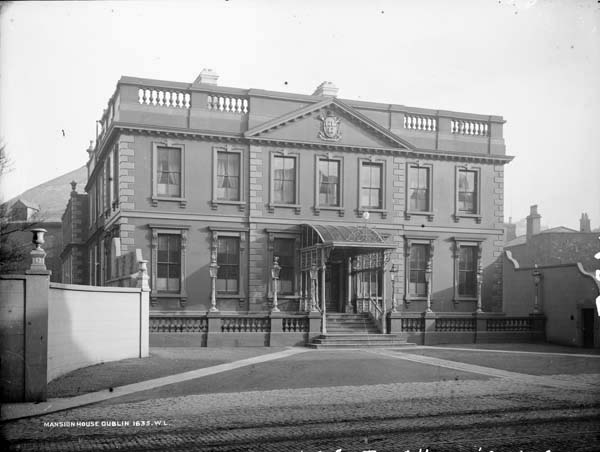
A historic image of the Mansion House (French Collection, National Library of Ireland)

A historic image of the Mansion House (French Collection, National Library of Ireland)

The meeting took place on 4 February 1918, and the Irish Independent proclaimed the following day that:

The scene in the Round Room was an extraordinary one. The passage up the centre of the spacious and crowded floor was occupied by a dense body of men standing. Near the front of this body was borne aloft a red flag, and during an interval in proceedings, while a collection was being taken up, the song ‘The Red Flag’ was sung.

A resolution was passed at this meeting that was put forward by Cathal O’Shannon, with newspaper reports noting that it expressed that the “people of Dublin were at one with the Bolsheviks”, and “maintaining that the Russian interpretation of the democratic principle was the only one that would be acceptable to the people of Ireland.” O’Shannon, from Antrim, was a trade unionist and republican who had spent time in Richmond Barracks, Frongoch and Reading jail in the aftermath of the Easter Rising, despite not seeing action during the rebellion. There were several other republicans who had either fought in the Rising or been interned in its aftermath at this meeting, including Dr. Kathleen Lynn of the Irish Citizen Army, who stated that some people were shy to acclaim the Russian revolution for fear of being labelled anti-clerical. Lynn was a tireless campaigner for the poor of Dublin and the medical well-being of children, and established the Saint Ultan’s Hospital for Infants in 1919.

The media noted that some Russian Bolsheviks were on the platform at this meeting, alongside leading lights of the trade union movement. Thomas Johnston of the Labour Party proclaimed that “the cry for bread was at the bottom of all successful revolutions”, to loud applause.

Dr. Kathleen Lynn, shown her with Madeline ffrench Mullen.

Dr. Kathleen Lynn, shown here with Madeline ffrench Mullen.


Patrick Coates also spoke at this meeting, describing himself as a revolutionary socialist, he drew a huge cheer by noting that he wasn’t sure if this was the first time ‘The Red Flag’ had been sung in the Mansion House, but that “it would not be the last.” He later stated that when Ireland received her liberty the people would transform the Viceregal Lodge into the headquarters of the Transport Workers’ Union!

Countess Markievicz rose to offer congratulations to the Bolsheviks “on behalf of the Irish Citizen Army”, and in the aftermath of this meeting thousands would march through the city of Dublin, though interestingly there were no reports of any confrontation between this demonstration of solidarity with the Russian revolution and anti-socialist elements.

Only weeks after the meeting, The Irish Times warned that Bolshevism was creeping into Ireland, noting that:

They have invaded Ireland, and if the democracies do not keep their heads, they may extend to other countries in Europe. The infection of Ireland by the anarchy of Bolshevism is one of those phenomena which, though almost incredible to reason and experience, are made intelligible by the accidents of fortune and human folly.

This is the third post on the website looking at cartoons printed in the Sunday Independent during the course of the 1913 Lockout. Part 1 can be read here, while the follow-up post is here.

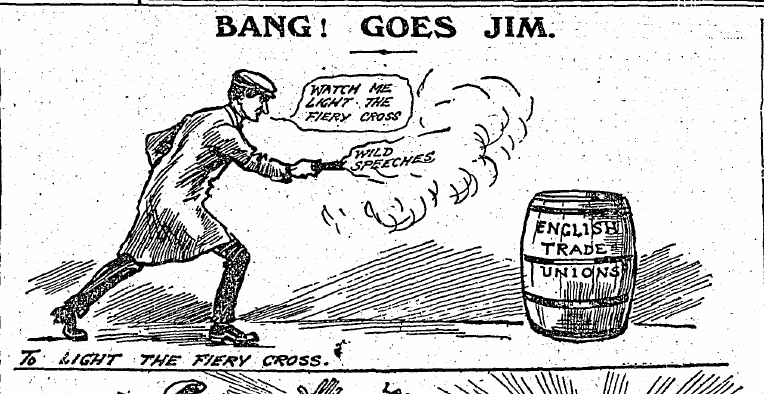
The cartoonist often poked fun at Jim Larkin’s expense, especially as the dispute dragged on, and this cartoon shows him and William O’Brien, another leading trade unionist of the day. Larkin would go to England during the dispute to drum up support among the English workers and trade union leadership, referring to this as the Firey Cross campaign. The mission was to instigate solidarity strikes in Britain which could be of assistance to the cause of the Dublin workers, but Larkin failed in this task. Here we see a match, representing the English union movement, with Larkin bemoaning the fact “it will only strike on its own box”.

23 November 1913. Sunday Independent.

23 November 1913. Sunday Independent.

Larkin’s attempt to ‘light’ the Firey Cross was ridiculed the following week once more. Larkin was shown firing at a barrel, which in another cartoon below was shown to explode with ‘trade union snubs’ and ‘hostile public opinion’ and the like. Mocking Jim, the paper noted on its frontpage that Larkin was a “Liberty Hall autocrat” who was “looking for trouble” in England.

30 November 1913 (Sunday Independent)

30 November 1913. Sunday Independent.

One cartoon which did not feature in either post to date and really should have is this powerful image, showing a Catholic priest rescuing a child from ‘socialism’.

26 October 1913. Sunday Independent.

26 October 1913. Sunday Independent.

The cartoon is a reference to the Save the Kiddies campaign, essentially an attempt to send the children of locked out workers to England during the labour conflict. The intervention of the church in this dispute was reprehensible, physically preventing working class children from leaving the city. The attitude of the church hierarchy was captured best in a letter from Archbishop Walsh to the media in which he targeted the mothers of the children and claimed

.

I can only put it to them that they can be no longer held worthy of the name of Catholic mothers if they so far forget that duty as to send away their children to be cared for in a strange land, without security of any kind that those to whom the poor children are to be handed over are Catholics, or, indeed, are persons of any faith at all.

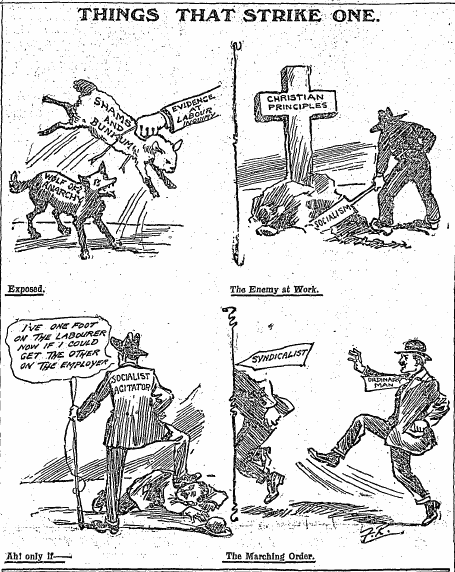
This series of cartoons featured on the front page of the Sindo on 5 October 1913. ‘Socialism’ is shown burying ‘Christian Principles’, while the ‘Ordinary Man’ is showing telling the ‘Syndicalist’ where to go. Both of these were common themes in the Indo cartoons, the idea that socialism was somehow anti-Catholic or anti-Irish, and the idea that the ‘ordinary people’ of Dublin would be the ones to ultimately tell Larkin and his followers they were not wanted.

5 October 1913. Sunday Independent.

5 October 1913. Sunday Independent.

On 19 October, this series of cartoons appeared. One shows the ‘Sympathetic Strike’ represented in the form of a hot air balloon. This tactic was central to Larkin’s political ideas, and involved bringing out workers not directly involved in a dispute in solidarity with those who were. It is clear Murphy’s paper believed that the lockout was breaking this tactic and Larkinism in general. The bottom right cartoon gives some commentary on the housing crisis, insisting that “a helping hand” was needed to provide better housing for the working class. The horrific Church Street collapse in September 1913 ensured housing was a topic on the lips and minds of many in the last four months of 1913.

19 October 1913. Sunday Independent.

19 October 1913. Sunday Independent.

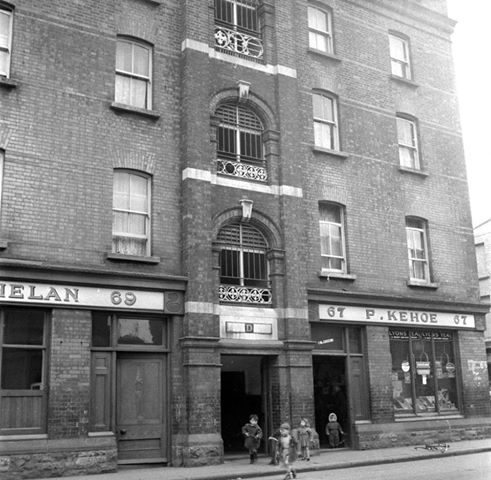
A historic image of Benburb Street (Via 'Dublin Tenement LIFE')

A historic image of Benburb Street (Via ‘Dublin Tenement LIFE’)

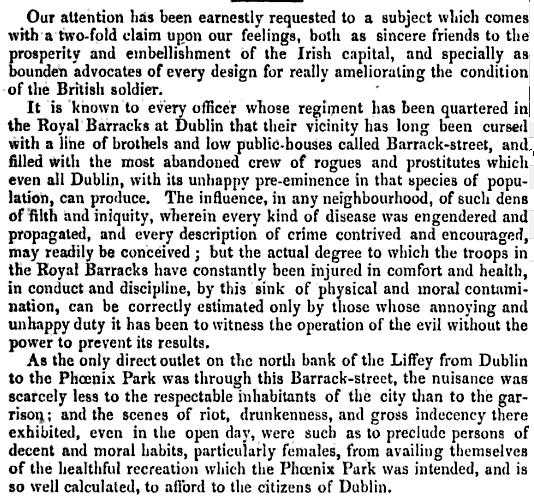
Recently while researching tenement Dublin and the history of prostitution in Dublin, I stumbled across an 1837 publication The United Service Journal. Speaking about the area around the Royal Barracks in Dublin, the publication noted that “scenes of riot, drunkenness and gross indecency” were common place, and that the area was home to many prostitutes but lacking in “persons of decent and moral habits” . Royal Barracks is Collins Barracks today of course, and Barrack Street has since been renamed Benburb Street.

Benburb Street was the location for the first Dublin Corporation housing scheme in the late nineteenth century. Shortly afterwards, the Corporation also constructed public housing on Montgomery Street, in the heart of what was known as ‘The Monto’. By attempting to keep public housing cheap, the Corporation ended up constructing homes in areas with long standing social problems. I’ve long had a personal interest in Benburb Street as my great-grandmother lived in a tenement on that street, and in-time we will look in detail at the first Corporation housing schemes in Dublin on the website.

Here is the extract:

Excerpt from 1837 publication.

Excerpt from 1837 publication.

The publication is available to read here.

The centenary of the Church Street disaster is fast approaching, and will rightly be commemorated and remembered as one of the most tragic incidents during the course of the 1913 Lockout. On September 2nd 1913 two tenement homes collapsed to the ground, killing seven working class Dubliners, with children among the dead. While this tragedy did spark a very significant housing inquiry, tenement collapses remained all too common in Dublin in the decades that followed. This is the first of a number of posts in the weeks ahead looking at tenement disasters in Dublin.

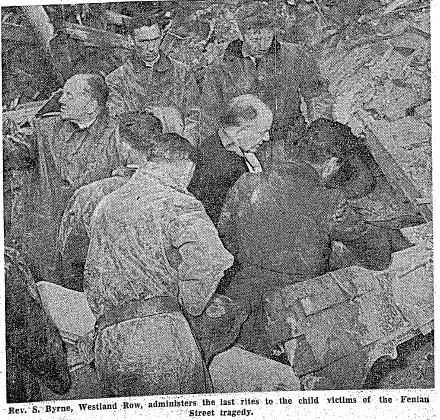
The scene on Fenian Street following a tenement collapse, 1963.

The scene on Fenian Street following a tenement collapse, 1963.

Two tenements collapsing within weeks of each other in June 1963 forced Dubliners to re-examine the housing situation in the city, and sparked a huge inquiry into housing in the city which delivered many shocking finds. It also saw hundreds of families moved out of their homes at short notice, for fear further collapses could be imminent. The panic began on June 2nd, when two elderly Dubliners were killed on Bolton Street when a four-story tenement home collapsed, trapping them under the rubble and wounding seven other occupants of the house. The destruction to the tenement home was clear from this shocking image featured in The Irish Times. Incredibly, the paper reported that when firefighters arrived on the scene, they could hear Billy, a pet bird on the fourth floor of the house, still “singing in the sunshine in his cage” in a corner that had withstood the collapse.

The destruction on Bolton Street (Irish Times)

The destruction on Bolton Street (Irish Times)

The collapse of this tenement home sparked a real fear for other properties in the area, and many people came forward to the Corporation believing that their own homes could be in danger of collapse. Only days later it was being reported in newspapers that two families living in a home less than 100 yards away were moved to Cabra and Fatima Mansions. This evacuation of dangerous properties continued in the weeks that followed, and by June 22nd the media were reporting that since the Bolton Street disaster “156 houses have been evacuated because they were in a dangerous condition. This has necessitated the rehousing of 520 families.” It was reported that an astonishing 223 families were still awaiting rehousing, and it was clear the Corporation were unable to provide housing with the required urgency, rehousing people in some very unlikely locations. It is noted in a history of the Dublin Fire Brigade that Dublin’s fire service “were forced by a panicking Corporation to allow tenants into the former married quarters in both Dorset Street and Buckingham Street fire stations.”

The Bolton Street collapse was followed on June 12th by a similar incident on Fenian Street, this time claiming the lives of two young children. Marion Vardy (9) and Linda Byrne (8) were the victims of that incident, as two three-storey buildings toppled onto the street. There were scenes of anguish on the streets at the time, with the Irish Press writing that “Hundreds of Dubliners, many visibly crying, crowded the narrow streets leading to the scene of the collapse as firemen and Gardaí frantically shoveled bricks, rubble and mortar aside to reach the victims.” The two young girls, described by their loved ones as inseparable, were returning home from buying sweets at a corner shop. One man, Andrew Dent, jumped for his life from the collapsing tenement.

Tragedy on Fenian Street (Irish Times)

Tragedy on Fenian Street (Irish Times)

Only days after this second tragedy, a third was narrowly avoided. The top storey of 36 York Street collapsed shortly after 1pm on June 16th, thankfully after families had been evacuated from the building but one man who had returned to collect belongings from the building left it literally moments before it collapsed. He would tell reporters “I had just closed the front door when I heard a resounding thud as bricks and mortar came crashing through the landing in a cloud of dust.”

The response to all of this was an inquiry launched at City Hall. Some Dubliners were skeptical of what this inquiry could achieve, with reports of one group of protesters marching onto City Hall behind placards telling the city not to wait until their homes too had collapsed around them. Exceptionally bad weather at the time was cited as a factor in the June collapses, and other collapses were discussed which had not made the news to the same extent as those with tragic consequences. On the first day of the inquiry a story was told of an Inspector who had left a house at Buckingham Street “white-faced” and horrified by the condition of the structure, which was immediately evacuated. The inquiry was told that there had been a partial collapse of this empty property on June 11th, despite immediate emergency work.

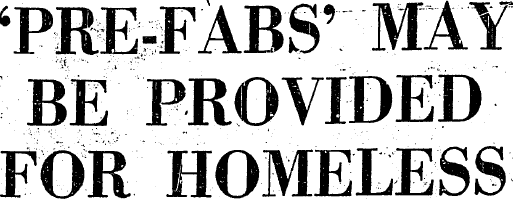
Irish Independent report on the response to the disasters.

Irish Independent report on the response to the disasters.

It was reported in July that the Corporation was seriously considering prefabs as a response to the housing crisis in Dublin, and that “red tape is being slashed to overcome this emergency.” The Irish Independent reported that Griffith Barracks was among the locations housing those moved from tenement dwellings during the emergency period.

Erika Hanna notes in her recent study of urban change in Dublin in this period that in the eighteen months that followed the Fenian Street disaster “around 1,200 of Dublin’s Georgian terrace houses and mews were destroyed, mainly in the north and east of the city.” What were the long-term consequences of these tragedies? The Ballymun Housing Scheme and other such plans which would follow were, in a way, a response to the urgency of the problem in Dublin city centre. These incidents were a tragic reminder that fifty years after Church Street, Dublin’s working class were still to be found living in houses unfit for human habitation.

Jim Larkin at the windows of Liberty Hall during the Lockout.

Jim Larkin at the windows of Liberty Hall during the Lockout.

Yesterday I was on Newstalk discussing a peculiar incident that occurred early on during the 1913 Lockout. You can listen to the audio here. Previously featured on the site, a game between Bohemians and Shelbourne was targeted by Jim Larkin as he believed there to be scabs playing for each team. I was joined by Will Irvine, the co-director of ANU Productions. ANU are doing great work with their Dublin Tenement Experience (Sadly coming to an end soon) and this incident features in their performance. A sound clip from the Tenement Experience was featured in the piece.

The opening scene, in what was to prove a prolonged and sanguinary drama, was enacted in the Ringsend district. In his speech on Friday night Mr. Larkin had referred to a football match which was to be played on Saturday in the Shelbourne Ground at Ringsend between two local clubs. ‘ There are ” scabs ” in one of the teams, and you will not be there except as pickets,’ he said, in language whose menacing character was understood by those who heard him. In obedience to the implied command, a large body of members of the Transport Workers’ Union gathered at the time announced for the match near the entrance to the grounds.

-From Arnold Wright’s Disturbed Dublin.

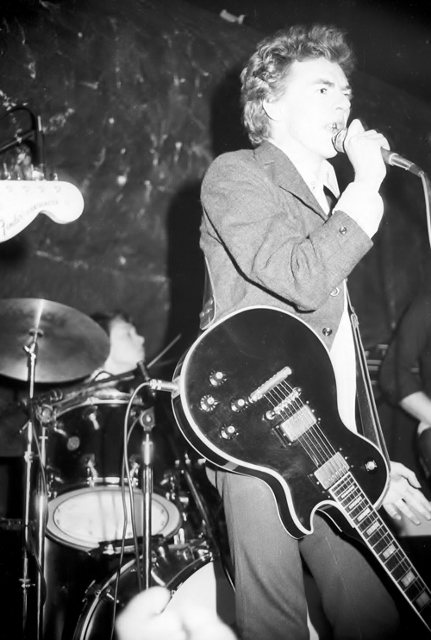
Phillip Chevron at McGonagle's. Photo - Patrick Brocklebank. (From 'u2theearlydayz.com').

Phillip Chevron at McGonagle’s. Photo – Patrick Brocklebank. (From ‘u2theearlydayz.com’) January 1979.

In the run up to Philip Chevron’s testimonial tomorrow night, a number of pieces have been published in the Sunday Independent, The Herald and Examiner. (It’s a pity the Irish Times didn’t do any feature).

Declan Lynch – ‘ Truly, there’s nobody like Philip Chevron‘ in the Sunday Independent on 3 August 2013.

It also brought into play Phil’s pursuit of great music in every form imaginable, his gifts as a collector and an archivist. I’ve always felt that he could be a brilliant journalist too, ideally writing about the theatre on which I believe he may well be one of the greatest living authorities.

Barry Egan – ‘Diamond in the Crown‘ in the  Sunday Independent on 11 August 2013.

Time spent with Philip is a leap into the exhilarated air of a life living through rock ‘n’ roll, punk, balladry and poetry and into graciousness with which the wisdom, knowledge and humour gathered up along the way is imparted. Philip does all that to the max. – Fiachna Ó Braonáin (Hot House Flowers)

Eamon Carrr – ‘It’s about time we all saluted the living genius of Philip Chevron‘ in the  The Herald on 21 August 2013

The fact that Philip … has never been nominated as a member of official Ireland’s cultural elite is a savage and humiliating indictment of that body … Philip gallantly says the song gave him the impetus to finish Ghostown, arguably the finest Irish rock album… ever.

Ed Power – ‘Philip Chevron — a Radiator and a Pogue‘ in the Irish Examiner on 20 August 2013.

The Radiators from Space are regarded as one of the great lost bands of punk, but they had a reasonable profile during the heyday of the scene. Several of their singles were playlisted by the BBC and they were supported, with varying degrees of enthusiasm, by the UK rock press (whose approval was essential). Punk arguably had a greater impact in Ireland than anywhere else.  “If you look at what happened in the country between ’76 and ’81, the change was immense. It had a massive resonance. Hot Press magazine was founded. 2FM started up, in response to the pirate stations. And you had all these bands coming along. Punk changed a lot.”

Finally, Pete Holidai and Steve Rapid (The Radiators from Space) and Cait O’Riordan (The Pogues) spoke on RTE Radio 1 , along with contributions from Shane MacGowan, on 21 August. You can listen back here.


Philip Chevron, late 2000s.

Philip Chevron, late 2000s.


Note 1: Previously we’ve looked at the city’s oldest restaurants, the first Chinese restaurants, the first Italian restaurants, the first pizzerias and the first Indian restaurants.

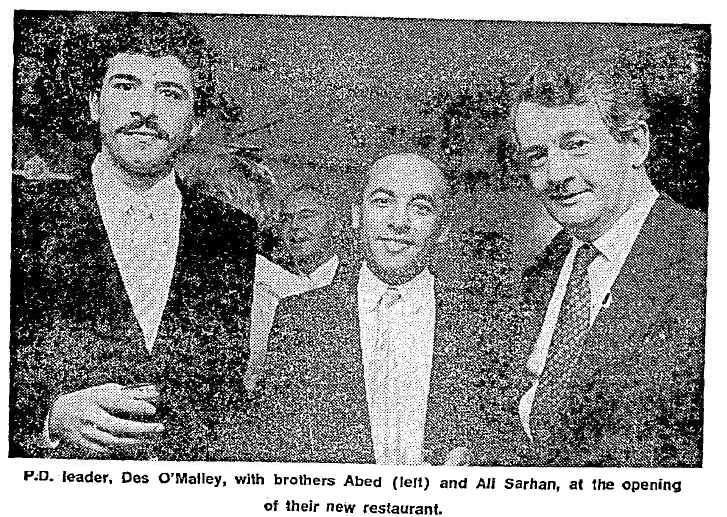
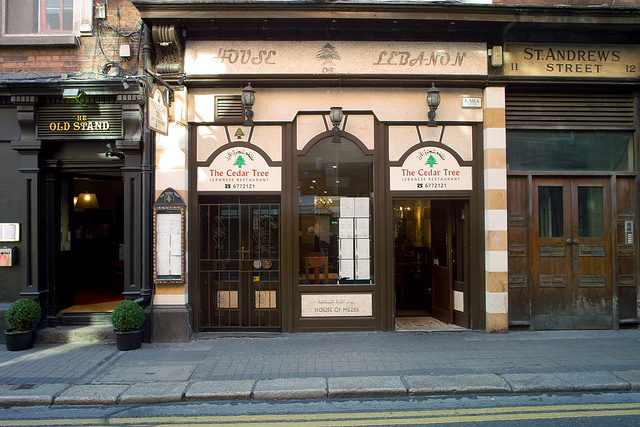
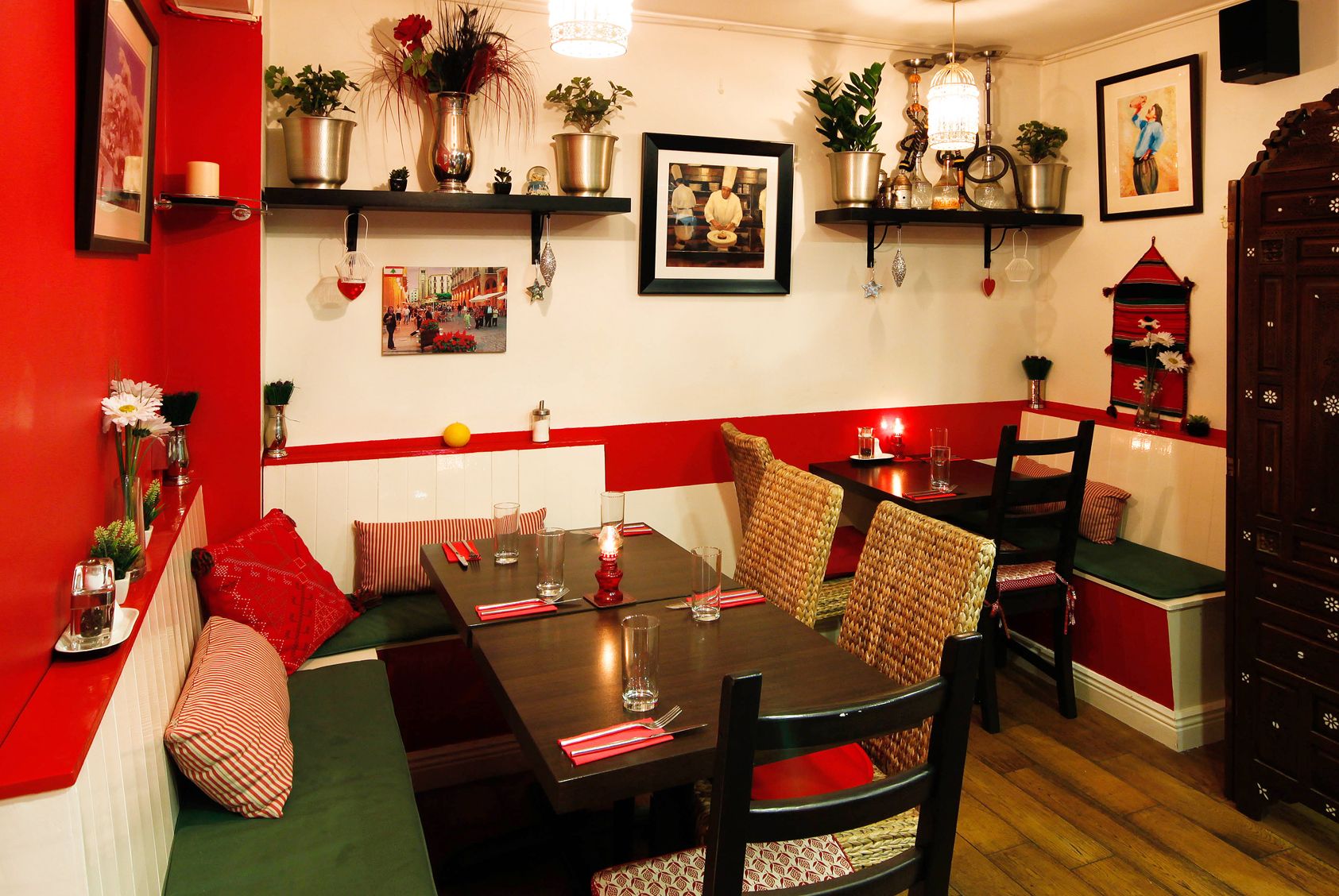
Ireland’s first Lebanese restaurant, The Cedar Tree, was opened at 11 St. Andrew’s Street in October 1986 by two brothers from Beirut, Abed and Ali Sarhan.

Opening of the Cedar Tree.19 October 1986,  Sunday Independent.

Opening of the Cedar Tree.19 October 1986, Sunday Independent.

It is still in business 27 years later which is extremely impressive.

Cedar Tree, 2010. Credit - William Murphy (Flickr)

Cedar Tree, 2010. Credit – infomatique/William Murphy (Flickr)

Ronit Lentin wrote in the Irish Press (24 Nov 1986) that you could get a cheap filling lunch of Falafel in pitta bread for about £1.70  in Exile restaurant in Rathmines.

In The Irish Times (29 Oct 1987), journalist Pauline Lindsay let her readers know that could buy falafel in Mubarak’s Spar shop on Camden Street.

In the same year The Phoenician Lebanese restaurant was opened at 10 Lower Camden Street but I’m not sure how long it lasted. Today, this building houses the Dublin Camera Club.

Sinners (estd. 1993) at 12 Parliament Street was reviewed favourably in the Irish Independent (13 Aug 1996) by Myles McWeeney. Owner Jerry Salam, who is half-Egypitian and half-Lebanese, explained that the main characteristics of Lebanese food was:

… not hot chili spicyness like Indian or Mexican food but a delicate blend of vegetables, herbs and spices like garlic, onions, parsley and coriander, cinnamon and black pepper.

His food, particularly the falafel and dolmas, were particularly popular with vegetarians. Sinners closed in 2009 after sixteen years in business

Ali Sarhan established the Alis Beef and Beer Bazzar on South William Street in July 1992. In the run up to the opening night Ali told Irish Press journalist Barbara McKeon (23 July 1992) that:

Lebanese food has an international appeal. And I saw there was a gap in the market between the very expensive, high-class restaurants and the burger joints so I decided this is what Dublin needs. We have good food and drink for under £10.

Since 2000, a huge number of Lebanese (and Middle-Eastern) and restaurants have sprung up including: The Silk Road Cafe (estd. 2000) at the Chester Beatty Library at Dublin Castle; Keshk Cafe (estd. c. 2008) at 71 Mespil Road; Rotana Cafe (estd. 2008) at 31 Richmond Street South;  Little Jerusalem (estd c. 2009) in Rathmines);  Damascus Gate (estd. 2012) at 10 Upper Camden Street and Beriut Express (estd. 2012) at 69 Dame Street.

Interior of the Rotana Cafe in Portobello

Interior of the Rotana Cafe in Portobello. Lovely place.

In terms of kebabs and cheaper dining, Iskanders Kebab House (estd. 1996) at 29-30 Dame Street remains a firm favourite  as does Zaytoon (estd. 2001) at 14-15 Parliament Street. Sultan on George’s Street is also supposed to be quite good though I’ve never been.

More recently,  Falafel & Kebab (estd. 2012) at 11 East Essex Street in Temple Bar and Ephesus (estd. 2011) at 20 Capel Street are proving popular for budget-conscious foodies.

We hope Mark from the ‘Dublin Falafel hunt‘ blog keeps up his quest for the best falafel in the city!

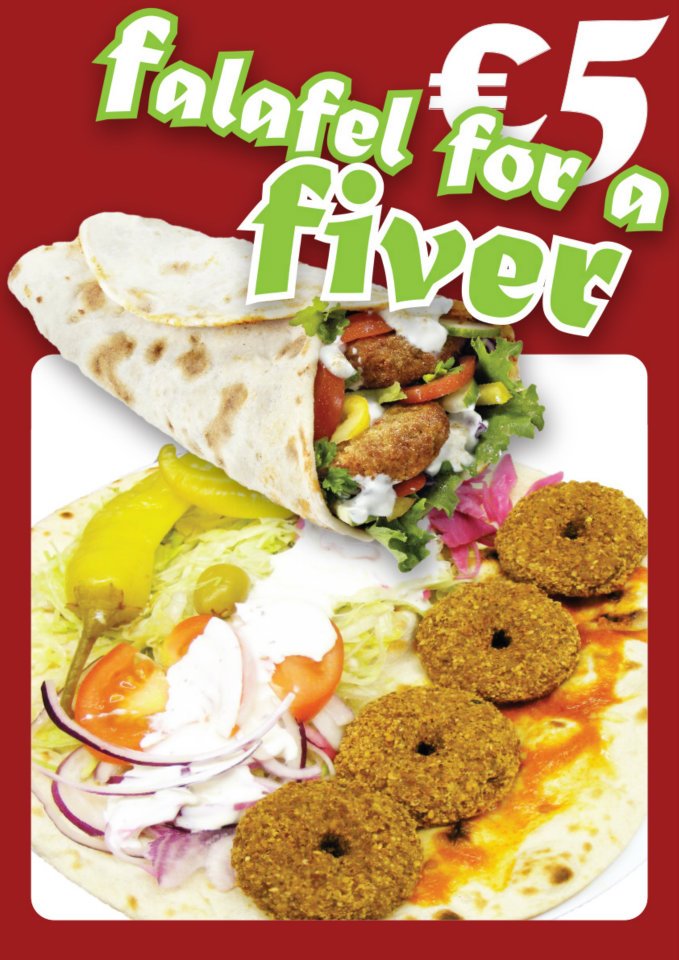
Falafel and Kebab advertisement

Advertisement from ‘Falafel and Kebab’ in Temple Bar

John's Lane Church - Image by Paul Reynolds

John’s Lane Church (Paul Reynolds)

This image by Paul Reynolds captures the beautiful John’s Lane Church in the heart of the Liberties, which has long interested me because of its hidden history.

The Thomas Street church first opened in 1874 (after work began in 1862), with Edward Welby Pugin the architect behind the project. Pugin came from an incredibly distinguished architectural family, the son of Augustus Pugin, who carried out the interior design of the Palace of Westminster, as well as being responsible for many religious buildings in Ireland and Britain.

My interest in John’s Lane Church comes not from the architectural history of the building, but rather a nickname the church has acquired in its own community, spoken of as the ‘Fenian Church’. This nickname comes from the fact many Fenians worked at the building site, such as the Pagan O’Leary, Denis Cromien, Dan Gleason, Michael Lawless and Michael Malone. Ironically however, so too did a man named Pierce Nagle, a comrade in their eyes but a secret informer who would send them to penal servitude.

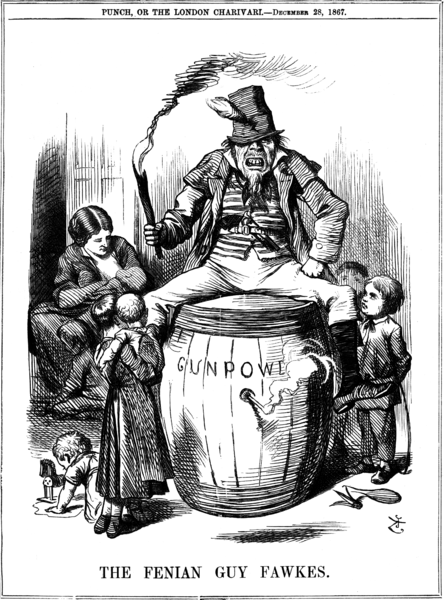
The Fenian Brotherhood in Ireland had been founded in Dublin by James Stephens and others on Saint Patrick’s Day in 1858. Stephens was a veteran republican who had spent time in exile in Paris as a result of his revolutionary activity. It was to be a secret revolutionary organisation, established thanks to American financial backing, which would advocate armed revolution to establish Irish independence. The Fenians were a real threat to the establishment, mounting bombing campaigns in Britain for example which targeted military infrastructure, government and public transport among other targets.

A Punch cartoon from 1867 depicting a 'Fenian Guy Fawkes'

A Punch cartoon from 1867 depicting a ‘Fenian Guy Fawkes’

The centenary booklet of the church issued by the church in 1962 noted that:

…While their hearts were busy with trowel and shovel their hearts were busy with revolution. By day they were the busy builders of John’s Lane, by night they talked of arms and Man and drilled in halls and fields. They were the Fenian Men. Denis Cromien, foreman of foremen, was there and had sworn a thousand men of the building trade into his circle.

Patrick O’Leary who worked on the site, known as the Pagan O’Leary, is a fascinating character in the history of Irish republicanism. Originally from County Cork, O’Leary spent some time in America, studying for a priesthood in the Catholic Church and even fighting in the Mexican War. Active within the Fenian Brotherhood having settled in New York, he would develop intense anti-Catholic views, and as Bridget Hourican has noted “he hated England and the Roman Catholic church with equal intensity, arguing that after driving out the English, Ireland should revert to the old paganism of Fionn mac Cumhaill”. As a result of these views, the name Pagan O’Leary was bestowed upon him by contemporaries.

While many of the stonemasons working on the church had taken the Fenian Oath, their betrayal came in 1865 thanks to the testimony of Pierce Nagle, a Tipperary native who had won the confidence and trust of those around him within the republican movement and at the John’s Lane site. He had first offered his service to the British authorities in 1864 while in America, and Nagle’s position within the movement kept the authorities aware of plans for insurrection and revolt in 1865. Many of the men who worked on John’s Lane Church would be sentenced to terms of penal servitude on the back of Nagle.

The church also boasts a strong connection to James Pearse, the father of Patrick and William Pearse. The English-born Pearse was a mason and monumental sculptor, who operated out of a premises on Great Brunswick Street. This street is today known as Pearse Street, and the family shop front has been beautifully restored with a plaque to the Pearse brothers also upon it.

27 Pearse Street today.

27 Pearse Street today.

The twelve statues in the niches on the church tower are the work of Pearse. Pearse was a very capable sculptor, and had won an award at the 1882 Dublin Exhibition for example for his High Altar for the Rotunda. The name ‘Pearse and Sons’ was adopted by the company he had established at the time of his death, and The Ireland Institute (who maintain the premises today) note:

On his death, Willie and Patrick Pearse took over the running of the business. Willie was nineteen and studying at the Metropolitan School of Art and was later to travel to London and Paris for further training. Patrick was at this stage using the title ‘Patrick H. Pearse, Sculptor’ and the company’s name had become ‘Pearse and Sons.’

Following the closure of the family business, the premises became home to the South City Workingmen’s Temperance Club, later a car company and many other ventures. It was acquired by its present owners in 1996, and has hosted many cultural and political events. Its facade, and the figures upon the ‘Fenian Church’ on Thomas Street, are reminders of the talented James Pearse.

Image cover: Irish Academic Press

Image cover: Irish Academic Press

I’m very pleased to announce that Locked Out: A Century of Irish Working-Class Life is about to be released by Irish Academic Press. Edited by David Convery, a historian and friend of Come Here To Me, it is a collection of chapters looking at the lives of working class people in Ireland in the last hundred years. I have contributed a chapter to the book looking at the rather infamous ‘Animal Gangs’ of the 1930s, a product of inner-city Dublin who emerged from a newspaper strike in 1934 but whose name became synonymous with gang violence in the city for generations. Other chapters look at things like the beautiful game, the NSPCC, class and gender, and one chapter even has reference to Tallafornia in it. It’s the one I’m most eager to read. The full list of chapters and more information is here. The book aims to remain affordable (sadly so often not the case with academic titles) and should be in all good bookshops very soon, in fact as early as next week.

In 1913, a titanic battle gripped the city of Dublin that polarised Irish society. The Irish Transport and General Workers’ Union, led by Jim Larkin, took on the might of one of the biggest Irish capitalists of the day, William Martin Murphy. What began as a strike over union recognition in Murphy’s Dublin United Tramway Company quickly escalated, as Murphy, backed by the state and the Dublin Employers’ Federation, declared all-out war on the trade union movement. Despite tremendous efforts, the workers went down to a bitter defeat. Historians and other commentators have tended to view the 1913 Lockout as a tragic, but unique case in Irish history. However, its uniqueness lies mainly in its scale. The working class continued to exist after 1913. It continued to develop its own organisations, its own cultural and leisure activities, its own forms of self-representation and identity. It also continued to engage in strike action and other forms of protest against the employers and ruling establishment. Yet the study of an independent working class has been neglected in favour of an all-embracing focus on nationalism in politics, culture and wider society. That class, rather than ethnicity, religion, or the idea of national identity could have a role to play in politics and cultural production is an alien one to mainstream Irish debate. The working class has been locked out of history.

An artist’s impression of the proposed new Irish Jewish Museum in Portobello, Dublin, which would involve demolishing five houses and building a two-storey-over-basement museum incorporating a cafe, synagogue, archive storage and audiovisual theatre. Credit - The Irish Times

An artist’s impression of the proposed new Irish Jewish Museum in Portobello, Dublin, which would involve demolishing five houses and building a two-storey-over-basement museum incorporating a cafe, synagogue, archive storage and audiovisual theatre. Credit – The Irish Times

Last year, the Irish Jewish Museum in Portobello, Dublin 8 announced a major development plan which would involve demolishing five houses and building a new two-storey-over-basement museum incorporating a café and synagogue.

(A review from Donal of the fantastic museum can be found here)

However, local residents, councillors and the city council conservation officer have criticised aspects of the plan. Residents are worried about the massive increase in cars and pollution into the area while conservation officer Nicola Matthews, referring to the proposal to demolish and reconstruct the synagogue, said this “façadist approach” would mean “removing the authenticity and real experience of the original site”. Locals are also worried that excavations and pile-driving for the 5.5-metre deep basement could destabilise nearby houses.

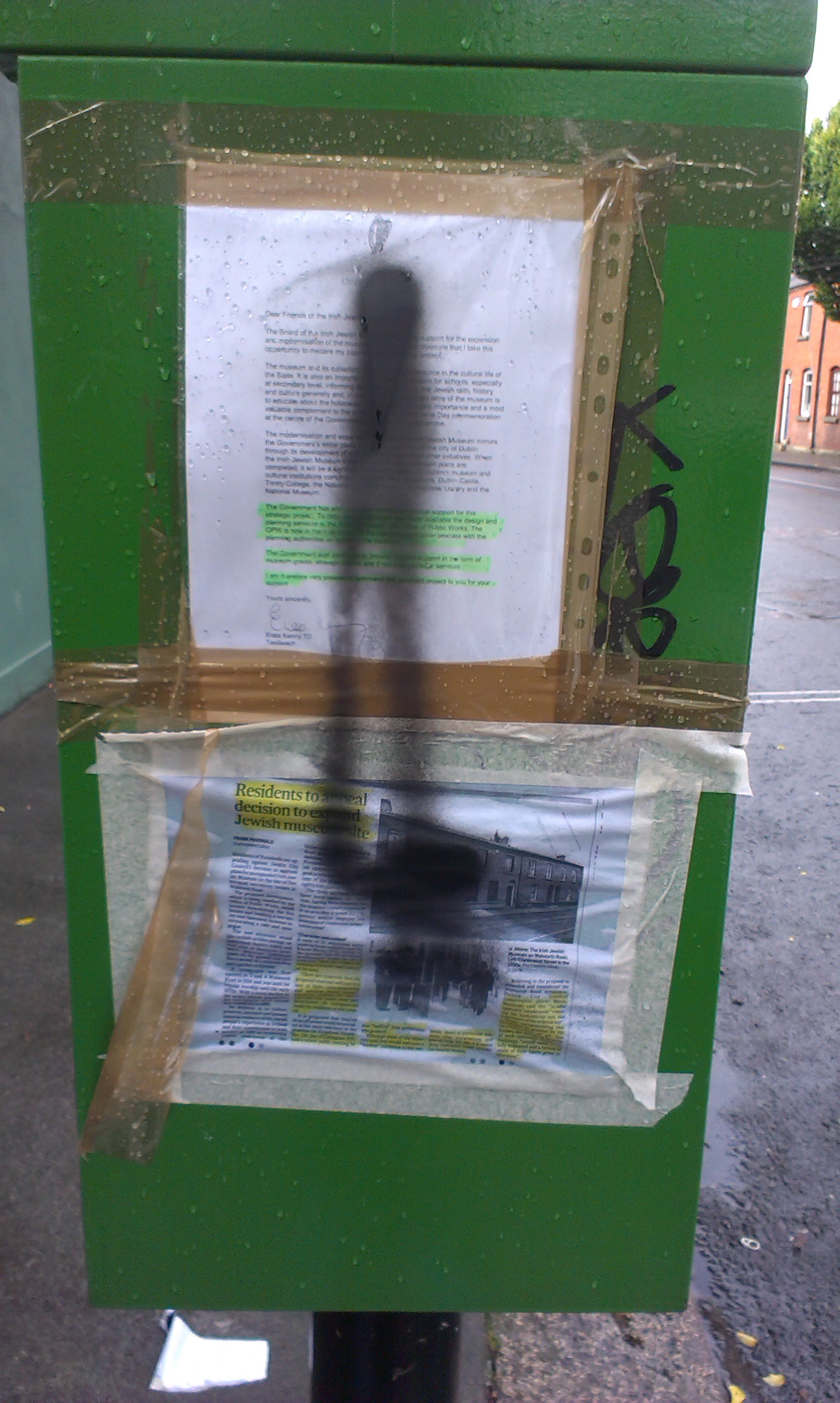
Recently a number of posters have appeared on lamposts and in the windows of houses in the area.

This particular poster shows photographs of a large tour group visiting the museum and the related congestion on the narrow streets.

Poster on pole.

Poster on pole. Credit – Sam

It would appear that someone, perhaps in favour of the development, used black spray paint to cover newspaper articles (in relation to local opposition to the plan) which were fastened on a post box.

An individual has used black spray paint to cover newspaper articles which critised the plan

An individual has used black spray paint to cover newspaper articles which critised the plan. Credit – Sam

Similar thing again:

Another poster was torn

Another poster was torn. Credit – Sam

Finally, one example of a large number of houses who have put posters in their front windows:

One of a large number of houses who have put similar posters in their front windows

Front window. Credit – Sam

I have family in the area and they’ve told me that they are both worried about the scale of the planned development and are upset that the anonymous campaign against the development has made no reference in their posters for support for the museum in general.

Let’s just hope that a resolution is found that is agreeable to all parties.

More on Jewish history from the blog:

RTE Nationwide special on Dublin Jewish community (January 2013)

Reactionary murders in Dublin (including two Jewish men killed in 1923)

Dublin Maccabi Assoication Facebook page

Burman vs. Alpers court case (1946)

Stein Opticians

Remembering Ettie Steinberg 

A look at the Dublin story of ‘Joe Edelstein’s Alarm’ in Little Jerusalem

James Connolly’s 1902 Yiddish election leaflet translated

“I am a Jew and I’m quite happy to live in that country” – Robert Briscoe

William Blakeny

William Blakeny, who once stood on Sackville Street

While many Dubliners are aware of the fact the site of the Spire today was once occupied by Nelson’s Pillar, what stood there before the Pillar is a mystery to most. Given the manner in which the Spire is often ridiculed and its merit debated by the locals, I’ve always liked the fact Nelson was quite controversial too in his day. Yet even before Nelson the site was occupied by a monument of a military figure, which went up on Saint Patrick’s Day in 1759. Fittingly, given the history of the site, it seems Dubliners were eager to vandalise and attack it.

Long before Admiral Nelson, a statue of William Blakeney (1st Baron Blakeney) stood in the centre of Dublin’s Sackville Street. It was placed there by an organisation known as the Friendly Brothers of Saint Patrick, who made the decision in 1756 to honour Blakeney with a monument, in praise of his defence of Port Phillip in the island of Minorca against French attack in that same year. At the time Blakeney was serving as Lieutenant Governor of Minorca, but the Limerick man had a long military career behind him, and had even served in the Irish House of Commons. He had been given the freedom of Dublin by the Corporation in 1757, indicating the respect for him at the time.

The Friendly Brothers of Saint Patrick, who erected the monument, were a very interesting organisation in the Dublin of their day. Described by Robin Usher in his work Protestant Dublin, 1660-1760: Architecture and Iconography as “a masonic fraternity that opposed duelling and aimed to promote social harmony among the respectable, Catholics (nominally) included”, the Friendly Brothers of Saint Patrick frequently met at the Rose Tavern, which was one of the most notable taverns of Dublin. J.T Gilbert writes about it in his history of Dublin which was published in the late 1850s. He states that it stood on the north side of Castle Street, and that “This establishment continued in fashion from the first part of the eighteenth century to about thirty years before the Union.” Gilbert gives great detail of the customs and styling of the order, noting that the members wore “Gold medals, suspended from a green ribbon, bearing on one side a group of hearts with a celestial crown”, and with the motto ” Quis separabit?” upon them. This translates into ‘who shall separate us?’, and in more recent times the motto has been associated with sections of the Loyalist community in the north, as it was adopted by one Loyalist terror group. Arthur Guinness was very involved with the Friendly Brothers of Saint Patrick, at one point serving as Secretary.

Arthur Guinness, brewer and Secretary of the Friendly Order of Saint Patrick.

Arthur Guinness, brewer and one-time Secretary of the Friendly Order of Saint Patrick.

The statue was the work of celebrated sculptor John Van Nost, responsible for several statues in the city of Dublin, including King George II who stood in Saint Stephen’s Green and the monument of Justice in Dublin Castle. Ciarán discussed this monument in our recent book, quoting the brilliant epithet in her honour that: ‘There she stands, upon her station, with her face to the Castle and her arse to the nation.’

Lady Justice at the Castle (Ciarán Murray)

Lady Justice at the Castle (Ciarán Murray)

The entry on Van Nost in the classic A Directory of Irish Artists (1913) gives great detail of the ceremony that unveiled the statue on Saint Patrick’s Day in 1759. The pieces quotes from an article published in Pue’s Occurrences magazine in March 1759. It seems that following the unveiling of the statue, the Friendly Brothers of Saint Patrick returned once more to their haunt at the Rose Tavern.

Last Friday evening the fine Brass Statue of the Right Hon. Lord Blakeney, Knight of the Bath, richly gilded and done by Mr. Van Nost, was carried from his house in Aungier Street, and erected on a superb white marble pedestal in the centre of the Mall in Sackville Street, and Saturday, being St. Patrick’s Day, the anniversary festival of that Patron of Ireland, the Grand Knot of the Ancient and Most Benevolent Order of the Friendly Brothers of St. Patrick, assembled in the morning at the Rose Tavern in Castle Street, and, according to annual custom, walked in procession to St. Patrick’s Cathedral, where they heard a sermon preached by the Rev. Mr. Benson; after which they proceeded to the Mall where that curious figure was unmasked in the presence of that illustrious body, and amidst unnumbered spectators, amongst whom were many travellers and competent judges of statuary, who declared this performance to be equal, if not superior, to any piece of the kind in Europe, not only for the strength and judgment expressed in the likeness of the brave old original, but also in the beauty and elegance with which the drapery and armour is executed, and which will be a monument to perpetuate the memory of the noble veteran whom it represents, as well as a lasting honour to him and his native country at whose expense it was erected, and which produced a member so worthy of such a reward for his valour, integrity and unshaken fortitude in his eminent services to the King and the public. After the statue was unmasked the Society returned to the Rose, where an elegant entertainment was prepared for their reception.

This statue was all the more remarkable considering its subject was still alive, with Blakeney dying in September 1761. This was also the first statue erected to the honour of an Irishman in Dublin, though it would fall victim to frequent attack, thrown down from its pedestal and greatly damaged in 1763. Indeed, the monument was so badly damaged it had to be taken away at the time. Just when the statue was removed once and for all is somewhat unclear, but an article in the Hibernian Magazine in 1783 refereed to it in the past-tense, noting that there “formerly stood a pedestrian statue of General Blakeney” at the site, but “what became of it we know not.” Robin Usher has suggested that perhaps the Friendly Order of Saint Patrick did not “attempt to make good the damage”, and that the vandalism to the monument so soon after it was erected may have removed it from the streets for good. A 1926 article in the Irish Independent on this mysterious statue claimed that “it was taken to the brass foundry at Clondalkin and melted down to make cannon”, but I haven’t found a reference to this elsewhere.

It seems like Admiral Nelson was doomed from the start!

Dr Daire Keogh, President of St Patrick’s College, Drumcondra will launch the book ‘Defying the law of the land: Agrarian radicals in Irish history’ (ed. Brian Casey) tomorrow evening (Friday) at 6.30pm in the Teacher’s Club Parnell Square.

The book, published by the History Press, looks at the Land League, the Knights of the Plough and the perception and reality of Irish landlords while furthering understanding of the importance of the land question in Irish history.

Book cover

Book cover

The collection of academic authors includes both established experts in their field, namely Carla King, Gerard Moran and Fintan Lane, and new voices in the arena from young and upcoming scholars across Ireland.

A link to the Facebook event page can be found here.