Feeds:
Posts
Comments

Issue 16 of Look Left out now

Our bi-monthly update letting our readers know about the publication of the latest issue of Look Left. Available for €2 in Easons and other newsagents, issue 16 includes articles on:

POLITICAL FOOTBALL
Kevin Brannigan examines some of the political dimensions to football, past and present

NO GODS: ONLY OPPRESSION
Angela Nagle reports from a recent conference on secularism and feminism

2013 – PRO-CHOICE VICTORY?
The debate on abortion was to the fore in the Dáil and on the streets once again

WE OWN IT
Cian McMahon on the international union interest in co-operatives

NO ONE DARES PUSH US AROUND
Who were the Molly Maguires asks Joe Mooney.

THE SAINT OF CAPITALISM
Kevin Squires talks Bono with Harry Browne.

I’M SPARTACUS
Sam McGrath on the The Farm’s mix of music, football and politics

Look Left (Issue 16)

Look Left (Issue 16)

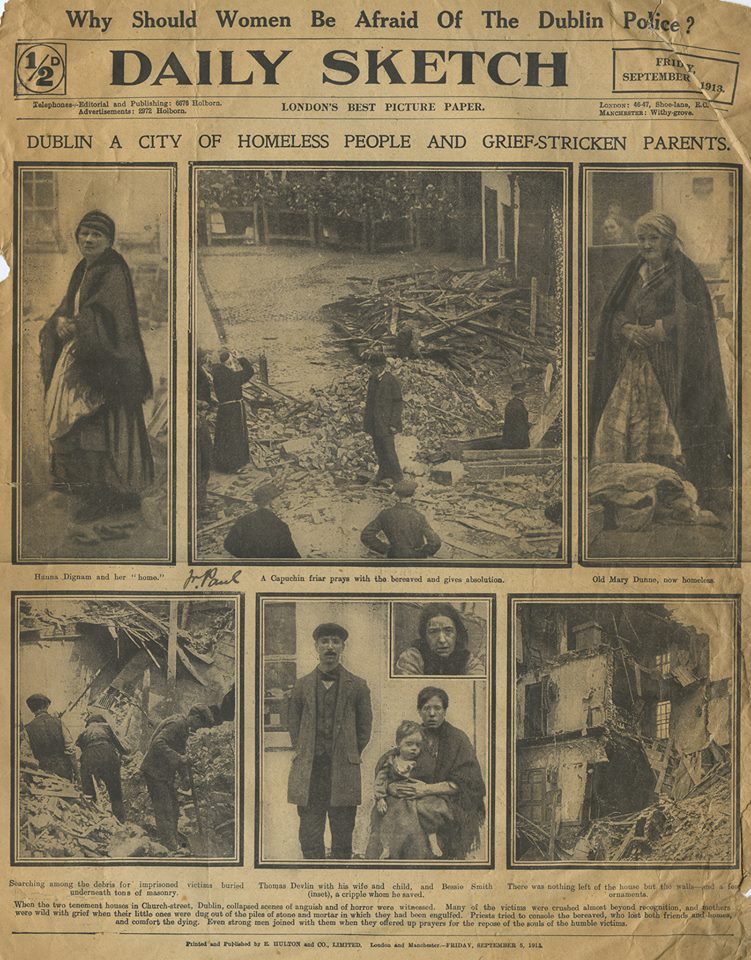
News coverage of Church Street collapse. (Posted with permission from Irish Capuchin Archive)

News coverage of Church Street collapse. (Posted with permission from Irish Capuchin Archive)

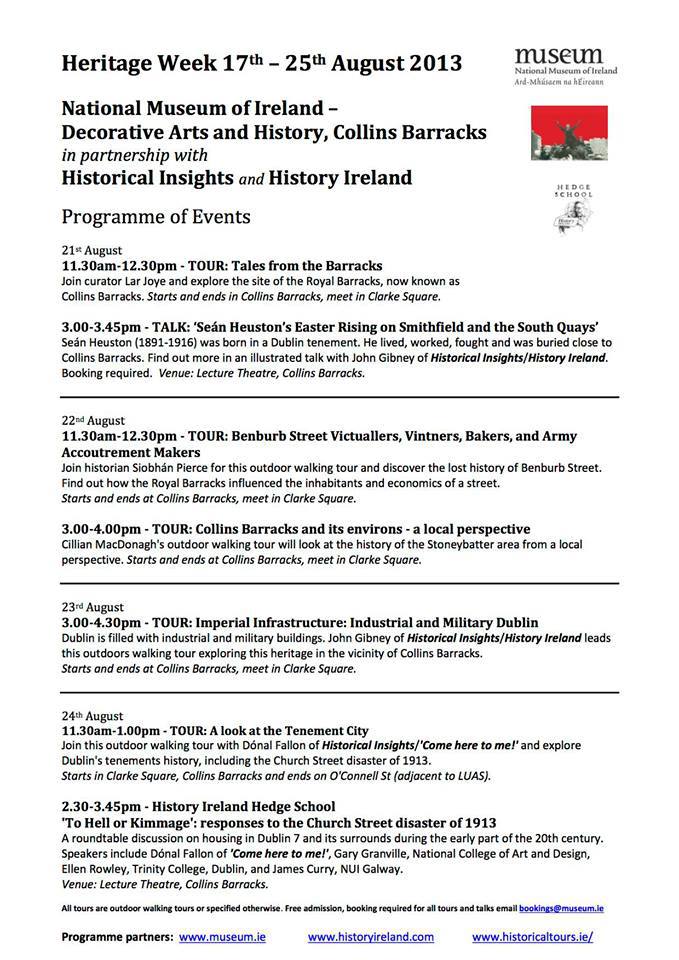
As part of Heritage Week, a nice calendar of events has been put together by a few of us in the Historical Insights team, in conjunction with the National Museum of Ireland and others. This programme largely involves events with a focus on the Dublin 7 area around the Collins Barracks branch of the National Museum, ranging from the revolutionary history of the area to its rich social history. There are also walking tours of the area, with John Gibney exploring the area around the Museum, while I’ll be looking at the housing in Dublin historically. If you’d like to attend any events on the below programme, email bookings@museum.ie

I’m participating in two events for this programme. The times and meeting information can be found in the poster below.

Heritage Week Tour: A look at the Tenement City
Join this outdoor walking tour with Donal Fallon of Historical Insights/’Come here to me!’ and explore Dublin’s tenements history, including the Church Street disaster of 1913. Booking requried. Adult tour.

History Ireland Hedge School: ’To Hell or Kimmage’: responses to the Church Street disaster of 1913
A round table discussion on housing in Dublin 7 and its surrounds during the early part of the 20th century. Speakers include Donal Fallon of ’Come here to me!’, Gary Granville, National College of Art and Design and Ellen Rowley, Trinity College, Dublin. Lecture Theatre.Booking required.

Programme of events

Programme of events

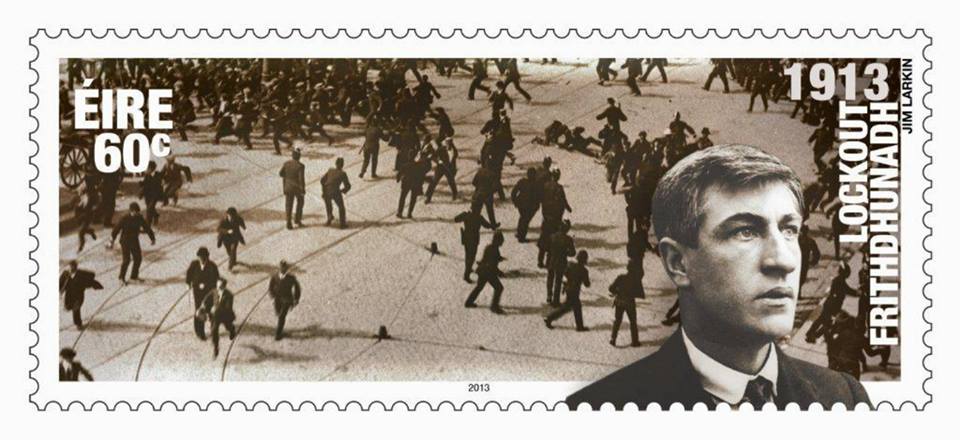
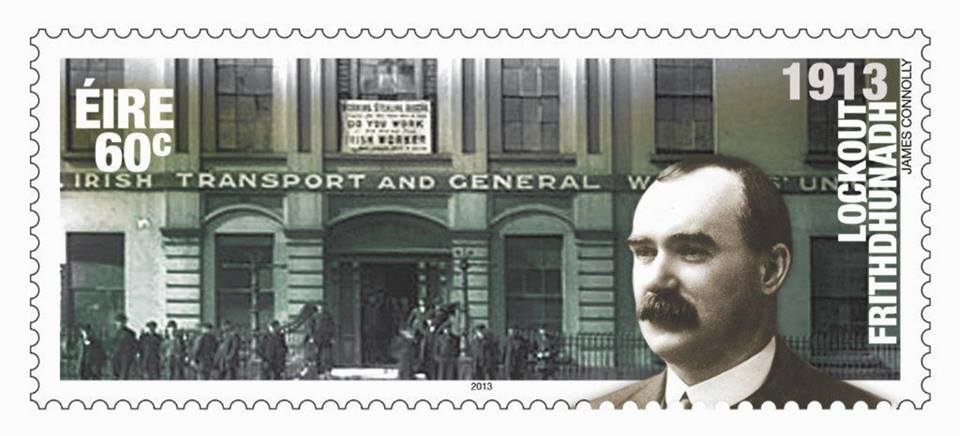
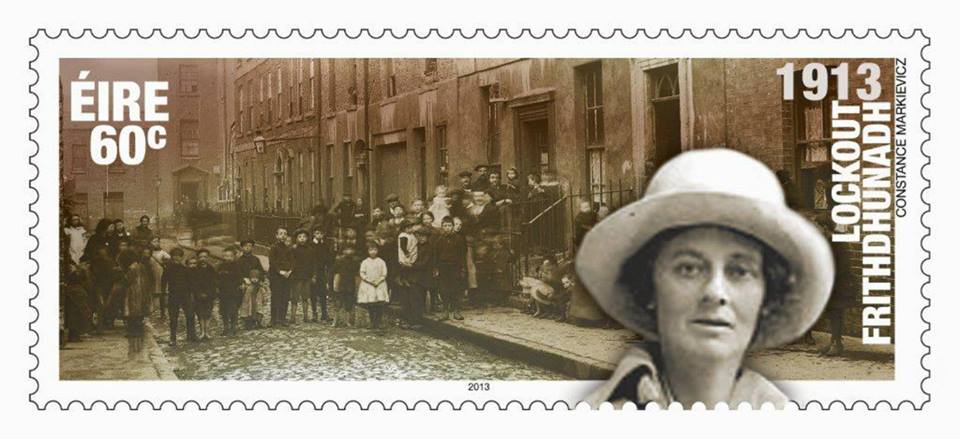
An Post are issuing three beautiful stamps to commemorate the 1913 Lockout. The stamps commemorate three of the leading figures of the labour movement at the time, in the form of Jim Larkin, James Connolly and Countess Markievicz. They go on release on August 22nd. More information on the stamps is available in a recent issue of ‘Irish Stamps: The Collector’. They certainly make a nice little commemorative and collectable piece, much like the stamps issued in 1966 on the fiftieth anniversary of the Easter Rising.

JimLarki

JamesConnolly

Countess

Dublin has seen her fair share of disturbances involving theatres. From the famous incidents at the Abbey like the 1926 demonstrations at The Plough and the Stars, to an attempt by militant Suffragettes to torch the Theatre Royal, there are many stories of protest and outrage. This post looks at the attempt of members of the Orange Order to cause a sectarian riot in the Theatre Royal in 1822, during a performance that was attended by the Lord Lieutenant and others.

On December 14th 1822, a performance of Oliver Goldsmith’s She Stoops to Conquer took to the stage at the Theatre Royal in Dublin. Among those in attendance was the Lord Lieutenant of Ireland, Marquis Wellesley, the brother of the Duke of Wellington. Wellesley was quite unpopular at the time among Orange Order members in the city, owing to what their perceived as he’s role in stopping an annual ceremony at the statue of King William of Orange on College Green, and other perceived concessions to the Catholic population.

Undated postcard showing the monument of King William of Orange on College Green.

Undated postcard showing the monument of King William of Orange on College Green.

This statue was the location for annual rituals organised by loyalist elements in the city, with events held in July (to mark the Battle of the Boyne) and November (to mark the birthday of William) a flashpoint on the Dublin calendar. The historian Shunsuke Katsuta has noted that it was common at this ceremony to “decorate the equestrian statue of William with orange symbols (‘dressing the statue’), with shamrocks strewn under the feet of the king’s horse, to symbolise William’s victory over Catholics.” Heavily criticised by Daniel O’Connell and other nationalist voices, Dublin Castle would distance itself from the ceremonies, but it was the eventual banning of the November ceremony which infuriated the Orange Order into action.

Following clashes at the event in July 1822, a decision was made by Marquess Wellesley, in his capacity as Lord Lieutenant, to seek a ban against the November event. A heavy military presence prevented the traditional loyalist display. This decision would cause great resentment towards Wellesley from loyalists in the city, as would other actions such as appointing a Catholic lawyer to a position of importance in the courts. A visit by him to the Theatre Royal was seen as an opportunity to show that discontent. The Theatre Royal on Hawkins Street was relatively new at the time, having only opened the previous year. The announcement that the Lord Lieutenant would be attending the theatre caused considerable excitement in the city, with the Freeman’s Journal printing the below notice days before the event:

An announcement that appeared in the Freeman's Journal, December 1822.

An announcement that appeared in the Freeman’s Journal, December 1822.

In his study A History of Irish Theatre 1601-2000, Chris Morash notes that:

The conspiracy was hatched in the Shakespeare Tavern, on the edge of a grimy alley known as Leinster Market, directly across from the canopied state entrance of the Theatre Royal on Hawkins Street.

Six men met in the tavern on Wednesday December 11th, all members of the Orange Order. John and George Atkinson, James Forbes, William Graham and Henry and Matthew Handwith drank to “the glorious, immortal and pious memory” of King William of Orange, plotting a protest against the Lord Lieutenant which would grab the attention of the city. On December 13th, a meeting of Lodge 1612 of the Orange Order on Werburgh Street decided to fund the purchase of twelve pit tickets for the upcoming play, with the aim of creating a scene which would embarrass the Lord Lieutenant.

A highly dramatic and over-the-top description of what unfolded in the theatre comes from a contemporary source, with the Theatrical Observer writing that:

His Excellency the Lord Lieutenant honoured the theatre with his presence on Saturday evening, when the rank and fashion of the metropolis crowded to receive him. Upon his arrival he was cheered with the most ardent and enthusiastic plaudits, which continued throughout uninterrupted for several minutes; but soon a serpent’s hiss, poisoning the atmosphere of the house, became the signal to some sanguinary confederation of satanic monsters and rebellious cowards to mar the harmony of the evening and kindle within the theatre the torch of political discord and rebellious fanaticism…

Richard Wellesley, 1st Marquess Wellesley.

Richard Wellesley, 1st Marquess Wellesley.

In reality, the trouble had begun inside of the theatre with the tossing of pamphlets with the slogan ‘No Popery’ upon them, most of which drifted towards the stage. There were some cries of ‘No Popish Lord Lieutenant’, and the Lord Mayor of Dublin was also subject to ridicule. Yet the play began as planned, only to be interrupted throughout. One rather comical intervention came as two characters sat down to a drink, with an Orange heckler encouraging them to drink the toast to “the glorious and immortal memory” of King William of Orange! The crowd also called on the cast to sing ‘God Save the King’, and a series of items were thrown in the direction of the Lord Lieutenant, including “the blade of a watchman’s rattle, an empty bottle, and an orange labeled ‘no popery'”. The event would come to known as ‘The Bottle Riot’ in Dublin, owing to the missiles thrown. While the Lord Lieutenant was never in any real physical danger, the incident was hugely embarrassing for the authorities, with mob rule taking centre stage at one of Dublin’s most prestigious venues.

Several days later, the behaviour of the Orangemen was the subject of a protest meeting in Dublin. This meeting was significant as it was addressed by some hugely influential figures, including the Duke of Leinster, Daniel O’Connell, Henry Grattan jr. and Arthur Guinness jr, son of the famous brewer. Guinness denounced the men as a “mischievous faction” and called for them to be opposed “by the severe but wholesome discipline of the laws”.

While the instigators of the affair were brought in front of the courts on two separate occasions (first tried on the grounds of conspiracy to murder and attempted murder, and later on the grounds of conspiracy to riot and rioting) both cases collapsed, causing much anger. Chief Justice Charles Kendal Bushe remarked to the jury in his summation that “an audience may cry down a play, or hiss, or hoot an actor”, but that riotous behaviour was not permitted. One effect of the mini-riot was the outlawing of the Orange Order for a period, when the Unlawful Societies Act of 1825 came into being.

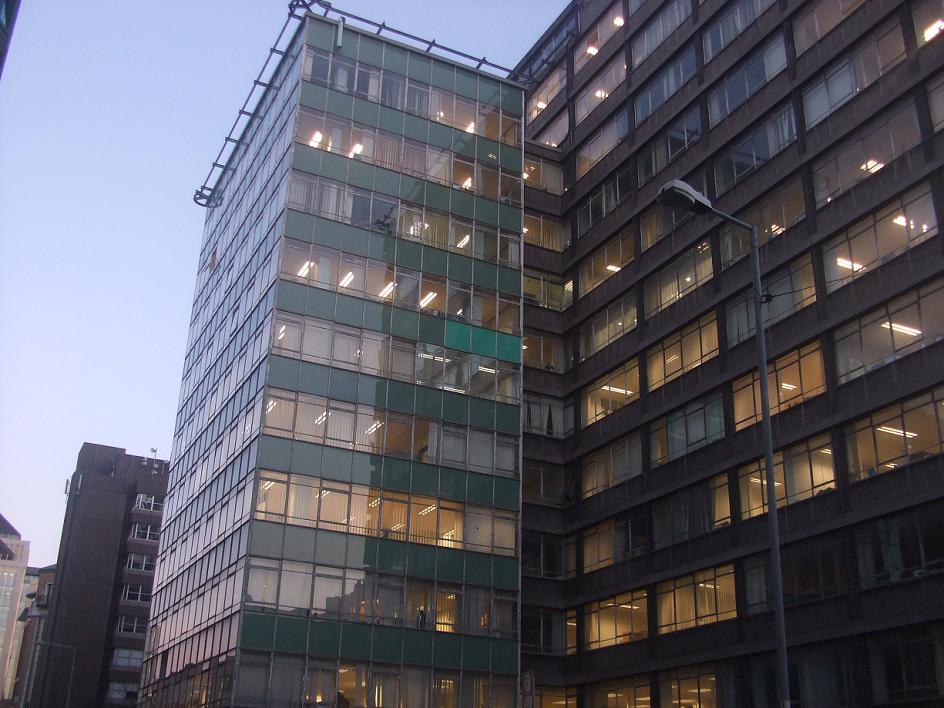
The Theatre Royal is no longer with us in any form, though the building in which the mini-riot occurred was destroyed by fire in 1880. The theatre which replaced it was demolished in the 1930s, and the third and final theatre would stand in the location until 1962. Today, the location is occupied by Hawkins House.

Hawkins House today.

Hawkins House today.

The Real Dublin Decider

On a weekend when huge crowds flocked to Lansdowne Road for a glorified friendly, it could be forgotten that Shelbourne, Saint Patrick’s, Bohs, UCD and Rovers were all in action too on the domestic front, with a huge Dublin derby in Tallaght the highlight. While nothing really remains to be said on this site about the running of the domestic league and the priorities of the F.A.I, I’ve always felt it more productive to promote the national league. This brilliant video by Billy Galligan captures the emotion in Tallaght Stadium on Friday night perfectly, where Pats took home a 4 goal victory over Shamrock Rovers.

Point a camera into the crowd instead of onto the pitch, this is what you get:

Last month, a Youtube user uploaded the 94 minute documentary ‘Que Sera Sera’ which traced the Republic of Ireland’s historical path to Italia ’90 and their first ever World Cup Finals.

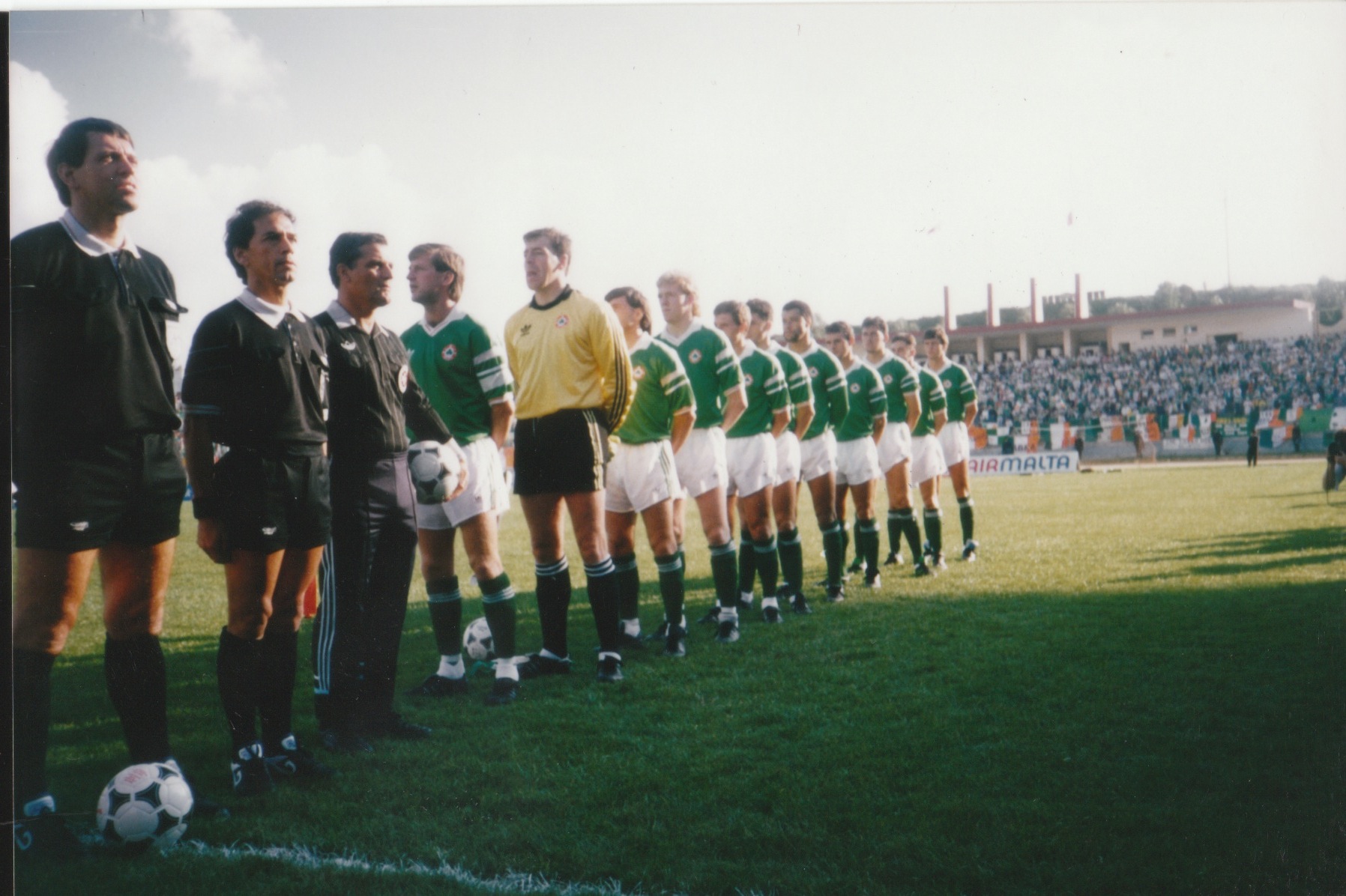
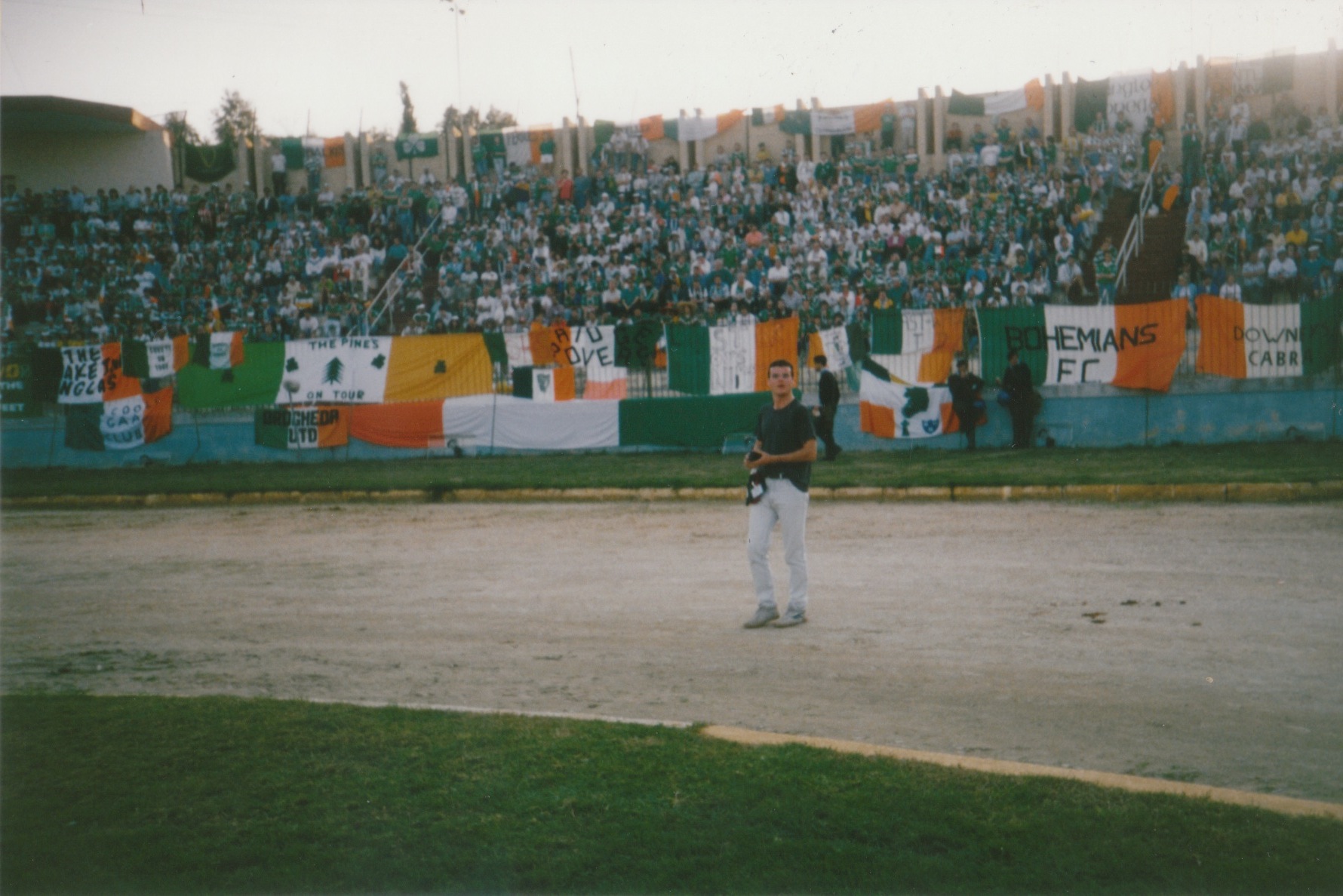
A family member was involved in the production of this film and I recently scanned up some pictures he had taken from Ireland’s game against Malta (which secured their place in the finals) in November 1989 and the trip to Italy in the summer of 1990.

Here are a few from the Malta game:

Republic of Ireland team lining up. Copyright - BM.

Republic of Ireland team lining up against Malta. Copyright – BM.

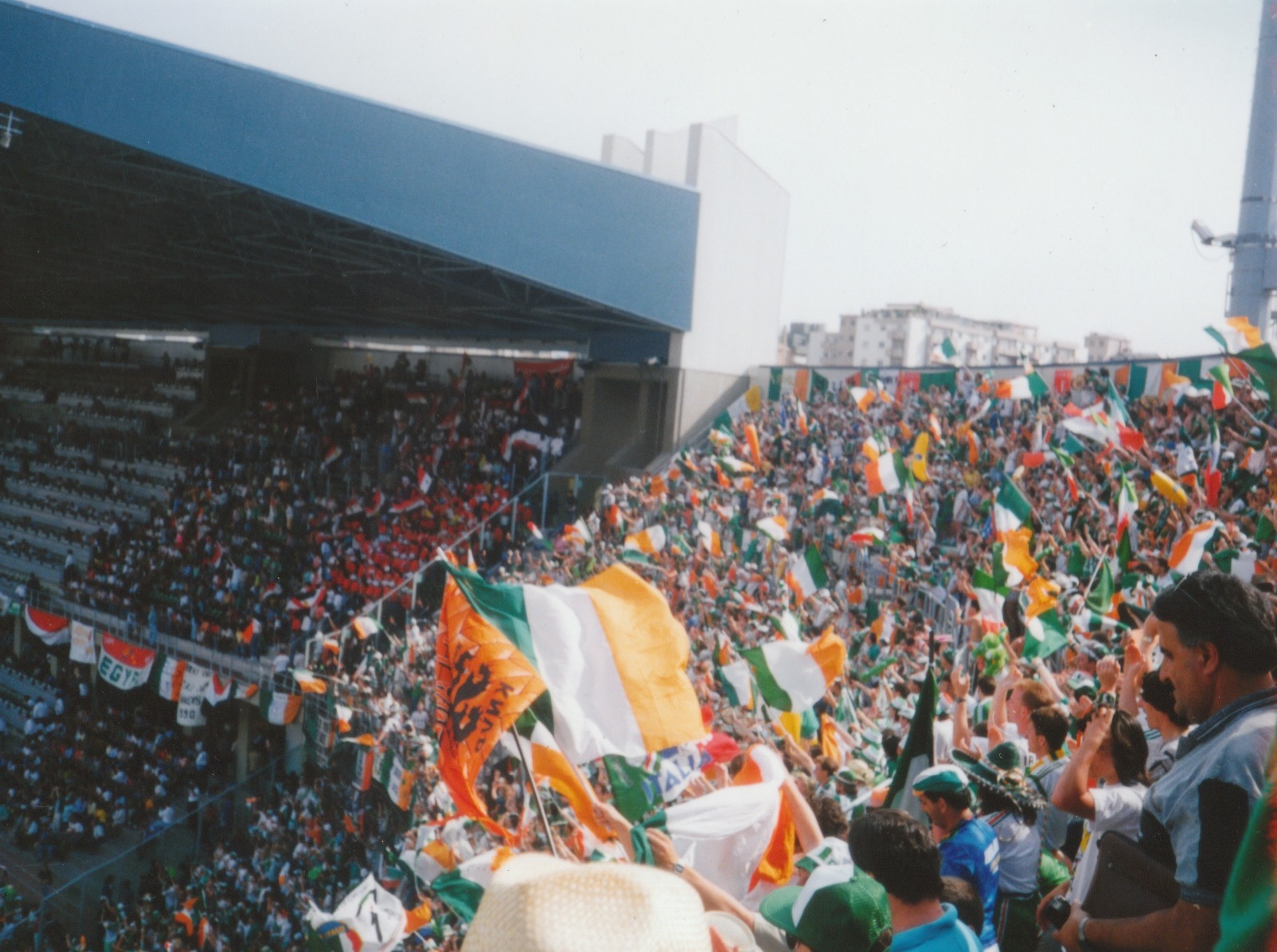
Irish fans and their flags. Credit - BM

Irish fans and their flags in Malta. Copyright – BM

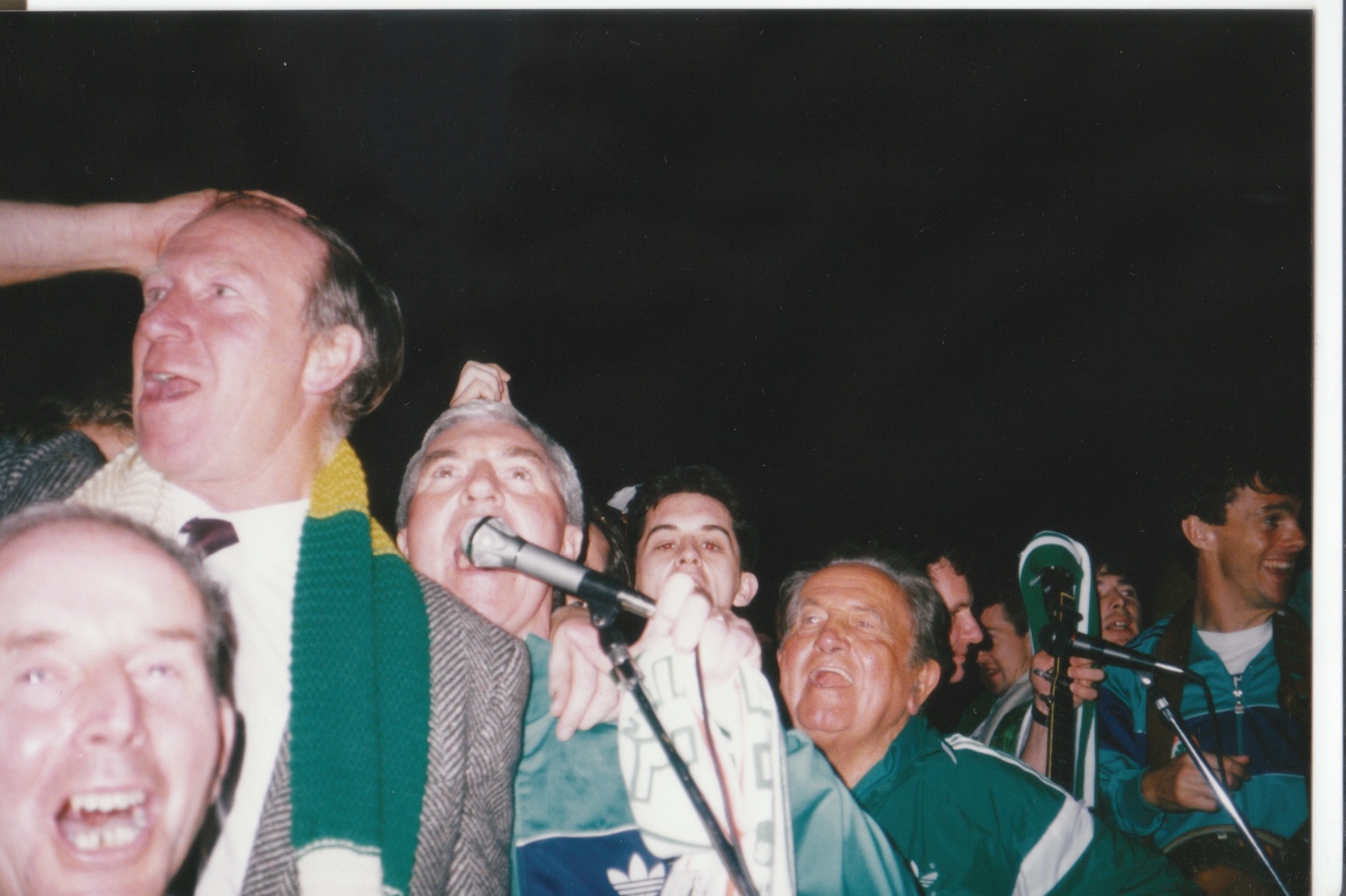
Jackie Charlton celebrating. Copyright - BM

Jackie Charlton singing ‘Molly Malone’ and celebrating win against Malta. Looks like David O’Leary at far right. Copyright – BM

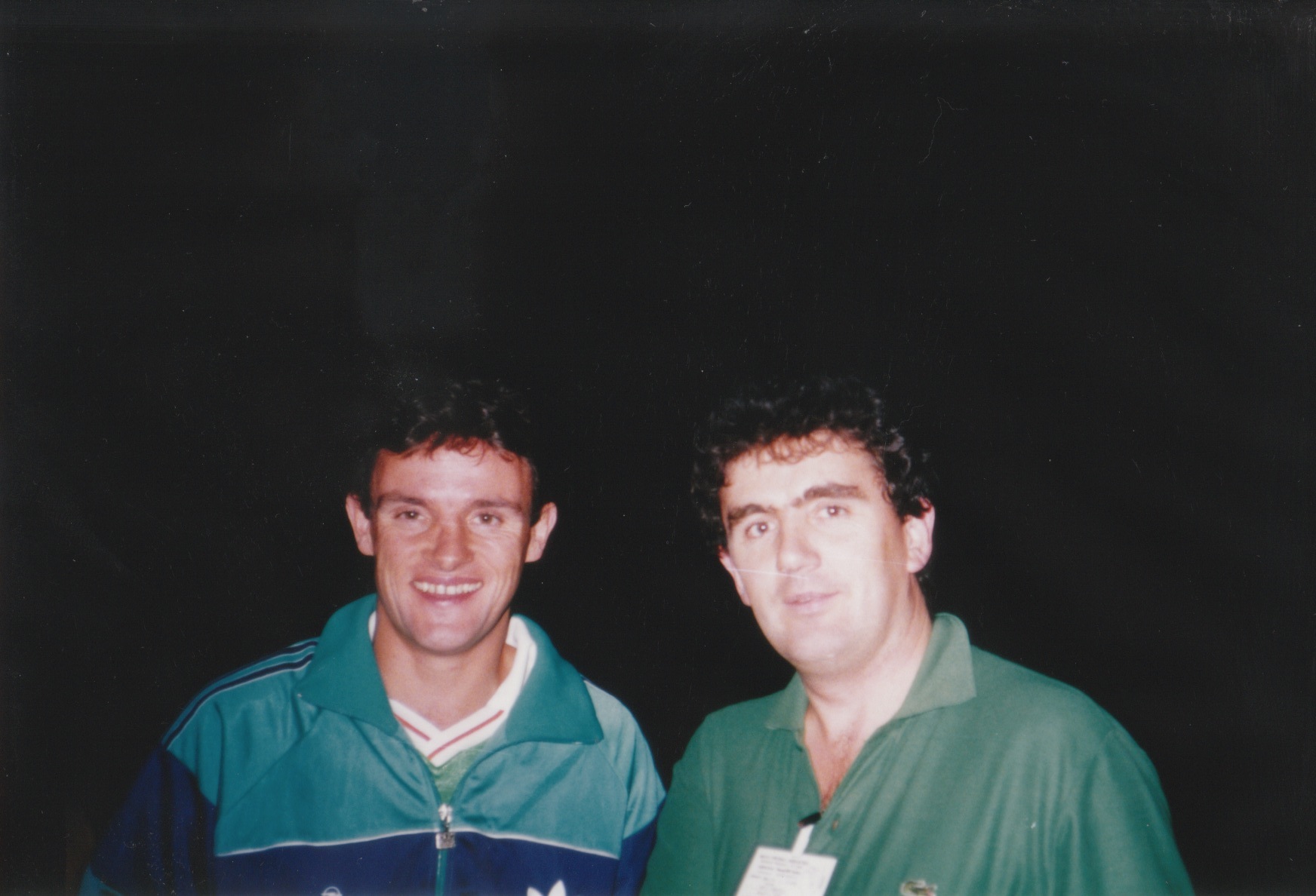
Kevin Moran and Des Cahill (RTE). Credit - BM

Kevin Moran and Des Cahill (RTE). Copyright – BM

From Ireland’s one-all draw against the Netherlands, 21 June 1990:

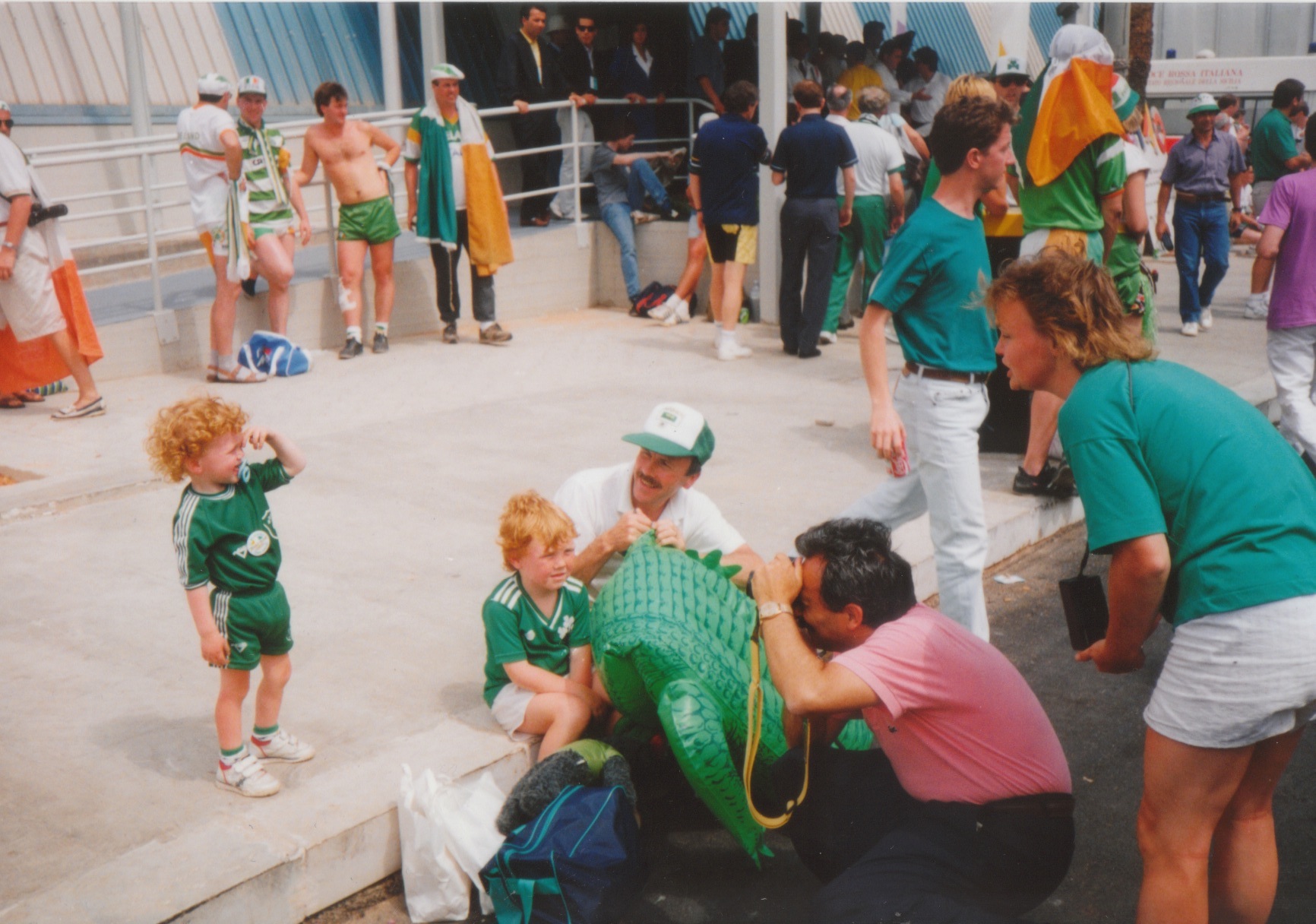
Young Irish fan is overwhelmed by the attention of a photographer. Credit - BM

Young Irish fan is overwhelmed by the attention of a photographer. Copyright – BM

Irish and Dutch fans. Credit - BM

Irish and Dutch fans. Copyright – BM

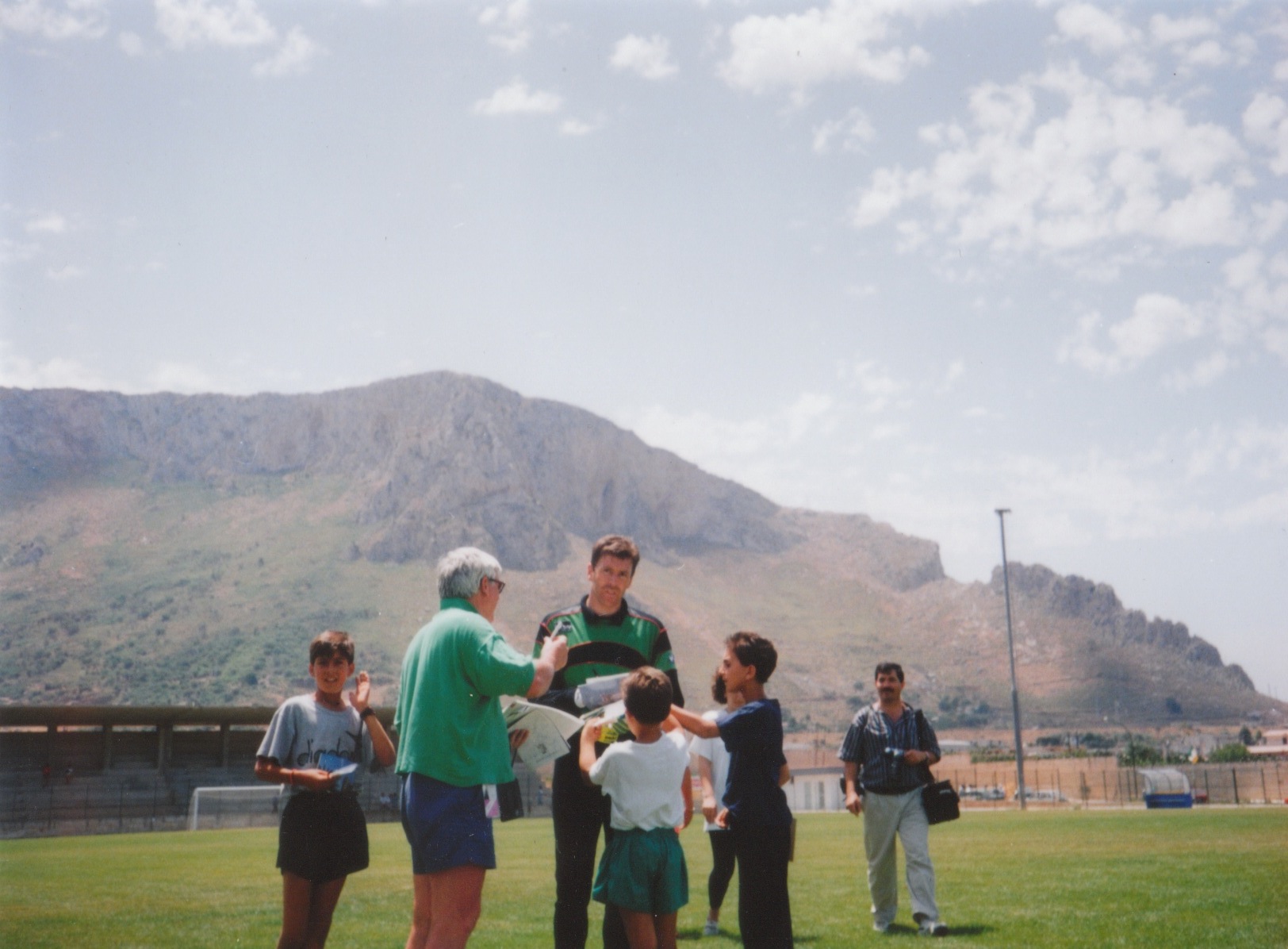
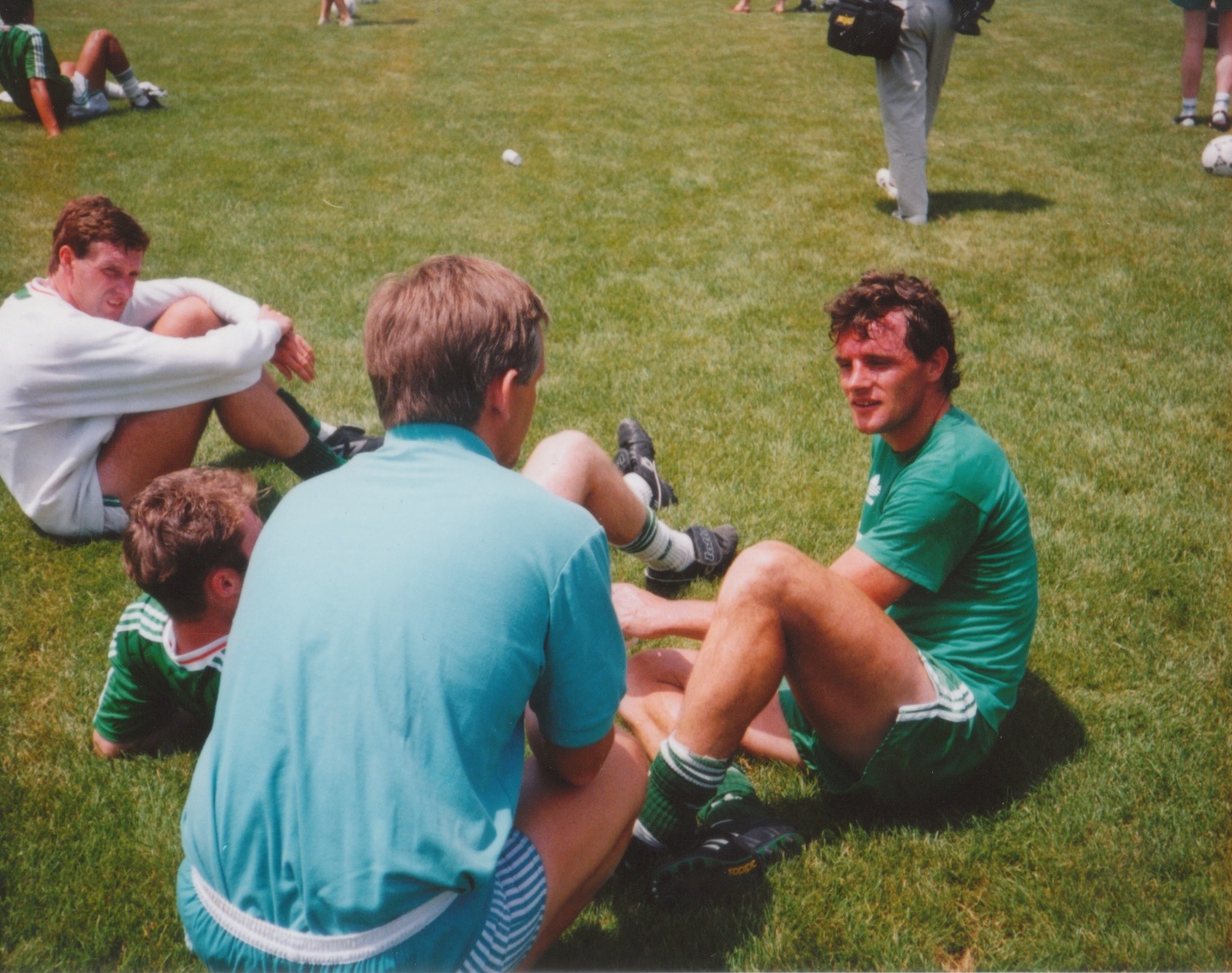
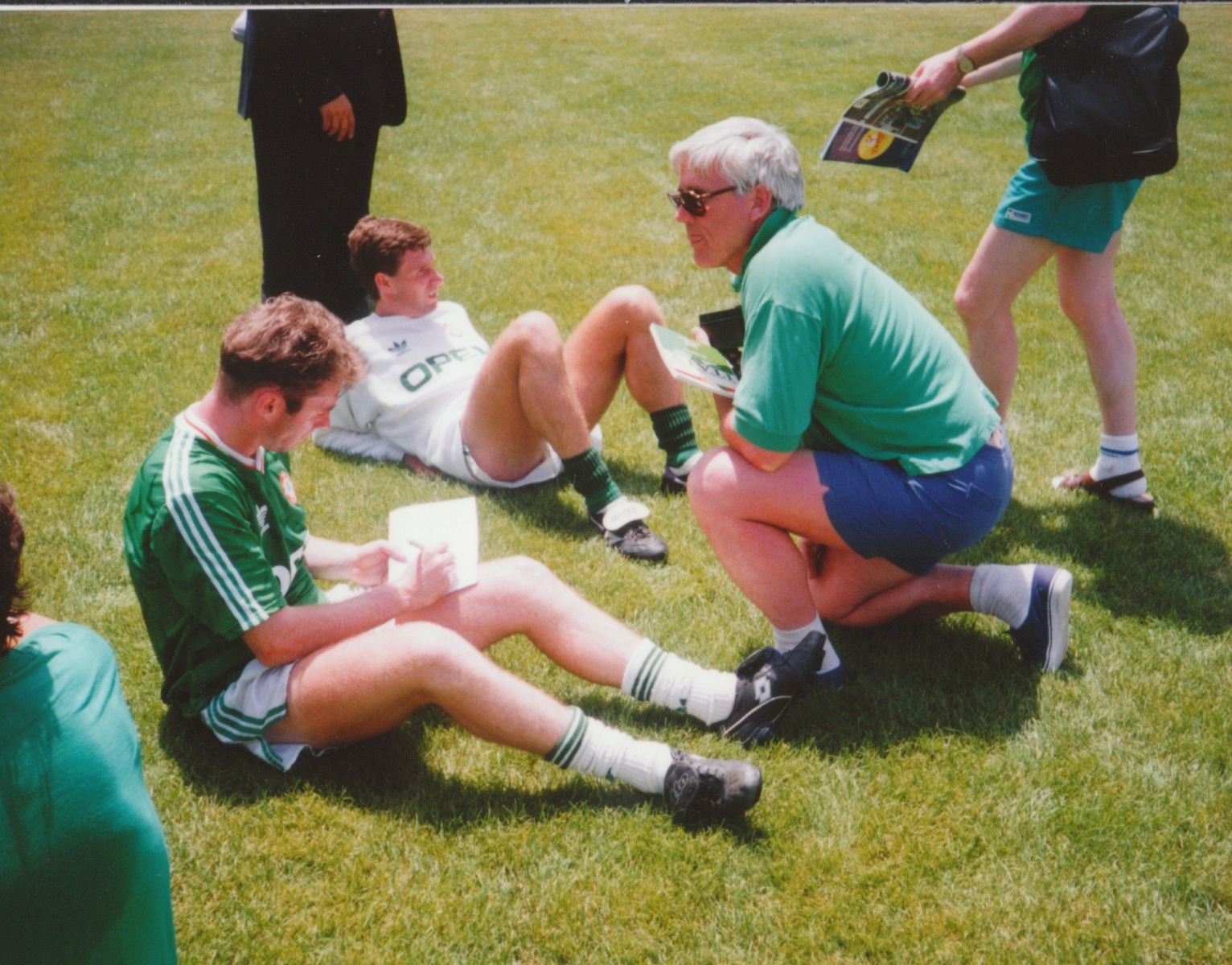
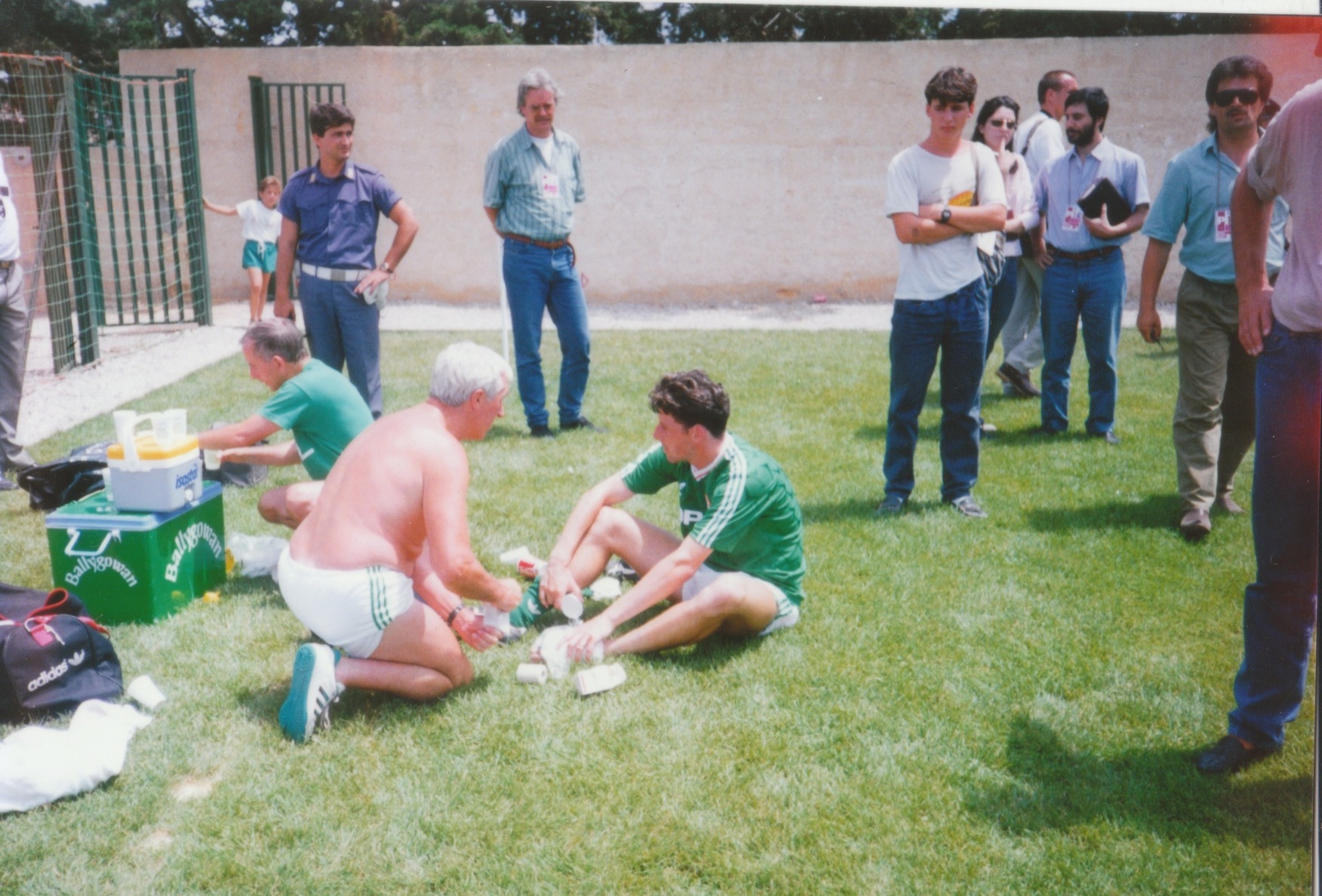
These are taken in Ireland’s training ground in Sicily:

Packie Bonner signing autographs. Credit - BM

Packie Bonner signing autographs. Copyright – BM

Kevin Moran and other players taking a break. Credit - BM

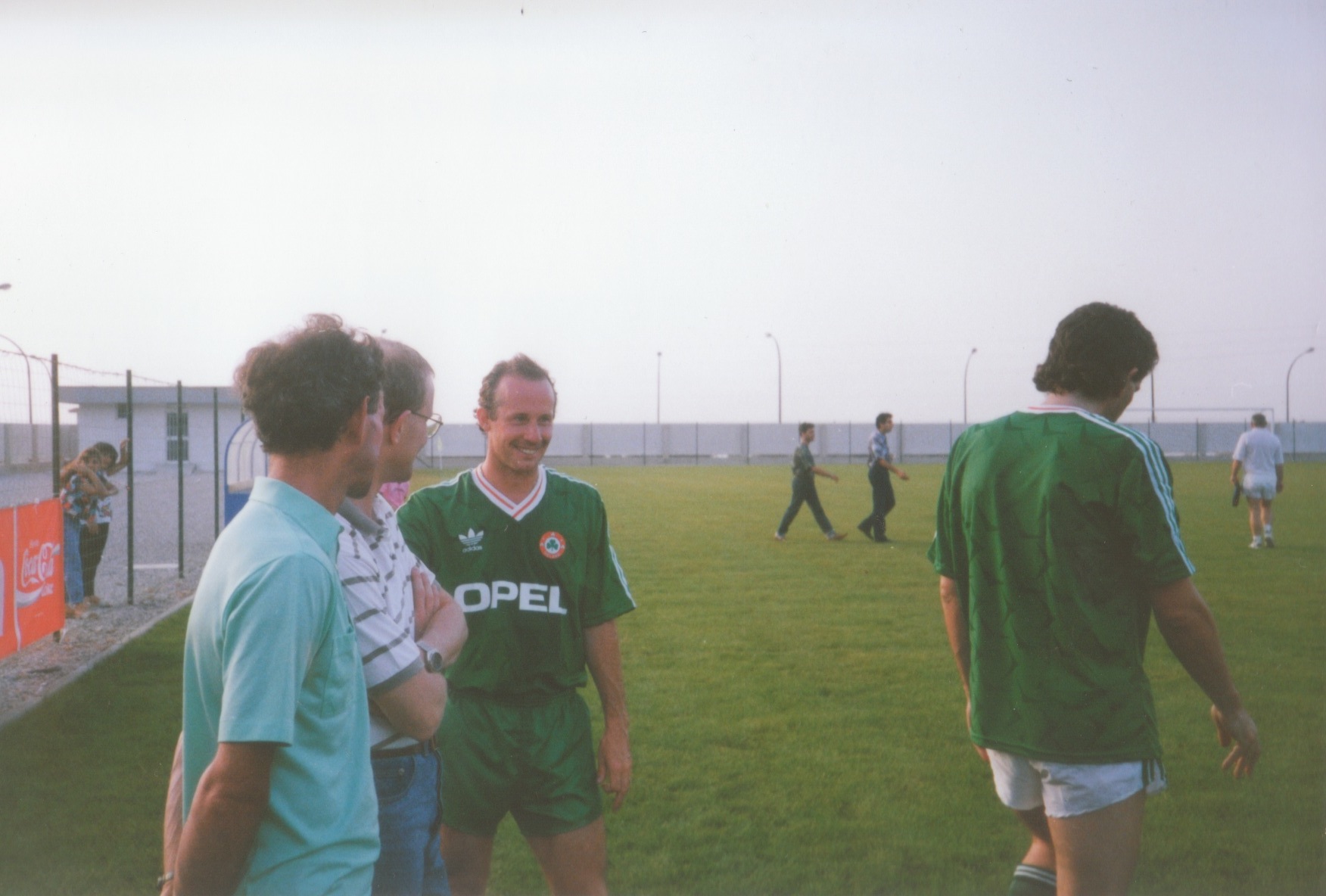
Kevin Sheedy, Chris Morris and Kevin Moran taking a break. Copyright – BM

Autograph hunters approach Packie Bonner. Credit - BM

Autograph hunters approach Packie Bonner. Copyright – BM

Andy Townsend receiving some treatment. Credit - BM

Andy Townsend receiving  treatment. Copyright – BM

A smiling Liam Brady. Credit - BM

A smiling Liam Brady at game between Irish and Italian media. Copyright – BM

This got me thinking about Ireland’s 22 man squad that played at the finals and how many were Dublin born or had played for League of Ireland clubs. This is what I came up:

Kevin Moran, who grew up in Rialto and then Walklinstown, made one appearance with Bohemians in the 1974/75 season before moving to UCD. In December 1975, UCD won the Collingwood Cup beating Dublin University at Belfield Park. In February 1976, Moran scored the winning goal for ‘Irish Universities’ in the Universities Championship final against their Scottish counterparts. Moran joined Manchester United in 1978.

Ronnie Whelan, grew up in Finglas West, made his League of Ireland debut for Home Farm on his 16th birthday at Tolka Park on 25th September 1977. He played with the side for two seasons before joining Liverpool in 1979.

Paul McGrath, who was born in London but was brought up in a number of orphanages in Dublin, made his debut for St. Patrick’s Athletic in a League of Ireland Cup clash with Shamrock Rovers in August 1981 at Richmond Park. He ultimately excelled at St Pat’s, earning the nickname “The Black Pearl of Inchicore” and receiving the PFAI Player of the Year Award in his first and only season, scoring four goals in 31 total appearances. He joined Manchester United in 1982.

David O’Leary moved to Dublin from London at the age of three but did not play for any League of Ireland side. Neither did Niall Quinn from Perrystown in Dublin or Frank Stapleton who grew up in Artane.

Meanwhile Steve Staunton from Drogheda made 13 appearances in the 1985/86 season with Dundalk F.C. while Birmingham-born David Kelly finished his football career with seven appearances (and two goals) at Derry City F.C. in 2002.

Grafton Street, 1973 (Irish Press)

Grafton Street, 1973 (Irish Press)

On 8 June 1973, five men were brought before District Justice Breathnach in Dublin District Court 6. They were all members of the Hare Krishna grouping. A Garda detective rose before the courts, and stated that:

They were walking down Grafton Street playing music and making a lot of noise. I had cautioned them on previous occasions not to play music to the annoyance of the inhabitants of the street….They were using cymbals and drums and bells. They were walking in single file but people had to walk in the roadway to avoid them.

Charged with obstructing traffic while playing instruments, the Judge asked if any of the five before him spoke English, only to hear that three came from Ireland. Angered by the presence of a cylindrical drum suspended from the neck of one the men, the Judge informed them that “I can warn you that you are lucky not to have been assaulted by a crowd. Any decent Irishman would object to this carry-on.” Going one further, he complained that “I’ve no jurisdiction to order a forfeiture of those things, bells and leaflets. If I had, I’d be fairly radical and confiscate those nonsensical things.” The five were fined seven pounds each and sent on their way, but outside there was more to come when The Irish Times reported a Garda as asking the five why they prayed the way they did. “You should pray in the church”, he told them, “and even then the priests don’t pray all day.”

A bad day for tolerance in Ireland then, a country clearly still adapting to the new presence on its streets, in the form of practising Hare Krishnas. Their first appearances in the Irish media seem to have been in 1971, though then it was their London equivalent who were being discussed, with the Inside London column of The Irish Times noting that “not that it could ever happen in Dublin: we already have our Jesus freaks.”

Essentially, The International Society for Krishna Consciousness is a faith group dating back to 1966. Its followers ” dedicate their thoughts and actions towards pleasing the Supreme Lord, Krishna”, and today it runs an impressive international network that includes over 50 schools and 90 restaurants, several of which are here in Dublin.

1973 saw the group the focus of huge media attention in Ireland. Not alone had the recent arrivals attracted the scorn of Gardaí and Judges, but there was huge general interest in their acquiring a premises, in the form of a bungalow overlooking Dublin Bay at Sutton. Following on from the remarks made by District Justice Breathnach, journalists flocked to the Hare Krishnas to hear their story, with Des Hickey from the Irish Independent writing that six men were living in the bungalow, or “temple” as they described it, able to live on £20 a week between them. He wrote that “After the chanting and praying and dancing, Narrahari brought me into a small room to show me rows of bottles of perfume he had made. They sell them in a Dublin market at weekends, with colourfully produced Krishna books.” Far from District Court 6, it seemed the people of Sutton were largely not bothered by their neighbours.

An image from inside the Hare Krishna home at Sutton, taken from the Irish Independent.

An image from inside the Hare Krishna home at Sutton, taken from the Irish Independent.

An Irish Press journalist visiting the home was introduced to Brendan, a young man from Drimnagh, who had become involved with the group though was not yet fully initiated. He may well have best captured the appeal of the group to young Dubliners at the time, noting that “I’ve been into a lot of things since I left school, you know? Things like Yoga, the Divine Light Mission, the hippies. I suppose I’ve been into a lot of isms”.

Rather unsurprisingly, the incredibly reactionary comments of the District Judge led to quite a lot of rather sympathetic coverage for the group, with a sort of eagerness to understand them in the media. The Irish Times followed several members from Dublin to Galway, on a “brief tour to towns and villages along the coat, preaching their antidote to the ills of modern life.” The group managed to get lost in the housing estates of Raheny first however, “looking for a laundry to collect some clean robes.”

Previously on the blog Sam has looked at the history of vegetarianism in Dublin. In a 1975 Irish Times article entitled ‘The Whole Vegetarian Thing’, Patrick Comerford quoted the owner of the Ormond Health Centre as saying the growth of organisations like the Hare Krishnas and the Divine Light Mission was contributing to a rise in demand for vegetarian produce in the city. Still, the group remained minuscule in Dublin with regards to numbers, and gradually media interest waned until the later half of the 1970s. Indeed, in 1975 the religious correspondent of the same newspaper asked “whatever happened to Hare Krishna?”

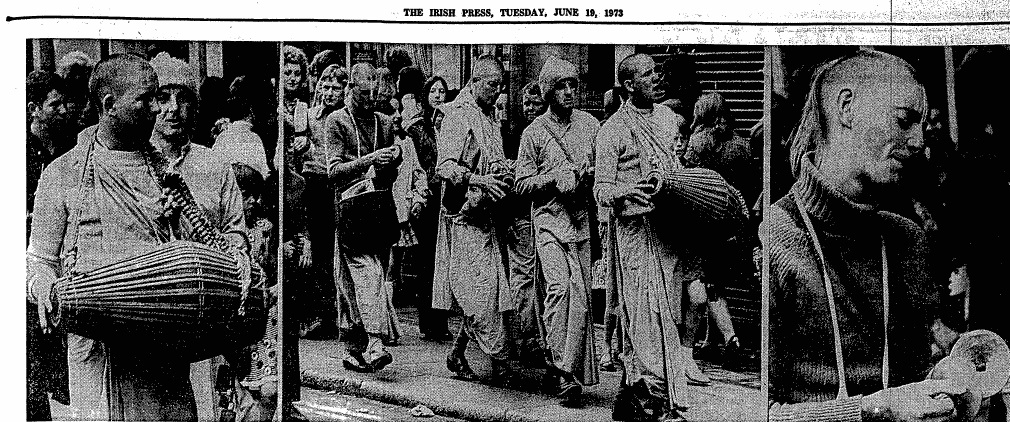
Irish Press images of Hare Krishnas.

Irish Press images of Hare Krishnas.

In 1978 a new premises was acquired at Belvedere Place, leading to a new media interest in the faith once more. This impressive premises, opened in what was a fine renovated Georgian House, gave some indication of the growth of the faith globally, and 50 to 60 people partook in the opening ceremony, with some travelling to Dublin for the occasion. No doubt in reference to the remarks made in 1973, The Irish Times asked “whether Dublin wants the knowledge which they claim they and their scriptures offer remains to be seen, but hopefully it has grown more tolerant since they were here before.” A follow-up article a year later would see the group claim that Ballymena in Antrim was “where they are received best” outside of Dublin, and the group claiming 30 full-time Irish devotees. The group welcomed the visit of the Pope in 1979, noting that “the essence of all religions is to develop love of God”.

One of my favourite views in Dublin is looking over into Rathmines from the Portobello Bridge, with the dome of the Catholic church visible.

The beautiful dome of the church dates back to 1923, as the church was almost totally destroyed by a fire in 1920. Incredibly, it appears from the statements of some IRA members to the Bureau of Military History that this church premises was being used to store weapons at the time of the fire by republicans in Dublin, and that weapons were hidden from authorities following the destruction of the church by sympathetic figures in the fire brigade.
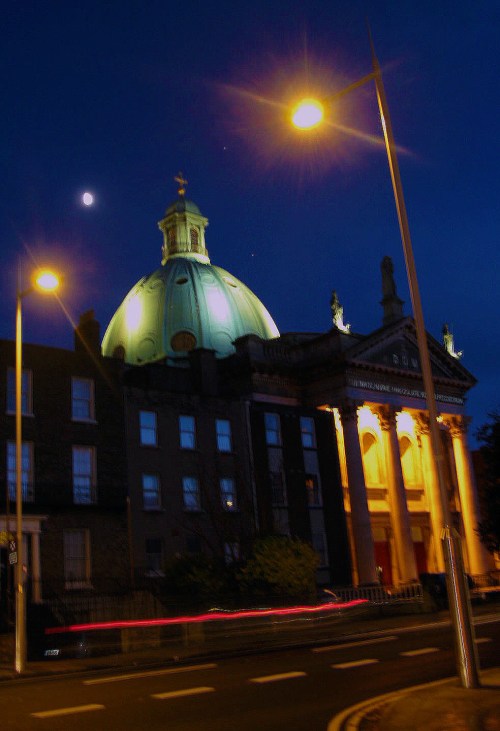
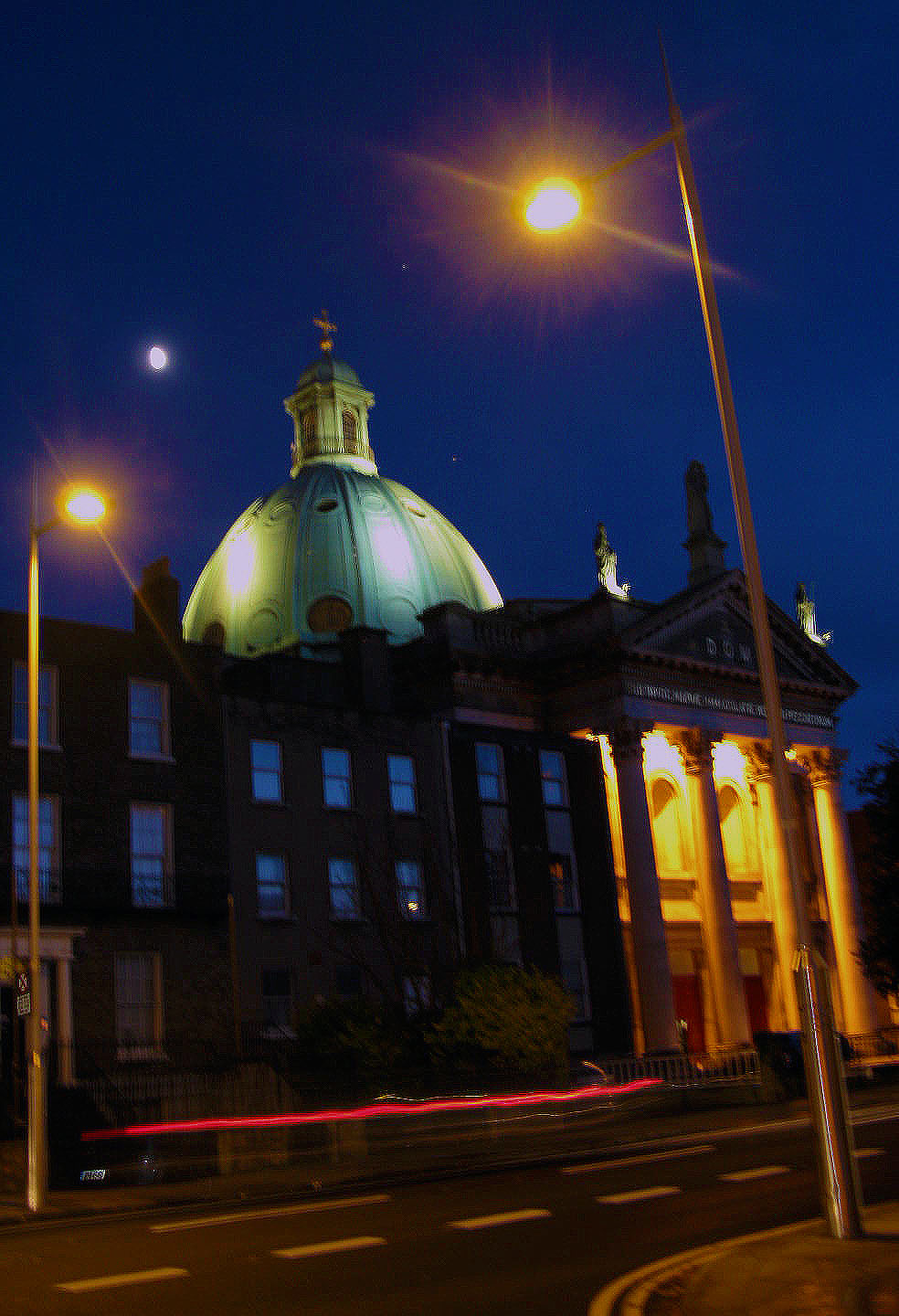
The dome of the church at night. (Image: Ciaran Murray/CHTM)

The dome of the church at night. (Image: Ciaran Murray/CHTM)

On 26 January 1920, the sacristan of the Catholic Church of Our Lady of Refuge arrived shortly after six o’clock to find the switchboard that controlled the electricity ablaze inside the vestry. Fire quickly spread throughout the church, with newspapers noting that the flames were “spreading with alarming rapidity in all parts of the building, and mounting up the walls to the base of the spacious dome.” While Rathmines had its own functioning fire service at this time, the Dublin Fire Brigade also arrived on the scene, with The Irish Times reporting that:

The Dublin Fire Brigade, which had been sent for, worked in unison with the Rathmines Brigade, and placed two engines on either side of the Grand Canal at Portobello Bridge, and soon had a copious supply of water sent in through the rear of the church by way of Mountpleasant Avenue.

The fire was an incredibly dangerous job for the firefighters on the scene, with the dome roof of the church crashing down, leading to fears some men may have been trapped underneath, although this was thankfully not the case. The Irish Times noted that for hours after the blaze continuous streams of water were poured upon it, and that the overall damage to the church was estimated at between £30,000 and £35,000, thankfully covered by insurance.

The first hand testimonials of several republicans given to the Bureau of Military History suggest that the church in Rathmines was used by republicans as a place to store weapons, and indeed as a place in which to seek refuge. Henry Murray, a veteran of the Easter Rising and active with the Dublin IRA through the War of Independence recalled that he and another members of ‘A’ Company of the Dublin Brigade “frequently slept in Rathmines Catholic Church when ordered to remain away from home to evade arrest.”

Murray gives plenty of information in his Witness Statement to suggest that there was a strong relationship between local republicans and this church, noting that:

The Clerk of this Church was at that time a member of “A” Company and he acted as assistant to the Company Quarter-master. In pursuance of his military duties he utilised some of the vaults in the Church as a “dump” for the major portion of the Company’s arms and equipment.

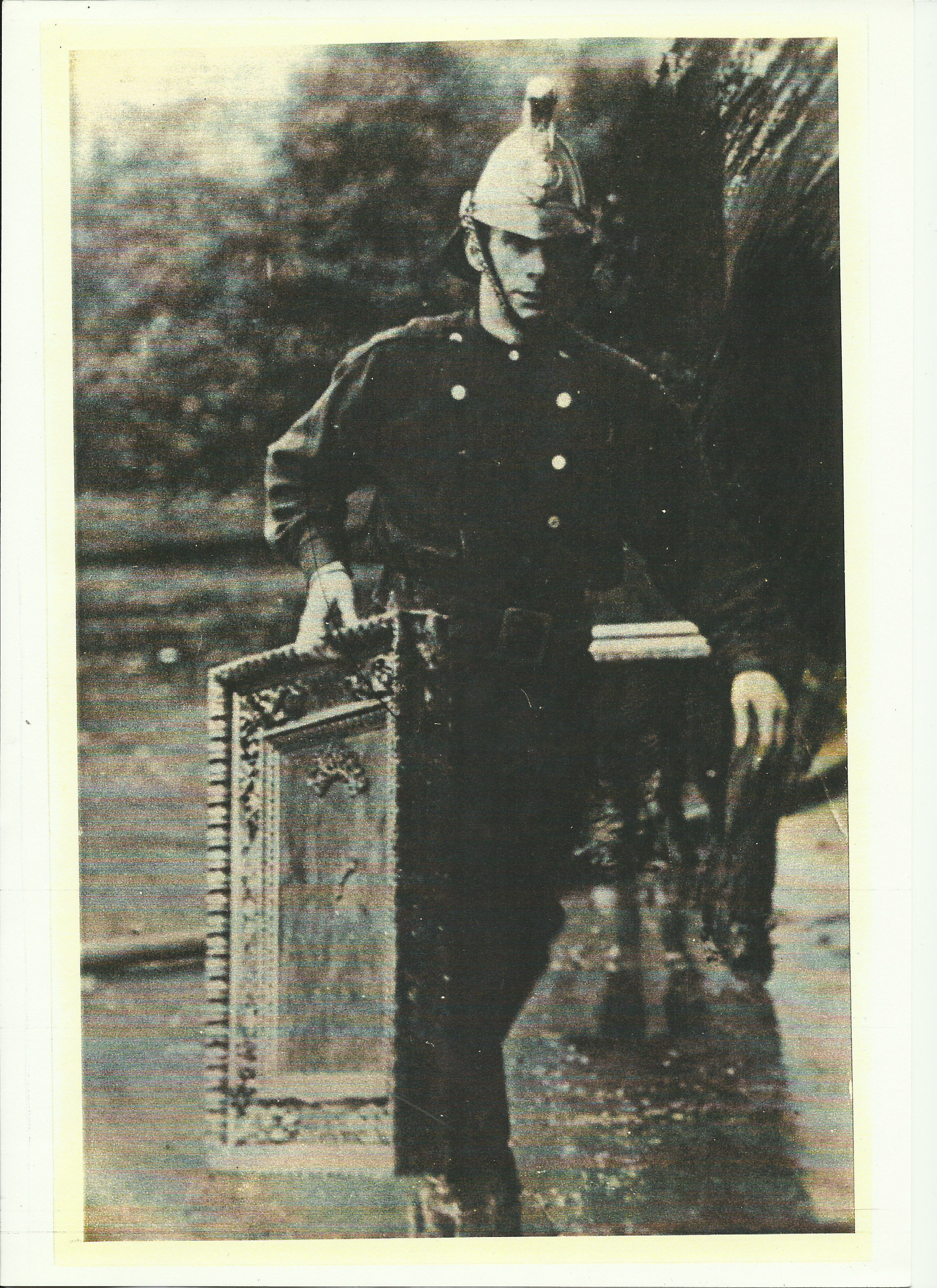
A firefighter removes an item from the fire in the  Rathmines church (Image via Las Fallon)

A firefighter removes an item from the fire in the Rathmines church (Image via Las Fallon)

Murray claimed that the IRA were storing “rifles, revolvers, ammunition, hand grenades and military equipment” in the vaults of this church, and that when he arrived at the scene of the fire:

I found that several members of the Company who were aware of the position, had entered the building at great personal risk, made their way to the vaults and were engaged in removing the dumped arms and ammunition to places of safety.

Another account of the church and the movement is found in the statement of Michael Lynch, a member of ‘B’ company of the 4th Battalion of the Dublin Brigade of the IRA. Lynch gives a different account of the fire somewhat, which suggested that many weaposn were destroyed by the blaze, but noting that there existed a fear among the IRA that the presence of a weapons dump in the church may be discovered by the British during the clean-up, and that “I knew what a disaster it would be to ourcause if the British got hold of the fact that we were using the vaults of houses of worship as dumps for arms.”

Lynch describes going to meet with Captain Myers of the Dublin Fire Brigade, who he knew to be “a very fine fellow and, from the
national point of view, thoroughly sound and reliable in every way.” John Myers, the head of the Dublin Fire Brigade at the time, could even boast of appearing within the pages of Ulysses, and in the days of revolution in Dublin he appears to have been a very useful ally to the IRA, as Lynch recalled:

I told him the true story and asked him to see that the Rathmines people got no inkling whatever of the fact that some dozens of rifles and revolvers were lying in the debris under the floor of the church. He told me not to worry, that nobody would ever know. The incident passed unnoticed by anybody.
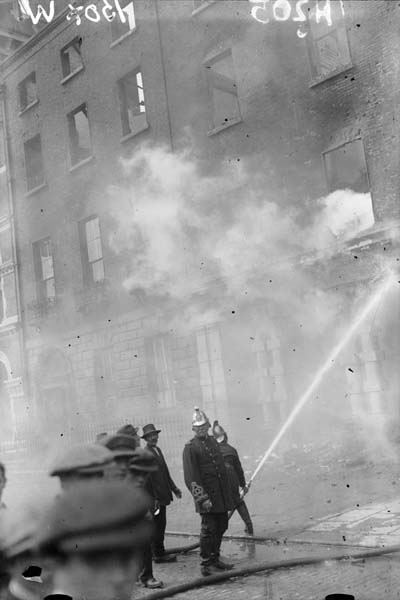
Captain Myers, who was asked by concerned republicans to ensure no weapons would be recovered from the church (NLI)

Captain Myers, who was asked by concerned republicans to ensure no weapons would be recovered from the church (NLI)


If Myers had republican sympathies, he was certainly in the right line of work. In the recent book Dublin Fire Brigade and the Irish Revolution, Las Fallon details how several members of the Dublin fire service were secretly involved with the IRA and Irish Citizen Army at the height of the troubles, even assisting in rescuing IRA men from inside the Custom House following the burning of that building in 1921. Indeed, on that occasion one fireman would recall entering the building and spreading the fire “into parts of it which had not previously been on fire.” Members of the Dublin Fire Brigade had fought in the Easter Rising, War of Independence and Civil War, and the likely assistance of Dublin firemen in keeping an arms vault at Rathmines secret may well also indicate republican feeling in the ranks of the job.
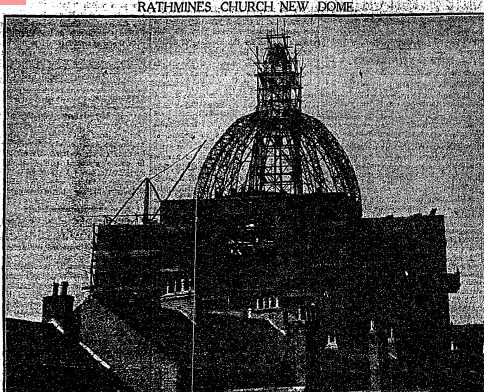
A 1923 image of the new church dome. (Irish Times)

A 1923 image of the new church dome. (Irish Times)

The distinctive dome of the church today is often said to have originally been intended for Russia, with an article in the Sunday Times in 2001 writing of the fire that destroyed the Rathmines church in 1920 and noting that:

Meanwhile, across the water in Glasgow, a specialist manufacturing firm had just mothballed a massive, ornate copper dome believed to have been commissioned for a church in Russia. It is likely the contract was derailed as a result of the Russian revolution and the emergence of Lenin’s anti-religious Bolsheviks.

A contemporary newspaper report from the 1920s on the construction of the new dome however stated that “the architects are Messrs. W.H Byrne and Sons, Suffolk Street, Dublin; the consulting engineer Mr. Alfred Delap….of Dublin and the steel contractors Messrs. J and C. McGloughlin Ltd., Great Brunswick Street, Dublin.” We’d love to hear from anyone who knows more of the contemporary dome and its origins.

——

Rathmines has featured on CHTM before, with this article from Sam looking at working class housing in the area. Dublin Fire Brigade and the Irish Revolution, referenced above, is available to purchase here.
An advertisement for U.2 and The Blades at The Baggot Inn (u2theearlydayz.com)

An advertisement for U.2 and The Blades at The Baggot Inn (u2theearlydayz.com)

On August 8th, CHTM will be taking part in ‘Banter on the Liffey’, a night of chat and discussion organised by Jim Carroll of The Irish Times. It’s all happening as part of the Liffey Legover Festival, and Sam will be joining Jim to talk about some of Dublin’s famous (and infamous) musical venues historically. From Punk to Rave, Rock to New Wave, it’s a fascinating subject that has featured on the site here plenty. It’s one of three discussions Jim has organised. The other two see legendary DJ Tony Fenton discuss his career and life, and visual artist Fergal McCarthy discusses the River Liffey and how it has influenced his work. Some of you may remember the giant Monopoly homes floating in the Liffey!

The three talks:
The Tony Fenton Retrospective In 35 Minutes – the Today FM legend on his life on and off the airwaves
Dives, sweatboxes and ballrooms – Come Here To Me’s Sam McGrath on the life and times of some of the city’s most celebrated music venues
The Liffey and me – visual artist Fergal McCarthy on how the river has influenced his works like Liffeytown and No Man’s Land

According to Jim:

We’ll start the night at 7pm-ish in the Workman’s Club, move across the river to the Grand Social for 8.30pm and bring it all to a close at the Twisted Pepper, the place where Banter started, for 10pm-ish. Admission to all events will be free

The Workman's Club  on Wellington Quay, in a former life.

The Workman’s Club on Wellington Quay, in a former life.

American newspaper image showing Gardaí keeping protesters away from Edward Kennedy at Trinity College Dublin, 1970.

American newspaper image showing Gardaí keeping protesters away from Edward Kennedy at Trinity College Dublin, 1970.

The fiftieth anniversary of the visit of John F. Kennedy to Ireland has seen much commemoration, with events in Dublin and across the country marking the Presidential visit. While protest was absent during the visit of J.F.K, international coverage of the visit of Edward Kennedy to Trinity College Dublin a few years later in 1970 had plenty to say about protesters and a less-welcoming crowd. Protests against Kennedy were largely orchestrated by Maoist students, and while they ultimately failed to disrupt Kennedy’s visit in any real way, they received huge media coverage in Ireland and the United states. The Milwaukee Journal went as far as to claim “it was the first time in Irish history that more than a few isolated Irishmen even spoke against the Kennedy family.”

In March 1970 Kennedy was invited to Trinity College as part of the bicentenary celebrations of the College Historical Society. He was to give a lecture in honour of Edmund Burke, one of the most celebrated graduates of the university and indeed the society. In opposition to this visit, Kennedy was met by protests not alone at the college itself but even at Dublin Airport. This opposition was organised largely by Maoist students at the university, a small but dedicated band of left-wing activists who had a rather high-profile having launched major protests against the visit of King Baudoin of Belgium to the college in the summer of 1968.

A rather unusual headline from The Meridian Journal (Connecticut)

A rather unusual headline from The Meridian Journal (Connecticut)

Conor McCabe has written on the history of the Maoist tendency among the student left in Trinity College Dublin, pinpointing November 1965 as the moment ‘The Internationalists’ were founded. In his article he identifies Hardial Bains, a lecturer in bacteriology who was originally from India, as crucially important to the growth of Maoism in the college. Bains was also referenced in American media reports at the time of Kennedy’s visit, with The Meridian Journal claiming he had come from Canada to Trinity and since returned there, “leaving a hardcore of about 40 Trinity Maoists” An article on the Maoists published in 1970 by Nusight, and available to read in full here, was a little less generous, estimating that their membership was something around fifteen in the college, but noting:

There are quite a few Maoists in Ireland now. In Trinity College there are about 15, in U.C.D. about 8. In U.c.c. there are only 4 or so, while in Galway university there are about 5. In Limerick there are around 6 while in Dublin outside the university there are possibly another 10 to 15. This numbers in all about 50 Mao­ists.

In addition to this there are numerous camp followers in the uni­versities. Various dilletante socialists follow the Maoists because they feel they are the “authentic” social­ists. Other students follow them but do not join either because they are not allowed to or because they are unwilling to commit themselves wholly to the group. This might bring the total of Maoists in the country up to about 70-80. They re­main nevertheless a static group

The Internationalists called on Trinity students to protest against the visit of Edward Kennedy in propaganda leaflets, even drawing on the memory of the 1963 visit of JFK by noting that such visits by the family to Ireland were designed to present themselves as “friendly visiting celebrities” and to confuse people “about the true nature of U.S imperialism”. The students condemned Kennedy as “representative of the most barbarous class of parasites the world has seen”, and called on students to join a mass demonstration against him at 7.30 on Tuesday 3 March, designed to coincide with his speech.

An Associated Press image showing Ted Kennedy in Dublin, being welcomed by Dublin County Chairman P.J Burke

An Associated Press image showing Ted Kennedy in Dublin, being welcomed by Dublin County Chairman P.J Burke

Kennedy’s visit was not limited to Dublin, he also visited New Ross, where a crowd of several hundred welcomed him warmly. The Sarasota Herald-Tribune in the U.S claimed that “students from Dublin – the ‘long haired brigade’ as the locals call them- invaded the town during the night and plastered up posters saying ‘Oppose Ted Kennedy: American Imperialist!’ but most were taken down before Kennedy arrived from Dublin.” Kennedy had first visited New Ross in 1962, but in 1970 the purpose of his visit was to visit the John F. Kennedy Memorial Park, which had been opened to commemorated his murdered brother. A rather different environment than what awaited him in Dublin, newspaper reports noted that he was “surrounded by a crowd of around 200 jostling to shake his hand.”

When Kennedy spoke on the topic of Edmund Burke at Trinity College Dublin on the Tuesday night, it was reported that “demonstrators outside displayed portraits of Communist Chinese leader Mao Tse-tung alongside a ‘Down With Kennedy!’ banner”. Kennedy’s speech was interrupted by a student in the gallery waving the little red book of Mao’s theory, shouting “Down with U.S imperialism- Kennedy get out!”. Kennedy joked “there goes one of the great debaters” as he was removed from the hall.

A cartoon in The Irish Times following Kennedy's speech.

A cartoon in The Irish Times following Kennedy’s speech.

As Kennedy left the university, his car was blockaded by a few dozen students, with a Garda force of only forty reportedly on hand. The pounding of the car lasted for several minutes, with Gardaí arresting one student demonstrator. This was not to prove the only confrontation between Kennedy and the Internationalists however, as protesters also made their presence felt outside his hotel by attempting to prevent his driver bringing him to meet with the Taoiseach, Jack Lynch. Even prior to his departure from the city at Dublin Airport, Kennedy was again greeted by protesters. Though a crowd of 200 or so gathered to cheer him, there were also opposition voices.

The Internationalists remain a fascinating chapter in the history of the student left and the broader radical left in Ireland. At the time, they were viewed by some in the media as a very real threat. In 1970, The Irish Times wrote that Maoism was gaining some influence in Irish secondary schools, with the suspension of four young Dublin students receiving significant coverage in the paper.

Yet others viewed things differently. The Nusight article quoted above ended on the following note, only months after the Kennedy visit:

Anyone who understands the Irish working class knows that the Maoists are not a threat to the status quo in Ireland. They are however a threat to the radical left in that they dis­credit socialism in the eyes of the ordinary people and are a constant source of ammunition for professional scare-mongers in Ireland

.

Anthony Cronin, John Ryan and Patrick Kavanagh at the Martello Tower, Sandycove , marking the first Bloomsday (National Library of Ireland)

Anthony Cronin, John Ryan and Patrick Kavanagh at the Martello Tower, Sandycove , marking the first Bloomsday (National Library of Ireland)

The first Bloomsday in 1954 is the stuff of Dublin legend. Flann O’Brien and Patrick Kavanagh paid drunken homage to the masterpiece of Joyce, joined by an array of characters including the publican and artist John Ryan, Anthony Cronin and Tom Joyce. Tom was a dentist, but crucially he was also a relative of the more famous Joyce. The plan was to travel the city in horsecabs, following the journey of Leopold Bloom.

Despite the good intentions of the group, the entire thing was abandoned for a session at The Bailey, a public house that was conveniently owned by Ryan. Interestingly, The Bailey was once been the home of the front door of No.7 Eccles Street, the address of Leopold Bloom in the work. Ryan had the good sense to save this door at the time major construction was taking place on Eccles Street for further development of the Mater Hospital, and he placed the door inside of his pub. Today, it is on view in the James Joyce Centre.

This brilliant video footage was posted to YouTube recently by artfarrago· It shows Flann O’Brien in particular looking well on his way, but it is perhaps the sight of literary talent pissing against the wall at Sandymount Strand that will interest readers!

Storymap have just released over a dozen new videos of Dublin storytellers, as part of the Dubline project. The Dubline is intended as a historical and cultural route that runs from Trinity College Dublin to Kilmainham. These stories are a great adddition to the stories along the route which were already recorded as part of their broader project of mapping the city. You can see their map of the Dubline stories here.
A screengrab of the new Storymap.

A screengrab of the new Storymap ‘Dubline’.

Beginning down at College Green, Lorcan Collins has contributed this great video on the history of King Billy on College Green. We’ve looked at this statue in the past, quoting from Ireland in Pictures (1898) who wrote that “no statue in the world, perhaps, has been subject to so many vicissitudes.” Lorcan’s story ends with praise for the brilliant Thomas Davis statue, and the meaning of that man to the nation:

Ross Keane from the IFI talks about the history of that institution, including controversies around films which suffered to Ireland’s infamous film censorship such as Natural Born Killers.

My own father has contributed to the series, telling the story of the horrific Whiskey Fire that hit the Liberties in 1875. Horses and pigs running through the streets, dead bodies carried out of wakes and burning tenements all feature. You’ll be amazed to hear how all those who died met their end:

My own earlier contribution to the Storymap series features along the route, in the form of the story of Vonolel, a famous and honoured horse. We’ve posted that here on the site before.