Feeds:
Posts
Comments

Anne Devlin Bridge

With potential names for the new bridge across the River Liffey at Marlborough Street whittled from seventeen candidates down to ten recently, only two women’s names remain in the running- Rosie Hackett and Kay Mills.

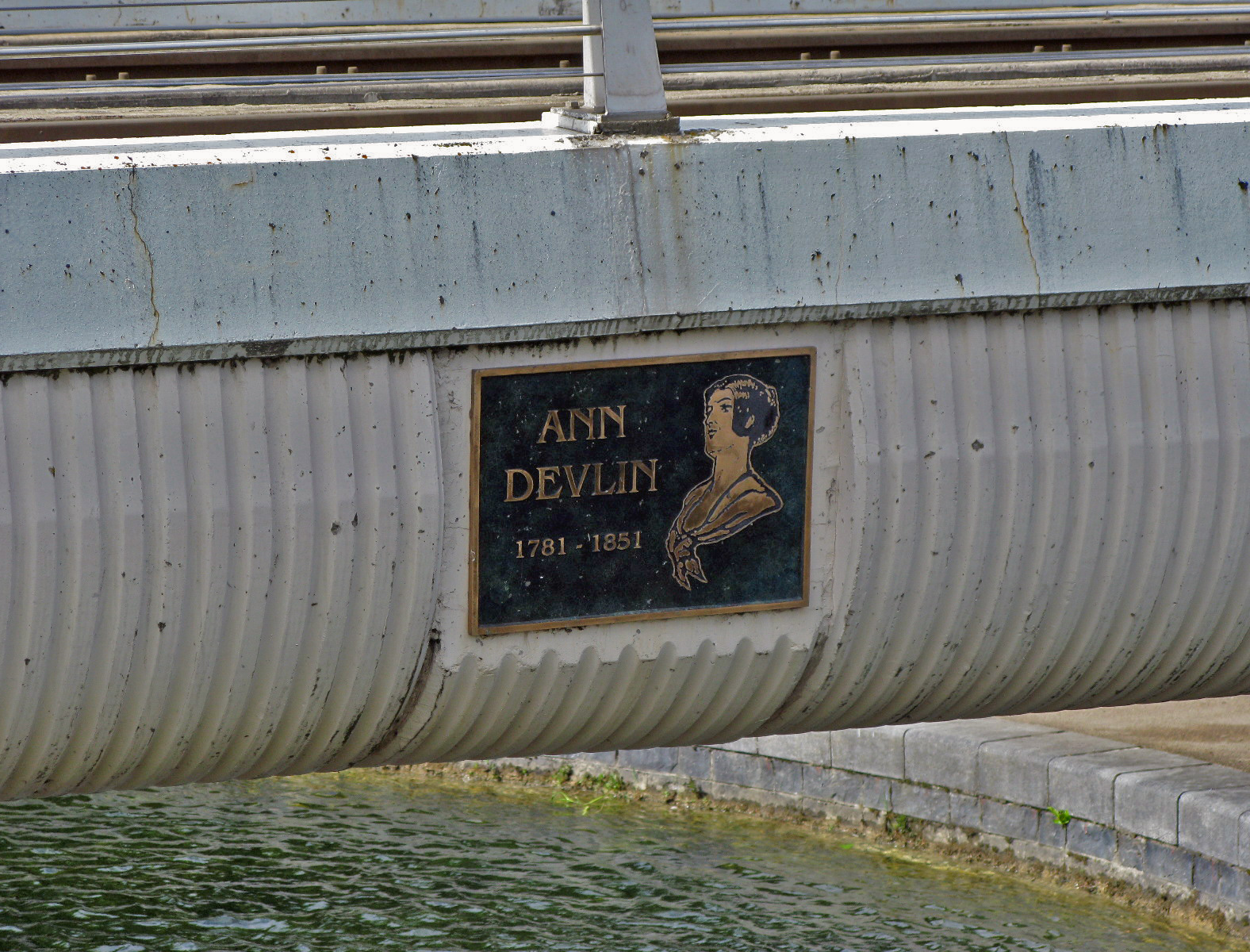
Now it’s not as if Dublin is awash with bridges or in fact any landmarks named after women of historical importance. When you look at our abundance of waterways; the Liffey, the Grand Canal, the Royal Canal, the Dodder, the Tolka and the Camac, (and they’re only the ones that haven’t been forced underground,) you’d expect more than one name to pop up. I’m not going to include Victoria Bridge or the Anna Livia Bridge for obvious reasons, and Sally’s Bridge (an alternative name for Parnell Bridge) doesn’t exactly count either. So even at an approximate guess of the fifty or so bridges in Dublin City named after historical figures, and I’m open to correction, there is currently only one named after a woman, and that’s not even a decade old. The Anne Devlin Bridge was opened in 2004 to facilitate the crossing of the canal by the LUAS at it’s Suir Road stop. And even at that, they spelled her name wrong on the plaque.

anndevlin

“Ann” Devlin Bridge. Photo by hXci.

Anne Devlin was born into a family of nationalist stock near Rathdrum, Co. Wicklow in 1780; amongst others, she was cousin to famed Irish rebels Michael Dwyer and Hugh Byrne on her mother’s side. At the age of 17, and just a year before the rising of 1798, Anne moved to Inchicore where she became a servant of the Hempenstall family. Brought back to her homestead by her father in early ’98 she, along with the rest of the Devlin’s and Dwyer’s suffered at the hands of the British authories and watched as her father Bryan was thrown into jail without being charged of a crime where he was to stay for two years before a suprising aqcuittal on retrial. Two uncles and two cousins of Anne suffered the same fate and Hugh Byrne was executed having escaped and consequently recaptured.

Persecution drove the family to move to Rathfarnham, where they became neighbours of  “Mr. Ellis,” an assumed name of none other than Robert Emmet, who had taken residence there with the intention of preparing for his rising of 1803. Anne, along with Rosie Hope (wife of Jemmy Hope) took on the roles of housekeeper’s at Emmet’s house at Butterfield Lane, although in reality, they were much more than that. Anne was to become an advisor, messenger and confidante between Emmet and his partner, Sarah Curran. The failure of the rising, where numbers failed to materialise, and having lost control of his men in the Thomas Street area, who having spotted the Chief Justice, Lord Kilwarden in his carriage, pulled him from it and stabbed him to death with their pikes, caused Emmet to go into hiding.

The house at Butterfield Lane was searched, and finding Anne there, soldiers submitted her to questioning. Her repeated replies of “I have nothing to tell; I’ll tell nothing,” led to Anne being surrounded and advanced upon with fixed bayonnets. The piercing of her skin head to toe still didn’t break her, and she was taken outside where they half- hanged her from a tilted cart.  She still would not speak and was later arrested and taken to Kilmainham Jail where she was again questioned by Henry Charles Sirr. Sirr offered her £500 for the where-abouts of Emmet’s hiding places and co-conspirators to no avail and she was thrown in jail. Her entire family was imprisoned in an effort to wear her down, leading to the death of her  8 year old brother, and Emmet himself before his execution begged her to speak, knowing himself to be a dead man either way. She refused, saying she did not want to go down in history as an informer. She was eventually released in 1806 under an amnesty upon the change of British administration in Ireland.  

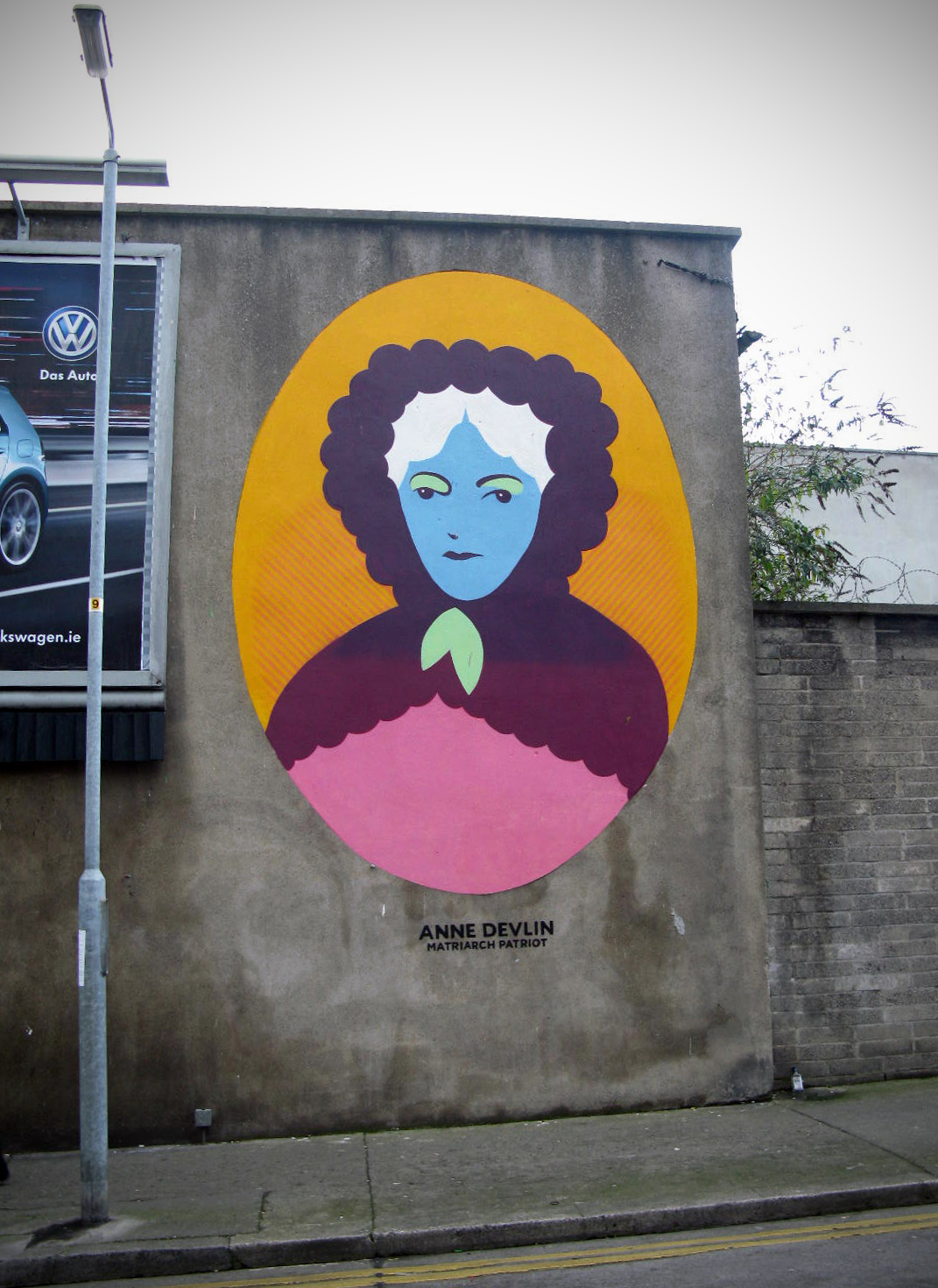
AD2 copy

Anne Devlin portrait, by Maser. Photo by hXci.

After her release, Anne found employment under Elizabeth Hammond at 84 Sir John Rogersons Quay, where she spent four years. She married a man named Campbell and had two children, a boy and a girl and made a living washing and cleaning. Campbell died in 1845 and Anne, whose children lived away from her, was left alone in a squalid residence at 2 Little Elbow Lane in Dublin’s Liberties. An appeal was made for assistance for Anne in the Liberty Newspaper in 1947, and while there was some response, it was far from adequate. She died in obsecurity on September 16 1851 and was buried in a paupers plot in Glasnevin before her body was exhumed by Dr. R. R. Madden, the chief historian of the United Irishmen, and re-buried in the plot she lies in today.

One from fifty is not enough. Sign the petition to have the new Liffey bridge named in honour of Rosie Hackett here:

 
And check out the Facebook here:
 

This Sunday, I’m happy to be taking part in a discussion at the History Festival of Ireland. This is the second year of the event, and it is taking place “amidst the ruins and walled gardens of Ducketts Grove in Co. Carlow.” There is a great line up of events for the weekend, with Saturday and Sunday both seeing discussions on everything from the Bronze Age to the 1913 Lockout. The full programme is available to read here.

Carlow

The discussion I’m taking part in is on history in the 21st century, and I’m sharing the panel with people who I think are doing very interesting things as far as bringing history to a mainstream audience is concerned.

Sunday – 1.15pm A Future for Our Past: History in the 21st Century – Roisin Higgins (chair & author of ‘Transforming 1916′), Donal Fallon (co-founder of the Come Here to Me blog), Tommy Graham (founder of History Ireland magazine) and Neil Jackman (founder of Abarta Audioguides) on the way in which our understanding of history is being honed by technology.

The event is being organised by Turtle Bunbury, who also runs the brilliant Wistorical page on Facebook. It has posted a few Dublin gems in recent times, including a brilliant little tidbit on the 1911 Census Form of 1916 leader Seán Mac Diarmada.

Seán enjoyed filling out the census form in April 1911. Under “Marriage”, the 26-year-old remarked “Single, but not for long” and under “Disabilities” he wrote “heart-broken from being single”.

Under “Religion”, he entered “Náisiuntacht na h-Eireann”, meaning “The Nationhood of Ireland”. This was helpfully, but erroneously, translated by the enumerator as “Church of Ireland”.

At the time Seán was living at 15 Russell Place, Dublin…

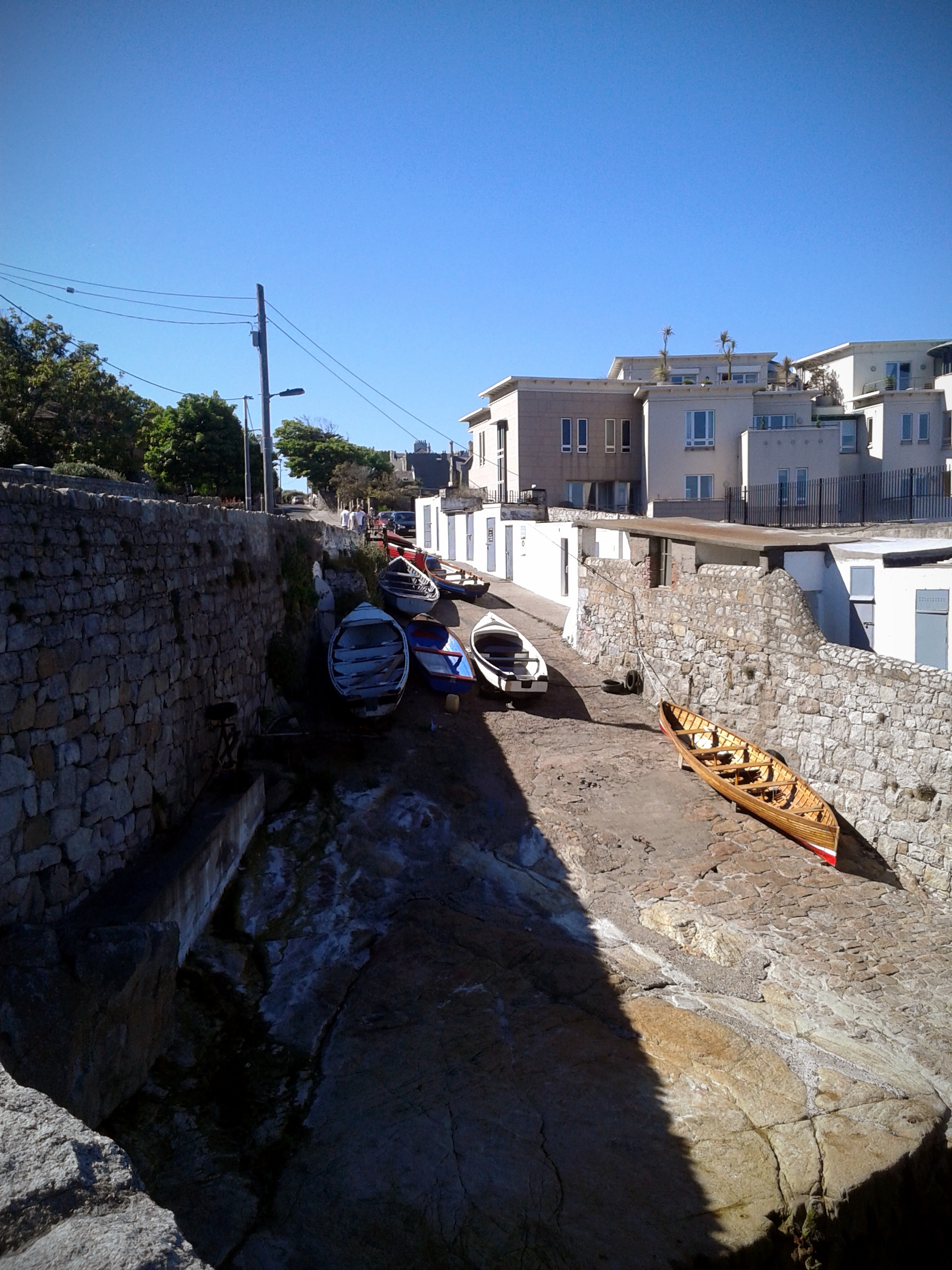
It was never going to last forever; summers in Ireland rarely do, but when we had it, we had it good. The forecast suggests that we’re back to the four seasons in one day we know and love but who knows what lies around the corner; a couple of weeks down the line we might actually have blue skies that aren’t the catalyst for rucks out in Portmarnock… Here’s a few snaps I took this weekend on a couple of cycles that spanned Dublin Bay from Killiney to Howth.

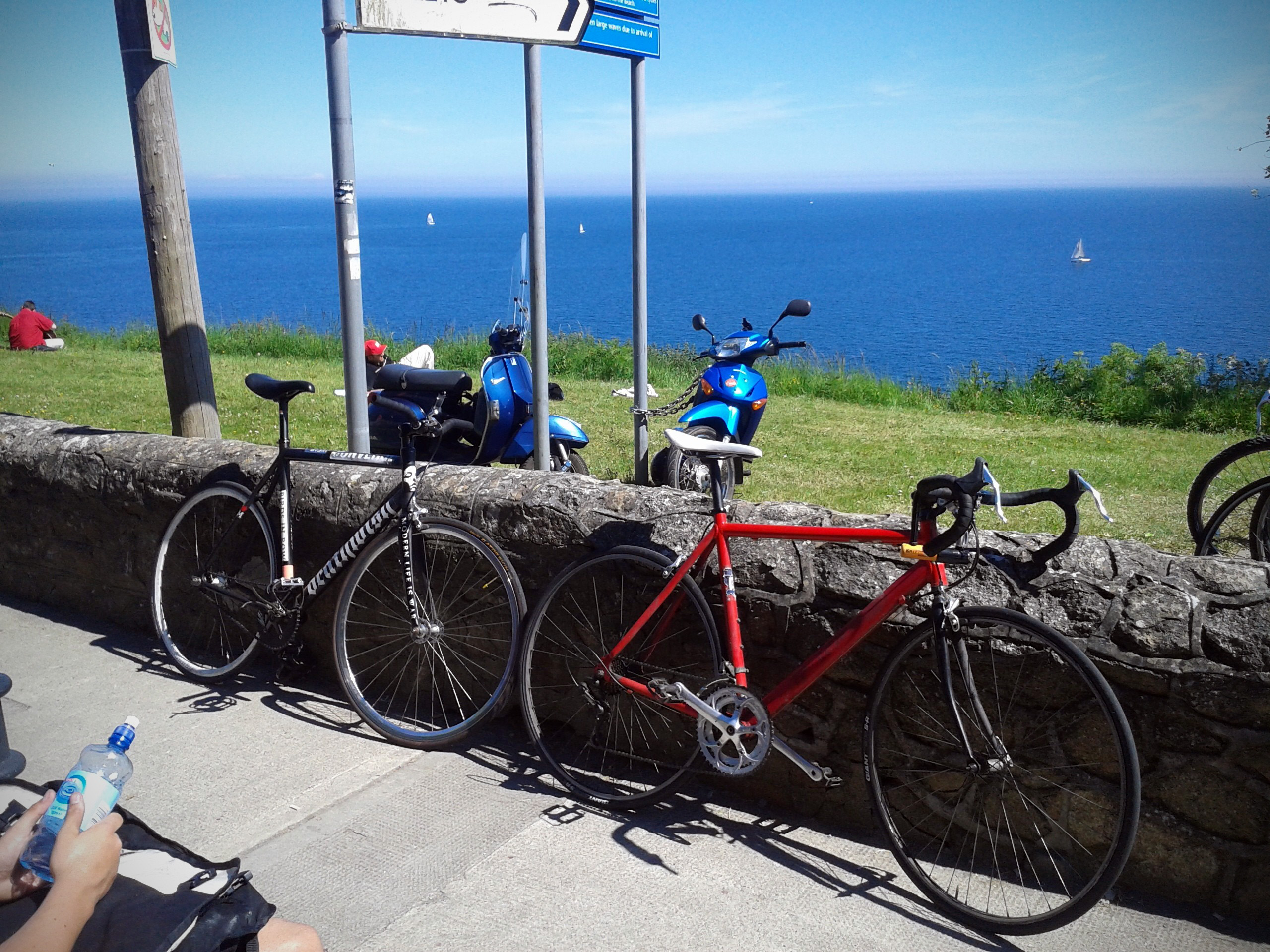
bikes Starting on Sunday, a skip down the coast-road as far as Killiney. It looked like half of Dublin had the same idea as the road to Bray (our intended destination) quickly resembled something like the M50 at rush hour. Getting up and down the hill at Kiliney is hard enough at the best of times, trying to skip between Range Rovers and convertibles made it all the harder. We called it a day at the spot above and headed slowly back.

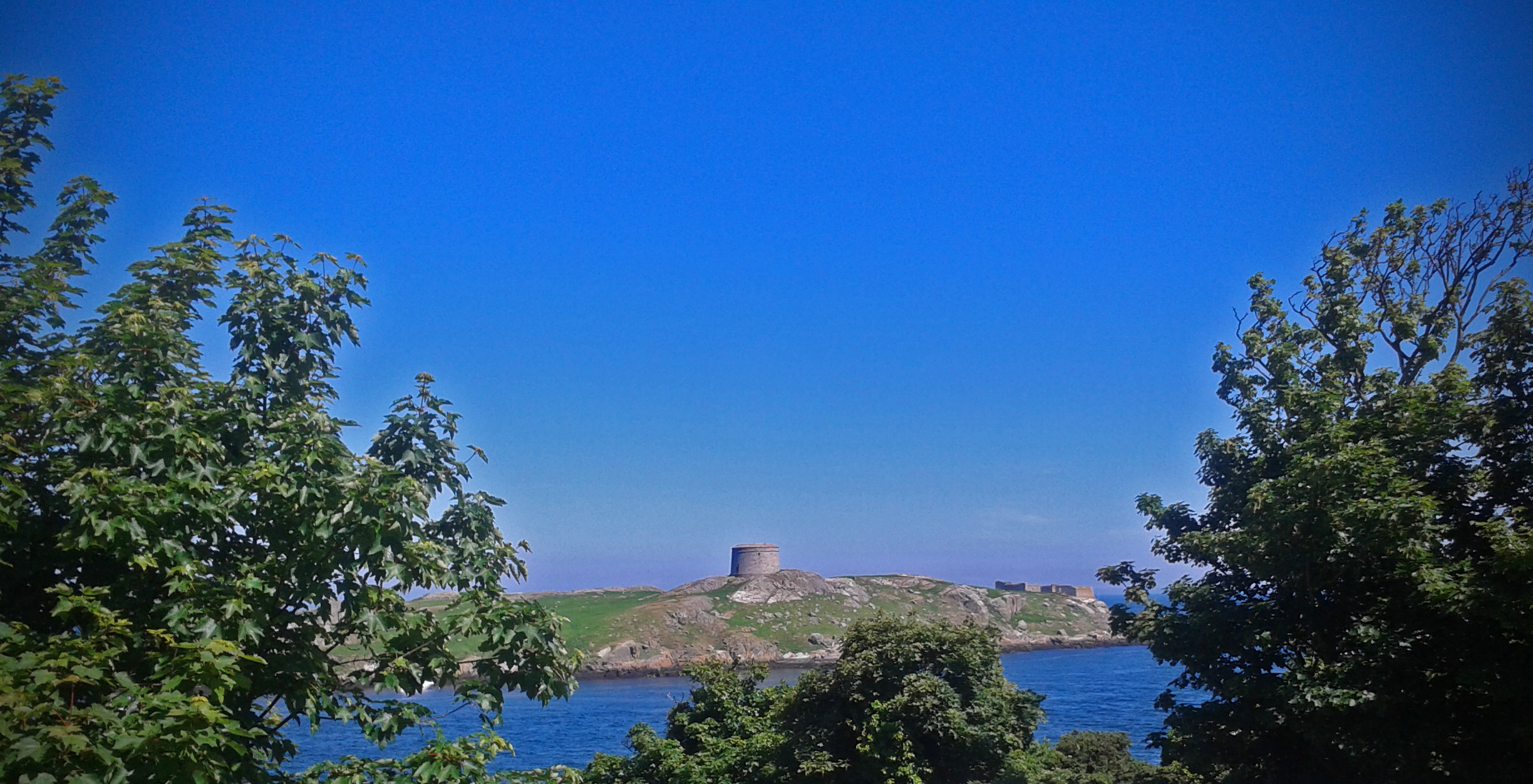
towerThe Martello Towers along the coast are something I’ve always meant to look at in depth but haven’t gotten around to in yet. Here’s a view through the trees of the one on Dalkey Island.

boats

Continue Reading »

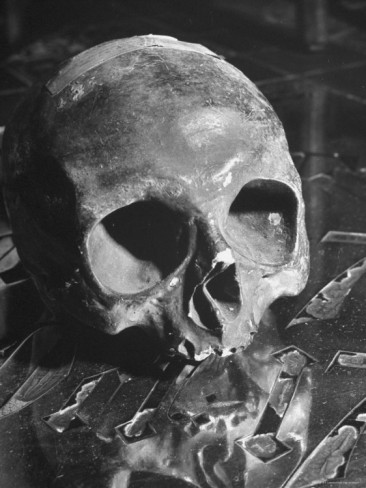
A cast of Jonathan Swift's skull, at Saint Patrick's Cathedral.

A cast of Jonathan Swift’s skull, at Saint Patrick’s Cathedral (Credit:LIFE)

A rather unusual story from the history of Saint Patrick’s Cathedral involves the remains of Jonathan Swift and his companion Esther Johnson, popularly known as Stella. Today, a visitor to the cathedral will see the epitaph Swift himself wrote. While it is in Latin, it has been translated into English as follows:

Here is laid the Body
of Jonathan Swift, Doctor of Sacred Theology,
Dean of this Cathedral Church,

where fierce Indignation
can no longer
injure the Heart.
Go forth, Voyager,
and copy, if you can,
this vigorous (to the best of his ability)
Champion of Liberty.

He died on the 19th Day of the Month of October,
A.D. 1745, in the 78th Year of his Age.

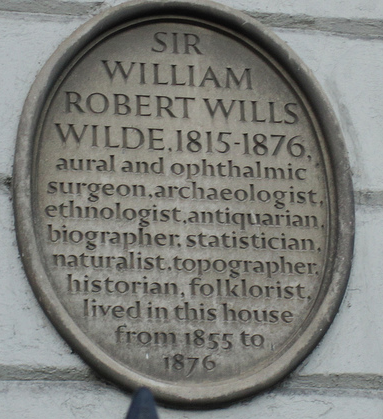
Among the exhibited items in the Cathedral today is a cast of the skull of Swift, but incredibly this cast dates to 1835, ninety years after the passing of the Dean. William Wilde, the father of none other than Oscar Wilde, would later detail the examinations upon the skull. Wilde was a prominent medical figure in Dublin, a leading eye and ear surgeon as well as author of several works on medicine. In his work The Closing Years of the Life of Dean Swift he described the exhuming of the body in 1835 in some detail.

A plaque to Wilde upon the family home at Merrion Square today.

A plaque to Wilde upon the family home at Merrion Square today.

By 1835, the magnificent Cathedral found itself in dire need of restoration and renovation owing to water damage, and Wilde notes in his study that the frequency of flooding in the River Poddle led to much injury to the cherished cathedral. Repairs to the Vaults led to the exposure of the coffins of Swift and Stella, and Wilde stresses in his study that the repairs were “the sole cause of these sacred relics being again exposed.”

Incredibly, these coffins were not alone moved but actually opened, and among those present was the anatomist Dr. John Houston, who described the remains of Swift by writing of how “the bones were all clean, and in a singularly perfect state of preservation. When first removed, they were nearly black, but on being dried they assumed a brownish colour.”

Not alone were the coffins of the dead opened, but the skulls of both Stella and Swift were removed from the Cathedral, for examination by the British Association for the Advancement of Science. As Wilde notes:

The British Association were, at that very time,meeting in Dublin, and the skulls of Swift and Stella were then removed, for the purpose of being phrenologicaly examined by the corps of phrenologists that used to follow in the wake of that learned body…

For those unfamiliar with the term, Phrenology can be described as “a pseudoscience primarily focused on measurements of the human skull, based on the concept that the brain is the organ of the mind, and that certain brain areas have localized, specific functions or module.”

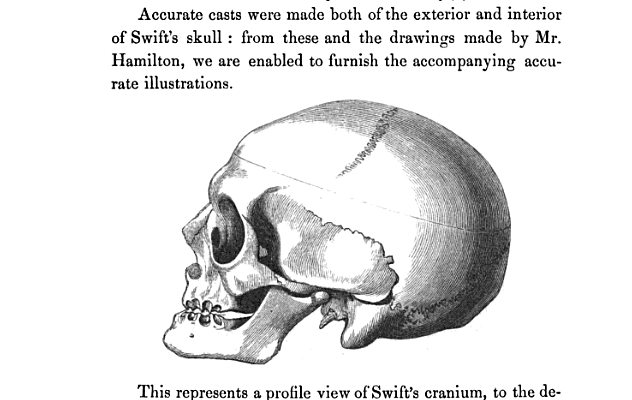
Casts and drawings of the skulls survive from 1835, and a number of these drawings were used as illustrations in the work of William Wilde:

From Wilde's study.

From Wilde’s study.

The observations made by one examiner of the skull seem quite humourous today, given the status of Swift as one of the greatest wits in Irish history:

On looking at Swift’s skull, the first thing that struck me was the extreme lowness of the forehead, those parts which the phrenologists have marked out as the organs of wit, casualty and comparison, being scarcely developed at all.

It has been noted that the skulls were ‘going the rounds’ at the time, becoming objects of great curiosity to Dubliners and visitors alike, and while the main examination of the skull was said to have occurred at the home of Sir Henry Marsh, Wilde notes in his study that “during the week or ten days which elapsed before they were returned….they were carried to most of the learned, as well as all the fashionable societies of Dublin.”

The manner in which the skulls were examined angered many at the time, and brought considerable criticism upon the then Dean of the Cathedral. Swift and Stella’s skulls were thankfully brought back to the cathedral. William Wilde’s study of the Dean is a very readable work available to read in full here, and particularly interesting is Wilde’s observation that a loose bone in Swift’s inner ear (Ménière’s disease) was responsible for much of his behaviour that was sometimes presented as insanity.

Wilde noted that:

… neither in his expression, nor the tone of his writing, nor from an examination of any of his acts, have we been able to discover a single symptom of insanity, nor aught but the effects of physical disease, and the natural wearing and decay of a mind such as Swift’s.

Today, a cast of Stella’s skull can be seen in Marsh’s Library, next to Saint Patrick’s Cathedral, while Swift’s can be viewed at the cathedral.

Postcard views of Dublin

Many thanks to Mick Healy for sending these on.

'Postcard views of Dublin'

‘Postcard views of Dublin’

O'Connell St

O’Connell St

College Green

College Green

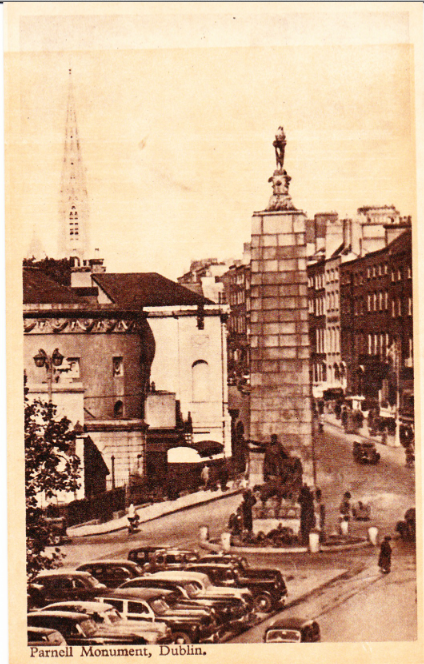
Parnell Monument

Parnell Monument

St. Stephen's Green

St. Stephen’s Green

Pearse and the Pillar

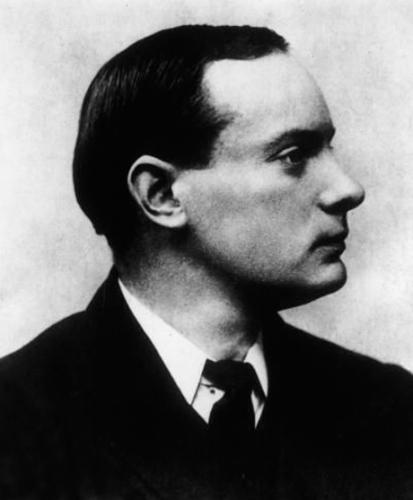
P.H Pearse, one of the signatories of the 1916 proclamation, executed for his role in the rebellion.

P.H Pearse, one of the signatories of the 1916 proclamation, executed for his role in the rebellion.

The afterlife of the Nelson Pillar on O’Connell Street is every bit as interesting as its lifespan, and from the late 1960s onwards various committees and campaign groups lobbied with the aim of placing a monument in the location where Nelson had stood. One reaccuring proposal was to replace Nelson with a monument to Patrick Pearse. Indeed, the idea of putting Pearse on top of the monument was even floating around before the destruction of the Pillar, with a motion calling for Nelson to be removed and replaced by the revolutionary leader brought before Dublin Corporation in August 1948.

In 1979, architect Yann Goulet brought forward a controversial model for a proposed Pearse monument to the City Council.

Architect Yann Goulet with his proposed monument to Patrick Pearse, photographed at City Hall in 1979.

Architect Yann Goulet with his proposed monument to Patrick Pearse, photographed at City Hall in 1979.

Higher than the GPO, and containing over £150,000 worth of bronze, the proposal was ridiculed when brought towards the City Council, with Councillor Frank Sherwin stating “it should be thrown in the Liffey”, while Councillor Hanna Barlow described it as “the yoke”. The proposed 100-foot-high abstract monument did not enjoy significant support from any quarters, but it is was just one proposed monument in honour of Pearse for the site. An earlier proposal in the same year came from the Pearse Commemoration Committee, who proposed a much more traditional style monument, to be carried out by sculptor Gary Trimble. The Irish Independent newspaper totally opposed any monument to Pearse in an editorial which noted:

If anything is to replace the Pillar, it should be something which will bring people together, and not something which will caused divisiveness and bitterness, as the proposed Pearse statue is clearly destined to do.

There were wild scenes at one meeting to discuss a proposed Pearse monument, when Lord Mayor Paddy Belton condemned the Pearse Commemoration Committee as “a bunch of Provos”, insisting that members of Sinn Féin were to the fore of the campaign to honour Pearse on O’Connell Street. This was a hugely controversial remark, as the Pearse committee had come from a very broad spectrum of Irish society, including Gael Linn and other Irish language groups. Bord Fáilte also objected to any planned memorial to Pearse, a surprise blow to the campaign, on the grounds that “it may interfere with the view of the GPO which is the vocal point of O’Connell Street.”

Trimble’s proposed monument was comparable in size to the monument to Parnell, and would show Pearse reading from a book, surrounded by children:

Trimble's proposed monument.

Trimble’s proposed monument.

Various points of view on any proposed monument to Pearse were reported in the media, ranging from over-the-top praise (“The messiah of the nation’s revival” in the words of Frank Sherwin) to calls for a monument that would be inclusive of the other 1916 leaders. Tomas Mac Giolla for example noted that James Connolly should not be forgotten in any monument at the site. The Pearse pressure group continued to campaign for the placing of a monument to Pearse on O’Connell Street, even if the Pillar site itself was off-limits. Councillor Pat Carroll reportedly pondered if it would be possible “to take down one of the monuments in O’Connell Street, such as that of John Gray, which did not seem to be too important.” However with Gray’s leading role in establishing a clean water supply for much of Dublin, I’d argue today he is far from unimportant!

Today, James Connolly remains the only one of the seven signatories of the proclamation with a statue in Dublin city centre.

There have been a small but not insignificant number of reactionary murders in Dublin and on the island of Ireland since the 1920s. I have tried to compile a list of these here. They are divided up into areas of anti-Semitism, homophobia and racism.

I have purposely not included murders in regard to nationality (Irish/English) or religion (Catholic/Protestant), as due to this island’s history, these are a completely different matter.

Obviously not all murders of ‘foreign nationals’ in Ireland can be considered ‘racist’. Those that have been included all had a racial element to them though.

Anti-Semitism:

31 October 1923: Bernard Goldberg, Dublin
Golderg (42), a Manchester jeweller and father of four, was shot on St Stephen’s Green after three men had stopped him and his brother Samuel and demanded their names.
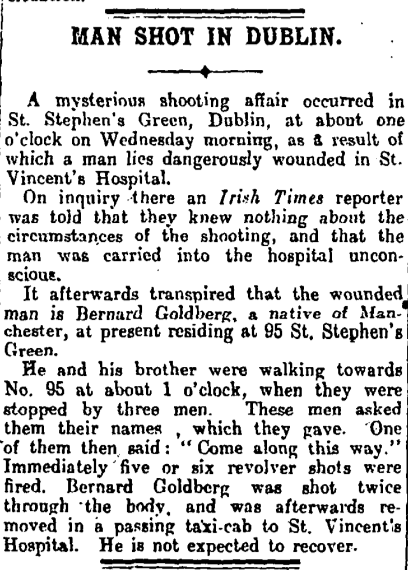
The Weekly Irish Times, 3 November 1923.

The Weekly Irish Times, 3 November 1923.

14 November 1923: Emmanuel Kahn, Dublin
Dublin-born Kahn (24) of Lennox Street, was gunned down in Stamer Street in Portobello as he returned home after an evening playing cards. David Millar, who was with him in the Jewish Club in Harrington Street, was also shot in the shoulder but managed to stagger home.

The principal instigator of these two murders was Commandant James Patrick Conroy, who claimed to have resigned from the army in December 1924 because he disagreed with the policy of the then government. He fled to Mexico and then to the United States, along with with two other suspects, after the incidents. No-one was ever convicted. A curious footnote to the whole affair was found in remarks in the Dail in February 1934, when Fianna Fail finance minister Sean McEntee claimed that one of the killers was walking free, and was a member of the fascist-style Blueshirts organisation.

Sexuality:

3 June 1979: Anthony McCleave, Belfast
McLeave was murdered in one of the city’s best known ‘cruising areas’. He was found with his head rammed onto a spike on a protective bollard outside the fire station on Chichester Street. The RUC closed the case within twenty-four hours but was it reopened after a campaign by the Northern Ireland Gay Rights Association (NIGRA) which was backed by the McCleave family. No-one was ever charged with his death.

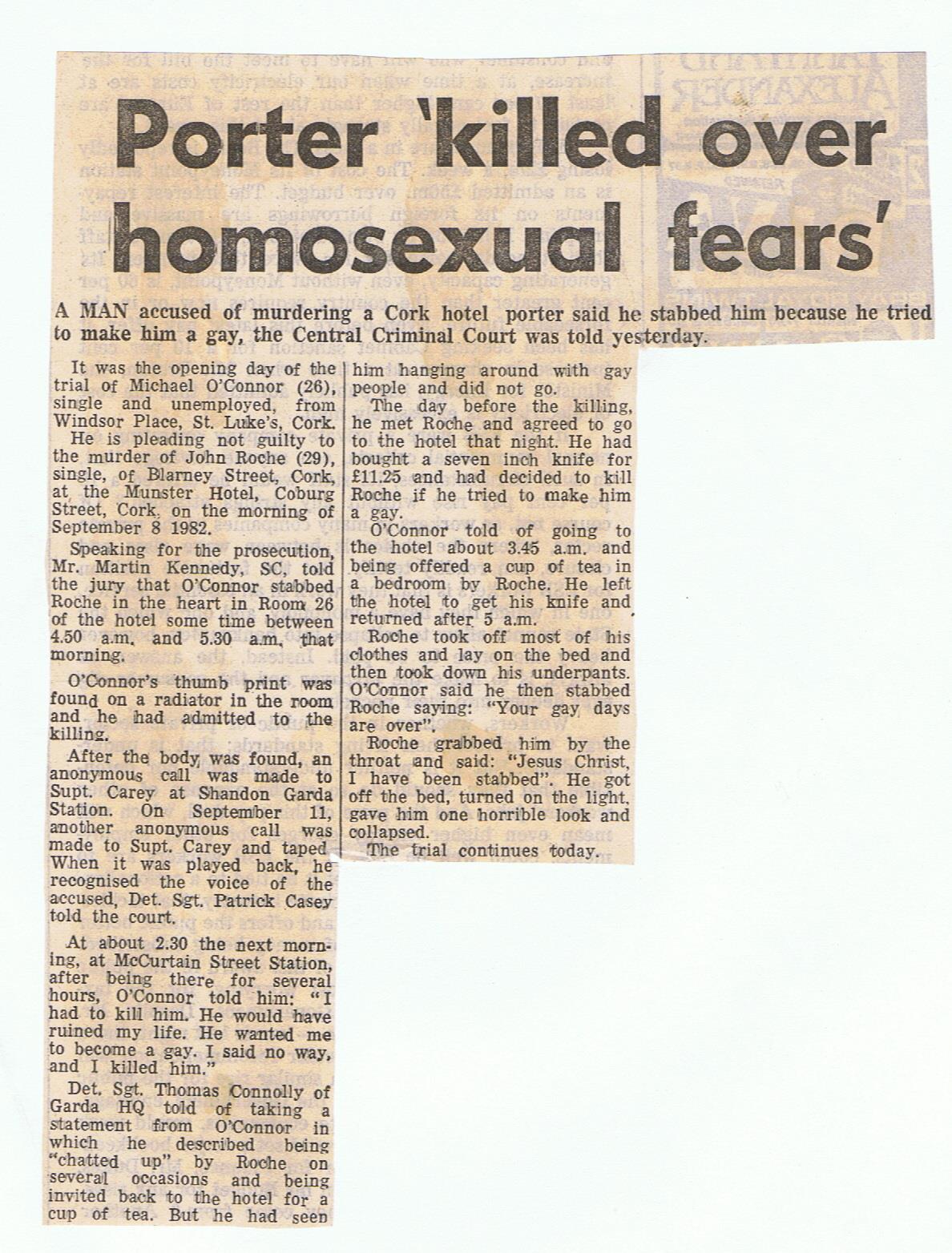
8 September 1982: John Roche, Cork
Roche (29), a gay man, was murdered by Michael O’Connor in the Munster Hotel in Cork City. The victim, who worked in the hotel as a night porter, was found tied to a chair in one of the bedrooms. He had been stabbed in the chest with a 15cm (6″ ) knife. Repulsed by the victim’s alleged advances O’Connor stabbed Roche, telling him “Your gay days are over”. Michael O’Connor was found by a jury to be not guilty of murder but guilty of manslaughter.
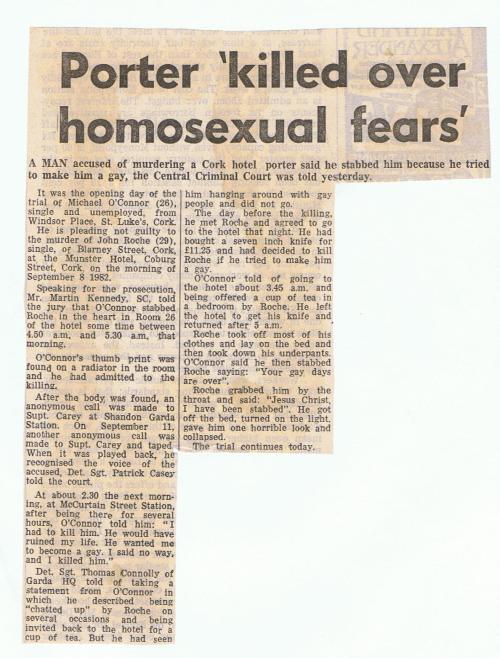
Evening Press, 11th May 1983. Credit - Irish Queer Archive

Evening Press, 11th May 1983. Credit – Irish Queer Archive

November 1982: Henry McLarnon, Ballymena, Co. Antrim
McLarnon (22), father of two, was murdered by Richard John Nicholl in Ballymena. In court, Nicholl said that McLarnon had lured him to the quarry where he had made a sexual advance. In response, he stabbed McLarnon with a work tool. There was controversy at the trial when Nicholl was convicted of the lesser charge of manslaughter and received a two-year suspended sentence. In 2002, Nicholl took his own life.

21 January 1982: Charles Self, Dublin
Self (33), a RTE set designer originally from Glasgow, was murdered in his flat on Brighton Avenue, Monkstown. He was found with knife wounds to his chest and neck. The investigation led to almost 1,500 gay men being questioned, photographed and fingerprinted at Pearse Street Garda Station. For many in the gay community, it felt like the police were more interested in compiling dossiers on gay men rather than solving the brutal murder. No-one was ever charged.

9 September 1983: Declan Flynn, Fairview Park, Dublin
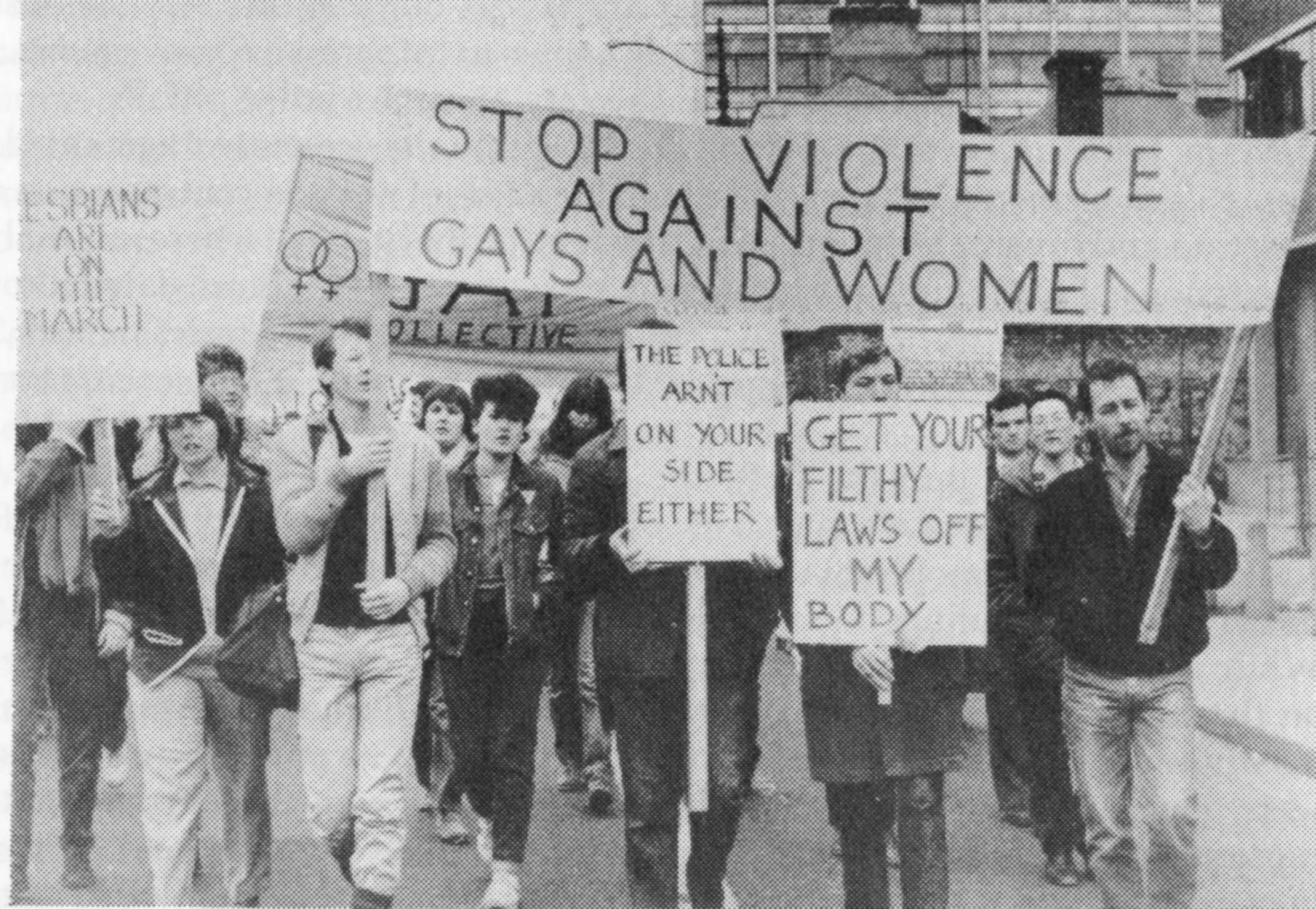
Flynn (31), an Aer Rianta worker, was beaten to death by a group of five teenagers in a ‘gay-bashing’ incident in Fairview Park. The gang had been responsible for a spate of attacks on gay men in previous weeks and it emerged that they used the park to target members of the gay community. As Flynn lay dying, £4 from his pocket and his watch was stolen. In court, one of the teenagers admitted that “we were all part of the team to get rid of the queers from Fairview Park”. The five male teenagers were all released on a suspended manslaughter charge with Judge Sean Gannon saying “This could never be regarded as murder”.
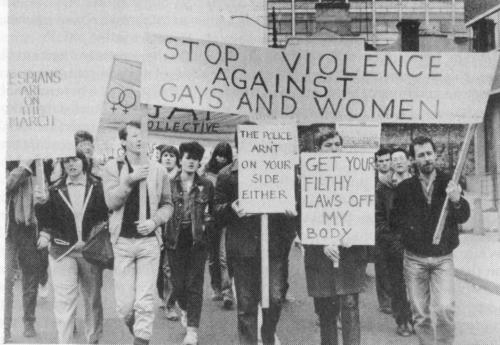
Fairview Park Protest March photographed on Amiens Street by Derek Speirs, courtesy "Out For Ourselves" (Womens Community Press, 1986). Credit - Irish Queer Archives

Fairview Park Protest March photographed on Amiens Street by Derek Speirs, courtesy “Out For Ourselves” (Womens Community Press, 1986). Credit – Irish Queer Archives

7 February 1997: David J. Templeton, Belfast
Templeton (43) was a minister of the Presbyterian Church in Ireland who was murdered after he was ‘outed’ as a gay man by the Sunday Life newspaper. Three men wearing balaclavas, believed to have been UVF members, entered his home in north Belfast and beat him with baseball bats with spikes driven through them. He died in hospital several weeks later.

(Note: Some websites list Darren Bradshaw, a gay men and RUC officer, murdered in 1997 by the INLA as a homophobic murder. However, it is probably fair to say that he was killed because of his occupation rather than his sexuality?)

7 September 2002: Ian Flanagan, Belfast
Flanagan (30), a civil servant, was battered with a wheel brace and stabbed with a kitchen knife in the grounds of Barnett’s Demesne park. His two killers ‘deliberately set out to target a member of the gay community’. Raymond Taylor was sentenced to 13 years and Trevor Peel was given 14 years.

3 December 2002: Aaron (Warren) McCauley, Belfast
McCauley (54), a nurse for over 30 years at Muckamore Abbey hospital, was lured and battered to death in a well-known ‘cruising’ spot. He was found in an alley just 30 yards from the Church Lane toilets and died two days later without regaining consciousness. The attack was believed to have been motivated by homophobia. His injuries consisted of a blow to the side of the head and another to the throat. Nobody was ever charged.

23 March 2008: Shaun Fitzpatrick, Dungannon, Co. Tyrone
Fitzpatrick (32), a supermarket manager, was kicked to death after leaving Donaghy’s Bar by two homophobic Lithuanian men. The court heard that when Mr Fitzpatrick’s body was found, he had been beaten so savagely that paramedics thought he had been shot. The pair were sentenced to to life imprisonment.

5 February 2012: Andrew Lorimer, Lurgan, Co. Armagh
Lorimer (43), a former canoeing instructor and security guard, was kicked and beaten to death with a hammer in his own flat in Portlec Place. Three men were charged with the ‘homophobic murder’.

Race:

24 December 1982: Abousef Abdussalem Salim, Limerick
Salim (21), a Libyan trainee airplane pilot, was stabbed in the head with a screwdriver by a Limerick man who screamed ‘nigger’ and ‘bastard’ before the attack at a taxi rank on Thomas Street. The attacker was sentenced to five years penal servitude for manslaughter.
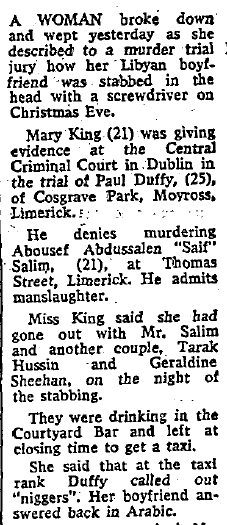
The Irish Independent, 3 February 1984.

The Irish Independent, 3 February 1984.

24 June 1996: Simon Tang, Carrickfergus, Co. Antrim
Tang (27), a Chinese businessman, was beaten and robbed as he left his takeaway business in Carrickfergus. Described by police as a ‘racist attack’, the father of two had his watch and the night’s takings stolen. He was taken to hospital but later died from his injuries. In 2002, two men were remanded in custody charged with the murder but they were later released. No-one has been convicted of the killing.

27 January January 2002: Zhao Liu Tao, Dublin
Tao (29), a Chinese student of English, was attacked by a five-member gang in Beaumont, on the northside of the city. The gang were reported as making racist taunts and a fracas followed. One of the youths struck Mr Zhao with a metal bar. He died three days later in Beaumont Hospital. An 18-year-old youth was sentenced to four years detention, the last two years were suspended because of the perpetrators age and the fact that he had no previous convictions.

29 August 2002: Leong Ly Min, Dublin
Min (50), who had been living in Dublin since 1979 after fleeing Vietnam, was assaulted in Temple Bar. He suffered head injuries and later died in hospital. Two men were charged in relation to this crime. At the time it was reported by the media that there might have been racist insults used during the attack.
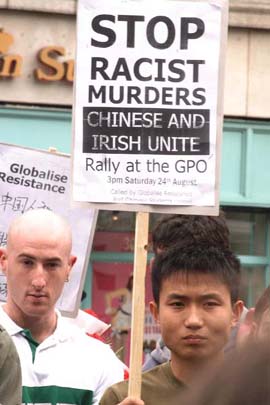
Anti-Racist protest after murder of Leong Ly Min. Credit - An Phoblact

Anti-Racist protest after murder of Leong Ly Min. Credit – An Phoblact

23 February 2010: Pawel Kalite and Marius Szwajkos, Dublin
Kalite (28) and Szwajkos (27), Polish nationals, were racially abused before being stabbed in the head with screwdrivers on Benbulben Road, Drimnagh. Two Dublin teenagers are currently serving mandatory life sentences.

2 April 2010: Toyosi Shittabey, Dublin
Shittabey (15), a talented footballer originally from Nigeria, died after being stabbed in Tyrrelstown, Dublin 15. A row with “racist undertones” began outside the house of Paul Barry at Mount Garrett Rise between Paul, his brother Michael and a group of black males and white females after one of the females asked Paul for a cigarette lighter and he had refused. Believing a phone was taken by the group, Mr Barry and his brother Paul went into his house to fetch a knife and then pursued them in a car. They encountered the group of teenagers at a roundabout in Tyrrelstown. Shittabey, known as “Toy”, urged his friends to walk away again but was stabbed in the heart by Paul Barry The two brothers were charged with murder. Paul Barry (40) committed suicide the day before the trial was due to begin. His brother Michael (26) was acquitted because it was his brother inflicted the stab wound. It transpired that Paul had been involved in another racist knife attack ten years previously.
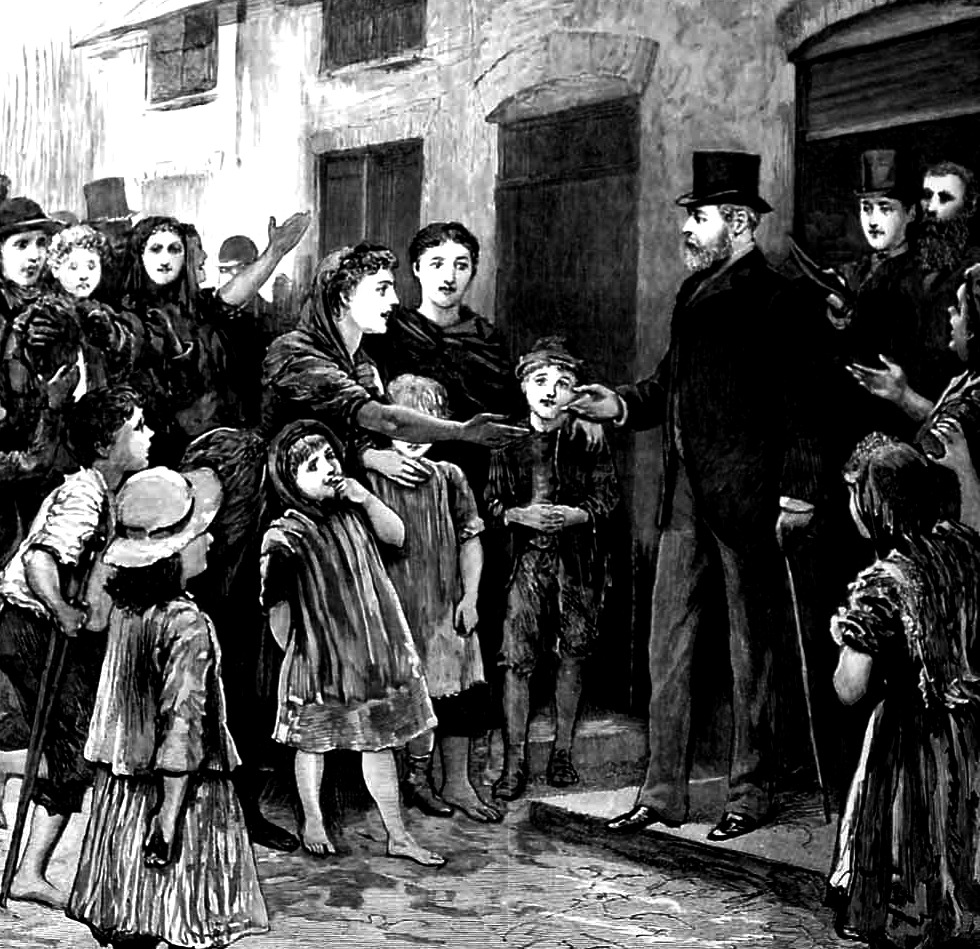
A contemporary illustration of a Royal visit to the slums of Dublin.

A contemporary illustration of a Royal visit to the slums of Dublin.

This above illustration from 1885 captures a rather surreal moment in the history of inner-city Dublin, when the slums of the city were visited by none other than the Prince of Wales, Prince Albert Edward. He would later visit the poor of Dublin again on a Royal visit in 1903, although on that occasion he had risen to the role of King. His 1885 visit to Golden Lane attracted huge media attention at the time.

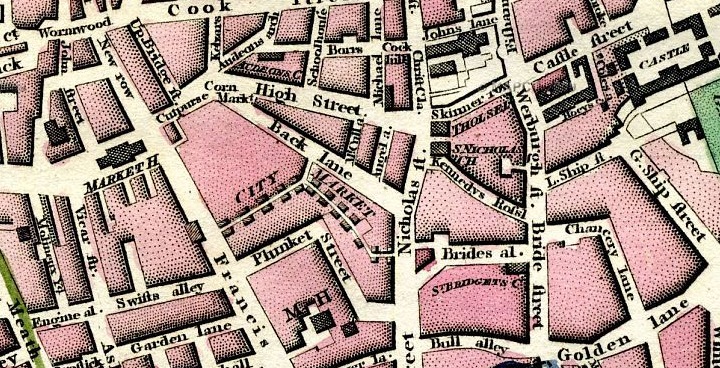
The visit of Prince Albert Edward in 1885 was not universally welcomed, and Dublin Corporation voted by 41 votes to 17 against participating in the official welcoming of the Prince to Dublin. Yet while Dublin Corporation were rather hostile to the visit on the whole, one individual who seized upon the presence of the Prince in Dublin was Sir Charles Cameron. Cameron held charge of the Public Health Department of Dublin Corporation for over a half century, and was a tireless campaigner for improved health standards in the city. Cameron accompanied the Prince on a visit to the slums at Golden Lane, ironically located very close to Dublin Castle.

This map from the late eighteenth century gives an idea of the proximity of Dublin Castle to Golden Lane. (Source: http://dublin1798.com/dublin15.htm)

This map from the late eighteenth century gives an idea of the proximity of Dublin Castle to Golden Lane. (Source: http://dublin1798.com/dublin15.htm)

In his memoirs, Charles Cameron discussed this visit to the slums, writing that:

I suggested to Earl Spencer, Lord Lieutenant at the time, that as the Prince of Wales had visited many model dwellings for the working classes, he ought to see some of the wretched dwellings in which the poor lived and which it was desirable should be replaced by healthy abodes. The proposal met with some opposition from the Prince’s entourage, but ultimately it was agreed that he would visit the slums, but strictly incognito. At 11 o’clock one morning, the Prince, the Duke of Clarence, and Sir Dighton Probyn left Dublin Castle in a plain carriage to visit, under my guidance, slums, and also the model dwellings erected at the expense of Sir Edward Cecil Guinness (now Viscount Iveagh). We went to Golden Lane, which was not far off.

Just as we stopped at a large tenement house a woman discharged into the channel course a quantity of water in which cabbage had been boiled and which contained fragments of leaves. In getting out of the carriage the Duke of Clarence unfortunately stepped into this fluid, slipped, and fell. He was much startled, and his coat and one glove were soiled. We wiped him with handkerchiefs, and Sir Dighton, a man of almost gigantic stature, took o:ff a light overcoat and invested the Duke with it. As the Duke was of moderate height, the coat reached nearly to his feet. On entering the large yard of the tenement house, a ragged boy familiarly took the Prince by the arm and enquired what he was looking for. The Prince took all this, including the Duke’s contretemps, with great good humour, and in visiting the rooms he left something behind him which delighted its recipients.

This visit is also referenced in King Edward VII, his life & reign; the record of a noble career, published first in 1910. There, it is noted that:

The heir to the British throne, accompanied by his heir, Prince Albert
Victor, was there among the dwellers in the slums of the Irish capital, unannounced, unguarded by soldiers or police, trusting himself, with a manly and well-merited confidence, to the people themselves. Readily recognized, he and his son were, at every step, attended by words of welcome and by ringing cheers from those who, apart from political agitation, are as warm-hearted and loyal as any people in the world.

In 1903, as King Edward VII, he once more visited the slums of the city, and it was noted that Lord Iveagh donated a sum of £50,000 to be distributed among the various Dublin hospitals, as a result of this visit and its impact. While these visits certainly attracted considerable media attention, the problem of slum housing in Dublin continued long into the days of Irish independence, and without famous visitors it went largely ignored.

Charles Cameron would become a Freeman of Dublin, an incredible honour to have bestowed among an employee of Dublin Corporation. Writing in his memoirs, published in the year of the Lockout, he noted that “I would like to bear testimony to the wonderful kindness which the poor show to those who are still poorer and more helpless than themselves.”

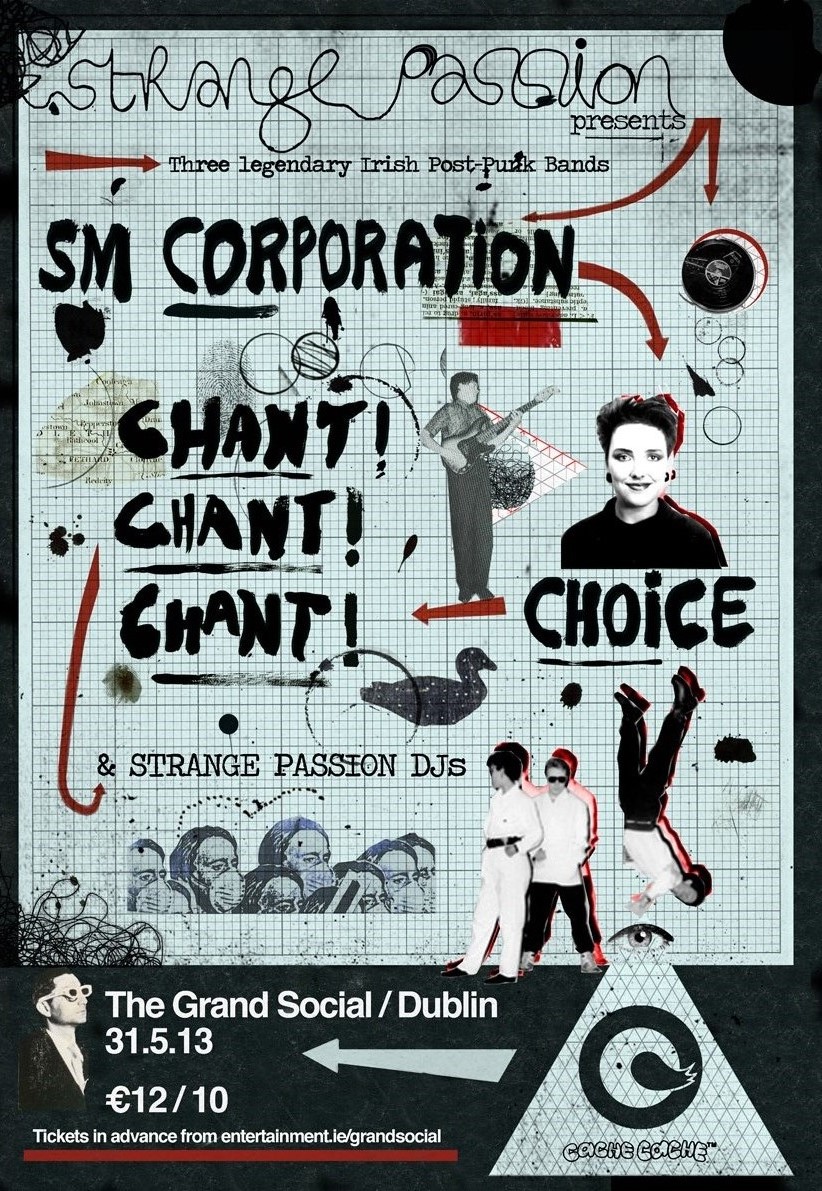
Strange Passion, 31 May 2013

Strange Passion, 31 May 2013

Three Irish Post Punk bands return to the stage this Friday after a 30 year hiatus following the release of critically acclaimed compilation Strange Passion in 2012.

The Grand Social, Dublin. Friday 31st May. Doors open 8pm. First band on at 8.30pm sharp. €12 entry.

Line up:

The SM Corporation(Irish rock entry)

Dublin electronic experimenters come electro-pop pioneers 1978-1987 made up of Tina O’Brien (vocals), Paul Wynne (Keyboards, Rhythms) and Steve Rapid (Keyboards, Noises)

SM Corporation, 1979.

SM Corporation, 1979.

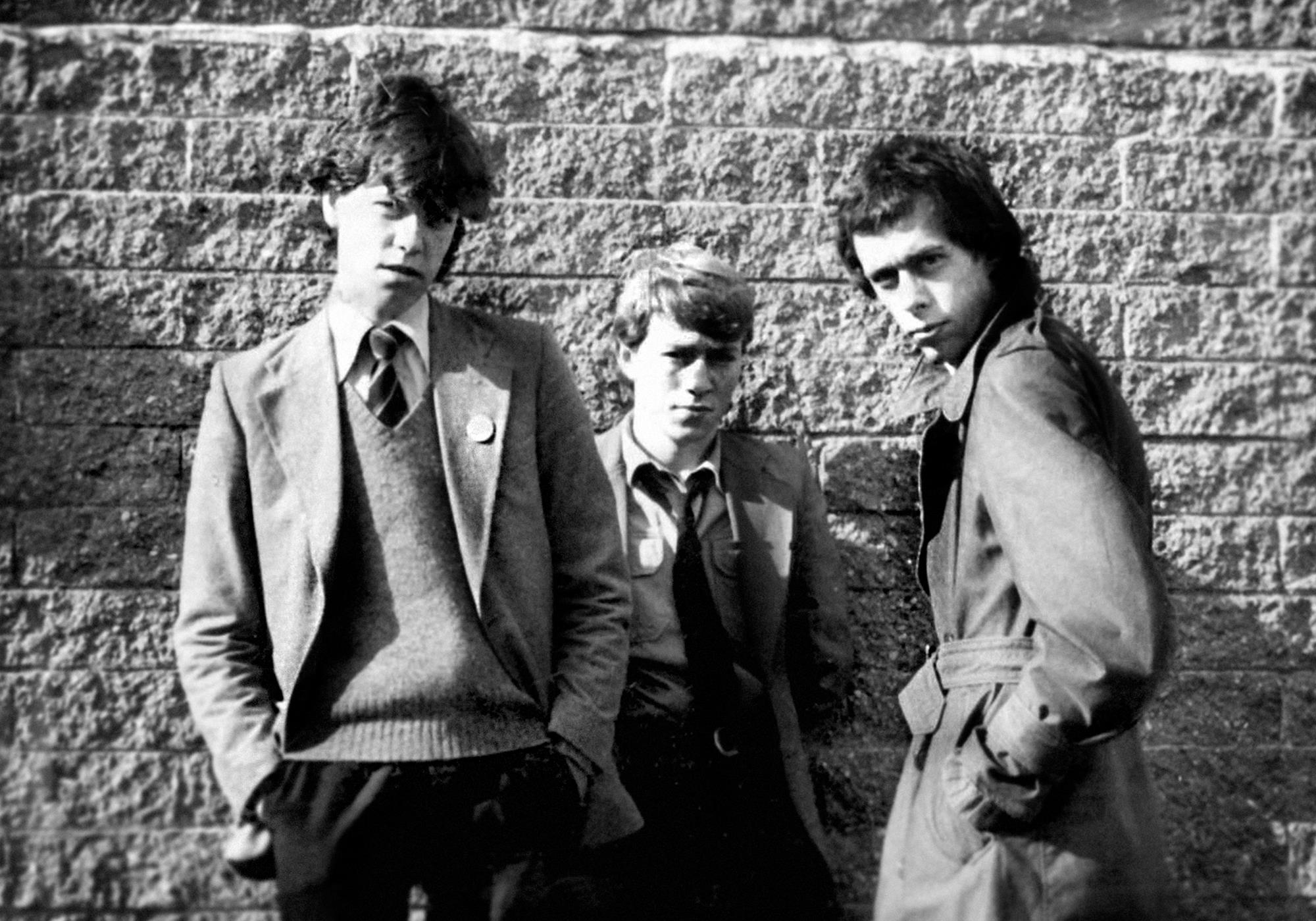
Chant! Chant! Chant! (Irish Rock entry)

Dublin post punk legends (reminiscent of The Birthday Party and Gang Of Four) made up of Eoin Freeney (vocals), Robby Wogan (guitar), Larry Murphy (bass) and Paul Monahan (drums). Supported the The Fall in Cork & the infamous 4 BE 2’s charade in the Trinity JCR.

Chant! Chant! Chant!,  1980

Chant! Chant! Chant!, 1980

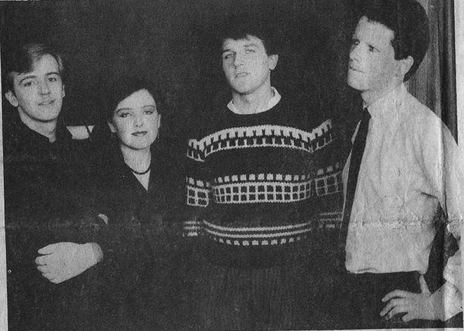
Choice

Dundalk electronic pop band formed in 1980 with Brian McMahon (aka Dougie Devlin) on bass, Ciaran Vernon (aka CV) on synths, Noel McCabe on drums and Jaki McCarrick on vocals. With the departure of drummer, the band became a three-piece – with a drum machine.

Choice, early 1980s

Choice, early 1980s

For those interested, check out our previous post – Dublin Punk & New Wave singles timeline (1977 – 1983)

Recently, we’ve featured a series of blog posts looking at the year 1913, which primarily have involved the Lockout and its effect on the city of Dublin. While browsing the archives, I stumbled across a very interesting article from November 1913 which was printed in The Irish Times, dealing with the ‘Dublin Volunteer Corps’, or ‘Dublin Volunteer Force’. This was an armed movement established by Dublin loyalists, following in the footsteps of the Ulster Volunteer Force, and about whom little has been written. The article claimed in its subheading that “over 2,000 men” were enrolled within this band of men, and noted that:

While Ulster is preparing to resist Home Rule by force if necessary, and is busy building up a great citizen army, the spirit of militarism that has gripped that province and fired the enthusiasm of its young manhood is also at work in Dublin.

Dubliner Edward Carson inspects the Ulster Volunteer Force (UVF) in 1914.

Dubliner Edward Carson inspects the Ulster Volunteer Force (UVF) in 1914.

The paper noted that “should a Home Rule Parliament be established in Dublin, this volunteer force is intended to be used in the preservation of the civil and religious liberties of Protestants in Dublin and the south.” It was noted that “company after company was formed, and drill instructors were appointed”, and that while membership was at first confined to members of the Orange Institution, due to an excess of applications it was decided to broaden the ranks, with “over 2,000 men already enrolled.”

It was claimed that the force would serve as a reserve of the Ulster Volunteers, and that:

should civil war break out in Ulster as a consequence of Home Rule, the leaders of the Dublin Volunteers have undertaken to hold in readiness a force of at least 2,000 men for service wherever required by the Commander-In-Chief of the Ulster Army.

Union flags can be seen on Grafton Street, in this photograph taken around the time of the last Royal Visit to a British Dublin, 1911.

Union flags can be seen on Grafton Street, in this photograph taken around the time of the last Royal Visit to a British Dublin, 1911.

The training of these men was reported to take place “at various centres in the city three nights of every week”, and that firing exercises and musket training featured. It was also claimed that similar training was happening in various locations outside of the city, in South County Dublin.

From that 1913 report, I wondered what else I could find online. A recent report in the Belfast Newsletter shined further light on this force, noting that:

IN June 1935, a Dublin Board of Works employee was among a group working at part of the Dublin GPO (General Post Office), the men having been assigned to remove presses from the cellar of the GPO Customs Parcels Section, located at 10 Parnell Square.

When several presses were removed however, some mortar appeared insecure, and when touched, collapsed. Upon further investigation the employee realised he had uncovered a large cavity several feet long. Within it, in perfectly dry conditions, lay a massive arms cache. He had discovered over 90 rifles and over 2000 rounds of ammunition.

This weapons were not in fact for Irish nationalists, but rather the new Dublin loyalist organisation. The Belfast Newsletter piece is a fascinating insight into the group, focusing on the role of Fowler Hall for Dublin Loyalists. Located at 10 Parnell Square, this was one of several Orange Halls in the city and a centre of activity for the organisation.

Interestingly, a 1964 article in The Irish Times claimed that these weapons were actually found during renovations in 1927, and claimed that at least one rifle was stamped “For God and Ulster.”

The arms from Fowlers Hall discussed in The Irish Times in 1964.

The arms from Fowlers Hall discussed in The Irish Times in 1964.

The Orange Order were forced from the Fowler Hall by the IRA at the time of the split of the organisation into Pro and Anti-Treaty wings, and in his Witness Statement to the Bureau of Military History republican Patrick J. Kelly noted that “During the period when Belfast refugees were pouring into Dublin the Dublin Brigade H/Q quartered the homeless in the Fowler Hall, Parnell Square, and supplied them with food.”

It’s certainly interesting to think about this band of Dublin loyalists, willing to take up arms against their fellow Irishmen. What else is known about this organisation?

As part of background research for my dissertation, I am trying to collate a list of Irish archives/museums and community/individual history projects that have an active Facebook page and post historical material. Here’s what I’ve come up with so far.

Do you know of anymore?

Cultural/Social:

Dublin Dockers – Amazing selection of scanned images. Post regularly.

Irish Queer Archive – Excellent quality of scans and descriptions of items. Posts every few days.

Irish Photo Archive – Amazing selection of images. Updated at least once a day.

Irish Traditional Music Archive – Mainly contemporary posts. Some historical images.

Where Were You? – Series of photos posted in batches every other week. Lots of personal comments and memories.

Gay Health Action (GHA) 60's Night Benefit Disco. Flyer, designer unattributed. 1985 [Ephemera Collection, IQA/NLI]

Gay Health Action (GHA) Benefit Disco at Sides DC. Flyer, designer unattributed. 1985 [Ephemera Collection, IQA/NLI]

Established:

Irish Architectural Archive – Post regularly but not much historical stuff.

County Archives

Clare – Updated quite a bit. Interesting conservation photos.

Cork – Very irregular posts. Some historical material.

Donegal -Updated quite regularly. Mainly historical items.

Waterford – Updated quite regularly. Some historical material.

Glasnevin Museum – Great mixture of posts about contemporary issues (tour guides etc.) and historical bits and pieces.

National Library of Ireland – Excellently run page. Updated regularly.

Political:

Irish Anarchist History Archive – Irregular posts of scanned up documents or photos.

Irish Student Movement Research Project – Nice mixture of scans and short text posts.

Official Republican/WP Archive – Diverse selection of photos and newspaper clippings. Some scans not of high quality.

Students outside Dail Eireann highlighting the Stardust (Artane, 1981) and the Central Hotel (Bundoran, 1980) fire disasters. Credit - Irish Student Movement Research Project.

Students outside Dail Eireann highlighting the Stardust (Artane, 1981) and the Central Hotel (Bundoran, 1980) fire disasters. Credit – Irish Student Movement Research Project.

Religious:

Capuchin Archive – Post fantastic historical documents every other day.

Sport:

Dublin Maccabi (Jewish sporting club)  – All historical photos and documents. Lots of personal comments and memories.

Jackie Jameson Irish Football Legend (Bohs) – Mainly historical photos being posted.

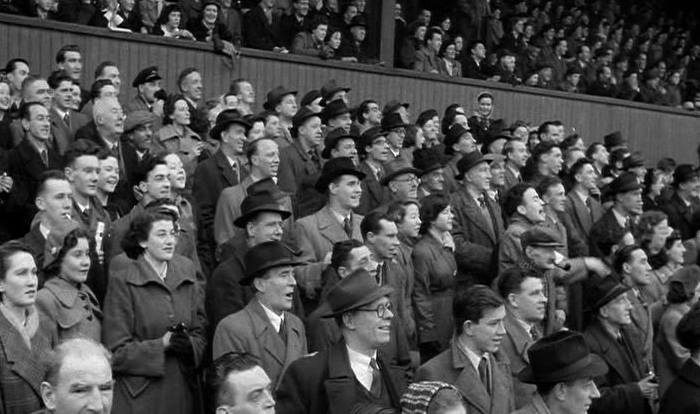
Dalymount Park in 1952. Credit - Jackie Jameson Irish Football Legend

Dalymount Park in 1952. Credit – Jackie Jameson Irish Football Legend

'Duck, You Sucker!' - The cover for a recent DVD special edition of the 1971 film.

‘Duck, You Sucker!’ – The cover for a recent DVD special edition of the 1971 film.

Duck, You Sucker!, also known as A Fistful of Dynamite and Once Upon a Time… the Revolution, is a 1971 Italian film directed by Sergio Leone and starring Rod Steiger,James Coburn and Romolo Valli. A much praised film, the film caused considerable controversy at the time of its release with certain scenes deemed excessively violent. The film is set in Mexico in 1913 around the time of the Mexican revolution.

The plot is a bit of a head scratcher, centering around the story of Sean Mallory, an explosions expert from the IRA hiding out in America. Mallory comes into contact with Juan Miranda, a Mexican outlaw who attempts to convince him to join a raid on the Mesa Verde national bank. Details on the film can be found on its Wiki page, but what makes of interest to Come Here To Me is this scene below, which tells viewers why Mallory felt the need to leave Dublin.

Toners pub shown in the film.

The bar in Toners shown in the film.

Here, we see a familiar pub, Toners on Baggot Street! This flashback scene shows us just why Mallory is on the run from the British authorities, following a shooting in the pub:

Another flashback scene in the film was filmed at the grounds of Howth Castle in Dublin:

The film is hugely entertaining and Ennio Morricone’s excellent score works incredibly well with the flashback scenes. Users of the popular internet film review site Rotten Tomatoes have given the film a glowing 90% approval rating.

My thanks to Peter Box Andersson who put this idea into my head, and reminded me what a rich history Dublin has as a filming location historically!