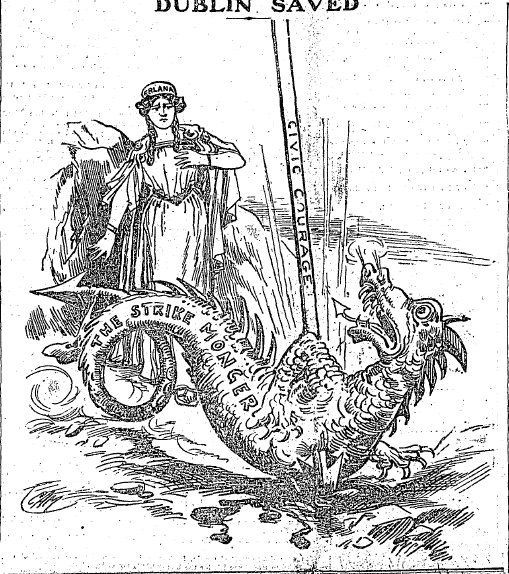
It’s hoped that over the coming weeks and months we can post several stories relating to the 1913 Lockout, looking at some of the key events and characters in brief posts which should serve as an introduction to the event and the protagonists. This brief post looks at an unusual aspect of the story of William Martin Murphy, leader of the employers in that great dispute.
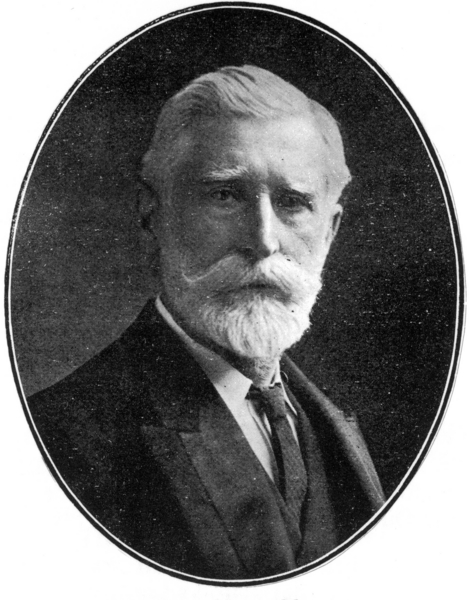
William Martin Murphy (Image Credit: Multitext UCC)
More out of laziness than anything else I’ve always believed, the 1913 Lockout has often been spoken of as some sort of ‘dress rehearsal’ for the 1916 Rising. The Lockout was not a dress rehearsal for anything however, but rather it is a hugely important moment in Irish history in its own right, representing the greatest ideological battle between labour and capital in Irish history.
While ‘Big Jim’ continues to hold a central place in the popular memory and folklore of Dublin, William Martin Murphy is a figure many Dubliners are unfamiliar with in any detail. Murphy was an incredibly complex character, and his own politics were actually of an Irish nationalist type.
The eldest son of a Co.Cork building contractor named Dennis William Murphy, he was born in 1845. Educated at Belvedere College in Dublin, he worked in the offices of the Irish Builder and The Nation publications as a young man. Patrick Maume writes in his biographical entry on Murphy for the Dictionary of Irish Biography that:
In 1863 Murphy inherited the family business on the death of his father. In 1867 he moved to Cork, where in 1870 he married Mary Julia Lombard, daughter of a prominent Cork businessman, James Fitzgerald Lombard (qv). They had five sons and three daughters, whose marriages (notably with the Chance family) strengthened Murphy’s political and business alliances. His success was based on building light railways in the south and west of Ireland; he also became involved in running these railways, sat on several boards, and facilitated the merger that created the Great Southern and Western Railway.
Padraig Yeates notes in his history of the Lockout that Murphy displayed “an entrepreneurial talent rare for Ireland in that era and developed an expertise in constructing light rail and tramway systems.”
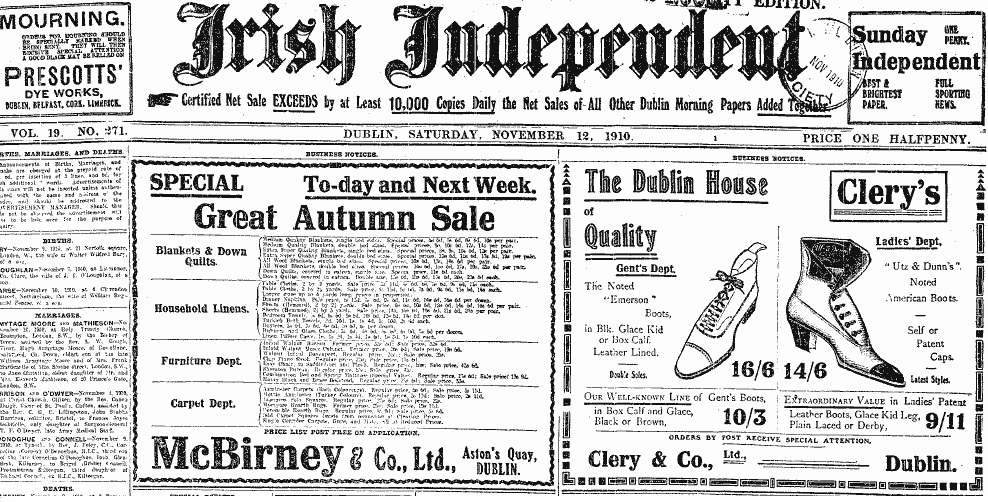
Murphy was elected as an MP for the Irish Parliamentary Party for St Patrick’s, Dublin at the 1885 general election. Following the split in the party, Murphy sided with the Anti-Parnellites, which cost him in Dublin, a city which remained loyal to the fallen leader. In 1900, he purchased a fledgling Parnellite newspaper the Irish Daily Independent from the Parnellites, merging it with the Daily Nation. This move gave birth to the Irish Independent, a paper still with us today. By the time of his death in 1919, Yeates estimates that “he had accumulated a fortune of over £250,000, had built railways and tramway systems in Britain, South America and West Africa, and owned or was a director of many Irish enterprises, including Clery’s department store, the Imperial Hotel and the Metropole Hotel”.
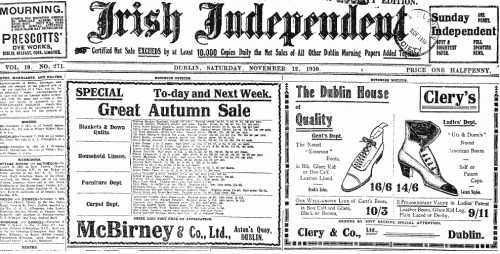
Two aspects of the one empire. An advertisement for Clery’s on the front of the Irish Independent (1910)
Continue Reading »













 Click on the book for more.
 Click on the book for more.
 Donal
Donal Ciarán
 Sam
Sam


 Come Here To Me!